NeuroscienceandBiobehavioralReviews73(2017)1–22
Contents
lists
available
at
ScienceDirect
Neuroscience
and
Biobehavioral
Reviews
j o u
r n
a l
h
o m
e p a g e :
w w w . e l s e v i e r . c o m / l o c a t e / n e u b i o r e v
Review
article
The
search
for
neuroimaging
and
cognitive
endophenotypes:
A
critical
systematic
review
of
studies
involving
unaffected
first-degree
relatives
of
individuals
with
bipolar
disorder
Kamilla
W.
Miskowiak
a
,
∗
,
1
,
Hanne
L.
Kjærstad
a
,
1
,
Iselin
Meluken
a
,
Jeff
Zarp
Petersen
a
,
Beatriz
R.
Maciel
b
,
Cristiano
A.
Köhler
b
,
Maj
Vinberg
a
,
Lars
V.
Kessing
a
,
André
F.
Carvalho
b
aCopenhagenAffectiveDisorderResearchCentre,PsychiatricCentreCopenhagen,CopenhagenUniversityHospital,Rigshospitalet,Copenhagen,Denmark bTranslationalPsychiatryResearchGroupandDepartmentofClinicalMedicine,FacultyofMedicine,FederalUniversityofCeará,Fortaleza,CE,Brazil
a
r
t
i
c
l
e
i
n
f
o
Articlehistory:
Received26May2016
Receivedinrevisedform5October2016 Accepted9December2016
Availableonline12December2016
Keywords:
Bipolardisorder Endophenotype Cognition Neurocognition Neuroimaging Psychiatry Mooddisorder Pathophysiology
a
b
s
t
r
a
c
t
Thephenomenologyandunderlyingpathophysiologyofbipolardisorder(BD)areheterogeneous.The identificationofputativeendophenotypesforBDcanaidintheinvestigationofuniquepatho-etiological pathways,whichmayleadtothedevelopmentofpersonalisedpreventativeandtherapeuticapproaches forthismulti-faceteddisorder.Weincludedoriginalstudiesinvolvingunaffectedfirst-degreerelatives ofBDpatients(URs)andahealthycontrol(HC)comparisongroupwithnofirst-degreefamilyhistory ofmentaldisorders,investigating:‘cold’and‘hot’cognitionandfunctionalandstructuralneuroimaging. Seventy-sevencross-sectionalstudiesmettheinclusioncriteria.ThepresentreviewrevealedthatURsin comparisonwithHCsshowed:(i)widespreaddeficitsinverbalmemory,sustainedattention,and exec-utivefunction;(ii)abnormalitiesinthereactivitytoandregulationofemotionalinformationalongwith aberrantrewardprocessing,andheightenedattentionalinterferencebyemotionalstimuli;and(iii)less consistencyinthefindingsregardingstructuralandrestingstateneuroimaging,andelectrophysiological measures.
©2016ElsevierLtd.Allrightsreserved.
Contents
1. Introduction...2
2. Methods...3
2.1. Searchstrategy...3
2.2. Selectioncriteria...3
3. Results...3
3.1. Cognitiveendophenotypes...3
3.1.1. ‘Cold’cognition...3
3.1.2. Generalintellectualfunctioning...3
3.1.3. Speedofprocessing...3
Abbreviations: ACC,anteriorcingulatecortex;CPT,continuousperformancetask;dlPFC,dorsolateralprefrontalcortex;DSM,theDiagnosticandStatisticalManualof MentalDisorders;DTI,diffusiontensorimaging;EEG,electroencephalogram;ERP,event-relatedpotential;HC,healthycontrols;ICD,theInternationalClassificationof Diseases;mOFC,medialorbito-frontalcortex;mPFC,medialprefrontalcortex;omPFC,orbito-medialprefrontalcortex;SC,Schizophrenia;SCWT,StroopColourWordTask; TMT,Trailmakingtask;UD,unipolardepression;UR,healthy,unaffectedfirst-degreerelativesofpatientswithBD;vACC,ventralanteriorcingulatecortex;VBM,voxelbased morphology;VLPFC,ventrolateralprefrontalcortex;vmPFC,ventromedialprefronalcortex;WAIS,WechslerAdultIntelligenceScale;WM,workingmemory;WMH,white matterhyperintensities;WMS,WechslerMemoryScale.
∗Correspondingauthorat:PsychiatricCentreCopenhagen,CopenhagenUniversityHospital,Rigshospitalet,Blegdamsvej9,DK-2100Copenhagen,Denmark. E-mailaddress:[email protected](K.W.Miskowiak).
1 Sharedfirstauthors.
http://dx.doi.org/10.1016/j.neubiorev.2016.12.011
3.1.4. Attention/Vigilance...3
3.1.5. Verballearningandmemory...11
3.1.6. Visuallearningandmemory...11
3.1.7. Reasoningandproblem-solving...11
3.1.8. Workingmemory...14
3.1.9. Verbalfluency...14
3.1.10. Executivefunction...14
3.1.11. Interimsummary...14
3.2. ‘Hot’cognition...14
3.2.1. Emotionprocessingandregulation...14
3.2.2. Cognitiveinterferenceofemotionalstimuli...15
3.2.3. Risk-taking,rewardandpunishmentprocessing...15
3.2.4. Interimsummary...15
3.3. Neuroimaging...15
3.3.1. Structuralneuroimagingabnormalities...15
3.3.2. Restingstatefunctionalconnectivity...15
3.3.3. Event-relatedpotentialsandthestartlereflex...18
3.3.4. Interimsummary...18
4. Discussion...18
4.1. ‘Cold’and‘hot’cognition...18
4.2. Structuralneuroimagingandresting-statefindings...18
4.3. Limitationsandimplications...18
5. Conclusion...19
Conflictofinterest...19
Acknowledgements ... 19
AppendixA. Supplementarydata...20
References...20
1.
Introduction
Bipolar
disorder
(BD)
is
a
common
chronic
illness
that
is
char-acterised
by
extreme
mood
fluctuations
and
substantial
cognitive
impairment
(
Goodwin
and
Jamison,
2007
;
Grande
et
al.,
2016
).
Although
compelling
evidence
indicates
that
BD
is
associated
with
a
high
degree
of
heritability
(e.g.,
Goes,
2016
;
Kieseppä
et
al.,
2004
;
McGuffin
et
al.,
2003
),
its
exact
pathophysiology
remains
elusive
and
involves
a
complex
set
of
gene-environment
interac-tions
(
Uher,
2014
).
Replication
of
genome
wide
association
studies
have
proven
to
be
difficult
due
to
the
complexity
of
the
disor-der,
differences
in
diagnostic
criteria,
methodological
challenges,
and
possible
patho-etiological
heterogeneity
(
Gatt
et
al.,
2015
;
Kerner,
2015
;
McCarroll
et
al.,
2014
),
although
notably
a
recent
study
identified
some
putative
biological
pathways
involved
in
the
genetic
predisposition
to
BD
(e.g.,
hormonal
regulation,
calcium
cannels;
see
Nurnberger
et
al.,
2014
).
Endophenotypes
are
disease-associated
traits
that
are
highly
heritable,
associated
with
the
illness,
independent
of
the
clinical
state,
and
found
in
non-affected
family
members
to
a
greater
extent
than
in
the
general
population
(
Gershon
and
Goldin,
1986
;
Gottesman
and
Gould,
2003
;
Leboyer
et
al.,
1998
).
The
past
decades,
the
field
has
witnessed
an
intensive
research
effort
in
to
putative
endophenotypes
for
BD,
which
may
improve
the
understanding
of
disease
heterogeneity
through
bio-logical
validation
and
phenotype
stratification
(
Hasler
et
al.,
2006
;
Kerner,
2015
).
The
search
for
candidate
endophenotypes
for
BD
has
revealed
substantial
evidence
for
trait-related
abnormalities
across
sev-eral
neurocognitive
domains
(
Balanza-Martinez
et
al.,
2008
)
and
neuroimaging
measures
(
Hozer
and
Houenou,
2016
;
Wu
et
al.,
2016
).
However,
studies
in
unaffected
relatives
(URs)
of
BD
patients
have
produced
less
uniform
evidence
for
changes
in
neurocogni-tive
function
and
neuroimaging
measures.
It
is
therefore
crucial
to
evaluate
which
abnormalities
are
most
consistently
exhibited
in
genetically
predisposed
individuals
to
identify
the
most
promis-ing
candidate
endophenotypes
for
BD.
These
efforts
may
lead
to
identification
of
the
most
consistent
biological
pathways
in
BD.
Cognitive
deficits
are
candidate
endophenotypes
of
BD
(e.g.,
Bora
et
al.,
2009b
;
Glahn
et
al.,
2010
).
These
include
disturbances
in
both
‘cold’
(i.e.,
non-emotional)
and
‘hot’
(i.e.,
emotion-laden)
cog-nition
(
Roiser
and
Sahakian,
2013
).
Trait-related
deficits
in
‘cold’
cognition
have
been
repeatedly
reported
in
individuals
with
BD
across
several
neurocognitive
domains,
particularly
within
verbal
memory
and
executive
function
(
Bourne
et
al.,
2013
;
Robinson
et
al.,
2006
;
Torres
et
al.,
2007
),
as
well
as
in
their
unaffected
rel-atives
(
Arts
et
al.,
2008
;
Balanza-Martinez
et
al.,
2008
).
Although
changes
in
the
processing
of
emotional
information
and
emotional
regulation
are
core
abnormalities
in
mood
disorders
(
Miskowiak
and
Carvalho,
2014
;
Phillips
et
al.,
2008
),
these
aspects
of
‘hot’
cog-nition
have
only
recently
become
a
focus
of
scientific
investigation
in
URs
of
patients
with
mood
disorders.
These
studies
suggest
that
emotion
dysregulation
is
not
only
present
in
BD
during
acute
mood
episodes
(
Almeida
and
Phillips,
2013;
Phillips
et
al.,
2008
)
and
in
remission
(
Townsend
et
al.,
2013
),
but
also
occur
in
genetically
predisposed
individuals
(
Heissler
et
al.,
2014
;
Kanske
et
al.,
2015
).
Functional
and
structural
imaging
studies
of
BD
have
revealed
fronto-limbic
functional
abnormalities
(
Chen
et
al.,
2011a
;
Strakowski
et
al.,
2012
;
Strakowski
et
al.,
2005
)
coupled
with
struc-tural
changes,
such
as
lateral
ventricle
enlargement
(
Arnone
et
al.,
2009
;
Kempton
et
al.,
2008
;
McDonald
et
al.,
2004
).
However,
little
research
has
been
conducted
on
URs
of
patients
with
BD
(
Mathias
de
Almeida
et
al.,
2013
).
Functional
neuroimaging
studies
of
resting
state
activity
in
the
prefrontal
cortex,
anterior
cingulate
cortex,
and
mesolimbic
structures
that
subserve
processing
of
emotionally-laden
stimuli
and
emotion
regulation
show
promise
in
revealing
putative
brain-based
endophenotypes
(
Phillips
and
Vieta,
2007
;
K.W.Miskowiaketal./NeuroscienceandBiobehavioralReviews73(2017)1–22 3
The
aim
of
the
present
systematic
review
is
to:
(i)
synthesise
the
extant
findings
in
‘hot’
and
‘cold’
cognition
and
structural
and
functional
neuroimaging
measures
in
unaffected
first-degree
rel-atives
(URs),
i.e.,
with
no
history
of
psychosis
or
mood
disorder,
of
patients
with
in
comparison
with
healthy
controls
(HCs);
and
in
particular,
(ii)
to
clarify
which
of
the
abnormalities
within
these
domains
constitute
the
most
promising
endophenotypes
of
BD
that
deserve
further
investigation
in
meta-analytical
studies.
2.
Methods
2.1.
Search
strategy
Computerised
searches
on
the
PubMed/MEDLINE,
EMBASE,
and
PsychInfo
databases
were
performed
from
inception
up
until
April
2016
(see
supplementary
online
material
for
the
detailed
search
strategy
used
in
this
systematic
review).
Two
reviewers
independently
performed
title/abstract
screening
(kappa
=
0.90).
Disagreements
were
discussed
and
consensus
was
reach
in
all
cases.
Full-texts
of
potentially
eligible
articles
were
retrieved
and
both
reviewers
considered
these
unique
references
for
inclu-sion/exclusion
during
the
secondary
screening.
The
search
strategy
was
augmented
through
tracking
the
citations
of
eligible
articles
in
Scholar.
This
systematic
review
has
followed
the
pro-cedures
of
the
Preferred
reporting
items
for
systematic
reviews
and
meta-analyses
(PRISMA)
statement
(
Moher
et
al.,
2009
).
2.2.
Selection
criteria
We
included
original
peer-reviewed
articles
involving:
(a)
first-degree
unaffected
relatives
(URs)
of
individuals
meeting
Diagnostic
and
Statistical
Manual
of
Mental
Disorders
(DSM)
(
Association,
2013
)
or
International
Classification
of
Diseases
(ICD)
(
Organization,
1992
)
criteria
for
BD
(including
discordant
twins)
and
a
healthy
control
(HC)
comparison
group;
(b)
a
diagnosis
of
BD
established
through
a
validated
structured
diagnostic
interview;
(c)
investigated
‘hot’
or
‘cold’
cognition,
functional
or
structural
neuroimaging,
and/or
evoked
potentials
(ERP);
(d)
articles
pub-lished
in
English,
Portuguese,
Spanish,
Danish,
German
or
French.
We
excluded
articles
that:
(a)
included
samples
with
several
diag-noses
(unless
data
for
BD
was
reported
separately);
(b)
studies
in
which
URs
and
HCs
were
not
directly
compared;
(c)
studies
in
which
first-degree
relatives
and/or
HCs
had
a
history
of
psy-chosis,
mood
disorder,
and/or
substance
use
disorders
to
avoid
confounding
variables
of
interest;
(d)
genetic
studies;
and
(e)
meet-ing
abstracts,
reviews,
and
case
reports.
Whenever
studies
provided
data
from
overlapping
samples,
we
included
only
the
report
that
included
the
largest
dataset.
In
case
of
doubt,
the
corresponding
author
was
contacted
by
e-mail.
If
reports
with
sample
duplica-tion
investigated
different
variables
of
interest
(i.e.,
within
different
overarching
themes
of
interest
and/or
within
different
subdomains
of
cold
cognition),
both
were
included.
For
studies
on
‘cold’
cognition,
we
grouped
the
results
of
the
individual
neuropsychological
tests
into
cognitive
categories
based
on
the
Measurement
and
Treatment
Research
to
Improve
Cogni-tion
in
Schizophrenia
(MATRICS),
except
for
verbal
fluency
which
was
separated
from
processing
speed,
according
to
the
approach
adopted
by
Bora
and
Pantelis
(2015)
.
The
neuropsychological
tests
that
were
not
part
of
the
MATRICS
were
classified
under
the
rel-evant
cognitive
domains
based
on
factor
loadings
as
reviewed
by
Rodriguez-Jimenez
et
al.
(2012)
.
Further,
in
accordance
to
the
Inter-national
Society
for
BD
Task
Force
on
neurocognition,
we
also
included
an
‘executive
function’
domain
to
include
response
inhi-bition,
cognitive
flexibility,
and
attention
switching
(
Van
Rheenen
and
Rossell,
2014
).
Effect
sizes
were
estimated
whenever
a
given
cognitive
finding
was
clearly
replicated
across
studies.
3.
Results
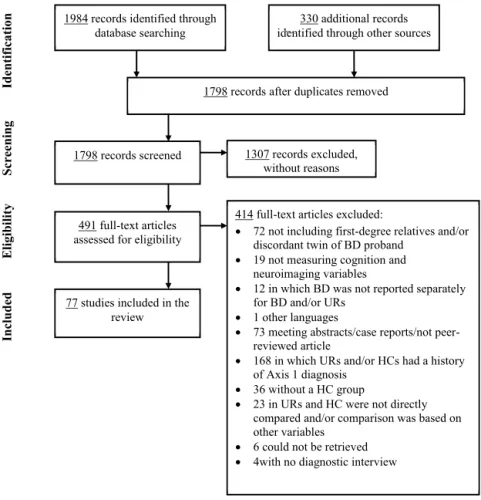
After
removal
of
duplicated
hits,
1799
unique
references
were
initially
screened.
After
reviewing
their
title/abstracts,
493
full-text
articles
were
examined
for
eligibility.
Of
these
493
articles,
77
met
inclusion
criteria
and
were
included
in
this
review;
36
studies
investigated
‘cold’
cognition
alone,
21
studies
assessed
‘hot’
cog-nition
alone,
22
assessed
neuroimaging
alone,
nine
investigated
‘cold’
and
‘hot’
cognition,
four
investigated
‘cold’
cognition
and
neu-roimaging,
and
two
studies
included
all
three
areas
of
interest.
Fig.
1
depicts
the
PRISMA
flowchart.
Given
the
amount
of
evidence
in
some
of
the
aforementioned
fields,
when
more
than
10
studies
are
cited,
we
refer
to
the
respective
table
for
an
overview
of
the
data.
3.1.
Cognitive
endophenotypes
3.1.1.
‘Cold’
cognition
As
seen
from
Table
1
,
51
studies
investigated
‘cold’
cognition
(
Adleman
et
al.,
2014
;
Antila
et
al.,
2007
;
Besnier
et
al.,
2009
;
Bora
et
al.,
2008
;
Brotman
et
al.,
2014
;
Brotman
et
al.,
2009
;
Brotman
et
al.,
2008b
;
Chang
and
Lenzenweger,
2005
;
Christodoulou
et
al.,
2012a,b
;
Civil
Arslan
et
al.,
2014
;
Costafreda
et
al.,
2009
;
Daban
et
al.,
2012
;
Deveci
et
al.,
2013
;
Deveney
et
al.,
2012
;
Dima
et
al.,
2016
;
Doyle
et
al.,
2009
;
Erk
et
al.,
2014
;
Erol
et
al.,
2014
;
Frangou,
2012
;
Frangou
et
al.,
2005
;
Frantom
et
al.,
2008
;
Hıdıro˘glu
et
al.,
2015
;
Juselius
et
al.,
2009
;
Keri
et
al.,
2001
;
Kim
et
al.,
2015
;
Kim
et
al.,
2012
;
Kosger
et
al.,
2015
;
Kulkarni
et
al.,
2010
;
Ladouceur
et
al.,
2008
;
Li
et
al.,
2015
;
Linke
et
al.,
2013
;
Maziade
et
al.,
2009
;
Nehra
et
al.,
2014
;
Olsavsky
et
al.,
2012
;
Patino
et
al.,
2013
;
Pattanayak
et
al.,
2012
;
Seidel
et
al.,
2012
;
Sepede
et
al.,
2012
;
Singh
et
al.,
2014b
;
Sobczak
et
al.,
2003
;
Sobczak
et
al.,
2002
;
Szoke
et
al.,
2006a,b
;
Teixeira
et
al.,
2014
;
Thermenos
et
al.,
2011
;
Trivedi
et
al.,
2008
;
Tseng
et
al.,
2015
;
Versace
et
al.,
2010
;
Wessa
et
al.,
2015
;
Zalla
et
al.,
2004
);
these
examined
general
intellectual
functioning
(k
=
31;
N
=
844
URs,
1040
HCs),
speed
of
processing
(k
=
14;
N
=
630
URs,
551
HCs),
attention/vigilance
(k
=
13;
N
=
408
URs,
396
HCs),
verbal
learning
and
memory
(k
=
18;
N
=
654
URs,
635
HCs),
visual
learning
and
memory
(k
=
9;
N
=
341
URs,
389
HCs),
reasoning
and
problem
solving
(k
=
20;
N
=
718
URs,
734
HCs),
working
memory
(k
=
12;
N
=
390
URs,
412
HCs),
verbal
fluency
(k
=
12;
N
=
307
URs,
440
HCs),
and
executive
function
(k
=
25;
N
=
888
URs,
981
HCs)
(for
an
overview
and
study
details
see
Table
1
).
3.1.2.
General
intellectual
functioning
All
but
one
small
study
(
Frantom
et
al.,
2008
)
found
no
difference
between
URs
and
HCs
on
IQ
measures,
which
indicates
that
general
intelligence
is
not
an
illness-trait
conferring
genetic
liability
for
BD.
3.1.3.
Speed
of
processing
Nine
of
11
studies
using
the
Trail
Making
Test
A
(TMT-A)
showed
no
reduction
in
speed
of
processing
in
URs
(
Table
1
).
A
recent
study
found
that
only
URs
with
two
or
more
relatives
with
BD
dis-played
poorer
psychomotor
speed,
suggesting
a
possible
influence
of
genetic
load
on
this
cognitive
domain
(
Kosger
et
al.,
2015
).
In
contrast,
two
of
four
(i.e.,
half)
studies
using
the
WAIS
digit
sym-bol
subtest
revealed
slower
performance
in
URs
(
Antila
et
al.,
2007
;
Daban
et
al.,
2012
),
possibly
executive
function
and
memory
ele-ments
in
this
test.
However,
overall
these
finding
provide
little
indication
for
slower
psychomotor
speed
in
URs.
3.1.4.
Attention/Vigilance
K.W.
Miskowiak
et
al.
/
Neuroscience
and
Biobehavioral
Reviews
73
(2017)
1–22
Table1
Eligiblestudies(k=51)inwhichdifferentdomainsrelatedto‘cold’cognitionwerecomparedbetweenunaffectedrelativesandhealthycontrols.
Author Paradigm Measure N Age Gender(%female) URfamilystatus Finding
Intelligence
Antilaetal.(2007) WAIS-R:Vocabulary subtest
Behaviour 40URs,55HCs 51.4(9.1) 53 Mixed URs=HCs
Boraetal.(2008) WAIS-R:Information subtest
Behaviour 34URs,25HCs 45.7(12.2) 59 Siblings,parents URs=HCs
Brotmanetal.(2008b) WASI-twoscaleIQ Behaviour 25URs,36HCs 12.15(3.05) 28 Offspring,siblings URs=HCs
Brotmanetal.(2009) WASI−FSIQ Behaviour 26URs,24HCs 12.0(3.0) 31 Offspring,siblings URs=HCs
Brotmanetal.(2014) WASI-FSIQ Behaviour 15URs,29HCs 14.5(2.2) 40 Offspring,siblings URs=HCs
Christodoulouetal.(2012a,b)a WAIS-R:Vocabulary
Subtest
Behaviour 17URs,23HCs 38.7(13.4) 76 Mixed URs=HCs
Costafredaetal.(2009) WASIverbalIQ fMRI 7URs,48HCs 39.4(15.8) 86 Co-twins URs=HCs
Dabanetal.(2012) WAIS-III:Vocabulary sub-test
Behaviour 50URs,60HCs 39.3(13.7) 67 – URs=HCs
Deveneyetal.(2012) WASItwo-scaleIQ Behaviour,fMRI 13URs,21HC 13.5(1.8) 54 Offspring,siblings URs=HCs
Doyleetal.(2009) WISC-IIIorWAIS-III: Vocabularyandblock designsubtest
Behaviour 118URs,79HCs 12.8(4.0) 47 Siblings URs=HCs
Erketal.(2014) Mehrfachwahl- Wortschatz-Intelligenztes(verbal IQ)
Behaviour,fMRI 59URs,110HCs 31.8(11.8) 61 Mixed URs=HCs
Frangouetal.(2005) WAIS-RFSIQ Behaviour 15URs,43HCs 27.2(8.9) 67 Offspring URs=HCs
Frangou(2012) WAIS-RFSIQ Behaviour,fMRI 48URs71HCs 36.5(13.8) 52 Siblings,offspring URs=HCs
Frantometal.(2008) WAISIII:Vocabulary andblockdesign subtests
Behaviour 19URs,19HCs 38.3(15.7) 79 Mixed URs<HCs
Kerietal.(2001) WAIS-RFSIQ Behaviour 20URs,20HCs 35.1(9.5) 60 Siblings URs=HCs
Kimetal.(2015) KoreanWAIS: Vocabularyandblock design
Behaviour 29URs,34HCs 31.8(8.0) 59 – URs=HCs
Ladouceuretal.(2008) WISC-III:FSIQ Behaviour 20URs,22HCs 13.0(2.7) 55 Offspring URs=HCs
Linkeetal.(2013) MultipleChoiceWord Vocabulary(IQ)
Behaviour 22URs,22HCs 28.0(11.0) 50 Siblings,offspring URs=HCs
Maziadeetal.(2009) WISC-IIIorWAIS-IIIfor relativesandWASIfor relatives
Behaviour 23URs,45HCs 17.5(4.5) 39 Offspring URs<HCs
Olsavskyetal.(2012) WASIFSIQ Behaviour 13URs,56HCs 14.0(2.4) 46 Offspring,siblings URs=HCs
Seideletal.(2012) Mehrfachwahl- Wortschatz-Intelligenztes(verbal IQ)
Behaviour 21URs,21HCs 38.4(17.7) 48 – URs=HCs
Sepedeetal.(2012) WAISFSIQ Behaviour,fMRI 22URs,24HCs 31.5(7.3) 68 Offspring,siblings URs=HCs
Singhetal.(2014b) WASIFSIQ Behaviour 20URs,25HCs 12.7(2.9) 65 Offspring URs=HCs
Sobczaketal.(2002) GroningerIntelligence Test(GIT)
Behaviour 30URs,15HCs 41.4(2.6) 73 Mixed URs=HCs
Sobczaketal.(2003) GroningerIntelligence Test(GIT)
Behaviour 30URs,15HCs 41.0(2.9) 67 Mixed URs=HCs
Teixeiraetal.(2014) WASI(noinfoiffull scaleornot)
Behaviour 18URs,20HCs 12.7(3.1) 50 Offspring URs=HCs
Thermenosetal.(2011) WAISorWISC (EstimatedIQwith eightsubtest)
Behaviour,fMRI 10URs,10HCs 18.4(4.2) 50 – URs=HCs
K.W.
Miskowiak
et
al.
/
Neuroscience
and
Biobehavioral
Reviews
73
(2017)
1–22
5
Wessaetal.(2015) GermanCultureFair Intelligencetest
Behaviour 27URs,29HCs 31.8(14.4) 52 – URs=HCs
Zallaetal.(2004) WAIS-RFSIQ Behaviour 33URs,20HCs 37.3(11.0) 61 Parents,siblings URs=HCs
Speedofprocessing
Antilaetal.(2007) TMTA,DigitSymbol Behaviour 40URs,55HCs 51.4(9.1) 53 Mixed DigitSymbol:UR<HC;TMT
A:UR=HC
Arslanetal.(2014) TMTA Behaviour 55URs,32HCs 37.7(3.6) 56 Mixed URs=HCs
Boraetal.(2008) TMTA Behaviour 34URs,25HCs 45.7(12.2) 59 Siblings,parents URs=HCs
Dabanetal.(2012) Digitsymbol Behaviour 50URs,60HCs 39.3(13.7) 67 – URs<HCs
Devecietal.(2013) TMTA Behaviour 30URs,37HCs 12.3(2.8) 50 Offspring URs<HCs
Doyleetal.(2009) DigitSymbolCoding, DigitSymbolSearch
Behaviour 118URs,79HCs 12.8(4.0) 47 Siblings DigitSymbolCoding: URs=HCsDigitSymbol Search:URs=HCs
Eroletal.(2014) TMTA Behaviour 50URs,50HCs 56.2(6.7) 50 Parents URs=HCs
Frantometal.(2008) TMTA Behaviour 19URs,19HCs 38.3(15.7) 79 Mixed URs=HCs
Kosgeretal.(2015) TMTA Behaviour 24FP(≥tworelatives
withBD),26SP(One first-degreerelative), 26HCs
FP:57.5(7.6);SP:56.1 (5.8)
FP:46;SP:54 Mixed FPs<HCs;SPs=HCs
Kulkarnietal.(2010) TMTA Behaviour 30URs,30HCs 28.9(7.1) 20 Siblings URs=HCs
Nehraetal.(2014) Digitsubstitution Behaviour 20URs,20HCs 36.9(8.6) 15 Siblings URs=HCs
Pattanayaketal.(2012) TMTA Behaviour 20URs,20HCs 30.7(11.4) 40 Mixed URs=HCs
Szokeetal.(2006b) TMTA Behaviour 51URs,50HCs 40.4(13.3) 63 – URs=HCs
Szokeetal.(2006a) TMTA Behaviour 63URs,48HCs 40.7(13.0) 61 – URs=HCs
Attention/vigilance
Adlemanetal.(2014) TheFlankertask Behaviour 15URs,34HCs 4.6(0.6) 27 Offspring,siblings URs<HCs(variabilityofRT
onincongruenttrails)
Boraetal.(2008) Conners’CPT-II Behaviour 34URs,25HCs 45.7(12.2) 59 Siblings,parents URs=HCs
Brotmanetal.(2009) FlankerCPT Behaviour 26URs,24HCs 12.0(3.0) 31 Offspring,siblings URs<HC
Devecietal.(2013) Testofvariablesof attention(TOVA)
Behaviour 30URs,37HCs 12.3(2.8) 50 Offspring URs=HCs
Doyleetal.(2009) SeidmanauditoryCPT Behaviour 118URs,79HCs 12.8(4.0) 47 Siblings URs<HCs
Frantometal.(2008) CPT Behaviour 19URs,19HCs 38.3(15.7) 79 Mixed URs=HCs
Kimetal.(2015) Auditoryandvisual CPT
Behaviour 29URs,34HCs 31.8(8.0) 59 – URs=HCs
Kulkarnietal.(2010) CPT Behaviour 30URs,30HCs 28.9(7.1) 20 Siblings URs=HCs
Maziadeetal.(2009) CPT-II Behaviour 23URs,45HCs 17.5(4.5) 39 Offspring URs=HCs
Patinoetal.(2013) TheEriksenFlanker Task
Behaviour 22URs,20HCs 15.0(3.0) 46 Offspring URs<HCs
Sepedeetal.(2012) DegradedstimulusCPT Behaviour,fMRI 22URs,24HCs 31.5(7.3) 68 Offspring,siblings Behaviour:URs<HCs.
↑activationinbilateral
insulaandposterior middlecingulatecortex duringnon-correcttarget response.Duringcorrect targetresponse,URs showed↑deactivationof
K.W.
Miskowiak
et
al.
/
Neuroscience
and
Biobehavioral
Reviews
73
(2017)
1–22
Table1(Continued)
Author Paradigm Measure N Age Gender(%female) URfamilystatus Finding
Sobczaketal.(2003) DichoticListeningtask (DLT),Left/rightChoice reactiontime(CRT), Motorchoicereaction time(MRCT)
Behaviour 30URs,15HCs 41.0(2.9) 67 Mixed DLT:URs<HCs,MCR; Us<HCs,CRTURs=HCS.(FH Ivs.II:DLT:URs=HCs, MRCT:URs<HCs,CRT URs=HCs.GroupxTRP loadinginteraction:DLT: URs=HC,MCRT:URs=HCS, CRT:URs>HCs)
Trivedietal.(2008) CPT Behaviour 10URs,10HCs 30.1(11.2) 10 Siblings URs<HCs
Verballearningandmemory
Antilaetal.(2007) CVLT Behaviour 40URs,55HCs 51.4(9.1) 53 Mixed URs=HCs
Arslanetal.(2014) RAVLT Behaviour 55URs,32HCs 37.7(3.6) 56 Mixed URs<HCs
Boraetal.(2008) RAVLT Behaviour 34URs,25HCs 45.7(12.2) 59 Siblings,parents URs=HCs
ChangandLenzenweger(2005) TheMiller-Selfridge Task
Behaviour 30URs,30HCs – 47 – URs=HCs
Christodoulouetal.(2012a) CVLT Behaviour 17URs,23HCs 38.7(13.4) 76 Mixed URs<HCs
Devecietal.(2013) RAVLT Behaviour 30URs,37HCs 12.3(2.8) 50 Offspring URs<HCs
Doyleetal.(2009) CVLT-II(trails1–5 only)
Behaviour 118URs,79HCs 12.8(4.0) 47 Siblings URs=HCs
Erketal.(2014) Verballearningand memorytask(VLMT)
Behaviour 59URs,110HCs 31.8(11.8) 61 Mixed URs=HCs
Frantometal.(2008) CVLT Behaviour 19URs,19HCs 38.3(15.7) 79 Mixed URs=HCs
Kerietal.(2001) Verbalrecalland recognition
Behaviour 20URs,20HCs 35.1(9.5) 60 Siblings URs<HCs
Kimetal.(2015) K-AVLT Behaviour 29URs,34HCs 31.8(8.0) 59 – URs=HCs
Kosgeretal.(2015) CVLT Behaviour 24FP(≥tworelatives
withBD),26SP(One first-degreerelative), 26HCs
FP:57.5(7.6);SP:56.1 (5.8)
FP:46;SP:54 Mixed FD<HCs,SP=HCs
Kulkarnietal.(2010) RAVLT Behaviour 30URs,30HCs 28.9(7.1) 20 Siblings URs<HCs
Maziadeetal.(2009) CVLT Behaviour 23URs,45HCs 17.5(4.5) 39 Offspring URs<HCs
Nehraetal.(2014) Hopkinsverbal learningtest-revised (HVLT-R)
Behaviour 20URs,20HCs 36.9(8.6) 15 Siblings URs<HCs
Pattanayaketal.(2012) PGIMemoryScale Behaviour 20URs,20HCs 30.7(11.4) 40 Mixed URs=HCs
Sobczaketal.(2002) Visualverballearning task(VVLT)
Behaviour 30URs,15HCs 41.4(2.6) 73 Mixed URs<HCs.URs(BD I)<URs(BDII).Groupxtrp depletioneffects: URs=HCs
Sobczaketal.(2003) Visualverballearning task(VVLT)
Behaviour 30URs,15HCs 41.0(2.9) 67 Mixed URs<HCs. URs(BDI)<URs(BDII). Groupxtrploading interaction:URs=URs Visuallearningandmemory
Doyleetal.(2009) Rey-Osterreich Complexfigure
Behaviour 118URs,79HCs 12.8(4.0) 47 Siblings URs=HCs
Erketal.(2014) fMRI 59URs110HCs 31.8(11.8) 61 Mixed ↓activityinleftandright
K.W.
Miskowiak
et
al.
/
Neuroscience
and
Biobehavioral
Reviews
73
(2017)
1–22
7
Frantometal.(2008) Rey-Osterrieth ComplexFigure(ROCF), BiberFigureLearning Test-Extended(Biber), FacesIandIIsubtests oftheWechsler MemoryScaleIII, BentonFacial Recognition
Behaviour 19URs,19HCs 38.3(15.7) 79 Mixed Biber1–5trail:URs<HCs, ROCF:URs<HCs,↓
performanceonWMS FacesI.Noothergroup differences.
Kimetal.(2015) K-Complexfiguretask Behaviour 29URs,34HCs 31.8(8.0) 59 – URs=HCs
Kulkarnietal.(2010) Rey’sComplexFigure Test
Behaviour 30URs,30HCs 28.9(7.1) 20 Siblings URs<HCs
Maziadeetal.(2009) Reycomplexfigure Behaviour 23URs,45HCs 17.5(4.5) 39 Offspring URs<HCs
Nehraetal.(2014) Briefvisuospatial memorytest-revised
Behaviour 20URs,20HCs 36.9(8.6) 15 Siblings URs=HCs
Sobczaketal.(2002) Picturelearningtask Behaviour 30URs,15HCs 41.4(2.6) 73 Mixed URs=HCs.FHIvs.FH
II:URs=HCs.GroupxTrp depletioneffects: URs=HCs.
Tsengetal.(2015) Emotionalface encoding
Behavioural,fMRI 13URs,37HCs 13.7(2.3) 39 Offspring,sibling ↓activationinmiddle frontalgyrusand↑
activationin parahippocampalgyrus duringsuccessfulvs. unsuccessfulencoding. Reasoningandproblemsolving
Arslanetal.(2014) WCST Behaviour 55URs,32HCs 37.7(3.6) 56 Mixed URs<HCs
Boraetal.(2008) Behaviour 34URs,25HCs 45.7(12.2) 59 Siblings,parents URs<HCs
Devecietal.(2013) WCST Behaviour 30URs,37HCs 12.3(2.8) 50 Offspring URs=HCs
Doyleetal.(2009) WCST Behaviour 118URs,79HCs 12.8(4.0) 47 Siblings URs<HCs
Eroletal.(2014) WCST Behaviour 50URs,50HCs 56.2(6.7) 50 Parent URs=HCs
Frangouetal.(2005) WCST Behaviour 15URs,43HCs 27.2(8.9) 67 Offspring URs>HCs
Frantometal.(2008) WCST,WechslerBlock Design
Behaviour 19URs,19HCs 38.3(15.7) 79 Mixed WechslerBlockDesign: URs<HCs,WCST: URs=HCs
Juseliusetal.(2009) WCST Behaviour 19URs,114HCs 45.8(1.7) 32 Co-twins URs=HCs
Kimetal.(2015) WCST Behaviour 29URs,34HCs 31.8(8.0) 59 – URs=HCs
Kosgeretal.(2015) WCST Behaviour 24FD(≥tworelatives
withBD),26SP(One first-degreerelative), 26HCs
FP:57.5(7.6);SP:56.1 (5.8)
FP:46;SP:54 Mixed FD<HCs.SP<HCs
Kulkarnietal.(2010) WCST,TOL Behaviour 30URs,30HCs 28.9(7.1) 20 Siblings TOL:URs<HCs;WCST:
URs=HCs
Lietal.(2015) WCST Behaviour 20URs,20HCs 40.6(10.5) 45 Siblings URs=HCs
Linkeetal.(2013) TheIntra-Extra DimensionalSetShift Task
Behaviour 22URs,22HCs 28.0(11.0) 50 Siblings,offspring URs<HCs
Maziadeetal.(2009) WCST,TOL Behaviour 23URs,45HCs 17.5(4.5) 39 Offspring WCST:URs<HCs
Nehraetal.(2014) WCST Behaviour 20URs,20HCs 36.9(8.6) 15 Siblings URs=HCs
Sobczaketal.(2002) Compu-TOL Behaviour 30URs,15HCs 41.4(2.6) 73 Mixed URs<HCs,FHIvs.FHII:FH
I<FHII.GroupbyTrp depletion:URs<HCs.
Sobczaketal.(2003) Compu-TOL Behaviour 30URs,15HCs 41.0(2.9) 67 Mixed URs=HCs;FHIvs.FHII:FH
I=FHII.GroupbyTrp loading:URs=HCs
K.W.
Miskowiak
et
al.
/
Neuroscience
and
Biobehavioral
Reviews
73
(2017)
1–22
Table1(Continued)
Author Paradigm Measure N Age Gender(%female) URfamilystatus Finding
Szokeetal.(2006a) WCST Behaviour 63URs,48HCs 40.7(13.0) 61 – URs=HCs
Trivedietal.(2008) WCST Behaviour 10URs,10HCs 30.1(11.2) 10 Siblings URs<HCs
Workingmemory
Antilaetal.(2007) DigitSpanForwardand Backward(WMS-R), VisualSpanForward andBackward (WMS-R)
Behaviour 40URs,55HCs 51.4(9.1) 53 Mixed VisualSpanBackwardtask: URs<HCs
Boraetal.(2008) AuditoryConsonant Trigrams(ACTT),Digit Spanforwardand Backward, Letter-Number Sequencing,
Behaviour 34URs,25HCs 45.7(12.2) 59 Siblings,parents ACTTtotal,Digits backward,Letter-Number Sequencing:URs<HCs. Digitsforward:URs=HCs
Devecietal.(2013) DigitspanForwardand backward(DST) Auditoryconsonant trigramtest(ACTT)
Behaviour 30URs,37HCs 12.3(2.8) 50 Offspring ACTT,digitspanforward: URs<HCs.Digitspan backward:URs=HCs
Doyleetal.(2009) WAIS-III:Arithmetic subset
Behaviour 118URs,79HCs 12.8(4.0) 47 Siblings URs=HCs
Dimaetal.(2016) N-backWMparadigm Behaviour,fMRI 25URs,46HCs 39.7(13.7) 48 Siblings Behavioural:URs>HCs
(accuracy3-back condition);fMRI:↑
activationofbilateral middle,inferiorfrontal gyrus,righttemporalgyrus andbilateralACC;no differenceinendogenous connections.
Frantometal.(2008) DigitSpan,SpatialSpan Behaviour 19URs,19HCs 38.3(15.7) 79 Mixed URs=HCs
Kerietal.(2001) Spantasks Behaviour 20URs,20HCs 35.1(9.5) 60 Siblings URs=HCs
Kimetal.(2015) DigitSpanforwardand backward
Behaviour 29URs,34HCs 31.8(8.0) 59 – Backwarddigitspan: URS<HCs.ForwardDigit Span:URs=HCs
Linkeetal.(2013) WAIS:digitspan subtest
Behaviour 22URs,22HCs 28.0(11.0) 50 Siblings,offspring URs=HCs
Maziadeetal.(2009) WAISDigitspan subtest,Corsi(working memory)
Behaviour 23URs,45HCs 17.5(4.5) 39 Offspring URs=HCs
Pattanayaketal.(2012) VerbalWorking MemoryN-BackTest
Behaviour 20URs,20HCs 30.7(11.4) 40 Mixed URs=HCs
Thermenosetal.(2011) 2-backand0-back controlWMtask
Behaviour,fMRI 10URs,10HCs 18.4(4.2) 50 – Behaviour:URs=HCs. fMRI:↓activationin Cerebellarvermison2 back↑during0-back condition.↓activityin
frontopolarregionand
K.W.
Miskowiak
et
al.
/
Neuroscience
and
Biobehavioral
Reviews
73
(2017)
1–22
9
Verbalfluency
Christodoulouetal.(2012b) Controlledoralwork associationtest
Behaviour 17URs,23HCs 38.7(13.4) 76 Mixed URs<HCs
Costafredaetal.(2009) LetterfluencyTask fMRI 7URs,48HCs 39.4(15.8) 86 Co-twins URs=HCs
Devecietal.(2013) Controlledword associationtest
Behaviour 30URs,37HCs 12.3(2.8) 50 Offspring URs<HCs
Eroletal.(2014) Verbalfluencytest Behaviour 50URs,50HCs 56.2(6.7) 50 Parents URs=HCs
Frantometal.(2008) Controlledoralwork association
Behaviour 19URs,19HCs 38.3(15.7) 79 Mixed URs=HCs
Juseliusetal.(2009) LetterfluencyTest, SemanticfluencyTest
Behaviour 19URs,114HCs 45.8(1.7) 32 Co-twins URs=HCs
Kerietal.(2001) Letterfluency Behaviour 20URs,20HCs 35.1(9.5) 60 Siblings URs=HCs
Kimetal.(2015) VerbalfluencyTest Behaviour 29URs,34HCs 31.8(8.0) 59 – URs=HCs
Maziadeetal.(2009) Verbalfluencytask Behaviour 23URs,45HCs 17.5(4.5) 39 Offspring URs<HCs
Sobczaketal.(2002) Verbalfluencytest Behaviour 30URs,15HCs 41.4(2.6) 73 Mixed URs=HCs;FHIvsFHII:FH
I=FHII:GroupxTRP depletion:URs=HCs
Sobczaketal.(2003) Verbalfluencytest Behaviour 30URs15HCs 41.0(2.9) 67 Mixed URs=HCs;FHIvs.FHII:FH
I=FHII:GroupbyTRP loading:URs=HCs
Zallaetal.(2004) Verbalfluency Behaviour 33URs,20HCs 37.3(11.0) 61 Parents,siblings URs=HCs
Executivefunction
Antilaetal.(2007) TMTB Behaviour 40URs,55HCs 51.4(9.1) 53 Mixed URs<HCs(%correct)
Arslanetal.(2014) SCWT,TMT-B Behaviour 55URs,32HCs 37.7(3.6) 56 Mixed URs=HCs
Besnieretal.(2009) SCWT Behaviour 30URs,60HCs 41.8(13.8) 57 Parents,siblings URs=HCs
Boraetal.(2008) SCWT,TMTB Behaviour 34URs,25HCs 45.7(12.2) 59 Siblings,parents URs<HCs
Christodoulouetal.(2012b) Haylingsentence completiontask
Behaviour 17URs,23HCs 38.7(13.4) 76 Mixed URs=HCs
Devecietal.(2013) SCWT Behaviour 30URs,37HCs 12.3(2.8) 50 Offspring URs=HCs
Deveneyetal.(2012) Stopsignaltask(SST) Behaviour,fMRI 13URs,21HCs 13.5(1.8) 54 Offspring,siblings Stopincorrectvs.Stop correct:↑activityinleft putamen.Stopincorrectvs. Go:↑activityinbilateral putamen.Stopcorrectvs. gocontrast:nogroupdiff. Nodifferenceinnucleus accumbensandinwhole brainanalysis.
Doyleetal.(2009) SCWT Behaviour 118URs,79HCs 12.8(4.0) 47 Siblings URs<HCs
Eroletal.(2014) SCWT,TMTB Behaviour 50URs,50HCs 56.2(6.7) 50 Parents URs<HCs
Frangouetal.(2005) Haylingsentence completiontask
Behaviour 15URs,43HCs 27.2(8.9) 67 Offspring URs<HCs
Frangou(2012) SCWT Behaviour,fMRI 48URs,71HCs 36.5(13.8) 52 Siblings,offspring Behaviour:URs=HCs.
K.W.
Miskowiak
et
al.
/
Neuroscience
and
Biobehavioral
Reviews
73
(2017)
1–22
Table1(Continued)
Author Paradigm Measure N Age Gender(%female) URfamilystatus Finding
Frantometal.(2008) SCWT,TMTB Behaviour 19URs,19HCs 38.3(15.7) 79 Mixed URs=HCs
Hidirogluetal.(2013) Stop-SignalTask,SCWT Behaviour 30URs,33HCs 21.0(8.9) 53 Mixed URs<HCs
Juseliusetal.(2009) SCWT,TMTB-A Behaviour 19URs,114HCs 45.8(1.7) 32 Co-twins SCWT:URs<HCs,TMTB-A:
Urs>HCs
Kimetal.(2012) Thechangetask Behaviour,fMRI 13URs,21HCs 13.9(2.0) 54 Siblings,offspring Behaviour:nodifferences.
fMRI:Successfulchangevs. Go:↑activationinright VLPFC,rightinferior parietallobe,andleft cerebellarregions; Unsuccessfulchangevs. Go:↑activationinright caudateandleft cerebellum;Successful changevs.Unsuccessful change:↑activationin rightVLPFC.
Kosgeretal.(2015) SCWT,TMTB Behaviour 24FD(≥tworelatives
withBD),26SP(One first-degreerelative), 26HCs
FP:57.5(7.6);SP:56.1 (5.8)
FP:46;SP:54 Mixed SCWT:FDs<HCs; SPs<HCs,TMTB:URs<HCs
Kulkarnietal.(2010) SCWT,TMTB Behaviour 30URs,30HCs 28.9(7.1) 20 Siblings URs=HCs
Maziadeetal.(2009) SCWT Behaviour 23URs,45HCs 17.5(4.5) 39 Offspring URs=HCs
Pattanayaketal.(2012) SCWT,TMTB Behaviour 20URs,20HCs 30.7(11.4) 40 Mixed SCWT:URs=HCs,TMTB:
URs<HCs
Sobczaketal.(2002) SCWT Behaviour 30URs,15HCs 41.4(2.6) 73 Mixed URs=HCs;FHIvs.FHII:FH
I=FHII;GroupxTrp depletion:.URs=HCs
Sobczaketal.(2003) Go/NoGotask(GONT) Behaviour 30URs,15HCs 41.0(2.9) 67 Mixed URs=HCS;FHIandFHII:
FHI=FHII;GroupxTrp loading:URs<HCs
Szokeetal.(2006b) TMTB Behaviour 51URs,50HCs 40.4(13.3) 63 – Urs=HCs
Szokeetal.(2006a)b TMTB Behaviour 63URs,48HCs 40.7(13.0) 61 – URs<HCs
Wessaetal.(2015) Stopsignaltask(SST) Behaviour 27URs,29HCs 31.8(14.4) 52 – URs=HCs
Zallaetal.(2004)b SCWT Behaviour 33URs,20HCs 37.3(11.0) 61 Parents,siblings URs<HCs
Notes:WAIS-R=WechslerAdultIntelligenceScale(Revised);WASI=WechslerAbbreviatedScaleofIntelligence;WISC=TheWechslerIntelligenceScaleforChildren;TMT-A=TrialMakingTestA;CPT=ContinuousPerformance Test;CVLT=CaliforniaVerbalLearningTest;RAVLT=Reyauditory-verballearningtest;K-AVLT=KoreanversionoftheReyauditoryverballearningtest;Compu-TOL=ComputerisedTowerofLondontest;Trp=Tryptophan; WM=workingmemory;BDI=typeIbipolardisorder;BDII=TypeIIbipolardisorder;WCST=WisconsinCardSortingTest;TMTB−TrialMakingTestB;TMTB=TrialMakingTestB;SCWT=StroopColourWordtest;FH1=URsof typeIBDpatients;FH2=URsoftypeIIBDpatients;URs=unaffectedrelativesofsubjectswithBD;HCs=HealthyControls.
K.W.Miskowiaketal./NeuroscienceandBiobehavioralReviews73(2017)1–22 11
Fig.1. PRISMAflowchartforstudyselectionforsystematicreview.
Abbreviations:BD=bipolardisorder;HC=healthycontrols;UR=unaffectedfirst-degreerelativesofpatientswithbiopalardisorder.
2009
;
Doyle
et
al.,
2009
;
Patino
et
al.,
2013
;
Sepede
et
al.,
2012
;
Sobczak
et
al.,
2003
;
Trivedi
et
al.,
2008
).
This
discrepancy
is
likely
due
to
differences
between
the
implemented
tests
with
ceiling
effects
in
some
(less
demanding)
tests
(variations
of
the
CPT:
e.g.,
Conners’
vs.
TOVA,
as
well
as
auditory
vs.
visual
measures;
see
Table
1
).
Notably,
impairment
in
sustained
attention
was
more
often
reported
in
unaffected
children
than
adults
at
genetic
risk
(
Adleman
et
al.,
2014
;
Brotman
et
al.,
2009
;
Deveci
et
al.,
2013
;
Doyle
et
al.,
2009
;
Patino
et
al.,
2013
).
This
could
potentially
indi-cate
acquisition
of
compensatory
strategies
with
increasing
age
as
a
result
of
CNS
maturation.
Neuroimaging
examination
of
URs
revealed
that
sustained
attention
deficits
were
accompanied
by
abnormally
increased
insula
and
middle
cingulate
cortex
activity
(
Sepede
et
al.,
2012
).
The
study
also
showed
increased
insula
and
parietal
activation
in
conditions
with
greater
attentional
load
in
URs,
suggesting
a
need
for
allocation
of
greater
neural
resources
to
sustain
attention
(i.e.,
inefficient
processing).
Taken
together,
the
findings
point
to
deficits
in
URs
on
more
challenging
sustained
attention
tests,
while
other
tests
with
lower
attentional
demands
show
only
neuronal
activity
differences.
3.1.5.
Verbal
learning
and
memory
Eleven
of
the
18
studies
(61%)
of
verbal
memory
in
URs
detected
impairments
in
immediate
and
delayed
recall
and
in
recognition
(see
Table
1
).
The
discrepancy
across
studies
may
be
due
to
differ-ences
in
BD
subtype
(I
versus
II)
in
URs’
affected
family
member,
as
poorer
verbal
memory
outcomes
have
been
reported
in
URs
of
BD-I
relative
to
BD-II
patients
(
Kosger
et
al.,
2015
;
Sobczak
et
al.,
2003
;
Sobczak
et
al.,
2002
).
Deficits
in
verbal
learning
and
memory
may
thus
be
associated
selectively
with
genetic
liability
to
BD-I,
rather
than
being
a
general
endophenotype
of
BD.
3.1.6.
Visual
learning
and
memory
Three
studies
of
visuospatial
memory
identified
impaired
per-formance
in
URs
(
Frantom
et
al.,
2008
;
Kulkarni
et
al.,
2010
;
Maziade
et
al.,
2009
),
while
an
equivalent
number
of
studies
(k
=
4)
with
larger
sample
sizes
showed
no
deficits
(
Doyle
et
al.,
2009
;
Kim
et
al.,
2015
;
Nehra
et
al.,
2014
;
Sobczak
et
al.,
2002
).
Regard-ing
visual
memory
for
faces,
URs
displayed
impairments
on
one
(Wechsler
Memory
Scale-III
[WMS-III]
Faces
I)
but
not
on
two
other
tests
(WMS-III
Faces
II
or
the
Benton
Facial
Recognition
Test)
(
Frantom
et
al.,
2008
).
Neuroimaging
studies
in
URs
showed
hyper-activation
in
parahippocampal
gyrus
and
hypo-
activation
in
medial
PFC
regions
during
encoding
of
emotional
faces
(
Tseng
et
al.,
2015
)
as
well
as
hypo
-activity
in
the
hippocampus
and
anterior
cingulate
cortex
(ACC)
during
memory
retrieval
of
faces
(
Erk
et
al.,
2014
).
In
summary,
there
is
no
convincing
evidence
for
visual
learning
and
memory
impairments
in
URs,
although
emerging
evidence
points
to
aberrant
neural
activity
during
encoding
and
retrieval
of
faces.
3.1.7.
Reasoning
and
problem-solving
rea-K.W.
Miskowiak
et
al.
/
Neuroscience
and
Biobehavioral
Reviews
73
(2017)
1–22
Table2
Eligiblestudies(k=21)inwhichdomainsrelatedto“hot”cognitionwereinvestigatedinunaffectedrelativesandhealthycontrols.
Authors Paradigm Measure N Age Gender(%
female)
URfamilystatus Finding
Besnieretal.(2009) TheEmotionalStroop Paradigm
Behaviour 30URs,60 HCs
41.8(13.8) 57 Parents,siblings ↑emotionalinterferencetodisease-associated
words
Brandetal.(2012) AffectiveGo/No-Go Behaviour 20URs,20
HCs
39.2(10.5) 70 Siblings ↑biasedresponsestonegativestimuli
Brotmanetal.(2008a) TheFacialExpression subtestoftheDiagnostic AnalysisofNonverbal AccuracyScale
Behaviour 24URs,78 HCs
11.5(4.0) 29 Offspring,siblings ↑Misidentificationofemotionsonbothchild andadultfaces.
Brotmanetal.(2008b) EmotionalExpression MultimorphTask
Behaviour 25URs,36 HC
12.15 (3.05)
28 Offspring,siblings URsdemandedhigherfacialexpression intensitytoallfacialexpressionscomparedto HCs.
Brotmanetal.(2014) Parametricfacesparadigm Behaviour,fMRI 15URs,29 HCs
14.5(2.2) 40 Offspring,siblings Behavioural:angryandhappyfacesratedless hostilebyURsthanHCs.fMRI:↓amygdala modulationwithincreasinglyangryfaces.No differenceinhappyfaces.↓Modulationof
interiorfrontalgyrusduringexplicithostility ratings,↑modulationduringimplicithostility ratings.
Dimaetal.(2016) Facialaffect-recognition paradigm
Behaviour,fMRI 25URs,46 HCs
39.7(13.7) 48 Siblings Behavioural:URs=HCs;fMRI:↑connectivity betweentheamgydalaandtheVLPFC,and betweenIOGandFG.
Giakoumakietal.(2010) StartleresponsetoIAPS images
EMG 19URs,42 HCs
31.8(7.4) – Siblings URsscoredpleasantandneutralpictures↑pos, andunpleasantpictures↑negthanHCs. Relativeshas↓baselinestartleamplitudeand bluntedattentionalandaffectivestartle modulationcomparedtoHCs.
Greenetal.(2011) CERQ Self-report 124URs,63
HCs
52.3(15.7) 62 Parents,siblings ↑Habitualruminationandself-blame.
Hidirogluetal.(2013) TheBalloonAnalogueRisk Task
Behavioural 25URs,30 HCs
40.2(13.4) 68 Mixed ↑risktakingpropensity(loweradjustment scores).
Kanskeetal.(2015) CERQ,Emotionregulation toIAPSpictures
Self-report, Behaviour,fMRI
17URs,17 HCs
36.7(16.3) 47 Mixed Self-report:↓habitualreappraisal. Behavioural:URratedpositiveimagesless positive,andwerelesssuccessfulat down-regulatingpositiveemotionduring reappraisal.fMRI:↓down-regulationof
amygdaladuringreappraisal.Reversed amygdala-OFCconnectivity.
Kulkarnietal.(2010) IowaGamblingTask Behaviour 30URs,30
HCs
28.9(7.1) 20 Siblings NodifferenceonIGT.
Ladouceuretal.(2013) TheemotionalfaceN-Back task
Behaviour,fMRI 16URs,15 HCs
14.2(2.3) 44 Offspring Behavioural:nogroupdifferencesonaccuracy orRT.fMRI:↑VLPFCactivationtohappyface
distracters,and↓VLPFCmodulationofright
K.W.
Miskowiak
et
al.
/
Neuroscience
and
Biobehavioral
Reviews
73
(2017)
1–22
13
Linkeetal.(2012,2013)a ReversalLearningTask
(RLT),CambridgeGambling Task(CGT)
RLT:Behaviour, fMRI;CGT: Behaviour,DTI
22URs,22 HCs
28.0(11.0) 50 Siblings,offspring RLT:Behavioural:NodiffinRT.fMRI:↑
activationofmOFCtoreward,punishment, andrulereversal,↑activationinamygdalato rewardandrulereversal.CGT:↑risktaking (i.e.,pointsgambled)inURs.Risktaking correlatednegativelywithFAintheanterior limbofinternalcapsuleforURsandHCs.
Olsavskyetal.(2012) Facialemotionprocessing paradigm
Behaviour,fMRI 13URs,56 HCs
14.0(2.4) 46 Offspring,siblings Behavioural:nogroupdiffinafraidratingsof fearfulandhappyfaces.fMRI:↑activationin rightamygdalatofearfulfaces.
Pavlickovaetal.(2014) TheDomain-Specific Risk-TakingTest (DOSPERT)
Self-report 30URs,30 HCs
15.9(1.9) 57 Offspring Nodifferencesinrisk-taking.
Seideletal.(2012) Facialemotionrecognition paradigm
Behaviour 21URs,21 HCs
38.4(17.7) 48 – ↓accuracyinemotionrecognition(lowest accuracyforsadfaces).↓RTtoemotionalfaces.
(lowesttofearfulfaces).
Sepedeetal.(2015) Emotionprocessingto negativeIAPSpictures
fMRI 22URs,24 HCs
31.5(7.3) 68 Offspring,siblings ↑activationinleftinsulaandrightlingual gyrus,↓activationinrightsupramarginal gyrus,pre-supplementarymotorarea,and rightsuperiorfrontalgyrustonegativeimages.
Singhetal.(2014b) MonetaryIncentiveDelay Task
Voxel-wise neuroimaging
20URs,25 HCs
12.7(2.9) 65 Offspring ↑activationinleftlateralOFCtoreward,↓
activationinpregenualcingulatetolosses,and weakerfunctionalconnectivitybetweenthe pregenualcingulateandtherightVLPFCwhile anticipatingrewards.
Surguladzeetal.(2010) Facialemotionprocessing paradigm
fMRI 20URs,20 HCs
43.0(13.8) 40 – ↑activationinmPFCtofearfulandhappyfaces.
↑activityinleftamygdalatointenselyhappy faces.
Wessaetal.(2015) CambridgeGamblingTask Behaviour 27URs,29 HCs
31.8(14.4) 52 – ↑delayaversion
Notes:URs=unaffectedfirst-degreerelativesofindividualswithBD;HCs=Healthycontrols;IAPS=InternationalAffectivePictureSystem;VLPFC=Ventrolateralprefrontalcortex;EMG=Electromyography;CERQ=Cognitive EmotionRegulationQuestionnaire;IOG=Inferioroccipitalgyrus;FG=Fusiformgyrus;IGT=IowaGamblingTask;RT=ReversalLearningtask;OFG=OrbitofrontalCortex;mOFG=medialorbitofrontalcortex;mPFC=medial prefrontalcortex.