J Educ Eval Health Prof 2015, 12: 28 • http://dx.doi.org/10.3352/jeehp.2015.12.28
RESEARCH ARTICLE
Open Access
Comparison of the knowledge, attitudes, and perception of
barriers regarding adverse drug reaction reporting between
pharmacy and medical students in Pakistan
Muhammad Umair Khan
1, Akram Ahmad
1*, Areeba Ejaz2, Syed Ata Rizvi
3, Ayesha Sardar
4, Kazim Hussain
3,
Tayyaba Zafar
4, Shazia Q. Jamshed
51Department of Clinical Pharmacy, Faculty of Pharmaceutical Sciences, UCSI University, Kuala Lumpur, Malaysia; 2Department of Paediatrics, Civil
Hospital; 3Faculty of Pharmacy, Hamdard University; 4Dow Medical College, Dow University of Health Sciences, Karachi, Pakistan; 5Department of
Pharmacy Practice, Kulliyyah of Pharmacy, International Islamic University Malaysia, Kuantan Campus, Kuantan, Malaysia
Abstract
Purpose: The goal of this study was to compare the knowledge and attitudes of pharmacy and medical students regard-ing adverse drug reactions (ADRs), as well as their perceptions of barriers to ADR reportregard-ing, in a Higher Education Com-mission-recognised Pakistani university. Methods: A cross-sectional study was conducted among inal-year pharmacy (n = 91) and medical (n = 108) students in Pakistan from June 1 to July 31, 2014. A self-administered questionnaire was used to collect the data. The responses of pharmacy students were compared to those of medical students. Results:
Pharmacy students had a significantly better knowledge of ADRs than medical students (mean ± SD, 5.61 ± 1.78 vs. 3.23 ± 1.60; P < 0.001). Gender showed a signiicant relationship to knowledge about ADRs, and male participants were apparently more knowledgeable than their female counterparts (P < 0.001). The attitudes of pharmacy students regard-ing their capability to handle and report ADRs were signiicantly more positive than those of medical students (P < 0.05). In comparison to pharmacy students, a lack of knowledge of where and how to report ADRs was the main barrier that medical students perceived to ADR reporting (P = 0.001). Conclusion: Final-year pharmacy students exhibited more knowledge about ADRs and showed more positive attitudes regarding their capacity to handle and report ADRs than i-nal-year medical students.
Key Words: Pharmacy; Medical; Students; Pharmacovigilance; Pakistan; Comparison
INTRODUCTION
he reporting of adverse drug reactions (ADRs) is still oten ignored by healthcare professionals in Pakistan. Researchers have found that the high prevalence of substandard medicines, the irrational use of drugs, medication errors, and drug-relat-ed morbidity and mortality highlight the nedrug-relat-ed for
pharmaco-vigilance centres in Pakistan [1]. he under-reporting of ADRs in Pakistan may lead to further complications associated with the above-mentioned problems. Furthermore, healthcare pro-fessionals in Pakistan also need to be educated about the im-portance of ADR reporting. It is imperative for future phar-macists and physicians to be well trained, knowledgeable, and aware of how to identify, prevent, manage, and report ADRs. To our knowledge, only one study of this issue have been con-ducted in Pakistan, and they have focused on comparing the knowledge and attitudes of medical and dental students in Pakistan towards ADRs [2].his study aimed to compare the knowledge and attitudes of medical and pharmacy students in
*Corresponding email: [email protected] Received: November 19, 2014; Accepted: June 15, 2015; Published: June 17, 2015
his article is available from: http://jeehp.org/
Karachi, Pakistan regarding ADRs and ADR reporting.
METHODS
A descriptive, cross-sectional study was conducted among inal-year pharmacy and medical students of a Higher Educa-tion Commission-recognised Pakistani university from June 1 to July 31, 2014. he sampling frame included the inal-year students of both professional programs, and each participant was approached individually about participating in this study. A self-administered questionnaire was used to collect data from the participants. The questionnaire was distributed to the students by two of the authors, who were responsible for data collection. he same authors were also assigned the re-sponsibility of explaining the questionnaire to the students. he questionnaire was also subjected to content validity and reliability testing. An initial drat was designed by the authors after an extensive literature review [2-5], after which it was sent to four experts from the Faculty of Pharmacy and the Faculty of Medicine. Expert opinions were provided with the goal of making the questionnaire more relevant and signii-cant. A pilot study was also conducted on a small sample of both pharmacy and medical students (n = 10). he responses from these participants were not included in the inal analysis. Changes were made to the questionnaire with the aim of mak-ing it more brief and simple. he internal consistency of the questionnaire was measured with the reliability coefficient, Cronbach’s alpha, which was found to be 0.81.
The finalized questionnaire was divided into six sections. he irst section included demographic information, such as gender, degree program, and previous experience with and/or exposure to ADRs. he second section included questions as-sessing the knowledge of students regarding ADRs and ADR reporting. This section comprised 10 multiple-choice ques-tions. One point was given for each correct answer and zero points were given for each incorrect answer. he maximum possible score was 10 and the minimum possible score was 0. A score < 7 was considered to indicate a poor level of knowl-edge, and a score ≥ 7 was considered to indicate a good level of knowledge.
The third section assessed the attitudes of pharmacy and medical students towards ADRs and ADR reporting. his sec-tion included eight quessec-tions, responses to which were mea-sured on a four-point Likert scale. A score of 1 indicated strong agreement, a score of 2 indicated agreement, a score of 3 indi-cated disagreement, and a score of 4 indiindi-cated strong disagree-ment. A mean score ≤ 2 was considered to relect a positive overall attitude, while a score > 2 was considered to indicate a negative overall attitude. he fourth section of the question-naire examined students’ perceptions of reasons for not
report-ing ADRs. Students were asked to select the likely reasons for not reporting ADRs, and multiple selections were possible. he ith and sixth sections of the questionnaire assessed par-ticipants’ sources of information about ADRs and the reasons for ADR reporting, respectively.
he sample included all the inal-year PharmD and medical students who were enrolled as full-time students in the Higher Education Council-recognised university in which the study was carried out. A list of all the enrolled students was obtained from the lecturers of both the Faculty of Medicine and the Fac-ulty of Pharmacy. Questionnaires were distributed to the par-ticipants in face-to-face meetings. Permission was obtained from the relevant lecturers and preceptors of both faculties. Students were provided with a comprehensive explanation of the objectives of this study. Students were informed that com-pleting and returning the questionnaire would be considered to indicate their consent to participate in this study. he data were handled with a high level of anonymity and conidentiality.
he statistical analysis of the data was carried out using IBM SPSS ver. 20.0 (IBM Co., Armonk, NY, USA). Descriptive anal-ysis was applied to present the results in percentages. he mean and SD were also computed for the variables in the study. he Kolmogorov-Smirnov test was performed to assess the nature of the data distribution. Since the data were normally distrib-uted, the independent t-test was applied to compare the mean score of the section that assessed students’ knowledge of ADRs with their demographic information. he chi-square test was applied to identify associations between dependent and inde-pendent variables. However, if 25% or more of the cells in a given table had an expected frequency of < 5, Fisher’s exact test was performed instead of the chi-square test. he Monte Carlo test (two-sided) with a 99% confidence level was also used to estimate the Fisher’s exact P-value, and P-values < 0.05 were considered to indicate statistical signiicance.
RESULTS
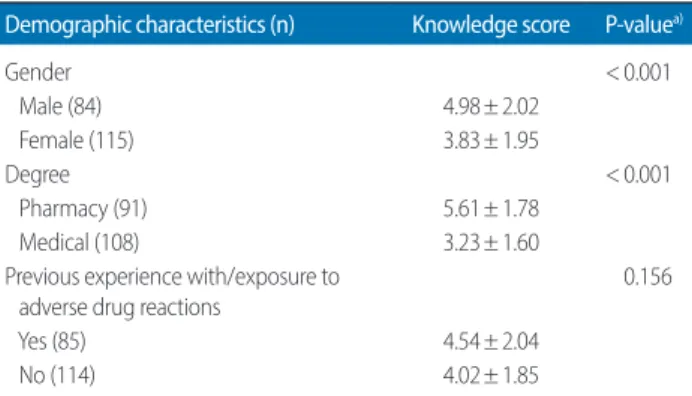
diference was observed between the pharmacy and medical students, the mean knowledge score of both groups was inad-equate. Similarly, a diference was observed between the mean knowledge scores of respondents who reported previous ex-posure to ADRs (4.54± 2.04) and their counterparts (4.02± 1.85); however, this difference was not statistically significant (P = 0.156). he complete set of relationships between demograph-ic variables and respondents’ knowledge of ADRs is presented in Table 1.
Our results showed that pharmacy students exhibited more knowledge regarding every aspect of ADRs and their report-ing than medical students. However, the discrepancy between pharmacy and medical students varied from question to ques-tion. When asked if ADRs can be fatal if not identified and managed in a timely manner, 76.9% of pharmacy students
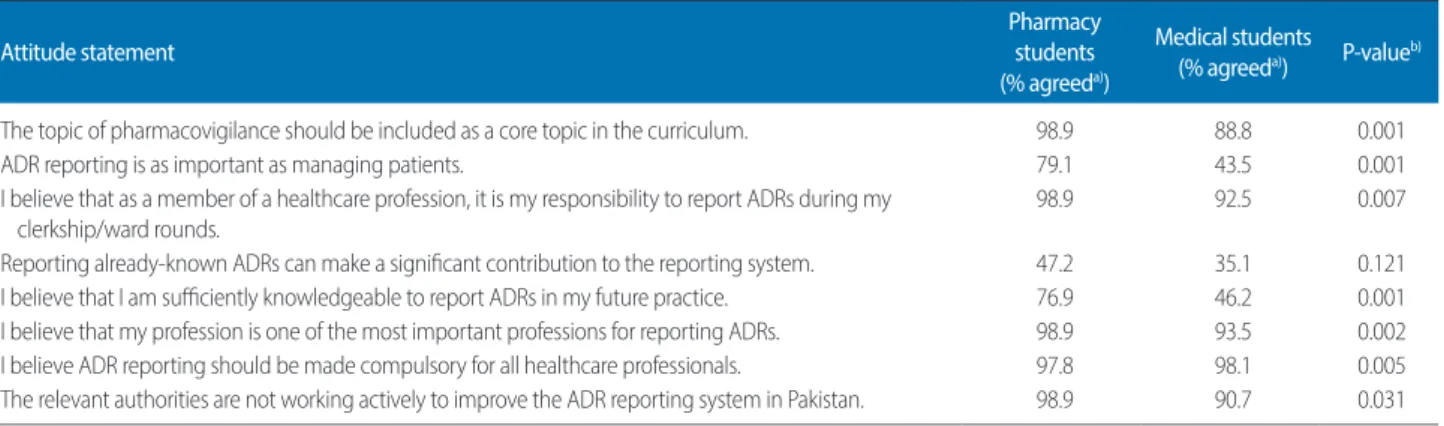
an-swered correctly, compared to only 9.25% of medical students. Similarly, the knowledge gap between the two groups was wide regarding their knowledge of the minimum requirements for the submission of ADRs (pharmacy, 42.8%; medical, 7.4%). Conversely, the knowledge level of pharmacy and medical stu-dents was almost the same regarding awareness of the regula-tory body in Pakistan that regulates ADR reporting (37.3% and 35.1%, respectively). Both groups showed a similar ability to identify the correct deinition of ADRs (91.2% and 84.2%, respectively). Although participants showed an adequate over-all knowledge of ADRs, surprisingly, only a few participants in either group were aware of the term ‘pharmacovigilance’ (31.8% and 20.3%, respectively). The responses to all of the questions assessing students’ knowledge of ADRs are present-ed in Table 2. Our results showpresent-ed that the overall attitude of pharmacy students towards these issues was positive (mean score ± SD, 1.82 ± 0.2), in contrast to medical students (mean score± SD, 2.1± 0.32). Pharmacy students reported more posi-tive responses to all of the attitude statements than the medi-cal students (P < 0.05 for almost all of the statements related to attitude). However, while pharmacy students overwhelmingly agreed that the reporting of already-known ADRs makes a sig-niicant contribution to the reporting system, their responses did not difer from those of the medical students to a statisti-cally signiicant extent (P = 0.121). he responses of pharmacy and medical students towards attitude statements are summa-rized in Table 3.
he majority of the students believed that the absence of in-formation provided by the patient was the main reason for not reporting ADRs; however, more pharmacy students (95.6%) agreed with this statement than medical students (85.1%). his diference was also statistically signiicant (P < 0.05). Similarly, both groups reported that a lack of encouragement on the part of the authorities was a reason for non-reporting, although more
Table 1. Relationships of the demographic characteristics of the
partici-pants with their knowledge scores (N = 199)
Demographic characteristics (n) Knowledge score P-valuea)
Gender < 0.001
Male (84) 4.98 ± 2.02
Female (115) 3.83 ± 1.95
Degree < 0.001
Pharmacy (91) 5.61 ± 1.78
Medical (108) 3.23 ± 1.60
Previous experience with/exposure to adverse drug reactions
0.156
Yes (85) 4.54 ± 2.04
No (114) 4.02 ± 1.85
Values are presented as mean ± SD. Knowledge was assessed by giving one point for a correct answer and zero points for each incorrect answer. The scale measured knowledge from a minimum of 0 to a maximum of 10. A score of ≥ 7 was considered to indicate a good level of knowledge, while a score of < 7 was considered to relect a poor level of knowledge.
a)Independent sample t-test.
Table 2. Proportions of inal-year pharmacy and medical students who correctly answered knowledge questions regarding ADRs and ADR reporting
Knowledge questions Correct answers (%)
Pharmacy students Medical students
Deinition of ADRs 91.2 84.2
What is pharmacovigilance? 31.8 20.3
Type A ADRs 68.1 40.7
Type B ADRs 67.0 36.1
ADRs should be reported only when they are serious and unexpected. 34.0 21.2
ADRs associated with herbal drugs should also be reported. 60.4 33.3
ADRs should not be reported until the particular drug responsible for it is identiied. 41.7 33.3
ADRs can be FATAL if not identiied and managed in a timely manner. 76.9 9.25
Knowledge of the minimum requirements for the submission of an ADR report. 42.8 7.4 Awareness of the regulatory body in Pakistan that regulates ADR reporting. 37.3 35.1
pharmacy students agreed with this statement than medical students (93.4% vs. 77.7%, P = 0.002). Interestingly, 75.9% of medical students answered that a lack of knowledge about where and how to report ADRs is a major reason for non-reporting,
although only 49.4% of pharmacy students reported this rea-son (P = 0.001). he rearea-sons cited by the participants for not reporting ADRs are tabularized in Table 4.
he main source of information used by pharmacy students
Table 4. Reasons for not reporting adverse drug reactions
Reasons Pharmacy students (n = 91) (%) Medical students (n = 108) (%) P-valuea)
Lack of information provided by patients 95.6 85.1 0.017
I do not have enough time. 27.4 26.8 0.922
I do not know where and how to report. 49.4 75.9 0.001
I do not consider it important. 15.3 8.3 0.181
It is not widely encouraged by the relevant authorities. 93.4 77.7 0.002
I fear facing legal problems. 46.1 45.3 0.912
a)P-value derived from the chi-square test.
Table 3. Attitudes of pharmacy and medical students towards ADRs and ADR reporting
Attitude statement
Pharmacy students (% agreeda))
Medical students (% agreeda)) P-value
b)
The topic of pharmacovigilance should be included as a core topic in the curriculum. 98.9 88.8 0.001
ADR reporting is as important as managing patients. 79.1 43.5 0.001
I believe that as a member of a healthcare profession, it is my responsibility to report ADRs during my clerkship/ward rounds.
98.9 92.5 0.007
Reporting already-known ADRs can make a signiicant contribution to the reporting system. 47.2 35.1 0.121 I believe that I am suiciently knowledgeable to report ADRs in my future practice. 76.9 46.2 0.001 I believe that my profession is one of the most important professions for reporting ADRs. 98.9 93.5 0.002 I believe ADR reporting should be made compulsory for all healthcare professionals. 97.8 98.1 0.005 The relevant authorities are not working actively to improve the ADR reporting system in Pakistan. 98.9 90.7 0.031
Attitude was assessed numerically by giving a score of 1 to strong agreement, a score of 2 to agreement, a score of 3 to unsure, a score of 4 to disagreement, and a score of 5 to strong disagreement. Scores < 2 were taken to indicate positive attitudes, while scores ≥ 2 were taken to indicate negative attitudes. The mean atti-tude of pharmacy satti-tudents was 1.82 ± 0.2, while that of medical satti-tudents was 2.1 ± 0.32.
ADR, adverse drug reaction.
a)The percentages of responses indicating agreement and strong agreement were combined. b)Derived from the chi-square test.
Fig. 1. Pharmacy and medical students’ main sources of information about
adverse drug reactions. 70
60
50
40
30
20
10
0
Per
cen
tage
Internet Textbooks Journals Seminars Lectures 60
30
12 47
10
6 9
13 8
12 Pharmacy students Medical students
Fig. 2. The purposes of reporting ADRs cited by pharmacy and medical
students. ADR, adverse drug reaction. 100
80
60
40
20
0
Per
cen
tage
1 2 3 4 5 6 5.5
2.7 2.16.4 7.61.8 4.3
16.6 13.113.8
89 84.2
was the Internet (60%) while medical students relied mainly on textbooks (47%). Detailed information about this is psented in Fig. 1. Similarly, Fig. 2 illustrates the purposes for re-porting ADRs cited by pharmacy and medical students; the majority of pharmacy and medical students considered the purposes of ADR reporting to be to identify drugs involved in ADRs, to calculate the incidence of ADRs, to share informa-tion, to identify unrecognized ADRs, and to improve patient safety.
DISCUSSION
he results indicating that both pharmacy and medical stu-dents demonstrated an inadequate level of knowledge about ADRs may be explained by the lack of courses on ADRs and pharmacovigilance in their curricula. In this study, male dents were found to be more knowledgeable than female stu-dents. However, this result does not correspond to that of an-other study conducted in Malaysia, in which a superior level knowledge was reported among female students [4]. his dis-crepancy could be explained by cultural diferences, as male students in Pakistan are more practical and career-oriented, and are therefore more likely to be involved in various types of hospital internships, workshops, and seminars that would al-low them to become acquainted with issues such as ADRs. It was also noteworthy that no signiicant diference was observ-ed between the mean knowlobserv-edge scores of students with pre-vious experience of/exposure to ADRs and those who had no such background. his might indicate a systematic law in this aspect of the educational/training system, suggesting that it is not able to groom students who will be able to make signii-cant contributions in the area of ADR reporting.
The respondents’ lack of understanding about pharmaco-vigilance, which was observed among both pharmacy and medical students, needs to be addressed. Previous studies on this topic have reported similar results [6]. Another remark-able result was the lack of knowledge in both groups about the existence of a drug regulatory authority for reporting ADRs. he indings of this study suggest that signiicant diferences exist in the knowledge of pharmacy and medical students as assessed by a range of knowledge questions. his discrepancy might exist because pharmacy students take two to four semes-ters of pharmacology and two to four semessemes-ters of clinical phar-macy in their PharmD curriculum. In contrast, medical stu-dents study pharmacology for only one to two semesters in their medical curriculum. his indicates that PharmD students undergo rigorous training in pharmacology and clinical phar-macy, which is likely to be the reason that they displayed more knowledge than medical students in this domain. Courses on pharmacovigilance must be included in the curricula of both
pharmacy and medical students in order to improve their knowl-edge thereof. Similarly, clinical sessions and clinical/research projects should also be implemented, and the monitoring of ADRs should be considered to be an integral part of patient care. hese recommendations are also backed by the Uppsala Monitoring Centre, the international collaborating centre for ADR monitoring. According to the Uppsala Monitoring Cen-tre, pharmacovigilance courses should be taught at the under-graduate level to healthcare professional students alongside the rational use of medications [7]. he attitude of pharmacy students towards these issues was positive, in contrast to med-ical students. This result agrees with the results of previous studies that have likewise found that pharmacists have a posi-tive attitude towards their ability to handle and report ADRs [8]. Most students from both professional programs agreed that the topic of pharmacovigilance should be included as a core subject. his shows the positive attitude of the students towards the importance of pharmacovigilance, which they consider to be a weak link in their curricula. However, the data suggest that pharmacy students were more positively inclined towards recognizing the importance of pharmacovigilance than medical students. his discrepancy is problematic; medi-cal students require more rigorous knowledge and training in ADRs and pharmacovigilance, as they are healthcare profes-sionals of the future who will bear a great responsibility for pa-tient care.
he current study also explored the reasons given by phar-macy and medical students for not reporting ADRs. he ab-sence of information provided by the patient and a lack of en-couragement from the authorities were the major reasons re-ported in this study. hese results, however, difer from those of several other studies, which concluded that a lack of aware-ness of how and where to report ADRs were the major reasons for the underreporting of ADRs [9]. his inconsistency is like-ly due to patients’ distrust of pharmacists, which discourages them from sharing their health-related problems [10]. Anoth-er issue could be related to the inadequate functioning of the drug regulatory authority in Pakistan. Overall, our results dem-onstrate the need for raising awareness about ADR reporting in order to strengthen the bridge between the regulatory au-thorities and healthcare facilities in Pakistan.
generalizable to the entire population. Despite this limitation, we believe that our results are a valuable contribution to the existing literature in light of the scarcity of relevant data. Fur-thermore, our results encourage researchers to investigate this issue by assessing the situation in diferent pharmacy and med-ical schools in Pakistan.
In conclusion, it is suggested that although pharmacy stu-dents have more knowledge about ADRs and a more positive attitude towards ADR reporting and pharmacovigilance than medical students, students in both professional programs still lack a basic understanding of these concepts. It is imperative that ADR reporting and pharmacovigilance be incorporated as core subjects in the curricula of future healthcare profession-als, in order to best address the needs of the patients.
ORCID:
Muhammad Umair Khan: http://orcid.org/0000-0001-9553-9874; Akram Ahmad: http://orcid.org/0000-0002-9998-5860; Areeba Ejaz: http://orcid.org/0000-0003-4085-461X; Syed Ata Rizvi: http://orcid.org/0000-0002-9886-7192; Ayesha Sardar: http://orcid.org/0000-0002-9473-021X; Kazim Hussain: http: //orcid.org/0000-0003-1315-6541; Tayyaba Zafar: http://orcid. org/0000-0002-1980-3124; Shazia Q. Jamshed: http://orcid. org/0000-0003-0773-0463CONFLICT OF INTEREST
No potential conlict of interest relevant to this article was reported.
SUPPLEMENTARY MATERIAL
Audio recording of abstract.
REFERENCES
1. Mahmood KT, Tahir FA, Haq IU. Pharmacovigilance: a need for best patient care in Pakistan: a review. J Pharm Sci Res. 2011;3: 1566-1584.
2. Ifat W, Shakeel S, Naseem S, Imam S, Khan M. Attitudinal sur-vey to assess medical and dental students’ belief of ADR report-ing in Pakistan. Int J Pharm Pharm Sci. 2014;6:279-283. 3. Ahmad A, Patel I, Balkrishnan R, Mohanta GP, Manna PK. An
evaluation of knowledge, attitude and practice of Indian phar-macists towards adverse drug reaction reporting: a pilot study. PerspectClin Res. 2013;4:204-210. http://dx.doi.org/10.4103/2229-3485.120168
4. Elkalmi RM, Hassali MA, Ibrahim MI, Widodo RT, Efan QM, Hadi MA. Pharmacy students’ knowledge and perceptions about pharmacovigilance in Malaysian public universities. Am J Pharm Educ. 2011;75:96. http://dx.doi.org/10.5688/ajpe75596
5. Sathvik BS, Chukir DM, Abo-Aldan E, Soliman MN. Adverse drug reaction monitoring and reporting: knowledge, attitude and belief of physicians & pharmacists of Aas al Khaimah, Unit-ed Arab Emirates (UAE). Int J Pharm Sci Res. 2014;5:368-375. http://dx.doi.org/10.13040/IJPSR.0975-8232.5(2).368-75 6. Li Q, Zhang SM, Chen HT, Fang SP, Yu X, Liu D, Shi LY, Zeng
FD. Awareness and attitudes of healthcare professionals in Wu-han, China to the reporting of adverse drug reactions. Chin Med J (Engl). 2004;117:856-861.
7. Mann RD, Andrews EB. Pharmacovigilance. 2nd ed. West Sus-sex: John Wiley and Sons; 2007.
8. Granas AG, Buajordet M, Stenberg-Nilsen H, Harg P, Horn AM. Pharmacists’ attitudes towards the reporting of suspected adverse drug reactions in Norway. Pharmacoepidem Drug Safe. 2007;16: 429-434. http://dx.doi.org/10.1002/pds.1298
9. Tabali M, Jeschke E, Bockelbrink A, Witt CM, Willich SN, Oster-mann T, Matthes H. Educational intervention to improve physi-cian reporting of adverse drug reactions (ADRs) in a primary care setting in complementary and alternative medicine. BMC Public Health. 2009;9:274. http://dx.doi.org/10.1186/1471-2458-9-274