Pheromone Components of the Chinese Pine Caterpillar
Moth,
Dendrolimus tabulaeformis
Xiang-Bo Kong1, Kui-Wei Liu1,2, Hong-Bin Wang1, Su-Fang Zhang1, Zhen Zhang1*
1Key Laboratory of Forest Protection, Research Institute of Forest Ecology, Environment and Protection, Chinese Academy of Forestry, State Forestry Administration, Beijing, China,2Institute of Plant Protection, Shandong Agricultural University, Tai’an, Shandong, China
Abstract
Background:The Chinese pine caterpillar moth,Dendrolimus tabulaeformisTsai and Liu (Lepidoptera: Lasiocampidae) is the most important defoliator of coniferous trees in northern China. Outbreaks occur over enormous areas and often lead to the death of forests during 2–3 successive years of defoliation. The sex pheromone ofD. tabulaeformiswas investigated to define its chemistry and behavioral activity.
Methodology/Principal Findings:Sex pheromone was collected from calling femaleD. tabulaeformis by headspace solid phase microextraction (SPME) and by solvent extraction of pheromone glands. Extracts were analyzed by coupled gas chromatography/mass spectrometry (GC-MS) and coupled GC-electroantennographic detection (GC-EAD), using antennae from male moths. Five components from the extracts elicited antennal responses. These compounds were identified by a combination of retention indices, electron impact mass spectral matches, and derivatization as (Z)-5-dodecenyl acetate (Z 5-12:OAc), (Z)-5-dodecenyl alcohol (Z5-12:OH), (5Z,7E)-5,7-dodecadien-1-yl acetate (Z5,E7-12:OAc), (5Z,7E)-5,7-dodecadien-1-yl propionate (Z5,E7-12:OPr), and (5Z,7E)-5,7-dodecadien-1-ol (Z5,E7-12:OH). Behavioral assays showed that male D.
tabulaeformis strongly discriminated against incomplete and aberrant blend ratios. The correct ratio of Z5,E7-12:OAc,
Z5,E7-12:OH, andZ5,E7-12:OPr was essential for optimal upwind flight and source contact. The two monoenes,Z5-12:OAc and Z5-12:OH, alone or binary mixtures, had no effect on behavioral responses when added to the optimal three-component blend.
Conclusions/Significance:The fact that deviations from the optimal ratio of 100:100:4.5 ofZ5,E7-12:OAc,Z5,EZ7-12:OH, and
Z5,E7-12:OPr resulted in marked decreases in male responses suggests that biosynthesis of the pheromone components is precisely controlled. The optimal blend of the sex pheromone components ofD. tabulaeformisworked out in this study should find immediate use in monitoring this pest in Chinese forests.
Citation:Kong X-B, Liu K-W, Wang H-B, Zhang S-F, Zhang Z (2012) Identification and Behavioral Evaluation of Sex Pheromone Components of the Chinese Pine Caterpillar Moth,Dendrolimus tabulaeformis. PLoS ONE 7(3): e33381. doi:10.1371/journal.pone.0033381
Editor:Michel Renou, INRA-UPMC, France
ReceivedDecember 21, 2011;AcceptedFebruary 8, 2012;PublishedMarch 13, 2012
Copyright:ß2012 Kong et al. This is an open-access article distributed under the terms of the Creative Commons Attribution License, which permits unrestricted use, distribution, and reproduction in any medium, provided the original author and source are credited.
Funding:This work was supported by grants from National Nonprofit Institute Research Grant of CAF (CAFRIFEEP201002), and partially supported from the National Natural Science Foundation of China (Grant No. 30771737). The funders had no role in study design, data collection and analysis, decision to publish, or preparation of the manuscript.
Competing Interests:The authors have declared that no competing interests exist.
* E-mail: [email protected]
Introduction
The Chinese pine caterpillar moth,Dendrolimus tabulaeformis is native to northern China, where it is an economically important pest of conifers. It is mainly distributed in the provinces of He’bei, He’nan, Sha¯n’xi, Sha˘n’xi, Shan’dong, Liao’ning, Si’chuan, and Inner Mongolia autonomous region, where it attacks Chinese pine
(Pinus tabulaeformis Carr.), Scotch pine (P. sylvestris var. mongolica
Litv.), Armand pine (P. armandii Franch.), Masson pine (P.
massoniana Lamb.), and Bunge pine (P. bungeana Zucc. ex Endl.)
[1].Dendrolimus tabulaeformishas one to three generations per year
depending on climatic conditions. In the Beijing region, larvae that eclose from the end of August to mid-September feed until late autumn and then spend the winter in forest litter or soil close to the trunk. In spring, caterpillars climb up to the crown to feed intensively, and pupate in May/June in cocoons. Flights of adults
begin in June/July and last until August. Copulation usually lasts ca. 24 h and then females lay eggs on the needles. One egg mass may contain up to several hundred eggs. Control efforts againstD.
tabulaeformisconsist mainly of aerial treatment with chemical and
bacterial insecticides, and even collection of cocoons during outbreak years. Pheromone-baited traps are used to monitor the population dynamics of severalDendrolimusspecies so that pesticide applications can be optimally timed.
few male D. tabulaeformis [10] and the responses of antennae of
male D. tabulaeformis to these and similar compounds were
measured [11], the actual pheromone components of this species and their behavioral roles have not been properly identified. The purpose of this study was to properly identify the sex pheromone of
D. tabulaeformis. Field and wind tunnel experiments then were
carried out to optimize the pheromone blend.
Results
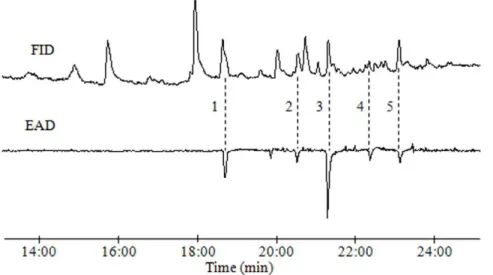
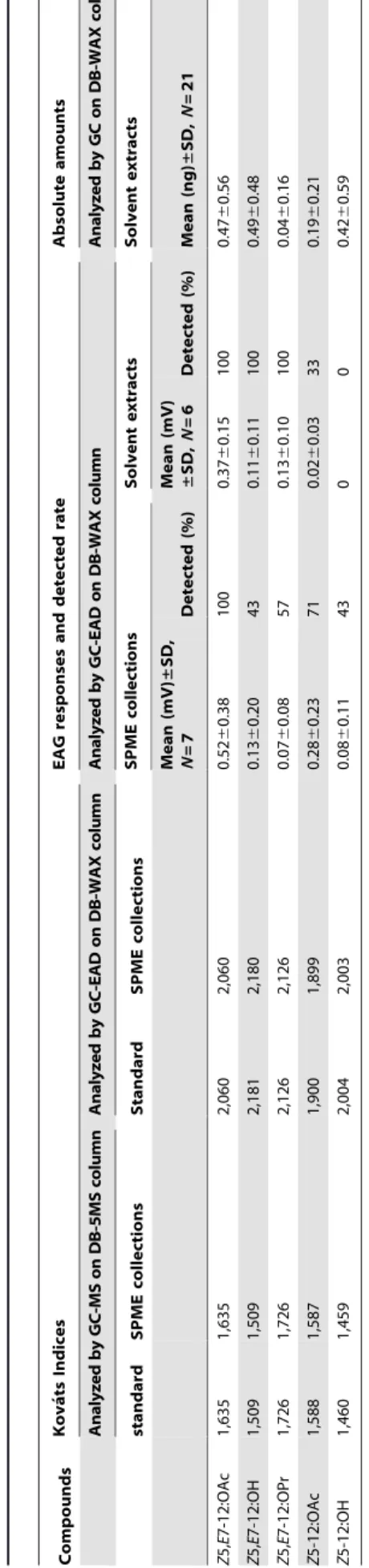
GC-EAD and GC analyses of pheromone extracts GC-EAD analyses of the headspace volatiles emitted by calling females showed five compounds that consistently elicited responses from antennae of maleD. tabulaeformismoths. These compounds had KIs of 1,899 (EAD1), 2,003 (EAD2), 2,060 (EAD3), 2,126 (EAD4), and 2,180 (EAD5) on a DB-WAX column, corresponding to the KIs and EAD activities of the authentic standards Z 5-12:OAc, Z5-12:OH, Z5,E7-12:OAc, Z5,E7-12:OPr, and Z5,E 7-12:OH, respectively (Figure 1, Table 1). Similar results were obtained with GC-EAD analyses of pheromone gland extracts. Thus, the five EAD-active compounds were tentatively identified as Z5-12:OAc (EAD1), Z5-12:OH (EAD2), Z5,E7-12:OAc (EAD3), Z5,E7-12:OPr (EAD4), and Z5,E7-12:OH (EAD5). In addition, the antennae of maleD. tabulaeformisalso responded to synthetic (5Z,7E)-5,7-dodecadienal (Z5,E7-12:Ald) and (5E,7Z )-5,7-dodecadienal (E5,Z7-12:Ald).
The stereochemistries of the five insect-produced compounds that elicited EAD responses were verified by analyses of extracts on two columns of different polarity (DB-WAX and DB-5MS). On both columns, the retention times of the insect-produced compounds were identical to those of syntheticZ5-12:OAc, Z 5-12:OH, Z5,E7-12:OAc, Z5,E7-12:OPr, and Z5,E7-12:OH, re-spectively, and markedly different from the KIs of the other isomers. Quantitative analyses on the DB-WAX column showed that single gland solvent extracts contained on average 0.1960.21 ng (mean ng/female 6 SD, N= 21) of Z5-12:OAc, 0.4260.59 ng of Z5-12:OH, 0.4760.56 ng of Z5,E7-12:OAc, 0.0460.16 ng of Z5,E7-12:OPr, and 0.4960.48 ng of Z5,E 7-12:OH, corresponding to a ratio of 39:86:96:8:100 (Table 1).
GC-MS analyses of pheromone extracts and MTAD and DMDS adducts
GC-MS analyses of SPME collections on a DB-5MS column confirmed the identities of the five components that had elicited EAD responses, including Z5,E7-12:OAc (KI: 1,635; M+N at m/z 224;
diagnostic fragment ions:m/z164, M+N-CH
3COOH; 136, C10H16+;
121, C9H13+),Z5,E7-12:OH (KI: 1,509; M+Natm/z182; diagnostic
fragment ions: m/z 164, M+N-H
2O; 135, M+N-C2H7O; 121, M+N
-C3H9O), Z5,E7-12:OPr (KI: 1,726; M+N at m/z 238; diagnostic
fragment ions: m/z 164, M+N-C
2H5COOH; 136, C10H16+), Z
5-12:OAc (KI: 1,587; diagnostic fragment ions: m/z 166, M+N
-CH3COOH; 138, C10H18+), andZ5-12:OH (KI: 1,459; diagnostic
fragment ions:m/z166, M+N-H
2O) (Table 1 and 2). No other isomers
or analogs were detected. The identities of these components were further confirmed by MTAD and DMDS derivatization of gland extracts. Mass spectra and retention times of MTAD derivatized gland extracts (30 FE) were identical with those obtained by MTAD treatment of synthetic Z5,E7-12:OH (23.50 min), Z5,E7-12:OAc (24.45 min), andZ5,E7-12:OPr (25.39 min) (Table 2). The positions of the conjugated double bonds of the components EAD3 (m/z337, M+N;m/z222, (M+N-115)), EAD4 (m/z351, M+N;m/z222, (M+N-129)),
and EAD5 (m/z295, M+N;m/z222, (M+N-73)) were confirmed as 5,7
based on the diagnostic fragments from cleavage on either side of the adducts formed between the gland components and the MTAD dienophile (Table 2). GC-MS analysis of the DMDS adducts (30 FE) showed a molecular ion at m/z 320, a base peak at m/z 145 [H-(CH2)6CH = S+CH3] and a peak at m/z 175 [CH3S+=
CH(CH2)4OOCCH3] for EAD1, and a molecular ion atm/z278,
a base peak atm/z145 [H-(CH2)6CH = S+CH3] and a peak atm/z
133 [CH3S+= CH(CH2)4OH] for EAD2, indicating that the double
bond was located at position 5 in both compounds (Table 2). The retention times also matched those of the adducts from authenticZ 5-12:OAc (21.59 min) and Z5-12:OH (20.43 min), confirming the previous identifications.
Behavioral assays of the potential pheromone components
Few or noD. tabulaeformismales were caught in traps baited with onlyZ5,E7-12:OH orZ5,E7-12:OAc, or binary mixtures of the
Figure 1. Simultaneously recorded responses from flame ionization detector (FID, top) and electroantennographic detection (EAD, bottom; sensing element: maleD. tabulaeformisantenna) to headspace volatiles collected by SPME from a virgin calling femaleD. tabulaeformismoth.Peaks indicated by 1–5 representZ5-12:OAc (EAD1),Z5-12:OH (EAD2),Z5,E7-12:OAc (EAD3),Z5,E7-12:OPr (EAD4), andZ5,E 7-12:OH (EAD5).
two (Table 3). Traps baited withZ5,E7-12:OAc/Z5,E7-12:OH/
Z5,E7-12:OPr in ratios of 1600:1600:0.7 or 1600:1600:7 were also no better than unbaited controls. However, traps baited with higher rates of Z5,E7-12:OPr (70mg or 120mg) in the
three-component blend attracted significantly large numbers of male moths (F(9,30)= 19.31,p,0.001). Attraction of maleD. tabulaeformis
to the optimal three-component blend was unaffected by the addition ofZ5-12:OAc and/orZ5-12:OH to that blend (Table 3). In wind tunnel bioassays, all males tested took flight in response to all synthetic blends tested except the solvent control, indicating that even the incomplete blend of Z5,E7-12:OAc and Z5,E 7-12:OH in a 1:1 ratio was sufficient to elicit flight initiation (Figure 2). When the minor component,Z5,E7-12:OPr, was added to the two-component blend, male moths approached the pheromone source, and the highest proportion of males contacting the source occurred with a 2000:2000:90 of Z5,E7-12:OAc,
Z5,E7-12:OH, andZ5,E7-12:OPr (72% of test males approached the source). In contrast, the 2000:2000:150 ng ratio significantly decreased source contacts compared to the 2000:2000:90 ratio (F(5,12)= 13.47,p,0.001).
Discussion
The five components from the pheromone glands that elicited EAD responses were unambiguously identified asZ5-12:OAc,Z 5-12:OH,Z5,E7-12:OAc,Z5,E7-12:OPr, andZ5,E7-12:OH by GC, GC-MS, GC-EAD analyses, and microscale derivatizations. Moreover, antennae of males responded to theZ5,E7-isomer of the conjugated dienes and theZ5-isomer of the monoenes acetate, alcohol, and/or propionate in EAD analyses, and the other isomers were not detected in the gland extracts. In wind tunnel bioassays, a mixture of the two major componentsZ5,E7-12:OAc andZ5,E7-12:OH in a 1:1 ratio was sufficient to induce flight by males, but the minor component,Z5,E7-12:OPr was essential for optimal upwind flight and source contact. In total, our data suggest that the female-produced sex pheromone ofD. tabulaeformis
is a three-component blend ofZ5,E7-12:OAc,Z5,E7-12:OH, and
Z5,E7-12:OPr, and the optimum ratio has been determined to be ca. 100:100:4.5, which is close to the ratio found in analyses of the volatiles emitted by calling females (100:100:8). Furthermore, our
Table 1. Compounds, Kova ´ts Indices, EAD responses, detected rate, and absolute amounts of potential pheromone components collected by CAR/DVB SPME fiber (70 m m) from live calling virgin females of Dendrolimus tabulaeformis or extracted from pheromone glands with hexane. Compounds Kova ´ts Indices EAG responses and detected rate Absolute amounts Analyzed by GC-MS o n D B-5MS column A nalyzed b y G C-EAD o n D B-WAX colu m n A nalyzed b y G C-EAD o n D B-WAX colum n A naly z e d b y G C on D B-WAX column standard SPME collections Standard SPME collections SPME collections Solvent extracts Solvent extracts Mean (mV) ± SD, N = 7 Detected (%) Mean (mV) ± SD, N = 6 Detected (%) Mean (ng) ± SD, N =2 1 Z 5, E 7-12:OAc 1,635 1,635 2,060 2,060 0 .52 6 0.38 1 00 0.37 6 0.15 100 0.47 6 0.56 Z 5, E 7-12:OH 1 ,509 1,509 2,181 2,180 0 .13 6 0.20 43 0 .11 6 0.11 100 0.49 6 0.48 Z 5, E 7-12:OPr 1,726 1,726 2,126 2,126 0 .07 6 0.08 57 0 .13 6 0.10 100 0.04 6 0.16 Z 5-12:OAc 1,588 1,587 1,900 1,899 0 .28 6 0.23 71 0 .02 6 0.03 3 3 0 .19 6 0.21 Z 5-12:OH 1 ,460 1,459 2,004 2,003 0 .08 6 0.11 43 0 0 0 .42 6 0.59 doi:10.1371/journal.pone. 0033381.t001
Table 2.Electron impact mass spectral data from
components of pheromone gland extracts, and their MTAD and DMDS derivatives for the Chinese pine caterpillar,
Dendrolimus tabulaeformis.
Components/
Derivatives Ions,m/z/abundance, %a
EAD1 166/53 138/43 123/10 110/46 95/100
EAD2 166/13 138/12 123/6 109/30 67/100
EAD3 224/15 164/31 136/32 121/28 79/100
EAD4 238/12 164/44 136/39 121/21 79/100
EAD5 182/26 164/35 135/8 121/19 79/100
EAD1+DMDS 320/10 213/5 175/9 145/100 115/9
EAD2+DMDS 278/39 213/7 145/100 133/38 85/53
EAD3+MTAD 337/9 280/18 238/13 222/100 165/21
EAD4+MTAD 351/11 294/16 238/23 222/100 165/25
EAD5+MTAD 295/10 238/28 222/100 181/6 165/17
aFrom full-scan spectra. MTAD, 4-methyl-1,2,4-triazoline-3,5-dione. DMDS,
dimethyl disulfide.
data showed that maleD. tabulaeformisstrongly discriminate against off-ratio pheromone blends, which would impose strong stabilizing selection on the pheromone signal.
Species-specific pheromone blends can be generated from different sets of constituents, or by mixing the same set of constituents in different ratios [12]. The identified sex pheromones
of Dendrolimus species share a common chemical theme of being
C12 5,7-dienes with alcohol, acetate, propionate, or aldehyde
functional groups, with species-specific blends being generated by using different subsets of components and/or ratios of compo-nents. For example, in the species studied here, a specific ratio of sex pheromone components is required in order to achieve optimal male flights. However, the best attractant for male D.
spectabilis, which is sympatric with D. tabulaeformis in Shan’dong,
Table 3.Catches of maleDendrolimus tabulaeformisin delta-shaped traps baited with various blends of potential pheromone components between 1 and 14 August 2011 in the experimental forest of Ping’quan city, He’bei province, China.
Composition of baits (mg) Mean catch±SE/trap
a
N= 4
Z5,E7-12:OAc Z5,E7-12:OH Z5,E7-12:OPr Z5-12:OAc Z5-12:OH
1600 —b
— — — 0.2560.25b
— 1600 — — — 0
1600 1600 — — — 0.2560.25b
1600 1600 0.7 — — 0.2560.25b
1600 1600 7 — — 1.2560.25b
1600 1600 70 — — 31.75616.07a
1600 1600 70 200 — 26.5065.12a
1600 1600 70 — 400 18.2566.25a
1600 1600 70 200 400 34.75612.27a
1600 1600 120 — — 20.5068.05a
Control 0.5060.50b
aMeans followed by the same letter in column are not significantly different at the 5% confidence level by Tukey’s tests (F
(9,30)= 19.31,p,0.001). b‘‘—’’ indicate the components were not included.
doi:10.1371/journal.pone.0033381.t003
Figure 2. Percentages of males exhibiting three key behaviors in the flight tunnel in response to various doses ofZ5,E7-12:OPr blended with fixed amounts ofZ5,E7-12:OAc andZ5,E7-12:OH (doses in ng).Taking flight = TF, (light bars); upwind flight over a 1.2-m distance = UP, (hatched bars with different upper-case letters were significantly different by Tukey’s test atp= 0.05 following ANOVA,F5,12= 4.30,
p= 0.018); and source contact = SC, (dark bars with different lower-case letters were significantly different by Tukey’s test atp= 0.05 following ANOVA,
F5,12= 13.47,p,0.001).
He’bei, Liao’ning, and Inner Mongolia, consists of a 100:3:25 blend of Z5,E7-12:OH/Z5,E7-12:OAc/Z5,E7-12:OPr [6], with
Z5,E7-12:OH as the principal sex pheromone component [2]. In contrast, comparative studies of the sex pheromones of the most closely related species, D. punctatus, which is sympatric with D.
tabulaeformis in Sha˘n’xi, He’nan, and Chong’qing, suggest that
male moths of this species respond to a broad range of ratios of
Z5,E7-12:OH/Z5,E7-12:OAc/Z5,E7-12:OPr blend (median blend 100:82:30) [13].Dendrolimus punctatus, D. spectabilis, and D.
tabulaeformis all share the same three pheromone components,
Z5,E7-12:OH, Z5,E7-12:OAc, and Z5,E7-12:OPr, but the differences in the ratios of the three-component blends are essential for maintaining separate communication channels.
Furthermore, the bioassay data suggests that Z5-12:OAc and
Z5-12:OH are not part of the attractive pheromone blend ofD.
tabulaeformis, although they elicit relatively strong EAD responses
from male antennae, because neither of these compounds enhanced the attractiveness of three-component blend in field test. The same phenomenon was also observed inD. punctatus[13]. However,D. tabulaeformis is partially sympatric withD. kikuchiiin He’nan province, and a major difference between the two pheromone systems is that the pheromone blend of D. kikuchii
substitutes Z5-12:OAc forZ5,E7-12:OPr in an optimal ratio of 100:20:25 Z5,E7-12:OAc/Z5,E7-12:OH/Z5-12:OAc [8]. Thus, the minor components Z5-12:OAc andZ5,E7-12:OPr may serve to enhance the specificity of the signals inD. tabulaeformisandD.
kikuchii. In addition, the antennae of male D. tabulaeformis
responded to synthetic Z5,E7-12:Ald and E5,Z7-12:Ald in our GC-EAD analyses, but the two compounds were not detected in pheromone gland extracts. It has been reported that the sex pheromones ofD. superansandD. houiconsist ofZ5,E7-12:Ald [7] and E5,Z7-12:Ald [9], respectively. Dendrolimus tabulaeformis is broadly sympatric withD. superansin Inner Mongolia, He’bei, and Liao’ning, and sympatric withD. houiin Sha˘n’xi and Chongqing. Addition ofZ5,E7-12:Ald (ca. 5% ofZ5,E7-12:OAc) to the three-component blend ofD. tabulaeformisresulted in decreased captures of males. Thus, these two aldehydes might play an important role in chemical communication of sympatric, closely related species, either as essential minor components of pheromone blends, or conversely as interspecific inhibitors.
The optimal blend of the sex pheromone components ofD.
tabulaeformisworked out in this study should find immediate use in
monitoring this pest in Chinese forests.
Materials and Methods
Ethics statement
All necessary permits were obtained for the described field studies. The forestry bureau of Ping’quan city, responsible for Da’shi lake forest center, issued the permission for our field studies in the Chinese pine forest at this site. These field studies did not involve endangered or protected species.
Insects
Cocoons of D. tabulaeformis were collected from the host tree,
Pinus tabulaeformisat Da’shi lake forestry center near Ping’quan city,
He’bei province on 30 July 2011 and maintained in a rearing room at 2561uC, 60–80% relative humidity (RH) with a photoperiod of 16:8 h light:dark until adult emergence. Newly emerged males and females were housed separately under the same conditions. Virgin females were used for preparation of pheromone extracts, whereas males were used for EAG studies.
Sample collection
Sex pheromone glands were excised from females during the peak period of calling (0–2 d old, 4–7 h into the scotophase) and extracted for 30 min with hexane (10ml per gland). The glands were removed before sealing the extracts in glass tubes, which were stored at220uC until bioassay and chemical analyses.
Pheromones emitted by 1–2 d old calling virgin females held in 0.02 m3 metal screen cages were collected by solid phase microextraction (SPME, 70mm CarboWax divinylbenzene (CW/DVB) coated fiber, Supelco Inc., Bellefonte, PA, USA) under ambient laboratory conditions. The SPME fiber was placed 1–2 mm from the extruded gland, sampling from the onset of calling (about 3 h into the scotophase) to the end of scotophase.
Chemicals and derivatives
All geometrical isomers of 5,7-dodecadien-1-yl acetate (Z5,Z7-,
E5,E7-, E5,Z7-, and Z5,E7-12:OAc) and its corresponding alcohols and propionates, together with Z5-12:OAc and Z 5-12:OH were purchased from Chemtech B. V. (Amsterdam, The Netherlands). Chemicals used as stimuli for electrophysiological and field trials were .98% chemically pure and .95% isomerically pure. C14-C24 straight-chain hydrocarbons for
assigning Kova´ts retention indices (KIs) were purchased from TCI Co. (Tokyo, Japan). 4-Methyl-1,2,4-triazoline-3,5-dione (MTAD, 95%) was purchased from Aldrich Chemical (Milwaukee, WI, USA), and dimethyl-disulfide (DMDS, 99%) was purchased from Acros Organics (Geel, Belgium).
The positions of double bonds in conjugated dienes were determined by means of MTAD derivatization [14,15], and in monounsaturated alkenes by the iodine-catalysed addition of dimethyl-disulfide across the double bond [16]. In this study, 30 female equivalents (FE) of extract were derivatized by MTAD and DMDS reagents respectively, as previously described [8,16]. The derivatives were analyzed by GC-MS.
Gas chromatography-electroantennographic detection (GC-EAD) analyses
The coupled GC-EAD system used was based on that described by Kong et al. (2011). The HP6890 GC (Agilent, Palo Alto, CA, USA) was equipped with a split/splitless injector, a DB-WAX column (J&W Scientific, Folsom, CA, USA, 30 m60.25 mm i.d.
60.25mm) with the column effluent split between the FID and
EAD detectors (FID/EAD, 1:2). The effluent exited into a purified and humidified airstream (450 ml/min) directed over the antennal preparation. A detached antenna from a 1-to 3-d-old male with the terminal segment removed, was mounted between two EAG probes (PRG-2, Syntech, Kirchzarten, Germany) with electrically conductive gel (Spectra 360 electrode gel, Parker Laboratories Inc. Orange, NJ, USA). Synthetic compounds and SPME fibers with loaded samples were injected splitless using a temperature program starting at 60uC for 1 min, then programmed at 6uC/ min to 230uC (15 min hold), using nitrogen carrier gas (33 cm/ sec). After adsorption, the CW/DVB fiber was treated with a 1ml
GC and GC-MS analyses
Quantitative analyses of 21 glands extracted individually were conducted on an HP7890 GC with an FID detector using a DB-WAX column (J&W Scientific, Folsom, CA, USA, 30 m60.25 mm i.d.60.25mm film) in splitless mode, temperature program, 60uC for 1 min, then 6uC/min to 240uC (hold 10 min). Injector and detector temperatures were set at 230uC and 250uC, respectively. A 1ml aliquot ofE5,Z7-12:OAc (5 ng/ml) was used as an external standard to quantify the pheromone components. Absolute amounts were calculated from the integrated peak area of each component relative to that of the external standard.
Pheromone gland solvent extracts, SPME collections (desorbed for 2 min in the injector), and references also were analyzed with a Finnigan Trace DSQ GC-MS (EI mode, 70 eV, mass range 41– 560 amu) on DB-WAX and DB-5MS capillary columns (splitless mode, 30 m60.25 mm i.d.60.25mm film) under the following
conditions: injector, ion source, and transfer line temperatures were held at 220uC, 250uC, and 240uC, respectively; helium as carrier gas at 1.0 ml/min; scan time 0.2 sec; oven temperature program: 60uC for 1 min, then 6uC/min to 260uC, hold for 20 min. When analyzed on the DB-5MS column, a 1ml aliquot of a series of straight-chain aliphatic hydrocarbons (from C14-C18,
5 ng/ml of each in dichloromethane) was added directly to the
sample-loaded fiber or solvent extracts with a syringe in order to assign retention indices to the components of crude extracts. DMDS and MTAD derivatives of pheromone gland extracts were analyzed with the same GC-MS (EI mode, 70 eV, mass range 41– 560 amu) on a DB-5MS capillary column (30 m60.25 mm i.d.
60.5mm film) in splitless mode. The column temperature was
programmed from 80uC for 1 min, then 8uC/min to 280uC (10 min hold). Injector, ion source, and transfer line temperatures were set at 280uC, 250uC, and 250uC, respectively. In GC-MS analysis, compounds were identified by comparison of retention indices and mass spectra with those of synthetic standards or their derivatives.
Behavioral assays
Field bioassays were conducted in the Da’shi lake forestry center near Ping’quan city, He’bei province. At 20–30 m intervals, delta-shaped traps made from adhesive cardboard were suspended from trees 1.5–1.7 m above ground in randomized complete blocks. In each of four blocks (replicates), traps were baited with a gray sleeve septum (The West Company, Phoenixville, PA, USA) impregnat-ed with test chemicals in hexane, and 200mg of BHT in 100ml CH2Cl2 were added subsequently as an antioxidant. The
experiment started on 1 August 2011 and was terminated two weeks later.
Synthetic compounds were selected for more detailed exami-nation in a wind tunnel (flight section 22061006120 cm) based on
data from the field tests. Air purified by filtration through activated charcoal was blown by a centrifugal fan at 40 cm/s into the tunnel and the outgoing air was exhausted with a second fan. The flight section was lit diffusely from the top at 2–3 lx with a red light, and the room was kept at 2562uC and 50–65% RH. Synthetic compounds in different ratios were released from the centre of the upwind end of the tunnel by means of gray rubber septa. Males 1– 3 days of age were placed in the tunnel room at the initiation of scotophase, 3 h prior to testing, to acclimate to the conditions of the assay room. Males were scored for three key behaviors in the flight sequence: taking flight (TF), initiation of upwind flight (UP), and source contact (SC) [18]. During each 4 h test period, two treatments were tested, with twenty males tested individually per treatment. The two- and three-component blends were prepared in hexane and applied in 50ml aliquots to gray rubber septa to achieve increasing dosages of 0, 30, 60, 80, 90, 100, and 150 ng/ septum forZ5,E7-12:OPr while keeping the major components,
Z5,E7-12:OH and Z5,E7-12:OAc in a 1:1 fixed ratio (2000 ng/ septum for each) in order to determine the behavioral effect of variable amounts of the minor componentZ5,E7-12:OPr.
Statistical analysis
Trap-catch data from field bioassays were subjected to transformation (log(x+1)) to ensure normal distribution and homogeneity of variance and then analyzed by one-way ANOVA followed by Tukey’s test with a significance level of 0.05, for comparisons of means (SPSS13.0). The zero trap-catch data were not included in the analyses because of their lack of variance. For wind tunnel bioassays, the percentage of males responding in the flight tunnel was arcsin(x) transformed and then submitted to a one-way ANOVA, followed by Tukey’s test with a significance level of 0.05, for comparisons of means.
Acknowledgments
We are grateful to Jocelyn Millar for correction of the manuscript. Thanks are also due to Ping’quan Department of Pests and Quarantine Control Station for assistance with field trials.
Author Contributions
Conceived and designed the experiments: XBK ZZ. Performed the experiments: XBK KWL HBW SFZ ZZ. Analyzed the data: XBK HBW. Contributed reagents/materials/analysis tools: XBK SFZ ZZ. Wrote the paper: XBK.
References
1. Yan JJ (1991) The biology and distribution ofDendrolimus tabulaeformisTsai and Liu. In: Xiao GY, 2nded. Forest Insects of China. Beijing: China Forestry Publishing House. pp 961–963.
2. Ando T, Vu MH, Yoshida S, Takahashi N, Tatsuki S, et al. (1982) (5Z,7E )-5,7-Dodecadien-1-ol: Female sex pheromone of the pine mothDendrolimus spectabilis Butler. Agricultural Biology and Chemistry 46: 709–715.
3. Priesner E, Bogenschu¨tz H, Albert R, Reed DW, Chisholm MD (1984) Identification and field evaluation of a sex pheromone of the European pine moth. Zeitschrift fu¨r Naturforschung 39c: 1192–1195.
4. Kovalev BG, Bolgar TS, Zubov PA, Zharkov DG, Golosova M, et al. (1993) Identification of additional components of the sex pheromone ofDendrolimus pini. Chemistry of Natural Compounds 29: 135–136.
5. Klun JA, Baranchikov YN, Mastro VC, Hijji Y, Nicholson J, et al. (2000) A sex attractant for the Siberian moth Dendrolimus superans sibiricus (Lepidoptera: Lasiocampidae). Journal of Entomological Science 35: 158–166.
6. Kong XB, Zhao CH, Sun YP, Feng SQ, Wu HS (2003) Identification of minor components of the pine caterpillar moth,Dendrolimus spectabilissex pheromone: components, electrophysiological activity, and field effects. Acta Entomologica Sinica 46: 131–137.
7. Kong XB, Zhao CH, Wang R (2007) Sex pheromone of the larch caterpillar moth,Dendrolimus superans, from northeastern China. Entomologia Experimen-talis et Applicata 124: 37–44.
8. Kong XB, Sun XL, Wang HB, Zhang Z, Zhao CH, et al. (2011) Identification of components of the female sex pheromone of the Simao pine caterpillar moth, Dendrolimus kikuchii Matsumura. Journal of Chemical Ecology 37: 412–419.
9. Kong XB, Zhang Z, Zhao CH, Wang HB (2007) Female sex pheromone of the Yunnan pine caterpillar moth, Dendrolimus houi: First (E,Z)-isomers in pheromone components ofDendrolimusspp. Journal of Chemical Ecology 33: 1316–1327.
10. Meng XZ, Wang HM (1983) Synthesis and field experiment of sex attractant for pine caterpillar,Dendrolimus tabulaeformis. Scientia Silvae Sinicae 19: 137–140. 11. Kong XB, Zhao CH, GAO W (2001) Identification of sex pheromones of four
economically important species in genusDendrolimus. Chinese Science Bulletin 46: 2077–2081.
13. Zhao CH, Li Q, Guo XY, Wang XY (1993) New components of sex pheromone in the pine caterpillar moth, Dendrolimus punctatus: identification of chemical structures and field tests. Acta Entomologica Sinica 36: 247–250.
14. Young DC, Vouros P, Holick MF (1990) Gas chromatography-mass spectrometry of conjugated dienes by derivatization with 4-methyl-1,2,4-triazoline-3,5-dione. Journal of Chromatography 522: 295–302.
15. McElfresh JS, Millar JG (1999) Sex pheromone of the common sheep moth, Hemileuca eglanterina, from the San Gabriel Mountains of California. Journal of Chemical Ecology 25: 687–709.
16. Buser HR, Arn H, Guerin P, Rauscher S (1983) Determination of double bond position in mono-unsaturated acetates by mass spectrometry of dimethyl disulfide adducts. Analytical Chemistry 55: 818–822.
17. Marques FdA, McElfresh JS, Millar JG (2000) Kova´ts retention indexes of monounsaturated C12, C14, and C16alcohols, acetates and aldehydes commonly found in Lepidopteran pheromone blends. Journal of the Brazilian Chemical Society 11: 592–599.