Differential Juvenile Hormone Variations in
Scale Insect Extreme Sexual Dimorphism
Isabelle Mifom Vea1¤*, Sayumi Tanaka1, Takahiro Shiotsuki2, Akiya Jouraku2, Toshiharu Tanaka1, Chieka Minakuchi1¤
1Graduate School of Bioagricultural Sciences, Nagoya University, Nagoya, Japan,2National Institute of Agrobiological Sciences, Tsukuba, Japan
¤Current Address: Laboratory of Applied Entomology, Graduate School of Bioagricultural Sciences, Nagoya University, Furo-cho, Chikusa-ku, Nagoya, 464-8601, Japan
Abstract
Scale insects have evolved extreme sexual dimorphism, as demonstrated by sedentary juvenile-like females and ephemeral winged males. This dimorphism is established during the post-embryonic development; however, the underlying regulatory mechanisms have not yet been examined. We herein assessed the role of juvenile hormone (JH) on the diverging developmental pathways occurring in the male and female Japanese mealybug
Planococcus kraunhiae(Kuwana). We provide, for the first time, detailed gene expression profiles related to JH signaling in scale insects. Prior to adult emergence, the transcript lev-els ofJH acid O-methyltransferase, encoding a rate-limiting enzyme in JH biosynthesis, were higher in males than in females, suggesting that JH levels are higher in males. Further-more, male quiescent pupal-like stages were associated with higher transcript levels of the JH receptor gene,Methoprene-tolerantand its co-activatortaiman, as well as the JH early-response genes,Krüppel homolog 1andbroad. The exposure of male juveniles to an ectopic JH mimic prolonged the expression ofKrüppel homolog 1andbroad, and delayed adult emergence by producing a supernumeral pupal stage. We propose that male wing development is first induced by up-regulated JH signaling compared to female expression pattern, but a decrease at the end of the prepupal stage is necessary for adult emergence, as evidenced by the JH mimic treatments. Furthermore, wing development seems linked to JH titers as JHM treatments on the pupal stage led to wing deformation. The female pedo-morphic appearance was not reflected by the maintenance of high levels of JH. The results in this study suggest that differential variations in JH signaling may be responsible for sex-specific and radically different modes of metamorphosis.
Introduction
The origin of complete metamorphosis (holometaboly) is a major event in insect evolution, and very likely led to the hyperdiversification of holometabolous insects (flies, butterflies, wasps, and beetles) [1]. These insects develop from a larval stage, undergo complete OPEN ACCESS
Citation:Vea IM, Tanaka S, Shiotsuki T, Jouraku A, Tanaka T, Minakuchi C (2016) Differential Juvenile Hormone Variations in Scale Insect Extreme Sexual Dimorphism. PLoS ONE 11(2): e0149459. doi:10.1371/journal.pone.0149459
Editor:Claude Wicker-Thomas, CNRS, FRANCE
Received:November 26, 2015
Accepted:February 1, 2016
Published:February 19, 2016
Copyright:© 2016 Vea et al. This is an open access article distributed under the terms of theCreative Commons Attribution License, which permits unrestricted use, distribution, and reproduction in any medium, provided the original author and source are credited.
Data Availability Statement:All cloned gene sequences are available in GenBank (Accessions: PkJHAMT (LC055463); PkMet (LC055464); PkTai (LC068770 LC068773); PkKr-h1 (LC075597 and LC075598); Pkbr (LC055465- LC055479); PkrpL32 (LC055462)). Data obtained from quantitative RT-PCR and embryo count are available in GitHub, accompanied with the R script (figures and statistical tests) (DOI:10.5281/zenodo.34238).
metamorphosis through a pupal stage, and emerge as a morphologically different imago. Since most juveniles and adult forms use different ecological habitats and food sources, the evolution of complete metamorphosis may have opened new niches for diversification [2,3]. How has this type of metamorphosis originated? The current phylogenetic framework of insects pro-vides that hemimetabolous paraneopterans (including true bugs), mostly developing through successive nymphal stages, with the progressive development of wings and no change in eco-logical niche, are the sister group to all Holometabola (flies, butterflies, beetles etc. . .) and thus, hemimetaboly may have given rise to holometaboly [4]. Therefore, investigating less diverse hemimetabolous groups (such as cockroaches, and grasshoppers) may provide insights into the origin of complete metamorphosis.
A few hemimetabolous insects convergently acquired a unique mode of metamorphosis referred to as neometaboly [4,5]. The juveniles (nymphs) of these insects first develop through successive molts similar to traditional hemimetaboly, but later enter non-feeding qui-escent stages before the imago. The development of wings and adult features occurs during these stages. Neometaboly has been reported in thrips, whiteflies, and male scale insects, which are related groups to holometabolous insects [6]. Therefore, a clearer understanding of how the onset of these quiescent stages is regulated may shed light on the origin of complete metamorphosis.
Insect metamorphosis is governed by two main growth hormones that act in concert: i) juvenile hormone (JH), a sesquiterpenoid produced by the corpora allata (CA) that inhibits metamorphosis by maintaining the juvenile state [7,8], and ii) ecdysone, a steroid hormone produced by the prothoracic gland that induces each molt [9,10]. Despite the concomitant dis-covery of these two hormones, research on their molecular actions have mainly focused on holometabolous insects, such asDrosophila melanogaster,Manduca sextaandBombyx mori, and mainly on ecdysone (reviewed in Jindra et al. [11]).
Among the reasons for the lack of molecular studies on JH, Methoprene-tolerant (Met), a protein belonging to the bHLH (basic-helix-loop-helix)/PAS (Per-Arnt-Sim) family, was only recently confirmed to be the JH receptor due to its high affinity for binding to JH III inD. mela-nogaster[12] and inTribolium castaneum[13]. The function ofMetas the JH receptor was also shown inT. castaneumby RNAi [14,15]. Taiman (Tai), another bHLH/PAS protein, was simultaneously identified as a Met co-activator by heterodimerization, and is required for JH signal transduction [16,17].
The recent development of functional techniques for non-model organisms (RNAi) prompted a number of studies on the molecular role of JH in hemimetaboly (e.g.,Pyrrhocoris apterus[18], andBlattella germanica[19–22]). The findings of these studies have provided unprecedented insights into how genes involved in the hemimetabolous JH signaling pathway orchestrate its function, such asKrüppel homolog 1(Kr-h1), a JH-inducible and early-response transcription factor in JH signaling [23,24] as well asbroad(br). For example,bris involved in the commitment to the pupal stage in holometabolous insects by its induction from ecdysone concomitant with low JH titer [25]. However, in hemimetabolous insects such as the milkweed bugOncopeltus fasciatusand the cockroachB. germanica,brresponds to JH and promotes wing development across successive nymphal stages [19,26]. During the post-embryonic development of thrips (Thysanoptera), developing through neometaboly,brincreases only once, at the onset of the quiescent stage, during which only the wings start to develop [27].
Scale insects and mealybugs (Hemiptera: Coccoidea) are important plant pests and are con-sistently characterized by an extreme sexual dimorphism. The wingless females grow through successive molts and retain juvenile features at the adult stage [28]. In contrast, males not only develop wings but, after a few nymphal molts, they enter two non-feeding quiescent stages (“prepupa”and“pupa”), in which the adult features are formed. Winged adult males show Research (15K07791) to CM from the Japan Society
for the Promotion of Science.
such prominent morphological differences with the females that both sexes do not appear to belong to the same species (Fig 1). This sexual dimorphism is established by divergent post-embryonic developmental pathways after the first-instar nymph. Therefore, growth hormones may be involved in the establishment of these differential pathways. For example, an anatomi-cal study of the soft sanatomi-cale insectLecanium corni(Coccidae) showed that the female CA appears to be significantly larger than the male CA [29]. This finding led Matsuda [30] to conclude that “more JH is secreted (presumably an excessive secretion) in the female than in the male, result-ing in the suppression of imaginal structures and concomitant maturation of oocytes because of its gonadotropic function”.
Scale insects present a unique opportunity to examine the JH signaling pathway because they provide two modes of metamorphoses in one study system. On one hand, examining the development of juvenile-like females may contribute to a better understanding of how the JH signaling pathway is involved in permanent aptery and neoteny. On the other hand, investigat-ing the male quiescent stages will provide insights into how JH regulates this rare type of meta-morphosis, thereby improving our understanding on the hormonal origin of complete metamorphosis. Finally, the study of two diverging types of metamorphoses in the same study system allows us to directly compare how JH modulations within the same species and same genome influence metamorphosis so radically.
In the present study, we used the Japanese mealybug,Planococcus kraunhiae(Kuwana) (Pseudococcidae) and determined whether any differential expression of genes related to JH signaling triggers diverging post-embryonic development between males and females. More specifically, we test whether higher levels of JH in female development compared to the males (as hypothesized by Matsuda), thereby inducing greater levels ofKr-h1transcripts, lead them to retain juvenile traits, by preventing metamorphosis.
Fig 1. Life cycle ofPlanococcus krauhniae.E: Egg, N1: first-instar nymph (undifferentiated in males and females), N2: second-instar nymph (the first few days are undifferentiated), N2♂: male second-instar nymph
(identifiable by filamentous secretions), N2♀: female second-instar nymph (filamentous secretions absent), N3: female third-instar nymph, Pre: male prepupa, Pu: male pupa, Ad: adult. Scale bars: 200μm (E, N1 and N2), 500μm (N2♀, N2♂, Pre, Pu, Ad). N1, N2, N3, Pre, Pu, and female adult specimens had their secretions removed in the photographs. Arrows: molting events. Red outline: non-feeding stages. Grey gradient: degree of sexual dimorphism.
Materials and Methods
Culture conditions
Our Japanese mealybug culture was founded from eggs graciously provided by Jun Tabata (National Institute for Agro-Environmental Sciences, Japan). The insects were subsequently reared at 23°C (16L8D) and fed on sprouted broad beans (Kokusai Pet Food, Kobe, Japan), placed in hermetic containers (12 x 9 cm) with a small opening blocked by a mesh. In order to control humidity levels, filter paper was added to the bottom of the container. Broad beans were replaced every week. Under these conditions, from egg oviposition to adult emergence, development times were approximately as follows: 10 days for the embryonic stage (E) after oviposition, 14-15 days for the first-instar nymphs (N1), 3-4 days for the phenotypically undif-ferentiated second-instar nymphs (N2), 4 days for the difundif-ferentiated second-instar nymphs (N2♂and N2♀), 7-8 days for the female third-instar nymphs (N3), 3 days for the male prepu-pae (Pre), and 5 days for the male puprepu-pae (Pu) (Fig 1).
Sex ratio estimation and collecting strategy
In mealybugs, during E, N1 and the first 3 days of N2, it is generally not possible to distinguish males and femalesin vivo. However, mealybug sex determination is based on paternal genome heterochromatization in future males [31–33], consisting of the condensation of the paternal genome at the beginning of the embryonic stage [34]. Observable with microscopy, this conden-sation therefore allows the sex of each embryo to be identified, although they have to be fixed and stained with 40, 6-diamidino-2-phenylindole (DAPI) beforehand (S1A Fig). This step prevents from identifying the sex and extracting RNA on the same individual. By using DAPI staining in Planococcus citri, a previous study found that the overall sex ratio of eggs that a female laid was 1:1 in average, but this ratio varied consistently during oviposition time [35]. In order to deter-mine whether any sex ratio variation occur inP. kraunhiae, we collected the eggs of five oviposit-ing females every 24 hours. Embryos were stained with DAPI as described in Ross et al. [35], with the following modifications: DAPI (Boehringer Mannheim) diluted at 5μg/mL in PBS was
used in our study. Each egg was observed using a Fluorescent Compound Microscope (Olympus BX41) at x200 magnification and sexed, and the average ratio was then calculated for each day.
In order to obtain staged nymphs, fertilized adult females were separated in glass dishes including a broad bean and the eggs were collected every 24 hours and monitored for develop-ment in separate glass dishes until they attained the desired stage. They were then collected and pooled in TRIzol reagent (Thermo Fisher Scientific, Inc.) for RNA extraction. Samples from E to N2D3 were collected using the sex-bias strategy resulting from sex ratio variations observed during oviposition.
Identification of sequences and cDNA cloning
The total RNA of pooled individuals from different stages was extracted using TRIzol reagent following the manufacturer’s manual with glycogen precipitation. Samples were collected, homogenized with a pestle in 50 to 100μL TRIzol, then flash frozen at−80°C until processed for RNA extraction. The final amount of RNA could not be assessed because of the presence of glycogen. Oligo-dT-primed reverse transcription was then performed using the PrimeScript II 1ststrand cDNA synthesis kit (Takara Bio, Shiga, Japan) using 8μL of RNA template. In the
theribosomal protein L32(rpL32, reference gene) were designed after identifying the putative homologous sequences from an unpublished transcriptome database (RNA-Seq) of the Japa-nese mealybug (seeS1 Text) and these fragments were then cloned using the RT-PCR approach (for a detailed protocol, seeS1 Text). The conserved region sequences of all investigated genes, were first identified using the transcriptome. Primers were then designed to perform 50and 30 end RACE using a SMARTer RACE cDNA Amplification Kit (Clontech) in order to obtain full-length cDNA sequences (seeS1 Text). Primer sequences are listed inS1 Table. All PCR products were purified and cloned into the pGEM-T Easy Vector (Promega, Madison, WI) and sequenced. DNA sequence data were deposited in the DDBJ/EMBL-Bank/GenBank Interna-tional Nucleotide Sequence Database with the following accession numbers:Pkjhamt (LC055463);PkMet(LC055464);Pktai(LC068770-LC068773);PkKr-h1(LC075597 and LC075598);Pkbr(LC055465- LC055479);PkrpL32(LC055462).
Quantitative real-time RT-PCR
Total RNA was extracted from all samples using the sex-bias collecting strategy as described above. Each sample consisted of 0.5 to 2 mg of pooled individuals homogenized in TRIzol reagent with glycogen precipitation, and reverse transcribed using the PrimeScript RT reagent Kit with the gDNA Eraser (Takara Bio). Expression profiles for the post-oviposition development of males and females were established by quantifying the levels of transcripts for targeted fragments using absolute quantitative RT-PCR performed on a Thermal Cycler Dice Real Time System (model TP800, Takara Bio) as described previously [27]. Primer sequences are listed inS1 Table. Serial dilutions of a plasmid containing the ORF of each gene were used as standards. The values obtained by the second derivative maximum (SDM) method were normalized with therpL32 lev-els of the transcripts. All the analyses performed using qRT-PCR data are detailed inS1 Text.
JHM treatments
JHM treatments were performed with pyriproxyfen. Groups of five males staged at PreD1 (24-48 h after molting to the prepupal stage) were placed on a filter paper (Toyo Roshi, Japan), and 5μL of pyriproxyfen (dissolved in methanol at the concentrations of 1 and 5 mM) was applied
on the prepupae. Excess chemical solution was immediately absorbed by the filter paper. After the prepupae started to move again, they were transferred into 1.5-mL tubes, in which filter paper with 10μL of distilled water was added to maintain humidity. The prepupae were
moni-tored until adult emergence (males stop feeding from the end of N2) and surviving males were transferred to separate glass dishes, including a virgin adult female feeding on a sprouted bean to establish whether they were capable of reproducing. We also observed any phenotypic differ-ences and measured the gene expression between the control and treated samples. To measure the gene expression levels, we proceeded to the same treatment protocol, except that each group of 4-6 PreD1 was pooled for RNA extraction 5 days after the treatment. RNA extraction and cDNA synthesis for quantitative RT-PCR were performed as described above. The same approach was used for treatments on PuD0 (0-24 h after molting to the pupal stage), and RNA was extracted 6 days after the treatment. For each of the treatment, we made five and six bio-logical replicates (for prepupal and pupal treatments respectively), each of them consisting of three to six male pupae pooled for RNA extraction.
Results
Collecting strategy for developmental profiles
days of oviposition (OD1 and OD2) and the highest bias towards female embryos during the fourth and fifth days of oviposition (OD4 and OD5) (S1B Fig). Therefore, our collecting strat-egy for samples between E and the middle of N2 consisted of isolating eggs laid during the first two days of oviposition (OD1 and OD2) for male-biased samples, and eggs laid during the fourth and fifth oviposition day (OD4 and OD5) for female-biased samples.
Expression profiles of JH biosynthetic and signaling genes during male
and female development
We examined the expression ofPkjhamtas an indicator of JH biosynthesis. A phylogenetic reconstruction with the JHAMT protein sequences of other insects confirmed that thePkjhamt that we cloned was homologous to this enzyme (S2 Fig).Pkjhamtwas initially expressed in male-biased and female-biased samples during the embryonic stage. However,Pkjhamtin males only increased approximately 5 days after oviposition, while its expression in females started early after the day of oviposition (Fig 2A).Pkjhamtremained at low levels after hatch-ing until the beginnhatch-ing of N2 in male-biased samples. Its expression rapidly increased and peaked towards the end of N2♂(28 days after oviposition) (Fig 2A), and then decreased before
Fig 2. JH biosynthesis, JH signal transduction, and early responses.JH biosynthesis, JH signal transduction and early response. Expression profiles ofPkjhamt(A),PkMet(B),Pktai(C), andPkKr-h1(D) during male and female mealybug development after egg oviposition. E: Egg, N1: first-instar nymph, N2: early second-instar nymphs, N3: female third-instar nymph, f: female adult, pre: male prepupa, pu: male pupa, m: male adult. Samples were collected from E to N2D3, using the sex-bias strategy (see theMethods
section).
stopping at the beginning of Pu. In contrast, after the embryonic stage in females,Pkjhamt remained at relatively low levels throughout the rest of the post-embryonic development.
Met and Tai, by heterodimerization, form the active receptor of JH. PkMet included the bHLH and PAS domains (S3A Fig). The relative levels ofPkMettranscripts increased in the last days of the embryonic stage, and then were higher in female-biased N1, but remained equivalent in both sexes during N2 until immediately before molting to N3 or Pre.PkMet increased slowly from Pre in males until they emerged as adults. In females,PkMetexpression decreased and stayed at low levels until the adult stage (Fig 2B).
50and 30end RACE allowed us to identify two isoforms on both the N- and C-termini of Pktai(S3B Fig). On the C-terminus, the two isoforms resulted from an indel region (INDEL-1) previously identified inB. germanicaandT. castaneum. The isoforms identified on the N-ter-minus (S3B Fig;Pktai5A and 5B) differed in the region preceding the bHLH domain. We mea-sured the levels of transcripts for five regions ofPktai: the common region (Pktaicom), 50A region (Pktai5A), 50B region (Pktai5B) and the indels on the 30end (PktaiIN-1 andPktai DEL-1).Pktaicom mRNA levels were the highest at the end of the embryonic stage and begin-ning of N1, especially in male-biased samples. However, no distinct expression pattern was observed after the middle of N2 between males and females (Fig 2C). The expression ofPktai IN-1 was generally higher thanPktaiDEL-1 by a factor of 10 to 20. However, differences in expression after N2D3 were more evident, with an expression pattern similar toPkMetmRNA (increase in males and decrease in females) (S3C Fig). The expression ofPktai5A andPktai5B differed during the embryonic stage, with that ofPktai5B, starting in late embryos, whereas the expression after N2 was similar toPktaiIN-1 (S3D Fig).
We identified two isoforms at the 50end ofPkKr-h1(here mentioned asPkKr-h1com for the common region andPkKr-h1A andPkKr-h1B for each isoform).PkKr-h1B consisted of a 294-bp deletion on the 50end, and the translated amino acid sequence ofPkKr-h1B was shorter than that ofPkKr-h1A by 34 amino acids (S4 Fig). The expression ofPkKr-h1com (Fig 2D) andPkKr-h1A followed a similar pattern (S5A Fig), with (i) high transcript levels during the embryonic stage and the beginning of N1, and (ii) diverging expression between males and females starting during N2.PkKr-h1was maintained throughout N2♂, dropped rap-idly during Pre, then remained at low levels in Pu. In contrastPkKr-h1continuously decreased throughout N2♀, and was maintained at low levels during N3. The transcript levels ofPkKr-h1 B were significantly lower in males and females (S5B Fig), suggesting that it may be a minor isoform.
PkKr-h1 A
is involved in JH signaling
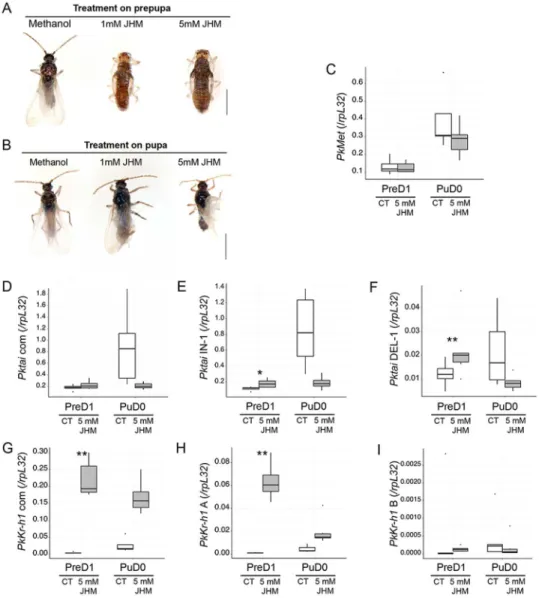
The treatment with the JHM (pyriproxyfen) during the prepupal stage resulted in a delay in adult molting. JHM-treated male prepupae molted to normal pupae after 3 days. However the following molt resulted in a second pupal stage (Pupa II) after 2 or 3 days and the latter never emerged as adults (Fig 3A,Table 1). Pupae II that were then kept with virgin females did not result in oviposition as opposed to the control treatment. JHM-treated male pupae resulted in variations of adults with different degrees of wing developmental defaults, whereas other fea-tures were developed normally (Fig 3B,Table 1). In this case, JH- and methanol-treated males that were subsequently kept with virgin females resulted in oviposition.
only (Fig 3G and 3H). In PuD0 treatments,PkKr-h1increased but not as markedly as for the prepupal stage, and not considered to be significant.
Pkbr3
is involved in JH signaling
While examining the transcriptome of the Japanese mealybug, three highly similar copies ofbr were identified (S6A Fig) and described asPkbr1,Pkbr2andPkbr3hereafter. 30RACE identi-fied different isoforms with and without a zinc-finger motif for each of the three copies (S6B–
S6D Fig). A phylogenetic tree constructed based on the protein sequence alignment of each zinc-finger isoform (Fig 4A) identified them as homologous to Z2 (Pkbr1Z2,Pkbr2Z2 and Fig 3. JHM pyriproxyfen effects on male development and JH signaling.A. Treatment during prepupa. B. Treatment during pupa. (C-I) Effects of JHM on gene expression. PreD1: Treatment 24-48 hours after the prepupal molt, RNA extraction 5 days after the treatment, N = 6. PuD0: Treatment 0-24 hours after the pupal molt, RNA extraction 6 days after the treatment, N = 5. Boxplots were constructed with the ggplot2 R package (with upper and lower hinges: 1st and 3rd quartiles, middle line: median, dots: outlier values). Unpaired two-sample Student’s t-test with*: p-value<0.05 and**: p-value<0.01. C.PkMet; D.Pktaicom; E.PktaiIN-1; F.
PktaiDEL-1; G.PkKr-h1; H.PkKr-h1A; I.PkKr-h1B.
Fig 4.brcopies and zinc-finger isoforms in the Japanese mealybug.A. Protein alignment of the zinc-finger motif for each identified isoform. B. Phylogeny of zinc-zinc-finger isoforms for different insect groups. See Supporting Information for the phylogenetic analysis method.
doi:10.1371/journal.pone.0149459.g004
Table 1. Effects of the pyriproxyfen (JHM) treatment on male metamorphosis inP. kraunhiae.
Hormonal treatment N Number of dead
individuals (%)
Pupa II Deformed adult Normal adult
Treated stage Compound Prepupa Pupa
Prepupa Methanol 40 9 (22.5) 1 (2.5) 0 (0) 0 (0) 30 (75)
1 mM JHM 27 4 (15) 0 (0) 23 (85) 0 (0) 0 (0)
5 mM JHM 31 7 (22.6) 2 (6.5) 22 (70.9) 0 (0) 0 (0)
Pupa Methanol 38 NA 9 (23.7) 0 (0) 0 (0) 29 (76.3)
1 mM JHM 23 NA 2 (8.7) 0 (0) 19 (82.6) 2 (8.7)
5 mM JHM 39 NA 4 (10.3) 0 (0) 29 (75.4) 5 (15.3)
NA: Non-applicable.
Pkbr3Z2), and Z4 (Pkbr1Z4-1,Pkbr1Z4-2 andPkbr2Z4) (Fig 4B). AlthoughP. kraunhiae genome is not available at this moment, thePkbrcopies we identified are likely to be recent paralogs and each of them encode for at least Z2 and Z4 isoforms.
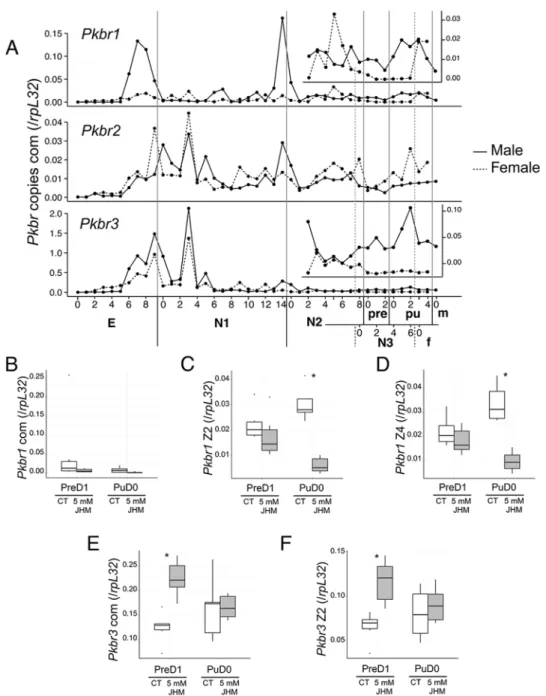
We examined the expression profiles of each of the zinc-finger isoforms, along with the common region of each copy. In males, the expression of thePkbr1common region (Pkbr1 com) peaked before hatching and at the molting event from N1 to N2, then remained at equiv-alent levels after N2. In the case of females, the levels ofPkbr1mRNA were consistently low (Fig 5A, top).Pkbr1Z2 and Z4 showed a similar pattern toPkbr1(S7A and S7B Fig).Pkbr2 com and its isoforms were expressed at significantly lower levels than the other copies and did not show any sex-specific patterns (Fig 5Amiddle,S7C and S7D Fig). The expression profile of Pkbr3mRNA presented the most similar pattern to that ofPkKr-h1, with the highest levels being observed during the embryonic stage and beginning of N1, and a divergence in expres-sion between males and females at the very end of N2. However,Pkbr3expression levels con-tinued to increase and peaked during the pupal stage (Fig 5Abottom). This pattern was similar to that ofPkbr3Z2 (S7E Fig).
A JHM treatment on PreD1 did not affect the expression ofPkbr1or its isoforms (Fig 5B), while this treatment performed on PuD0 induced a significant decrease inPkbr1Z2 andPkbr1 Z4 (Fig 5C and 5D; p<0.01 and 0.05 respectively,S2 Table).Pkbr3andPkbr3Z2 expression significantly increased with the prepupal treatments (p<0.01,S2 Table), whereas the increase observed for the pupal treatment was not significant (Fig 5E and 5F).Pkbr2and its isoforms were not affected by the JHM treatment (S8 Fig). Taken together, these results suggest that Pkbr3is the copy involved in the JH signaling pathway, and may be induced by the expression ofPkKr-h1.
Discussion
Scale insects exhibit two types of sex-specific metamorphoses, the investigation of which has implications in the understanding of: 1) the origin of complete metamorphosis with male qui-escent stages, and 2) the underlying mechanisms of pedogenesis in females. In the present study, we followed the development of each sex and assessed the expression of genes known to be involved in the insect JH signaling pathway.
We provide, for the first time, thePkjhamtexpression profile in scale insects, a gene that codes the enzyme acting in the last step of JH biosynthesis [36,39]. We favored indirect mea-surements of JH titers because, given the minute size of the early developmental stages, a daily direct measurement was challenging. PkJHAMT enzymatic activity still needs to be assessed. However, based on our expression results,Pkjhamttranscript levels are consistent with PkKr-h1. Moreover, a phylogenetic analysis of the protein confirmed PkJHAMT homology to other functional JHAMT in insects (S2 Fig).
Kr-h1, a transcription factor containing several C2H2-type zinc-fingers [41], is induced down-stream ofMetas an early-response gene of JH [24] and has been shown to be functionally essen-tial for the embryonic development ofDrosophila[42]. InDrosophila, three isoforms have been identified at the N-terminus and Kr-h1 a is responsible for metamorphosis [24,43]. Two isoforms Fig 5. Expression profiles and JHM effects onbr.A. Expression profiles ofPkbrcopies identified in the present study. E: Egg, N1: first-instar nymph, N2: second-instar nymphs, N3: female third-instar nymph, Pre: male prepupa, Pu: male pupa. Samples were collected using the sex-bias strategy from E to N2D3. B-F. Effects of JHM on gene expression. PreD1: Treatment 24-48 hours after the prepupal molt, RNA extraction 5 days after the treatment, N = 6. PuD0: treatment 0-24 hours after the pupal molt, RNA extraction 6 days after the treatment, N = 5. Boxplots were constructed with the ggplot2 R package (with upper and lower hinges: 1st and 3rd quartiles, middle line: median, dots: outlier values). Unpaired two-sample Student’s t-test with*: p-value<0.05 and**: p-value<0.01. B.Pkbr1com, C.Pkbr1Z2, D.Pkbr1Z4, E.Pkbr3com, F.Pkbr3Z2.
at the 50end have been identified inB. mori[44]. In thrips, three isoforms at the 50end were also identified, although they did not differ in the ORFs [27]. In the present study, we identified two isoforms,PkKr-h1A andPkKr-h1B, which differed by the deletion of 34 amino acids inPkKr-h1 B. However, the general expression pattern suggested thatPkKr-h1B is a minor isoform.
We also identified three presumably paralogous copies ofPkbr, withPkbr1andPkbr2 hav-ing at least isoforms, Z2 and Z4, withPkbr3possessing at least the Z2 isoform. Only one copy ofbrhas been identified in other insects so far to date. Given the high similarity between the isoforms of each copy, we suggest thatPkbr1, 2, and 3 are paralogs and that onlyPkbr3plays a role in JH signaling. InB. germanica, Z2 is the most abundant isoform [19], and this may explain why we easily identified this isoform for thebrgene three copies.
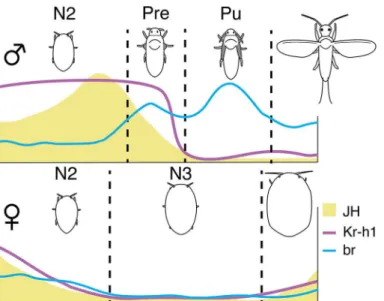
We generally found that JH-induced genes were expressed during 1) the embryonic stage and 2) towards the middle of N2 in males. The expression patterns ofPkKr-h1andPkbr3during the embryonic stage corroborates with previous findings on thrips (Kr-h1andbr[27]), true bugs (Kr-h1andbr[18]), andB. germanica(bronly [45]), in which the expression ofKr-h1and brare the highest during the second half of the embryonic stage, andPkbr3continues to be expressed at the onset of N1. Thereafter, although not as high as during the embryonic stage, the expression ofPkKr-h1starts to differ by its decrease in N2♀, while it increases in N2♂, and drops at the end of prepupa. This general expression pattern at least in males, is similar to that of thrips, an insect group basal to holometabolous insects and with a similar mode of metamor-phosis to male scale insects [27]. Based onPkjhamtand downstream gene expression levels, we suggest that sexual dimorphism in scale insects is established by a divergence in JH titers, at the middle of N2, resulting in opposite expression levels of the first response genes in JH signaling (Fig 6), which triggers different pathways in development towards the adult stage in males and females.
Male quiescent stages and wing development
The function of Br in wing development, more specifically wing size and shape, has been dem-onstrated in a few instances in hemimetabolous insects [19,26] and also in the basal
Fig 6. Summary of differential JH titers and early response gene patterns when phenotypic differences arise during post-embryonic development inP. kraunhiae.N2: Second-instar nymph, N3: female third-instar nymph, Pre: prepupa, Pu: pupa.
holometabolous red flour beetle [15,46,47], and this function also appears to be present in highly derived holometabolous insects such asDrosophila. Previous studies reported that a Drosophilamutant lackingbrarrested at the end of the larval stage [48,49], suggesting thatbr is a key specifier of pupal development [50].
In the present study, the expression pattern ofPkbr3was more similar to that ofPkKr-h1 than to the otherbrcopies, withPkbr3in males continuing to increase even afterPkKr-h1 lev-els decreased at the end of the prepupal stage. Applying JHM at the onset of the prepupal stage prolonged the expression ofPkKr-h1andPkbr3to the pupal stage and disrupting adult meta-morphosis, thereby reinforcing that JH plays a role in male quiescent stages throughPkKr-h1 andPkbr3in scale insects. However, functional studies using RNAi techniques will provide a better understanding of the role of eachPkbrcopy and isoform.
ThePkbr3expression pattern is more similar to that of the last instar and adult stages ofP. apterusthan thebrpattern of thrips, with levels decreasing in the same manner asKr-h1in the latter [18]. The phylogenetic affinity between true bugs (Heteroptera) and scale insects, both of which belonging to Hemiptera, may explain this similarity. More importantly, our results can imply and we hypothesize that thrip and male scale insect neometaboly, although phenotypi-cally similar, do not follow the same regulatory mechanisms, thereby corroborating with a con-vergent origin of this type of metamorphosis.
We found thatPkbr1expression peaked at the end of the embryonic stage and N1 in male-biased samples. Despite the high similarity of BTB protein sequences, the RNA transcripts lev-els differ from each other andPkbr1isoforms responded significantly and negatively to JHM only if treated during the pupal stage, suggesting a role in development that differs from the JH pathway. Further studies on the transcriptional regulation ofPkbrby ecdysone will provide deeper insights into the role ofPkbr1.
Female neoteny
The maintenance of juvenile features in adults, through neoteny, has evolved independently at least 6 times in insects [51]. Sexual dimorphism with sex-specific neoteny has also been reported in female Strepsiptera and a study on the expression ofbrisoforms suggested that the suppression of pupal determination (by the absence of the induction ofbrcom andbrZ3) con-tributed to female neoteny [52]. In scale insects, female pedogenetic development, character-ized by the lack of wings and other adult features found in males, is a key characteristic of this diverse group [28] with no later reversion, suggesting that this form of development in female scale insects is advantageous for plant parasitism and also that the mechanism underlying the retention of juvenile traits may be highly conserved. Although it is plausible to consider that more than one mechanism for the establishment of neotenic adult has arisen in scale insect evolution, fossil records [53] and current diversity [28] provide solid evidence that scale insect juvenile-like adult females only appeared once.Kr-h1levels in a wax scale insect were assessed at each developmental stage except for the embryos and highest levels were measured in FA3 (late female adult) when oocytes had already developed and were possibly already fertilized. PkKr-h1was the lowest during FS (female second-instar) [40].
showing thatE93is involved in female neoteny (Vea et al., in prep.) and more detailed func-tional studies on the transcription factor and related genes will provide a clearer understanding of how low levels ofPkKr-h1contribute to the pedomorphic development of female scale insects.
Supporting Information
S1 Text. Protocols for RT-PCR and RACE and R analyses. (PDF)
S1 Fig. Sex ratio variations inPlanococcus kraunhiaeduring oviposition.A. Photograph of fixed and DAPI-stained embryos at oviposition, top: male embryo as evidenced by the bright, condensed paternal genome, bottom: female embryo as evidenced by homogeneous nuclei. B. Percentage of male embryos on each oviposition day. Counts were made using DAPI-stained embryos collected every 24 hours from fertilized females (N = 5) and observed an Olympus BX41 Fluorescence microscope (x200).
(JPG)
S2 Fig. Phylogeny of JHAMT protein sequences obtained with MrBayes 3.2.5.GenBank accession numbers:Acyrthosiphon pisum: NP_001156251,Aedes aegypti: EAT42177,Apis mel-lifera: AGG79412,Bombyx mori: NP_001036901,Drosophila melanogaster: AAF53533, Naso-nia vitripennis: XP_001604463,Planococcus kraunhiae: LC055463,Samia ricini: ABE98256, Schistocerca gregaria: ADV17350,Tribolium castaneum: EFA02917. Regarding analysis meth-ods, see above.
(JPG)
S3 Fig. Structures and expression of Pktai isoforms.A. Protein structure of PkMet with bHLH, PAS and PAS B domains. B. Structure of PkTai with the identified isoforms. Grey: Open Reading Frame. C. Expression profiles ofPktaiIN-1 andPktaiDEL-1. D. Expression profiles ofPktai5A andPktai5B.
(JPG)
S4 Fig. Structure of PkKr-h1.A. Alignment of the zinc-finger region of Krüppel homolog 1 of different insect species. GenBank accession numbers: Bg (Blattella germanica): CCC55948, Bm (Bombyx mori): NP_001171332, Dm (Drosophila melanogaster): NP_477466, Fo (Frankliniella occidentalis): BAJ41257, Pa (Pyrrhocoris apterus): AEW22979, Pk (Planococcus kraunhiae): LC075597 and LC075598, Tc (Tribolium castaneum): NP_001129235. B. Structure ofPkKr-h1 cDNA. Grey: ORF. Scale bar: 200 bp. C. Amino acid alignment of the indel regions forPkKr-h1 A andPkKr-h1B.
(JPG)
S5 Fig. Expression profiles ofPkKr-h1isoforms during male and female development after oviposition.A.PkKr-h1A, B.PkKr-h1B. E: Egg, N1: 436 first-instar nymph, N2: second-instar nymphs, N3: female third-instar nymph, Pre: 437 male prepupa, Pu: male pupa, m: male adult, f: female adult. Samples were collected 438 from E to N2D3 using the sex-ratio bias strategy (see theMethodssection)
(JPG)
Bm (Bombyx mori): NP_001036976, Ap (Acyrthosiphon pisum): XP_008180579,Pkbr1: LC055465-LC055472,Pkbr2: LC055473-LC055475,Pkbr3: LC055476-LC055479. B. Structure ofPkbr1, C. Structure ofPkbr2, D. Structure ofPkbr3. Grey: ORF. Scale bar: 100 bp. NZ (non-zinc-finger) means an isoform lacking zinc-finger motifs. Arrows: primers designed for quanti-tative RT-PCR.
(JPG)
S7 Fig. Expression profiles of Pkbr isoforms identified for each of the threePkbrcopies.A. Pkbr1Z2. B.Pkbr1Z4. C.Pkbr2Z2. D.Pkbr2Z4. E.Pkbr3Z2.
(JPG)
S8 Fig. Effects of the pyriproxyfen treatment onPkbr2.A.Pkbr2common. B.Pkbr2Z2. C. Pkbr2Z4. PreD1: Treatment 24-48 hours after the prepupal molt, RNA extraction 5 days after the treatment, N = 6. PuD0: Treatment 0-24 hours after the pupal molt, RNA extraction 6 days after the treatment, N = 5. Boxplots constructed with the ggplot2 R package (with upper and lower hinges: 1st and 3rd quartiles, middle line: median, dots: outlier values).
(JPG)
S1 Table. List of primers designed for this study. (PDF)
S2 Table. Output of Student’s t-test (2-sample and unpaired) using R. (PDF)
Acknowledgments
We thank Jun Tabata for providing the Japanese mealybugs used in this study and Dr Mayumi Teshiba provided mealybug samples for the transcriptome data. We are grateful to Xavier Bellés for his comments on this study. I.M.V. is a Postdoctoral fellow funded by the Japan Soci-ety for the Promotion of Science and this work was supported by a Grant-in-aid for Scientific Research (15K07791) to C.M. from the Japan Society for the Promotion of Science.
Author Contributions
Conceived and designed the experiments: IMV CM. Performed the experiments: IMV CM ST TT TS. Analyzed the data: IMV AJ. Contributed reagents/materials/analysis tools: IMV TS TT CM. Wrote the paper: IMV CM.
References
1. Grimaldi D, Engel MS. Evolution of the Insects. 1st ed. New York: Cambridge University Press; 2005.
2. Truman JW, Riddiford LM. Endocrine insights into the evolution of metamorphosis in insects. Annu Rev Entomol. 2002; 47(1):467–500. doi:10.1146/annurev.ento.47.091201.145230PMID:11729082 3. Truman JW, Riddiford LM. The origins of insect metamorphosis. Nature. 1999; 401(6752):447–452.
doi:10.1038/46737PMID:10519548
4. Bellés X. Origin and evolution of insect metamorphosis. eLS; 2011.
5. Sehnal F, Svacha P, Zrzavý JZ. Evolution of insect metamorphosis. In: Metamorphosis postembryonic reprogramming of gene expression in amphibian and insect cells. San Diego, CA: Academic Press; 1996. p. 3–58.
6. Misof B, Liu S, Meusemann K, Peters RS, Donath A, Mayer C, et al. Phylogenomics resolves the timing and pattern of insect evolution. Science. 2014; 346(6210):763–767. doi:10.1126/science.1257570
PMID:25378627
8. Karlson P. On the hormonal control of insect metamorphosis. A historical review. Int J Dev Biol. 1996; 40(1):93–96. PMID:8735917
9. Nijhout HF. Insect hormones. Princeton University Press; 1998.
10. Riddiford LM. Cellular and molecular actions of juvenile hormone I. General considerations and preme-tamorphic actions. In: Advances in Insect Physiology. Academic Press; 1994. p. 213–274.
11. Jindra M, Palli SR, Riddiford LM. The juvenile hormone signaling pathway in insect development. Annu Rev Entomol. 2013; 58:181–204. doi:10.1146/annurev-ento-120811-153700PMID:22994547 12. Miura K, Oda M, Makita S, Chinzei Y. Characterization of theDrosophilaMethoprene-tolerant gene
product. Juvenile hormone binding and ligand-dependent gene regulation. FEBS J. 2005; 272 (5):1169–1178. doi:10.1111/j.1742-4658.2005.04552.xPMID:15720391
13. Charles JP, Iwema T, Epa VC, Takaki K, Rynes J, Jindra M. Ligand-binding properties of a juvenile hor-mone receptor, Methoprene-tolerant. Proc Natl Acad Sci USA. 2011; 108(52):21128–21133. doi:10. 1073/pnas.1116123109PMID:22167806
14. Konopova B, Jindra M. Juvenile hormone resistance geneMethoprene-tolerantcontrols entry into metamorphosis in the beetleTribolium castaneum. Proc Natl Acad Sci USA. 2007; 104(25):10488– 10493. doi:10.1073/pnas.0703719104PMID:17537916
15. Parthasarathy R, Tan A, Bai H, Palli SR. Transcription factor broad suppresses precocious develop-ment of adult structures during larval-pupal metamorphosis in the red flour beetle, Tribolium casta-neum. Mech Dev. 2008; 125(3-4):299–313. PMID:18083350
16. Zhang Z, Xu J, Sheng Z, Sui Y, Palli SR. Steroid receptor co-activator is required for juvenile hormone signal transduction through a bHLH-PAS transcription factor, methoprene tolerant. J Biol Chem. 2011; 286(10):8437–8447. doi:10.1074/jbc.M110.191684PMID:21190938
17. Li M, Mead EA, Zhu J. Heterodimer of two bHLH-PAS proteins mediates juvenile hormone-induced gene expression. Proc Natl Acad Sci USA. 2011; 108(2):638–643. doi:10.1073/pnas.1013914108
PMID:21187375
18. Konopova B, Smykal V, Jindra M. Common and distinct roles of juvenile hormone signaling genes in metamorphosis of holometabolous and hemimetabolous insects. PLoS ONE. 2011; 6(12):e28728. doi:
10.1371/journal.pone.0028728PMID:22174880
19. Huang JH, Lozano J, Bellés X. Broad-complex functions in postembryonic development of the cock-roachBlattella germanicashed new light on the evolution of insect metamorphosis. Biochim Biophys Acta. 2013; 1830(1):2178–2187. PMID:23041750
20. Lozano J, Kayukawa T, Shinoda T, Bellés X. A role for Taiman in insect metamorphosis. PLoS Genet. 2014; 10(10):e1004769. doi:10.1371/journal.pgen.1004769PMID:25356827
21. Lozano J, Bellés X. Role of Methoprene-tolerant (Met) in adult morphogenesis and in adult ecdysis of
Blattella germanica. PLoS ONE. 2014; 9(7):e103614. doi:10.1371/journal.pone.0103614PMID:
25072526
22. Lozano J, Bellés X. Conserved repressive function ofKrüppel homolog 1on insect metamorphosis in hemimetabolous and holometabolous species. Sci Rep. 2011; 1:163. doi:10.1038/srep00163PMID:
22355678
23. Minakuchi C, Namiki T, Shinoda T. Krüppel homolog 1, an early juvenile hormone-response gene downstream of Methoprene-tolerant, mediates its anti-metamorphic action in the red flour beetle Tribo-lium castaneum. Dev Biol. 2009; 325(2):341–350. PMID:19013451
24. Minakuchi C, Zhou X, Riddiford LM. Krüppel homolog 1 (Kr-h1) mediates juvenile hormone action dur-ing metamorphosis ofDrosophila melanogaster. Mech Dev. 2008; 125(1-2):91–105. PMID:18036785 25. Zhou B, Riddiford LM. Hormonal regulation and patterning of the broad-complex in the epidermis and
wing discs of the tobacco hornworm,Manduca sexta. Dev Biol. 2001; 231(1):125–137. PMID:
11180957
26. Erezyilmaz DF, Riddiford LM, Truman JW. The pupal specifier broad directs progressive morphogene-sis in a direct-developing insect. Proc Natl Acad Sci USA. 2006; 103(18):6925–6930. doi:10.1073/ pnas.0509983103PMID:16641104
27. Minakuchi C, Tanaka M, Miura K, Tanaka T. Developmental profile and hormonal regulation of the tran-scription factorsbroadandKrüppel homolog 1in hemimetabolous thrips. Insect Biochem Mol Biol. 2011; 41(2):125–134. PMID:21111817
28. Gullan PJ, Kosztarab M. Adaptations in scale insects. Annu Rev Entomol. 1997; 42(1):23–50. doi:10. 1146/annurev.ento.42.1.23PMID:15012306
30. Matsuda R. Animal evolution in changing environments with special reference to abnormal metamor-phosis. New York: John Wiley & Sons, Ltd; 1987.
31. Nur U. Evolution of unusual chromosome systems in scale insects (Coccoidea: Homoptera). In: Black-man RL, Hewitt GM, Ashburner A, editors. Insect Cytogenetics. Blackwell Scientific Publications; 1980. p. 97–117.
32. Schrader F. The chromosomes of Pseudococcus nipae. Biol Bull. 1921; 40(5):259. doi:10.2307/ 1536736
33. Bachtrog D, Mank JE, Peichel CL, Kirkpatrick M, Otto SP, Ashman TL, et al. Sex Determination: Why So Many Ways of Doing It? PLoS Biol. 2014; 12(7):e1001899. doi:10.1371/journal.pbio.1001899
PMID:24983465
34. Bongiorni S, Mazzuoli M, Masci S, Prantera G. Facultative heterochromatization in parahaploid male mealybugs: involvement of a heterochromatin-associated protein. Development. 2001; 128(19):3809– 3817. PMID:11585806
35. Ross L, Langenhof MBW, Pen I, Beukeboom LW, West SA, Shuker DM. Sex allocation in a species with paternal genome elimination: the roles of crowding and female age in the mealybugPlanococcus citri. Evol Ecol Res. 2010; 12(1):89.
36. Marchal E, Zhang J, Badisco L, Verlinden H, Hult EF, Van Wielendaele P, et al. Final steps in juvenile hormone biosynthesis in the desert locust,Schistocerca gregaria. Insect Biochem Mol Biol. 2011; 41 (4):219–227. PMID:21195178
37. Li W, Huang ZY, Liu F, Li Z, Yan L, Zhang S, et al. Molecular cloning and characterization of juvenile hormone acid methyltransferase in the honey bee,Apis mellifera, and its differential expression during caste differentiation. PLoS ONE. 2013; 8(7):e68544. doi:10.1371/journal.pone.0068544PMID:
23874662
38. Minakuchi C, Namiki T, Yoshiyama M, Shinoda T. RNAi-mediated knockdown of juvenile hormone acid O-methyltransferase gene causes precocious metamorphosis in the red flour beetleTribolium casta-neum. FEBS J. 2008; 275(11):2919–2931. doi:10.1111/j.1742-4658.2008.06428.xPMID:18435763 39. Shinoda T, Itoyama K. Juvenile hormone acid methyltransferase: a key regulatory enzyme for insect
metamorphosis. Proc Natl Acad Sci USA. 2003; 100(21):11986–11991. doi:10.1073/pnas. 2134232100PMID:14530389
40. Yang P, Chen XM, Liu WW, Feng Y, Sun T. Transcriptome analysis of sexually dimorphic Chinese white wax scale insects reveals key differences in developmental programs and transcription factor expression. Sci Rep. 2015; 5:8141. doi:10.1038/srep08141PMID:25634031
41. Schuh R, Aicher W, Gaul U, Côte S, Preiss A, Maier D. A conserved family of nuclear proteins contain-ing structural elements of the fcontain-inger protein encoded by Krüppel, aDrosophilasegmentation gene. Cell. 1986; 47(6):1025–1032. doi:10.1016/0092-8674(86)90817-2PMID:3096579
42. Beck Y, Pecasse F, Richards G. Krüppel-homolog is essential for the coordination of regulatory gene hierarchies in earlyDrosophiladevelopment. Dev Biol. 2004; 268(1):64–75. PMID:15031105 43. Pecasse F, Beck Y, Ruiz C, Richards G.Krüppel-homolog, a stage-specific modulator of the prepupal
ecdysone response, is essential forDrosophilaMetamorphosis. Dev Biol. 2000; 221(1):53–67. PMID:
10772791
44. Kayukawa T, Minakuchi C, Namiki T, Togawa T, Yoshiyama M, Kamimura M, et al. Transcriptional reg-ulation of juvenile hormone-mediated induction of Krüppel homolog 1, a repressor of insect metamor-phosis. Proc Natl Acad Sci USA. 2012; 109(29):11729–11734. doi:10.1073/pnas.1204951109PMID:
22753472
45. Piulachs MD, Pagone V, Bellés X. Key roles of the Broad-Complex gene in insect embryogenesis. Insect Biochem Mol Biol. 2010; 40(6):468–475. PMID:20403438
46. Suzuki Y, Truman JW, Riddiford LM. The role of Broad in the development ofTribolium castaneum: implications for the evolution of the holometabolous insect pupa. Development. 2008; 135(3):569–577. doi:10.1242/dev.015263PMID:18171684
47. Konopova B, Jindra M. Broad-Complex acts downstream of Met in juvenile hormone signaling to coor-dinate primitive holometabolan metamorphosis. Development. 2008; 135(3):559–568. doi:10.1242/ dev.016097PMID:18171683
48. Kiss I, Bencze G, Fodor G, Szabad J, Fristrom JW. Prepupal larval mosaics inDrosophila melanoga-ster. Nature. 1976; 262(5564):136–138. doi:10.1038/262136a0PMID:819843
49. Kiss I, Beaton AH, Tardiff J, Fristrom D, Fristrom JW. Interactions and developmental effects of muta-tions in the Broad-Complex ofDrosophila melanogaster. Genetics. 1988; 118(2):247–259. PMID:
50. Zhou X, Riddiford LM. Broad specifies pupal development and mediates the‘status quo’action of juve-nile hormone on the pupal-adult transformation inDrosophilaandManduca. Development. 2002; 129 (9):2259–2269. PMID:11959833
51. Hodin J, Riddiford LM. Parallel alterations in the timing of ovarian ecdysone receptor and ultraspiracle expression characterize the independent evolution of larval reproduction in two species of gall midges (Diptera: Cecidomyiidae). Dev Genes Evol. 2000; 210(7):358–372. doi:10.1007/s004270000079
PMID:11180842
52. Erezyilmaz DF, Hayward A, Huang Y, Paps J, Acs Z, Delgado JA, et al. Expression of the pupal deter-minantbroadduring metamorphic and neotenic development of the strepsipteranXenos vesparum
Rossi. PLOS ONE. 2014; 9(4):e93614. doi:10.1371/journal.pone.0093614PMID:24709670
53. Vea IM, Grimaldi DA. Diverse new scale insects (Hemiptera, Coccoidea) in amber from the Cretaceous and Eocene with a phylogenetic framework for fossil Coccoidea. Am Mus Novit. 2015; 3823(3823):1– 15. doi:10.1206/3823.1
54. Matsuda R. Morphology and evolution of the insect abdomen: with special reference to developmental patterns and their bearings upon systematics. Pergamon Press; 1976.
55. Bellés X, Santos CG. The MEKRE93 (Methoprene tolerant-Krüppel homolog 1-E93) pathway in the regulation of insect metamorphosis, and the homology of the pupal stage. Insect Biochem Mol Biol. 2014; 52:60–68. PMID:25008785