ACPD
8, 7509–7554, 2008Low altitude anthropogenic plume
processing
Real et al.
Title Page
Abstract Introduction
Conclusions References
Tables Figures
◭ ◮
◭ ◮
Back Close
Full Screen / Esc
Printer-friendly Version
Interactive Discussion
Atmos. Chem. Phys. Discuss., 8, 7509–7554, 2008 www.atmos-chem-phys-discuss.net/8/7509/2008/ © Author(s) 2008. This work is distributed under the Creative Commons Attribution 3.0 License.
Atmospheric Chemistry and Physics Discussions
Lagrangian analysis of low level
anthropogenic plume processing across
the North Atlantic
E. Real1,*, K. Law1, H. Schlager2, A. Roiger2, H. Huntrieser2, J. Methven3, M. Cain3, J. Holloway4, J. A. Neuman4, T. Ryerson5, F. Flocke6, J. de Gouw4, E. Atlas7, S. Donnelly8, and D. Parrish5
1
Service d’A ´eronomie, 3 `eme ´etage, Tour 45-46, 4 Place Jussieu, 75005 Paris, France
2
Deutsches Zentrum f ¨ur Luft- und Raumfahrt (DLR), Oberpfaffenhofen, Institut f ¨ur Physik der Atmosph ¨are, 82230 Wessling, Germany
3
Departement of Meteorology, University of Reading, PO Box 243, Earley Gate, Reading, RG6 6BB, UK
4
NOAA ESRL / CIRES, University of Colorado at Boulder, Boulder CO 80309, USA
5
NOAA ESRL, 325 Brodway, Boulder, CO 80305, USA
6
Atmospheric Chemistry Division, NCAR, 1850 Table Mesa Drive Boulder, CO 80305, USA
7
RSMAS/MAC University of Miami, Miami, FL 33149 USA
8
Departement of Chemistry, Fort Hays State University, Hays KS 67601, USA
*
now at: CEREA, a Joint Laboratory ENPC/EDF R&D, 6–8 avenue Blaise Pascal, Cit ´e Descartes Champs-sur-Marne, 77455 Marne la Vall ´ee, France
Received: 12 March 2008 – Accepted: 26 March 2008 – Published: 17 April 2008 Correspondence to: E. Real ([email protected])
ACPD
8, 7509–7554, 2008Low altitude anthropogenic plume
processing
Real et al.
Title Page
Abstract Introduction
Conclusions References
Tables Figures
◭ ◮
◭ ◮
Back Close
Full Screen / Esc
Printer-friendly Version
Interactive Discussion
Abstract
The photochemical evolution of an anthropogenic plume from the New-York/Boston region during its transport at low altitudes over the North Atlantic to the European west coast has been studied using a Lagrangian framework. This plume, originally strongly polluted, was sampled by research aircraft just offthe North American east coast on 5
3 successive days, and 3 days downwind offthe west coast of Ireland where another aircraft re-sampled a weakly polluted plume. Changes in trace gas concentrations during transport were reproduced using a photochemical trajectory model including deposition and mixing effects. Chemical and wet deposition processing dominated the evolution of all pollutants in the plume. The mean net O3 production was evaluated to 10
be -5 ppbv/day leading to low values of O3by the time the plume reached Europe. Wet deposition of nitric acid was responsible for an 80% reduction in this O3 production. If the plume had not encountered precipitation, it would have reached the Europe with O3levels up to 80-90 ppbv, and CO levels between 120 and 140 ppbv. Photochemical destruction also played a more important role than mixing in the evolution of plume CO 15
due to high levels of both O3and water vapour showing that CO cannot always be used as a tracer for polluted air masses, especially for plumes transported at low altitudes. The results also show that, in this case, an important increase in the O3/CO slope can be attributed to chemical destruction of CO and not to photochemical O3production as is often assumed.
20
1 Introduction
It is recognised that emissions from large urban/industrial regions can have large-scale impacts on levels of O3, particles, and other trace constituents downwind from conti-nents. These impacts are important because they may affect the ability of downwind countries to meet air quality standards, and because of the climate impacts of O3 25
ACPD
8, 7509–7554, 2008Low altitude anthropogenic plume
processing
Real et al.
Title Page
Abstract Introduction
Conclusions References
Tables Figures
◭ ◮
◭ ◮
Back Close
Full Screen / Esc
Printer-friendly Version
Interactive Discussion
boundary layer (BL) over continents. This pollution may then be transported at low lev-els directly impacting the BL of a downwind continent or may be exported from the BL into the mid and upper troposphere by frontal systems or convection and transported at higher altitudes (Li et al.,2005). Because of lower water vapour and temperature, loss processes are less active and pollutant lifetimes are longer in the upper troposphere. 5
However, high altitude plumes are less likely to directly impact the BL composition of a downwind continent. Several modelling studies have already shown that long-range transport of pollutants from North America to Europe is one of the most important due to large emissions and relative proximity of the two continents (Wild and Akimoto,2001;
Stohl,2001;Stohl et al.,2002). There is clear experimental and modelling evidence for 10
such export from North America at both low and high altitudes. Polluted plumes have been sampled at remote surface sites such as Sable Island or Chebogue Point (Parrish
et al.,1998;Millet et al.,2006), offthe New England coast, and also downwind in the Azores (Parrish et al.,1998;Owen et al.,2006) in the mid Atlantic Ocean. Analysis of these polluted plumes showed that they were usually transported at low altitudes, be-15
low 3 km. Modelling studies suggest that one third of CO exported from North America occurs in the lowest 3 km (Li et al.,2005) and Owen et al. (2006) suggested that low level transport of North American pollution above the marine BL may provide an ef-fective mechanism for long-range transport of anthropogenic pollution over the Atlantic ocean with a resulting impact on lower tropospheric O3in downwind regions.
20
Whilst there have been several measurements of polluted plumes with North Amer-ican origins in the free troposphere over Europe (e.g.Huntrieser et al., 2005), there have been fewer detailed cases at low levels and the impact of such long-range trans-port on O3 levels in the European BL is not well documented (Derwent et al.,1998). Ground-based sites on the west coast of Europe do occasionally observe such cases. 25
im-ACPD
8, 7509–7554, 2008Low altitude anthropogenic plume
processing
Real et al.
Title Page
Abstract Introduction
Conclusions References
Tables Figures
◭ ◮
◭ ◮
Back Close
Full Screen / Esc
Printer-friendly Version
Interactive Discussion
portant. Li et al. (2002) and Auvray and Bey(2005) estimated an increase of 2 to 4 parts per billion by volume (ppbv) in European O3concentrations during summer, which could be responsible for 20% of the violation of the European Union threshold for O3. These studies suggest that half of the import of North American O3in the BL is due to transport at low altitudes with the remainder due to subsidence of high altitude plumes. 5
Derwent et al.(2004) suggested a higher value of 8 ppbv increase in the European BL using an O3tracer technique in a semi-Lagrangian global model. During high pollution events, under conditions typified by a strong Icelandic Low located between Iceland and the British Isles, Auvray and Bey (2005) simulated an increase of European O3 due to North American pollution of more than than 10 ppbv. Several explanations have 10
been proposed for the difference between the non-negligible impact of North American pollution on Europeean O3simulated by models and the lack of experimental evidence.
Stohl et al.(2002) suggested that North American pollution reaches the European BL primarily south of the Pyrenees where measurement sites are sparse, and also that North American plumes are generally older then 10 days when reaching Europe, and 15
therefore, hard to accurately trace back to sources.
In this study we address these issues through the analysis of data collected in a pol-lution plume transported at low level over the North Atlantic as part of the International Consortium for Atmospheric Research on Transport and Transformation (ICARTT) (Fehsenfeld et al.,2006) also encompassing the European Intercontinental Transport 20
of Ozone and Precusors (ITOP) experiment, which took place in summer 2004. As part of this campaign, the International Transport and Chemical Transformation (ITCT)- La-grangian 2K4-experiment (an IGAC task) executed a LaLa-grangian study of polluted air masses transported across the North Atlantic. Four research aircraft based in North America, the Azores and western Europe sampled the same air masses several times 25
compar-ACPD
8, 7509–7554, 2008Low altitude anthropogenic plume
processing
Real et al.
Title Page
Abstract Introduction
Conclusions References
Tables Figures
◭ ◮
◭ ◮
Back Close
Full Screen / Esc
Printer-friendly Version
Interactive Discussion
ing two Lagrangian samplings, and the processes leading to these changes can be evaluated with reduced uncertainty. After the campaign a detailed analysis using tra-jectories, a Lagrangian dispersion model, and in-situ measurements was performed by
Methven et al.(2006), and showed that there were five cases where the same air mass had been sampled several time across the Atlantic.
5
The overall goal of this paper is to improve our understanding about low level long-range transport of anthropogenic plumes over the North Atlantic and their impact on O3 and precursors levels over Europe. In particular, we analyse the evolution of a North American plume observed during the Lagrangian 2K4 experiment which was originally very polluted, and then transported at low levels over the North Atlantic toward Europe. 10
The aim is also to determine the relative importance of processes influencing its chem-ical composition, and to explain why polluted North American plumes are not easily detected at surface measurement sites over Europe.
The Lagrangian plume in question originated from the New York-Boston conurbation and was sampled 3 times just offthe New England coast on 3 successive days by the 15
National Oceanic and Atmospheric Administration (NOAA) P3, and then, 2 days later offthe west coast of Ireland, and 3 days later over the English Channel by the Ger-man Deutsches Zentrum fur Luft- und Raumfahrt (DLR) Falcon. First, the Lagrangian matches identified byMethven et al.(2006) are discussed in Sect. 2together with the observed chemical evolution of pollutants during the plume transport. Cases where 20
the Lagrangian matching is less good due to the influence of other processes such as mixing with local emissions are also identified. Next, to evaluate the relative contribu-tions of chemical, physical and dynamical processes to changes in O3concentrations in the plume during transport, a photochemical trajectory model was used (Sect.3). In Sect.4, results are presented from model runs initialised with upwind data over New 25
ACPD
8, 7509–7554, 2008Low altitude anthropogenic plume
processing
Real et al.
Title Page
Abstract Introduction
Conclusions References
Tables Figures
◭ ◮
◭ ◮
Back Close
Full Screen / Esc
Printer-friendly Version
Interactive Discussion
close proximity to the plume (Sect.4.3). The ability of the model to simulate the contri-bution of photochemical processes to O3 changes in the plume was further tested by examining the evolution of trace gas correlations using multiple model runs initialised across the first plume sampling (Sect.4.4). Conclusions are presented in Sect.5.
2 Lagrangian case: measurements and analysis
5
2.1 Identification of Lagrangian matches
Methven et al.(2006) used a novel technique to identify Lagrangian matches between flight segments from different aircraft during the entire IGAC Lagrangian 2K4 campaign in July 2004. This technique combined trajectories, calculated using global meteoro-logical analysis (European Center for Medium Range Weather Forecast 40 year Re-10
analysis; ERA-40), and hydrocarbon fingerprint analysis. A match was defined as an occasion when a pair of whole air samples (analysed for their hydrocarbon content) collected during different flights exhibited highly correlated hydrocarbon fingerprints (when such measurements were available), and the sample time windows were also connected by both backward and forward trajectories. Results from the Lagrangian par-15
ticle dispersion model, FLEXPART, run with CO tracers (Stohl et al.,2004) were also used to confirm matches. Five clear Lagrangian cases covering a variety of situations were identified. Further details can be found inMethven et al.(2006).
In this paper, we build on the work of Real et al. (2007) which focused on the La-grangian analysis of the forest fire case, also discussed by Methven et al. (2006), 20
with the examination of the case of low level pollutant plume transport. An anthro-pogenic plume from New York-Boston was sampled first by the NOAA P3 over the Gulf of Maine and Nova Scotia on 3 successive days (20, 21, 22 July), and then by the DLR Falcon flying just offthe coast of Ireland on 25 July and over the English Channel on 26 July 2004. The flight tracks of these 5 flights are shown in Fig.1. The segments of 25
ACPD
8, 7509–7554, 2008Low altitude anthropogenic plume
processing
Real et al.
Title Page
Abstract Introduction
Conclusions References
Tables Figures
◭ ◮
◭ ◮
Back Close
Full Screen / Esc
Printer-friendly Version
Interactive Discussion
Methven et al.(2006). The same Lagrangian time windows are used in this study. The ability of theMethven et al. (2006) analysis to identify Lagrangian matches has been shown to work well in the free troposphere where transport is mainly driven by advec-tion (Real et al.,2007). However at low altitudes, certain meteorological features are not well resolved by analysed winds, and can induce errors in the Lagrangian analysis. 5
For example,Riddle et al.(2006) analysed the ability of trajectory models to represent air mass transport during the ICARTT campaign by using Lagrangian balloons. These balloons were launched close to the Lagrangian match of the NOAA-P3 aircraft on 20 July. On 21 July, the balloon location and aircraft Lagrangian match were very well co-located (less than 2 km apart) suggesting that the matching between these 2 sam-10
ples is good. However, this is not the case for 22 July. Important differences were found between balloon and model trajectories between 21 and 22 July over the Newfoundland coast, maybe due to poor simulation of strong coastal winds in the ECMWF analyses. Moreover, the hydrocarbon match on 22 July was the least consistent. Therefore, it ap-pears that Lagrangian match on 22 July is less good. The accuracy of the Lagrangian 15
samplings is discussed further in the next section where the observations in the plume segments are discussed.
The meteorological situation during plume transport has been examined using the Geodetic Earth Orbiting Satellite GOES-1 and METEOSAT satellite images superim-posed with surface pressure values (see Fig.3). On 19 July, a cold front passed over 20
the north-east coast of the United States (US). Behind this front, strong outflow took place below 3 km transporting air from the New York-Boston region on 20 July towards Newfoundland on 22 July. From the 22 to 25 July, strong winds established over the At-lantic Ocean between the Azores/Bermuda High and the Icelandic Low, particularly on 22 July, which transported the polluted plume to Europe. On 25 July the Icelandic Low 25
moved northward allowing the air masses to reach the Irish coast. This low level export from the North American east coast in conjunction with a cold front is a classical feature of North American summertime meteorology, and has been shown by, for example,Li
con-ACPD
8, 7509–7554, 2008Low altitude anthropogenic plume
processing
Real et al.
Title Page
Abstract Introduction
Conclusions References
Tables Figures
◭ ◮
◭ ◮
Back Close
Full Screen / Esc
Printer-friendly Version
Interactive Discussion
veyor belts associated with cold fronts lift pollution from the central and north-eastern US into the upper troposphere over Newfoundland, and strong north-eastward outflow takes places at low level behind the cold front. Li et al.(2005) evaluated the occur-rence of such events to be 5 to 7 per month in summer. The transport over the North Atlantic towards Europe is then dependent on the Azores High/Icelandic Low position 5
and strength. Guerova et al.(2006) reported that of the export events identified by Li
et al. (2005), 3 reached central Europe, with about half at low levels. Li et al.(2002) evaluated a higher frequency of low level North American plumes reaching Europe dur-ing summer 1994 to 1997. The plume studied here is a case of this kind of pollutant export.
10
2.2 Chemical composition of the Lagrangian matches
Detailed information about the instrumentation on board the aircraft can be found in
Fehsenfeld et al.(2006). Since measurements taken by the different aircraft will be used to infer the chemical evolution of the plume, it is important to compare these measurements. Several comparison flights were performed between the 4 aircrafts 15
involved in the campaign. Overall, the comparison indicated that O3 measurements agree within 2 ppbv and CO within 3 ppbv, for the aircraft used in this study. Compar-ison of hydrocarbons was more difficult but where possible, comparison showed good agreement. More details about the comparison flights can be found inMethven et al.
(2006) and Fehsenfeld et al.(2006). The general behaviour of the plume evolution is 20
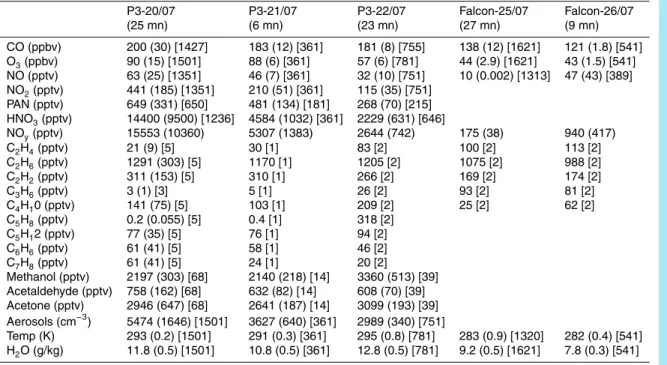
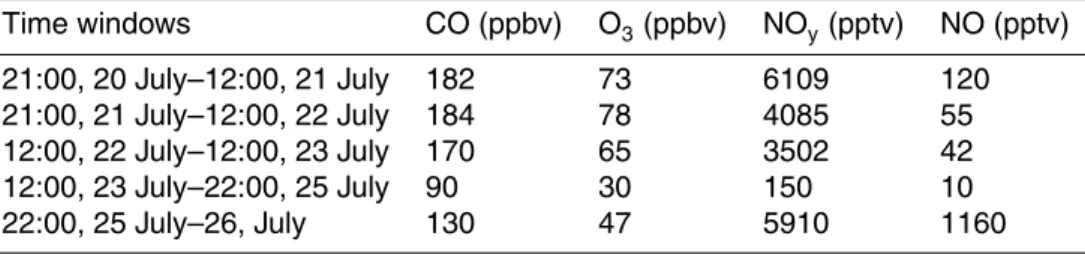
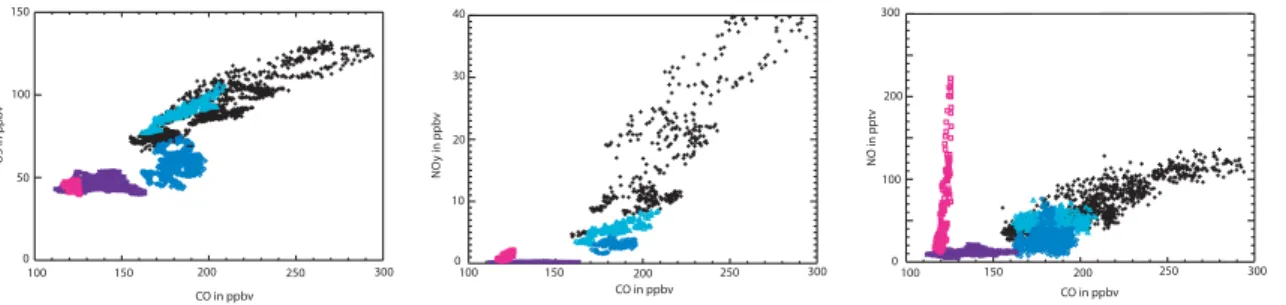
first examined in terms of observed trace gas mean values and correlations. Observed concentrations of O3, NO and NOy with respect to CO in the 5 Lagrangian matches are shown in Fig.2 with averaged values during the 5 match time windows reported in Table 1. Correlation coefficients, r, and slopes were also calculated and provide information about the dispersion of data around the correlation line, and therefore, the 25
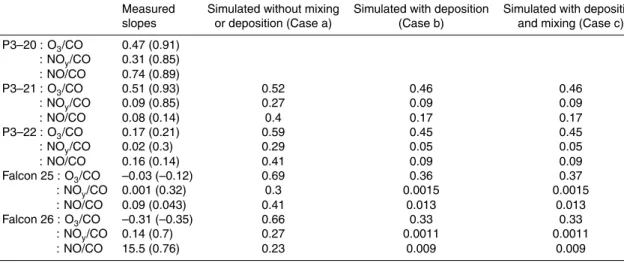
quality of the correlation. These results are given in Table4 and are also discussed later in Sect.4.4when they are compared to model simulations.
ACPD
8, 7509–7554, 2008Low altitude anthropogenic plume
processing
Real et al.
Title Page
Abstract Introduction
Conclusions References
Tables Figures
◭ ◮
◭ ◮
Back Close
Full Screen / Esc
Printer-friendly Version
Interactive Discussion
plume with high values of CO (200 ppbv) very well correlated (r=0.91) with high values of O3 (90 ppbv), NOx (500 pptv) and very high levels of NOy(15 550 pptv). Here, NOy was mainly in the form of HNO3representing approximately 92% of total NOy. One day later, CO, O3 and NOx levels slightly decreased, but remained elevated. HNO3 con-centrations showed the strongest decrease to only 32% of the initial value. O3and CO 5
were still highly correlated with a similar slope (0.51) whereas the slope between NO and CO decreased strongly even though the two species were still very well correlated (r=0.85). On 22 July, CO, NOx, PAN, HNO3 and O3 levels decreased and the species are not correlated anymore with value ofr between 0.14 and 0.3. Moreover, concen-trations of the main volatile organic compounds (VOCs) (C2H6, C2H4, C5H8, CH3OH, 10
acetone) increased and are higher than on the first Lagrangian sampling. This lack of correlation as well as the increase in VOCs could be explained by very strong and inhomogeneous mixing with another air mass, or as previously discussed this match appears to be incorrect due to large uncertainties in the calculation of trajectories on this day. Therefore, although comparisons between model results and data on 22 July 15
are shown, the uncertainty surronding this match should be kept in mind
The 3 North American interceptions (20, 21 and 22 July) were made close to remote surface sites in New England (Sable Island, Chebogue Point and Appledore Island). Polluted plumes from the New York-Boston region are often encountered in this region, as shown byChen et al.(2007) who estimated that these events occurred 15% of the 20
time during summer 2004. Comparison of measurements in the Lagrangian match and those analysed byParrish et al.(1998) at Sable Island and Chebogue Point between 1991–1994, shows that the mean O3 and CO values as well as the O3/CO measured slopes are in the upper range of the surface observations. The aircraft observations were collected above the surface and were probably subject to less dry deposition of 25
ACPD
8, 7509–7554, 2008Low altitude anthropogenic plume
processing
Real et al.
Title Page
Abstract Introduction
Conclusions References
Tables Figures
◭ ◮
◭ ◮
Back Close
Full Screen / Esc
Printer-friendly Version
Interactive Discussion
After the plume crossed the North Atlantic it was intercepted on 25 July by the DLR Falcon aircraft off the west coast of Ireland. Lower concentrations of pollutants were measured with mean concentrations of 138 ppbv CO, 44 ppbv O3, and 175 pptv NOy, which represents only 2% of the initial NOyvalue. Correlation between species are now very low including the O3/CO slope (–0.03). Mean values and slopes can be compared 5
with those measured in summer at Mace Head (53◦N, 10◦W), on the Irish west coast between 1994 to 1997 byLi et al. (2002). Indeed, using global model runs with and without North American sources,Li et al.(2002) estimated CO and O3levels in North American plumes reaching Mace Head. Mean values measured in the Lagrangian plume are typical of those evaluated byLi et al.(2002), but the O3/CO slope is much 10
less than the typical values of 0.2 to 0.4 reported by Li et al. (2002). Reasons for the discrepancies between these measured slopes are analysed further in Sect.4.4. Although these O3 value are much less than on the first sampling of the plume, they still represent an increase compared to background for the remote marine environment where the measurements were taken, i.e. 10 to 20 ppbv above average for O3 and 10 15
to 40 ppbv for CO.
According to Methven et al. (2006), the plume was intercepted a last time by the Falcon over the English Channel on 26 July with CO and O3 levels slightly lower than the previous day and a negative O3/CO slope. As for NO and NOy, measured levels strongly increased compared to the previous match and NO and NOylevels were even 20
higher than in the first match. This suggests that strong mixing with freshly polluted European air masses had taken place.
The evolution of the plume observed here seems fairly typical in terms of the reduc-tions in pollutant levels during transport across the Atlantic and the transport pathway by cold front advection over the US followed by rapid transport towards Europe. Further 25
ACPD
8, 7509–7554, 2008Low altitude anthropogenic plume
processing
Real et al.
Title Page
Abstract Introduction
Conclusions References
Tables Figures
◭ ◮
◭ ◮
Back Close
Full Screen / Esc
Printer-friendly Version
Interactive Discussion
3 Modelling
The Lagrangian photochemical model, CiTTyCAT (CambrIdge Tropospheric TrajectorY model of Chemistry And Transport) has been used to examine the different processes influencing the evolution of trace gases within the plume, and in particular, O3, CO and NOy. CiTTyCAT has been used previsously to examine the origin of polluted layers 5
over the North Atlantic during past campaigns (Wild et al.,1996;Evans et al.,2000). This model also successfully captured the trace gas evolution in the forest fire La-grangian plume transported over the North Atlantic during ICARTT (Real et al.,2007) and identified byMethven et al.(2006). The model is considered as an isolated air par-cel, and run along trajectories calculated using large-scale meteorological analyses. 10
Ninety chemical species are treated in the model including degradation of 14 hydro-carbons using chemical rate data from JPL (2003), and updates discussed in Arnold
et al. (2006). The photolysis scheme used in the runs presented here is based on a 2-stream multiple scattering scheme (Hough,1988).
3.1 Chemical initialisation 15
The model was first used to try to reproduce the average evolution of average con-centrations in the plume (Sects.4.1,4.2.1,4.3). The model was initialised with con-centrations measured in the plume on 20 July by the P3, and compared with average concentrations measured by the same aircraft on 21 and 22 July as well as by the Falcon on 25 and 26 July. These measured concentrations are indicated Table 1. 20
The only species for which the initial value has not be taken from measurements is methane, with a typical value of 1.8 ppmv. In order to characterise the variability in plume concentrations, 3 simulations were carried out: one with mean concentrations measured during the plume match segment, and 2 others using the mean concentra-tions + (–) standard deviation (std). Note that all species are well correlated in the 25
ACPD
8, 7509–7554, 2008Low altitude anthropogenic plume
processing
Real et al.
Title Page
Abstract Introduction
Conclusions References
Tables Figures
◭ ◮
◭ ◮
Back Close
Full Screen / Esc
Printer-friendly Version
Interactive Discussion
and their inter-relationships (correlations) analysed (Sect.4.4). 3.2 Trajectories
The model was run along a trajectory calculated with the FLEXTRA model (Stohl et al.,
1995) using ECMWF ERA-40 wind fields. Position, temperature and water vapour used in CiTTyCAT were interpolated from the FLEXTRA trajectory at every CiTTyCAT 5
time-step. All trajectories initialised in the P3 Lagrangian match on 20 July showed approximately the same transport, so the one initialised around 21:20 was chosen (see Fig.1). This trajectory passes closest to the P3 Lagrangian matches on 21 and 22 July, and the Falcon matches on 25 and 26 July.
3.3 Representation of physical phenomenon 10
Wet and dry deposition as well as mixing can be included in the model. Dry deposi-tion is simulated when the air parcel is in the BL using a velocity parameter which de-pends on surface type and on the height of the BL. The BL was defined climatologically from GEOS-1 meteorological data (Schubert et al.,1993). The original wet deposition scheme is a simple scheme using a lifetime for soluble species. More details about 15
the model can be found inWild et al.(1996) andEvans et al.(2000). The model was first run with only photochemical processes (Sect.4.1). in order to study the chemi-cal evolution of the plume in absence of other processes. Then, since the plume was transported at low altitudes, and sometimes in the BL, runs were made including dry deposition (Sect.4.2.1). GEOS METEOSAT satellite images (see Fig.3) indicate the 20
presence of clouds, on certain occasions in the same location as the plume, especially over the North American coast. Moreover, the strong decrease in HNO3 measured in the plume is likely to be the result of wet deposition since HNO3is highly soluble. For this reason, runs were also carried out including wet deposition. In addition, a new scheme was implemented based on precipitation rates from ECMWF (Sect. 4.2.2). 25
ACPD
8, 7509–7554, 2008Low altitude anthropogenic plume
processing
Real et al.
Title Page
Abstract Introduction
Conclusions References
Tables Figures
◭ ◮
◭ ◮
Back Close
Full Screen / Esc
Printer-friendly Version
Interactive Discussion
and 22 July from a number concentration of about 5.5×103cm−3 to 3.0×103cm−3,
which may also indicate that deposition was active, even if other mechanisms (i.e. dilu-tion, coagulation) can also explain this decrease. Heterogeneous reactions, were not included in the simulations discussed here. One of the main impacts of heterogeneous reactions is to through the conversion of NOxinto HNO3via the heterogeneous hydrol-5
ysis of N2O5 at night. This process may be important for NOx budget but the rate for conversion (γ) is highly variable and may depend, in particular on the sulfate aerosol loading (Brown et al.,2006). Brown et al.(2006) evaluated a not negligible value ofγ
in the Newfoundland region during ICARTT, but less important than westward. It will be seen in Sect.4.3that NOxlevels in the plume are underestimated in the simulation, 10
suggesting that the inclusion of heterogeneous N2O5 hydrolysis would not give better results in this case. Finally, mixing between the plume and surrounding air masses was also considered (Sect.4.3).
4 Results
4.1 Chemistry-only simulations 15
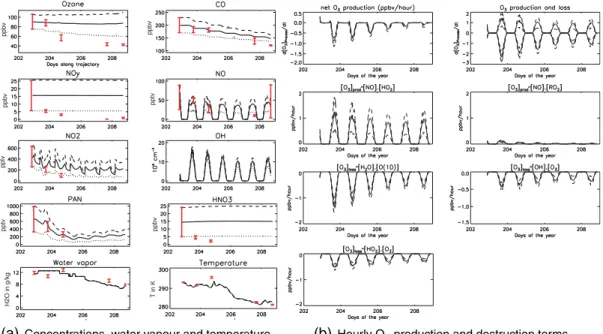
Simulated concentrations of CO, O3, NO, NO2, HNO3 and PAN for the model runs initialised with mean, mean+std and mean –std concentrations measured in the P3 Lagrangian match on 20 July are shown in Fig.4together with simulated O3production and destruction terms. Water vapour and temperature data interpolated along the trajectory from ECMWF analyses are also shown. These results include only changes 20
due to chemical processes in the model.
4.1.1 Simulated plume characteristics
ACPD
8, 7509–7554, 2008Low altitude anthropogenic plume
processing
Real et al.
Title Page
Abstract Introduction
Conclusions References
Tables Figures
◭ ◮
◭ ◮
Back Close
Full Screen / Esc
Printer-friendly Version
Interactive Discussion
maintained in the plume whereas PAN levels decrease rapidly due to high tempera-tures. Analysis of O3 production and destruction terms shows that O3destruction due to water vapour is important, but is almost balanced by the O3production. Sensitivity tests will help to understand the origin of this high O3production (see Sect.4.1.3). The second interesting feature is the high oxidising capacity of the plume. In these chem-5
istry only simulations, OH levels remain high during the entire run with mean values of 4×10⁶molecs. cm−3and peaks around 15×106molecs. cm−3around noon. This can
be mainly explained by high water vapour, due to the low altitude of the plume, and high levels of O3.
One of the main impacts of this high oxidising capacity is the strong photochemical 10
destruction of CO, which decreases by about 50 ppbv in 6 days. CO is often considered as a pollution tracer, not really affected by chemical loss over a period of 10 days or less and a strong decrease in CO levels is usually attributed to dilution and mixing. In this case, assuming no other loss processes, CO levels decreased by 25% solely as a result of chemical destruction. This would imply that for this plume, transported at low 15
altitudes, the CO chemical lifetime is about 20 days. This value can be compared with a value of 30 days for the global mean CO lifetime during summer.
4.1.2 Comparison of measured and simulated concentrations
The general evolution of measured PAN and CO values can be reproduced by chem-ical processing suggesting an important role for photochemistry in this case although 20
CO is still overestimated after 6 days and PAN data were only available from the P3. Measured NO and NO2values are generally overestimated by the mean simulations, and are more represented by the mean –std simulation. O3 values are overestimated by more than 40 ppbv after 5 days but the strongest difference is found between simu-lated and measured HNO3with average modelled concentrations 13 ppbv higher after 25
ACPD
8, 7509–7554, 2008Low altitude anthropogenic plume
processing
Real et al.
Title Page
Abstract Introduction
Conclusions References
Tables Figures
◭ ◮
◭ ◮
Back Close
Full Screen / Esc
Printer-friendly Version
Interactive Discussion
results discussed in the next sections. Concerning OH, simulated values are the same order of magnitude as those calculated byWarneke et al. (2004) using a box model initialised with measurements from a research ship along the New England coast, i.e. in the same region as the Lagrangian plume during the first 3 days, albeit at a lower alti-tude. However, the peak noon values simulated here are higher than those measured, 5
for example, in the Los Angeles basin byGeorge et al. (1999) (7×10⁶ molecs.cm−3),
and byEhhalt and Roher (2000) at a rural German site (12×106 molecs.cm−3).
Mea-sured JO1D and JNO2during the 3 first Lagrangian samplings are in good agreement with simulated values (not shown) but the model underestimates several VOCs: C2H2, C2H6, C4H10, C2H4 and C3H6 are underestimated by 70, 140, 20, 110 and 90 pptv 10
respectively on the 25 July. Concerning water vapour and temperature, the difference between measured values and those interpolated from ECMWF analyses along the trajectory is always less than 20% for water vapour and 4K for temperature. Therefore, in these runs which only take chemical processes into account, the overestimation in O3is leading to an overestimation in OH and therefore other processes are also playing 15
an important role as will be discussed in the following sections.
4.1.3 Sensitivity tests
In order to better understand photochemical processing in the plume and possible rea-sons for the differences between simulated and observed O3, two sensitivity tests were performed. Firstly, initial HNO3 concentrations were reduced to zero (S-noHNO3) in 20
order to study the role of HNO3in the net production of O3during transport. Secondly, a cloud with an optical depth of 5 (value of the mean cloud optical depth observed around the world byRossow and Schiffer,1991) was simulated just above the plume (S-CLOUD) in order to examine the maximum effect of a cloud layer on photolysis rates inside the plume. The S-CLOUD simulation is representative of a maximum 25
ACPD
8, 7509–7554, 2008Low altitude anthropogenic plume
processing
Real et al.
Title Page
Abstract Introduction
Conclusions References
Tables Figures
◭ ◮
◭ ◮
Back Close
Full Screen / Esc
Printer-friendly Version
Interactive Discussion
rates agree well with the measurements. The chosen optical depth is also relatively high for non-convective clouds. In both cases simulations were initialised with mean values measured in the plume. Results of these sensitivity tests are shown in Fig.5.
Results of the run S-noHNO3clearly show that the maintenance of high O3levels in the chemistry-only simulation is mainly due to HNO3 photolysis. Indeed after 6 days, 5
O3concentrations in the S-noHNO3simulation are lower than the reference simulation by about 35 ppbv, and the mean net O3 production has decreased by 70%. One of the consequences of this is a reduction in the oxidising capacity of the plume (OH is reduced by 30%) leading to slightly higher simulated CO concentrations. It shows that when initial HNO3concentrations are high, the quantity of HNO3available for photoly-10
sis becomes non-negligible, and, in the absence of loss processes, HNO3, which acts initially as a reservoir, then releases NO2during long-range transport. Neuman et al. (2006) also measured high HNO3 in several other plumes during the ICARTT cam-paign, some of them as far as 1000 km downwind from source regions and showed the importance of HNO3in the production of O3in plumes rich in HNO3. However, this 15
strong role played by HNO3assumes a weak influence of wet deposition.
Concerning the S-CLOUD simulation, the presence of cloud above the plume is responsible for a reduction in photolysis rates (–9% for NO2rate and –7% for O3rate) in these runs. Since there are compensating effects both O3production and destruction are reduced and so the presence of cloud does not modify O3 levels by much and 20
cannot explain the difference in between observed and simulated O3values. Because of the O3 photolysis reduction, the oxidising capacity of the plume is slightly reduced (by a few percent) and therefore CO destruction.
4.2 Chemistry and deposition simulations
4.2.1 Dry deposition 25
Results of model runs including photochemistry plus dry deposition are shown in Fig.6
ACPD
8, 7509–7554, 2008Low altitude anthropogenic plume
processing
Real et al.
Title Page
Abstract Introduction
Conclusions References
Tables Figures
◭ ◮
◭ ◮
Back Close
Full Screen / Esc
Printer-friendly Version
Interactive Discussion
i.e. about 15% of the time. The BL definition in the model is climatologically defined, and so, not specifically calculated for the days of the study. The modelled BL heights for the Lagrangian matches were checked by plotting vertical profiles of water vapour observed by the P3 aircraft around the Lagrangian matches. In the BL, air masses are mixed and the water vapour profile should be relatively homogeneous whereas outside 5
the BL it should exhibit strong vertical gradients. The profiles in Fig.7show that every time the aircraft was over ocean (profiles a) and part of profile b), the BL height was less than 0.4 km and so the plume was above it, whereas over land, it was between 1 and 1.5 km and the plume was in the BL. This corresponds well to the model simulation with no dry deposition simulated for the 2 first Lagrangian sampling (over sea) whereas dry 10
deposition is active on 22 July (over land). Inclusion of dry deposition in the simulations leads to decreases of 8 and 20% in O3 and HNO3, respectively. However, it is clear that dry deposition alone cannot explain the observed decrease in either HNO3or O3in this plume. For a plume travelling at lower altitude and spending more time in the BL, a much more important impact of dry deposition could be expected. The results are also 15
sensitive to the definition of the BL height and to positional errors in the trajectories as already discussed for 22 July in Sect.2.
4.2.2 Wet deposition
As noted already, satellite images and the strong decrease of HNO3levels in the plume suggest that wet deposition was active during the transport of this plume away from 20
source regions. In the basic model, wet deposition is parameterised using a local constant loss rate, r (s-1) (run S-WET1). In this study, two new schemes have also been implemented linking wet deposition to more realistic precipitation using column integrated precipitation rates, p (mm s−1) calculated from ECMWF. The first scheme (S-WET2) is based on Walton et al. (1988) who introduced a wet deposition coeffi -25
ACPD
8, 7509–7554, 2008Low altitude anthropogenic plume
processing
Real et al.
Title Page
Abstract Introduction
Conclusions References
Tables Figures
◭ ◮
◭ ◮
Back Close
Full Screen / Esc
Printer-friendly Version
Interactive Discussion
for the simulation of wet loss of a very soluble species,r=p/Lwere Lrepresents the quantity of condensed water integrated over the tropospheric column (mm).Wentz and
Spencer (1998) estimated a value ofLfrom a satellite study using 0.18×(1+(Hp)0.5),
whereH is the rain column depth, taken as equal to 3 km at mid latitudes. In this for-mulation there is no distinction between convective and stratiform precipitation. These 5
two formulations apply to very soluble gases like HNO3. To evaluater for other gases, results fromCrutzen and Lawrence(2000) have been used. They determined a factor
αspec that varies from 0 for insoluble gases to 1 for very soluble gases, and depends on the Henry’s Law coefficient (see Table2) in such way that the new local loss fre-quency, r∗=r×αspec is calculated. Note that none of these wet deposition schemes 10
make a distinction between precipitation within and below clouds. This information was not available from ECMWF analyses for this study.
Results from the runs including dry and wet deposition, WET1 (pink lines), S-WET2 (blue lines) and S-WET3 (green lines) are shown in Fig.6 together with pre-cipitation rates simulated by ECMWF along the trajectory. It can be noted that the 15
Lagrangian matches correspond with very low precipitation which is coherent with the fact that modelled photolysis rates agree well with measured values in runs with no clouds.
In order to compare the rate of decrease of HNO3, a parameterτ1/2 can be defined asτ1/2=log(2)×rmean1 wherermeanis the mean local loss frequency calculated along the 20
trajectory. This parameter is the half-life of a trace gas corresponding to an exponential decrease in its concentration. It is equal to 19, 15 and 6 h, respectively, for simulations dry+S-WET1, dry+S-WET2 and dry+S-WET3. The run dry+S-WET3 underestimates HNO3 concentrations by about 2.5 ppbv compared to the measurements on 21 July. Results from the dry+S-WET1 and dry+S-WET2 simulations compare better with the 25
data even if HNO3 is underestimated in the dry+S-WET2 run by about 1.5 ppbv on 21 July, and overestimated in the dry+S-WET1 run by the same order of magnitude.
ACPD
8, 7509–7554, 2008Low altitude anthropogenic plume
processing
Real et al.
Title Page
Abstract Introduction
Conclusions References
Tables Figures
◭ ◮
◭ ◮
Back Close
Full Screen / Esc
Printer-friendly Version
Interactive Discussion
in the following sections, results using wet deposition scheme, S-WET2, have been used because it gives better agreement with HNO3measurements than S-WET3, and is more physically realistic that S-WET1. Since NOy is mainly made up of HNO3, the half-life of HNO3 with the S-WET2 scheme can be compared with the one estimated byStohl et al.(2002) for NOy during the 1997 NARE campaign also offthe north-east 5
coast of North America. In that studyτ1/2was estimated to be around 40 h, a factor of 2 slower than in the case studied here. This can be partly explained by the fact that air masses selected byStohl et al. (2002) were rapidly exported out of the BL by frontal warm conveyor belts, and so only subject to wet deposition. The plume studied here stayed in the BL during the first few days, and was therefore influenced by both wet 10
and dry deposition.
Overall results from the chemistry and dry/wet deposition are closer to the measure-ments than the chemistry only run. The impact of wet deposition is also important for other species apart from HNO3. Modelled NOxis now almost equal to zero after 6 days due to the loss of HNO3. This has an impact on O3production rates which decrease by 15
60 % due to the wet removal of HNO3. This leads to better agreement with the obser-vations, although O3is still overestimated slightly and NO slightly underestimated. OH is reduced by 27% when wet deposition is included leading to a slight increase in CO lifetime from 20 to 23 days. CO is still overestimated compared to the data suggesting that dilution and mixing were also important.
20
4.3 Role of mixing
4.3.1 Mixing parametrisation
In the previous simulations the plume was considered isolated from the background. In the real atmosphere, a plume is subject to stirring by large-scale winds followed by mixing by processes such as turbulence. This mixing process entrains surrounding air 25
ACPD
8, 7509–7554, 2008Low altitude anthropogenic plume
processing
Real et al.
Title Page
Abstract Introduction
Conclusions References
Tables Figures
◭ ◮
◭ ◮
Back Close
Full Screen / Esc
Printer-friendly Version
Interactive Discussion
decay of plume concentrations toward background concentrations with a typical time scale, τ-mix. Because of the Lagrangian aspect of this work, measurements made in the vicinity of the plume during the 5 match segments can be used to estimate background concentrations. This method has already been applied successfully to the Lagrangian forest fire plume case sampled during ICARTT (Real et al., 2007). 5
The values used here are summarised in Table 3. During the first 3 days, the so-called background concentrations were typical of polluted air masses. Indeed, pollutant concentrations measured by the P3 on 20, 21 and 22 July between the ground and 2 km were always elevated over the Gulf of Maine and Nova Scotia. Between 22 and 25 July, the plume left the North American east coast, and travelled over the ocean. It can be 10
considered that after leaving the coast, the plume was no longer surrounded by polluted air masses but by marine air masses. For this reason, air masses typical of marine air, measured in proximity to the plume on 25 July, were used to characterise background air masses during this transport. Finally, high levels of NO (up to 1.5 ppbv) and NOy (up to 6 ppbv) were measured on 26 July just after the sampling of the plume and so, 15
higher levels of trace gases were used to define background values. These NOy rich air masses were relatively poor in CO and O3but rich in NO suggesting that they could be due to local ship emissions in the English Channel (Corbett and Koehler, 2003). However, back trajectories also show transport from southern England suggesting a possible urban source.
20
With regard to determination of τ-mix, changes in CO concentration are often used since CO evolution is usually associated with strong dilution of polluted plumes (e.g. seeReal et al.,2007). However, in this case, the decrease in CO is strongly in-fluenced by photochemical processes, and so, is not a very good indicator of mixing.
Arnold et al.(2006) evaluated aτof 10 days with a method based on hydrocarbon ra-25
mea-ACPD
8, 7509–7554, 2008Low altitude anthropogenic plume
processing
Real et al.
Title Page
Abstract Introduction
Conclusions References
Tables Figures
◭ ◮
◭ ◮
Back Close
Full Screen / Esc
Printer-friendly Version
Interactive Discussion
sured on the 26 July in the vicinity of the plume are very close to the value in the plume itself. On this day, the plume was not easily distinguishable from the background based on CO or O3measurements alone. The mixing time-scale of 10 days, used during the first 5 days, implies slightly weaker mixing rates compared to previous studies (Real
et al.,2007;Price et al.,2004). This could be related to the plume remaining relatively 5
intact during transport due to strongly converging low level winds, and the fact that the plume was decoupled from the marine BL during transport making mixing and dilution less important in this case. However, the impact of the chosen value for the mixing rate is strongly dependent on the background mixing values used. For example, applying a stronger mixing rate during the first 3 days would not change results by much as the 10
chosen background values are similar to those in the plume. The chosen mixing rates are therefore linked to a particular definition of the geographical limits of the plume, and should not therefore be taken as representative values for the lower atmosphere.
4.3.2 Results: chemistry, deposition and mixing
Model results including chemistry, deposition and mixing processes are shown in Fig.8. 15
During the first 5 days, mixing does not change concentrations very much, mainly be-cause of the low mixing rates used, and the fact that background concentrations used during the first 3 days are not much different from those in the plume. Overall, there is now good general agreement between the model simulations and the measurements for the entire period except for 22 July, which supports the hypothesis that this day is 20
not a truely Lagrangian match. The agreement on the 21 is generally good although NO which is still slightly underestimated. There is good agreement with CO and O3 data on 25 July, with further decreases of 13 and 6 ppbv, respectively, but NO is still underestimated. However, as the measured NO value is so low that it is close to the detection limit of the instrument it is hard to come to any conclusion on the overesti-25
ACPD
8, 7509–7554, 2008Low altitude anthropogenic plume
processing
Real et al.
Title Page
Abstract Introduction
Conclusions References
Tables Figures
◭ ◮
◭ ◮
Back Close
Full Screen / Esc
Printer-friendly Version
Interactive Discussion
correlations.
Concerning the modelled OH values, the runs including deposition and mixing lead to a reduction in OH of 25% with a mean values of 3×10⁶molecs. cm−3over the period
from the 21 to 25 July, with peak noon values around 14×106 molecs. cm−3. These
values are still slightly higher than measurements fromGeorge et al.(1999) in recent 5
polluted plumes but in better agreements with the ones of Ehhalt and Roher(2000). Moreover, since theJ-values and O3data agree well we can have some confidence in OH results.
It is also interesting to re-examine the comparison with measured VOCs. Whereas all VOCs measured on 25 July were underestimated in the run with chemistry only, the 10
model results including deposition and mixing for the long lived VOCs are now in better agreement with the data mainly because of the decrease in modelled OH. For exam-ple, on 25 July, the comparisons are 1076 pptv, 159 pptv and 22 pptv for modelled C2H6, C2H2and C4H10 against measured values of 1075 pptv, 169 pptv and 25 pptv, respec-tively. On the other hand, modelled values of C2H4 and C3H6 with shorter lifetimes 15
of 2 and 0.8 days are almost zero when measurements show values around 100 pptv for this two species. It is possible that the plume was influenced by local oceanic or biogenic emissions of these species off the coast of Ireland. Such air masses with elevated emission of alkenes and low CO and O3values were measured in proximity to the Lagrangian plume by the Falcon.
20
Further light is shed on this in the next section comparing modelled and measured trace gas correlations (see Sect. 4.4).
4.3.3 Influence of the different processes on pollutant levels in the plume
By analysing simulated O3production and destruction terms, the influence of chemical, deposition and mixing processes on O3 can be evaluated. In the runs including all 25
ACPD
8, 7509–7554, 2008Low altitude anthropogenic plume
processing
Real et al.
Title Page
Abstract Introduction
Conclusions References
Tables Figures
◭ ◮
◭ ◮
Back Close
Full Screen / Esc
Printer-friendly Version
Interactive Discussion
gives a mean net O3production of –5 ppbv/day. The remaining 25% is due to direct O3 dry deposition (10%) and mixing (15%). Without both wet and dry deposition the net O3production is only –1.1 ppbv/day. This is mainly due to HNO3photolysis providing a source of NOx as discussed previously. Thus, these model results show that indirectly deposition processes were responsible for 80% of the impact of photochemistry on O3, 5
with the large majority (78%) being due to wet deposition rather than dry deposition. Modelled CO decreases by 60 ppbv which is in good agreement with the observed evolution in the plume. Analysis of model results shows that 66% is due to chemical destruction and 34% due to mixing and dilution of the plume. Therefore, in this case, photochemical processes governed the evolution of both O3 and CO in the plume. 10
Whilst this has been shown previously to be the case for O3, this is the first time, to our knowledge, that photochemistry has been shown to be the dominant process governing CO evolution over a period of several days. If the plume had not been subject to deposition processes, it would have reached Europe with much higher levels of O3 (80–90 ppbv), and lower levels of CO (120–140 ppbv). It can be envisaged, that plumes 15
originating from North America with slightly lower CO values, would reach Europe with even lower CO values due to strong OH oxidation, and thus may not be detected using the methods often applied to diagnose pollutant plumes such as application of CO thresholds. This point is discussed further in the next section.
4.4 Correlation study 20
Comparison of the full range of observed and simulated concentrations in the La-grangian match samplings, and their interelationships can provide useful additional information about the evolution of pollutant concentrations in a plume, than just com-parison of means±std. Observed correlations in the Lagrangian matches have already
been discussed in Sect.2. In this section, multiple runs are used in order to charac-25
ACPD
8, 7509–7554, 2008Low altitude anthropogenic plume
processing
Real et al.
Title Page
Abstract Introduction
Conclusions References
Tables Figures
◭ ◮
◭ ◮
Back Close
Full Screen / Esc
Printer-friendly Version
Interactive Discussion
2007).
The multiple model runs were initialised with P3 measurements averaged every 30s during 20 July Lagrangian match samplings. With this method, each run represents a different part of the initial correlation (black crosses in Fig. 9) observed by the P3. Model results after 1 (green triangles), 2 (blue diamonds), 4 (pink squares) and 5 (vi-5
olet stars) days are shown in Fig.9for 3 cases: chemistry-only simulations (case A), simulations with chemistry and wet plus dry deposition (case B), and simulations with chemistry, deposition and mixing (case C). O3/CO and NOy/CO correlations are shown for each case, and NO/CO correlations are shown for case C. The simulated slopes for the different cases are reported in Table4.
10
It has already been seen in Sect. 4.1 that the chemistry-only runs were unable to reproduce the chemical evolution of the plume but, nevertheless, it is still interesting to examine the evolution of the slopes in the case without deposition or mixing. The O3/CO and NOy/CO simulated in case A are very different from those observed. The slopes increase with time whereas the data show an overall decrease. The modelled 15
increase is not due to an increase in NOy or O3 that remains nearly constant, but is due to the strong chemical destruction of CO in these runs. Therefore, in the run with chemistry only, an increase in the O3/CO slope is the result of a decrease in CO, and not the result of photochemical O3 production as it is often stated (Andreae et al.,1994;Mauzerall et al.,1998). Along the same lines,Chin et al. (1994) showed 20
that a decrease in O3/CO slope could be due to the secondary production of CO by hydrocarbon oxidation in a fresh plume, and not only due to chemical destruction or deposition of O3. When deposition processes are included (case B), NOy/CO slopes show very good agreement with those observed on 21 and 25 July but not on 26 July. Modelled O3/CO slopes now decrease but less than observed on the 25 July. Because 25
ACPD
8, 7509–7554, 2008Low altitude anthropogenic plume
processing
Real et al.
Title Page
Abstract Introduction
Conclusions References
Tables Figures
◭ ◮
◭ ◮
Back Close
Full Screen / Esc
Printer-friendly Version
Interactive Discussion
data in this correlation space although there are still some differences. The bad match between measurements and simulations on the 22 July has already been identified using mean concentrations analysis (Sect.4.1) and is not discussed further.
Interestingly, this approach shows differences for the 25 July in measured and mod-elled O3/CO slopes (–0.03 and 0.36, respectively) that were not apparent in the sim-5
ulations using mean concentrations which agree well with the mean data. Further analysis based on the correlations suggests that the measurements in this Lagrangian match can be divided into 2 different parts, from 15:54 to 16:06 and 16:06 to 16:21, and 2 different air masses may have in fact been sampled. This distinction is shown in Fig.10 based on the observed O3/CO correlation. For the first segment, CO and 10
O3are not really correlated, with a slope of 0.02 whereas for the second segment, the slope is positive with a value of 0.28, and a correlation coefficient of 0.75. This slope is comparable to measured values at ground-based sites such as Mace Head (Li et al.,
2002). It is also closer to the simulated slope (0.36) whereas the weak slope in the first segment is not reproduced by the model runs initialised with measurements on 15
20 July. Therefore, it seems that the second segment represents the best match with the plume from 20 July whereas the first segment appears to have been influenced by inhomogeneous mixing in the edges of the plume, possibly with marine air masses, not reproduced by the model.
The last important difference is observed between modelled and measured NO/CO 20
and NOy/CO slopes between the 25 and 26 July. The data slopes are particularly strong on the 26 July, especially compared to the 25 July. In this case the Lagrangian plume appears to have been strongly dispersed when it reached Europe on the 26 July and “background” concentrations also included fresh emissions with very high levels of NO and NOy, as noted previously. The model does not capture this variability since the 25
ACPD
8, 7509–7554, 2008Low altitude anthropogenic plume
processing
Real et al.
Title Page
Abstract Introduction
Conclusions References
Tables Figures
◭ ◮
◭ ◮
Back Close
Full Screen / Esc
Printer-friendly Version
Interactive Discussion
5 Conclusions
The case of an anthropogenic plume transported from North America (New York-Boston region) over the North Atlantic to Europe at low altitudes has been studied in a Lagrangian framework. This plume was initially strongly polluted with high con-centrations of O3, CO and NOx, typical of North American polluted plumes, and also 5
very high levels of HNO3. During transport, all pollutant concentrations decreased, and the plume was much less polluted when it was intercepted off the west coast of Ireland several days later. A Lagrangian photochemical model (CiTTyCAT), has been used to assess the different processes influencing the evolution of pollutant levels in the plume during this long-range transport. Average concentrations and correlations 10
between trace species (O3/CO and NOy/CO) were examined, and compared to data collected in the Lagrangian match segments. Overall, the analysis shows that some of the links identified as Lagrangian byMethven et al.(2006) are not truly Lagrangian, in particular for 22 July because of probable errors in ECMWF coastal winds and 26 July due to the influence of local emissions. In addition the correlation analysis showed that 15
part of the match on 25 July also appears not to be well linked to 20 July.
The evolution of the chemical composition in the plume (mean values and correla-tions lines) is best reproduced when photochemistry, dry/wet deposition and mixing with surrounding air masses are all included. Model results show that these changes were mainly driven by photochemical and deposition processes, especially wet de-20
position. Mixing with air masses in close proximity to the plume during transport did not have a strong impact on trace gas concentrations during the first 5 days due to strong and rapid transport by low level winds and isolation of the plume from the ma-rine boundary layer over the Atlantic. Mixing with local pollution sources (from ships or London connurbation) appears to have been important on the 26 July.
25
ACPD
8, 7509–7554, 2008Low altitude anthropogenic plume
processing
Real et al.
Title Page
Abstract Introduction
Conclusions References
Tables Figures
◭ ◮
◭ ◮
Back Close
Full Screen / Esc
Printer-friendly Version
Interactive Discussion
compare to the remote oceanic region where the plume was sampled. Plume O3was directly impacted by dry deposition, and indirectly by wet deposition through the strong scavenging of HNO3. For the plume studied here, this implies that wet deposition was responsible for an 80% reduction in net O3 production. This study and the one from
Neuman et al. (2006) show that because polluted plumes from the New-York/Boston 5
region were very rich in HNO3, wet deposition can have a strong impact on O3levels. Runs with no wet deposition, showed that HNO3photolysis can maintain high O3levels during plume transport leading to much lower mean net loss (–1 ppbv/day). In that case, the plume would have reached Europe with much higher O3levels (between 80 and 90 ppbv) resulting in a strong import of O3directly in the European BL.
10
Another important result is the important influence of photochemistry on CO levels in the plume rather than mixing which is usually assumed to be the most important process over this time scale. In this case, photochemical destruction explains 66% of the CO decrease compared to only 34% for mixing. This is due to relatively high O3 levels coupled with high water vapour levels leading to a high oxidising capacity in the 15
plume, and therefore a reduction of CO chemical lifetime to 23 days. This has several consequences. Firstly, this means that CO cannot be always used as a tracer of North American pollution when the plume transport is at low altitudes. This may also explain the low levels of CO often observed in the European BL in plumes originating from North America. The latter does not imply that the plume was weakly polluted but that 20
photochemistry was intense. Secondly, we have shown that an observed increase in the O3/CO correlation slope can result from CO chemical oxidation (destruction), and not photochemical production of O3as is often assumed.
Overall, these results show that O3import into downwind regions can be very sen-sitive to scavenging processes along route as well as photochemical processing and 25
eval-ACPD
8, 7509–7554, 2008Low altitude anthropogenic plume
processing
Real et al.
Title Page
Abstract Introduction
Conclusions References
Tables Figures
◭ ◮
◭ ◮
Back Close
Full Screen / Esc
Printer-friendly Version
Interactive Discussion
uated plume transport and processing in global models that typically have problems resolving such features.
Acknowledgements. E. Real and K. Law acknowledge financial support from national pro-grammes (PNCA, PATOM) provided by INSU, ADEME and also from Insitut Pierre Simon Laplace (IPSL) for the French ITOP project as well as the Institut Geographique National (IGN)
5
for hosting the DLR Falcon campaign at Creil, France. We would like to thank the whole ICARTT team, and in particular P3 scientists.
References
Andreae, M. O., Anderson, B. E., Blake, D. R., Bradshaw, J. D., Collins, J. E., Gregory, G. L., Sachse, G. W., and Shipham, M. C.: Influence of plumes from biomass burning on
atmo-10
spheric chemistry over the equatorial and tropical South Atlantic during CITE3, J. Geophys. Res., 99, 12,793–12,808, 1994. 7532
Arnold, S. R., Methven, J., Evans, M. J., Chipperfield, M. P., Lewis, A. C., Hopkins, J., McQuaid, J. B., Watson, N., Purvis, R. M., Lee, J. D., Atlas, E. L., Blake, D. R., and Rappenglck, B.: Quantification of mean OH concentration and air mass dilution rates from successive
15
observations of non-methane hydrocarbons in single air masses, J. Geophys. Res., 112, D10S40, doi:10.1029/2006JD007594, 2006.7519,7528
Auvray, M. and Bey, I.: Long-range transport to Europe: Seasonal variations and implications for the European ozone budget, J. Geophys. Res., 110, D11 303, doi:10.1029/2004JD005503, 2005. 7512
20
Brown, S. S., Ryerson, T. B., Wollny, A. G., Brock, C. A., Peltier, R., Sullivan, A. P., Weber, R. J., Dub, W. P., Trainer, M., Meagher, J. F., Fehsenfeld, F. C., and Ravishankara, A. R.: Variability in nocturnal nitrogen oxide processing and its role in regional air quality, Science, 311, 67–70, 2006. 7521
Chen, M., Talbot, R., Mao, H., Sive, B., Chen, J., and Griffin, R. J.: Air mass classification in
25
coastal New England and its relationship to meteorological conditions., J. Geophys. Res., 112, D10S05, doi:10.1029/2006JD007687, 2007. 7517
ACPD
8, 7509–7554, 2008Low altitude anthropogenic plume
processing
Real et al.
Title Page
Abstract Introduction
Conclusions References
Tables Figures
◭ ◮
◭ ◮
Back Close
Full Screen / Esc
Printer-friendly Version
Interactive Discussion Corbett, J. J. and Koehler, H. W.: Updated emissions from ocean shipping., J. Geophys. Res.,
108, 4650, 2003. 7528
Crutzen, P. J. and Lawrence, M. G.: The impact of precipitation scavenging on the transport of trace gases: A 3-dimensional model sensitivity study, J. Atmos. Chem., 37, 81–112, 2000.
7526 5
Derwent, R. G., Richard, G., Jenkin, M. E., Saunders, S. M., and Pilling, M. J.: Photochemi-cal ozone creation potentials for organic compounds in northwest Europe Photochemi-calculated with a master chemical mechanism., Atmos. Environ., 32, 2429–2441, 1998. 7511
Derwent, R. G., Ollins, D. S. S. W. J., and Johnson, E.: Intercontinental transport and the origins of the ozone observed at surface sites in Europe., Atmos. Environ., 38, 1891–1901, 2004.
10
7512
Ehhalt, D. and Roher, F.: Dependence of the OH concentration on solar UV., J. Geophys. Res., 105, 3565–3571, 2000.7523,7530
Evans, M. J., Shallcross, D. E., Law, K. S., Wild, J. O. F., Simmonds, P. G., Spain, T. G., Berrisford, P., Methven, J., Lewis, A. C., McQuaid, J. B., Pillinge, M. J., Bandyf, B. J., Penkett,
15
S. A., and Pyle, J. A.: Evaluation of a Lagrangian box model using field measurements from EASE (Eastern Atlantic Summer Experiment) 1996, Atmos. Environ., 34, 3843–3863, 2000.
7519,7520,7527
Fehsenfeld, F., Ancellet, G., Bates, T., Goldstein, A., Hardesty, M., Honrath, R., Law, K., Lewis, A., Leaitch, R., McKeen, S., Meagher, J. F., Pszenny, A., Russell, P., Schlager, H., Seinfeld,
20
J., Trainer, M., Talbot, R., and Zbinden, R.: International Consortium for Atmospheric Re-search on Transport and Transformation (ICARTT) - North America to Europe: Overview of the 2004 summer field study, J. Geophys. Res., 111, D23S01, doi:10.1029/2006JD007829, 2006. 7512,7516
George, L. A., Hard, T. M., and O’Brian, R. J.: Measurements of free radicals OH and HO2 in
25
Los Angeles smog, J. Geophys. Res., 104, 11 643–11 655, 1999. 7523,7530
Guerova, G., Bey, I., Atti, J.-L., Martin, R. V., Cui, J., and Sprenger, M.: Impact of transatlantic transport episodes on summertime ozone in Europe, Atmos. Chem. Phys., 6, 2057–2072, 2006,
http://www.atmos-chem-phys.net/6/2057/2006/. 7516
30
tro-ACPD
8, 7509–7554, 2008Low altitude anthropogenic plume
processing
Real et al.
Title Page
Abstract Introduction
Conclusions References
Tables Figures
◭ ◮
◭ ◮
Back Close
Full Screen / Esc
Printer-friendly Version
Interactive Discussion posphere., J. Geophys. Res., 109, D24310, doi:10.1029/2004JD005147, 2004. 7517
Hough, A.: The calculation of photolysis rates for use in global troposheric modeling studies, Tech. rep., Energy Res. Estab., Her Majesty’s Stn. Off., London, 1988. 7519
Huntrieser, H., Heland, J., Schlager, H., Forster, C., Stohl, A., Aufmhoff, H., Arnold, F., Scheel, H. E., Campana, M., Gilge, S., Eixmann, R., and Cooper, O.:
Intercon-5
tinental air pollution transport from North America to Europe: Experimental evidence from airborne measurements and surface observations., J. Geophys. Res., 110, D01305, doi:10.1029/2004JD005045, 2005. 7511
Li, Q., Jacob, D. J., Bey, I., Palmer, P., Duncan, B. N., Field, B. D., Martin, R. V., Fiore, A. M., Yantosca, R. M., Parrish, D. D., Simmonds, P. G., and Oltmans, S. J.: Transatlantic transport
10
of pollution and its effects on surface ozone in Europe and North America., Atmos. Environ., 107(D13), 4166, doi:10.1029/2001JD001422, 2002. 7511,7512,7516,7518,7533
Li, Q., Jacob, D. J., Park, R., Wang, Y., Heald, C., Hudman, R., Yantosca, R., Martin, R., and Evans, M.: North American pollution outflow and the trapping of convectively lifted pollution by upper-level anticyclone., J. Geophys. Res., 110, D10301, doi:10.1029/2004JD005039,
15
2005. 7511,7515,7516
Mauzerall, D. L., Logan, J. A., Jacob, D. J., Anderson, B. E., Blake, D. R., Bradshaw, J. D., Haikes, B., Sachse, G. W., Singh, H., and Talbot, B.: Photochemistry in biomass burning plumes and implications for tropospheric ozone over the tropical South Atlantic, J. Geophys. Res., 103, 8401–8423, 1998.7532
20
Methven, J., Arnold, S. R., Stohl, A., Avery, M., Law, K., Lewis, A., Parrish, D., Reeves, C., Schlager, H., Atlas, E., Blake, D., and Rappenglck, B.: Establishing Lagrangian connec-tions between observaconnec-tions within air masses crossing the Atlantic during the ICARTT ex-periment, J. Geophys. Res., 111, D23S62, doi:10.1029/2006JD007540, 2006. 7513,7514,
7515,7516,7518,7519,7534,7541
25
Millet, D. B., Goldstein, A. H., Holzinger, R., Williams, B. J., Allan, J. D., Jimenez, J. L., Worsnop, D. R., Roberts, J. M., White, A. B., Hudman, R. C., Bertschi, I. T., and Stohl, A.: Chemical characteristics of North American surface layer outflow: Insights from Chebogue Point Nova Scotia, J. Geophys. Res., 111, D23S53, doi:10.1029/2006JD007287, 2006. 7511
Neuman, J. A., Parrish, D. D., Trainer, M., Ryerson, T. B., Holloway, J. S., Nowak, J. B.,
Swan-30