RESEARCH ARTICLE
Carotid Intima-Media Thickness, a Marker of
Subclinical Atherosclerosis, and Particulate
Air Pollution Exposure: the Meta-Analytical
Evidence
Eline B. Provost1,2, Narjes Madhloum1, Luc Int Panis2,3, Patrick De Boever1,2, Tim S. Nawrot1,4*
1Centre for Environmental Sciences (CMK), Hasselt University, Diepenbeek, Belgium,2Environmental Risk and Health, Flemish Institute for Technological Research (VITO), Mol, Belgium,3School for Mobility (IMOB), Hasselt University, Diepenbeek, Belgium,4Department of Public Health & Primary Care, Leuven University (KU Leuven), Leuven, Belgium
Abstract
Introduction
Studies on the association between atherosclerosis and long-term exposure to ambient air pollution suggest that carotid intima-media thickness (CIMT), a marker of subclinical athero-sclerosis, is positively associated with particulate matter (PM) exposure. However, there is heterogeneity between the different studies concerning the magnitude of this association. We performed a meta-analysis to determine the strength of the association between CIMT and particulate air pollution.
Methods
We queried PubMed citation database and Web of Knowledge up to March 2015 in order to identify studies on CIMT and particulate air pollution. Two investigators selected and com-puterized all relevant information, independently. Eight of the reviewed epidemiological publications provided sufficient details and met our inclusion criteria. Descriptive and quan-titative information was extracted from each selected study. The meta-analysis included 18,349 participants from eight cohorts for the cross-sectional association between CIMT and PM and 7,268 participants from three cohorts for the longitudinal analysis on CIMT pro-gression and PM exposure.
Results
The average exposure to PM2.5in the different study populations ranged from 4.1 to 20.8µg/m3and CIMT averaged (SD) 0.73 (0.14) mm. We computed a pooled estimate from a random-effects model. In the combined cross-sectional studies, an increase of 5µg/m3 PM2.5was associated with a 1.66% (95% CI: 0.86 to 2.46;P<0.0001) thicker CIMT, which corresponds to an average increase of 12.1µm. None of the studies moved the combined
PLOS ONE | DOI:10.1371/journal.pone.0127014 May 13, 2015 1 / 12
OPEN ACCESS
Citation:Provost EB, Madhloum N, Int Panis L, De Boever P, Nawrot TS (2015) Carotid Intima-Media Thickness, a Marker of Subclinical Atherosclerosis, and Particulate Air Pollution Exposure: the Meta-Analytical Evidence. PLoS ONE 10(5): e0127014. doi:10.1371/journal.pone.0127014
Academic Editor:Eliseo A Eugenin, Rutgers University, UNITED STATES
Received:December 1, 2014
Accepted:April 9, 2015
Published:May 13, 2015
Copyright:© 2015 Provost et al. This is an open access article distributed under the terms of the Creative Commons Attribution License, which permits unrestricted use, distribution, and reproduction in any medium, provided the original author and source are credited.
Data Availability Statement:The data used in this meta-analysis are extracted from previously published papers and their references are available within the paper.
Funding:This work was supported by the EU Program "Ideas" [ERC-2012-StG 310898;http://erc. europa.eu/; TSN] and Research Foundation–
estimate outside the confidence interval of the overall estimate. A funnel plot suggested ab-sence of publication bias. The combined longitudinal estimate showed for each 5µg/m3 higher PM2.5exposure, a 1.04µm per year (95% CI: 0.01 to 2.07;P=0.048) greater
CIMT progression.
Conclusion
Our meta-analysis supports the evidence of a positive association between CIMT, a marker of subclinical atherosclerosis, and long-term exposure to particulate air pollution.
Introduction
Increases in cardiovascular morbidity and mortality have been associated with particulate air pollution levels.[1–4] Altered cardiac autonomic function and atherosclerosis are considered as pathophysiological pathways through which particulate air pollution can influence the cardio-vascular system.[5–7] Evidence from animal studies indicates that particulate matter exposure can initiate or accelerate atherosclerosis, substantiating it as a plausible disease causing factor. [8–12]
Carotid intima-media thickness (CIMT) is an important biomarker of subclinical athero-sclerosis.[13,14] Increases in CIMT are associated with both prevalent and incident cardiovas-cular morbidity and mortality, including coronary heart disease,[15–17] myocardial infarction and stroke.[18] Several epidemiological studies report an association between CIMT and mod-eled long-term exposure to particulate air pollution.[19–24] However, there is heterogeneity in the effect size of this reported association.
In this current meta-analysis, we determine whether the available observational data, up to March 2015, supports a positive association. Furthermore, we estimate the strength of the asso-ciation between CIMT and particulate air pollution.
Methods
Search strategy and selection criteria
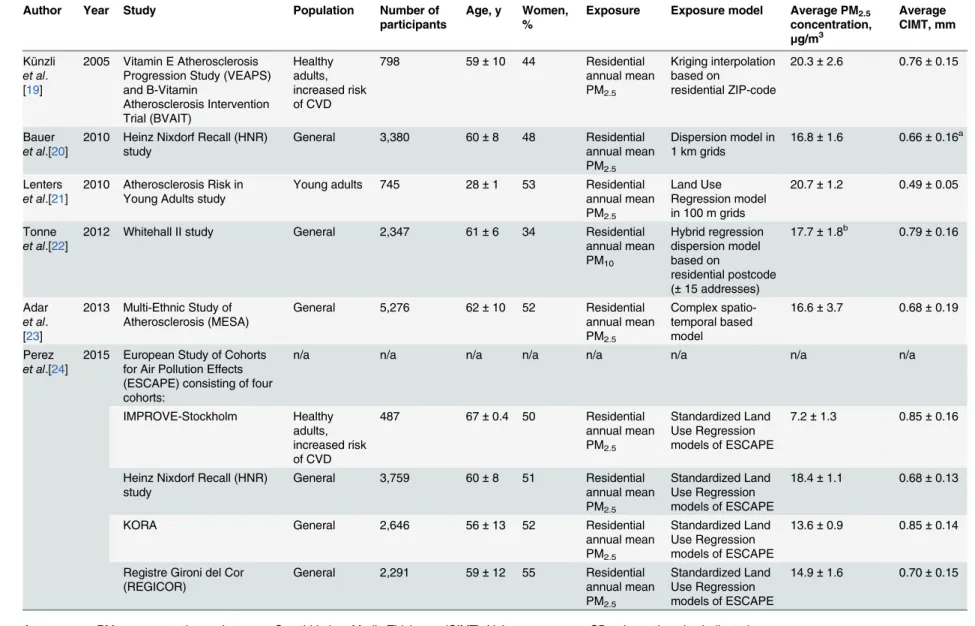
A systematic literature search was performed on PubMed and Web of Knowledge, who were last accessed on 1 March 2015, with no restriction for time of publication. The following search strategies were used: ('particular matter' OR 'air pollution' OR 'PM10' OR 'PM2.5') AND ('intima media thickness' OR 'carotid intima media thickness' OR 'carotid intima media' OR 'artery inti-ma media thickness' OR 'intiinti-ma media thickness measurement' OR 'intiinti-ma media thickness cardiovascular' OR 'carotid intima media thickness measurement' OR 'carotid intima media thickness cardiovascular'). We also considered references found in the literature search. Two investigators (EBP and NM) read all the papers and extracted and computerized the relevant information independently (Tables1and2). This meta-analysis complies with the preferred reporting items of the statement for Meta-analysis Of Observational Studies in Epidemiology (MOOSE).[25]
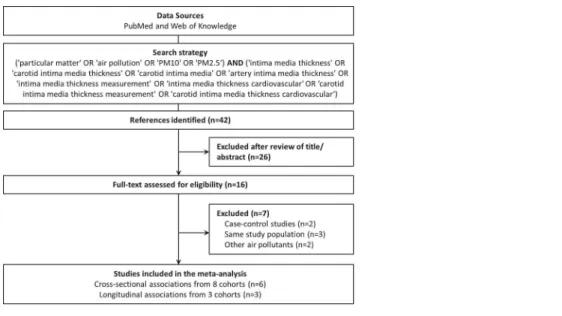
Selection of the studies was based on the research question, inclusion and exclusion criteria (Fig 1). All studies were reviewed by title and abstract and, if eligible for inclusion, by reading the full text. All types of studies and designs were considered for inclusion. Nevertheless, stud-ies needed to report originally collected data. Therefore, reviews, editorials and debates were excluded.
and analysis, decision to publish, or preparation of the manuscript.
Table 1. Characteristics of the studies included in the meta-analysis of cross-sectional results.
Author Year Study Population Number of participants
Age, y Women, %
Exposure Exposure model Average PM2.5 concentration,
μg/m3
Average CIMT, mm
Künzli
et al. [19]
2005 Vitamin E Atherosclerosis Progression Study (VEAPS) and B-Vitamin Atherosclerosis Intervention Trial (BVAIT) Healthy adults, increased risk of CVD
798 59±10 44 Residential
annual mean PM2.5
Kriging interpolation based on
residential ZIP-code
20.3±2.6 0.76±0.15
Bauer
et al.[20]
2010 Heinz Nixdorf Recall (HNR) study
General 3,380 60±8 48 Residential
annual mean PM2.5
Dispersion model in 1 km grids
16.8±1.6 0.66±0.16a
Lenters
et al.[21]
2010 Atherosclerosis Risk in Young Adults study
Young adults 745 28±1 53 Residential
annual mean PM2.5
Land Use Regression model in 100 m grids
20.7±1.2 0.49±0.05
Tonne
et al.[22]
2012 Whitehall II study General 2,347 61±6 34 Residential
annual mean PM10 Hybrid regression dispersion model based on residential postcode (±15 addresses)
17.7±1.8b 0.79±0.16
Adar
et al. [23]
2013 Multi-Ethnic Study of Atherosclerosis (MESA)
General 5,276 62±10 52 Residential
annual mean PM2.5
Complex spatio-temporal based model
16.6±3.7 0.68±0.19
Perez
et al.[24]
2015 European Study of Cohorts for Air Pollution Effects (ESCAPE) consisting of four cohorts:
n/a n/a n/a n/a n/a n/a n/a n/a
IMPROVE-Stockholm Healthy
adults, increased risk of CVD
487 67±0.4 50 Residential
annual mean PM2.5
Standardized Land Use Regression models of ESCAPE
7.2±1.3 0.85±0.16
Heinz Nixdorf Recall (HNR) study
General 3,759 60±8 51 Residential
annual mean PM2.5
Standardized Land Use Regression models of ESCAPE
18.4±1.1 0.68±0.13
KORA General 2,646 56±13 52 Residential
annual mean PM2.5
Standardized Land Use Regression models of ESCAPE
13.6±0.9 0.85±0.14
Registre Gironi del Cor (REGICOR)
General 2,291 59±12 55 Residential
annual mean PM2.5
Standardized Land Use Regression models of ESCAPE
14.9±1.6 0.70±0.15
Age, average PM2.5concentration and average Carotid Intima-Media Thickness (CIMT): Values are mean±SD unless otherwise indicated. aValues are median±IQR.
bAverage PM
2.5concentration calculated based on the assumption that PM10consists for 70% of PM2.5.
n/a: not applicable, characteristics are given for each subcohort below.
We selected the studies that used particulate matter with an aerodynamic diameter of 10μm
or less (PM10) or 2.5μm or less (PM2.5) as indicators of air pollution. Studies using only other air pollution measures or indicators were excluded. Furthermore, only studies measuring carot-id IMT were included.
Out of the 42 initially identified articles, 9 reported a cross-sectional association between CIMT and PM10[22] or PM2.5[19–21,23,24,28] and 3 reported longitudinal associations be-tween CIMT progression and PM2.5[23,26,27]. If a group published two or more papers based on the same study population,[23,28–30] only the publication that provided the most detailed information was included. We selected the results adjusted for gender, age, and BMI as well as for other known correlates of CIMT such as cholesterol levels and smoking status, if provided.
Statistical analysis
A meta-analytical combined estimate was derived from the point estimate of each separate study weighted by the inverse of the variance (1/SE2). In the case that only data for PM10was Table 2. Characteristics of the studies included in the meta-analysis of longitudinal results.
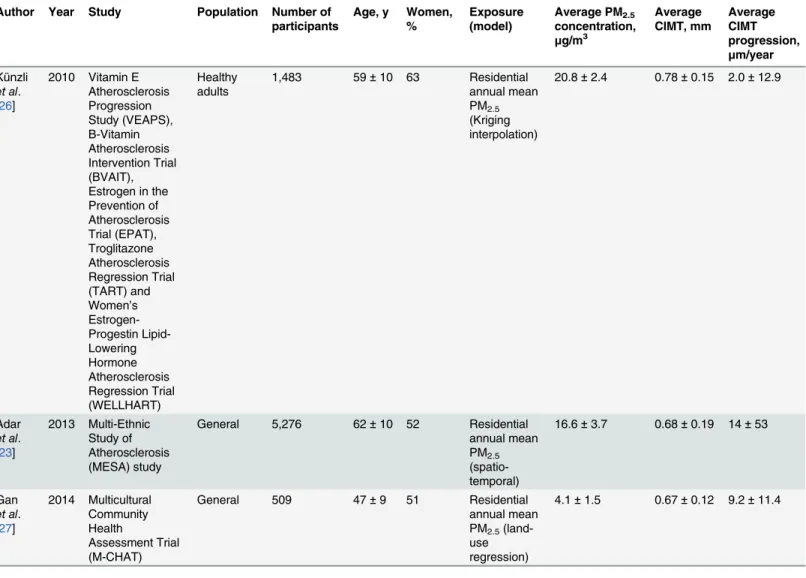
Author Year Study Population Number of participants
Age, y Women, %
Exposure (model)
Average PM2.5
concentration, μg/m3 Average CIMT, mm Average CIMT progression, μm/year Künzli
et al.
[26]
2010 Vitamin E Atherosclerosis Progression Study (VEAPS), B-Vitamin Atherosclerosis Intervention Trial (BVAIT), Estrogen in the Prevention of Atherosclerosis Trial (EPAT), Troglitazone Atherosclerosis Regression Trial (TART) and Women’s Estrogen-Progestin Lipid-Lowering Hormone Atherosclerosis Regression Trial (WELLHART) Healthy adults
1,483 59±10 63 Residential annual mean PM2.5 (Kriging interpolation)
20.8±2.4 0.78±0.15 2.0±12.9
Adar
et al. [23]
2013 Multi-Ethnic Study of Atherosclerosis (MESA) study
General 5,276 62±10 52 Residential annual mean PM2.5 (spatio-temporal)
16.6±3.7 0.68±0.19 14±53
Gan
et al. [27]
2014 Multicultural Community Health
Assessment Trial (M-CHAT)
General 509 47±9 51 Residential
annual mean PM2.5 (land-use regression)
4.1±1.5 0.67±0.12 9.2±11.4
Values are mean±SD
available (n = 1), we converted the point estimate under the assumption that PM10consist for 70% of PM2.5.[31] The combined estimate was computed using a random-effects model and is presented as a percent change in CIMT associated with a 5μg/m3higher long-term PM2.5
ex-posure for cross-sectional associations. Similarly, we computed a combined estimate based on the studies reporting a longitudinal association between the progression of CIMT and exposure to PM2.5. Results of this additional meta-analysis are presented asμm change in CIMT per year
for a 5μg/m3higher long-term PM2.5exposure.
The sensitivity of the cross-sectional findings was examined by recalculating the combined estimate while excluding one study at a time in order to evaluate the influence of individual studies on the combined effect size. If the combined estimate, excluding one study, lies outside the confidence interval of the overall estimate, the excluded study has a disproportionate influ-ence on the combined effect size. Further, between-study heterogeneity was examined using the Cochran Q and I2test. We plotted the association size against the SE of the study in order to investigate publication bias. This should result in a funnel shape (funnel plot) if there is no bias. As an additional sensitivity analysis, we recalculated the combined estimate while using the overall estimate of the European Study of Cohorts for Air Pollution Effects (ESCAPE), re-placing the separate estimates. As a final sensitivity analysis, we replaced the point estimates of the overall, between-city, association by the within-city estimate, presented by Adaret al.[23]
Results
Study selection
Of the 42 studies reviewed, 26 were excluded after review of the title and/or abstract; 19 re-ported associations with other types of exposures than PM2.5or PM10, or another outcome measure than CIMT. Three were reviews, one was on study design, one was performed in an animal model, one reported technical aspects of IMT measurements and one on PM2.5 model-ing approaches. After assessment of the full-text, 7 additional studies were excluded; three were based on the same study population[28–30], two were case-control studies of which no relevant association size could be computed[32,33] and 3 reported associations with other air pollution measurements or indicators than PM2.5or PM10.[34–36] We identified a set of six studies Fig 1. Flow chart of the study selection for meta-analysis.
doi:10.1371/journal.pone.0127014.g001
CIMT and PM, a Meta-Analysis
which investigated the cross-sectional association between CIMT and PM and three longitudi-nal studies on CIMT progression in association with PM (Fig 1).
Cross-sectional associations between CIMT and PM
The selection of six cross-sectional studies includes four longitudinal studies investigating base-line cross-sectional associations[20–23], one study reporting basebase-line cross-sectional analyses of two trials[19] and one reporting cross-sectional results from four different cohort studies within ESCAPE.[24]
The Heinz Nixdorf Recall (HNR) cohort, from the publication by Bauer and colleagues[20], is also one of the cohorts included in ESCAPE.[24] Since different modeling approaches were used for estimating the participants’exposure to PM2.5, differences between the reported point estimates of the two publications are found. We included the point estimates of the most recent publication from ESCAPE by Perezet al.[24] in the main meta-analysis and performed a sensi-tivity analysis using the point estimate from the publication by Baueret al. Therefore, all six studies are listed in chronological order inTable 1.
The five publications included in the main meta-analysis comprised 18,349 participants from 8 cohort studies. The majority of the study populations had an even gender distribution (range: 34 to 55% women) and an average age of 57 years. The average exposure to PM2.5in the different study populations ranged from 7.2 to 20.7μg/m3and CIMT averaged (SD) 0.73
(0.14) mm.
All studies used modeled PM concentrations based on the participant’s residence averaged over one year prior to the CIMT measurements. Whenever possible, preference was given to mean IMT measurements of the common carotid artery. In all reports, results were adjusted for gender, age and smoking status. Most studies also considered additional covariates includ-ing BMI,[20–22,24] blood pressure[19,21] and cholesterol levels.[19,21,23]
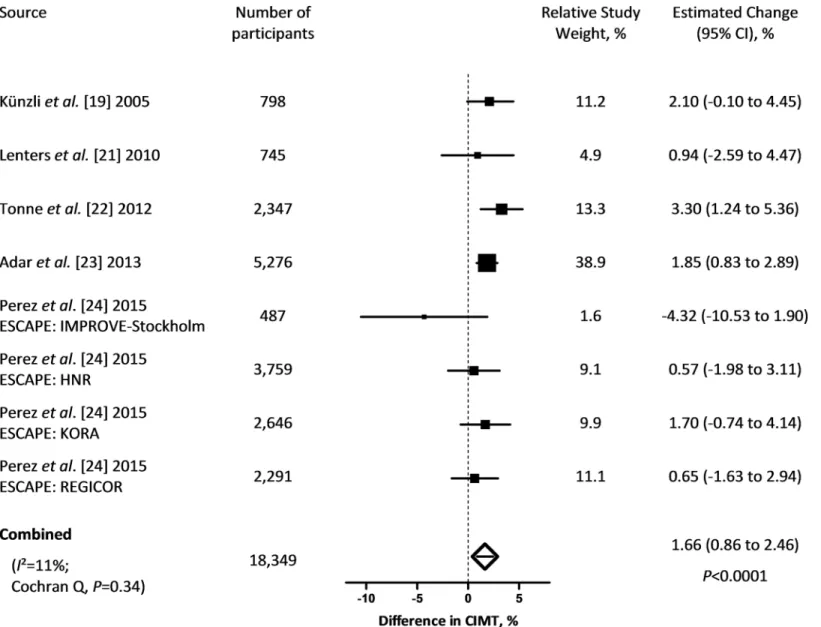
The combined estimate showed a 1.66% increment (95% CI: 0.86 to 2.46;P<0.0001) in CIMT for each 5μg/m3higher long-term PM2.5exposure (Fig 2). Cochran Q statistics did not
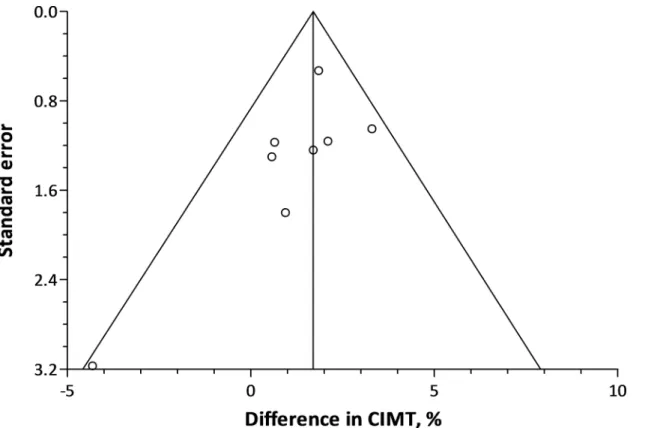
indicate incomparability of the study’s results (P= 0.34). Exclusion of Adaret al.[23] resulted in a drop in the combined estimate to 1.48% (95% CI: 0.35 to 2.62;P= 0.01), whereas it in-creased to 1.78% (95% CI: 1.07 to 2.49;P<0.0001) when omitting the results of the IMPRO-VE-Stockholm cohort from ESCAPE.[24] None of the studies moved the combined estimate outside the confidence interval of the overall estimate. Including the point estimate of the study by Baueret al.[20] as a result from the HNR study instead of the result from ESCAPE, in-creased the combined estimate to 1.99% (95% CI: 0.95 to 3.04;P= 0.0002). Using the overall point estimate of ESCAPE, instead of the results from the 4 subcohorts, increased the com-bined estimate to 1.73% (95% CI: 0.92 to 2.54;P<0.0001). In a final sensitivity analysis, we re-placed the overall, between-city, associations by the within-city associations as reported by Adaret al.[23] This lowered the combined estimate to 1.34% (95% CI: 0.30 to 2.38;P= 0.01) but the estimate remained within the confidence interval of the overall estimate of the main meta-analysis. The funnel plot did not provide indications of publication bias (Fig 3).
Progression of CIMT and PM
We identified three longitudinal studies, comprising 7,268 participants, which investigated the association between progression of CIMT and PM2.5of which the characteristics are listed in Table 2.[23,26,27] The study populations had an even gender distribution (range: 51 to 63% women) and an average age of 56 years. The average exposure to PM2.5in the different study populations ranged from 4.1 to 20.8μg/m3, CIMT averaged (SD) 0.71 (0.15) mm and average
The combined estimate showed a 1.04μm per year (95% CI: 0.01 to 2.07;P= 0.048) greater
CIMT progression for each 5μg/m3higher long-term PM2.5exposure (Fig 4). Cochran Q
sta-tistics did not indicate incomparability of the study’s results (P= 0.90). However, when replac-ing the between-city associations by the within-city associations as reported by Adaret al.[23], Cochran Q was significant (P= 0.0025) and the random combined estimate changed to 3.64μm per year (95% CI: -1.21 to 8.50;P= 0.14).
Discussion and Conclusion
The key finding of the present meta-analysis is that IMT of the carotid artery is positively associated with long-term exposure to particulate air pollution. CIMT was 1.66% thicker for a 5μg/m3increase in PM2.5exposure. These effects were calculated based on cross-sectional
re-sults from 8 cohorts comprising 18,349 study participants. Fig 2. Percent change in CIMT (95% CI) associated with a 5μg/m3higher long-term exposure to PM
2.5.Squares represent individual studies. The
magnitude of each square represents the inverse of the variance.
doi:10.1371/journal.pone.0127014.g002
CIMT and PM, a Meta-Analysis
Air pollution is a mixture of several pollutants but epidemiological and lab-based evidence suggests that PM per se might have an important role in the causation of adverse effects.[2] By Fig 3. Funnel plot showing the difference in CIMT associated with a 5μg/m3higher PM
2.5exposure against the standard error of each individual
cross-sectional study.
doi:10.1371/journal.pone.0127014.g003
Fig 4. Change in CIMT progression inμm per year (95% CI) associated with a 5μg/m3higher long-term exposure to PM
2.5.Squares represent
individual studies. The magnitude of each square represents the inverse of the variance.
selecting PM2.5as a common indicator, we envisioned to capture all effects of different sources and components of PM that promotes the pro-atherosclerotic process. Nonetheless, we are limited by the fact that different modeling approaches were used to estimate PM exposure within the different study populations. We expressed the combined estimate for a 5μg/m3
in-crease, which is realistic. Most urban areas worldwide have PM2.5concentrations greater than the WHO target of 10μg/m3, with a change in the population mean PM2.5exposure of 5μg/m3
needed to match the WHO guidelines set to protect public health. Carotid intima-media thick-ness is a strong predictor for both prevalent and incident cardiovascular morbidity and mortal-ity, including coronary heart disease, myocardial infarction and stroke.[16–18] If applied to the population at large, our findings have important implications for public health. Based on meta-analytical evidence of prospective studies, each 100μm increase in CIMT is associated with 8%
higher risk of myocardial infarction and 12% higher risk of stroke.[37] Our combined estimate of 1.66% increase in CIMT for a 5μg/m3increase in PM2.5corresponds to an average increase
of 12.1μm. A reduction in PM2.5of 5μg/m3in the population at large is therefore likely to
re-sult in a 0.94% decreased risk of myocardial infarction and a 1.4% decreased risk of stroke. Epidemiological studies, such as the ones included in the current meta-analysis, do not prove causation. However, the fact that associations with similar effect size can be observed in different study populations is one of the most important Hill criteria of causation.[38] Further-more, we performed a meta-analysis on studies reporting longitudinal associations between progression of CIMT and PM exposure, though the number of studies was limited. Results from this meta-analysis suggest that CIMT progression is increased with 1.04μm per year in
association with a 5μg/m3long-term exposure to PM2.5. This further adds to the causality
dis-cussion of the findings. In addition to PM, one study on NO2[34] and one on black carbon[35] were identified. Both compounds are proxies for traffic-related air pollution. Riveraet al.[34] reported a 0.56% (95% CI: -1.5% to 2.6%) thicker CIMT for a 25μg/m3increase in NO2
expo-sure within the REGICOR study. Wilker and colleagues[35] found that a 1.1% (95% CI: 0.4 to 1.7%) thicker CIMT was associated with a 260 ng/m3higher 1-year average black carbon expo-sure. Finally, a case-control study in highway toll collectors provided evidence for the effect of traffic-related air pollution on CIMT[32], showing similar effect sizes as a case-control study investigating the effect of biomass fuel smoke exposure on CIMT.[39]
Animal studies show that particulate air pollution can be an underlying cause of the devel-opment of atherosclerosis.[8–12] For example, concentrated ultrafine particles caused systemic oxidative stress, an inhibition of the anti-inflammatory capacity of HDL, and larger early ath-erosclerotic lesions in susceptible Apo lipoprotein E-deficient mice.[9] Oxidative modification of LDL is both a risk factor and a marker of the proatherogenic process.[40,41] Together with increased blood leukocytes and platelets it can contribute to the initiation and progression of atherosclerosis. Oxidative modification has also been positively associated with individual ex-posure to air pollution as exemplified by carbon load in lung macrophages of diabetes patients. [42]
The current meta-analysis should be interpreted within the context of its inherent limita-tions. Meta-analytical evidence might be biased due to the predicament of publication bias and the fact that only studies with positive results are published. However, our funnel plot did not suggest publication bias. Although the number of included publications was small (n = 5), they comprised a large number of participants (n = 18,349) from the general population in different age ranges. Although the magnitude of the association varied between the different studies, our combined estimate was robust and not driven by a single study, as substantiated by the sensitivity analyses.
In conclusion, our results show an overall statistically significant positive association be-tween subclinical atherosclerosis, characterized by carotid intima-media thickness, and
long-CIMT and PM, a Meta-Analysis
term exposure to particulate air pollution. Improvement of the air we breathe is a very relevant target to reduce proatherosclerotic effects associated with particulate air pollution in
the population.
Supporting Information
S1 PRISMA Checklist. Preferred Reporting Items for Systematic Reviews and Meta-Analy-ses (PRISMA) checklist.
(DOC)
S1 File. Full-text excluded articles, with reasons for exclusion. (DOCX)
Author Contributions
Conceived and designed the experiments: TSN. Performed the experiments: EBP NM. Ana-lyzed the data: EBP NM TSN. Wrote the paper: EBP TSN. Analysis and interpretation of data: EBP NM LIP PDB TSN. Critical revision of the manuscript: EBP NM LIP PDB TSN.
References
1. Nawrot TS, Perez L, Kunzli N, Munters E, Nemery B. Public health importance of triggers of myocardial infarction: a comparative risk assessment. Lancet. 2011; 377(9767): 732–740. doi: 10.1016/S0140-6736(10)62296-9PMID:21353301
2. Brook RD, Rajagopalan S, Pope CA III, Brook JR, Bhatnagar A, Diez-Roux AV, et al. Particulate matter air pollution and cardiovascular disease: An update to the scientific statement from the American Heart Association. Circulation. 2010; 121(21): 2331–2378. doi:10.1161/CIR.0b013e3181dbece1PMID:
20458016
3. Pope CA III, Dockery DW. Health effects of fine particulate air pollution: lines that connect. J Air Waste Manag Assoc. 2006; 56(6): 709–742. PMID:16805397
4. Mustafic H, Jabre P, Caussin C, Murad MH, Escolano S, Tafflet M, et al. Main air pollutants and myo-cardial infarction: a systematic review and meta-analysis. JAMA. 2012; 307(7): 713–721. doi:10.1001/ jama.2012.126PMID:22337682
5. Gill EA, Curl CL, Adar SD, Allen RW, Auchincloss AH, O'Neill MS, et al. Air pollution and cardiovascular disease in the Multi-Ethnic Study of Atherosclerosis. Prog Cardiovasc Dis. 2011; 53(5): 353–360. doi:
10.1016/j.pcad.2011.02.001PMID:21414470
6. Grahame TJ, Schlesinger RB. Cardiovascular health and particulate vehicular emissions: a critical evaluation of the evidence. Air quality, atmosphere, & health. 2010; 3(1): 3–27.
7. Pieters N, Plusquin M, Cox B, Kicinski M, Vangronsveld J, Nawrot TS. An epidemiological appraisal of the association between heart rate variability and particulate air pollution: a meta-analysis. Heart. 2012; 98(15): 1127–1135. doi:10.1136/heartjnl-2011-301505PMID:22628541
8. Chen LC, Quan C, Hwang JS, Jin X, Li Q, Zhong M, et al. Atherosclerosis lesion progression during in-halation exposure to environmental tobacco smoke: a comparison to concentrated ambient air fine par-ticles exposure. Inhal Toxicol. 2010; 22(6): 449–459. doi:10.3109/08958370903373845PMID:
20235771
9. Araujo JA, Nel AE. Particulate matter and atherosclerosis: role of particle size, composition and oxida-tive stress. Part Fibre Toxicol. 2009; 6(24). doi:10.1186/1743-8977-6-24PMID:19761620
10. Niwa Y, Hiura Y, Murayama T, Yokode M, Iwai N. Nano-sized carbon black exposure exacerbates ath-erosclerosis in LDL-receptor knockout mice. Circ J. 2007; 71(7): 1157–1161. PMID:17587728 11. Sun Q, Wang A, Jin X, Natanzon A, Duquaine D, Brook RD, et al. Long-term air pollution exposure and
acceleration of atherosclerosis and vascular inflammation in an animal model. JAMA. 2005; 294(23): 3003–3010. PMID:16414948
12. Suwa T, Hogg JC, Quinlan KB, Ohgami A, Vincent R, van Eeden SF. Particulate air pollution induces progression of atherosclerosis. J Am Coll Cardiol. 2002; 39(6): 935–942. PMID:11897432
14. de Groot E, Hovingh GK, Wiegman A, Duriez P, Smit AJ, Fruchart JC, et al. Measurement of arterial wall thickness as a surrogate marker for atherosclerosis. Circulation. 2004; 109(23 Suppl 1): III33–38. PMID:15198964
15. Chambless LE, Heiss G, Folsom AR, Rosamond W, Szklo M, Sharrett AR, et al. Association of coro-nary heart disease incidence with carotid arterial wall thickness and major risk factors: the Atherosclero-sis Risk in Communities (ARIC) Study, 1987–1993. Am J Epidemiol. 1997; 146(6): 483–494. PMID:
9290509
16. Nambi V, Chambless L, Folsom AR, He M, Hu Y, Mosley T, et al. Carotid intima-media thickness and presence or absence of plaque improves prediction of coronary heart disease risk: the ARIC (Athero-sclerosis Risk In Communities) study. J Am Coll Cardiol. 2010; 55(15): 1600–1607. doi:10.1016/j.jacc. 2009.11.075PMID:20378078
17. Plichart M, Celermajer DS, Zureik M, Helmer C, Jouven X, Ritchie K, et al. Carotid intima-media thick-ness in plaque-free site, carotid plaques and coronary heart disease risk prediction in older adults. The Three-City Study. Atherosclerosis. 2011; 219(2): 917–924. doi:10.1016/j.atherosclerosis.2011.09.024
PMID:22005196
18. O'Leary DH, Polak JF, Kronmal RA, Manolio TA, Burke GL, Wolfson SK Jr. Carotid-artery intima and media thickness as a risk factor for myocardial infarction and stroke in older adults. Cardiovascular Health Study Collaborative Research Group. N Engl J Med. 1999; 340(1): 14–22. PMID:9878640 19. Kunzli N, Jerrett M, Mack WJ, Beckerman B, LaBree L, Gilliland F, et al. Ambient air pollution and
ath-erosclerosis in Los Angeles. Environ Health Perspect. 2005; 113(2): 201–206. PMID:15687058 20. Bauer M, Moebus S, Mohlenkamp S, Dragano N, Nonnemacher M, Fuchsluger M, et al. Urban
particu-late matter air pollution is associated with subclinical atherosclerosis: results from the HNR (Heinz Nix-dorf Recall) study. J Am Coll Cardiol. 2010; 56(22): 1803–1808. doi:10.1016/j.jacc.2010.04.065PMID:
21087707
21. Lenters V, Uiterwaal CS, Beelen R, Bots ML, Fischer P, Brunekreef B, et al. Long-term exposure to air pollution and vascular damage in young adults. Epidemiology. 2010; 21(4): 512–520. doi:10.1097/ EDE.0b013e3181dec3a7PMID:20407379
22. Tonne C, Yanosky JD, Beevers S, Wilkinson P, Kelly FJ. PM mass concentration and PM oxidative po-tential in relation to carotid intima-media thickness. Epidemiology. 2012; 23(3): 486–494. doi:10.1097/ EDE.0b013e31824e613ePMID:22450694
23. Adar SD, Sheppard L, Vedal S, Polak JF, Sampson PD, Diez Roux AV, et al. Fine particulate air pollu-tion and the progression of carotid intima-medial thickness: a prospective cohort study from the multi-ethnic study of atherosclerosis and air pollution. PLoS Med. 2013; 10(4): e1001430. doi:10.1371/ journal.pmed.1001430PMID:23637576
24. Perez L, Wolf K, Hennig F, Penell J, Basagana X, Foraster M, et al. Air Pollution and Atherosclerosis: A Cross-Sectional Analysis of Four European Cohort Studies in the ESCAPE Study. Environ Health Per-spect. 2015;
25. Stroup DF, Berlin JA, Morton SC, Olkin I, Williamson GD, Rennie D, et al. Meta-analysis of observation-al studies in epidemiology: a proposobservation-al for reporting. Meta-anobservation-alysis Of Observationobservation-al Studies in Epidemi-ology (MOOSE) group. JAMA. 2000; 283(15): 2008–2012. PMID:10789670
26. Kunzli N, Jerrett M, Garcia-Esteban R, Basagana X, Beckermann B, Gilliland F, et al. Ambient air pollu-tion and the progression of atherosclerosis in adults. PLoS One. 2010; 5(2): e9096. doi:10.1371/ journal.pone.0009096PMID:20161713
27. Gan WQ, Allen RW, Brauer M, Davies HW, Mancini GB, Lear SA. Long-term exposure to traffic-related air pollution and progression of carotid artery atherosclerosis: a prospective cohort study. BMJ open. 2014; 4(4): e004743. doi:10.1136/bmjopen-2013-004743PMID:24710134
28. Sun M, Kaufman JD, Kim SY, Larson TV, Gould TR, Polak JF, et al. Particulate matter components and subclinical atherosclerosis: common approaches to estimating exposure in a Multi-Ethnic Study of Ath-erosclerosis cross-sectional study. Environmental Health. 2013; 12(39). doi: 10.1186/1476-069X-12-39PMID:23641873
29. Kim SY, Sheppard L, Kaufman JD, Bergen S, Szpiro AA, Larson TV, et al. Individual-level concentra-tions of fine particulate matter chemical components and subclinical atherosclerosis: a cross-sectional analysis based on 2 advanced exposure prediction models in the multi-ethnic study of atherosclerosis. Am J Epidemiol. 2014; 180(7): 718–728. doi:10.1093/aje/kwu186PMID:25164422
30. Diez Roux AV, Auchincloss AH, Franklin TG, Raghunathan T, Barr RG, Kaufman J, et al. Long-term ex-posure to ambient particulate matter and prevalence of subclinical atherosclerosis in the Multi-Ethnic Study of Atherosclerosis. Am J Epidemiol. 2008; 167(6): 667–675. doi:10.1093/aje/kwm359PMID:
18227099
31. Ballester F, Medina S, Boldo E, Goodman P, Neuberger M, Iniguez C, et al. Reducing ambient levels of fine particulates could substantially improve health: a mortality impact assessment for 26 European
CIMT and PM, a Meta-Analysis
cities. J Epidemiol Community Health. 2008; 62(2): 98–105. doi:10.1136/jech.2007.059857PMID:
18192596
32. Erdogmus B, Yazici B, Annakkaya AN, Bilgin C, Safak AA, Arbak P, et al. Intima-media thickness of the common carotid artery in highway toll collectors. J Clin Ultrasound. 2006; 34(9): 430–433. PMID:
17078025
33. Tsao TM, Tsai MJ, Wang YN, Lin HL, Wu CF, Hwang JS, et al. The health effects of a forest environ-ment on subclinical cardiovascular disease and heath-related quality of life. PLoS One. 2014; 9(7): e103231. doi:10.1371/journal.pone.0103231PMID:25068265
34. Rivera M, Basagana X, Aguilera I, Foraster M, Agis D, de Groot E, et al. Association between long-term exposure to traffic-related air pollution and subclinical atherosclerosis: the REGICOR study. Environ Health Perspect. 2013; 121(2): 223–230. doi:10.1289/ehp.1205146PMID:23384708
35. Wilker EH, Mittleman MA, Coull BA, Gryparis A, Bots ML, Schwartz J, et al. Long-term exposure to black carbon and carotid intima-media thickness: the normative aging study. Environ Health Perspect. 2013; 121(9): 1061–1067. doi:10.1289/ehp.1104845PMID:23820848
36. Armijos RX, Weigel MM, Myers OB, Li WW, Racines M, Berwick M. Residential exposure to urban traf-fic is associated with increased carotid intima-media thickness in children. J Environ Public Health. 2015; 2015(713540). doi:10.1155/2015/713540PMID:25685160
37. Den Ruijter HM, Peters SA, Anderson TJ, Britton AR, Dekker JM, Eijkemans MJ, et al. Common carotid intima-media thickness measurements in cardiovascular risk prediction: a meta-analysis. JAMA. 2012; 308(8): 796–803. doi:10.1001/jama.2012.9630PMID:22910757
38. Hill AB. The Environment and Disease: Association or Causation? Proc R Soc Med. 1965; 58(5): 295– 300.
39. Painschab MS, Davila-Roman VG, Gilman RH, Vasquez-Villar AD, Pollard SL, Wise RA, et al. Chronic exposure to biomass fuel is associated with increased carotid artery intima-media thickness and a higher prevalence of atherosclerotic plaque. Heart. 2013; 99(14): 984–991. doi: 10.1136/heartjnl-2012-303440PMID:23619984
40. Jacobs L, Emmerechts J, Hoylaerts MF, Mathieu C, Hoet PH, Nemery B, et al. Traffic air pollution and oxidized LDL. PLoS One. 2011; 6(1): e16200. doi:10.1371/journal.pone.0016200PMID:21283820 41. Wallenfeldt K, Fagerberg B, Wikstrand J, Hulthe J. Oxidized low-density lipoprotein in plasma is a
prog-nostic marker of subclinical atherosclerosis development in clinically healthy men. J Intern Med. 2004; 256(5): 413–420. PMID:15485477