STRUCTURE AND FUNCTION OF BIOPOLYMERS
Inhibition of sodium-dependent phosphate transporter
NaPi2b function with MX35 antibody
V. S. Gryshkova, V.V. Filonenko, R. G. Kiyamova
Institute of Molecular Biology and Genetics NAS of Ukraine 150, Akademika Zabolotnoho St., Kyiv, Ukraine, 03680
Sodium-dependent phosphate transporter NaPi2b is involved in transport of inorganic phosphate and the main-tenance of phosphate homeostasis in human body. NaPi2b was recently identified as a marker of ovarian cancer, termed MX35. Monoclonal antibody (mAb) against transporter NaPi2b, called MX35, demonstrated therapeutic efficacy in radioimmunotherapy of patients with ovarian cancer. Aim. The present experiments explored
whe-ther MX35 antibody can affect function of NaPi2b to transport inorganic phosphate ions in cellular models.
Methods. HEK293 cells stably expressing wild type NaPi2b and mutant NaPi2b_T330V, which could not be
re-cognized by MX35 antibody, were incubated with MX35 antibody and analyzed by phosphate uptake assay.
Results. Cells expressing wild type NaPi2b showed reduced phosphate uptake after incubation with MX35
an-tibody at concentration 50 µg/ml. No significant changes in phosphate transport were detected for cells expres-sing NaPi2b_T330V at the same experimental conditions. Conclusions. Our results demonstrate 1,8-fold
de-crease of NaPi2b-mediated phosphate transport in HEK293 cells stably expressing wild type NaPi2b after MX35 antibody application, which can be considered as a specific inhibitor of NaPi2b function.
Keywords: NaPi2b, MX35 antibody.
Introduction. Sodium-dependent phosphate transpor-ter NaPi2b (SLC34A2, NaPiIIb, Npt2)is normally ex-pressed in mammalian small intestine at the apical side of enterocyte’s brush-border membranes. NaPi2b par-ticipates in the transcellular inorganic phosphate (Pi)
absorption, contributing to the maintenance of phos-phate homeostasis in the organism [1–3]. The studies on conditional knockout mice demonstrated that NaPi2b contributes to > 90 % of total active phosphate absorption [4].
The attempts to generate NaPi2b homozygous de-ficient mice resulted in death of embryos in uterus soon after implantation, indicating that NaPi2b is the major Pi transporter during mouse embryonic development
[5].
The expression of NaPi2b mRNA was revealed by Northern blot analysis in many human normal tissues including lung, kidney, liver, prostate, pancreas, testis, ovary, thymus [1, 2]. The expression of NaPi2b on pro-tein level has been detected in normal human salivary glands by Western blotting with polyclonal antibodies against NaPi2b [6].
It was reported that alterations in NaPi2b expres-sion are linked to several human abnormalities. In lungs, NaPi2b is the only phosphate transporter that is highly expressed, and it is involved in uptake of phos-phate for synthesis of surfactant proteins. Deregulation of the NaPi2b transporter function as a result of muta-tions in SLC34A2 gene may lead to the pulmonary alveolar microlithiasis, autosomal recessively inherited disease, characterized by deposition of calcium-phos-phate precipitates in lungs [7, 8].
The increased expression of SLC34A2 gene in can-cer was detected in ovarian and papillary thyroid tu-mors [9, 10]. Recently, it has been demonstrated that the expression level of SLC34A2 gene is increased in human breast tumors [11]. Low dietary Piuptake,
well-known regulator of NaPi2b expression and function, was shown to cause lung tumorigenesis in K-ras (LA1) model mice on the background of increased NaPi2b expression [12].
Previously, we identified NaPi2b as an ovarian cancer antigen MX35 by screening cDNA library from OVCAR3 cells with the MX35 antibody [13]. This antibody was generated from mice immunized with a cocktail of human ovarian carcinoma cells and showed reactivity with approximately 90 % samples of human epithelial ovarian cancers [14]. Heterogeneous expres-sion profile of MX35/NaPi2b protein was further con-firmed for epithelial ovarian tumors of different histo-morphological types [15]. The radiolabelled MX35 antibody was used in clinical trials and was shown to possess the therapeutic effect in patients with ovarian cancer [16, 17]. However, the unlabelled MX35 anti-body did not have any therapeutic effect on tumor gro-wth in model mice [18].
Playing an essential role in phosphate homeostasis in a human body NaPi2b is considered as a target for in- hibition of hyperphosphatemia in patients with chronic renal failure [19]. There are some Pi-containing
com-pounds that have been reported as inhibitors of sodium- dependent phosphate transport including phospho-noformic acid, 2V-phosphophloretin, and JTP-59557 [20–22]. But all mentioned inhibitors are not strictly specific for sodium-dependent phosphate transport me- diated by NaPi2b.
The identification of MX35 ovarian cancer antigen as sodium-dependent transporter NaPi2b gave an op-portunity to investigate the impact of specific antibody MX35 on the transport function of NaPi2b. This study aimed to analyze the effect of MX35 antibody on the functioning of sodium-dependent phosphate transpor-ter NaPi2b using cellular models and to detranspor-termine whe- ther this antibody can function as a specific inhibitor of NaPi2b-mediated phosphate transport.
Materials and methods. Constructs, stable cell line generation. Generation of HEK293 cells stably ex- pressing wild type and mutant forms of NaPi2b was
previously described [23]. Briefly, human NaPi2b cDNA (NaPi2b_WT) was cloned into pcDNA3.1(+) («Invitrogen», USA) in the frame with EE-tag. A mu-tant form of NaPi2b (pcDNA3.1(+)/NaPi2b_T330V) was obtained by site-directed mutagenesis. HEK293 cells were transfected with recombinant plasmids (pcDNA3.1(+)/NaPi2b_WT, pcDNA3.1(+)/NaPi2b_ T330V or empty vector) using FuGene («Roshe», Switzerland). Cells were cultured in the presence of G418 antibiotic («Gibco», UK) at the concentration of 1 mg/ml for 7–10 days to eliminate nontransfected cells before splitting.
Phosphate uptake analysis. HEK293 cells were placed on 96-well plate at 3×10⁴
cells/well and incubated with the MX35 antibody for different time (6, 12, 24, 48, 96 h). The MX35 antibody was kindly provided by Dr. Gerd Ritter (Ludwig Institute for Cancer research, USA). After medium was removed cells were washed 3 times with 200 ml of wash solution (137 mM NaCl, 5.4 mM KCl, 2.8 mM CaCl2, 1.2 mM MgSO4, 14 mM Tris HCl (pH 7.4)). 50 ml of assay solution (0.1 mM KH2PO4, 137 mM NaCl, 5.4 mM KCl, 2.8 mM CaCl2, 1.2 mM MgSO4, 14 mM Tris HCl (pH 7.4)) with [
33 P] orthophosphate (1 mCi/ml) was added to each well and incubated at room temperature. Then, assay solution was removed and cells were rinsed 3 times with 150 ml of ice-cold stop solution (137 mM NaCl, 14 mM Tris HCl (pH 7.4)). Cells were lysed in 50 ml of lysis buffer (0.01 M Tris HCl, pH 7.5, 0.15 M NaCl, 0.01 M MgCl2, 0.5 % NP-40) and 25 ml of cell lysate was used to de-termine radioactivity in a liquid scintillation counter («Perkin Elmer», USA). The rest of cell lysate was used to determine protein concentration using BCA protein assay kit («Pierce Biotechnology», USA). To inhibit sodium-dependent phosphate transport phos-phonoformic acid («Sigma», USA) was added to the assay solution at 5 mM concentration.
´ PBST for 1 h at RT and incubated with the MX35 antibody at 4 °C overnight. After incubation with HRP-conjugated goat anti-mouse IgG («Promega», USA) the membranes were developed using the ECL system («Amersham», Sweden) and then exposed to Agfa X-ray film.
Statistical analysis. Data are provided as means ± ± SEM. All experiments were repeated 3 times; in all repetitions qualitatively similar data were obtained.
Results and discussion. Sodium-dependent phos-phate transporter NaPi2b, which plays an essential role in the maintenance of phosphate homeostasis in the human body, was revealed as ovarian cancer marker MX35 [13]. It has been shown that the radiolabelled MX35 antibody recognizing NaPi2b has therapeutic
effect in patients with ovarian cancer and F(ab)2 frag-ments of the MX35 antibody specifically localize in micrometastatic loci within peritoneal cavity [16, 17]. Knowledge about the function of MX35 antigen pro-vided the basis for the investigation of the MX35 an-tibody impact on the phosphate transport function of MX35/NaPi2b protein.
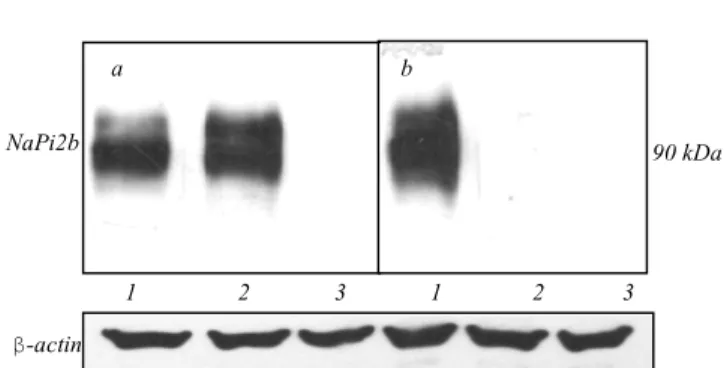
To investigate the function of NaPi2b as a trans-porter of inorganic phosphate we applied a phosphate uptake assay using HEK293 cells expressing the wild type and mutant form of NaPi2b as well as HEK293 cells transfected with empty pcDNA3.1(+) plasmid as a control. In the predicted topology of NaPi2b, both N-and C-terminal tails face cytoplasm, exposing loops of various length to the extracellular and intracellular compartments including a large extracellular loop (188–361 aa). Previously, we have shown that the epi-tope recognized by MX35 antibody is located within the predicted extracellular domain (311–340 aa) [13, 24]. Further studies have shown that the mutation T330V in the large extracellular loop of NaPi2b trans-porter is crucial for the recognition of NaPi2b by the MX35 antibody [23]. Western blot analysis of lysates of cell lines stably expressing the wild type and mutant form (NaPi2b_T330V) of transporter clearly indicated that mutant NaPi2b_T330V was not recognized by the MX35 antibody whereas both wild type and mutant form were recognized well by the EE-tag specific an-tibody (Fig. 1).
We applied a phosphate uptake assay to investigate the NaPi2b transport function in the cells expressing wild type NaPi2b and in the control cell line. In time-course study, the human NaPi2b-mediated Piuptake in-
creased linearly up to 30 min, thus 15 min uptake time was used to evaluate phosphate uptake in further ex-periments (data not shown).
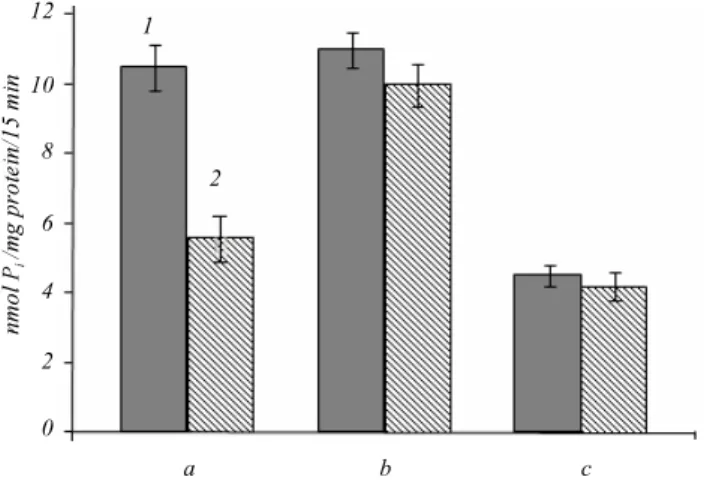
At this uptake time we observed 2.5-fold increase in Pi uptake in the cells expressing wild type NaPi2b
(10.6 ± 0.6 nmol/mg protein) in contrast to the cells transfected with empty pcDNA3.1(+) plasmid (4.2 ± ± 0.4 nmol/mg protein) (Fig. 2). The cells expressing the mutant form NaPi2b_T330V transported inorganic phosphate with the same efficiency as the cells expres-sing the wild type of NaPi2b (11.5 ± 0.7 nmol/mg protein) (Fig. 2). The use of well-known inhibitor of sodium-dependent phosphate transport phosphonofor-90 kDa
$-actin NaPi2b
1 2 3 1 2 3
a b
Fig. 1. Western blot analysis of HEK293 cells expressing wild type NaPi2b (1), mutant form NaPi2b_T330V (2) and cells transfected with empty pcDNA3.1(+) vector (3) by anti-EE-tag (a) and MX35 (b) antibodies; b-actin was used as a loading control
0 2 4 6 8 10 12
1 2 3 1 2 3
a b
mic acid at 5 mM concentration in assay solution led to the total abolishment of Piuptake in all the investigated
cell lines (Fig. 2).
To determine the effect of MX35 antibody on NaPi2b-mediated transport we performed the phospha- te uptake experiments for all mentioned cell lines after incubation with the MX35 antibody at different con-centrations (5, 10, 20, and 50 mg/ml) and different time (6, 12, 24, 48, 96 h) (data not shown). We detected a considerable inhibition of phosphate uptake in the cells expressing wild type of NaPi2b incubated for 24h with the MX35 antibody at concentration of 50 mg/ml. In this case 1,8-fold decrease in sodium-dependent phos-phate uptake was observed for the wild type NaPi2b (incubation with antibody – 10.52 ± 0.65 nmol/mg; incubation without antibody – 5.6 ± 0.45 nmol/mg). At the same time phosphate transport in the cell line trans-fected with empty pcDNA3.1(+) plasmid remained unchanged (incubation with antibody – 4.5 ± 0.3 nmol/ mg protein; incubation without antibody – 4.2 ± ± 0.4 nmol/mg) (Fig. 3).
To confirm the specificity of this inhibition we evaluated the effect of MX35 antibody on the cells ex-pressing the mutant form NaPi2b_T330V, which is not recognized by the MX35 antibody. No significant changes were detected in the phosphate uptake mea-surements in the cells expressing NaPi2b_T330V after incubation with the MX35 antibody (11.5 ± 0.7 nmol/ mg protein; 10 ± 0.5 nmol/mg protein) (Fig. 3). Our
data clearly demonstrate that the MX35 antibody spe-cific to NaPi2b transporter significantly decreased so-dium-dependent phosphate uptake in the cellular mo-dels used in this study.
The mechanism of remarkable inhibition of so-dium-dependent phosphate transport by the antibody specific to extracellular domain of NaPi2b still remains unknown. It should be further investigated whether the incubation of the cells expressing NaPi2b with the MX35 antibody may lead to down regulation of NaPi2b protein decreasing the number of transporter units on cell surface or the binding of MX35 antibody can cause conformational changes in transporter struc-ture affecting its function and vice versa it can prevent conformational changes necessary for transporter func- tioning.
Conclusions. Using cellular models expressing the wild type and mutant NaPi2b_T330V transporter we showed that the MX35 antibody directed against NaPi2b significantly decreased phosphate uptake me-diated by NaPi2b and, thus, can be considered as a spe-cific inhibitor of NaPi2b transport function.
Acknowledgments. V. Gryshkova was supported by Boehringer Inhelheim Fonds (BIF) travel grant to perform the part of this work at the University College London under I. Gout supervision.
В. С. Гриш ко ва, В. В. Філо нен ко, Р. Г. Кіямо ва
Інгібу ван ня функції натрій-за леж но го транс пор те ра фос фатів NaPi2b спе цифічни ми ан титілами MX35
Ре зю ме
Натрій-за леж ний транс пор тер фос фа ту NaPi2b бере участь у
пе рене сенні не органічно го фос фа ту та підтри манні фос фат но
-го -го ме ос та зу в організмі лю ди ни. Не що дав но NaPi2b опи са но як
мар кер раку яєчни ка МХ35. Мо нок ло нальні ан титіла (МКАТ)
про ти транс пор те ра NaPi2b, які от ри ма ли на зву МХ35, ви яв ля -ють те ра пев тич ну ефек тивність при ліку ванні хво рих на рак яєчни ка. Мета да ної ро бо ти по ля га ла в тому, щоб з’я су ва ти, чи
впливає зв’я зу ван ня МКАТ МХ35 з NaPi2b на його функцію транс
-пор ту ва ти іони не органічно го фос фа ту в клітин них мо де лях. Методи. Клітини лінії НЕК293, що стабільно експре су ють ди кий
тип NaPi2b та му тан тну фор му NaPi2b_T330V, яка не
роз-пізнається ан титілами МХ35, інку бу ва ли з ан титілами МХ35,
після чого аналізу ва ли по гли нан ня кліти на ми радіоак тив но міче
-но го фос фа ту. Результати. Після інку бації з ан титілами МХ35
у кон цен трації 50 мкг/мл відмічено знач не змен шен ня по гли нан ня
фос фа ту кліти на ми, які експре су ють ди кий тип NaPi2b. Для
клітин, що експре су ють му тан тну фор му NaPi2b_T330V, за ана
-логічних ек спе ри мен таль них умов знач них змін у по гли нанні фос
-фа ту не ви яв ле но. Висновки. Наші дані свідчать про 1,8-раз ове
0 2 4 6 8 10 12
a b c
1
2
знижен ня NaPi2b-за леж но го транс пор ту фос фа ту в ре зуль таті
інку бації з МКАТ МХ35, які мо жуть слу гу ва ти спе цифічним
інгі-біто ром функції NaPi2b.
Клю чові сло ва: NaPi2b, мо нок ло нальні ан титіла МХ35.
В. С. Гриш ко ва, В. В. Фи ло нен ко, Р. Г. Ки я мо ва
Инги би ро ва ние функ ции на трий-за ви си мо го транс пор те ра фос фа тов NaPi2b спе ци фи чес ки ми ан ти те ла ми MX35
Ре зю ме
Нат рий-за ви си мый транс пор тер фос фа та NaPi2b учас тву ет в
пе ре но се не орга ни чес ко го фос фа та и под дер жа нии фос фат но го го ме ос та за в орга низ ме че ло ве ка. Не дав но NaPi2b опи сан как
мар кер рака яич ни ка МХ35. Мо нок ло наль ные ан ти те ла (МКАТ)
про тив транс пор те ра NaPi2b, на зван ные МХ35, про яв ля ют те
-ра пев ти чес кую эф фек тив ность при ле че нии боль ных ра ком яич -ни ка. Цель дан ной ра бо ты со сто я ла в вы яс не нии того, вли я ет ли
свя зы ва ние МКАТ МХ35 с NaPi2b на его функ цию транс пор ти ро
-вать ионы не орга ни чес ко го фос фа та в кле точ ных мо де лях. Ме
-тоды. Клет ки ли нии НЕК293, ста биль но экс прес си ру ю щие ди кий
тип NaPi2b и му тан тную фор му NaPi2b_T330V, не рас поз на ва е
-мую ан ти те ла ми МХ35, ин ку би ро ва ли с ан ти те ла ми МХ35, по сле чего ана ли зи ро ва ли по гло ще ние клет ка ми ра ди о ак тив но ме чен -но го фос фа та. Результаты. Пос ле ин ку ба ции с ан ти те ла ми
МХ35 в кон цен тра ции 50 мкг/мл от ме че но зна чи тель ное умень
-ше ние по гло ще ния фос фа та клет ка ми, экс прес си ру ю щи ми ди кий тип NaPi2b. Для кле ток, экс прес си ру ю щих му тан тную фор му транс пор те ра NaPi2b_T330V, не вы яв ле но су щес твен ных из ме -не ний в по гло ще нии фос фа та при ана ло гич ных экс пе ри мен таль -ных усло ви ях. Выводы. Наши ре зуль та ты сви де т ельству ют о 1,8-крат ном сни же нии NaPi2b-за ви си мо го транс пор та фос фа
-та в ре зуль та те ин ку ба ции с МКАТ МХ35, ко то рые мож но рас
-смат ри вать как спе ци фи чес кий ин ги би тор функ ции NaPi2b. Клю че вые сло ва: NaPi2b, мо нок ло наль ные ан ти те ла МХ35.
REFERENCES
1. Xu H., Bai L., Collins J. F., Ghishan F. K. Molecular cloning, functional characterization, tissue distribution, and chromoso-mal localization of a human, schromoso-mall intestinal sodium-phosphate (Na+–Pi) transporter (SLC34A2) // Genomics.–1999.–62, N 2.–
Р. 281–284.
2. Hilfiker H., Hattenhauer O., Traebert M., Forster I., Murer H., Biber J. Characterization of a murine type II sodium-phosphate cotransporter expressed in mammalian small intestine // Proc. Natl Acad. Sci. USA.–1998.–95, N 24.–P. 14564–14569. 3. Virkki L. V., Biber J., Murer H., Forster I. C. Phosphate
trans-porters: a tale of two solute carrier families // Am. J. Physiol. Renal. Physiol.–2007.–293, N 3.–P. F643–F654.
4. Sabbagh Y., O’Brien S. P., Song W., Boulanger J. H., Stock-mann A., Arbeeny C., Schiavi S. C. Intestinal Npt2b plays a ma-jor role in phosphate absorption and homeostasis // J. Am. Soc. Nephrol.–2009.–20, N 11.–P. 2348–2358.
5. Shibasaki Y., Etoh N., Hayasaka M., Takahashi M. O., Kakitani M., Yamashita T., Tomizuka K., Hanaoka K. Targeted deletion of the type IIb Na(+)-dependent Pi-co-transporter, NaPi-IIb,
results in early embryonic lethality // Biochem. Biophys. Res. Commun.–2009.–381, N 4.–P. 482–486.
6. Homann V., Rosin-Steiner S., Stratmann T., Arnold W. H., Ga-engler P., Kinne R. K. Sodium-phosphate cotransporter in
hu-man salivary glands: molecular evidence for the involvement of NPT2b in acinar phosphate secretion and ductal phosphate re-absorption // Arch. Oral. Biol.–2005.–50, N 9.–P. 759–768. 7. Corut A., Senyigit A., Ugur S. A., Altin S., Ozcelik U., Calisir H.,
Yildirim Z., Gocmen A., Tolun A. Mutations in SLC34A2 cause pulmonary alveolar microlithiasis and are possibly associated with testicular microlithiasis // Am. J. Hum. Genet.–2006.–79, N 4.–P. 650–656.
8. Huqun, Izumi S., Miyazawa H., Ishii K., Uchiyama B., Ishida T., Tanaka S., Tazawa R., Fukuyama S.,Tanaka T., Nagai Y., Yoko- te A., Takahashi H., Fukushima T., Kobayashi K., Chiba H., Na- gata M., Sakamoto S., Nakata K., Takebayashi Y., Shimizu Y., Kaneko K., Shimizu M., Kanazawa M., Abe S., Inoue Y., Takeno- shita S., Yoshimura K., Kudo K., Tachibana T., Nukiwa T., Ha-giwara K. Mutations in the SLC34A2 gene are associated with pulmonary alveolar microlithiasis // Am. J. Respir. Crit. Care Med.–2007.–175, N 3.–P. 263–268.
9. Rangel L. B., Sherman-Baust C. A., Wernyj R. P., Schwartz D. R., Cho K. R., Morin P. J. Characterization of novel human ova-rian cancer-specific transcripts (HOSTs) identified by serial analysis of gene expression // Oncogene.–2003.–22, N 46.– P. 7225–7232.
10. Jarzab B., Wiench M., Fujarewicz K., Simek K., Jarzab M., Ocz- ko-Wojciechowska M., Wloch J., Czarniecka A., Chmielik E., Lange D., Pawlaczek A., Szpak S., Gubala E., Swierniak A. Ge-ne expression profile of papillary thyroid cancer: sources of va-riability and diagnostic implications // Cancer Res.–2005.–65, N 4.–P. 1587–1597.
11. Chen D. R., Chien S. Y., Kuo S. J., Teng Y. H., Tsai H. T., Kuo J. H., Chung J. G. SLC34A2 as a novel marker for diagnosis and targeted therapy of breast cancer // Anticancer Res.–2010.–30, N 10.–P. 4135–4140.
12. Xu C. X., Jin H., Lim H. T., Ha Y. C., Chae C. H., An G. H., Lee K. H., Cho M. H. Low dietary inorganic phosphate stimulates lung tumorigenesis through altering protein translation and cell cycle in K-ras (LA1) mice // Nutr. Cancer.–2010.–62, N 4.– P. 525–532.
13. Yin B. W., Kiyamova R., Chua R., Caballero O. L., Gout I., Gry-shkova V., Bhaskaran N., Souchelnytskyi S., Hellman U., Filo-nenko V., Jungbluth A. A., Odunsi K., Lloyd K. O., Old L. J., Rit- ter G. Monoclonal antibody MX35 detects the membrane trans-porter NaPi2b (SLC34A2) in human carcinomas // Cancer Immun.–2008.–8.–P. 3.
14. Mattes M. J., Look K., Furukawa K., Pierce V. K., Old L. J., Le-wis J. L. Jr., Lloyd K. O. Mouse monoclonal antibodies to hu-man epithelial differentiation antigens expressed on the surface of ovarian carcinoma ascites cells // Cancer Res.–1987.–47, N 24 (Pt 1).–P. 6741–6750.
15. Gryshkova V., Goncharuk I., Gurtovyy V., Khozhayenko Y., Nes-pryadko S., Vorobjova L., Usenko V., Gout I., Filonenko V., Ki-yamova R. The study of phosphate transporter NAPI2B expres-sion in different histological types of epithelial ovarian cancer // Exp. Oncol.–2009.–31, N 1.–P. 37–42.
16. Rubin S. C., Kostakoglu L., Divgi C., Federici M. G., Finstad C. L., Lloyd K. O., Larson S. M., Hoskins W. J. Biodistribution and intraoperative evaluation of radiolabeled monoclonal antibody MX35 in patients with epithelial ovarian cancer // Gynecol. Oncol.–1993.–51, N 1.–P. 61–66.
dosimetry of (211)At-MX35 F(ab')2 – a phase I study // J. Nucl. Med.–2009.–50, N 7.–P. 1153–1160.
18. Elgqvist J., Andersson H., Back T., Hultborn R., Jensen H., Karlsson B., Lindegren S., Palm S., Warnhammar E., Jacobsson L. Therapeutic efficacy and tumor dose estimations in radioim-munotherapy of intraperitoneally growing OVCAR-3 cells in nude mice with (211)At-labeled monoclonal antibody MX35 // J. Nucl. Med.–2005.–46, N 11.–P. 1907–1915.
19. Malluche H. H., Monier-Faugere M. C. Hyperphosphatemia: pharmacologic intervention yesterday, today and tomorrow // Clin. Nephrol.–2000.–54, N 4.–P. 309–317.
20. Loghman-Adham M., Levi M., Scherer S. A., Motock G. T., Totz- ke M. T. Phosphonoformic acid blunts adaptive response of re-nal and intestire-nal Pi transport // Am. J. Physiol.–1993.–265, N 6
(Pt 2).–P. F756–763.
21. Peerce B. E., Clarke R. A phosphorylated phloretin derivative. Synthesis and effect on intestinal Na(+)-dependent phosphate absorption // Am. J. Physiol. Gastrointest. Liver Physiol.– 2002.–283, N 4.–P. G848–855.
22. Matsuo A., Negoro T., Seo T., Kitao Y., Shindo M., Segawa H., Miyamoto K. Inhibitory effect of JTP-59557, a new triazole de-rivative, on intestinal phosphate transport in vitro and in vivo // Eur. J. Pharmacol.–2005.–517, N 1–2.–P. 111–119.
23. Gryshkova V. S., Lituyev D. S., Filonenko V. V., Kiyamova R. G. Creation of cellular models for the analysis of sodium-de-pendent phosphate transporter NaPi2b, a potential marker for ovarian cancer // Biopolym. Cell.–2009.–25, N 2.–P. 95–100. 24. Kiyamova R., Gryshkova V., Ovcharenko G., Lituyev D., Malyu-
chik S., Usenko V., Khozhayenko Y., Gurtovyy V., Yin B., Ritter G., Old L., Filonenko V., Gout I. Development of monoclonal antibodies specific for the human sodium-dependent phosphate co-transporter NaPi2b // Hybridoma.–2008.–27, N 4.–P. 277– 284.