www.biogeosciences.net/6/1273/2009/
© Author(s) 2009. This work is distributed under the Creative Commons Attribution 3.0 License.
Biogeosciences
Coastal hypoxia and sediment biogeochemistry
J. J. Middelburg1,2and L. A. Levin3
1Netherlands Institute of Ecology (NIOO-KNAW), Korringaweg 7, 4401 NT Yerseke, The Netherlands 2Faculty of Geosciences, Utrecht University, P.O. Box 80021, 3508 TA Utrecht, The Netherlands
3Integrative Oceanography Division, Scripps Inst. of Oceanography, 9500 Gilman Drive, La Jolla, CA 92093-0218, USA
Received: 25 March 2009 – Published in Biogeosciences Discuss.: 6 April 2009 Revised: 29 June 2009 – Accepted: 4 July 2009 – Published: 28 July 2009
Abstract. The intensity, duration and frequency of coastal hypoxia (oxygen concentration<63µM) are increasing due to human alteration of coastal ecosystems and changes in oceanographic conditions due to global warming. Here we provide a concise review of the consequences of coastal hy-poxia for sediment biogeochemistry. Changes in bottom-water oxygen levels have consequences for early diagenetic pathways (more anaerobic at expense of aerobic pathways), the efficiency of re-oxidation of reduced metabolites and the nature, direction and magnitude of sediment-water exchange fluxes. Hypoxia may also lead to more organic matter accu-mulation and burial and the organic matter eventually buried is also of higher quality, i.e. less degraded. Bottom-water oxygen levels also affect the organisms involved in organic matter processing with the contribution of metazoans de-creasing as oxygen levels drop. Hypoxia has a significant effect on benthic animals with the consequences that ecosys-tem functions related to macrofauna such as bio-irrigation and bioturbation are significantly affected by hypoxia as well. Since many microbes and microbial-mediated biogeo-chemical processes depend on animal-induced transport pro-cesses (e.g. re-oxidation of particulate reduced sulphur and denitrification), there are indirect hypoxia effects on biogeo-chemistry via the benthos. Severe long-lasting hypoxia and anoxia may result in the accumulation of reduced compounds in sediments and elimination of macrobenthic communities with the consequences that biogeochemical properties dur-ing trajectories of decreasdur-ing and increasdur-ing oxygen may be different (hysteresis) with consequences for coastal ecosys-tem dynamics.
Correspondence to:J. J. Middelburg ([email protected])
1 Introduction
There is accumulating evidence and growing concern that low oxygen (i.e. hypoxic) conditions are proliferating in ma-rine coastal environments worldwide (Diaz, 2001; Gray et al., 2002; Rabalais et al., 2001a, b; Diaz and Rosenberg, 2008). Hypoxia can have direct and indirect effects on the functioning and survival of organisms. The vulnerabil-ity to low oxygen varies widely across marine organisms. Changes in organism behaviour and functioning are gener-ally observed at higher dissolved oxygen levels than lethal oxygen thresholds (Diaz and Rosenberg, 1995; Gray et al., 2002; Vaquer-Sunyer and Duarte, 2008). Moreover, anoxic conditions with or without sulphide may have different con-sequences because of the toxicity of sulphides for many or-ganisms, in particular metazoans (Bagarinao, 1992). Another important factor governing the sensitivity of organisms to hy-poxia is the duration of hypoxic conditions, as short-lived events can be survived or avoided by migration (Levin et al., 2009a). It is the combination of sensitivity to oxygen lev-els and the duration and intensity of hypoxia that governs the survival and functioning of organisms under conditions of coastal hypoxia. Oxygen thresholds should therefore be considered in a dynamic context.
Coastal hypoxia may be an incidental or episodic event (e.g. storm causing entrainment of sulphidic subsurface wa-ters into surface wawa-ters), a recurrent seasonal phenomena (due to seasonality in algal growth and thus oxygen con-sumption or due to seasonal winds and upwelling), or a more permanent phenomena lasting for years to millennia. This distinction among short-lived, recurrent seasonal and long-lived hypoxia is critical when studying the benthos and sed-iment biogeochemistry. Organisms that have evolved in per-manently hypoxic setting such as oxygen-minimum zones appear to thrive at very low levels of dissolved oxygen (Chil-dress and Siebel, 1998; Levin, 2003). The effect of oxygen on sediment biogeochemistry depends on the history of the system, as large stocks of reactive components in sediments may delay and attenuate responses to higher or lower oxygen levels (Soetaert et al., 2000). For instance, coastal sediments with active faunal communities and iron and manganese cy-cles respond differently to low-oxygen conditions than do sediments rich in sulphide and lacking oxidants other than sulphate.
This review aims to synthesize the understanding of bio-geochemical processes affected by coastal hypoxia. We will discuss the direct and indirect effects of hypoxia on sediment biogeochemistry and sediment-water exchange fluxes. These processes have been studied extensively and it is beyond the scope of this review paper to cover the entire literature or all aspects. Our goals are (1) to provide a systematic and concise overview of the effect of oxygen on sediment bio-geochemistry, both direct and indirect via its effect on ben-thic faunal communities, and (2) to explore the dynamics and response of sediment biogeochemistry both in terms of sen-sitivity to and resilience to (recovery from) hypoxic events. We will not cover the consequences of hypoxia on benthic
primary producers because our overview is restricted to sed-iments not receiving sunlight (Larson and Sundb¨ack, 2008; Montserrat et al., 2008). Gooday et al. (2009) discuss the formation, preservation and use of proxies in hypoxia re-search and cover in detail the effect of hypoxia on trace el-ement sediment geochemistry. Naqvi et al. (2009) discuss the production and emission of radiatively active gases from hypoxic areas. Levin et al. (2009) review the effect of natu-ral and human-induced hypoxia on benthic communities and Kemp et al. (2009) discuss coastal-hypoxia responses to re-mediation. These complementary issues will not be repeated here. Rather, we present the direct effect of bottom-water oxygen concentrations on sediment biogeochemistry and or-ganic matter, the indirect effect of oxygen on sediment bio-geochemistry via the influence of hypoxia on animals and the implications for sediment and coastal ecosystem dynamics.
2 Bottom-water oxygen controls on sediment biogeochemistry
2.1 Sediment biogeochemistry in oxic settings
Biogeochemical processes in marine sediments are inti-mately linked to processes and conditions in the water col-umn: they are fueled by deposition of materials from the wa-ter column (e.g. labile organic matwa-ter) and are affected by the composition of bottom waters (Berner, 1980; Soetaert et al., 2000; Burdige, 2006). Biogeochemical conditions and processes in coastal sediments differ from those in the water column because of differences in transport processes (molec-ular versus eddy diffusion and particle settling versus biotur-bational mixing), relevant time scales and availability of par-ticulate and dissolved substances. Deposition of labile and reactive materials from the water column provides energy and nutrients for heterotrophic consumers inhabiting marine sediments. The majority of the organic matter deposited is processed by a diverse community of microbes, protozoans and metazoans and only a small part is eventually buried due to sediment accretion (Hedges and Keil, 1995; Middelburg and Meysman, 2008).
Deposition of OM
OM
Burial of OM
N2
Mn(II)
Fe(II)
H2S
CH4
Aerobic Respiration
NO3 reduction
Mn(IV) reduction
Fe(III) reduction
SO4 reduction
CH4 formation Fermentation
Hydrolysis
Redox Cascade
in
Oxidants
Use
and
Re
‐
Oxidation
CO2
PO4
NH4
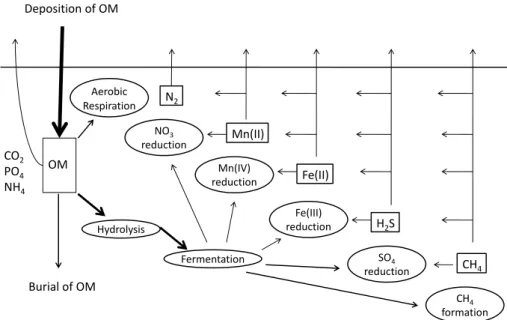
Fig. 1. Conceptual model of organic matter (OM) degradation pathways and re-oxidation pathways in marine sediments. Organic matter
degradation involves hydrolysis of macromolecular organic matter and fermentation to smaller compounds. These fermentation products are used by respiring micro-organisms and methanogens. Oxidants are utilized sequentially, first oxygen, then nitrate, metal oxides and sulphate. Dissolved reduced products (methane, sulphide, manganese (II) and iron (II)) diffuse upwards and are then oxidized. Some anaerobic re-oxidation pathways may not yet have been documented or unequivocally shown to be microbial mediated. However, anaerobic re-oxidation of methane by sulphate (Boetius et al., 2000) and nitrate (Raghoebarsing et al., 2006), and sulphide by metal oxides (Aller and Rude, 1988) and nitrate (Jørgensen, 2006) has been reported.
sequence is ultimately governed by thermodynamic energy yield, but it also depends on reaction kinetics and physiology of the micro-organisms involved (Burdige, 2006). If all ox-idants have been consumed, organic matter is anaerobically respired and fermented with the result that methane is gener-ated.
Mineralization of organic matter, in particular anaerobic respiration, results in the formation of various reduced sub-stance such as ammonium, iron (II), manganese (II), hy-drogen sulphide and methane (Fig. 1). These reduced sub-stances are normally efficiently re-oxidized within sediments because they contain a substantial amount of energy that was originally contained in the organic matter (Jørgensen, 1982). This guarantees optimal use of energy resources at the ecosystem level. Ammonium production from organic nitro-gen mineralization can be oxidized aerobically by bacteria and archaea (W¨uchter et al., 2006) or anaerobically by bac-teria (Anammox; Strous and Jetten, 2004). Dissimilatory re-duction of particulate metal oxides causes release of reduced iron and manganese in dissolved form. These are in turn efficiently oxidized by microbes using oxygen or nitrate as electron acceptors. Sulphate is the second most abundant an-ion in seawater and sulphate reductan-ion thus accounts for the majority of (anaerobic) mineralization in coastal sediments (Jørgensen, 1977, 1982, 2006; Soetaert et al., 1996). The
0% 10% 20% 30% 40% 50% 60% 70% 80% 90% 100%
R
e
spir
a
tion
pa
th
w
a
y
Oxygen (μM)
50 100 150 200 250 350
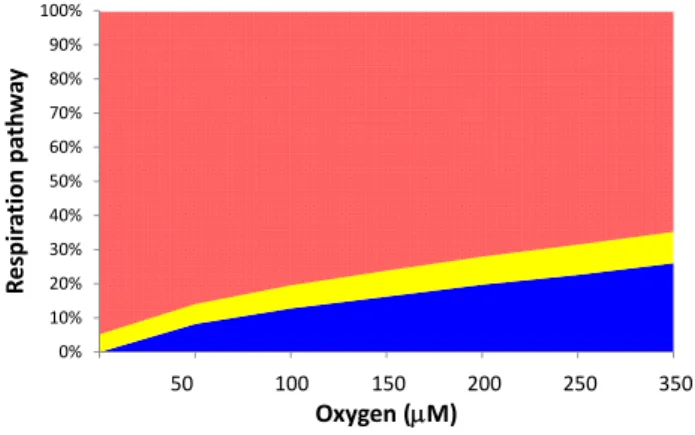
Fig. 2. Partitioning of community respiration among araerobic
res-piration (blue), denitrification (yellow) and anaerobic resres-piration (red) as function of bottom-water oxygen. Based on model sim-ulation of Middelburg et al. (1996).
Anaerobic mineralization dominates in most coastal sedi-ments because of high carbon loading, creating oxygen de-mands that are not balanced by oxygen supply (Soetaert et al., 1996). The associated high production rate of duced compounds implies a high demand of oxygen for re-oxidation processes. In fact, most of the oxygen consumption in coastal sediments can be attributed to re-oxidation pro-cesses with typically less than 25% of the oxygen consump-tion being due to aerobic respiraconsump-tion processes (Jørgensen, 1982; Heip et al., 1995; Soetaert et al., 1996; Glud, 2008). This limited importance of aerobic respiration processes for organic matter mineralization does not imply that bottom-water oxygen, and thus hypoxia, have limited impact on di-agenetic pathways (Fig. 2). In fact bottom-water oxygen availability is one of the main factors governing diagenetic pathways, sediment biogeochemistry and sediment-water ex-change fluxes, as well as the animal communities that influ-ence these processes.
2.2 The effect of oxygen on diagenetic pathways and sediment-water exchanges
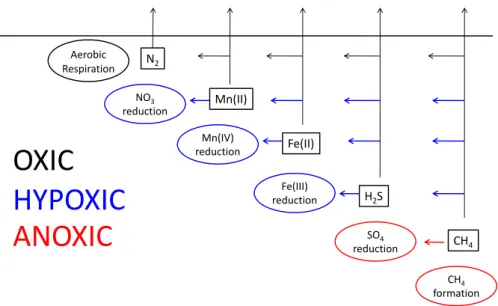
While discussing the effect of bottom-water oxygen concen-tration on diagenetic pathways, it is instructive to distinguish among oxic, hypoxic and anoxic settings (Fig. 3) and be-tween hypoxic settings with low and high nitrate. Oxic set-tings, i.e. coastal sediments underlying oxic (>63µM O2; >2 mg O2/l; >1.4 ml O2/l) bottom waters, are
character-ized by aerobic respiration by microbes and metazoans and re-oxidation of reduced components by oxygen as well as alternative oxidants. In hypoxic settings (<63µM O2; <2 mg O2/l; <1.4 ml O2/l) aerobic respiration and aerobic
oxidation processes are diminished, but anaerobic re-oxidation processes still operate based on nitrate and sulphate influxes and sedimentary stocks of metal oxides. In perma-nently anoxic settings (zero oxygen) and sulphidic settings
(zero oxygen and measurable free sulphide), sulphate reduc-tion and methanogenesis dominate mineralizareduc-tion because stocks of particulate oxidants have been exhausted (see be-low for an explanation) and anaerobic oxidation of methane coupled to sulphate reduction is the only major re-oxidation processes (Fig. 3).
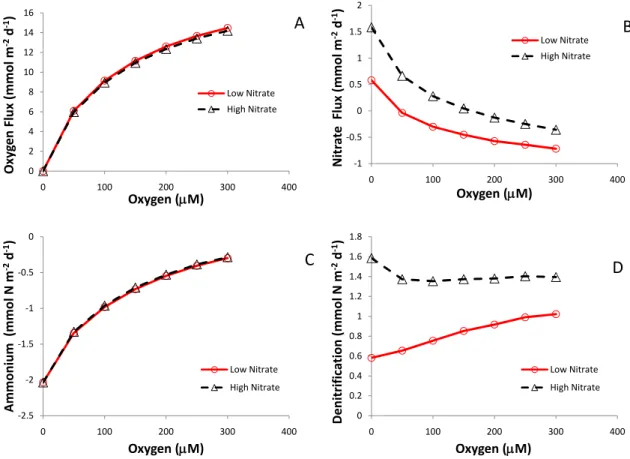
Bottom-water oxygen levels have a direct influence on rates of sediment oxygen consumption, aerobic respiration and re-oxidation reactions because oxygen gradients across the sediment-water interface are smaller at low oxygen con-centrations (Fig. 4a). This dependence of sediment oxy-gen uptake on sediment oxyoxy-gen concentrations has been ob-served on the Louisiana shelf (Rowe et al., 2002, 2008), in the Black Sea (Friedl et al., 1998) and along the ocean mar-gin off Washington State and Mexico (Hartnett and Devol, 2003) although the overriding control of carbon deposition may mask oxygen dependencies. Moreover, an oxygen de-pendency is also consistent with global-scale empirical re-lations (Cai and Reimers, 1995) and theoretical predictions based on the simple models incorporating zero-order uptake kinetics and diffusive transport (Bouldin, 1968).
The contribution of denitrification to organic matter min-eralization is rather constant among oxic, hypoxic and anoxic settings (Fig. 2), but the individual nitrogen species do show a significant dependence on bottom-water oxygen lev-els. Ammonium effluxes increase significantly when oxygen concentrations decline (Fig. 4c), because less of the nium produced is re-oxidized (i.e. nitrified). Higher ammo-nium effluxes under hypoxic conditions have been reported for a number of settings; e.g. Chesapeake Bay (Kemp et al., 1990, 2005), the Louisiana shelf (Childs et al., 2002; Mc-Carthy et al., 2008) and Danish coastal systems (Conley et al., 2007). These higher ammonium effluxes are not only due to less efficient nitrification due to hypoxia, but may also be related to higher mineralization rates and elevated levels of dissimilatory nitrate reduction to ammonium (DNRA; Mc-Carthy et al., 2008). Bottom-water oxygen also has a sig-nificant effect on nitrate fluxes, but it depends on the bottom-water nitrate concentration (Fig. 4b; Middelburg et al., 1996). In some hypoxic settings low oxygen bottom-waters are ac-companied by high nitrate concentrations (e.g. eastern Pa-cific borderland basins and shelves), whereas in some other settings low-oxygen bottom waters are also low in nitrate be-cause it has been consumed already. While most sediments in oxic settings are a source of nitrate to overlying water, they turn into nitrate sinks at low oxygen levels (Fig. 4b). Hy-poxic settings with high-nitrate bottom waters are a stronger sink than those with low-nitrate bottom waters. This oxygen-dependent switch between sediments acting as a sink and source for bottom-water nitrate is a clear example of how ecosystem functions may respond non-linearly to changing bottom-water conditions.
N2
Mn(II)
Fe(II)
H2S
CH4
Aerobic Respiration
NO3
reduction
Mn(IV)
reduction
Fe(III)
reduction
SO4
reduction
CH4
formation
OXIC
HYPOXIC
ANOXIC
Fig. 3.Conceptual picture of organic matter degradation and re-oxidation pathways in oxic, hypoxic and anoxic marine sediments. Sediments
underlying oxic bottom waters support aerobic respiration and re-oxidation of Mn (II), Fe (II), H2S and CH4by oxygen; these processes do
not occur in hypoxic and anoxic sediments. In sediments underlying permanently anoxic bottom waters reactive manganese and iron oxides stocks have been exhausted and organic matter degradation occurs by sulphate reduction and methane formation. While most of the methane formed is oxidized anaerobically, hydrogen sulphide may escape the sediments and enter the water column as has been reported in some systems.
production at low bottom-water nitrate levels can be at-tributed to a decrease in aerobic nitrification that can only be partly compensated by nitrate influxes (Fig. 4b). Conse-quently, in hypoxic systems where bottom-water nitrate con-centrations are very low, nitrate influxes can not compensate for decreases in aerobic nitrification and sedimentary denitri-fication may become very low (Kemp et al., 1990, 2005). In anoxic systems with no nitrate in the bottom-water, denitrifi-cation is consequently absent and most nitrogen is recycled in the form of ammonium. This ammonium is then oxidized aerobically or anaerobically at redox boundaries in the wa-ter column. Lam et al. (2007) reported anaerobic ammonium oxidation (anammox) coupled to archaeal and bacterial nitri-fication in the Black Sea basin.
The contribution of particulate oxidants such as manganese- and iron-oxides to organic matter mineral-ization depends in a complex way on sediment organic carbon loading, rates of particle mixing (bioturbation) and bottom-water oxygen levels (Thamdrup, 2000; Burdige, 2006). As oxygen concentrations in the bottom water decrease, the thin oxygenated surface layer of sediment decreases in thickness with the result that manganese (II) and iron (II) diffusing from more reduced layers at depth are less efficiently oxidized in oxygenated surface layers. Con-sequently, a large proportion of dissolved manganese and iron can escape to bottom waters (Sundby and Silverberg, 1985; Konovalov et al., 2007; Pakhornova et al., 2007). Less re-oxidation, hence less precipitation of manganese and iron oxides, lowers the recycling efficiency and thus
the contribution of metal oxides to organic matter degra-dation. Moreover, the escape of dissolved manganese (II) and iron (II) eventually results in sediments in hypoxic settings that are depleted in manganese and iron relative to sediments in oxic settings (Wijsman et al., 2001; Konovalov et al., 2007). Manganese-oxides are utilized at higher redox levels than iron-oxides (because of thermodynamics); manganese (II) is chemically oxidized less efficiently than iron (II) (because of kinetics) and manganese oxidation requires microbial mediation (Burdige, 2006). As a conse-quence of these differences in basic chemistry, manganese effluxes and depletion of sedimentary manganese stocks oc-cur at higher bottom-water oxygen levels than those of iron (Kristensen et al., 2003; Kristiansen et al., 2002). Another difference between sedimentary iron and manganese cycling and their dependence on oxygen relates to interactions with the sulphur cycle; these interactions are strong for iron and weak for manganese. Manganese oxide reduction can be coupled to oxidation of reduced sulphur compounds (Aller and Rude, 1988), but precipitation of manganese sulphides is unusual (e.g. Suess, 1979), whereas iron sulphide formation is one of the most common and important biogeochemical processes in sediments (Berner, 1984).
0 2 4 6 8 10 12 14 16
0 100 200 300 400
Ox yg e n Flux (mmol m ‐ 2d ‐ 1)
Oxygen (μM)
Low Nitrate
High Nitrate
‐1 ‐0.5 0 0.5 1 1.5 2
0 100 200 300 400
Nitr a te Flux (mmol m ‐ 2d ‐ 1)
Oxygen (μM)
Low Nitrate
High Nitrate
B
‐2.5 ‐2 ‐1.5 ‐1 ‐0.5 00 100 200 300 400
Ammonium (mmol N m ‐ 2d ‐ 1)
Oxygen (μM)
Low Nitrate
High Nitrate
C
0 0.2 0.4 0.6 0.8 1 1.2 1.4 1.6 1.80 100 200 300 400
Denitrifica tion (mmol N m ‐ 2d ‐ 1)
Oxygen (μM)
Low Nitrate
High Nitrate
A
D
Fig. 4.Fluxes of oxygen(A), nitrate(B)and ammonium(C)and rates of denitrification(D)as a function of bottom water oxygen
concen-trations for coastal sediments in low (10µM) and high (30µM) bottom-water nitrate settings. Positive fluxes indicate uptake and negative
fluxes release from sediments (Middelburg et al., 1996).
bottom waters, iron recycling is limited because of trapped iron in sulphide minerals. Increasing levels of oxygen in bot-tom waters increases iron recycling efficiencies from about 0.5 in anoxic systems (each mole of iron oxides arriving at sediment surface is used only once) to 0.9 in fully oxic sys-tems, where each iron molecule is cycled many times be-tween the zone of iron reduction at depth and iron oxida-tion in the surface layer (Fig. 5). This recycling efficiency primarily depends on bottom-water oxygen levels (Wijsman et al., 2001) and rates of bioturbation (Sundby and Silver-berg, 1985; Canfield et al., 1993; Thamdrup, 2000). Iron effluxes are maximal under hypoxic conditions because iron is trapped at lower oxygen levels and efficiently recycled and retained within sediments at higher oxygen levels (Pakho-mova et al., 2007). The manganese and iron mobilized from hypoxic sediments are often transported laterally to either more oxic settings where oxidation, precipitation and thus settling occurs or to fully anoxic settings where iron can be trapped by reaction with dissolved sulphide (Sundby and Sil-verberg, 1985; Wijsman et al., 2001; Severmann et al., 2008). This shuttle of iron and manganese from hypoxic to oxic or anoxic settings results not only in iron and manganese deple-tion of hypoxic sediments, but also in manganese enrichment
0 0.1 0.2 0.3 0.4 0.5 0.6 0.7 0.8 0.9 1
0 50 100 150 200 250 300 350
Ir on Flux (mmol m ‐ 2d ‐ 1) and R e cy cling E fficiency
Oxygen (μM)
Fig. 5.Sediment iron efflux (blue line with triangles) and recycling
efficiency (red dashed line with squares) as a function of bottom-water oxygen for coastal sediments (based on Wijsman et al., 2001).
in oxic settings (Sundby and Silverberg, 1985) and iron en-richment in anoxic settings (Wijsman et al., 2001; Anderson and Raiswell, 2004; Severmann et al., 2008).
cycle involves degradation of organic phosphorus, interac-tion of phosphate with sedimentary iron oxides, dissoluinterac-tion of fish debris and formation of authigenic apatite (Sundby et al., 1992; Slomp et al., 1996). The recycling efficiency of phosphate within sediments depends strongly on the avail-ability and cycling of iron oxides. Since the iron oxides with which phosphorus is associated show a strong dependence on bottom-water oxygen levels, a similar strong dependence is observed for phosphate. High fluxes of phosphate usually oc-cur conoc-currently with high fluxes of iron, either naturally or experimentally induced (Sundby et al., 1986), but not always because of iron trapping by sulphides. High phosphate fluxes under hypoxic and anoxic conditions have been reported for ocean-margin settings (Ingall and Jahnke, 1997), large to in-termediate coastal hypoxia such as found in the Chesapeake Bay (Kemp et al., 2005; Jordan et al., 2008), the Baltic Sea (Conley et al., 2003, 2009) and in smaller coastal systems (Rozan et al., 2002). This oxygen dependency of phosphorus cycling has received much attention since the 1940’s (Mor-timer, 1941) because of its implication for eutrophication and Earth System dynamics (Wallmann, 2003; Slomp and van Cappellen, 2007).
The effect of bottom-water oxygen on sulphur cycling is primarily related to the oxidative part of the sedimentary S-cycle because sulphate reduction dominates anaerobic miner-alization in most coastal sediments (Fig. 2; Jørgensen, 1982; Soetaert et al., 1996; Burdige, 2006). Lower bottom-water oxygen levels result in less oxidation of particulate and dis-solved reduced sulphur compounds with the result that more reduced sulphur is buried (high sulphide retention efficiency; Canfield, 1994; Passier et al., 1997) and that sulphide may es-cape from the sediments to the water column (Br¨uchert et al., 2003; Lavik et al., 2009). Hydrogen sulphide release from anoxic sediments has been reported for permanently anoxic systems such as the Black Sea and Cariaco basin as well as for more dynamic settings experiencing hydrogen-sulphide release events (Namibian coastal upwelling, Br¨uchert et al., 2003, Lavik et al., 2009; the Indian shelf, Naqvi et al., 2006). Recently, Lavik et al. (2009) reported detoxification of sul-phidic waters from the Namibian shelf by chemolithotrophs (of theγ- and β-proteobacteria) in the water column that completely consumed the sulphide and created a buffer zone between toxic, sulphidic subsurface waters and oxic sur-face waters. Sediment underlying hypoxic waters with high nitrate concentrations may support microbial communities comprised of large, nitrate-storing bacteria such as Beggia-toa spp. Thiomargarita spp. and Thioploca spp. that cou-ple nitrate reduction to reduced sulphur oxidation (Schulz and Jørgensen, 2001; Br¨uchert et al., 2003) These sulphur oxidizing, nitrate-storing bacteria often occur at high densi-ties forming thick mats that blanket the sediments. These mats represent specific hypoxic ecosystems that reduce sul-phide effluxes and host specialized protozoan and metazoan fauna (Br¨uchert et al., 2003; Bernhard et al., 2000). More-over, these giant bacteria also appear to a play a major role
in phosphorus cycling as they facilitate formation of authi-genic apatites in hypoxic and anoxic sediments (Schulz and Schulz, 2005).
3 The effect of bottom-water oxygen on sedimentary or-ganic matter
The question of whether organic matter is better preserved under conditions of anoxic bottom water has been much de-bated in geosciences because of its relevance for understand-ing the functionunderstand-ing of Earth system in the past and the forma-tion of oil source rocks (DeMaison and Moore, 1980; Ped-ersen and Calvert, 1990). Much of the discussion has fo-cused on unraveling and assessing the relative importance of bottom-water oxygen levels and high carbon inputs (i.e. pri-mary production) to organic carbon burial in marine sedi-ments (Tyson, 1995). These two governing factors are often difficult, if not impossible, to disentangle, because high or-ganic matter loadings usually induce hypoxic or anoxic con-ditions in bottom waters and hypoxia induces enhanced am-monium and phosphate effluxes (see Sect. 2.2) that may sus-tain high rates of primary production. The intense debate and many studies have resulted in a large body of knowledge and much correlative, but unfortunately often inconclusive, evidence. However, the accumulated evidence appears to fa-vor enhanced preservation potential under hypoxic to anoxic bottom waters (Moodley et al., 2005).
0 2 4 6 8 10 12
Coun
t
Anoxic
Oxic
0.2 0.6 1.0 1.4 1.8 2.2 2.6
mg
C
m
‐2A
0 2 4 6 8 10 12 14 16 18
Coun
t
Anoxic
Oxic
B
‐1.4 ‐1.2 ‐1.0 ‐0.8 ‐0.6 ‐0.4 ‐0.2
Degradation
Index
Fig. 6. The effect of oxygen on organic carbon to specific surface
areas(A)and organic matter quality as reflected in the amino acid
based degradation index(B). These data are based on sediment
sam-ples collected above, within and below the ocean minimum zone of the Arabian Sea (Vandewiele et al., 2009).
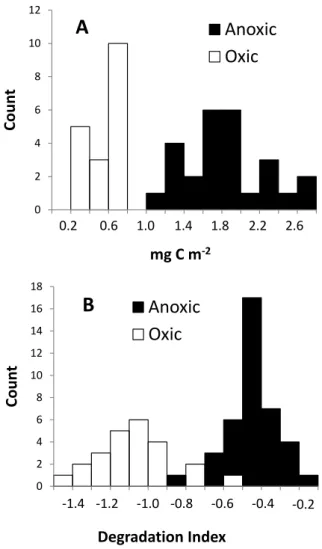
study of changes in sediment organic matter across the Pak-istan margin oxygen minimum zone (OMZ: 140–3200 m), Vandewiele et al. (2009) reported higher organic carbon con-tents per unit surface area in sediments underlying hypoxic and anoxic bottom water (Fig. 6a). Moreover, organic carbon contents were not correlated with surface areas as observed in oxic settings (Vandewiele et al., 2009). However, for the same sediments, Cowie et al. (2009) demonstrated variabil-ity in organic carbon content that was unrelated to oxygen, with the occurrence of maximal organic carbon contents un-der relatively oxidizing conditions towards the lower OMZ boundary (rather than at the OMZ core). These results indi-cate that factors other than oxygen contribute significantly as controls on organic carbon preservation (Cowie, 2005).
Such elevated OC/SS ratios in hypoxic and anoxic settings (Fig. 6a) imply a somewhat lower organic matter processing
efficiency at low oxygen levels. First-order degradation rate constants for oxic and anoxic degradation both show a sig-nificant relationship with the square of sediment accumu-lation rates (Toth and Lerman, 1977; Reimers and Suess, 1983), but with an offset between oxic and anoxic degrada-tion. This offset might suggest more efficient mineraliza-tion under oxic condimineraliza-tions, but this interpretamineraliza-tion has been questioned because of differences in methodology and dif-ferences in the age of the material degraded (Middelburg et al., 1993). Anaerobic mineralization normally occurs after aerobic mineralization and thus involves the less labile com-pounds remaining. There have been many laboratory inves-tigations in which the same organic material has been sub-jected to oxic and anoxic conditions. Most of these studies observed that degradation rates of labile organic matter are similar under oxic and anoxic conditions (e.g. Lee, 1992; Westrich and Berner, 1984). However, there is convincing evidence that refractory compounds require oxygen to be de-graded (e.g. Kristensen et al., 1995). Hulthe et al. (1998) incubated surface and subsurface sediments from a deposi-tional coastal environment and found that more refractory, older material may degrade faster when exposed to oxygen, in particular at low overall mineralization rates (Dauwe et al., 2001). Moodley et al. (2005) confirmed this oxygen depen-dence for ancient organic-rich layers from the Mediterranean and also showed that sulphide accumulation may inhibit min-eralization. Moreover, reaction of sulphide (or intermedi-ate sulphur compounds) with organic matter may enhance the preservation potential of organic matter (Damst´e and de Leeuw, 1990). Aller (1994) and Aller and Aller (1998) provided convincing evidence that alternating oxic-anoxic conditions result in more extensive mineralization than per-manently anoxic conditions. Intermittent oxygen exposure may result from alternating bottom-water conditions and an-imal activities within sediments, including intermittent bio-irrigation and particle transport from subsurface to surface layers.
Woulds et al. (2007, 2009) and Andersson et al. (2008) experimentally investigated the dependence of carbon pro-cessing, including respiration, on bottom-water oxygen con-centrations across an oxygen-minimum zone. They added
13C labeled phytodetritus to intact Pakistan margin sediments
containing live benthos (140 m to 1800 m) and traced the transfer of 13C to dissolved inorganic carbon, a measure of respiration, and to heterotrophs (bacteria, foraminifera and macrobenthic invertebrates). Phytodetritus processing was observed at all oxygen levels, but respiration rates were somewhat lower under hypoxic than oxic conditions. How-ever, this oxygen effect on respiration (based on dissolved inorganic carbon release) was secondary to the effect of tem-perature on respiration (Andersson et al., 2008). Bottom-water oxygen however, had a strong effect on the identity of the organisms involved in carbon processing, with di-minished metazoan contributions and greater foraminiferal contributions to carbon assimilation at reduced oxygen con-centrations (Woulds et al., 2007). Based on faunal re-sponses to oxygen shifts in time and space, they suggested an oxygen threshold between 5 and 7µM for the shift from foraminiferan/bacterial dominance of carbon processing to a significant macrofaunal contribution.
Most research on the effect of oxygen on sediment organic matter has focused on the quantity of organic matter buried, but there are also significant effects on the nature and qual-ity of the organic matter preserved. Geologists have studied the hydrogen index as a measure for preservation of organic material and have reported elevated hydrogen indices in sed-iments underlying hypoxic or anoxic waters (Cowie, 2005). Most biomarkers (organic molecules that serve as a proxy for environmental conditions or biogeochemical processes in the past) are better preserved under anoxic than oxic bottom wa-ters, implying enhanced preservation (Hoefs et al., 2002; Sin-ninghe Damst´e et al., 2002). Vandewiele et al. (2009) studied the amino-acid composition of sediments across the oxygen-minimum zone of the Pakistan margin in the Arabian Sea and used the degradation index (Dauwe et al., 1999) to quantify organic matter quality. Sediments deposited under hypoxic conditions were characterized by higher DI values than those deposited under oxic conditions on the shelf and in the deep sea (Fig. 6b). Vandewiele et al. (2009) attributed this differ-ence in organic matter quality to differdiffer-ences in preservation and bacterial processing. Accordingly, sediments deposited under low-oxygen bottom waters are characterized by higher amounts of organic matter that is also of higher quality. How-ever, most examples presented in this section are from ocean-margin and deep-sea environments, i.e. more stable depo-sition regimes, and it remains to be seen whether bottom-water oxygen concentrations play such a prominent role in dynamic, alternating oxic-anoxic settings (Aller, 1994). For instance, Hartnett et al. (1998) have shown very high vari-ability (from near zero to >60%) in burial efficiencies of coastal sediments with short oxygen- exposure times.
4 Bottom-water oxygen, macrobenthos and sediment
biogeochemistry
4.1 Macrobenthos and sediment biogeochemistry
Animals living at or in the sediments not only depend on the resources and conditions above and within the sediments, but also modify the texture and geochemistry of their environ-ment (Meysman et al., 2006). Suspension-feeding animals capture food particles from the water column; the labile frac-tion is used for growth and respirafrac-tion and a more refrac-tory fraction is deposited in the form of faeces or pseudofae-ces. This biodeposition flux of carbon to the seafloor varies spatially due to patchiness in suspension-feeder distributions, can locally dominate carbon delivery to the seafloor and con-stitutes an efficient coupling of benthic and pelagic processes (Herman et al., 1999). Animals feeding on resources at the sediment surface (surface-deposit feeders) or within the sed-iment (surface- and subsurface-deposit feeders) have signif-icant effects not only on organic carbon (by consuming it) and other organisms (by grazing and predation), but also via modification of sediment texture and structure, bio-irrigation and particle mixing (Aller and Aller, 1998; Herman et al., 1999; Meysman et al., 2006; van Nugteren et al., 2009). Animals in and on the seabed influence sediment and solute properties. Animals can alter sediment porosity, permeabil-ity, particle size, cohesion, and organic content and, perhaps more importantly, their spatial heterogeneity and thus gen-erate niches for smaller organisms (microbes, micro-, meio-and macrobenthos) (Aller, 1984; Reise, 1985; Levin et al., 1997; van Nugteren et al., 2009).
Bioturbation, the enhanced dispersal of particles result-ing from sediment reworkresult-ing by burrowresult-ing animals, is due to tube construction, burrowing, feeding and relocation of animals (Meysman et al., 2005, 2008). Particle displace-ment has many consequences for sedidisplace-ment biogeochemistry: e.g. labile organic matter is transported downward and di-luted into a larger pool of refractory carbon and metal ox-ides delivered to or formed in the surface layer may be trans-ported downward to more reduced layers (Sundby and Silver-berg, 1985; Thamdrup et al., 1994; Ferro et al., 2003; Bur-dige, 2006). Conversely, reduced products such as iron sul-phide (pyrite) may be mixed from subsurface to surface lay-ers where they are then oxidized by oxygen, nitrate or other oxidants (Berner and Westrich, 1985; Aller and Rude, 1988; Meysman and Middelburg, 2005). Accordingly, sedimentary iron and manganese cycling depend strongly on particle mix-ing as particulate metal oxides are transferred downwards to more reduced layers and particulate reduced forms (pyrite, manganese carbonates) are mixed upwards to zones of re-oxidation (Thamdrup, 2000; Burdige, 2006). Sedimentary sulphur and phosphorus cycles also depend strongly on bio-turbation because they are tightly linked to particulate iron phases (see Sect. 2).
Other effects of sediment-dwelling animals include the en-hancement of surface biofilms and mucous deposition, which may alter biogeochemical fluxes and create highly reactive substrates. The potential of animals, their exudates and their structures to alter surface roughness, critical erosion veloci-ties and other stability properveloci-ties (Widdows et al., 2004) all feed back to many of the properties discussed above.
4.2 Effect of oxygen on macrobenthos and
conse-quences for sediment biogeochemistry
Hypoxia affects the behavior, physiology, and ecology of soft-bottom invertebrate communities in ways that translate ultimately to reduced bioirrigation and bioturbation and loss of structural spatial heterogeneity and surface roughness. While standard definitions of hypoxia are often given, thresh-old effects vary among taxa, life stages, and settings, and sublethal effects often occur at much higher oxygen lev-els (e.g. 100µM) (Vaquer-Sunyer and Duarte, 2008; Levin et al., 2009a, b). At the most fundamental levels, a shift from normoxia to hypoxia will result in migration (away) of large, mobile invertebrates, mortality of selected taxa, emergence and a shallowing of infaunal activities within the sediment column of all but the most hypoxia-tolerant taxa (Pihl et al., 1992; Rabalais et al., 2001a, b; see also Levin et al., 2009). Hypoxia lowers the density and biomass of megafaunal- and selected macrofaunal-size organisms, lead-ing to a smaller community body-size structure (Levin 2003; Quiroga et al., 2005). Echinoderms and most crustaceans are particularly affected by oxygen depletion, while annelids, mollusks and cnidarians are typically more tolerant (Rosen-berg et al., 1991; Diaz and Rosen(Rosen-berg, 1995). Because
respiration and re-oxidation of reduced compounds typically drives pH down at the same time it drives oxygen down, an-imals with carbonate skeletons or shells (e.g. echinoderms and many mollusks) may be negatively affected. Depend-ing on the severity and duration of hypoxia, nearly complete mortality of the benthic fauna can occur in coastal settings seasonally (e.g. Mountford, 1977). However, commonly small macrofauna and meiofauna will persist (Levin, 2003; Neira et al., 2001; Sellanes et al., 2003; Sellanes and Neira, 2006; Sellanes et al., 2007); often these are opportunistic taxa with short generation times (Dauer et al., 1992). Under severe dysoxia or anoxia, filamentous, mat-forming bacte-ria (Jørgensen and Gallardo, 1999), calcareous foraminifera, nematodes and branchiate, and soft-bodied annelids are typ-ically favored (reviewed in Levin, 2003; Guttierez et al., 2008). High surface area to volume ratios enhance oxygen diffusion; such ratios are imparted by long thin morpholo-gies and masses of tentacles, palps or branchiae (Lamont and Gage, 2000).
Species and functional diversity of benthic faunas are re-duced under hypoxic conditions. Reduced species rich-ness is accompanied by high dominance; communities may be comprised of a very few, but highly abundant species. Usually surface-deposit feeders are favored over subsurface or suspension feeders (e.g. Gutierrez et al., 2000; Levin et al., 2000), although some carnivorous, epifaunal species such as polynoid polychaetes may persist. Large sediment-dwelling megafauna such as thalassinid shrimp, echiurans, enteropneusts, and burrowing bivalves and sipunculans are important sources of hetereogeneity, creating multiple micro-niches for smaller taxa (Reise, 1985). They are lost at reduced oxygen levels and sediment assemblages become much more homogeneous (Levin et al., 2000). Loss of struc-tures formed by foundation species such as seagrass beds (Duarte, 1995; Burkholder et al., 2007), oyster reefs (Bre-itburg et al., 2001) or mussel beds (Mee et al., 2005) also reduces heterogeneity, curtails benthic-pelagic coupling and exacerbates hypoxia-induced species loss.
involves a complete halt of bioturbation and the formation of sediment laminae (Rhoads and Boyer, 1982; Schaffner et al., 1992). The palaeo literature is replete with discus-sion of oxygen effects on trace (ichno) fossils and lamination (Rhoads and Morse, 1971; Savrda et al., 1984; Savrda and Bottjer, 1987, 1991). Trends in abundance, size, diversity and vertical distribution mirror those discussed for modern faunas (see Gooday et al., 2009). Loss of fauna combined with development of thick bacterial mats that inhibit diffu-sion of oxygen from the overlying water can lead to more stagnant conditions and buildup of microbial wastes (ammo-nium, sulphide), creating an environment inhospitable to aer-obic eukaryotes. However the interplay of oxygen, tempera-ture, sulphide buildup and food availability appears to modu-late the responses of benthic communities to specific oxygen conditions (Olenin, 1997; Levin et al., 2009a; Vaquer-Sunyer and Duarte, 2008).
The hypoxia-induced changes in benthic community structure and functioning have major consequences for sed-iment biogeochemistry via their effects on the intensity and depth distribution of bio-irrigation and particle mixing, and changes in flow dynamics at the sediment-water interface. These interactions among hypoxia, benthos and biogeochem-istry are complex and often non-linear (e.g. Aller, 2001). In shallow waters, interface and surface-deposit feeders are generally favored over subsurface-deposit feeders if bottom-water oxygen levels decline (Pearson and Rosenberg, 1978; Levin et al., 2009b). Particle mixing and bio-irrigation are consequently restricted to surface layers of sediment. Con-sequently, less organic matter is mixed downward and more labile organic matter is degraded at the surface, i.e. within the zone in diffusional exchange with the overlying water. This shortening of diffusion distances implies more efficient re-generation of nutrients (Aller and Aller, 1998). Shallower particle mixing also implies less efficient re-oxidation of iron sulphide formed at depth in the sediment. Sulphide burial and retention efficiencies increase at the expense of re-oxidation because the latter requires particle transport from the reduced, deeper to oxygenated, surface layers (Berner and Westrich, 1985). Loss of irrigating animals likely low-ers oxygen uptake because their consumption rates are often transport limited in coastal systems with abundant quantities of labile organic matter (Glud, 2008). Whether the loss of bioirrigation activity results in an increase or decrease of am-monium, manganese and iron effluxes is largely unknown and is system-specific because it depends on the balance between reduced re-oxidation (due to reduced oxygen sup-ply) and reduced removal of metabolites by burrow flushing (Aller, 2001). Metabolites may accumulate in pore-waters if bio-irrigation is less or shallower due to hypoxia. Accu-mulation of metabolites in pore-water may prevent settling of other organisms and in this way have consequences for population dynamics, ecosystem functioning and sediment biogeochemistry (Marinelli and Woodin, 2002).
The consequences of hypoxia-induced macrofauna diver-sity loss on biogeochemistry are multiple but poorly docu-mented. Many studies have examined the relationship be-tween macrofauna diversity and sediment metabolism or sediment-water exchange fluxes These studies showed that animal-diversity-biogeochemistry relationships are highly complex. They can be linear or non-linear (Mermillod-Blondin et al., 2005; Norling and Kautsky, 2007), idiosyn-cratic and depend on the context (Emmerson et al., 2001; Rossi et al., 2008), and vary with species identity, biomass and density (e.g. Aller and Yingst, 1985; Ieno et al., 2006; Waldbusser and Marinelli, 2006; Marinelli and Williams, 2003). Most of these studies were based on analyses of sin-gle species or artificially constructed assemblages of species. Recently, Rossi et al. (2008) investigated diversity – biogeo-chemistry relationships during macrofaunal recovery after deliberately induced anoxia. They showed that differences in diversity due to hypoxia result in differences in sediment-water exchange fluxes of nutrients. Sediment-water ex-change fluxes are governed by the balance between fauna-generated transport processes and microbe-mediated trans-formation processes (Meysman et al., 2005, 2006). To under-stand faunal diversity effects on sediment biogeochemistry therefore requires unraveling the effect of fauna on microbes via transport processes and food-web interactions (bacterial grazing), and understanding the feedback of microbes on fau-nal functioning. For instance, sulphate-reducing microbes generate sulphide that is toxic for many animals or that may impede their functioning (Hargraves et al., 2008), while re-duced sulphur oxidizing or sulphur disproportionating bac-teria detoxify the sediment so that is habitable for animals (Pearson and Rosenberg, 1978; Levin et al., 2009). Before we can understand the effect of oxygen via metazoan diver-sity on sediment biogeochemistry, it is necessary to elucidate the many trophic, competitive and non-competitive interac-tions between fauna and microbes (e.g. competition for labile organic matter, facilitation of transport via bioturbation, cre-ation of niches via burrow construction, grazing etc.; Levin et al., 1997; Meysman et al., 2005, 2006; Rossi et al., 2008, 2009).
5 Dynamics of sediment biogeochemistry and coastal
hypoxia
5.1 Pelagic-benthic coupling and coastal hypoxia
and re-oxidation reactions become less important and even-tually may take place only in the water column. Initially ni-trate may accumulate in hypoxic bottom waters (as observed in low-oxygen waters of the Eastern Pacific Basin) because nitrification in bottom waters (rather than sediments) outbal-ances enhanced nitrate uptake by the sediments (Soetaert and Middelburg, 2009). However, during prolonged periods of hypoxia, nitrification shallows in the water column and bot-tom waters become low in nitrate with the consequence that sediment denitrification decreases (Kemp et al., 1990, 2005; Childs et al., 2002). This loss of denitrification implies a higher recycling efficiency of nitrogen at the ecosystem level and may sustain or enhance algal blooms (Kemp et al., 2005). Hypoxia also results in release of manganese (II), iron (II) and elements such as phosphorus that are intimately linked to metal oxides in the water column. These reduced metals are transported to the redoxcline in the water column where (microbial) oxidation occurs (e.g. Black Sea; Konavalov et al., 2006; Lewis et al., 2007; Cariaco Basin; Percy et al., 2008). Part of the phosphate released from sediments will attach to the newly formed iron oxides (Shaffer, 1986), an-other part may sustain or enhance algal blooms (Rozan et al., 2002; Kemp et al., 2005). This enhanced recycling of am-monium and phosphate under hypoxic bottom-waters may lead to secondary eutrophication phenomena (Cloern, 2001; Kemp et al., 2005), including harmful algal blooms (Ma et al., 2006). This hypoxia-related enhanced regeneration of nutrients, in particular phosphorus, and basin-wide conse-quences for plankton communities and biogeochemical pro-cesses have been very well been documented in the Baltic Sea (Conley et al., 2009).
Little oxidation of reduced sulphur occurs in sediment underlying anoxic bottom waters and part of the hydrogen sulphide escapes sediments and is then oxidized in the wa-ter column (Black Sea; Konovalov et al., 2006; Cariaco Basin; Taylor et al., 2001; Delaware Inland Basins; Luther et al., 2004; Mariager Fjord; Zopfi et al., 2001; Namibian shelf; Lavik et al., 2009). This oxidation of reduced sulphur may occur aerobically or anaerobically with nitrate, resulting in an anoxic layer that separates oxic and sulphidic waters (Lavik et al., 2009). Moreover, Konovalov et al. (2003) have reported catalytic manganese oxide cycles in suboxic zones that are important to oxidation of sulphide. These oxidation processes can take place below and in the photic zone. Green pigmented sulphur oxidizing bacteria require light and hy-drogen sulphide and are often found in the lower part of the photic zone where hydrogen sulphide diffuses from below (e.g. Black Sea; Overmann et al., 1992; Damst´e et al., 1993). This temporal evolution from oxic, via hypoxic, to anoxic bottom-water conditions and the associated transition of anaerobic respiration and re-oxidation reactions from sed-iments to the water column can develop over very long times. It eventually results in permanent anoxia as seen in the Black Sea and Cariaco Basin (Damst´e et al., 2003), but can also be interrupted by natural (e.g. Baltic Sea; Conley
et al., 2002; Peru shelf; Gutierrez et al., 2008; Santa Bar-bara basin; Sholkovitz and Gieskes, 1971) or deliberately induced oxidation events (Luther et al., 2004). Each inter-ruption of the longer-term evolution to anoxic bottom water results in re-introduction of biogeochemical processes occur-ring at higher oxidation levels. For instance, advection of oxygenated North Sea water into the Baltic sea anoxic basins results in a cascade of reactions with consequences for nitro-gen cycles (Voss et al., 1998), formation of particulate man-ganese and iron oxides and cycling of phosphorus and sul-phur (Yakushev et al., 2007). Similar, responses have been reported for intrusions of Mediterranean water into the upper part of the Black Sea (Glazer et al., 2006). Temporal vari-ability in bottom-water oxygen levels can have major con-sequences for iron and manganese biogeochemistry of sedi-ments (Lyons et al., 1993; Wijsman et al., 2001; Kristensen et al., 2003), but the nature of the response depends strongly on previous exposure time to hypoxic or anoxic bottom wa-ters.
5.2 Duration of exposure to hypoxia matters for biogeo-chemical response
(a) (b)
Oxic
Hypoxic
Anoxic
Oxic
Hypoxic
Anoxic
Biog
eochemic
al
Pr
ocess
Ben
thic
Community
I
II
III
O2Profiles
Deep Irrigation Denitrification
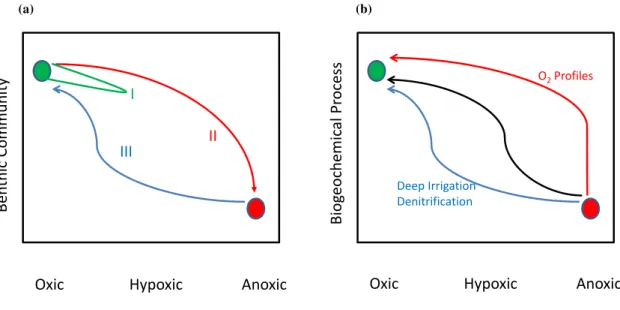
Fig. 7. (a)Conceptual model of benthic community response to hypoxia (based on Diaz and Rosenberg, 2008). Trajectory I occurs when
benthos is exposed to moderate hypoxia, trajectory II occurs when animals die upon increasing hypoxia and trajectory III represent the return
path from anoxia and involves successional dynamics of fauna. (b)Conceptual model of ecosystem functioning/biogeochemical process
recovery following anoxia and associated mortality of organisms.
accumulation in bottom waters (Luther et al., 2004). The duration, intensity and frequency of hypoxia play a major role as coupled nitrification-denitrification can be restored to previous levels during seasonal hypoxia, while after a long period of anoxia (with loss of faunal groups) denitrification will remain low following re-oxygenation of the water col-umn (Hietanen and Lukkari, 2007; Conley et al., 2009).
Katsev et al. (2007) studied the response of St. Lawrence River estuary sediment to progressive oxygen depletion over a decadal timescale. They calibrated a dynamic diagenetic model with data acquired over the last 30 years and then made model projections for the next 80 years (i.e. the period remaining before the system will turn anoxic given present-day decreases in oxygen concentrations). Consistent with short-term and seasonal responses to oxygen depletion, they predicted enhanced accumulation of iron sulphides, effluxes of iron (II) and manganese (II) and rather uniform levels of denitrification (consistent with Figs. 2 and 4). However, model-predicted phosphate effluxes were also rather con-stant because the seasonal iron-phosphate buffer is not effec-tive and phosphate effluxes balance the differences between phosphorus deposition and burial (Katsev et al., 2007).
This study also highlighted another aspect of sediment bio-geochemical response to slowly decreasing oxygen levels in bottom waters; i.e. the time required to reach steady-state is much longer than the actual period of decreasing oxygen levels. This indicates that steady-state approaches should be adopted with some reservation and that diagenetic history in-fluences the actual response. Because of its storage capac-ity for particulate and dissolved components, sediment is an important reservoir and by slowly exchanging material with
the overlying water, may influence long-term system behav-ior. Soetaert and Middelburg (2009) explored the response of hypoxic coastal systems to lowered nitrogen loadings and concluded that internal nitrogen loading (sediment nitrogen release) delays nitrogen restoration. Similar delays in system recovery to reduced-phosphorus loadings by internal loading in the sediment have been shown for certain lakes (Jeppesen et al., 2005). Turner et al. (2008) investigated the sensitiv-ity of Gulf of Mexico hypoxia to nitrogen loading and ob-served that organic matter and nitrogen accumulated in sedi-ment from previous years had increased the potential hypoxia development for a given nitrogen input to the system. A simi-lar legacy of eutrophication has been reported for phosphorus loadings in the Baltic Sea (Conley et al., 2002).
5.3 Dynamics of faunal response to hypoxia and sedi-ment biogeochemistry
its initial state (trajectory I in Fig. 7a). This resilience of benthic communities depends not only on the intensity of hy-poxia, but also on the temporal and spatial scales of hypoxia. Recovery from small-scale hypoxic events is usually fast be-cause of animal migration (as adults or larvae) from adjacent areas (Norkko et al., 2006). Long-term exposure to severe hypoxia and anoxia causes mortality of animals (trajectory II in Fig. 7a) and most metazoans are eventually eliminated. If the areal cover is extensive, the surroundings can no longer provide source propagules. The recovery trajectory (III in Fig. 7a) from severe hypoxia or anoxia is different than the decline path because the recovery involves successional dy-namics (colonizing opportunistic species are eventually re-placed by equilibrium species; van Colen et al., 2008; Rossi et al. 2008, 2009). This hysteresis due to macrobenthos mor-tality and recovery involving succession occurs when the du-ration and/or intensity of hypoxia is high (Rosenberg et al., 2002). There is thus an oxygen threshold below which hys-teresis in macrofauna community recovery occurs. Depend-ing on the system, the duration and intensity of hypoxia, the recovery may take many years (Diaz and Rosenberg, 2008).
During initial stage of hypoxia there are behavioural and physiological adaptations of organism such as shallowing of deposit-feeding organisms (Pearson and Rosenberg, 1995) and enhancement of pore-water ventilation rates to main-tain oxygen in the burrows (Forster et al., 1995). These be-havioural changes have consequences for bioturbation and bio-irrigation modes, intensities and depth-distribution pat-terns. However, when the hypoxia threshold has been passed and animals experience mortality, then biologically-induced particle mixing and solute transport rates become zero, with major consequences for sediment biogeochemistry. The re-installment of bioturbation and bioirrigation during macro-fauna recovery has not been studied but these macro-fauna-mediated transport modes will depend on the system-specific succes-sional dynamics. The first colonizers are often small-sized, interface/surface deposit feeders (Rhoads, 1994; van Colen et al., 2008) and bioturbation will consequently be shallow and limited (bioturbation intensity scales with size squared; Meysman et al., 2003). Subsurface- deposit feeders and large, deep-burrowing animals appear later in the recovery trajectory and then bioturbation and bio-irrigation activities are expected to increase. Biogeochemical modellers have employed linear and highly non-linear dependencies of bio-irrigation and bioturbation depth and intensities on bottom-water oxygen levels (Morse and Eldridge, 2007; Soetaert and Middelburg, 2009). Katsev et al. (2007) showed that ad-ditional knowledge about the response of bioturbation and bio-irrigation to hypoxia is necessary to further our predic-tive capabilities concerning the effect of oxygen on sediment biogeochemistry.
Biogeochemical dynamics during recovery from severe hypoxia is complicated by a basic lack of knowledge on the return of bioturbation and bioirrigation transport patterns, and on the interaction of fauna with the stock of reduced
(sulphur) compounds that have accumulated during anoxic periods. Complete elimination of fauna results in enhanced accumulation and retention of reduced sulphur in sediments. Initial colonizers have to deal with high sulphide concen-trations that are toxic to many species and appearance of other species may in part depend on the detoxification of strongly reduced sediments by shallow bioturbators (Pear-son and Rosenberg, 1978; Rhoads, 1974) or by sulphide-oxidizing microbes. Figure 7b shows a conceptual model for recovery of biogeochemical processes following a pe-riod of severe hypoxia or anoxia with elimination of animals. Biogeochemical processes that primarily depend on molec-ular diffusion of dissolved oxidants such as oxygen are ex-pected to become established within one-two days depending on the diffusion distance and the dynamics of the microbes involved. Montserrat et al. (2008) showed that benthic mi-croalgal communities were reestablished within two weeks following anoxia for more than 6 weeks. Biogeochemical processes that depend on interface feeders and shallow bio-turbators are expected to recover on time scales of weeks to months, while microbial processes that depend on particle mixing or pore-ventilation by large, deep living animals may need years to fully recover (Fig. 7b). While there are very few data to support or falsify this conceptual model for re-covery of biogeochemical processes, it is clear that microbial recovery, despite the inherent fast turnover of microbial pop-ulations, may take months because their recovery depends on the return of animal-induced transport processes.
While biogeochemical processes in hypoxic waters and sediments of the coastal zone are complex, they hold great significance for many large-scale phenomenon of concern. On short time scales, cycles of nutrient regeneration, pri-mary, secondary and fisheries production are all affected by biogeochemical pathways. On longer times scales, car-bon sequestration and burial and even the formation of en-ergy reservoirs are under biogeochemical control, with mi-crobes as the primary agents of change. As global change brings declining oxygen concentrations in coastal and shelf waters, greater understanding of animal-microbe interactions and feedbacks under different oxygen scenarios, and their mediation of biogeochemical processes, will facilitate pre-dictions, conservation and management of coastal resources.
Acknowledgements. We thank SCOR for supporting the working
group 128 and the members of this SCOR working group for exchange of ideas and providing a stimulating environment. Referees G. Luther and G. Cowie and editor W. Naqvi are thanked for constructive feedback. This research was partly funded by the US National Science Foundation, the Netherlands Organisation for Scientific Research and contributions to the EU supported HYPOX project. This is publication 4573 of the Netherlands Institute of Ecology, Yerseke.
References
Aller, R. C.: Quantifying solute distributions in the bioturbated zone of marine sediments by defining an average micro environment, Geochim. Cosmochim. Ac., 44, 1955–1965, 1980.
Aller, R. C.: The importance of relict burrow structures and bur-row irrigation in controlling sedimentary solute distributions, Geochim. Cosmochim. Ac., 48, 1929–1934, 1984.
Aller, R. C.: Bioturbation and remineralization of sedimentary or-ganic matter – Effects of redox oscillation, Chem. Geol., 114, 331–345, 1994.
Aller, R.C. : Transport and reactions in the bioirrigated zone, in: The benthic boundary layer: transport processes and biogeo-chemistry, edited by: Boudreau, B. P. and Jørgensen, B. B., pp. 269–301, 2001.
Aller, R. C. and Rude, P. D.: Complete oxidation of solid-phase sul-phides by manganese and bacteria in anoxic marine sediments, Geochim. Cosmochim. Ac., 52, 751–765, 1988.
Aller, R. C. and Yingst, J. Y.: Effects of the marine deposit feeders Heteromastus-Filiformis (Polychaeta), Macoma-Balthica (Bi-valvia), and Tellina-Texana (Bivalvia) on averaged sedimentary solute transport, reaction rates, and microbial distributions, J. Mar. Res., 43, 615–645, 1985.
Aller, R. C. and Aller, J. Y.: The effect of biogenic irrigation inten-sity and solute exchange on diagenetic reaction rates in marine sediments, J. Mar. Res., 56, 905–936, 1998.
Anderson, J. J. and Devol, A. H.: Extent and intensity of the anoxic zone in basins and fjords, Deep-Sea Res. Pt. I, 34, 927–944, 1987.
Anderson, T. F. and Raiswell, R.: Sources and mechanisms for the enrichment of highly reactive iron in euxinic Black Sea sedi-ments, Am. J. Sci., 304, 203–233, 2004.
Andersson, J. H., Woulds, C., Schwartz, M., Cowie, G. L., Levin, L. A., Soetaert, K., and Middelburg, J. J.: Short-term fate of phy-todetritus in sediments across the Arabian Sea Oxygen Minimum Zone, Biogeosciences, 5, 43–53, 2008,
http://www.biogeosciences.net/5/43/2008/.
Archer, D. and Devol, A.: Benthic oxygen fluxes on the Washington Shelf and Slope – a comparison of I in situ microelectrode and chamber flux measurements, Limnol. Oceanogr., 37, 614–629, 1992.
Bagarinao, T.: Sulphide as an environmental factor and toxicant: tolerance and adaptations in aquatic organisms, Aquat. Toxicol., 24, 21–62, 1992.
Berner, R. A.: Early diagenesis: A theoretical approach, Princeton Univ. Press, 1980.
Berner, R. A.: Sedimentary pyrite formation – an update, Geochim. Cosmochim. Ac., 48, 605–615, 1984.
Berner, R. A. and Westrich, J. T.: Bioturbation and the early diage-nesis of carbon and sulphur, Am. J. Sci., 285, 193–206, 1985. Bernhard, J. M., Buck, K. R., Farmer, M. A., and Bowser, S. S.:
The Santa Barbara Basin is a symbiosis oasis, Nature, 403, 77– 80, 2000.
Boetius, A., Ravenschlag, K., Schubert, C. J., Rickert, D., Wid-del, F., Gieseke, A., Amann, R., Jorgensen, B. B., Witte, U., and Pfannkuche, O.: A marine microbial consortium apparently me-diating anaerobic oxidation of methane, Nature, 407, 623–626, 2000.
Bouldin, D. R.: Models for describing diffusion of oxygen and other mobile constituents across mud-water interface, J. Ecol., 56, 77–
87, 1968.
Breitburg, D. L., Pihl, L., and Kolesar, S. E.: Effects of low dis-solved oxygen on the behavior, ecology and harvest of fishes: A comparison of the Chesapeake Bay and Baltic-Kattegat Sys-tems, in: Coastal and Estuarine Studies: Coastal Hypoxia Con-sequences for Living Resources and Ecosystems, edited by: Ra-balais, N. N. and Turner, R. E., American Geophysical Union, Washington, D. C., 293–310, 2001.
Br¨uchert, V., Jorgensen, B. B., Neumann, K., Riechmann, D., Schlosser, M., and Schulz, H.: Regulation of bacterial sulphate reduction and hydrogen sulphide fluxes in the central Namibian coastal upwelling zone, Geochim. Cosmochim. Ac., 67, 4505– 4518, 2003.
Br¨uchert, V.: Early diagenesis of sulfur in estuarine sediments: The role of sedimentary humic and fulvic acids, Geochim. Cos-mochim. Ac., 62, 1567–1586, 1998.
Burdige D. : Geochemistry of Marine Sediments, Princeton Univer-sity Press, 2006.
Burkholder, J. M., Tomasko, D. A., and Touchette, B. W.: Sea-grasses and eutrophication, J. Exp. Mar. Biol. Ecol., 350, 46–72, 2007.
Cai, W. J. and Reimers, C. E.: Benthic oxygen flux, bottom water oxygen concentration and core top organic carbon content in the deep northeast Pacific Ocean, Deep-Sea Res. Pt. I, 42, 1681– 1699, 1995.
Canfield, D. E., Jorgensen, B. B., Fossing, H., Glud, R., Gundersen, J., Ramsing, N. B., Thamdrup, B., Hansen, J. W., Nielsen, L. P., and Hall, P. O. J.: Pathways of organic-carbon oxidation in 3 continental margin sediments, Mar. Geol., 113, 27–40, 1993. Canfield, D. E.: Factors Influencing organic carbon preservation in
marine sediments, Chem. Geol., 114, 315–239, 1994.
Canfield, D. E.: Sulphate reduction and oxic respiration in marine sediments – Implications for organic carbon preservation in eux-inic environments, Deep-Sea Res. Pt. I, 36, 121–138, 1989. Childress, J. J. and Seibel, B. A.: Life at stable low oxygen
lev-els: adaptations of animals to oceanic oxygen minimum layers, J. Exp. Biol., 201, 1223–1232, 1998.
Childs, C. R., Rabalais, N. N., Turner, R. E., and Proctor, L. M.: Sediment denitrification in the Gulf of Mexico zone of hypoxia, Mar. Ecol.-Prog. Ser., 240, 285–290, 2002.
Cloern, J. E.: Our evolving conceptual model of the coastal eutroph-ication problem, Mar. Ecol.-Prog. Ser., 210, 223–253, 2001. Conley, D. J., Carstensen, J., Aertebjerg, G., Christensen, P. B.,
Dalsgaard, T., Hansen, J. L. S., and Josefson, A. B.: Long-term changes and impacts of hypoxia in Danish coastal waters, Ecol. Appl., 17, 165–184, 2007.
Conley, D. J., Humborg, C., Rahm, L., Savchuk, O. P., and Wulff, F.: Hypoxia in the Baltic Sea and basin-scale changes in phos-phorus biogeochemistry, Environ. Sci. Technol., 36, 5315–5320, 2002.
Conley, D. J., Bjorck, S., Bonsdorff, E., Carstensen, J., Destouni, G., Gustafsson, B. G., Hietanen, S., Kortekaas, M., Kuosa, H., Meier, H. E. M., Muller-Karulis, B., Nordberg, K., Norkko, A., Nurnberg, G., Pitkanen, H., Rabalais, N. N., Rosenberg, R., Savchuk, O. P., Slomp, C. P., Voss, M., Wulff, F., and Zillen, L.: Hypoxia-related processes in the Baltic Sea, Environ. Sci. Technol., 43, 3412–3420, 2009.
Chesa-peake Bay: Seasonal patterns, controlling factors and ecological significance, Estuaries, 19, 562–580, 1996.
Cowie, G.: The biogeochemistry of Arabian Sea surficial sedi-ments: A review of recent studies, Prog. Oceanogr., 65, 260–289, 2005.
Cowie, G. L., Mowbray, S., Lewis, M., Matheson, H., and McKen-zie, R.: Carbon and nitrogen elemental and stable isotopic com-positions of surficial sediments from the Pakistan margin of the Arabian Sea, Deep-Sea Res. Pt. II, 56, 271–282, 2009.
Cowie, G. L., Hedges, J. I., and Calvert, S. E.: Sources and relative reactivities of amino acids, neutral sugars, and lignin in an inter-mittent anoxic marine environment, Geochim. Cosmochim. Ac., 56, 1963–1978, 1992.
Damst´e, J. S. S. and de Leeuw, J. W.: Analysis, structure and chemical significance of organically-bound sulphur in the geo-sphere: state of the art and future research, Org. Geochem., 16, 1077–1101, 1990.
Damst´e, J. S. S., Rijpstra, W. I. C., and Reichart, G. J.: The influ-ence of oxic degradation on the sedimentary biomarker record II, Evidence from Arabian Sea sediments, Geochim. Cosmochim. Ac., 66, 2737–2754, 2002.
Damst´e, J. S. S., Wakeham, S. G., Kohnen, M. E. L., Hayes, J. M., and Deleeuw, J. W.: A 6000-Year sedimentary molecular record of chemocline excursions in the Black Sea, Nature, 362, 827– 829, 1993.
Dauer, D. M., Rodi, A. J., and Ranasinghe, J. A.: Effects of low dis-solved oxygen events on the macrobenthos of the Lower Chesa-peake Bay, Estuaries, 15, 384–391, 1992.
Dauwe, B., Middelburg, J. J., and Herman, P. M. J.: Effect of oxy-gen on the degradability of organic matter in subtidal and inter-tidal sediments of the North Sea area, Mar. Ecol.-Prog. Ser., 215, 13–22, 2001.
Dauwe, B., Middelburg, J. J., Herman, P. M. J., and Heip, C. H. R.: Linking diagenetic alteration of amino acids and bulk organic matter reactivity, Limnol. Oceanogr., 44, 1809–1814, 1999. Demaison, G. J. and Moore, G. T.: Anoxic environments and oil
source bed genesis, AAPG Bull.-Am. Assoc. Petr. Geol., 64, 1179–1209, 1980.
Diaz, R.: Overview of hypoxia around the world, J. Environ. Qual. 30, 275–281, 2001.
Diaz, R. J. and Rosenberg, R.: Marine benthic hypoxia: A review of its ecological effects and the behavioural responses of benthic macrofauna, London, Ann. Rev. Ocean. Mar. Biol., 33, 245–303, 1995.
Diaz, R. J. and Rosenberg, R.: Spreading dead zones and conse-quences for marine ecosystems, Science, 321, 926–929, 2008. Duarte, C. M.: Submerged Aquatic Vegetation in Relation to
Dif-ferent Nutrient Regimes, Ophelia, 41, 87–112, 1995.
Eldridge, P. M. and Morse, J. W.: Origins and temporal scales of hypoxia on the Louisiana shelf: Importance of benthic and sub-pycnocline water metabolism, Mar. Chem., 108, 159–171, 2008 Emmerson, M. C., Solan, M., Emes, C., Paterson, D. M., and
Raf-faelli, D.: Consistent patterns and the idiosyncratic effects of bio-diversity in marine ecosystems, Nature, 411, 73-77, 2001. Ferdelman, T. G., Church, T. M., and Luther, G. W.: Sulfur
en-richment of humic-substances in a Delaware saltmarsh sediment core, Geochim. Cosmochim. Ac., 55, 979–988, 1991.
Ferro, I., Van Nugteren, P., Middelburg, J. J., Herman, P. M. J., and Heip, C. H. R.: Effect of macrofauna, oxygen
ex-change and particle reworking on iron and manganese sediment biogeochemistry: A laboratory experiment, Vie Milieu, 53, 211– 220, 2003.
Friedl, G., Dinkel, C., and Wehrli, B.: Benthic fluxes of nutrients in the northwestern Black Sea, Mar. Chem., 62, 77–88, 1998. Forster, S., Graf, G., Kitlar, J., and Powilleit, M.: Effects of
biotur-bation in oxic and hypoxic conditions – a microcosm experiment with a North Sea sediment community, Mar. Ecol.-Prog. Ser., 116, 153–161, 1995.
Glazer, B. T., Luther, G. W., Konovalov, S. K., Friederich, G. E., Trouwborst, R. E., and Romanov, A. S.: Spatial and temporal variability of the Black Sea suboxic zone, Deep-Sea Res. Pt. II, 53, 1756–1768, 2006.
Glud, R. N.: Oxygen dynamics of marine sediments, Mar. Biol. Res., 4, 243–289, 2008.
Gooday, A. J., Jorissen, F., Levin, L. A., Middelburg, J. J., Naqvi, S. W. A., Rabalais, N. N., Scranton, M., and Zhang, J.: Histor-ical records of coastal eutrophication-induced hypoxia, Biogeo-sciences Discuss., 6, 2567–2658, 2009,
http://www.biogeosciences-discuss.net/6/2567/2009/.
Grantham, B. A., Chan, F., Nielsen, K. J., Fox, D. S., Barth, J. A., Huyer, A., Lubchenco, J., and Menge, B. A.: Upwelling-driven nearshore hypoxia signals ecosystem and oceanographic changes in the northeast Pacific, Nature, 429, 749–754, 2004.
Gray, J. S., Wu, R. S. S., and Or, Y. Y.: Effects of hypoxia and or-ganic enrichment on the coastal marine environment, Mar. Ecol.-Prog. Ser., 238, 249–279, 2002.
Gutierrez, D., Gallardo, V. A., Mayor, S., Neira, C., Vasquez, C., Sellanes, J., Rivas, M., Soto, A., Carrasco, F., and Baltazar, M.: Effects of dissolved oxygen and fresh organic matter on the bioturbation potential of macrofauna in sublittoral sediments off Central Chile during the 1997/1998 El Nino, Mar. Ecol.-Prog. Ser., 202, 81–99, 2000.
Gutierrez, D., Enriquez, E., Purca, S., Quipuzcoa, L., Marquina, R., Flores, G., and Graco, M.: Oxygenation episodes on the conti-nental shelf of central Peru: Remote forcing and benthic ecosys-tem response, Prog. Oceanogr., 79, 177–189, 2008.
Hargrave, B. T., Holmer, M., and Newcombe, C. P.: Towards a classification of organic enrichment in marine sediments based on biogeochemical indicators, Mar. Pollut. Bull., 56, 810–824, 2008.
Hartnett, H. E. and Devol, A. H.: Role of a strong oxygen-deficient zone in the preservation and degradation of organic matter: A carbon budget for the continental margins of northwest Mexico and Washington State, Geochim. Cosmochim. Ac., 67, 247–264, 2003.
Hartnett, H. E., Keil, R. G., Hedges, J. I., and Devol, A. H.: Influ-ence of oxygen exposure time on organic carbon preservation in continental margin sediments, Nature, 391, 572–574, 1998. Hedges, J. I. and Keil, R. G.: Organic geochemical perspectives on
estuarine processes: sorption reactions and consequences, Mar. Chem., 65, 55–65, 1999.
Hedges, J. I. and Keil, R. G.: Sedimentary Organic-Matter Preser-vation – an Assessment and Speculative Synthesis, Mar. Chem., 49, 81–115, 1995.