The
Drosophila melanogaster methuselah
Gene: A Novel
Gene with Ancient Functions
Ana Rita Arau´jo1., Micael Reis1., Helder Rocha1, Bruno Aguiar1, Ramiro Morales-Hojas1, Sandra Macedo-Ribeiro1, Nuno A. Fonseca2,3, David Reboiro-Jato4, Miguel Reboiro-Jato4, Florentino Fdez-Riverola4, Cristina P. Vieira1, Jorge Vieira1*
1Instituto de Biologia Molecular e Celular (IBMC), Universidade do Porto, Porto, Portugal,2Center of Research in Advanced Computing Systems (CRACS-INESC Porto), Universidade do Porto, Porto, Portugal,3EMBL-European Bioinformatics Institute, Hinxton, Cambridge, United Kingdom,4Departamento de Informa´tica, Universidade de Vigo, Ourense, Spain
Abstract
TheDrosophila melanogasterG protein-coupled receptor gene,methuselah(mth),has been described as a novel gene that is less than 10 million years old. Nevertheless, it shows a highly specific expression pattern in embryos, larvae, and adults, and has been implicated in larval development, stress resistance, and in the setting of adult lifespan, among others. Although
mthbelongs to a gene subfamily with 16 members inD. melanogaster, there is no evidence for functional redundancy in this subfamily. Therefore, it is surprising that a novel gene influences so many traits. Here, we explore the alternative hypothesis thatmthis an old gene. Under this hypothesis, in species distantly related toD. melanogaster, there should be a gene with features similar to those ofmth. By performing detailed phylogenetic, synteny, protein structure, and gene expression analyses we show that theD. virilis GJ12490gene is the orthologous ofmthin species distantly related toD. melanogaster. We also show that, in D. americana(a species of the virilisgroup of Drosophila), a common amino acid polymorphism at the GJ12490 orthologous gene is significantly associated with developmental time, size, and lifespan differences. Our results imply that GJ12490 orthologous genes are candidates for developmental time and lifespan differences inDrosophilain general.
Citation:Arau´jo AR, Reis M, Rocha H, Aguiar B, Morales-Hojas R, et al. (2013) TheDrosophila melanogaster methuselahGene: A Novel Gene with Ancient Functions. PLoS ONE 8(5): e63747. doi:10.1371/journal.pone.0063747
Editor:Suzannah Rutherford, Fred Hutchinson Cancer Research Center, United States of America
ReceivedJanuary 30, 2013;AcceptedApril 5, 2013;PublishedMay 16, 2013
Copyright:ß2013 Arau´jo et al. This is an open-access article distributed under the terms of the Creative Commons Attribution License, which permits unrestricted use, distribution, and reproduction in any medium, provided the original author and source are credited.
Funding:This work was funded by FEDER Funds through the Operational Competitiveness Programme – COMPETE and by National Funds through FCT – Fundac¸a˜o para a Cieˆncia e a Tecnologia under the projects FCOMP-01-0124-FEDER-008916 (PTDC/BIA-BEC/099933/2008), FCOMP-01-0124-FEDER-008916 (PTDC/ EIA-EIA/100897/2008), and the project FCOMP-01-0124-FEDER-022718 (PEST-C/SAU/LA0002/2011). Micael Reis is funded by a PhD grant attributed by FCT with the reference SFRH/BD/61142/2009. The funders had no role in study design, data collection and analysis, decision to publish, or preparation of the manuscript.
Competing Interests:The authors have declared that no competing interests exist.
* E-mail: [email protected]
.These authors contributed equally to this work.
Introduction
G protein-coupled receptors (GPCRs) are a large and important group of receptor proteins involved in signal transduction. They can be classified into five large families, namely Glutamate-like receptors, Rhodopsin-like receptors, Adhesion, Frizzled, and Secretin-like receptors [1], and are known to participate in a variety of biological processes, from light transduction to hormone signaling and development (see for instance, [1–3]). Therefore, it is not surprising that GPCRs are present in both protostomes and deuterostomes (see for instance, [1–3]). Nevertheless, within the secretin family there is one subfamily that has been reported as being insect-specific, themethuselahsubfamily (see for instance, [4]). Secretin receptors are characterized by long N-terminal domains that tend to recognize peptide ligands, such as, hormones and neuropeptides [5,6], and in insects are known to play a role in important biological processes, such as, the setting of the endogenous circadian clocks that affect behavior and reproduction [7], regulation of fluid and ion secretion [8], as well as, stress response and longevity [9]. Although the functional role of themth subfamily is largely unknown, they likely play an important role
during embryo and larval development [4]. Surprisingly, the number ofmth-like genes varies widely in different species from 16 inD. melanogaster[4] to only two inBombix mori[10].
Themth-like gene family is named after theDrosophila melanogaster methuselah (mth) gene [4]. Mth shows an N-terminal Mth ectodomain and a C-terminal seven transmembrane (7 tm) domain [11]. An important feature of the Mth ectodomain (only found in members of the mth subfamily) is the presence of 10 cysteine residues that form five disulfide bonds [11]. mth is significantly expressed during gastrulation, in the imaginal disc progenitor cells, in the third-instar central nervous system, and larval imaginal discs [4] (http://flybase.org/). Moreover, in adult flies, this gene is significantly expressed in the crop, Malpighian tubules, heart and spermatheca (http://flybase.org/). This gene has been shown to be required in the presynaptic motor neuron to acutely upregulate neurotransmitter exocytosis at larval glutama-tergic neuromuscular junctions [12].
effect is achieved by the use of Mth inhibitors [13]. Recently, it has been shown that reduced expression of mth in insulin-producing cells (IPCs) of the fly brain is sufficient to extend life [14]. Interestingly, overexpression of mth in these cells has similar phenotypic effects to reduced expression [14]. Reduced Mth signaling also inhibits insulin secretion from the IPCs, and therefore, the longevity enhancement might be through reduced insulin/IGF signaling [14]. InD. melanogaster, there are significant associations between naturally occurring Mth amino acid poly-morphisms and lifespan differences [15,16].
Besides extended lifespan, mth mutants also show enhanced resistance to stress [9], and reduced expression ofmthin IPCs of the fly brain is sufficient to enhance oxidative stress resistance [14]. Moreovermthmutants display a higher wing-beat frequency and coordinated visuomotor entrainment to motion during simulated flight [17], as well as no slowing of the rate of stem cell division with age [18]. Therefore, it has been suggested thatmthmutants not only have delayed chronological aging but also enhanced sensorimotor abilities critical to survival during early and middle, but not late life [17]. It should be noted, however, thatmthmutants do not show enhanced behavioral performance in all tasks [19,20]. Moreover, Baldal et al.[21] showed that the lifespan enhancing effect of themthmutants is completely abolished by mating, and these mutants also show trade-off effects between extended lifespan and reproductive output [21,22]. Therefore, non-functional mth alleles are unlikely to increase in frequency in natural populations. Changes inmthtranscript levels are thought to be related to the observed lifespan variation [9,12,15,16,23,24]. Nevertheless, mth also exhibits a significant pattern of adaptive amino acid divergence among D. melanogaster, D. simulans and D. yakuba [15,16], indicating that amino acid changes have been positively selected. The adaptive amino acid changes appear to be localized to those regions of the protein that modulate signal transduction [16].
Patelet al.[4] reported that mth is a novel gene (less than 10 million years old) that is present in species of the melanogaster subgroup only. Zhanget al.[25] reported that genes expressed in many tissues tend to be old. Therefore, it is surprising that a developmental gene with a highly specific expression pattern in embryos, larvae, and adults, and with so many pleiotropic effects, could have evolved recently. It should be noted that there is no evidence for functional redundancy in themthgene subfamily [4]. We have thus explored the possibility thatmthis an old gene. If this is the case, then in species distantly related toD. melanogaster, there should be a gene with features similar to those shown bymth. Here, we perform detailed phylogenetic, synteny, protein structure, and gene expression analyses that show that theD. virilis GJ12490gene is the orthologous gene ofmth in species distantly related toD. melanogaster. In D. americana (a species of the virilis group of Drosophila), a common amino acid polymorphism at theGJ12490 orthologous gene is here shown to be significantly associated with developmental time, size, and lifespan.
Materials and Methods
Gene Sequences
tBlastn searches were performed at FlyBase (http://flybase. org/) using as a query the D. melanogaster Methuselah protein (AAF47379.2), and the 12 publicly available and annotated Drosophila genomes. All retrieved sequences are annotated in FlyBase as mth-like sequences. Accession numbers are given in the figures showing the phylogenetic results (see results section). The same procedure was used to identify one mth-like sequence inDaphnia pulex(see results).
Phylogenetic Analyses
Phylogenetic analyses were performed using the ADOPS pipeline [26]. When ADOPS is used, nucleotide sequences are first translated and aligned using the amino-acid alignment as a guide. In order to determine how the choice of a given alignment algorithm influences the phylogenetic reconstruction, three sepa-rate analyses were performed using the ClustalW2, MUSCLE and T-Coffee alignment algorithms as implemented in T-Coffee [27]. It should be noted that when using ADOPS, only codons with a support value above two are used for phylogenetic reconstruction. Alignments of themth-like copies ofD. melanogasterresulting from MUSCLE and ClustalW2 were tested for nucleotide substitution saturation by plotting the observed number of transitions and transversions against the genetic distance (F84) as implemented in DAMBE v. 5.3.15 [28] (Fig. S1).
Bayesian trees were obtained using MrBayes 3.1.2 [29] as implemented in the ADOPS pipeline. The model of sequence evolution implemented in the analyses was the GTR, allowing for among-site rate variation and a proportion of invariable sites. Third codon positions were allowed to have a gamma distribution shape parameter different from that of first and second codon positions. Two independent runs of 2,000,000 generations with four chains each (one cold and three heated chains) were set up. The average standard deviation of split frequencies was always about 0.01 and the potential scale reduction factor for every parameter about 1.00 showing that convergence has been achieved. Trees were sampled every 100 th generation and the first 5000 samples were discarded (burn-in). The remaining trees were used to compute the Bayesian posterior probabilities of each clade of the consensus tree. A BI (Bayesian inference) analysis was performed with each alignment (obtained with ClustalW2 and MUSCLE) as input. The sequence of the related genecirlwas used as outgroup, as in Patelet al.([4]; see also the results section). The two alternative BI phylogenetic trees obtained with each alignment were compared using the Approximately Unbiased (AU) test [30] as implemented in the program CONSEL v0.1j [31].
Detection of Protein Domains
Protein domains were detected using the Conserved Domains tool at NCBI (http://www.ncbi.nlm.nih.gov/Structure/cdd/ wrpsb.cgi; [32]).
Homology Modelling
Mth ectodomain theoretical models were obtained using the I-TASSER [33] server (zhanglab.ccmb.med.umich.edu/I-TAS-SER/). The highest TM-score value that is obtained when performing a structural alignment using the TM-align algorithm (zhanglab.ccmb.med.umich.edu/TM-align/) was used to build a distance matrix by subtracting these values from one. The resulting matrix was used to build an UPGMA tree using Mega5 [34].
Gene Expression Analyses
contamination (data not shown). The presence or absence of gene expression was observed by agarose gel electrophoresis.
F2 Association Experiment
TheD. americanaF2 association study using strains H5 and W11, described in detail in [35], was used to test for associations between variation at theGJ12490orthologous gene and
develop-mental time, abdominal size and longevity. The first trait to be measured was developmental time. For this purpose, each of the 83 second generation crosses (F1) were transferred to new flasks every day in order to obtain the precise period of time between oviposition and adult emergence. The resulting F2 males were then individually collected. When F2 males were 10 days old (young adult flies), individual chill-coma recovery times were Figure 1. Phylogenetic relationships of theD. melanogaster mth-like genes, theD. melanogaster cirlgene and theDaphnia pulex gi321478728 gene, using three different alignment methods, as implemented in ADOPS[26].Values near the nodes are posterior credibility values.
doi:10.1371/journal.pone.0063747.g001
measured at+25uC after four hours of cold exposure at 0uC. Flies must be able to stand up on their legs in order to be considered completely recovered. Individual photographs were taken when individuals were 20 days old, using a stereomicroscope Nikon ZMS 1500 H. The resulting JPG files were saved with a resolution of 16006200 pixels. Relative abdominal size was estimated by counting the number of pixels in the picture that correspond to this structure, using Adobe Photoshop H. The flies were then transferred to new vials and kept until they died, in order to measure lifespan. Only males were used in order to avoid potential confounding effects caused by differences between sexes for the traits being studied (see for instance [37]). 453 F2 D. americana males showing extreme phenotypes (after excluding the individuals that show at least two phenotypic values in the second third of the distribution; the phenotypes that were considered are develop-mental time, chill-coma recovery time, abdominal size and lifespan), that are the descendants of three F0 H5 x W11 crosses (named crosses A, B and C), were selected out of 975 individuals. In this experiment isofemale rather than isogenic strains were used. Therefore, we sequenced a short fragment of the Mth ectodomain identified in GJ12490 gene in order to check for segregating polymorphisms within strains. The F0 individuals used were screened by direct sequencing of the amplification products obtained with primers Mth29_nsyn_F
(TGCTAACACTGC-TATTTCTA) and Mth29_nsyn_R
(GCGTGAT-GACCGTTTTGT) using standard PCR conditions with an annealing temperature of 52uC. Amplification products were purified using Gel Extraction kit from QIAGEN (Izasa Portugal, Lda.). Sequencing was performed using ABI PRISM Big Dye cycle-sequencing kit version 1.1 (Perkin Elmer, CA, USA) and
primers Mth29_nsyn_F and Mth29nsyn_seqR
(CGTGCGTTCATTGCTGTC). Sequencing runs were per-formed by STABVIDA (Lisbon, Portugal). Given the evidence for heterozigosity in cross A, only crosses B and C were used. The F0 individuals used in crosses B and C, in the sequenced region, differ only at one putative highly conserved N-glycosilation amino acid site of the Mth ectodomain of the protein encoded by the GJ12490orthologous gene. Since there was no restriction enzyme available to type the difference at the N-glycosilation amino acid site, a molecular marker in the close vicinity was used to follow this difference in the F2 individuals. The genomic region with 697 bp was amplified using standard PCR conditions and primers Mth_29_F (GTTCTTTCCGAGCAGCAA) and Mth_29_R (CA-GAGCACACAGCAGAGC) with an annealing temperature of 53uC. The PCR products were then digested with the restriction enzyme Sau3AI and typed as 0 (undigested), 1 (completely digested) and 0/1 (heterozygous).
All statistical tests and summary statistics were computed using the software SPSS Statistics 17.0 (SPSS Inc., Chicago, Illinois). Linear regression analyses (including a constant) were performed in order to estimate the percentage of variation in developmental time, lifespan and size that can be explained by the common amino acid polymorphism at theD. americana GJ12490orthologous gene. This may be an overestimate since, as noted above, we used only males showing extreme phenotypes for developmental time, chill-coma recovery time, abdominal size and lifespan.
Drosophila americanaWild-caught Individuals
In order to determine the frequency and distribution in natural populations of the N/S polymorphism at the protein encoded by theGJ12490orthologous gene, 12 wild-caughtD. americanamale individuals from Fremont (Nebraska, July, 2008) and eight individuals from Saint Francisville (Louisiana, July, 2010) were used, respectively. These individuals were screened by direct
sequencing of the amplification products obtained with primers
Mth29_nsyn_F (TGCTAACACTGCTATTTCTA) and
Mth29_nsyn_R (GCGTGATGACCGTTTTGT) using standard PCR conditions with an annealing temperature of 52uC. Amplification products were purified using Gel Extraction kit from QIAGEN (Izasa Portugal, Lda.). Sequencing was performed using ABI PRISM Big Dye cycle-sequencing kit version 1.1 (Perkin Elmer, CA, USA) and the sequencing primers
Mth29_nsyn_F and Mth29nsyn_seqR
(CGTGCGTTCATTGCTGTC). Sequencing runs were per-formed by STABVIDA (Lisbon, Portugal).
Results
Evolutionary History of themth-like Gene Family in
Drosophila
In order to address the question of whethermthis only present in themelanogastersubgroup as suggested by Patelet al.[4], detailed phylogenetic analyses are here performed using the sequences obtained from the search of the publicly available and annotated Drosophila genomes (http://flybase.org/). Given the level of polytomy present in the deeper branches of the tree obtained by Patelet al.[4], it is not possible to determine which copy is the ancestralmth-like gene (it could be eithermthl1, mthl5,mthl14, or mthl15 (CG31720)). Mthl1, Mthl5, and Mthl14 do not show a recognizable Mth ectodomain or the 10 cysteines typical of the Mth ectodomain (results not shown).
We first inferred the relationship of all D. melanogaster mth-like genes, theD. melanogaster cirlgene (thesecretingene used by Patel et al.[4] to root their tree), and theDaphnia pulex gi321478728gene. TheDaphniasequence shows a 7 tm domain but does not show a recognizable Mth ectodomain. Five out of the 10 cysteine residues typical of the Mth ectodomain are, however, conserved. Four out of the 10 typical cysteine residues are not conserved, but there are cysteine residues in the close proximity (less than ten amino acid residues away) in theDaphniasequence. When performing Blastp, as implemented in FlyBase (http://flybase.org/), using theDaphnia putative Mth-like ectodomain region sequence as a query, there are significant hits (expect value smaller than 0.05) withDrosophila proteins encoded by members of the mth gene family only. It should be noted that theDaphnia pulex gi321478728gene could be miss-annotated since there is an extra 153 amino acid block at the N terminal region that has no correspondence in Mth-like proteins (data not shown).
The phylogenetic inferences here made (Fig. 1) show that the choice of the alignment algorithm influences the conclusion on which one is the oldestmth-like gene. It should be noted that the levels of substitution saturation were high in the alignments (Fig. S1), thus, inferences from the phylogenetic analyses should be taken with care. However, some inferences can be made in combination with other lines of evidence. The sister relationship of mthl1 with a gene in a Crustacean species, and the structural homology analyses here performed (see below), suggest thatmthl1 is the ancestralmth-like gene copy inDrosophila. The phylogenetic analysis of the ClustalW2 alignment, however, placesmthl14as the sister gene copy to a clade comprising all the othermth-like genes (and including alsoDaphnia’s gene). On the other hand, when the MUSCLE algorithm is used, the phylogeny shows a basal polytomy including mthl5, mthl15 (CG31720), mthl14 and mthl1. Since it is not possible to infer which one is the most ancestral gene, in all subsequent Bayesian phylogenetic analyses we arbitrarily rooted the trees using the mthl14 gene, although this gene may not be the oldest one. We avoided using thecirlgene as the outgroup in the subsequent analyses, since, being highly divergent frommth-like genes (less than 30% amino acid identities), it would introduce many alignment gaps (the Cirl protein is about three times larger than Mth-like proteins), reducing the number of positions that could be analyzed, and it would increase phyloge-netic noise.
The inferred phylogenetic relationships obtained with two different alignments (ClustalW2 and MUSCLE) of 143Drosophila mth-like gene sequences retrieved from the 12 annotatedDrosophila genomes, are shown in Fig. 2. It should be noted that 12 additional sequences coding for proteins shorter than 250 amino acids (about half the size of Mth) were not used. The T-Coffee algorithm failed to produce an alignment that could be used for phylogenetic analyses (data not shown).
In agreement with the results of Patelet al.[4], species of the melanogastersubgroup show more mth-like genes (15–22) than the otherDrosophilaspecies analyzed (9–11; Table 1; the 12 sequences not included in the phylogenetic analyzes have been taken into
consideration for these calculations). In themelanogastersubgroup lineage, there are many recent gene duplication events of such genes, such as, theD. melanogaster genesmth, mthl2, mthl3, mthl4, mthl6,mthl7,mthl12, andmthl13.
The phylogenetic inferences here made, as well as, the synteny information that is available at FlyBase (http://flybase.org/; see also Fig. 3) implies that in distantly relatedDrosophilaspecies, the GJ12490orthologous gene is the best candidate for performing a function similar to that of theD. melanogaster mthgene. Indeed, the GJ12490gene is (together with GJ23561and GJ16328) the one that is most closely related to mth. Moreover, GJ12490 is the neighbor of thePtpmegandmthl10genes as it ismth. It should be noted, however, that the relative orientation of Ptpmeg gene is different in species from the Drosophila and Sophophora subgenus. Moreover, the GJ12490 protein shows all the typical features of Mth, including the presence of a recognizable Mth ectodomain with 10 conserved cysteines, and a 7 tm domain. It should be noted that in FlyBase (http://flybase.org/), theD. virilis GJ12490 gene is miss-annotated, having four extra exons 59of the start of the Mth ectodomain that belongs to a Drosophila gene from the odorant receptor family (data not shown). All D. virilis mth-like genes are expressed both in L2 larvae and adults, showing that they are not pseudogenes (data not shown). These genes are also expressed both in D. melanogaster larvae and adults with the exception ofmthl11(http://flybase.org/). InD. americana, a species closely related toD. virilis, allmth-like genes are also expressed both in L2 larvae and adults (data not shown).
Structural Analysis of theGJ12490 Mth Ectodomain In order to obtain further evidence that theGJ12490and mth could be performing a similar function, we obtained homology models of the structure of the Mth ectodomain of all proteins encoded byD. melanogaster mth-like genes, as well as the structure of the Mth ectodomain of the protein encoded by geneGJ12490. It is clear that theD. virilisGJ12490 Mth ectodomain is highly similar to that of theD. melanogasterMth protein (Fig. 4). The pattern of disulphide bonds that stabilize the 3D structure of the extracellular Figure 2.mth-like DNA sequence relationships inferred using a Bayesian approach.Values near the nodes are posterior credibility values. When there is no value near the node the posterior credibility value is 100%. When more than one transcript is available for the same gene, transcript PA has been used, unless otherwise stated. Sequences marked in light blue correspond to the genes that belong to themthcluster.
doi:10.1371/journal.pone.0063747.g002
Table 1.mth-like gene number inDrosophilaspecies.
Species Subgenus Group Subgroup mth-like gene number
D. melanogaster Sophophora melanogaster melanogaster 16
D. simulans Sophophora melanogaster melanogaster 15
D. sechellia Sophophora melanogaster melanogaster 22
D. erecta Sophophora melanogaster melanogaster 17
D. yakuba Sophophora melanogaster melanogaster 18
D. ananassae Sophophora melanogaster 10
D. pseudoobscura Sophophora obscura 9
D. persimilis Sophophora obscura 9
D. willistoni Sophophora willistoni 10
D. mojavensis Drosophila repleta 9
D. virilis Drosophila virilis 9
D. grimshawi Drosophila hawaiian drosophila 11
ectodomain is strictly conserved. The putative glycosylation site (Asn21, using as a reference the 1FJR accession) is maintained. Although the role of glycosylation remains unknown, from the structural point of view the covalently bound N-acetylglucosamine
inD. melanogasterectodomain seems to play a role in stabilization of theb2–b3 hairpin by forming hydrogen bonds with the conserved Ser at position 23 (Fig. 5). The conserved Glu27 and Phe26 stacking at the tip of this hairpin are at the interface between the Figure 3. Suggested evolutionary hypothesis for themthgene cluster.
doi:10.1371/journal.pone.0063747.g003
D1 and the D2D3 subdomains, and outline a putative ligand-binding region. Glu27 also forms part of a water-mediated hydrogen-bond network interconnecting the two subdomains, which also involves the non-conserved and exposed Trp120 (Fig. 5). Therefore one might hypothesize that removal of the carbohydrate at position 21 is likely to increase the flexibility of this hairpin and therefore impact on the interface between the two D1 and D2D3 subdomains, altering the size and conformation of a putative ligand binding pocket. The predicted size of the pocket, where the ligand putatively binds is similar in GJ12490 (753 A˚3) and Mth (746 A˚3) proteins (Fig. 5).
Naturally Occurring Variation at theD. americana GJ12490 Orthologous Gene is Associated with Developmental Time and Abdominal Size Differences
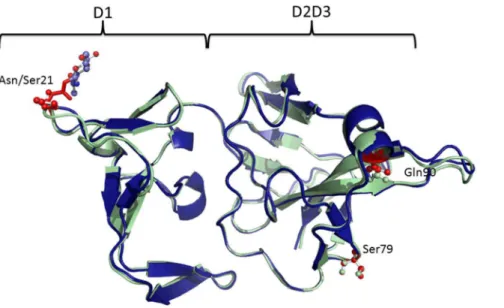
The D. melanogaster mth gene has been shown to be a developmental gene [4,12] although there is no evidence that it affects developmental time. Nevertheless, if gene GJ12490 is playing a role similar to that of mth during development, then variability at this gene could be associated with developmental time differences from egg to adult. In order to address this issue, we used D. americana, a species closely related to D. virilis (the common ancestor of the two species lived about 4.1 million years ago; [36] and an F2 association design (see Material and Methods)). In the F2 association experiment, theGJ12490variant 0 (not digested; assayed by digesting withSau3AI the 697 bp mth-like GJ12490 gene amplification product; see Material and Methods) goes with an N at position +16 relative to the first cysteine of the Mth ectodomain, while variant 1 (digested) goes with an S. The substitution of an N by an S destroys the putative highly conserved N-glycosylation site, and thus, this amino acid substitution could influence the stability of the hairpin harboring
the mutation. However the presence of a Pro residue at position 20 within the tight turn of theb2–b3 hairpin will likely counterbal-ance the effect of the disappearcounterbal-ance of the consensus glycosylation site (Figs. 6 and 7). Therefore, the N/S polymorphism does not seem to influence the capacity to bind a ligand. Only individuals not having a Pro at the preceding amino acid are predicted to be non-functional. Nevertheless, the non-glycosylation of this site may affect other aspects such as folding, maturation and/or intracel-lular trafficking of the protein.
Significant associations are found between genotype (N/N, N/S and S/S) and developmental time (Non-parametric Kruskal-Wallis Test; P,0.001). The average and standard deviation for genotypic classes N/N, S/S and N/S is 15.662.0 days (N = 54), 16.761.8 days (N = 83), and 15.761.9 days (N = 155), respectively. Signif-icant differences are detected, using Non-parametric Mann-Whitney tests, between genotypes N/N and S/S (P,0.005), and S/S and N/S (P,0.001), but not between genotypes N/N and N/ S (P.0.05). The significant differences remain significant after the sequential Bonferroni correction for multiple comparisons (P,0.05). Therefore, allele S seems to be recessive over allele N and to be associated with slow developmental time. Under this model, the N/S polymorphism explains 5.5% (P,0.001) of the variability observed in the F2 association experiment regarding developmental time (Pearson correlation coefficient = 0.235; P,0.001; the 95% lower and upper confidence limits for the correlation coefficient, determined by bootstrap (1000 samples), are 0.119 and 0.346, respectively). Individuals with the S/S genotype take on average 6.6% longer to develop than the remaining individuals.
The flies of the F2 association experiment have been phenotyped for abdominal size, as well. It is conceivable that developmental time differences give rise to adult size differences. Figure 4. UPGMA tree showing the overall similarity of the Mth ectodomain of the proteins encoded byD. melanogaster mth-like genes and the protein encoded by theD. virilis GJ12490gene.The values used to build the distance matrix were obtained by subtracting to 1 the lower TM-score value that is obtained when performing a structural alignment using the TM-align algorithm (zhanglab.ccmb.med.umich.edu/TM-align/).
Figure 5. Structural features of the Mth ectodomain. A) The amino acid sequence alignment of the extracellular ectodomain of D. melanogaster Mth andD. virilis GJ12490. The alignment was performed with ClustalW2, and colored with Aline [40]. The residues are colored according to a residue conservation scale (residues that are identical or similar among the sequences are given a colored background; red: identical residues; orange to blue: scale of conservation of amino acid properties in each alignment column; white: dissimilar residues). The numbers above the alignment refer to GJ12490 and the secondary structure to Mth (red cylinders,a-helices; red arrows,b-sheets). The lines below the sequences correspond to the cysteine residues involved in each disulfide bond. B) Cartoon representation ofD. melanogasterMth extracellular ectodomain 3D structure (PDB ID code 1FJR), highlighting the glycosylated Asn21 and the network of hydrogen bonds (dashed black lines) that a) stabilize theb2–b3 hairpin centered on Ser23 and b) interconnect this hairpin (through Glu27) to the central pocket and to the exposed Trp120. The color-coded scales for each amino acid correspond to residue conservation as shown in the sequence alignment. Water molecules are represented as red spheres. C) Cartoon representation of GJ12490 theoretical model colored as B).
doi:10.1371/journal.pone.0063747.g005
Figure 6. The predicted structure of theD. americanaMth ectodomain (the S variant is shown in blue and the N variant in green).The orange and red sticks are theD. virilisstructurally equivalent residues.
doi:10.1371/journal.pone.0063747.g006
Therefore, we looked for an association between the N/S polymorphism and abdominal size, and found a significant association (Non-parametric Kruskal-Wallis Test; P,0.005). The average and standard deviation for genotypic classes N/N, S/S and N/S is 1.0260.13 relative units (N = 54), 0.9560.14 relative units (N = 83), and 1.0060.14 relative units (N = 155), respectively. Significant differences are detected, using Non-parametric Mann-Whitney tests, between genotypes N/N and S/S (P,0.005), and S/S and N/S (P,0.005), but not between genotypes N/N and N/ S (P.0.05). The significant differences remain significant after the sequential Bonferroni correction for multiple comparisons (P,0.05). Therefore, the S allele seems to be recessive over the N allele, and to be associated with small abdominal size. Individuals with the S/S genotype are on average 5.8% smaller than individuals carrying at least one N allele.
Under this model, variation at gene GJ12490 explains 3.1% (P,0.005) of the variability observed in the F2 association experiment regarding abdominal size (Pearson correlation = 0.175; P,0.005; the 95% lower and upper confidence limits for the correlation coefficient, determined by bootstrap (1000 samples), are 0.062 and 0.285, respectively).
Evidence that Naturally Occurring Variation at Gene
GJ12490Affects Lifespan
InD. melanogaster, variability at themthgene has been reported to influence lifespan (see introduction). In order to gather further evidence that geneGJ12490could be playing the same role as the mth gene, we looked for an association between the N/S polymorphism (see above) and lifespan. A significant association between genotype and lifespan was found (Non-parametric Kruskal-Wallis Test; P,0.005). The average and standard deviation for genotypic classes N/N, S/S and N/S is 49.4620.0 days (N = 54), 59.2619.8 days; (N = 83), and 60.6621.1 days (N = 155). There are no significant differences regarding lifespan when genotypes S/S and N/S are compared (Non-parametric Mann-Whitney Test; P.0.05) but significant changes are observed when comparing genotypes N/N and N/S (Non-parametric Mann-Whitney Test; P,0.001), and when comparing genotypes N/N and S/S (Non-parametric Mann-Whitney Test; P,0.01). These results are significant after applying the sequential Bonferroni correction for multiple testing (P,0.05). Therefore, N/ N genotype seems to be associated with short lifespan. Individuals with genotypes S/S and N/S show a 21.7% average increase in lifespan in comparison with individuals with genotype N/N. Under the assumption that the N allele is recessive over the S allele, the N/S polymorphism explains 3.8% (Pearson correlation coefficient = 0.200; P,0.005; the 95% lower and upper confi-Figure 7. Amino acid variation at theD. americana mth-like GJ12490 protein.The amino acid replacement that is segregating in the F2 association experiment is highlighted in grey. C1– the first typical cysteine; N1– putative N-glycosylation site. Amino acid positions are given relative to the first typical cysteine.
dence limits for the correlation coefficient, determined by bootstrap (1000 samples), are 0.078 and 0.310, respectively) of the lifespan variability observed in the F2 association experiment.
Frequency of the N and S Variant in Natural Populations In order to determine the frequency and distribution in natural populations of the N/S polymorphism at the protein encoded by theGJ12490orthologous gene, 12 wild-caughtD. americanamale individuals from Fremont (Nebraska) and eight individuals from Saint Francisville (Louisiana) were used (Fig. 7). The derived S allele (by comparison withD. virilis) is at a high frequency in both the northern (66.6%) and southern (50.0%) populations, and thus, may help explain a significant amount of the variability regarding developmental time, abdominal size and lifespan in natural populations.
Discussion
It has been argued thatmthis a novel gene that is only present in species of the melanogaster subgroup [4]. It is surprising that a developmental gene that is expressed in embryos, larvae and adults, and that has many pleiotropic effects is of recent origin (see introduction), and therefore, here, we tested the alternative hypothesis that mth is an old gene. Under this hypothesis, it should be possible to find a gene with features similar to those presented by mth in Drosophila species distantly related to D. melanogaster. Here, we show that the neighbors ofmthandD. virilis GJ12490 are the same, that phylogenetic analyzes indicate that this gene is one of the most closely related tomth, that the predicted structure of the Mth ectodomain of the protein encoded by gene GJ12490is very similar to the structure of the Mth ectodomain of themthgene, and that the two genes have similar broad expression patterns. Moreover, inD. americana(a species of thevirilisgroup of Drosophila), there is a common amino acid polymorphism at the protein encoded by theGJ12490 orthologous gene that shows a strong association with developmental time, size and lifespan in an F2 association experiment, although in this case we cannot rule out the possibility that the association is caused by the presence of a neighbor gene. The association with developmental time is expected since mth is clearly a developmental gene [4]. On the other hand, naturally occurring amino acid variation at the D. melanogaster mth gene was previously associated with lifespan differences [15,16], and in our F2 association cross, individuals with genotypes S/S and S/N show a 21.7% average increase in lifespan in comparison with individuals with genotype N/N. This number is similar to the about 30% lifespan extension described forD. melanogaster mthmutant individuals [9]. Therefore, it is likely
thatmthandGJ12490orthologous genes are playing similar roles. This is an important observation because it implies thatGJ12490 orthologous genes could be candidates for explaining develop-mental time and lifespan differences inDrosophila in general. It should be noted that, despite of all similarities, Mth and the protein encoded by gene GJ12490 show less than 50% amino acid identity.
While addressing the above hypothesis we found amthl1gene in the Crustacean speciesDaphnia pulex. Therefore, themthsubfamily is not insect specific as previously reported. The mth subfamily must thus be older than 420 million years, the age of the separation of Insects and Crustaceans [37]. It is not possible to infer the early evolution of the mth-like gene family since the conclusions are highly dependent on the alignment algorithm that is used, and it is not possible to determine which alignment algorithm works best in general (see the discussion in [38]). Such a dependence on the alignment algorithm used has been reported in other cases involving old gene families as well [38,39] and shows the need to use multiple alignment algorithms when studying such cases, which can be easily done when using ADOPS [26]. As suggested by Patel et al. [4], subfunctionalization may be an important feature of the evolution of the mth gene subfamily. Detailed functional comparative studies are now needed in order to understand whether mth-like genes acquired novel functional-ities after the recent gene duplications events that are detected in themelanogastersubgroup lineage.
Supporting Information
Figure S1 Transitions (blue diamonds) and transversions (red squares) versus genetic distance plots showing the level of nucleotide substitution saturation at different codon positions (all positions (1); 1st and 2nd codon positions (2) and 3rd codon positions (3)) using the two different alignments (ClustalW2 (A) and MUSCLE (B)).
(TIF)
Table S1 PCR conditions used to address mth-like genes’ expression inD. virilisandD. americana.
(XLSX)
Author Contributions
Conceived and designed the experiments: MR CPV JV. Performed the experiments: ARA MR HR. Analyzed the data: ARA MR HR BA RMH SMR NAF DRJ MRJ FFR CPV JV. Wrote the paper: ARA MR HR BA RMH SMR NAF DRJ MRJ FFR CPV JV.
References
1. Fredriksson R, Lagerstro¨m MC, Lundin L-G, Schio¨th HB (2003) The G-protein-coupled receptors in the human genome form five main families. Phylogenetic analysis, paralogon groups, and fingerprints. Mol Pharmacol 63: 1256–1272.
2. Brody T, Cravchik A (2000)Drosophila melanogasterG protein–coupled receptors. J Cell Biol 150: F83–F88.
3. Nordstro¨m KJV, Lagerstro¨m MC, Walle´r LMJ, Fredriksson R, Schio¨th HB (2009) TheSecretinGPCRs descended from the family ofAdhesionGPCRs. Mol Biol Evol 26: 71–84.
4. Patel MV, Hallal DA, Jones JW, Bronner DN, Zein R, et al. (2012) Dramatic expansion and developmental expression diversification of themethuselahgene family during recentDrosophilaevolution. J Exp Zool B Mol Dev Evol 318: 368– 387.
5. Cardoso JCR, Clark MS, Viera FA, Bridge PD, Gilles A, et al. (2005) The secretin G-protein-coupled receptor family: teleost receptors. J Mol Endocrinol 34: 753–765.
6. Cardoso J, Vieira F, Gomes A, Power D (2010) The serendipitous origin of chordate secretin peptide family members. BMC Evol Biol 10: 135.
7. Mertens I, Husson SJ, Janssen T, Lindemans M, Schoofs L (2007) PACAP and PDF signaling in the regulation of mammalian and insect circadian rhythms. Peptides 28: 1775–1783.
8. Reagan JD (1994) Expression cloning of an insect diuretic hormone receptor. A member of the calcitonin/secretin receptor family. J Biol Chem 269: 9–12. 9. Lin Y-J, Seroude L, Benzer S (1998) Extended Life-Span and Stress Resistance
in theDrosophilaMutantmethuselah. Science 282: 943–946.
10. Fan Y, Sun P, Wang Y, He X, Deng X, et al. (2010) The G protein-coupled receptors in the silkworm,Bombyx mori. Insect Biochem Mol Biol 40: 581–591. 11. West AP, Llamas LL, Snow PM, Benzer S, Bjorkman PJ (2001) Crystal structure
of the ectodomain of Methuselah, a Drosophila G protein-coupled receptor associated with extended lifespan. Proc Natl Acad Sci U S A 98: 3744–3749. 12. Song W, Ranjan R, Dawson-Scully K, Bronk P, Marin L, et al. (2002)
Presynaptic Regulation of Neurotransmission inDrosophilaby the G Protein-Coupled Receptor Methuselah. Neuron 36: 105–119.
13. Ja WW, West AP, Delker SL, Bjorkman PJ, Benzer S, et al. (2007) Extension of
Drosophila melanogasterlife span with a GPCR peptide inhibitor. Nat Chem Biol 3: 415–419.
14. Gimenez LED, Ghildyal P, Fischer KE, Hu H, Ja WW, et al. (2013) Modulation of methuselah expression targeted toDrosophilainsulin-producing cells extends life and enhances oxidative stress resistance. Aging Cell 12: 121–129. 15. Schmidt PS, Duvernell DD, Eanes WF (2000) Adaptive evolution of a candidate
gene for aging inDrosophila. Proc Natl Acad Sci U S A 97: 10861–10865. 16. Duvernell DD, Schmidt PS, Eanes WF (2003) Clines and adaptive evolution in
themethuselahgene region inDrosophila melanogaster. Mol Ecol 12: 1277–1285. 17. Petrosyan A, Hsieh IH, Saberi K (2007) Age-dependent stability of sensorimotor
functions in the life-extendedDrosophilamutantMethuselah. Behav Genet 37: 585– 594.
18. Wallenfang MR, Nayak R, DiNardo S (2006) Dynamics of the male germline stem cell population during aging ofDrosophila melanogaster. Aging Cell 5: 297– 304.
19. Cook-Wiens E, Grotewiel MS (2002) Dissociation between functional senescence and oxidative stress resistance inDrosophila. Exp Gerontol 37: 1347–1357. 20. Martinez VG, Javadi CS, Ngo E, Ngo L, Lagow RD, et al. (2007) Age-related
changes in climbing behavior and neural circuit physiology inDrosophila. Dev Neurobiol 67: 778–791.
21. Baldal EA, Brakefield PM, Zwaan BJ, Hughes K (2006) Multitrait evolution in lines ofDrosophila melanogasterselected for increased starvation resistance: the role of metabolic rate and implications for the evolution of longevity. Evolution 60: 1435–1444.
22. Mockett RJ, Sohal RS (2006) Temperature-dependent trade-offs between longevity and fertility in theDrosophilamutant,methuselah. Exp Gerontol 41: 566– 573.
23. Pletcher SD, Macdonald SJ, Marguerie R, Certa U, Stearns SC, et al. (2002) Genome-wide transcript profiles in aging and calorically restrictedDrosophila melanogaster. Curr Biol 12: 712–723.
24. Kim H, Kim J, Lee Y, Yang J, Han K (2006) Transcriptional regulation of the
methuselahgene by dorsal protein inDrosophila melanogaster. Mol Cells 21: 261–268. 25. Zhang YE, Landback P, Vibranovski M, Long M (2012) New genes expressed in human brains: Implications for annotating evolving genomes. Bioessays 34: 982– 991.
26. Reboiro-Jato D, Reboiro-Jato M, Fdez-Riverola F, Vieira CP, Fonseca NA, et al. (2012) ADOPS - Automatic detection of positively selected sites. J Integr Bioinform 9: 200.
27. Notredame C, Higgins DG, Heringa J (2000) T-Coffee: A novel method for fast and accurate multiple sequence alignment. J Mol Biol 302: 205–217. 28. Xia X, Xie Z (2001) DAMBE: software package for data analysis in molecular
biology and evolution. J Hered 92: 371–373.
29. Ronquist F, Huelsenbeck JP (2003) MrBayes 3: Bayesian phylogenetic inference under mixed models. Bioinformatics 19: 1572–1574.
30. Shimodaira H (2002) An approximately unbiased test of phylogenetic tree selection. Syst Biol 51: 492–508.
31. Shimodaira H, Hasegawa M (2001) CONSEL: for assessing the confidence of phylogenetic tree selection. Bioinformatics 17: 1246–1247.
32. Marchler-Bauer A, Lu S, Anderson JB, Chitsaz F, Derbyshire MK, et al. (2011) CDD: a conserved domain database for the functional annotation of proteins. Nucleic Acids Res 39: D225–D229.
33. Roy A, Kucukural A, Zhang Y (2010) I-TASSER: a unified platform for automated protein structure and function prediction. Nat Protoc 5: 725–738. 34. Tamura K, Peterson D, Peterson N, Stecher G, Nei M, et al. (2011) MEGA5:
molecular evolutionary genetics analysis using maximum likelihood, evolution-ary distance, and maximum parsimony methods. Mol Biol Evol 28: 2731–2739. 35. Reis M, Vieira CP, Morales-Hojas R, Aguiar B, Rocha H, et al. (2011) A comparative study of the short term cold resistance response in distantly related
Drosophilaspecies: The role ofregucalcinandFrost. PLoS ONE 6: e25520. 36. Morales-Hojas R, Reis M, Vieira CP, Vieira J (2011) Resolving the phylogenetic
relationships and evolutionary history of the Drosophila virilis group using multilocus data. Mol Phylogen Evol 60: 249–258.
37. Gaunt MW, Miles MA (2002) An insect molecular clock dates the origin of the insects and accords with palaeontological and biogeographic landmarks. Mol Biol Evol 19: 748–761.
38. Santos JS, Fonseca NA, Vieira CP, Vieira J, Casares F (2010) Phylogeny of the teashirt-related zinc finger (tshz) gene family and analysis of the developmental expression oftshz2andtshz3bin the zebrafish. Dev Dyn 239: 1010–1018. 39. Vieira J, Fonseca NA, Vieira CP (2009) RNase-based gametophytic
self-incompatibility evolution: questioning the hypothesis of multiple independent recruitments of theS-pollen gene. J Mol Evol 69: 32–41.