Atmos. Chem. Phys., 13, 9211–9212, 2013 www.atmos-chem-phys.net/13/9211/2013/ doi:10.5194/acp-13-9211-2013
© Author(s) 2013. CC Attribution 3.0 License.
Atmospheric
Chemistry
and Physics
Open Access
Geoscientiic
Geoscientiic
Geoscientiic
Geoscientiic
Corrigendum to
“Thermodynamics of reactions of ClHg and BrHg radicals with
atmospherically abundant free radicals” published in Atmos. Chem.
Phys. 12, 10271–10279, 2012
T. S. Dibble, M. J. Zelie, and H. Mao
Chemistry Department, State University of New York-Environmental Science and Forestry, Syracuse, NY, USA
Correspondence to:T. S. Dibble ([email protected])
We have identified three errors in the above-referenced manuscript.
1. At the bottom of p. 10 276, the reference to Eq. (5) should be to Eq. (4).
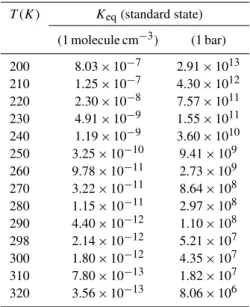
2. The values listed in Table 5 are actually 1/Keq, where
Keqis the equilibrium constant for the reaction listed. The corrected Table 5, on the right-hand side, is con-sistent with Eq. (1a) and Eq. (1b) of the original paper. 3. We mischaracterized the compounds described by Bal-abanov and Peterson (2003, cited as 2003b in the origi-nal paper). Balabanov and Peterson (2003) listed com-pounds as HgBrO and HgClO, following a convention of stoichiometric formulae in which atoms are listed from least to most electronegative. We misread these
stoichiometricformulae asstructuralformulae for
Hg-BrO and HgClO (a mercury atom bound to the halogen atom of a BrO or ClO radical). In fact, Balabanov and Peterson (2003) were describing divalent Hg(II) com-pounds with structural formulae BrHgO and ClHgO (a mercury atom bound directly to both an oxygen atom and a halogen atom). Note these same divalent Hg(II) compounds are described by stoichiometric formulae in another paper by Balabanov and Peterson (2004). In fact, no previous paper describes molecules with the structural formula HgBrO or HgClO.
To determine if BrO or ClO could bind to Hg(0), we char-acterized compounds with structural formulae HgBrO and HgClO using the same approach as described in our original paper. The computed Hg–XO bond lengths were∼3.6 Å and
Table 5. Recommended equilibrium constant, Keq(T), for
Br + Hg→ BrHg as a function of temperature for two standard
states.
T(K) Keq(standard state)
(1 molecule cm−3) (1 bar)
200 8.03×10⁻⁷ 2.91×10¹³
210 1.25×10⁻⁷ 4.30×10¹²
220 2.30×10⁻⁸ 7.57×10¹¹
230 4.91×10⁻⁹ 1.55×10¹¹
240 1.19×10⁻⁹ 3.60×10¹⁰
250 3.25×10⁻¹⁰ 9.41×10⁹
260 9.78×10⁻¹¹ 2.73×10⁹
270 3.22×10⁻¹¹ 8.64×10⁸
280 1.15×10⁻¹¹ 2.97×10⁸
290 4.40×10⁻¹² 1.10×10⁸
298 2.14×10⁻¹² 5.21×10⁷
300 1.80×10⁻¹² 4.35×10⁷
310 7.80×10⁻¹³ 1.82×10⁷
320 3.56×10⁻¹³ 8.06×10⁶
∼3.8 Å for X = Br and Cl, respectively, which are more
char-acteristic of van der Waals complexes than covalent bonds. The bond energies at CCSD(T)/aVTZ were negative, indicat-ing extremely weak bondindicat-ing. Balabanov and Peterson (2013) also obtained results suggestive of van der Waals molecules. Field studies (Obrist et al., 2011; Tas et al., 2011) and ex-periments (Raofie and Ariya, 2004; Spicer et al., 2005) had suggested that BrO can initiate Hg(0) oxidation. By contrast,
9212 T. S. Dibbl et al.: Corrigendum
the present work suggests that BrO cannot initiate gas-phase oxidation of Hg(0).
Acknowledgements. We are grateful to Steven B. Darby for point-ing out the incorrect reference to Eq. (5) and promptpoint-ing us to re-check the reported equilibrium constants.
References
Balabanov, N. B. and Peterson, K. A.,: Mercury and Reactive
Halo-gens: The Thermochemistry of Hg + {Cl2, Br2, BrCl, ClO, and
BrO}, J. Phys. Chem. A, 107, 7465–7470, 2003.
Balabanov, N. B. and Peterson, K. A.,: Accurate theoretical near-equilibrium potential energy and dipole moment surfaces of Hg-ClO and HgBrO, J. Chem. Phys., 120, 6585–6592, 2004.
Balabanov, N. B., and Peterson, K. A.: personal communication by K. A. Peterson of unpublished results on 8 August, 2013. Raofie, F. and Ariya, P. A.: Product Study of the Gas-Phase
BrO-Initiated Oxidation of Hg0: Evidence for Stable Hg1+
Com-pounds. Environ. Sci. Technol., 38, 4319–4326, 2004.
Obrist, D., Tas, E., Peleg, M., Matveev, V., Faïn, X., Asaf, D. and Luria, M.: Bromine-induced oxidation of mercury in the mid-latitude atmosphere, Nature Geosci., 4, 22–26, 2011.
Spicer, C. W., Sumner, A. L., Satola, J., and Mangaraj, R.: A Report on Kinetics of Mercury Reactions in the Atmosphere, Based on Florida DEP Contract No. AQ192, US EPA Contract No. 68-D-99-011, Task 0025, 2005.
Tas, E., Obrist, D., Peleg, M., Matveev, V., Faïn, X., Asaf, D., and Luria, M.: Measurement-based modelling of bromine-induced oxidation of mercury above the Dead Sea, Atmos. Chem. Phys., 12, 2429–2440, doi:10.5194/acp-12-2429-2012, 2012.