ELABORAÇÃO E VALIDADE DO TESTE DE RASTREIO DE DOENÇA DA ALZHEIMER COM PROVÉRBIOS (TRDAP) PARA INDIVÍDUOS A PARTIR DE
SESSENTA ANOS
Tese, apresentada à Universidade Federal
do Rio Grande do Norte, para a obtenção do
título de Doutora em Ciências da Saúde, pelo
Programa de Pós-graduação em Ciências da
Saúde.
NATAL
ELABORAÇÃO E VALIDADE DO TESTE DE RASTREIO DE DOENÇA DA ALZHEIMER COM PROVÉRBIOS (TRDAP) PARA INDIVÍDUOS A PARTIR DE
SESSENTA ANOS
Tese, apresentada à Universidade Federal
do Rio Grande do Norte, para a obtenção do
título de Doutora em Ciências da Saúde, pelo
Programa de Pós-graduação em Ciências da
Saúde.
Orientador: João Carlos Alchieri
Co-orientador: Everton Botelho Sougey
NATAL
Divisão de Serviços Técnicos
Catalogação da Publicação na Fonte. UFRN / Biblioteca Central Zila Mamede
Santos, Mauricéa Tabósa Ferreira.
Elaboração e validade do teste de rastreio de doença da Alzheimer com provérbios (TRDAP) para indivíduos a partir de sessenta anos / Mauricéa Tabósa Ferreira Santos . – Natal, RN, 2009.
121 f.
Orientador: João Carlos Alchieri.
Co-orientador: Everton Botelho Sougey.
Tese (Doutorado) – Universidade Federal do Rio Grande do Norte. Centro de Tecnologia. Programa de Pós-Graduação em Ciências da Saúde.
1. Doença de Alzheimer – Tese. 2. Validação de teste – Tese. 3. Memória de curto prazo – Tese. 4. Memória episódica – Tese. 5. Funções executivas – Tese. I. Alchieri, João Carlos. II. Sougey, Everton Botelho. III. Universidade Federal do Rio Grande do Norte. IV. Título.
CENTRO DE CIÊNCIAS DA SAÚDE
PROGRAMA DE PÓS-GRADUAÇÃO EM CIÊNCIAS DA SAÚDE
Coordenadora do Programa em Ciências da Saúde:
Profa. Dra. Técia Maria de Oliveira Maranhão
Mauricéa Tabósa Ferreira Santos
ELABORAÇÃO E VALIDADE DO TESTE DE RASTREIO DE DOENÇA DA ALZHEIMER COM PROVÉRBIOS (TRDAP) PARA INDIVÍDUOS A PARTIR DE
SESSENTA ANOS
Presidente da banca:
Prof. Dr. João Carlos Alchieri
BANCA EXAMINADORA
Prof. Dr. João Carlos Alchieri - UFRN
Prof. Dr. Sidarta Ribeiro - UFRN
Prof. Dr. Luis Roberto Ramos - Unifesp
Profª. Drª. Katie Almondes - UFRN
Prof. Dr. Othon Coelho Bastos Filho - UFPE
PENSAMENTO
“Eu quero ser, não posso ser e não tenho mais tempo de ser... Para mim a escrita
é uma câmara de choque, absorve o choque, reduz a tensão interior. Quem sofre
do mal de Alzheimer tem uma tensão interior... O que mais incomoda é perder o
trabalho, é a perda de valores como pessoa. Deixa-se de fazer, deixa-se de
acontecer, perde-se o valor. A característica da minha doença é a ausência de
lembrança.”
“Eu vou esquecer de que estou me esquecendo pra poder viver.”
Virgílio Soares Pinto, 57 anos, engenheiro aposentado, com diagnóstico de demência. “O interior revelado” (livro construído e em sessões de Terapia Ocupacional de setembro 1999 a abril de 2000, publicado em 2003).
Dedicatória
Aos meus pais, Maurício e Marinete,
companheiros fiéis. Ao meu avô Crispim,
inspiração da minha especialidade (in
memoriam). Aos meus filhos, Rodrigo e Tiago para que descubram seus sonhos. Ao meu esposo, Roberto, amigo, auxiliar, incentivador de todos os meus pleitos e grande companheiro, nesta jornada. Aos idosos e, especialmente, aos que serão.
Agradecimentos
Ao Prof. Dr. Eryvaldo Sócrates Tabosa do Egito, pela apresentação do Programa,
à Dra. Maria do Carmo Lencastre, à Dra. Luci de Holanda pelo incentivo inicial.
Ao Professor Dr. Everton Botelho Sougey que vislumbrou a escolha do tema e
pelo crédito a mim conferido. E Prof. Dr. João Carlos Alchieri que acompanhou
todas as etapas desta Tese e, com muito zelo e compreensão, fez as
considerações.
Aos professores dos Programas de Pós-graduação da UFPE, ao Prof. Dr. Othon
Bastos, assim como aos da UFRN e a Profa. Dra. Vera Rocha, que muito
contribuíram para o meu crescimento científico. Além de ao Prof. Carlos Gadelha,
estatística e ao Prof. Michael pela rapidez nas traduções.
À equipe multidisciplinar desta Pesquisa (Dr. Gutemberg Guerra, Dra. Terce Liana,
Dra. Tatiana Carvalho, Prof. Dr. Everton Botelho e Prof. Dr. João Alchieri).
Ao Ambulatório de Neurologia do Comportamento e da Cognição da UFPE,
atualmente no HGA, na pessoa de Dr. Gutemberg Gerra pelo contributo na
construção do instrumento pesquisado e na triagem de pacientes com Alzheimer.
Ao Programa de Atendimento ao Idoso / Hospital Geral de Areias, nas pessoas de
Dra. Clélia Lins e Dra. Célia Nóbrega, pela disponibilização do banco de dados.
Aos médicos: Álvaro Negromonte, Ermínia Petruccelli, Daniel Ktiner, Lucas
Andrade, pelo encaminhamento de idosos e à Dra. Vera Santiago, neuropsicóloga
pelos esclarecimentos, na forma de aplicação de testes padronizados.
Ao Núcleo de Atenção ao Idoso (UFPE), na pessoa de Dra. Márcia Carrera e dos
funcionários, disponibilizando ótimas instalações para coleta de dados e à Dra.
Terce Liana pela transmissão de conhecimentos sobre a doença de Alzheimer.
À UNATi, através de Dra. Ana Paula Marques, pelo espaço de divulgação e coleta.
Aos concluintes de Terapia Ocupacional, Ana Carla Amorim, Ana Carolina e
Simone Epitácio e a Tatiana Carvalho e Genaina Couto, pela colaboração na
coleta.
Ao Prof. Dr. Paulo Henrique Bertolucci, pela disponibilidade em elucidar os
questionamentos sobre os dados preliminares, apresentados em Congressos.
Às funcionárias, Patrícia, Danielli, Rosiana Clara e Alana, fundamentais no
atendimento aos alunos do PPGCSA - UFRN e a Solange do PPGNP (UFPE).
Aos idosos e aos cuidadores pelo esforço e motivação em participar da coleta.
Ao meu esposo, meus pais, meus filhos e amigos pela compreensão das minhas
longas ausências, no convívio diário.
Sumário
1. Introdução 14
2. Revisão da Literatura 17
2.1 Doença de Alzheimer (DA) 17
2.2 Funções neuropsicológicas comprometidas na DA 18
2.3 Testes neuropsicológicos utilizados para validade de critério do TRDAP
19
2.4 Processo de construção e validade de um teste psicológico 21
3. Objetivos 23
3.1 Objetivo geral 23
3.2 Objetivos específicos 23
4. Anexação de artigos 24
4.1 Preliminary data on a mnemonic instrument of proverbs to track
Alzheimer’s disease 24
4.2 Validity and reliability of the Screening Test for Alzheimer’s Disease
with Proverbs (STADP) for the elderly 31
5. Comentários, críticas e Conclusões 40
6. Anexos 50
Protocolo médico de avaliação 50
CDR: Instrumento de avaliação do grau de demência 52
7. Referências 55
Abstract 58
Apêndice 61
Produção Científica (resumos publicados em Congressos, participação no Encontro de Pesquisadores de Alzheimer, participação Congressos Nacionais e Internacionais)
61
Protocolo de pesquisa:
Questionário com dados sociodemográficos Fotografia do Jogo de Memória de Provérbios
Teste de Rastreio da Doença de Alzheimer com Provérbios (TRDAP) e Instruções de aplicação do TRDAP
Bateria de testes selecionados por especialistas Termo de Consentimento Livre e Esclarecido
77
Material Complementar
Apêndice 5: Artigo 2 corrigido 90 94
Lista de Tabelas e Quadros
Tabela 1a Demographic data and scores on tests among patients with Alzheimer’s disease and control individuals
Tabela 2a Correlation between variables and stage of Screening Test for Alzheimer’s Disease using Proverbs
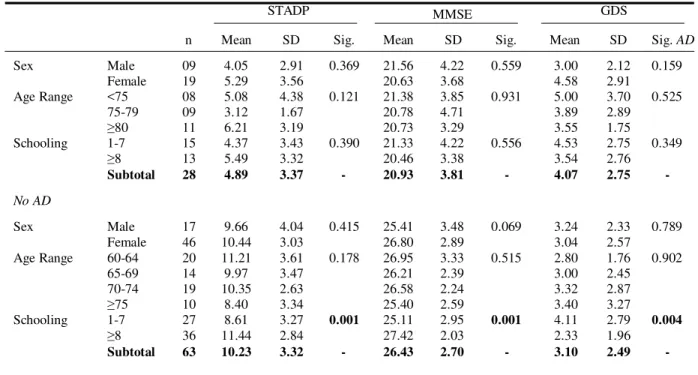
Tabela 1b Cognitive and mood performance of the sample in the STADP, MMSE
and GDS tests
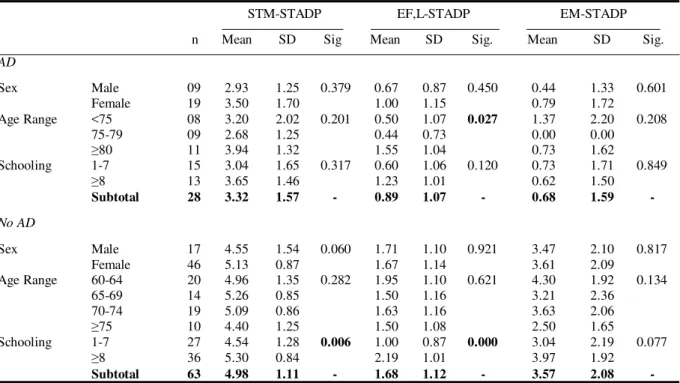
Tabela 2b Cognitive performance of the sample in the subtests (stages A.B.C) STADPin relation to the variables
Tabela 3b
Tabela 4b
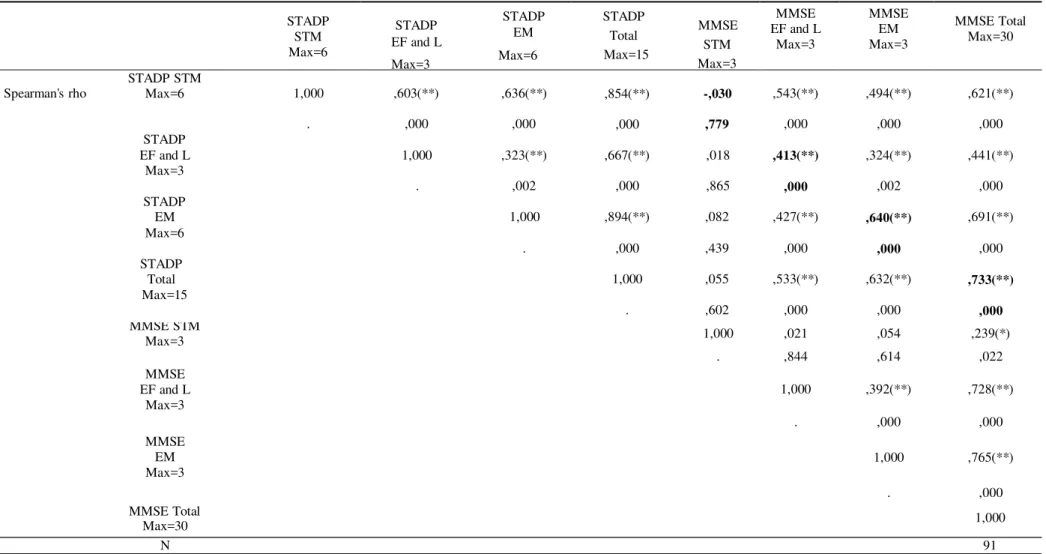
Spearman’s correlation between the STADP stages and some MMSE categories for convergent construct validity
Agreement between STADP screening and the other assessments (Medical and MMSE screening)
Gráfico 1 Complementar
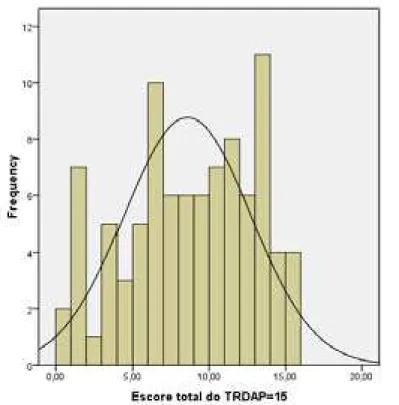
Distribuição do TRDAP / Histograma e Curva normal
Quadro 1 Complementar
Médias e desvios padrões do escore total e dos subtestes do TRDAP dos idosos com DA e controles (não publicado)
Quadro 2 complementar
Médias e desvios padrões dos escores totais e subtestes de todos os testes, utilizados no protocolo nos idosos com DA e controles (não publicado).
Quadro 3 Complementar
Correlação das variáveis: idade, escolaridade, reconhecimento dos provérbios e tempo de reação com o escore total e as etapas do TRDAP (não publicado)
Lista de abreviaturas e siglas
TRDAP Teste de Rastreio da Doença de Alzheimer com Provérbios
DA Doença de Alzheimer
DSM IV Diagnostic and Statistical Manual, IV Edition (Manual Diagnóstico e Estatístico dos Transtornos Mentais - quarta edição)
CERAD Consortium to Establish a Registry for Alzheimer's Disease (Consórcio para Estabelecer um Registro para Doença De Alzheimer)
CDR Clinical Dementia Rating (Escore Clínico de Demência) UFPE Universidade Federal de Pernambuco
HGA Hospital Geral de Areias
UNATi Universidade Aberta da Terceira Idade MEEM Miniexame do Estado Mental
EDG Escala de Depressão Geriátrica
FN Figura Semicomplexa de Rey – Neuropsi (adaptada para Bateria de avaliação neuropsicológica breve)
LP Lista de Palavras (Teste de memória verbal do CERAD)
TDR Teste do Desenho espontâneo do Relógio
SD Span de Dígitos (Subteste III da Escala de Inteligência Wechsler para adultos)
AVD Atividade de Vida Diária (Katz)
AIVD Atividade Instrumental de Vida Diária
FV Fluência Verbal
MCP Memória de Curto Prazo (etapa A do TRDAP)
ME Memória Episódica (etapa B do TRDAP)
FE e L Funções Executivas e Linguagem (etapa C do TRDAP)
Resumo
A escassez de instrumentos para a avaliação e a triagem da doença de Alzheimer, (DA), notadamente denominados de rastreio, com características de padronização e validados para o Nordeste, motivou este Estudo. Visando à triagem de uma etapa mais leve da doença e encaminhamento precoce ao tratamento multidisciplinar foi elaborado o Teste de Rastreio da Doença de Alzheimer com Provérbios (TRDAP), a partir de um Jogo de Memória de Provérbios, construído como recurso terapêutico ocupacional. Está composto de três etapas conforme a função neuropsicológica avaliada, a “A” (memória de curto prazo), “B” (funções executivas e linguagem) e “C” (memória episódica), além do reconhecimento de provérbios. O Estudo foi realizado em uma amostra de conveniência, com 91 idosos (28 DA e 63 controles), a partir de 60 anos, com um ou mais anos de escolaridade. Foram controladas as variáveis, como doenças intercorrentes ou déficits sensoriais que pudessem comprometer o desempenho dos pacientes, nos testes. O protocolo constou de oito testes selecionados por especialistas: Miniexame do Estado Mental (para validade convergente), Escala de Depressão Geriátrica – EDG (validade discriminante), Lista de Palavras, Fluência Verbal, Span de Dígitos, Figura Neuropsi, Teste do Relógio, Atividade de Vida Diária e Instrumental. Os resultados confirmaram a validade de construto convergente e discriminante, assim como a relação significativa (p<0,005) com todos os testes, exceto com o EDG. Quanto à validade concorrente, não houve discordância com o critério da avaliação médica observou-se consistência interna aceitável, conferindo confiabilidade no instrumento, o que não ocorreu com MEEM. Tais resultados permitem afirmar que o TRDAP possui características psicométricas, adequadas ao rastreio da fase leve da DA para população estudada.
Palavras-Chave: Doença de Alzheimer, Validação de Teste, Memória de Curto Prazo, Memória Episódica, Funções Executivas, Linguagem.
1 INTRODUÇÃO
O envelhecimento com saúde e qualidade de vida pode ser entendido,
como um estágio do desenvolvimento individual e, também, social. Devido à
transição demográfica, no Brasil, nas últimas décadas, vários estudos sobre
envelhecimento e saúde têm-se realizado.(1,2) O perfil da morbimortalidade, no
idoso, vem se modificando e, atualmente, as doenças crônicas não
transmissíveis, se comparadas a períodos anteriores, são as que necessitam
de maior atenção, como a doença de Alzheimer (DA), neurodegenerativa, que
compromete a autonomia e a independência.(2) A DA se inicia, insidiosamente,
com déficits de memória, funções executivas e linguagem, comprometendo a
praxia construtiva e a abstração(3-6,8), além de dificuldades sócio-ocupacionais
que culminam com a dependência total do paciente, possibilitando a
institucionalização.(5,7) Instrumentos de avaliação, notadamente, os de rastreio,
são fundamentais para o diagnóstico precoce e o prognóstico quanto ao
tratamento multidisciplinar. A diferenciação entre o envelhecimento normal e o
patológico, em relação aos déficits cognitivos, é tema de artigos recentes,(8-10)
que analisam a evolução para quadros de demência, em cerca de três anos,
especificamente, quando estão comprometidas, a memória episódica verbale
as funções executivas.(9-11) Daí a grande importância dos testes de rastreio,
como indicadores da necessidade de aprofundamento, em uma bateria de
testes, padronizados, validados para nosso meio e acessíveis aos profissionais
da área da saúde, mesmo sabendo-se do esforço, tempo e de recursos
financeiros que o processo de validação de um teste neuropsicológico pode
Para elaboração do Teste de Rastreio da Doença de Alzheimer com
Provérbios (TRDAP), utilizou-se do Jogo de Memória de Provérbios, construído
como recurso terapêutico ocupacional (apêndice 1- resumo1), com a finalidade
de atendimento de idosos, e desenvolvido no Mestrado de Neuropsiquiatria da
UFPE (2003). Nessa fase, foi elaborado um instrumento que demonstrou
relação com o teste Miniexame do Estado Mental (MEEM), apresentado no
Apêndice 1 - Resumo 2. Posteriormente, adaptou-se para rastreio de DA,
obedecendo à sequência determinada quanto aos procedimentos teóricos,
empíricos e analíticos,(14) além dos construtos - memória de curto prazo ou
operacional, funções executivas e linguagem, memória episódica e
reconhecimento de provérbios – (artigo 1).
Motivados a testar a hipótese de que o TRDAP poderia contribuir para o
rastreio de DA, justificou-se a realização do presente estudo de elaboração,
validade e confiabilidade desse novo Teste. Estudaram-se 91 idosos (63
controles e 28 DA) encaminhados por médicos ou cadastrados como
pacientes, no banco de dados – Centro de Referência para dispensação da
medicação específica - e oriundos de serviços específicos da UFPE e da
comunidade. O protocolo, composto de oito testes, referidos na literatura
científica e selecionados, por especialistas em DA, adquiriu um caráter
multidisciplinar para validade de construto do TRDAP. Elegeu-se o MEEM para
o estudo de validade convergente e a Escala de Depressão Geriátrica (EDG),
que indica suspeita de depressão, para a validade discriminante.
Consideraram-se dados demográficos, hábitos de leitura, de escrita, atividade
como variáveis, relacionadas e dependentes para caracterizar a sensibilidade e
2 REVISÃO DE LITERATURA
2.1. Doença de Alzheimer (DA)
Em 2006, centenário da descoberta da DA,(15) a Organização Mundial da
Saúde mostrou que, entre os transtornos neurológicos (incluindo os
neuropsiquiátricos), 12% da carga em Anos de Vida Ajustados por
Discapacidade (AVAD), sequelas e morte foram atribuídos à expressão da DA e a outras demências.(16) A prevalência de demência na América Latina é de
7,1% em idosos acima de 65 anos,(17) e existem cerca de 1.200.000 indivíduos,
com DA, no Brasil.(18)
A décima revisão do Código Internacional de Doenças (CID10)(19) remete à
etiologia desconhecida da DA, de instalação insidiosa, com duração de dois a
três anos, podendo ser mais extensa. É possível que ocorra, antes da meia
idade, com pior prognóstico, mas se instala com maior frequência entre 65-70
anos e o curso tende a ser mais lento. A DA caracteriza-se por um
comprometimento geral de funções corticais superiores, especialmente, a da
memória.
Estudos distinguem a existência de três fases da doença: leve, moderada e
grave. A dificuldade em definir a fase leve da DA está na etapa intermediária,
denominada Comprometimento Cognitivo Leve (CCL), que poderia ser a
expressão de uma demência incipiente, havendo conversão anual do
Comprometimento Cognitivo Leve para DA em aproximadamente, 10-15%.(9)
Um dos aspectos impactantes ligados a DA está nos altos custos sociais
que o paciente, sua família e a sociedade precisam arcar frente a um período
orçamento familiar, considerando-se os tratamentos, contratação de
cuidadores, adaptações domiciliares e perdas financeiras.(20)
2.2 Funções neuropsicológicas comprometidas na DA
Atualmente, postula-se que a memória é composta por vários sistemas e
os relatos de amnésia mostraram que os déficits ocorrem em algumas áreas e
outras ficam preservadas.(21) Referente ao tempo de manutenção, a memória
pode ser entendida como de curto prazo ou memória operacional, definida pelo modelo proposto por Baddeley e Hitch,(22) em que este é composto por
três subcomponentes principais, o centro executivo (controla as interações
entre os dois subsistemas subordinados e a memória de longa duração –
coordenando e planejando atividades ao entrar em contato com novas
situações que necessitam de ações modificadas), a alça fonológica
(mecanismo para informação que são apresentadas de forma verbal,
auditivamente, na memória operacional) e a alça visuoespacial, usada para
construir e manipular imagens visuais e para a representação de mapas
mentais. Esse tipo de memória seria, altamente, dependente da atenção e se
dissiparia, facilmente, com a distração.(23)
Autores afirmam que a memória, de curto prazo, estaria prejudicada na
DA leve(5) e encontraram associação desse tipo de memória com a de longo
prazo. Como a memória episódica,(24) que é acessada, conscientemente (chamada explícita), referente à recordação de fatos e eventos recentes
expressão inicial do processo degenerativo, junto a outros déficits cognitivos.
(artigos 1 e 2)
As funções executivas consistem naquelas capacidades que possibilitam uma pessoa se engajar, de forma satisfatória e independente, em um propósito
e ter domínio sobre o comportamento.(25) Abrangem atenção, concentração,
seletividade de estímulos, capacidade de abstração, planejamento,
flexibilidade, controle mental, autocontrole e memória operacional.(6) Portanto, apresenta dificuldade para ser avaliada, em tarefas de um teste
neuropsicológico simples, quanto às questões metodológicas e conceituais(26)
como a abstração do pensamento, que pode e tem sido avaliada na literatura,
pelos testes de provérbios.(27-29) Existem déficits de abstração, já, no início da
DA, (6-9,26,30) mas se ressalta a importância da adequação da tarefa para os
resultados, como a contextualização.
Quanto a linguagem, ela é uma função mental superior complexa, e como tal, utiliza-se dos elementos verbais (orais e gráficos) para promover a
comunicação humana,(30) mantendo estreita relação com a memória comprometida no início da DA.(31) Foram observados, na linguagem, déficits em
tarefas de compreensão auditiva e de denominação,(7) assim como em
formação de conceitos e raciocínio verbal ao interpretar provérbios.(11)
2.3 Testes Neuropsicológicos de avaliação de Doença de Alzheimer utilizados
para validade de critério do TRDAP.
1. Miniexame do Estado Mental (MEEM) - Folstein e col., 1975(32): teste,
Brasil, por Bertolucci e col. em 1994,(33) e os pontos de corte 13 para
analfabeto, 18 para de 1-7 anos e 26 para > 8 anos possuem sensibilidade e
especificidade.(34) Avalia orientação espacial e temporal, memória de curto
prazo e episódica, funções executivas (cálculo e habilidade construtiva) e
linguagem. O escore máximo é de 30 pontos. A versão, em português, é
adequada para aplicação em ambulatório, com confiabilidade em estudo de
tese-reteste.(35) É um teste útil, no diagnóstico sindrômico das demências.(36)
2. Teste do Desenho espontâneo do Relógio (TDR) - Freedman e col. 1994 (37):
segundo Okamoto, em tese de doutorado,(38) o teste é utilizado para
comparação com testes de rastreio de alterações cognitivas, avalia linguagem
(compreensão); habilidades visuoespaciais; memória; e funções executivas.
Pontuação máxima de 15 e ponto de corte, 11 pontos.
3. Memória da Lista de Palavras - Atkinson e Shiffrin, 1971(39,): recomendado
para avaliação de demência, na população brasileira.(11) Dez palavras não
relacionadas são apresentadas, em voz alta para repetição e evocação, além
de reconhecimento. Escore máximo 30. Encontrou-se diferenciação adequada
entre DA e controles, com medianas de 9 e 18 pontos, respectivamente
(memória curto prazo); 0,5 e 5 na memória episódica; e 5 e 10 em
reconhecimento verbal. Os valores de corte foram: 14, 3 e 8, respectivamente,
com sensibilidade e especificidade.(36)
4. Fluência Verbal semântica - Isaacs e Kennie, 1973(40): avalia funções
executivas e memória verbal. Pede-se que fale de todos os animais que
conseguir lembrar - vale qualquer tipo de bicho - em um minuto. Os pontos de
corte divergem entre os autores, optou-se por: 9 para <8 anos de escolaridade
5. Span de Dígitos – Wesheler, 1981(41): Série de sequências numéricas,
apresentadas, verbalmente para repetição literal (ordem direta e inversa). O
“span” é o número de itens de que uma pessoa pode lembrar e repetir,
imediatamente. Avalia-se a memória operacional, sendo a alça fonológica na
ordem direta e, na inversa, além da fonológica, o executivo central. Pontuação
máxima, 30 (16 e 14 respectivamente), com boa discriminação entre grupos
para escore <7, e maior chance de malignidade, indicado para demência
leve.(25)
6. Figura Semi-complexa de Rey (Neuropsi) – Ostrosky, Ardila e Rosselli,
1999(42): avalia memória visual e funções executivas. Pede-se a cópia e a
evocação do desenho e pontua-se um para cada reprodução (figuras
geométricas e linhas) ou meio, se, apenas, esboçar: pontuação máxima de 12
pontos, traduzida e adaptada ao português, por Abrisqueta-Gomez, 1999.
7. Escala de Depressão Geriátrica - Yesavage e col. 1983(43): instrumento de
rastreio de sintomas depressivos. Validada, internacionalmente, para versão de
15 pontos (sim/não), bastante utilizada na avaliação global geriátrica. Ponto de
corte 5/6. (44)
8. Escala de Atividade de Vida Diária – Katz, 1970(45) - e Instrumental: avalia
independência, necessidade de assistência e dependência nas atividades
cotidianas. São seis atividades básicas acrescidas de sete instrumentais.
Pontuam-se 2; 1; 0 respectivamente.(46)
Para construção de um instrumento psicológico, deve-se obedecer a uma
sequência temporal(14), definida, a partir de três pontos: (1) procedimentos
teóricos da construção - esta investigação permite as definições dos atributos,
sua dimencionalidade, definição constitutiva e operacional, objetivando a
construção dos itens e validação do conteúdo. Esses aspectos definem as
categorias comportamentais que irão representar o objeto psicológico a ser
medido; (2) procedimentos empíricos - escolha da amostra, instruções do teste,
e o estudo piloto para verificação das qualidades psicométricas; (3)
procedimentos estatísticos - para validação e precisão do teste, a ser concluído
3 OBJETIVOS
Objetivo Geral:
Elaborar e validar um Instrumento de rastreio, Teste de Rastreio da Doença
de Alzheimer com Provérbios (TRDAP) para ser utilizado em indivíduos, a partir
de sessenta anos.
Objetivos Específicos:
Elaborar um instrumento, a partir do Jogo de Memória de Provérbios,
construído para idosos;
Comparar o desempenho cognitivo de idosos, no instrumento
TRDAP e nos testes padronizados: o Miniexame do Estado Mental
(MEEM) para estudo da validade de construto convergente, a Escala
de Depressão Geriátrica (EDG) para validade discriminante, além do
Teste do Desenho do Relógio (TDR), Fluência Verbal (FV), Lista de
Palavras (LP), Figura Neuropsi (FN), Span de Dígitos (SD) e a
Atividade de Vida Diária (AVD), para validade de critério do TRDAP;
Analisar as possíveis interferências das variáveis sociodemográficas,
como idade, escolaridade e gênero, nos resultados do instrumento
TRDAP, para caracterizar a precisão do instrumento;
Identificar pontos de corte, quanto à sensibilidade e especificidade do
TRDAP, em referência à escolaridade.
Caracterizar a presença das variáveis, hábitos de leitura, escrita,
participação social, prática de atividade física, percepção da própria
saúde e queixa de memória, no desempenho cognitivo, quanto a
4 ANEXAÇÃO DE ARTIGOS
4.1 Artigo 1: Dados preliminares sobre um instrumento mnemônico de
provérbios para rastreio de Doença de Alzheimer
Preliminary data on a mnemonic instrument of proverbs to track Alzheimer’s
disease
Publicado na Revista Dementia & Neuropsychologia em dezembro de 2008.
ISSN: 1980-5764
Dementia & Neuropsychologia 2008 December;2(4):333-338
Preliminary data on a mnemonic instrument
with proverbs for tracking Alzheimer
’
s disease
Mauricéa Tabósa Ferreira Santos1, Gutemberg Guerra2, Terce Liana de Menezes3,
Tatiana Lins Carvalho4, João Carlos Alchieri5, Everton Botelho Sougey6
Abstract – In the differential diagnosis between Alzheimer’s disease (AD) and normal aging, tests evaluating memory and executive functions are frequently used. The addition of abstraction tests may enhance the effectiveness of screening tests for AD. Objectives: The aim of this study was to compare initial data of a new instrument – The Screening Test for Alzheimer’s Disease with Proverbs (STADP) – against other screening tests used in AD diagnosis. Methods: Sixty elderly individuals (46 controls and 14 AD subjects with CDR=1), aged ≥60 years, with at least one year of schooling, were evaluated using the STADP at outpatient clinic. The STADP assesses short-term memory, episodic memory, executive functions and language, in addition to proverb recognition. The performance of the participants on the Mini-Mental State Examination (MMSE), semantic Verbal Fluency (VF) and Clock Drawing Test (CDT) were evaluated and the habit of reading, writing and sociodemographic data were also taken into account. Results: There were significant correlations between STADP and the performance on the MMSE (r=0.64), CDT (r=0.50) and VF (r=0.56). Age influenced all sub-items of the STADP, specifically episodic memory (r= –0.54), whereas schooling mainly influenced executive functions and language (r=0.46). The total score, stages A and C and the “proverb recognition” of STADP (p<0.001), as well as the MMSE (p<0.001), CDT (p=0.016), VF (p<0.001) were significantly different in AD versus control groups. Conclusions: The findings point to the potential use of the STADP in AD, warranting the conducting of further studies.
Key words: memory, executive function, understanding proverbs, Alzheimer’s disease.
Dados preliminares sobre um instrumento mnemônico de provérbios para rastreio de doença de Alzheimer Resumo – No diagnóstico diferencial entre a doença de Alzheimer (DA) e envelhecimento normal testes que avaliam memória e função executiva são freqüentemente utilizados. A adição de testes de abstração ao de rastreio pode ampliar ainda mais a eficácia de testes de rastreio para DA. Objetivos: O objetivo deste trabalho foi comparar dados iniciais do novo instrumento – Teste de Rastreio de Doença de Alzheimer com Provérbios (TRDAP) – com testes padronizados para diagnóstico de DA. Métodos: Sessenta idosos (46 controles e 14 DA com CDR=1), escolaridade mínima de um ano, a partir de 60 anos, atendidos em ambulatórios foram avaliados com o TRDAP. O TRDAP avalia memória de curto prazo, memória episódica e funções executivas e linguagem, além do reconhecimento de provérbios. Foram usados o Mini-Exame Mental (MEEM), a Fluência Verbal semântica (FV), o Teste do Desenho do Relógio (TDR) e observados hábitos de leitura, escrita e dados sócio-demográficos. Resultados: Houve significativa correlação entre: TRDAP e MEEM (r=0,64), TDR (r=0,50) e FV (r=0,56). Idade influenciou os três testes, especificamente memória episódica do TRDAP (r= –0,54); escolaridade, em funções executivas e linguagem (r=0,46). Na comparação entre pacientes com DA e controles o escore total e as etapas A e C do TRDAP e o reconhecimento dos provérbios (p<0,001), assim como o MEEM (p<0,001), o TDR (p=0,016) e FV (p<0,001). Conclusões: Os achados apontam para utilidade potencial do TRDAP na DA, indicando que mais estudos devem ser realizados.
Palavras-chave: memória, funções executivas, compreensão de provérbios, doença de Alzheimer.
Center for Health Sciences of the Universidade Federal do Rio Grande do Norte, Natal, Brazil and Universidade Federal de Pernambuco, Recife, Brazil (UFRN and UFPE). 1Occupational Therapist, gerontologist and doctorate student in the Postgraduate Program of Health Sciences (UFRN). 2Neurologist, Master in Neuropsychiatry and coordinator of Behavioral and Cognitive Neurology Outpatient Facility (UFPE). 3Neurologist, Doctor of Neuropsychiatry and head of the Cognitive Neurology Outpatient Facility of the Center for Elderly Care (UFPE). 4Occupational therapist at the Outpatient Facility of Oswaldo Cruz Hospital and specialist in Gerontology at the Faculdade Integrada do Recife (FIR). 5Psychologist, Doctor of Psychology and adjunct profes- sor II in the Department of Psychology of UFRN. 6 Associate Professor, PhD, Department of Neuropsychiatry of UFPE.
The devising of diagnostic methods to identify and prognosticate new cases of Alzheimer’s disease (AD) more swiftly is an emergency of socioeconomic importance. The search for clinical markers in the early stage of AD points to a significantly lower percentage of hits than that of the control group in episodic memory tests (more so in verbal memory) and short-term or working memory. This ex- plains the low performance seen in other cognitive tasks, in addition to significantly longer response latencies in all the tests, indicating a slowing of the information processing by the central nervous system in AD1 With regard to language,
Mansur et al.2 reported that this is difficult to analyze in
AD because of the intricate way in which it manifests itself in the functions of memory and attention, and given that working memory – a system that temporarily stores and manipulates the information needed for complex cognitive functions3 – is involved in many language processes, such
as sentence and text comprehension. Longitudinal stud- ies analyzing the integration of the operational aspects of the attention network with semantic aspects are essential. These studies should also focus on the relationship of the semantic domain, which is linked to the capacity to re- tain general facts and knowledge about the world,4 with
the processing of lexical and discourse aspects, observing a mutual interference in the domain of lexical knowledge in the processes of understanding and recalling items. There is a need for early language diagnosis in AD, with assessments consisting of the oral comprehension of texts that analyze the different memory subsystems (short and long term). According to Jacobson et al.,5 executive function deficits
occur as a result of the dementia processes and may be used as differential diagnostic markers between dementias and normal aging; Hamdan and Bueno6 also found sig-
nificant differences in relation to tests of executive control in control groups and patients with initial AD. Moreover, other authors have suggested the use of executive function tests in the initial phase of AD.7,8 Therefore, the addition of
abstraction tests to those of screening tools may enhance the effectiveness of instruments such as the Mini-Mental State Examination (MMSE),9 and the Clock Drawing Test
(CDT), cited in the current literature.10-12 Furthermore,
tests of abstraction using proverbs may prove valuable test,13 and have already been used in literature since the
1950s.14-16 According to Siviero,17 the interpretation of
proverbs involves various cognitive aspects: declarative memory, concept categorization, analogies between figures and words (temporal and parietal lobes), logic reasoning (frontal lobe) and verbalizing understanding (left temporal lobe and motor areas).
In this article we present the preliminary profile data of patients with early AD and of control individuals on
the Screening Test for Alzheimer’s Disease using Proverbs (STADP).
Methods
Sixty elderly individuals (46 control individuals and 14 patients with AD), aged ≥60 years, 26% men, with at least one year of schooling and who were able to read, were eval- uated at the Cognitive and Neurology Ambulatory Facility of the Center for Elderly Care and at the Behavioral and Cognitive Neurology Ambulatory Facility, Open Univer- sity for the Third Age (UNATI), all at Federal University of Pernambuco, or at the Elderly Care Program of the Areias General Hospital (HGA), specialized in treating Alzheim- er’s or at a private geriatric clinic.
The diagnoses of dementia were performed by neu- rologists and geriatricians according to DSM-IV criteria, using the MMSE and the Clinical Dementia Rating (CDR). All patients with AD were taking cholinesterase inhibitor and/or memantine. Only AD patients with CDR=1 and with scores of at least 19 on the MMSE were included. The control participants were all CDR=0 and scored at least 25 on the MMSE. Data collection took place in a quiet climate-controlled room. Interviews were conducted to obtain socioeconomic data and information on a num- ber of habits.18 The following instruments were used: the
STADP – that assesses memory, executive function and language, the MMSE – an assessment of overall cognition, the semantic verbal fluency (VF) for language and execu- tive functions, and the spontaneous CDT – an evaluation of executive functions.
The STADP contains six pairs of wooden pieces from the Memory Game of Proverbs (Figure 1),19 with legible let-
ters and six proverbs divided into two parts (initial and fi- nal). There are three stages (A, B, C) as follows: “A” consists of soliciting the pairing and memorization of the first three
proverbs, reading them out loud and then turning them face down; “B” involves pairing three others and interpret- ing them; these are read by the researcher, who records the interpretation; and “C” the recall of the first three proverbs. The total score is 15 points, subdivided into three: (A), 6 points for short-term memory with three consecutive at- tempts and possibility of learning; (B), 3 points for execu- tive functions – abstraction/language-syntax; and (C), 6 points for delayed recall. The result is the sum of the three scores. At the end, six proverbs were shown containing the first three (A) for recognition.
The study was approved by the Research Ethics Com- mittee of the Federal University of Pernambuco on 22 May, 2007 (protocol number 072/07). An informed consent form was signed by all the participants and witnessed by a family member, when the former were accompanied. For statistical analysis we used the Mann-Whitney U test to compare the sociodemographic data and the performance on the tests by control subjects and AD patients. Pearson’s correlation coefficients (r) were used to analyze the correlations between the variables age, schooling, stages scores (A, B, C) on the STADP, MMSE, semantic VF and CDT, while Spearman’s correlation
coefficient (rho) was used for
cor-relation with habits. The SPSS software, version 15.01, was used for the statistical analysis.
Results
The means and standard deviations of age were 70.1 years (7.2), and of schooling years was 9.2 years (4.2). Table 1 shows means and standard deviations of the performance on the MMSE, semantic VF and CDT and on STADP of the patients and control individuals.
Age, the MMSE, semantic VF and CDT as well as the STADP (score total), short-term memory (stage A) STADP, episodic memory (stage C) STADP and the “proverb recognition” of STADP were significantly different between patients and controls. Conversely, schooling years and executive functions / language (stage B) of STADP did not differ, although there was a trend for significance in stage B of the STADP.
Spearman’s correlation coefficient showed correlation of schooling years with the habit of writing (rho=0.50) whereas the correlation with habit of reading was lower (rho=0.15).
There were inverse correlations between age with the STADP – total score, stages A and C, as well as with the
Table 1a. Demographic data and scores on tests among patients with Alzheimer’s disease and control individuals.
Variables Group N Means SD P
Age Control AD 46 14 67.63 76.93 5.81 5.92 <0.001
Schooling years Control
AD 46 14 9.48 9.57 4.13 5.00 0.979 MMSE Control AD 46 14 27.46 21.86 1.50 2.88 <0.001
MMSE (recalled words) Control
AD 46 14 1.57 0.21 1.07 0.80 <0.001
Spontaneous CDT Control
AD 46 14 12.26 8.93 2.60 4.45 0.016
Semantic Verbal Fluency test (VF) Control AD 46 14 16.20 10.71 4.32 2.92 <0.001
STADP (score total) Control
AD 46 14 10.91 5.46 2.97 2.48 <0.001
Short-term memory (stage A) STADP Control AD 46 14 5.19 3.67 0.85 1.08 <0.001
Executive functions / language (stage B) STADP Control AD 46 14 1.78 1.14 1.15 1.17 0.073
Episodic memory (stage C) STADP Control AD 46 14 3.93 0.64 2.06 1.34 <0.001
Proverb Recognition (STADP) Control AD 46 14 2.96 1.64 0.21 1.34 <0.001
Table 2a. Correlation between variables and stage of Screening Test for Alzheimer’s Disease using Proverbs. Age Sch. years STADP score total STADP stage A STADP stage B STADP Stage C MMSE MMSE recorded
words CDT VF
STADP proverb recogn.
Age 1 –0.08 –0.49** –0.37** –0.09 –0.54** –0.57** –0.45** –0.39** –0.41** –0.48**
Sch. Years 1 0.21 0.08 0.46** 0.07 0.06 0.29* 0.21 0.26* 0.03
Total STADP l 1 0.82** 0.59** 0.88** 0.64** 0.51** 0.50** 0.56** 0.38** STADP stage A 1 0.48** 0.56** 0.52** 0.38** 0.51** 0.45** 0.40**
STADP stage B 1 0.21 0.28* 0.22 0.29* 0.47** 0.02
STADP stage C 1 0.62** 0.51** 0.40** 0.44** 0.40**
MMSE 1 0.62** 0.54** 0.57** 0.62**
MMSE recalled words 1 0.17 0.44** 0.43**
CDT 1 0.38** 0.41**
VF 1 0.19
STADP proverb recog. 1
CDT, Clock Drawing Spontaneous Test; MMSE, Mini-Mental State Examination; recog.: recognition; sch. Years: schooling years; STADP Screening Test for Alzheimer’s Disease using Proverbs; STADP (stage A), Short-term memory; STADP (stage B), Executive functions / language; STADP (stage C), Episodic memory; VF, Test semantic Verbal Fluency. *Correlation significantly at level 0.05 (bilateral); **Correlation significantly at level 0.01 (bilateral).
“recognition of proverbs” and with the MMSE, semantic VF and CDT. With regard to the B stage (executive func- tions and language) there was no correlation with age, the opposite occurring with schooling years, for which stage B showed significant correlation (Table 2) (r=0.46).
The total score on the STADP, its three stages and the recognition of proverbs were correlated with the MMSE, semantic VF and CDT.
The highest correlation with the MMSE was seen with the total score of the STADP(r=0.64), followed by stage “C”– episodic memory (r=0.62) and by stage A – short- term memory (r=0.52); With the evocation of the words of MMSE, the strongest correlations were with the stage C (r=0.51) and total score (r=0.51) of the STADP. The stage B – executive functions and language – correlated better with semantic FV (r=0.47). The CDT had better correla- tion with stage A followed by stages C and B.
The highest correlation among these tests was between STADP total score and stage C (r=0.88), stage A (r=0.82) and stage B (r=0.59).
Discussion
The performance of the patients with AD was lower than that of the control individuals on the MMSE, CDT and se- mantic VF as well as on the STADP. Only stage B (executive functions and language of the STADP, which assesses execu- tive functions and language by means of the interpretation of proverbs) was unable to differentiate the groups. There is consensus that memory and executive function tests are the most appropriate tests for the diagnosis of AD.6,20
There is the possibility that the sample size of AD patients may have contributed toward minimizing the difference found. In addition, previous knowledge of the proverbs may have positively influenced the accuracy of their inter- pretation by the participants, including subjects with AD.
Concerning the STADP and usual screening tests, the best correlation was found with the MMSE21 (screening test
of overall mental status). However, stage B of the STADP showed the best correlation with VF (a test suggested for executive functions and language)11 corroborating the
findings in the literature. Semantic VF also showed good correlation with the whole of STADP. The CDT, used to evaluate executive function, showed a significant although not strong correlation with stage B of the STADP (r=0.29). These findings indicate that the STADP may have good internal consistency and is a test able to evaluate several cognitive domains.
The total score of STADP and stages A (short memory), C (episodic memory) and the recognition of the proverbs were inversely correlated with age. The mean age was higher in the group with AD than in the control individu- als which may have contributed to our findings. However, stage B of the STADP, which assesses executive functions and language by means of the interpretation of proverbs, was not correlated with age.
The means of years of schooling were similar between the groups, greater than nine years, further increasing the reliability of our findings. Banhato and Nascimento20 previ-
besides identifying a trend of effect of schooling on tasks of abstract reasoning.
According to Ortiz and Bertolucci,22 in the initial
stage of AD, language processing probably suffers interference from the decline in memory making it difficult to understand sentences, in agreement with findings of Mansur et al.2 that pointed to
controversial issues regarding the possible factors contributing to this difficulty. The reduced storage capacity of short-term memory may be involved2. In
our study, a significant correlation (r=0.48) was found between stage B (interpretation of the proverbs) and stage A (short-term memory). Other cognitive deficits may contribute to the language processing in early AD, such as problems in the central executive working memory as well as multifactorial disorders (semantic aspects and effect processing). The literature affirms that there are cor relations between memory, executive functions21 and
language, which are the cognitive functions impaired in early AD.2,6,19,23 Moreover, the variable “proverb
recognition” of the STADP showed a significant correlation (r=0.40) with stage A (short-term memory), indicating memory codification difficulties in the AD patients, a hypothesis in agreement with Hamdan and Bueno6 who evidenced impairment of
storage in short-term memory in AD.
Regarding total score of STADP, the observed correlations with short-term and episodic memories, with executive functions and language, and the “recognition of proverbs” were also significant, suggesting that STADP can adequately evaluate cognitive deficits proposed. As Charchat et al.1 reported, the main neuropsychological char-
acteristics of the early stages of AD are the impairment in episodic memory observed across all tests, more markedly in the tests of verbal memory, indicating a bilateral involvement of the temporal lobes, with a predominance of the dominant hemisphere (left), and the impairment of short- term memory which has been correlated with dysfunction in the frontal lobe.
The main limitation of this ongoing study is the small sample of AD patients. Notwithstanding, it was possible to verify that the STADP may prove a useful test for the diagnosis and evaluation of cognitive abilities in AD. Further studies comparing the STADP with other standardized tests, together with a better understanding of the cognitive deficits of early AD may contribute to screening of the dis- ease, attributing to this instrument the proper contextualization proposed by Alchieri.24
References
1. Charchat H, Nitrini R, Caramelli P, Sameshima K. Investigação de marcadores clínico dos estágios iniciais da doença de Alzheimer com testes neuropsicológicos computadorizados. Psicol Refl Crít 2001;14:305-316.
2. Mansur LL, Carthery MT, Caramelli P, Nitrini R. Linguagem e cognição na doença de Alzheimer. Psicol Refl Crít 2005;18:300-307.
3. Baddeley AD, Hitch G. Working memory. In: Bower GA, editor. The psychology of learning and motivation. Vol. 8 New York: Academic Press; 1974:47-89.
4. Tulving, E. Episodic and semantic memory. In: Tulving E, Donaldson W, editors. Organization of memory. New York: Academic Press; 1972:381-403. 5. Jacobson MW, Delis DC, Bondi MW, Salmon DP.
Do neuropsychological tests detect preclinical Alzheimer’s disease: individual test versus cognitive discrepancy score analyses. Neuropsychology 2002;16:132-139.
6. Hamdan AC, Bueno O. Relações entre controle executivo e memória episódica verbal no comprometimento cognitivo leve e na demência do tipo Alzheimer. Estud Psicol (Natal) 2005;10:63-71. 7. Diniz CMC, Carvalho FRC, Minett TSC, Bueno OFA,
Bertolucci PHF. The assessment of executive functions in elderly with Alzheimer’s disease: clinical and functional correlations. Dement Neuropsychol 2007;1(Suppl 2):9-10.
8. Lam LC, Lui VW, Chiu HF, Chan SS, Tam CW. Executive function impairment in community elderly subjects with questionable dementia. Dement Geriatr Cogn Disord 2005;19:86-90.
9. Fischer JS, Hannay HJ, Loring DW, Lezak MR. Observational Methods, Rating Scales, and Inventories. In: Lezak MD, Howieson DE, Loring DW, editors. Neuropsychological Assessment. 4th ed. New
York: Oxford University Press; 2004: 698-737. 10. Okamoto IH. Aspectos cognitivos da doença de
Alzheimer no teste do relógio: Avaliação de amostra da população brasileira. Tese. Escola Paulista de Medicina. São Paulo. 2001.
11. Nitrini R, Caramelli P, Bottino C, et al. Diagnóstico de Alzheimer no Brasil: avaliação cognitiva e funcional. Recomendações do Departamento Científico de Neurologia Cognitiva e do Envelhecimento da Academia Brasileira de Neurologia. Arq Neuropsiquiatr 2005;63:713-719.
other neuropsychological tests in dementia. Int J Geriatr Psychiatry 2002;7:347-353.
13. Lacerda RC, Lacerda HRC, Abreu FS. Dicionário de Provérbios. Francês, Português, Inglês. Rio de Janeiro. Lacerda editora; 1999:XIII.
14. Elmore CM, Gorhan DR. Measuring the impairment of the abstracting function with the proverbs test. J Clin Psychol 1957;13:263-266. 15. Silva CBP, Lomônaco JFB. Elaboração e validação
de um instrumento para avaliar tipos de pensamento através da interpretação de provérbios. Psic.: Teor Pesq 1995;11:73-80.
16. Lomônaco JFB, Claro ECF, Sousa JTP, Mori NNR, Barrera SD, Lima VS. Escolaridade e capacidade de abstração: um estudo com Teste Brasileiro de Provérbios. Psic.: Teor Pesq 1995;11:101-106.
17. Siviero MO. Capacidade de abstração e o Teste de Provérbios. Dissertação de Mestrado. Escola Paulista de Medicina, São Paulo. 1997.
18.American Psychological Association. Presidential task force on the assessment of age-consistent memory decline and dementia: guidelines for the evaluation of dementia and age- related cognitive decline. Am Psychol 1998;53:1298-1303.
19. Santos MTF, Carvalho TL, Bastos O, Sougey EB. Estudo piloto de desempenho mnêmico com “Jogo de Memória de Provérbios” criado para idosos.
Neurobiologia 2005;68(2):106.
20. Banhato EFC, Nascimento E. Funções executivas em idosos: um estudo utilizando subtestes da Escala WAIS-III. Psico-USF 2007:12:65-73
21. Folstein MF, Folstein SE, McHugh PR. “Mini-Mental
State”. A practical method for grading the cognitive state of patients for the clinician. J Psychiatr Res 1975; 12:189-198.
22. Ortiz KZ, Bertolucci. Alterações de linguagem nas fases iniciais da doença de Alzheimer. São Paulo. Arq Neuropsiquiatria 2005;63:311-317.
23. Bäckman L, Jones S, Berger AK, Laukka EJ, Small BJ. Cog- nitive impairment in preclinical Alzheimer’s disease: a meta-analysis. University of South Florida Neuropsychology 2005;19:520-531.
4.2 Artigo 2: Validade e confiabilidade do Teste de Rastreio da Doença de Alzheimer
com Provérbios (TRDAP) para idosos
Validity and reliability of the Screening Test for Alzheimer’s Disease with Proverbs
(STADP) for the elderly
Publicado na Revista Arquivos de Neuro-Psiquiaria em setembro de 2009.
Esta versão, deverá ser substituída, futuramente, pela constante na errata desta Tese
(apêndice 5), pois ocorreu um problema na mencionada edição. Apesar de enviadas,
as correções solicitadas, pelos revisores da Revista, quanto à análise da amostra
(divisão dos grupos com e sem DA) e a mudança de instrumentos estatísticos de
Pearson para Spearman e do teste t de Student para ANOVA, foi publicado o texto
anterior, sem atendimento às sugestões feitas e, prontamente, aceitas. Portanto, os
resultados e discussões, da presente Tese seguem os dados do Artigo corrigido
(apêndice5).
ISSN: 0004-282X
Arquivos de Neuro- Psiquiat ria versão impressa I SSN 0004- 282X
Arq. Neuro-Psiquiatr. vol.67 no.3b São Paulo set. 2009
doi: 10.1590/ S0004-282X2009000500011
Validity and reliability of the screening test for Alzheimer's disease with proverbs (STADP) for the elderly
Validade e confiabilidade do teste de rastreio de Doença de Alzheimer com provérbios (TRDAP) para idosos
Mauricéa Tabosa Ferreira SantosI; Everton Botelho SougeyII; João Carlos AlchieriIII
IOccupat ional t herapist , geront ologist and doct oral st udent in t he Post graduat e Program of Healt h Sciences at UFRN; Cent er for Healt h Sciences of t he Universidade Federal do Rio Grande do Norte, Nat al, Brazil and Universidade Federal de Pernam buco, Recife PE, Brazil ( UFRN and UFPE) I IAssociat e Professor, PhD, Depart m ent of Neuropsychiat ry of UFPE; Cent er for Healt h Sciences of t he Universidade Federal do Rio Grande do Nort e, Nat al, Brazil and Universidade Federal de Pernam buco,
Recife PE, Brazil ( UFRN and UFPE)
I I IPsychologist , Doctor of Psychology and Adj unct Professor in t he Depart m ent of Psychology at UFRN. Cent er for Healt h Sciences of t he Universidade Federal do Rio Grande do Nort e, Nat al, Brazil and Universidade Federal de Pernam buco, Recife PE, Brazil ( UFRN and UFPE)
ABSTRACT
The prevalence Alzheim er's disease wit h age com prom ises m em ory, language, execut ive funct ions, const ruct ive praxis and abst raction, requiring early evaluat ion wit h st andardized t est s.
OBJECTIVE: To validat e t he Screening Test for Alzheim er's Disease wit h Proverbs ( STADP) , elaborat ed using pieces from t he proverb m em ory gam e.
METHOD: The t est contains t hree st ages ( A: short - t erm m em ory, B: execut ive funct ions and language and C: episodic m em ory) . The sam ple consist ed of 91 elderly individuals wit h m inim um age of 60 years and one year of schooling, CDR of one or zero, cared for at specialized services of UFPE, HGA and privat e inst it utions. Sociodem ographic data, habit s and healt h percept ion wer e assessed. Am ong t he test s used were MMSE ( convergent validit y) and GDS ( discrim inating) .
RESULTS: A good correlat ion wit h st andardized test was found, accept able int ernal consist ency ( 0.71) , cut off point for schooling of 6.49 ( low) (80% and 77.8% ) and 8 .66 ( high) ( 84.6% and 86.1% ) ; Kappa coefficient of 1 ( p= 0.000) int er- rat er consist ency.
CONCLUSION: STADP is a valid t est for screening Alzheim er's disease.
Key words: Alzheim er's disease, proverbs, language, t est validit y.
RESUMO
A prevalência da doença de Alzheim er com o envelhecim ent o, que com prom ete m em ória, linguagem , funções execut ivas, praxia const rut iva e abst ração, necessit a avaliação precoce com t est es padronizados.
91 idosos com m ínim os de 60 anos e de um ano de escolaridade, CDR ( um ou zero) , de serviços especializados da UFPE, HGA e part icular. Avaliaram - se dados sociodem ográficos, hábit os e percepção de saúde. Dent re os test es ut ilizados - MEEM ( validade convergente) , EDG ( discrim inant e) .
RESULTADOS: Apont aram para boa correlação com t est es padronizados, consist ência interna aceit ável ( 0,71) ; ponto de cort e por escolaridade foi 6,49 ( 80% e 77,8% ) - baixa, e alt a 8,66 ( 84,6% e 86,1% ) ; coeficient e Kappa igual a 1 ( p= 0,000) int er - avaliadores.
CONCLUSÃO: O TRDAP m ost ra- se válido para rast rear doença de Alzheim er.
Palavras-chave: doença de Alzheim er, provérbios, m em ória, linguagem , validade de t est es.
Wit h aging, t he presence of chronic incapacit at ing diseases, such as Alzheim er's disease ( AD) , com prom ises t he independence and aut onom y of individuals1- 5. St udies on t he init ial phase of t he disease point t o deficit s in episodic declarative m em ory and in execut ive funct ions, wit h an im pact on daily activit ies6- 8, causing fam ily dist ress and increasing t he likelihood of inst it utionalization9,10, reinforced by language, com prehension and int erpret ation difficult ies11,12. Early diagnosis is a clinical priorit y aim ed at prevent ive m ultidisciplinary int ervent ions wit h appropriate m easuring inst rum ent s for t he sociocult ural cont ext . There are several inst rum ent s, but few have been psychom et rically defined, st andardized and validat ed for our environm ent13, and m ainly in relation t o accuracy and assessm ent t im e3, avoiding errors caused by t iredness and lack of m ot ivat ion/ at tent ion14.
The use of proverbs t o evaluat e concret e and abst ract t hinking about diseases dat es from t he 1950s15, and in AD showed com prom ise in aspect s relat ed t o t heir abst ract interpret at ion3,16. Lezak17 suggest ed t he use of proverbs associated to t he Mini- Ment al St at e Exam inat ion ( MMSE)18 t o im prove accuracy. The int erest in proverbs em erged from clinical observat ion and int erpersonal cont act , in t he m ot ivation of t he elderly to evoke t hem and t ransm it t hem t o younger individuals.
This st udy sought t o elaborat e an inst rum ent , ent it led Screening Test for Alzheim er's Disease wit h Proverbs ( STADP)19,20, wit h t he ludic and cult ural charact erist ics of t he respondent s. The STADP consist s of six pairs of wooden pieces from t he Proverb Mem ory Gam e, wit h legible writ ing, and six proverbs divided int o t wo part s, at t he st art and at the end. There are t hree stages ( A,B,C) . St age "A" consist s of m at ching and m em orizing t he first t hree proverbs, reading t hem out loud and t hen placing t he wooden pieces face down; "B" involves m at ching t he ot her t hree and t he consequent int erpret ation, read by t he exam iner, who records the respondent 's com m ents; and "C" t he recall of t he first t hree. Tot al score is 15 point s, subdivided int o t hree: ( A) 6 point s for short -t erm m em ory wit h t hree consecut ive attem pt s and t he possibilit y of learning; ( B) 3 point s for execut ive funct ions - abst ract ion/ language- synt ax; and ( C) 6 point s for verbal episodic m em ory. The final result is t he sum of t he t hree scores. The respondent is t hen asked to recognize t he proverbs ( st age A) am ong ot her non- used ones. A prelim inary version20,21 showed a significant relat ionship bet ween scores using st andardized inst rum ent s and m ore current inst rum ent s suit able for t he Brazilian realit y.
The lat t er were t he basis of t he present invest igat ion, aim ed at validating t he convergent and discrim inating const ruct and det erm ining t he reliability of STADP in a sam ple of elderly individuals.
METHOD
suspect ed depression; Kat z I ndex ( ADL) - degree of funct ional dependence and Sem ant ic Verbal Fluency ( SVF) - language and execut ive funct ions. However, t he MMSE was used t o invest igate t he validit y of t he convergent const ruct wit h a cut off point for schooling18,22, ( 18 for 1- 7 years and 26 for > 8 years) and t he discrim inat ing const ruct was t he GDS 23 ( reduced version - 15 point s) , bot h cited in t he literat ure as being reliable24,25. The ret est occurred t hree m ont hs lat er, as well as orient at ion from a specialist and as ret ribut ion to t he part icipant s, t hey were offered a m em ory workshop. The st udy was approved by t he Research Et hics Com m it t ee of UFPE on May 22, 2007 ( prot ocol num ber 072/ 07) .
The inst rum ent s used from t he SPSS 15.0 st at ist ical package were: Pearson's correlat ion t est for st at ist ical significance; t he St udent 's t - t est - equalit y of m eans; Cronbach's Alpha - analysis of t he int ernal consist ency of t he STADP; t he chi- squared t est - association bet ween diagnosis of AD and screening using STADP and MMSE, t aking schooling int o account . Furt herm ore, t he ROC curve was used t o at t ribut e t he cut off point wit h t he best sensit ivit y and specificit y and the Kappa test for int er-exam iner analysis.
RESULTS
A t ot al of 91 seniors were assessed, aft er one was excluded for scoring higher t han 10 point s on t he GDS. The sam ple profile was analyzed wit h respect t o sociodem ographic dat a, healt h perception and healt hy habit s, and it was found t hat 71% were wom en; age varied bet ween 60 and 90 years ( 39.6% bet ween 60- 69 and 60.4% > 70) ; schooling: 31.9% ( 1- 4 years) , 27.5% ( 5- 7 years) , 20.9% ( 8- 11 years) and 19.8% ( > 12 years) . Around 50% of t he part icipant s w ere m arried or living wit h a com m on- law spouse and had incom e of m ore t han t hree m inim um m ont hly fam ily wages ( 1 m inim um
monthly income ≈ US$ 230.00). In regard to health, only 39.6% of the elderly reported having good
healt h, which coincided wit h t he percent age who t ook part in social act ivities. The com orbidit ies found were classified into: no disease ( 5% ) , one disease ( 29.6% ) , t wo ( 28.5% ) , t hree or m ore ( 31.8% ) and no response ( 6.1% ) , showing greater percent age for one or m ore diseases, in agreem ent wit h t he literat ure26,27. Physical activit y was reported by 60.4% , reading by 56% and writ ing by 34.1% of t he respondent s, showing t hat m any rem ained act ive despit e t he difficulties observed. Mem ory problem s were cit ed by 80.2% , but only 26.4% needed help in daily act ivit ies, coinciding wit h t he elderly wit h AD.
The elderly expressed concern about developing dem ent ia and t hese individuals were referred to m em ory workshops, courses at t he UNATi and annual healt h exam inat ions. The t ot al scores on STADP, MMSE and GDS were analyzed in t erm s of sex, age and schooling (Table 1) . The MMSE was used t o evaluat e convergent validit y and GDS for discrim inat ing validit y.
Mean perform ance and t he st andard deviat ion of point s on t he STADP was 8.59± 4.14, on MMSE 24.74± 3.99 and on GDS 3.40± 2.60. There was no significant difference wit h respect t o sex in t he STADP, MMSE and GDS result s. The result s point t o t he im pact of schooling on STADP ( p= 0.002) , on MMSE ( p= 0.007) and on GDS ( p= 0.006) . Age obt ained an equal p= 0.000 in bot h STADP and MMSE, showing a discrepancy in t he 60- 64 age range com pared t o 85 years and older, corroborat ing ot her st udies12,17,29, whereas in GDS t here was no significance ( p= 0.770) . However, t he 75- 90 year range showed lower values on STADP and MMSE com pared t o t he 80 - 84 year range, as did t he schooling range of 8- 11 years com pared to t he 5-7 year range, where t he largest num ber of individuals wit h AD is concent rat ed.
The result s of t he STADP st ages were also analyzed by age and schooling (Table 2) , where t he effect of age, com paring t he ext rem es, showed poorer perform ance in t he older seniors, but t he int erference of t he presence of AD was great er in all t he st ages, regardless of age, corroborat ing Carchat6. When episodic and short - t erm m em ory were analyzed, st at ist ical significance was found for age, a finding not observed in execut ive and language funct ions ( p= 0.111) . However, in term s of schooling, t hese last t wo underwent t he m ost int erference ( p= 0.000), in cont rast t o t he findings of Cam panha et al.16, who found no relat ionship bet ween schooling and m et alinguist ic t asks, in int erpreting popular proverbs. Short - term m em ory on STADP was relat ed to schooling ( p= 0.005), a result not found wit h episodic m em ory, which only exhibit ed a t endency ( p= 0.079) . The 8- 11 year schooling range obt ained lower m em ory scores ( Stages A and C) , possibly because it cont ains m ore elderly wit h AD, whose m em ories are significant ly m ore affect ed by AD, confirm ing dat a in t he int ernat ional literat ure.