LETTERS TO THE EDITOR
Applicability of the
single-case methodology in a
patient with dementia with
Lewy bodies
Rev Bras Psiquiatr. 2013;35:439––440 doi:10.1590/1516-4446-2013-1124
When dealing with patients with peculiarities (such as unusual sociodemographic characteristics) that can hinder comparison with existing standards for neuro-psychological tests, the single-case methodology can be an interesting option to ascertain whether actual deficits exist. The single-case methodology proposed by Crawford & Howell1 is one such alternative. This methodology uses a modified t-test to verify if the performance of the patient is significantly below the expected mean estimated by a small comparator group. Toward this end, the t-test formula was modified to consider the patient as a group of n=1, which does not
contribute variance to the test. Besides enabling objective assessment and requiring only a small control group, this methodology generates a significance test (expressed as a p-value) and estimates effect sizes. We present a case report as an example of use of this statistical tool.
A 71-year-old woman with no formal education, was referred to our service for neuropsychological examina-tion and comprehensive cognitive assessment with a presumptive diagnosis of dementia with Lewy bodies (DLB), which had been suggested by a geriatrician on the basis of clinical history and examination. Her caregiver provided written consent for participation in the CAAE project no. 0240.0.203.000-11, approved by the Research Ethics Committee of Universidade Federal de Minas Gerais (UFMG), Belo Horizonte, Brazil. DLB is a senile degeneration characterized by deficits of attention, executive function, and visuospatial ability. Other notable symptoms are fluctuating cognition, visual hallucinations, and spontaneous motor features of parkinsonism.2
According to her caregivers, the patient had been experiencing nighttime hallucinations, unexplained falls, motor rigidity, and fluctuations in her cognitive status. She also reports episodic memory complaints, but memory appeared to be relatively less impaired considering the
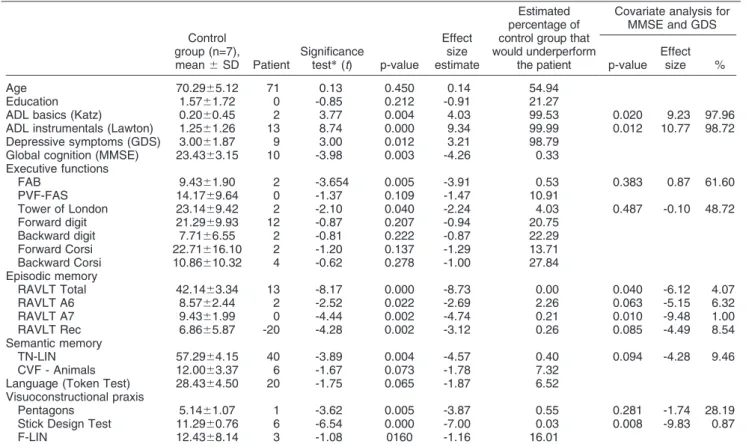
Table 1 Comparison between the patient and the control group and covariate analysis for the MMSE and GDS
Control group (n=7), mean6SD Patient
Significance
test*(t) p-value
Effect size estimate
Estimated percentage of control group that would underperform
the patient
Covariate analysis for MMSE and GDS
p-value Effect
size %
Age 70.2965.12 71 0.13 0.450 0.14 54.94
Education 1.5761.72 0 -0.85 0.212 -0.91 21.27
ADL basics (Katz) 0.2060.45 2 3.77 0.004 4.03 99.53 0.020 9.23 97.96 ADL instrumentals (Lawton) 1.2561.26 13 8.74 0.000 9.34 99.99 0.012 10.77 98.72 Depressive symptoms (GDS) 3.0061.87 9 3.00 0.012 3.21 98.79
Global cognition (MMSE) 23.4363.15 10 -3.98 0.003 -4.26 0.33 Executive functions
FAB 9.4361.90 2 -3.654 0.005 -3.91 0.53 0.383 0.87 61.60 PVF-FAS 14.1769.64 0 -1.37 0.109 -1.47 10.91
Tower of London 23.1469.42 2 -2.10 0.040 -2.24 4.03 0.487 -0.10 48.72 Forward digit 21.2969.93 12 -0.87 0.207 -0.94 20.75
Backward digit 7.7166.55 2 -0.81 0.222 -0.87 22.29 Forward Corsi 22.71616.10 2 -1.20 0.137 -1.29 13.71 Backward Corsi 10.86610.32 4 -0.62 0.278 -1.00 27.84 Episodic memory
RAVLT Total 42.1463.34 13 -8.17 0.000 -8.73 0.00 0.040 -6.12 4.07 RAVLT A6 8.5762.44 2 -2.52 0.022 -2.69 2.26 0.063 -5.15 6.32 RAVLT A7 9.4361.99 0 -4.44 0.002 -4.74 0.21 0.010 -9.48 1.00 RAVLT Rec 6.8665.87 -20 -4.28 0.002 -3.12 0.26 0.085 -4.49 8.54 Semantic memory
TN-LIN 57.2964.15 40 -3.89 0.004 -4.57 0.40 0.094 -4.28 9.46 CVF - Animals 12.0063.37 6 -1.67 0.073 -1.78 7.32
Language (Token Test) 28.4364.50 20 -1.75 0.065 -1.87 6.52 Visuoconstructional praxis
Pentagons 5.1461.07 1 -3.62 0.005 -3.87 0.55 0.281 -1.74 28.19 Stick Design Test 11.2960.76 6 -6.54 0.000 -7.00 0.03 0.008 -9.83 0.87 F-LIN 12.4368.14 3 -1.08 0160 -1.16 16.01
ADL = activities of daily living; CVF - Animals = Category Verbal Fluency, Animals; FAB = Frontal Assessment Battery; F-LIN = Simplified Figure of the Laboratory of Neuropsychological Investigations; GDS = Geriatric Depression Scale; MMSE = Mini Mental State Examination; PVF-FAS = Phonologic Verbal Fluency –– F, A, S letters; RAVLT = Rey Auditory Verbal Learning Test –– A6 (immediate recall), A7 (late recall), Rec (recognition); SD = standard deviation; TN-LIN = Naming Test of the Laboratory of Neuropsychological Investigations.
*One-tailed test.
Revista Brasileira de Psiquiatria. 2013;35
whole of her clinical condition. The patient was also impaired in her instrumental activities of daily living (IADLs) and had depressive symptoms.
A comprehensive neuropsychological evaluation was performed, including assessment of global cognition, episodic and semantic memory, executive functions, language, constructional praxis, functionality, and depressive symptoms. A comparison group, composed by seven women matched by age and education, performed the same protocol. The tests and results are presented in Table 1.
The patient scored poorer than the control group in functionality, depression, and all cognitive functions, except language. However, as the patient differed sig-nificantly in global cognition and depressive symptoms, we chose to covariate our findings with these variables.3The results of the covariate comparison between the patient and the control group are shown in Table 1.
The absence of differences between the patient and the control group in paper-and-pencil tests that measure complex visuoconstructional ability demonstrates that the influence of formal education on these cognitive pro-cesses should be taken into account. The impairment in late recall of episodic memory was beyond the global cognitive status and depressive symptoms. Testing of executive functions and semantic memory did not indicate a patient deficit to any further extent.
Nevertheless, these results suggest that the patient has a significant impairment of visuoconstructional ability, as tested by a simple task, regardless of her general cognition and depressive symptoms. These results also indicate that some instruments used to evaluate cognitive functions, such as the complex line drawing task4and the Mini Mental State Examination pentagons,5 can be influenced by educational attainment. Clinicians should be aware of this phenomenon.
The single case study methodology has broad applic-ability in the clinical setting for patients with particular characteristics, and can enhance characterization of possible dementia in older adults with low educational attainment.
Laiss Bertola,1Jonas Jardim de Paula,1 Edgar Nunes Moraes,2Vitor Geraldi Haase,3 Leandro Fernandes Malloy-Diniz1,4 1Laboratory of Neuropsychological Investigations (LIN), National
Science and Technology Institute for Molecular Medicine, School of Medicine, Universidade Federal de Minas Gerais (UFMG), Belo Horizonte, MG, Brazil.2Department of Medical Practice, School of Medicine, UFMG, Belo Horizonte, MG, Brazil.3Laboratory of Developmental Neuropsychology, Department of Psychology, School of Philosophy and Human Sciences, UFMG, Belo Horizonte, MG, Brazil.4Department of Mental Health, School of Medicine, UFMG, Belo Horizonte, MG, Brazil
Submitted Feb 27 2013, accepted Apr 08 2013.
Acknowledgements
This study has received grants from the National Science and Technology Institute for Molecular Medicine (INCT-MM), Fundac¸a˜o de Amparo a` Pesquisa do Estado de
Minas Gerais (FAPEMIG) (protocol nos. CBB-APQ-00075-09 and APQ-01972/12), and Conselho Nacional de Desenvolvimento Cientı´fico e Tecnolo´gico (CNPq) (protocol no. 573646/2008-2).
Disclosure
The authors report no conflicts of interest.
References
1 Crawford JR, Howell DC. Comparing an individual’s test score against norms derived from small samples. Clin Neuropsychol. 1998;12:483-6.
2 McKeith IG, Dickson DW, Lowe J, Emre M, O’Brien JT, Feldman H, et al. Diagnosis and management of dementia with Lewy bodies: third report of the DLB consortium. Neurology. 2005;65: 1863-72.
3 Crawford JR, Garthwaite PH, Ryan K. Comparing a single case to a control sample:Testing for neuropsychological deficits and dissocia-tions in the presence of covariates. Cortex. 2011;47:1166-78. 4 Ardila A, Rosselli M, Rosas P. Neuropsychological assessment in
illiterates: Visuospatial and memory abilities. Brain Cogn. 1989;11: 147-66.
5 Laks J, Coutinho ES, Junger W, Silveira H, Mouta R, Baptista EM, et al. Education does not equally influence all the Mini Mental State Examination subscales and items: inference from a Brazilian community sample. Rev Bras Psiquiatr. 2010;32:223-30.
Letters to the Editor 440