Surveying DNA Elements within Functional
Genes of Heterocyst-Forming Cyanobacteria
Jason A. Hilton1¤*, John C. Meeks2, Jonathan P. Zehr1
1University of California Department of Ocean Sciences, Santa Cruz, California, United States of America,
2University of California Department of Microbiology and Molecular Genetics, Davis, California, United States of America
¤ Current address: Stanford University School of Medicine, Department of Genetics, Palo Alto, California, United States of America
Abstract
Some cyanobacteria are capable of differentiating a variety of cell types in response to envi-ronmental factors. For instance, in low nitrogen conditions, some cyanobacteria form het-erocysts, which are specialized for N2fixation. Many heterocyst-forming cyanobacteria have DNA elements interrupting key N2fixation genes, elements that are excised during heterocyst differentiation. While the mechanism for the excision of the element has been well-studied, many questions remain regarding the introduction of the elements into the cya-nobacterial lineage and whether they have been retained ever since or have been lost and reintroduced. To examine the evolutionary relationships and possible function of DNA sequences that interrupt genes of heterocyst-forming cyanobacteria, we identified and com-pared 101 interruption element sequences within genes from 38 heterocyst-forming cyano-bacterial genomes. The interruption element lengths ranged from about 1 kb (the minimum able to encode the recombinase responsible for element excision), up to nearly 1 Mb. The recombinase gene sequences served as genetic markers that were common across the interruption elements and were used to track element evolution. Elements were found that interrupted 22 different orthologs, only five of which had been previously observed to be interrupted by an element. Most of the newly identified interrupted orthologs encode pro-teins that have been shown to have heterocyst-specific activity. However, the presence of interruption elements within genes with no known role in N2fixation, as well as in three non-heterocyst-forming cyanobacteria, indicates that the processes that trigger the excision of elements may not be limited to heterocyst development or that the elements move randomly within genomes. This comprehensive analysis provides the framework to study the history and behavior of these unique sequences, and offers new insight regarding the frequency and persistence of interruption elements in heterocyst-forming cyanobacteria.
a11111
OPEN ACCESS
Citation:Hilton JA, Meeks JC, Zehr JP (2016) Surveying DNA Elements within Functional Genes of Heterocyst-Forming Cyanobacteria. PLoS ONE 11 (5): e0156034. doi:10.1371/journal.pone.0156034
Editor:Franck Chauvat, CEA-Saclay, FRANCE
Received:July 17, 2015
Accepted:April 14, 2016
Published:May 20, 2016
Copyright:© 2016 Hilton et al. This is an open access article distributed under the terms of the Creative Commons Attribution License, which permits unrestricted use, distribution, and reproduction in any medium, provided the original author and source are credited.
Data Availability Statement:All previously-published genomic sequences are available from the NCBI and JGI databases as specified inS1 Table, and the relevant sequences from the Calothrix rhizosoleniae SC01 genome are within the Supporting Information files of this paper.
Funding:This work was sponsored in part by a Gordon and Betty Moore Foundation Investigator award (#493.01, J.P.Z.) and the National Science Foundation Center for Microbial Oceanography: Research and Education (EF0424599, J.P.Z.).
Introduction
Cyanobacteria can alter their cell shape and size, cell wall thickness, and filament orientation in response to environmental conditions varying from nutrient limitation to predation [1–3]. The morphological diversity of cyanobacteria also extends to cell differentiation as some filamen-tous cyanobacteria can form akinetes, hormogonia, and heterocysts, in addition to vegetative cells. Akinetes are spore-like cells formed during unfavorable growth conditions [4], while hor-mogonia are small-celled, motile filaments that are especially important in symbiosis initiation [5]. Heterocysts are the sites of N2fixation under nitrogen (N) limitation [6].
N2fixation, the process of converting N2to NH3, can be a means of avoiding a common
nutrient limitation for microbial growth in a variety of environments [7,8]. Nitrogenase, the enzyme that catalyzes N2fixation, is sensitive to inactivation by oxygen (O2) [9], and must
withstand the O2that is in the environment and that evolves through photosynthesis.
Hetero-cysts create and maintain a microoxic microenvironment by shutting down the activity of O2
-evolving photosystem II, increasing respiratory O2uptake, and creating a thick envelope
around the cell wall to restrict gas diffusion [6].
Heterocyst differentiation is regulated by many signaling pathways [10] and is accompanied by the changes in the expression of 500 to 1,000 genes [11,12]. In some heterocyst-forming cya-nobacteria, genome rearrangement is also necessary in order to form fully functional hetero-cysts. Key N2fixation genes are often interrupted in the genome of vegetative cells by DNA
sequences, referred to herein as interruption elements, previously observed to be as long as 80 kb in length [13]. Excision of an interruption element during heterocyst formation results in a contiguous, functional gene in heterocyst genomes [14] (Fig 1). These elements are not in all heterocyst-forming cyanobacterial genomes, but have been commonly found withinhupL, which encodes one subunit of an uptake hydrogenase responsible for recycling hydrogen (H2)
produced during N2fixation, andnifD, which encodes the nitrogenase alpha subunit [13–18].
Additionally, elements have been reported withinfdxN, which encodes a ferredoxin and is located in an operon with nitrogenase genesnifU,nifS, andnifB, and likelynifH,nifD, and
nifK, as well. [14,15,17,19,20]. More recently, elements have been found in the nitrogenase iron subunit genenifH, and innifK, the nitrogenase beta subunit gene [13,21,22].
The elements are removed during the later stages of heterocyst development by a site-spe-cific recombinase, which is encoded by a gene located within the element [15,23]. To excise the interruption element, the recombinase binds to direct repeats that bracket the element [24]. Genes for these recombinases have been identified asxisA,xisC, andxisFwithinnifD,hupL, andfdxNelements, respectively [14,25,26]. ThenifHelement recombinase gene sequences is
Fig 1. ThecoxA3element found in theCalothrixsp. PCC 7103 genome.An example of an element interrupting a gene (split into
coxA31andcoxA32) in the vegetative genome. The complete, functionalcoxA3gene is present in the heterocyst genome due to the element excision by the protein encoded by thexisgene.
most similar to that ofxisA[21], and the sequence of the recombinase gene in thenifKelement is most closely related to thexisFsequence [22].xisAexpression is likely regulated by the tran-scriptional regulators for nitrogen, NtcA, and ferric uptake, FurA; however, little is known of the details of the regulatory mechanisms and other potential regulating factors of interruption element recombinases [27–29]. Two additional genes,xisHandxisI, located in theNostocsp. strain PCC 7120 (Nostoc7120)fdxNelement are also required for excision of that element [30]. The specific roles ofxisHandxisIare unclear, but they may be related to determining the direction of recombination catalyzed by XisF—integration vs. excision [31]. It is also unclear when or how all of these interruption elements originated; it has been hypothesized that they are the remnants of viruses or phages [18,32].
Yet another mystery is whether the elements provide any advantage or disadvantage to het-erocyst-forming cyanobacteria or if they are selfish DNA, and have little to no effect(s) on the organisms [33]. The possession or lack of anifDelement did not affect cell growth or N2
fixa-tion of two differentNostocstrains in the presence of combined N or with N2as the sole N
source [34,35]. Thus, the presence or absence of this element has no apparent selective advan-tage under laboratory growth conditions, at least not within the timescale of these experiments.
In an effort to more fully explore the evolution and potential purposes of the interruption elements, the work presented here examines the elements found in all currently sequenced het-erocyst-forming cyanobacterial genomes. We defined 101 interruption elements in heterocyst-forming cyanobacterial genomes, including many previously unknown elements, and com-pared them in an attempt to determine their evolutionary paths. Additionally, in an effort to provide evolutionary context for these elements, we searched all cyanobacterial genomes for interruption elements and discovered three elements within genes of cyanobacteria that are not capable of forming heterocysts.
Materials and Methods
As of the writing of this report, there were 38 heterocyst-forming cyanobacteria with sequenced genomes; 27 from the order Nostocales and 11 from the order Stigonematales (Fig 2). The
Calothrix rhizosoleniaeSC01 genome is yet unreleased, but sequences relevant to this study can be found inS1andS2Data. Accession numbers for all of the other genomes can be found in Table A inS1 File. Annotations of the genomes were examined, focusing on regions near the five genes previously shown to contain interruption elements (nifH,nifD,nifK,hupL, and
Fig 2. Heterocyst-forming cyanobacteria 16S phylogeny.Maximum likelihood phylogenetic tree of 16S rRNA from 38 heterocyst-forming cyanobacterial genomes, rooted withTrichodesmium erythraeumIMS 101. The size of the genome and the number of interruption elements within the genome are shown within parentheses. Cyanobacteria of the order Nostocales are in shaded boxes, and all other cyanobacteria belong to the order Stigonematales, with the exception ofT.erythraeumIMS101. Open circles at branch connections indicate a bootstrap value of at least 75%.
serve as a marker for the end and beginning of each element. As more interruption elements were confirmed, thexisgene sequences from each were added to the set, and the BLAST analy-sis was repeated to find more potential gene interruptions and associatedxisgenes.
A BLAST analysis was then conducted with all of the confirmedxisgenes from the hetero-cyst-forming cyanobacterial genomes against all non-heterohetero-cyst-forming cyanobacterial genomes (blastp, e-value10−50). More stringent criteria was used for this BLAST analysis in order to limit our results to only those recombinase genes most similar to the knownxisgenes. All BLAST hits were checked for interrupted genes as described above.
For the recombinase gene and 16S rRNA phylogenetic trees, nucleotide sequences were aligned in MEGA5 with ClustalW [36]. The recombinase gene sequence alignments were done with respect to codons, and thus, no gaps were inserted within a codon. Maximum likelihood phylogenetic trees were constructed with MEGA5 using the Tamura-Nei model and only those alignment sites with at least 90% coverage were used [37]. Statistical support for nodes was based on 1,000 bootstrap replicates [38].
To analyze shared genes within the gene content of the elements, a bi-directional BLAST analysis (blastp, e-value10−20) was conducted on all of the genes from each heterocyst-form-ing cyanobacterial genome against the full gene set from each of the other genomes. We then identified the genes encoded in an element that had bi-directional best hits to at least four other genes from elements. The bi-directional best hits of each of those genes were then used to identify non-element genes occurring in other genomes.
Results
We identified 101 interruption elements within 28 genomes of heterocyst-forming cyano-bacteria, while an additional 10 genomes did not have any observed elements (Fig 2). Five out of 11 cyanobacteria within Stigonematales each had at least one element. On the other hand, 23 out of 27 Nostocales organisms possessed at least one interruption element, with as many as 11 elements in one genome (Calothrixsp. PCC 7103). The structure of the phyloge-netic tree generated based on the 16S rRNA sequences of these 38 genomes largely agreed with phylogenetic trees that were made using concatenated gene sequences from many of the same genomes, with the main exception beingAnabaenasp. PCC 7108 which has grouped more closely withAnabaena cylindricaPCC 7122 andNostoc azollae0708 in other trees [39,40].
The interruption elements were as small as the 1.3 kb element within aScytonema hofmanni
UTEX 2349 FAD-dependent oxidoreductase gene up to the nearly 1 MbcoxAelement in Calo-thrixsp. PCC 6303 (Table B inS1 File). The average element length was 41.5 kb, excluding seven elements that could not be characterized due to apparent genome mis-assembly and nine elements that were predicted from sequences on separate contigs, and thus may be longer than determined by genomic analysis. All of the elements that were found in this study and theirxis
genes are catalogued fully in Table B inS1 File.
variants were found amongst the 19nifHelements. Two variants each were found fornifK,
nifB,hupL,hupS, andcoxA3elements.
The presence of element variants with more than three occurrences in the heterocyst-form-ing cyanobacterial genomes was plotted along the 16S rRNA phylogeny (Figures B and C inS2 File). The variants range from those organisms possessing them clustering together (e.g.nifH
405 andfdxN) to those that were spread out throughout the 16S rRNA phylogenetic tree (e.g.
hupL590 andnifD895).
Axisgene was identified for 100 out of the 101 elements (Table B inS1 File). A contig break prevented the confirmation of a recombinase-coding gene in theRichelia intracellularisRC01
nifHelement. There were also seven cases that involved the two sections of the interrupted gene oriented in opposite directions (Figure D inS2 File). These are likely due to mis-assembly of the genome, and have been labeled as "odd assembly" in Table B inS1 File. The sequences for the correspondingxisgenes were included in phylogenetic analysis but no further charac-terization of the interruption elements was done. There were 44 additional genes with a BLAST hit to axisgene (e-value<10−20), but an interrupted gene could not be located near them, and, thus, could not be verified as element excision genes, possibly due to the bias introduced by limiting our search for an interrupted gene to within 3 kb of each possiblexisgene.
Table 1. The 22 ortholog groups that were found to have at least one representative gene interrupted by an element in heterocyst-forming cyano-bacteria, and three additional orthologs that had interruption elements in non-heterocyst-forming cyanobacteria.
Gene Product Gene Symbol Reference Locus Tag Elements Variants
nitrogenase molybdenum-iron protein alpha subunit nifD Aazo_1353 34 4
nitrogenase iron protein nifH Aazo_1354 19 6
uptake hydrogenase large subunit hupL Aazo_3865 11 2
nitrogenase molybdenum-iron protein beta subunit nifK Aazo_1352 8 2
uptake hydrogenase small subunit hupS Aazo_3866 4 2
ferredoxin fdxN Aazo_1357 3 1
nitrogenase cofactor biosynthesis protein nifB Aazo_1358 2 2
nitrogenase molybdenum-iron cofactor biosynthesis protein nifE Aazo_1350 2 1
pyruvate ferredoxin/flavodoxin oxidoreductase nifJ Cal7507_5433 2 1
flavin reductase domain-containing FMN-binding protein flv3B Aazo_4140 2 1
cytochrome c oxidase subunit I coxA Aazo_2640 3 3
polyketide-type polyunsaturated fatty acid synthase hglE Aazo_3917 1 1
NADPH-dependent FMN reductase Aazo_5221 1 1
FAD-dependent oxidoreductase Cal7507_5656 1 1
phospholipase D/transphosphatidylase Cal7507_0570 1 1
primase P4 Ana7108_2845 1 1
arabinose efflux permease Mic7126DRAFT_5075 1 1
integrase family protein Aazo_2682 1 1
transposase Ava_B0242 1 1
transposase (ISSoc8) Mas10914DRAFT_5058 1 1
caspase domain-containing protein Cal7103DRAFT_00047390 1 1
hypothetical protein CylstDRAFT_1988 1 1
In non-heterocyst-forming cyanobacteria
predicted integral membrane protein Pse6802_3453 1 1
hypothetical protein Cya7822_6696 1 1
ATP-dependent DNA helicase recQ Pse6802_0098 1 1
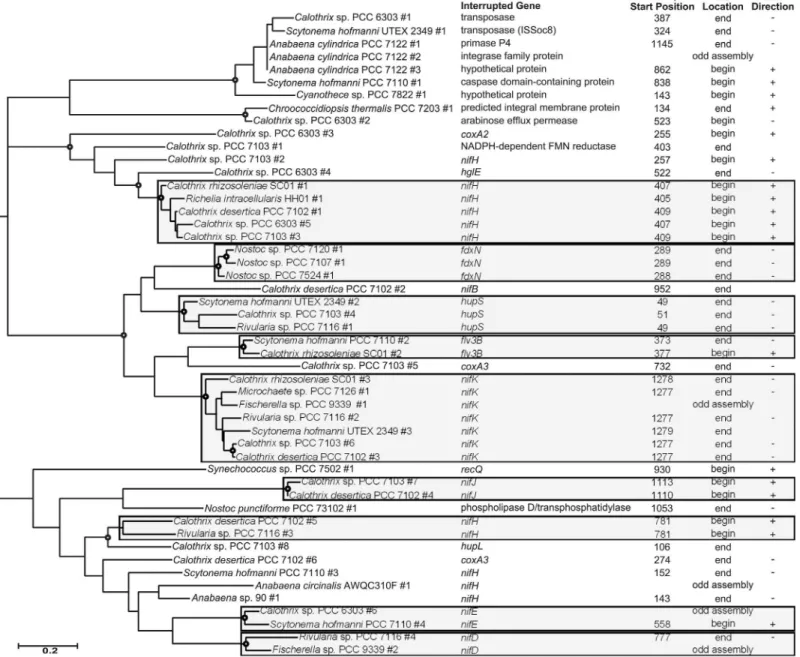
Of thexisgenes found in this study, 48 encoded recombinases belonging to the serine recombinase superfamily, while the remaining 52 encoded recombinases of the tyrosine super-family (Table B inS1 File). At least one element containing a serine recombinase was found interrupting each of the 22 ortholog groups, but only six ortholog groups had an occurrence of an element containing a tyrosine recombinase. The 23xisgenes aligned in the same orientation as the interrupted genes were located towards the beginning of the element. All but one of the 70xisgenes that were oriented in the opposite direction to the interrupted gene were found closer to the end of the element (example:Fig 1). Thexisgene in theCalothrixsp. PCC 6303 arabinose efflux permease interruption element was the exception to this, and although ori-ented in the opposite direction of the interrupted gene, it was located at the beginning of the element.
The majority ofxisgene sequences formed well-supported phylogenetic clusters with other
xisgenes found in interruption elements of the same element variant (Figs3and4), but there were a few exceptions. The threexisgene sequences of elements that interruptednifHat posi-tion 150 (± 7 bp) were closely-related, but did not form a branch like thexisgenes from each of the other variants (Fig 3;Anabaenasp. 90 element #1,Anabaena circinalisAWQC310F #1, andScytonema hofmanniPCC 7110 #3). ThenifDelements with insertion locations at position 895 (± 1 bp) containedxisgene sequences that clustered together, however, four of the genes were within a subcluster with strong bootstrap support (Anabaena cylindricaPCC 7122 #5,
Anabaenasp. PCC 7108 #2,Cylindrospermum stagnalePCC 7417 #2, andMicrochaetesp. PCC 7126 #2), while theRivulariasp. PCC 7116 (#6) andCalothrixsp. PCC 7103 (#10) genes were phylogenetically distant (Fig 4). TheRivulariasp. PCC 7116 andCalothrixsp. PCC 7103
xisgenes within these elements were located at the end of the element, oriented in the opposite direction asnifD, but thexisgenes within the other four elements of this variant were found at the beginning of the element and read in the same direction asnifD. Similarly, the twoxisgene sequences from thenifDelements with insertion locations at position 227 clustered together, but exhibited long branch lengths and low bootstrap support, and thexisgenes differed in loca-tion and orientaloca-tion (Fig 4;Rivulariasp. PCC 7116 #9 andCalothrixsp. PCC 7103 #11). The
flv3Belements ofS.hofmanniPCC 7110 andCalothrix rhizosoleniaeSC01 also hadxisgenes of differing location and orientation (Fig 3). TheS.hofmanniPCC 7110xisgene was located at the end of the element and was oriented in the opposite direction of theflv3Bthat it inter-rupted, while theC.rhizosoleniaeSC01xisgene was at the beginning of the element and was read in the same direction asflv3B.
In some cases,xisgene sequences grouped phylogenetically by organism. For example, seven genes in theA.cylindricaPCC 7122 were identical to each other, and while no interrup-tion element could be identified for four of the genes, the three other genes were identified as encoding element excision proteins (Fig 3;A.cylindricaPCC 7122 #1–3). Similarly, thexis gene of the interruption element within aS.hofmanniUTEX 2349 transposase was identical to thexisgene in an oxidoreductase gene interruption element in the same genome (Table B inS1 File). However, the oxidoreductase gene interruption elementxisgene sequence was shortened by a gap in the genome assembly, and, thus, was left out of the analysis. Although more diver-gent than theA.cylindricaPCC 7122 andS.hofmanniUTEX 2349xisgenes, theRivulariasp. PCC 7116xisgene sequences responsible for thenifBandhupSelements clustered together (Fig 4). The length and GC content of each element was plotted along thexisphylogeny (Fig-ures E-H inS2 File), but no clear patterns emerged.
hypothetical protein was conserved in fivehupLelements and also found in one additional genome not in en element. A translation elongation factor G paralog was found in three differ-ent elemdiffer-ent variants of five genomes and in two other genomes, which have the potdiffer-ential to be in elements, as discussed below. A transposase gene was also found on multiple element variants.
Interruption elements were also found within genes of three unicellular non-heterocyst-forming cyanobacteria, including a hypothetical membrane protein ofChroococcidiopsis ther-malisPCC 7203 (Table B inS1 File). ASynechococcussp. PCC 7502 DNA helicase gene and a
Cyanothecesp. PCC 7822 hypothetical protein were also interrupted by interruption elements. Fig 3. Serine recombinase phylogeny.Maximum likelihood phylogenetic tree of serine recombinase gene (xis) nucleotide sequences and data
characterizing the element eachxisgene is found on. Shaded boxes group element variants together. Open circles at branch connections indicate a bootstrap value of at least 75.
Thexisgene sequences from these elements were spread throughout the serine recombinase gene phylogenetic tree, and all three genes were oriented in the same direction as the inter-rupted gene. Thexisgenes within theSynechococcussp. PCC 7502 andCyanothecesp. PCC 7822 elements were located at the beginning of their respective elements, while that of theC. Fig 4. Tyrosine recombinase phylogeny.Maximum likelihood phylogenetic tree of tyrosine recombinase gene (xis) nucleotide sequences and data characterizing the element eachxisgene is found on. Shaded boxes group element variants together. Open circles at branch connections indicate a bootstrap value of at least 75.
thermalisPCC 7203 hypothetical protein element was the only positively orientedxisgene in this study to be found at the end of the element.
Discussion
Interrupted genes
The newly discovered interruption elements presented here provide context for which to answer many questions that have surrounded these features for decades. Among those ortho-logs that were not previously reported to contain elements are several genes known to be important to N2fixation or maintenance of a microoxic microenvironment in heterocysts. The
products ofnifEandnifBare involved in the synthesis of the nitrogenase Fe/Mo cofactor [41], andhupSencodes an uptake hydrogenase subunit and is in an operon withhupL.nifJencodes an oxidoreductase that is responsible for electron transfer to nitrogenase, and is required for N2fixation when iron is limiting [42,43]. A previous study ofNostoc7120 indicated that
expression of genes orthologous to the two element-containing cytochrome c oxidase subunit I copies,coxA2andcoxA3, are specific to heterocysts, while a third copy,coxA1, is expressed only in vegetative cells [44]. The role of cytochrome c oxidase in heterocysts is in respiratory O2consumption [44]. Similarly, theflv3Bgene product ofNostoc7120 is a heterocyst-specific
flavin reductase that reduces O2[45]. The fatty acid synthase encoded byhglEis involved in
the formation of heterocyst glycolipids, which form a layer in the envelope that acts to retard gas diffusion into the heterocyst [46]. Given the heterocyst-specific roles of these genes, the excision of their interruption elements is likely dependent on transcription of the respectivexis
genes during heterocyst formation, as is assumed to be the case with all of the previously reported elements [15].
The presence of interruption elements within genes with no known role in N2fixation
opens several possibilities. First of all, these interrupted genes may indeed have heterocyst-spe-cific roles and are excised during heterocyst formation. Additionally, the elements may not be excised under any circumstances, thus, leaving the genes that they interrupt non-functional. However, this inactivation would likely lead to rapid deterioration of the interrupted gene, and likely thexisgene, as well. On the other hand, the excision of some elements could be brought on by factors other than heterocyst development, such as differentiation of other cell types. Many heterocyst-forming cyanobacteria also form akinetes [4] and hormogonia [5]. Addition-ally, the element-containing unicellularChroococcidiopsisspp. form survival cells upon nitro-gen limitation [47]; the excision of the interruption element from the gene encoding a
membrane protein could be triggered by the formation of these cells. This idea is supported by a phylogenetic relationship betweenC.thermalisand heterocyst-forming cyanobacteria that provides a possible evolutionary link between these survival cells and heterocysts [40,48]. Thus, interruption element excision triggered by cell differentiation may be shared between these organisms.
oriented in different ways than the others in this study. While element excision may be trig-gered by differentiation of various cell types, the mechanisms could differ depending on the cell type.
Factors other than cell differentiation should also be considered for triggers of interruption element excision in heterocyst-forming cyanobacteria. However, similar to the case of a non-terminal cell type, the excision of interruption elements throughout a population during a sin-gle event would result in the element being present in future generations exclusively as extra-chromosomal DNA. Reintegration would again be required, but the interruption elements found inSynechococcussp. PCC 7502 andCyanothecesp. PCC 7822 do not contain transpo-sases. The presence of interruption elements in these unicellular cyanobacteria, neither of which has been shown to differentiate cells of any kind, supports the possibility of other factors prompting genome rearrangements.
Evolution of recombinase genes and element variants
The two recombinase superfamilies (tyrosine and serine) responsible for interruption element excision from heterocyst-forming cyanobacterial genes are named for the amino acid residue of each that covalently binds to the DNA, and each superfamily uses a different mechanism for recombination [24]. They have different evolutionary histories, and the lack of an evolutionary relationship between the recombinase superfamilies indicates there have been at least two events in which the heterocyst-forming cyanobacterial lineage has acquired interruption ele-ments, one involving each type of recombinase.
The relatedness of the recombinase gene sequences within each superfamily provides clues as to how the interruption elements have evolved in heterocyst-forming cyanobacteria. In gen-eral, the recombinase gene sequences mostly clustered with those from the same element vari-ant in other organisms. However, theA.cylindricaPCC 7122 andS.hofmanniUTEX 2349 sets of serine superfamily recombinase gene sequences clustered with others from the same organ-ism, and are likely the result of transposition events within the genome. TheRivulariasp. PCC 7116xisgenes responsible for thenifBandhupSelements are the only examples of tyrosine recombinase gene sequences from the same organism clustering together, and they are much more divergent than those serine recombinase gene clusters. Additionally, serine superfamily recombinase genes are found in elements interrupting more ortholog groups than tyrosine superfamily recombinase genes, including all of the genes with no known N2fixation role. The
relationships of the available recombinase gene sequences provide evidence that serine super-family recombinase genes have a greater tendency to integrate into a genome or replicon, or replicate within a genome than tyrosine superfamily recombinase genes. This replication is a characteristic of selfish DNA [33], and is likely the mechanism for the origin of an element variant.
The element variant that interruptsnifDat position 1355 (± 2 bp) was, by far, the most com-mon variant observed in the genomes studied here. This was likely either the first interruption element to integrate and persist in heterocyst-forming cyanobacteria, or this particular element variant is more likely to be retained than other elements, possibly due to some advantage it pro-vides to the host organism. Either way, it is this frequently occurring element variant that war-rants special attention when examining the origin of interruption elements within this lineage.
Element gene content
commonly the elements that interruptnifDat position 1355 (± 2 bp), including several that have been previously identified as conserved in many of those elements [18,49,50]. Most of these genes were also found in genomes outside of interruption elements, indicating their func-tions are likely not element-specific despite their conservation in many elements. The ATPase that was found in six elements is the exception as it was not found in any other genome, although it is unclear what possible function it may have with regards to the element.
The genes encoding translation elongation factor G (TEFG) paralogs in multiple element variants also may have a function specific to the element. TEFG paralogs were found in the
Richelia intracellularisHH01 andR.intracellularisRC01nifHelements, theCalothrixsp. PCC 7103 andCalothrix deserticaPCC 7102nifKelements, and theRivulariasp. PCC 7116 element that interruptsnifDat position 1353. TheC.rhizosoleniaeSC01 TEFG paralog is in an 11.9 kb contig, and may be in one of several interruption elements that are disjointed by a contig break (hupL,nifH,nifK, orflv3B) or not in any interruption element. Similarly, theM.testarum
BC008 TEFG paralog is located in a 40.5 kb contig. No interruption element has been con-firmed in that genome, but there are two possiblexisgenes that are located near contig edges, and thus, are possible element recombinase genes. Therefore, the TEFG paralog may be exclu-sively located in interruption elements in heterocyst-forming cyanobacteria. However, the interruption elements containing the TEFG paralogs are not closely related, based on recombi-nase gene sequences, indicating the TEFG paralog was not simply inherited with that interrup-tion element through speciainterrup-tion. In bacteria, TEFGs are involved in elongainterrup-tion during protein synthesis and ribosome recycling [51–53]. In addition to a TEFG of cyanobacterial ancestry, a TEFG paralog is found in some cyanobacteria [54], including the seven closely related hetero-cyst-forming strains analyzed here. Thus, the TEFG paralog may be preserved in interruption elements due to an element-specific function, such as a role in the synthesis of proteins encoded in the excised element in the heterocyst.
Based on the relatedness of their recombinase genes, the interruption elements within each variant appear to have a strong evolutionary connection, yet there are very few physical simi-larities within variant groups. The lack of consistencies in length or GC content among all interruption elements of a single variant indicates that the interruption elements are dynamic sequences that have undergone changes within the individual organisms. The highly variable gene content encoded in each interruption element is also indicative of a dynamic sequence with gene deletions and insertions taking place over time. The transformations that the inter-ruption elements have undergone over time have clouded genetic signatures and made it diffi-cult to connect the elements to their origin.
Conclusion
closely related to elements that have excision triggered by the cell, but interrupt genes that have no known function in N2fixation, reveals the possibility of factors beyond heterocyst
differen-tiation that could activate the excision of interruption elements. Through expansion of the interruption element data set, we have begun to trace the evolutionary paths of these unique genetic features and identified that their impact is broader than previously thought.
Supporting Information
S1 Data.Calothrix rhizosoleniaeSC01 gene sequences.The DNA sequences for the fourxis genes (from Table B inS1 File) and three genes that were shared across elements (from Table C inS1 File) in theCalothrix rhizosoleniaeSC01 genome.
(FAS)
S2 Data.Calothrix rhizosoleniaeSC01 contig sequences.The seven contigs from the
Calo-thrix rhizosoleniaeSC01 genome that contained part of an element. (FAS)
S1 File. Tables A-C.Detailed information describing the genomes analyzed in this study, the interruption elements that were found in those genomes, and shared genes across the elements. (XLSX)
S2 File. Figures A-H.Images providing depictions of specific interruption elements, element frequency relative to phylogeny, and element length and GC content trends.
(PDF)
Acknowledgments
This work was sponsored in part by a Gordon and Betty Moore Foundation Investigator award (#493.01, J.P.Z.) and the NSF Center for Microbial Oceanography: Research and Education (EF0424599, J.P.Z.). We thank I. Shilova and J. Robidart for comments on the manuscript.
Author Contributions
Conceived and designed the experiments: JAH JPZ JCM. Performed the experiments: JAH. Analyzed the data: JAH. Contributed reagents/materials/analysis tools: JPZ. Wrote the paper: JAH JPZ JCM.
References
1. Marcus Y, Zenvirth D, Harel E, Kaplan A. Induction of HCO3- transporting capability and high photosyn-thetic affinity to inorganic carbon by low concentration of CO2inAnabaena variabilis. Plant Physiol.
1982; 69: 1008–1012. PMID:16662334
2. Mühling M, Harris N, Belay A, Whitton BA. Reversal of helix orientation in the cyanobacterium Arthros-pira. J Phycol. 2003; 39: 360–367.
3. Pattanaik B, Montgomery BL. FdTonB is involved in the photoregulation of cellular morphology during complementary chromatic adaptation inFremyella diplosiphon. Microbiology. 2010; 156: 731–741. doi: 10.1099/mic.0.035410-0PMID:19959581
4. Kaplan-Levy RN, Hadas O, Summers ML, Rücker J, Sukenik A. Akinetes: dormant cells of cyanobacte-ria. Dormancy and Resistance in Harsh Environments. New York, NY: Springer; 2010. pp. 5–27.
5. Herdman M, Rippka R. Cellular differentiation: hormogonia and baeocytes. Methods Enzymol. 1988; 167: 232–242.
6. Wolk CP, Ernst A, Elhai J. Heterocyst metabolism and development. The Molecular Biology of Cyano-bacteria. New York, NY: Springer; 2004. pp. 769–823.
8. Zehr JP, Kudela RM. Nitrogen cycle of the open ocean: from genes to ecosystems. Annu Rev Mar Sci. 2011; 3: 197–225.
9. Wong PP, Burris RH. Nature of oxygen inhibition of nitrogenase fromAzotobacter vinelandii. Proc Natl Acad Sci. 1972; 69: 672–675. PMID:4501581
10. Zhang C-C, Laurent S, Sakr S, Peng L, Bédu S. Heterocyst differentiation and pattern formation in cya-nobacteria: a chorus of signals. Mol Microbiol. 2006; 59: 367–375. PMID:16390435
11. Christman HD, Campbell EL, Meeks JC. Global transcription profiles of the nitrogen stress response resulting in heterocyst or hormogonium development inNostoc punctiforme. J Bacteriol. 2011; 193: 6874–6886. doi:10.1128/JB.05999-11PMID:22001509
12. Ehira S. Transcriptional regulation of heterocyst differentiation inAnabaenasp. strain PCC 7120. Russ J Plant Physiol. 2013; 60: 443–452.
13. Wang H, Sivonen K, Rouhiainen L, Fewer DP, Lyra C, Rantala-Ylinen A, et al. Genome-derived insights into the biology of the hepatotoxic bloom-forming cyanobacteriumAnabaenasp. strain 90. BMC Geno-mics. 2012; 13: 613. doi:10.1186/1471-2164-13-613PMID:23148582
14. Golden JW, Wiest DR. Genome rearrangement and nitrogen fixation inAnabaenablocked by inactiva-tion ofxisAgene. Science. 1988; 242: 1421–1423. PMID:3144039
15. Golden JW, Robinson SJ, Haselkorn R. Rearrangement of nitrogen fixation genes during heterocyst differentiation in the cyanobacteriumAnabaena. Nature. 1985; 314: 419–423. PMID:3920531
16. Carrasco CD, Buettner JA, Golden JW. Programmed DNA rearrangement of a cyanobacterialhupL
gene in heterocysts. Proc Natl Acad Sci. 1995; 92: 791–795. PMID:7846053
17. Carrasco CD, Golden JW. Two heterocyst-specific DNA rearrangements ofnifoperons inAnabaena
cylindrica andNostocsp. strain Mac. Microbiology. 1995; 141: 2479–2487. PMID:7582007
18. Henson BJ, Hartman L, Watson LE, Barnum SR. Evolution and variation of thenifDandhupLelements in the heterocystous cyanobacteria. Int J Syst Evol Microbiol. 2011; 61: 2938–2949. doi:10.1099/ijs.0. 028340-0PMID:21278412
19. Mulligan ME, Haselkorn R. Nitrogen fixation (nif) genes of the cyanobacteriumAnabaenaspecies strain PCC 7120. ThenifB-fdxN-nifS-nifUoperon. J Biol Chem. 1989; 264: 19200–19207. PMID:2553733
20. Ungerer J, Pratte BS, Thiel T. RNA processing of nitrogenase transcripts in the cyanobacterium Ana-baena variabilis. J Bacteriol. 2010; 192: 3311–3320. doi:10.1128/JB.00278-10PMID:20435734
21. Vintila S, Selao T, Norén A, Bergman B, El-Shehawy R. Characterization ofnifHgene expression, mod-ification and rearrangement inNodularia spumigenastrain AV1. FEMS Microbiol Ecol. 2011; 77: 449– 459. doi:10.1111/j.1574-6941.2011.01127.xPMID:21569060
22. Hilton JA, Foster RA, Tripp HJ, Carter BJ, Zehr JP, Villareal TA. Genomic deletions disrupt nitrogen metabolism pathways of a cyanobacterial diatom symbiont. Nat Commun. 2013; 4: 1767. doi:10.1038/ ncomms2748PMID:23612308
23. Lammers PJ, Golden JW, Haselkorn R. Identification and sequence of a gene required for a develop-mentally regulated DNA excision inAnabaena. Cell. 1986; 44: 905–911. PMID:3006922
24. Carrasco CD, Ramaswamy K, Ramasubramanian T, Golden JW.Anabaena xisFgene encodes a developmentally regulated site-specific recombinase. Genes Dev. 1994; 8: 74–83. PMID:8288129
25. Carrasco CD, Holliday SD, Hansel A, Lindblad P, Golden JW. Heterocyst-specific excision of the Ana-baenasp. strain PCC 7120hupLelement requiresxisC. J Bacteriol. 2005; 187: 6031–6038. PMID: 16109944
26. Chastain CJ, Brusca JS, Ramasubramanian TS, Wei T-F, Golden JW. A sequence-specific DNA-bind-ing factor (VF1) fromAnabaenasp. strain PCC 7120 vegetative cells binds to three adjacent sites in the
xisAupstream region. J Bacteriol. 1990; 172: 5044–5051. PMID:2118506
27. Ramasubramanian TS, Wei TF, Golden JW. TwoAnabaenasp. strain PCC 7120 DNA-binding factors interact with vegetative cell-and heterocyst-specific genes. J Bacteriol. 1994; 176: 1214–1223. PMID: 8113160
28. López-Gomollón S, Hernández JA, Pellicer S, Angarica VE, Peleato ML, Fillat MF. Cross-talk between iron and nitrogen regulatory networks inAnabaena(Nostoc) sp. PCC 7120: identification of overlapping genes in FurA and NtcA regulons. J Mol Biol. 2007; 374: 267–281. PMID:17920076
29. Ramaswamy K, Carrasco CD, Fatma T, Golden JW. Cell-type specificity of theAnabaena fdxN-element rearrangement requiresxisHandxisI. Mol Microbiol. 1997; 23: 1241–1249. PMID:9106215
30. Hwang WC, Golden JW, Pascual J, Xu D, Cheltsov A, Godzik A. Site-specific recombination of nitro-gen-fixation genes in cyanobacteria by XisF-XisH-XisI complex: structures and models. Proteins Struct Funct Bioinforma.
32. Orgel LE, Crick FHC, Sapienza C. Selfish DNA. Nature. 1980; 288: 645–646. PMID:7453798
33. Brusca JS, Chastain CJ, Golden JW. Expression of theAnabaenasp. strain PCC 7120xisAgene from a heterologous promoter results in excision of thenifDelement. J Bacteriol. 1990; 172: 3925–3931. PMID:2113913
34. Meeks JC, Campbell EL, Bisen PS. Elements interrupting nitrogen fixation genes in cyanobacteria: presence and absence of anifDelement in clones ofNostocsp. strain Mac. Microbiology. 1994; 140: 3225–3232.
35. Thompson JD, Higgins DG, Gibson TJ. CLUSTAL W: improving the sensitivity of progressive multiple sequence alignment through sequence weighting, position-specific gap penalties and weight matrix choice. Nucleic Acids Res. 1994; 22: 4673–4680. PMID:7984417
36. Tamura K, Peterson D, Peterson N, Stecher G, Nei M, Kumar S. MEGA5: molecular evolutionary genet-ics analysis using maximum likelihood, evolutionary distance, and maximum parsimony methods. Mol Biol Evol. 2011; 28: 2731–2739. doi:10.1093/molbev/msr121PMID:21546353
37. Felsenstein J. Confidence limits on phylogenies: an approach using the bootstrap. Evolution. 1985; 39: 783–791.
38. Shih PM, Wu D, Latifi A, Axen SD, Fewer DP, Talla E, et al. Improving the coverage of the cyanobacter-ial phylum using diversity-driven genome sequencing. Proc Natl Acad Sci. 2013; 110: 1053–1058. doi: 10.1073/pnas.1217107110PMID:23277585
39. Howard-Azzeh M, Shamseer L, Schellhorn HE, Gupta RS. Phylogenetic analysis and molecular signa-tures defining a monophyletic clade of heterocystous cyanobacteria and identifying its closest relative. Photosynth Res. 2014; 122: 171–185. doi:10.1007/s11120-014-0020-xPMID:24917519
40. Roberts GP, MacNeil T, MacNeil D, Brill WJ. Regulation and characterization of protein products coded by thenif(nitrogen fixation) genes ofKlebsiella pneumoniae. J Bacteriol. 1978; 136: 267–279. PMID: 361694
41. Shah VK, Stacey G, Brill WJ. Electron transport to nitrogenase. Purification and characterization of pyruvate: flavodoxin oxidoreductase. ThenifJgene product. J Biol Chem. 1983; 258: 12064–12068. PMID:6352705
42. Bauer CC, Scappino L, Haselkorn R. Growth of the cyanobacteriumAnabaenaon molecular nitrogen: NifJ is required when iron is limited. Proc Natl Acad Sci. 1993; 90: 8812–8816. PMID:8415612
43. Valladares A, Herrero A, Pils D, Schmetterer G, Flores E. Cytochrome c oxidase genes required for nitrogenase activity and diazotrophic growth inAnabaenasp. PCC 7120. Mol Microbiol. 2003; 47: 1239–1249. PMID:12603731
44. Ermakova M, Battchikova N, Allahverdiyeva Y, Aro E-M. Novel heterocyst-specific flavodiiron proteins inAnabaenasp. PCC 7120. FEBS Lett. 2013; 587: 82–87. doi:10.1016/j.febslet.2012.11.006PMID: 23178714
45. Campbell EL, Cohen MF, Meeks JC. A polyketide-synthase-like gene is involved in the synthesis of het-erocyst glycolipids inNostoc punctiformestrain ATCC 29133. Arch Microbiol. 1997; 167: 251–258. PMID:9075624
46. Billi D, Grilli-Caiola M. Effects of nitrogen limitation and starvation onChroococcidiopsissp. (Chroococ-cales). New Phytol. 1996; 133: 563–571.
47. Fewer D, Friedl T, Büdel B.Chroococcidiopsisand heterocyst-differentiating cyanobacteria are each other’s closest living relatives. Mol Phylogenet Evol. 2002; 23: 82–90. PMID:12182405
48. Grindley ND, Whiteson KL, Rice PA. Mechanisms of site-specific recombination. Annu Rev Biochem. 2006; 75: 567–605. PMID:16756503
49. Lammers PJ, McLaughlin S, Papin S, Trujillo-Provencio C, Ryncarz AJ. Developmental rearrangement of cyanobacterialnifgenes: nucleotide sequence, open reading frames, and cytochrome P-450 homol-ogy of theAnabaenasp. strain PCC 7120nifDelement. J Bacteriol. 1990; 172: 6981–6990. PMID: 2123860
50. Henson BJ, Watson LE, Barnum SR. Characterization of a 4 kb variant of thenifDelement inAnabaena
sp. strain ATCC 33047. Curr Microbiol. 2005; 50: 129–132. PMID:15883871
51. Rodnina MV, Savelsbergh A, Katunin VI, Wintermeyer W. Hydrolysis of GTP by elongation factor G drives tRNA movement on the ribosome. Nature. 1997; 385: 37–41. PMID:8985244
52. Hirokawa G, Nijman RM, Raj VS, Kaji H, Igarashi K, Kaji A. The role of ribosome recycling factor in dis-sociation of 70S ribosomes into subunits. RNA. 2005; 11: 1317–1328. PMID:16043510
53. Zavialov AV, Hauryliuk VV, Ehrenberg M. Splitting of the posttermination ribosome into subunits by the concerted action of RRF and EF-G. Mol Cell. 2005; 18: 675–686. PMID:15949442