Introduction
The most useful method of hybrid material prepara-tions consisted in grafting a desired agent on the sur-face or by employing the sol–gel process under experi-mental control procedure by using catalyst or template molecules [1]. The grafting methodology takes into ac-count a post-synthesis of a precursor support by attach-ing normally a molecule containattach-ing the functional moi-eties to the solid surface whose modification by incorporating organic groups is most commonly car-ried out by silylation. The majority of members of this class of hybrids available for immobilization with silylating agents, are inorganic polymeric natural or synthetic supports. There are large silanol group popu-lations on their surfaces, which act as convenient points to anchor organic functionalization. In this con-text silica gel has been one of the most explored sur-faces as shown by special investigations performed on analytical applications on preconcentration and reten-tion of heavy careten-tions from solureten-tions [2–4], chemically bonded phases in chromatography [5] and adsorption of biological compounds [6]. However, other inorganic supports have been used as suitable supports for silylation by including metallic oxides, glasses, natural and phyllosilicates [7–14].
Framework layers of most natural clay minerals are generated by a combination of octahedral and tetra-hedral sheets, normally classified in two hydrous phyllosilicates groups that have the inorganic struc-tural arrangement in 1:1 or 2:1 layers. The first nastruc-tural layered structure consists of single tetrahedral coordi-nated [Si2O5](OH)2 layer, which is connected to an edge-shared octahedral M(OH)6sheet whereMis
nor-mally Mg2+or Al3+[15]. The 2:1 layered material con-tains one octahedral sandwiched by two tetrahedral layers and in both cases the oxygen atoms are responsi-ble for connecting the sheets. Isomorphous substitu-tions by casubstitu-tions of comparable radii are possible both in the tetrahedral and in the octahedral clay layers. These features illustrate the great versatility of the kind of compound, in particular this is explored in the pres-ent investigation: the synthesis and characterization of inorganic–organic hybrid resulting from reaction of chloropropyl trimethoxysilane of the general formula (CH3O)3Si(CH2)3R, where R=CH2CH2CH2Cl and its subsequent interactions with aliphatic diamines.
Experimental
Materials
Chemicals
The silylating agent chloropropyl trimethoxysilane (Aldrich) was employed as received. All other re-agents such as xylene (Merck) and ethanol (Merck) were used without previous purification. Ethylene, butyl and hexyldiamine (Aldrich) were used without treatment. The vermiculite sample was obtained from União Brasileira de Mineração, a Company from the municipality of Santa Rita (Paraíba, Brazil). Chemi-cal analyses of the sample were performed by AAS using a PerkinElmer 5100 Model instrument with an air-acetylene flame. The samples were digested in a mixture of HF–HCl.
1388–6150/$20.00 Akadémiai Kiadó, Budapest, Hungary © 2007 Akadémiai Kiadó, Budapest Springer, Dordrecht, The Netherlands Journal of Thermal Analysis and Calorimetry, Vol. 87 (2007) 3, 771–774
SYNTHESIS AND CHARACTERIZATION OF HYBRIDS DERIVED FROM
VERMICULITE CHLOROPROPYL AND ALIPHATIC DIAMINES
Ana Paula M. Alves, André Leonardo P. Silva, Oberto G. da Silva,
Maria G. da Fonseca
*, Luiza N. H. Arakaki and J. G. P. Espínola
Departamento de Química, CCEN, Universidade Federal da Paraíba (UFPB), 58059-900 Jo±o Pessoa, Paraíba, Brazil
Silylation of vermiculite surface with organosilane (H3CO)3SiR, beingRis the corresponding organic moieties –CH2CH2CH2Cl, were
carried out to yield organofunctionalized nanomaterial, named as VCl. The product reacted subsequently with three aliphatic diamines H2N (CH2)nNH2(n=2, 4 and 6). The new hybrids were characterized by elemental analysis, infrared spectroscopy, X-ray diffraction and
thermogravimetry. The grafting chloro derivates onto surface amounted to 2.1 mmol g–1. The incorporation of alkyl amines was more ef-fective for butyl>ethylene>hexyldiamines. The sequence is in agreement with thermogravimetry and elemental analysis data.
Keywords:clay, inorganic–organic hybrids, vermiculite
Silylation of vermiculite
Vermiculite (V) was initially activated by heating under vacuum for 48 h at 373 K. Immobilized silane was pre-pared by mixing. 5.0 g of activated inorganic matrix was stirred with 150 cm3of dry xylene under nitrogen atmo-sphere at 353 K. Then, 5.0 cm3of silane was added by using a syringe to this suspension and the reaction mix-ture was kept for two days under these conditions. Fi-nally, the product was filtered, washed with ethanol and dried under vacuum at 323 K for a day. The new hybrid was named to VCl. The reproducibility of this reaction was checked by using an increased amount of silylant agent, to yield successfully the same products. The degree of functionalization on vermiculite was esti-mated by quantification of chlorite content by using Mohr method.
Diamine incorporation
The solid VCl was submitted to reactions with three alkyl diamines. In a typical reaction 2.0 g of VCl was suspended in 100.0 cm3of xylene. Then, 5.0 cm3of each amine ethylene, butyl and hexyldiamine was added and reacted for 24 h. The products were sepa-rated by filtration. The new solids were designated as VCl–en, VCl–but and VCl–hex, respectively.
Instrumentation
Elemental analyses were performed in triplicate using a PerkinElmer PE-2400 instrument.
X-ray diffraction (XRD) patterns were obtained on a Shimadzu XD3A model diffractometer equipped with monochromatic CuKα operating at 40 kV and 30 mA. The diffraction patterns were recorded from 1.4 to 70° at scan rate of 0.67° s–1.
Infrared spectra were recorded at room tempera-ture by using a Bomem spectrometer MB series in the range of 4000–400 cm–1 at a resolution of 4 cm–1 and 30 scans for each run using KBr disks.
Thermogravimetric curves (TG) were recorded on a DuPont 1090 B model thermogravimetric appa-ratus coupled to a DuPont 951 thermobalance. The samples were heated up to 1273 K at a 0.17 K s–1 heat-ing rate in dry nitrogen atmosphere. The sample masses were between 3.0–15.0 mg.
Results and discussion
The CHN contents increased with the increase of the size of the organic chain attached in the inorganic–or-ganic hybrid formed as shown in Table 1. However, from the amount of nitrogen found in samples, the number of pendant moles of organic groups in the
ma-trices estimated were 0.46, 0.88 and 0.45 mmol g–1for VCl–en, VCl–but and VCl–hex, respectively.
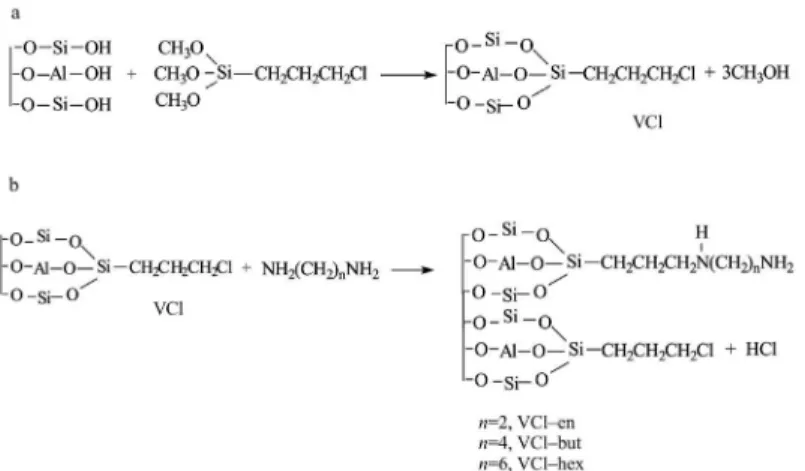
In order to rationalize the obtained results, the amount of the organic chains anchored on silicate in-creases with the increase in size of the chain of the diamine employed, except for reaction with hexyl-diamine. The values listed in Table 1 show some dif-ference between the calculated and observed C:N rela-tionships with high-calculated value in all cases. The observed disagreement can be interpreted as a partial substitution involving the chloropropyl groups on VCl by akyldiamines causing an increase in carbon content. Thus, in the final product chloropropyl remains dis-posed on the surface. Based on CHN data a reaction scheme is suggested here. At first, the chloropropyl groups anchored on surface reacted subsequently with the diamines as illustrated in Scheme 1.
Infrared spectroscopy was useful tool to detect the success of immobilization process. This proposal can be clarified by comparing the precursor and the modified surfaces. Thus, the main characteristic fea-ture in the spectrum of vermiculite (Fig. 1) is the com-plete absence of a very large band at 3500–3400 cm–1 attributed to stretching of hydrogen-bonded silanol group modes and trapped water molecule presenting a well-known band at 3420 cm–1. The broad symmetric stretching modes assigned to Si–O–Si and Si–O–Al appeared at 1010 cm–1. Another band associated to Al–OH stretching is located at 814 cm–1[16, 17]. Ab-sorption at 1640 cm–1was attributed to the characteris-tic bend deformation of the O–H group of water. For
772 J. Therm. Anal. Cal., 87, 2007
ALVESet al.
Table 1Carbon (C), hydrogen (H) and nitrogen (N) content, number of organic anchored groups (Nf), and
car-bon/nitrogen molar ratio (in parenthesis the theoreti-cal value) for the reaction of alkyldiamines in chloropropyl vermiculite
Hybrid C/% H/% N/% Nf/mmol g–1 C:N
VCl–en 3.34 3.19 1.34 0.48 2.9 (2.5)
VCl–but 8.46 3.40 2.47 0.88 4.0 (3.5)
VCl–hex 7.68 2.98 1.72 0.61 5.2 (4.5)
all modified hybrids the spectra can be characterized for the appearance of the new bands at 2950 and 2840 cm–1 ascribed to asymmetric and symmetric stretching modes of CH3groups [18], respectively. The band assigned to N–H group deformation can be over-lapped by water angular deformation band at 1622 cm–1. A series of bands are also observed in the 3500–3000 cm–1 range, but the presence of adsorbed water obscured them.
The diffraction patterns of precursor and the hy-brid compounds are very similar as it is shown in Fig. 2, suggesting the maintenance of the original crystallinity of the inorganic matrix, when reactions take place. The same basal spacing values of 1422 pm were detected for all solids, reinforcing the hypothe-sis of immobilization of organic moieties on the exter-nal surface of vermiculite.
Thermogravimetry data are summarized in Fig. 3. For precursor vermiculite the thermal decom-position occurred in a single stage with total mass loss of 9.68%, being attributed to the release of water present in the external surface and in the interlayer space. For modified vermiculites larger mass loss was detected depending on the length of organic moieties. Thus, for solids containing the largest groups, the highest mass loss values were observed. For
chloro-propyl vermiculite, this was 11.8% between 300 and 1200 K. For other hybrids, they were 13.6, 13.7 and 22.6%, respectively for materials derived from inter-actions of chloropropyl vermiculite with ethylene-, butyl- and hexyldiamine. These mass changes are as-sociated to the water loss and the decomposition of the organic content.
Conclusions
New organofunctionalized vermiculites were synthe-sized through silylating agent resulting in inor-ganic–organic hybrid with grafting of the external sur-face with chloro propyl chains. Suspended silanized vermiculite reacted with alkyl diamines. The results gave clear indication that the occurrence of subsequent reactions depends on the size of amine chain. The reac-tions are more effective for shorter chains.
Acknowledgements
The authors are indebted to CNPq for financial support.
J. Therm. Anal. Cal., 87, 2007 773
SYNTHESIS AND CHARACTERIZATION OF VERMICULITE HYBRIDS
Scheme 1Reaction scheme of immobilization of organic moieties on vermiculite a – silanization and b – subsequent immobiliza -tion of alkyl diamines
Fig. 2X–ray diffraction patterns of a – vermiculite, b – VCl, c – VCl–en, d – VCl–but and e – VCl–hex
References
1 N. M. Jose and L. A. S. A. Prado, Quím. Nova, 28 (2005) 281.
2 L. N. H. Arakaki, V. L. S. Augusta Filha, J. G. Espínola, S. F. Oliveira, T. Arakaki, M. G. Fonseca and C. Airoldi, J. Environ. Monit., 5 (2002) 366.
3 A. Walcarius and C. Delacôte, Anal. Chim. Acta, 547 (2005) 3.
4 L. N. H. Arakaki, V. L. S. Augusta Filha, J. G. Espínola, S. F. Oliveira, T. Arakaki, M. G. Fonseca and C. Airoldi, Thermochim. Acta, 442 (2006) 176.
5 C. R. Silva, C. Airoldi, K. E. Collins and C. H. Collins, J. Chromatogr. A, 1114 (2006) 45.
6 D. Park, S. Haam, K. Jang, I.-S. Ahn and W.-S. Kim, Proc. Biochem., 40 (2005) 53.
7 M. G. Fonseca and C. Airoldi, J. Mater. Chem., 9 (1999) 1375.
8 M. G. Fonseca and C. Airoldi, Mater. Res. Bull., 36 (2001) 277.
9 M. ErdemoÈlu, S. ErdemoÈlu, F. SayÏlkan, M. Akarsu,
.ener and H. SayÏlkan, Appl. Clay Sci., 27 (2004) 41.
10 K. W. Park, S. Y. Jeong and O. Y. Kwon, Appl. Clay Sci., 27 (2004) 21.
11 P. A. Wheeler, J. Wang, J. Baker and L. J. Mathias, Chem. Mater., 17 (2005) 3012.
12 H. He, J. Duchet, J. Galy and J. F. Gerard, J. Colloid Interf. Sci., 288 (2005) 171.
13 S. Xue, M. Reinholdt and T. J. Pinnavaia, Polymer, 47 (2006) 3344.
14 A. M. Shanmugharaj, K. Y. Rhee and S. H. Ryu, J. Colloid Interf. Sci., 298 (2006) 854.
15 M. M. Duane, C. Robert and Jr. Reynolds, X-ray Diffraction and the Identification and Analysis of Clay Minerals, Oxford Press, London 1997.
16 V. C. Farmer and J. C. Russel, Spectrochim. Acta, 20 (1964) 1149.
17 P. J. Launer, Am. Mineral., 51 (1967) 764. 18 R. M. Silverstein, G. C. Basser and T. C. Morrill,
Spectrometric Identification of Organic Compounds, John Wiley Sons, 2ndEd., New York 1991.
DOI: 10.1007/s10973-006-7855-0
774 J. Therm. Anal. Cal., 87, 2007