Vol-7, Special Issue3-April, 2016, pp2066-2074 http://www.bipublication.com
Research Article
The Efficacy of Training and Application of Severity of Illness Scoring
Systems on Knowledge and Attitude of ICU Staff
Masoumeh Bagheri-Nesami1, Tahereh Yaghoubi2, Afshin Gholipour-Baradari3, Yaser Talebyan-Keyakalayeh4,
Jamshid Yazdani-Cherati5 and Attieh Nikkhah6
1
Associate Professor, Antimicrobial Resistant Nosocomial Infection Research Center, Mazandaran University of Medical Sciences, Sari, [email protected]
2PhD student in Disaster & Emergency Health,
Department of Disaster Public Health, School of Public Health, Tehran University of Medical Sciences, Iran. [email protected]
3
Associate Professor of Anesthesiology,
Mazandaran University of Medical Sciences, Sari, Iran. [email protected]
4MSC in Critical Care Nursing,
Mazandaran University of Medical Sciences, Sari, Iran.
E-mail: [email protected]. . Tel: 01133367345. Fax: 01133268936
5PhD in Biostatistics, Associate Professor of Mazandaran University of Medical Science. 6.MSC in Critical Care Nursing, Antimicrobial Resistant Nosocomial Infection Research Center,
Mazandaran University of Medical Sciences, Sari, Iran. [email protected]
ABSTRACT
The predicting scoring systems help us to patients' classification in order to receive services and medical care. It seems one of reasons for not using these systems is unaware of staffs. The aim of this study was assessment the effect of training predicting scoring systems and applying SOFA on knowledge and attitude of nurses and specialists in ICU wards of educational hospital in Sari city.This pre-experimentalstudy was performed using a self-made questionnaireto assessknowledge andattitudes. After primary assessment, participants were trained and applied SOFA for three months. Evaluation was performedinfour stages;before training, 10 days after training, onemonth and threemonths afterSOFA application. Resultswere analyzed bySPSSsoftware, descriptive tests and repeated measurement.Results show that therewere 43(71.7%) female and mean age was 32.53±7.3 years. The average knowledge score was improved from very weak to excellent and the average attitude score was improved from moderate to excellent after three months of applying SOFA.
Regarding the importance of these systems in the ICU management, we recommend this topic is included in nursing and medical curriculums. Also strategiesshould be considered forapplying themin all ICU wards in the country.
Keywords: knowledge, attitude, ICU staff, predictive scoring systems, SOFA
[I]INTRODUCTION
Nowadays organ dysfunction can occur while managing critically ill patients and is considered the main cause of morbidity and mortality in intensive care units[1].For this reason, one of the
choose patient with more critical condition, as well nurse and physician do therapeutic options with more accuracy[3]. Application of scoring
systems help stop patients’ classification
regarding to types of medical care and provides better judgment for prediction of mortality, bed occupancy, and progress of treatment[4]. Outcome prediction can be useful in providing information on likely patient outcomes for relatives of critically ill patients and potentially for therapeutic decision making and guide to resource allocation. Determination of disease severity and outcome due to in evaluating various medical interventions, quality of care, better management of medical records, patient classification, standardization of clinical research, and plan optimal and cost-effective therapeutic approaches[5].It is also important to viewpoint of managing because it provides logical state to priority patients in receiving special services, to alter human resources and occupancy rate[4, 5].
There are four severity of illness scoring systems that are more valid by most sources: 1) Acute Physiologic And Chronic Health Evaluation (APACHE II, III, IV); 2) Simplified Acute Physiologic Score (SAPS); 3) Mortality Prediction Model (MPM); and 4) Sequential Organ Failure Assessment (SOFA)[5-7]that the predictive value of these scores is approved after many studies[1,8].These scoring systems have been used as an auxiliary tool categorize participants in many clinical trials[9-11].
The APACHE scoring system is widely used in the United States. The most recent versions include APACHE II through IV. APACHE requires the input of many clinical variables, from which a severity score is derived. This is including factors such as age, diagnosis, prior treatment location, numerous acute physiologic and chronic health variables. APACHE uses the worst values from the initial 24 hours of ICU admission. All of
the APACHE instruments have excellent
discrimination, but less impressive calibration. Like most predictive models, APACHE requires periodic retesting, revising, and updating because
its accuracy decreases as treatments and other factors influencing mortality change. The most frequently cited APACHE models are APACHE II and III, although APACHE IV has also been
validated[7]. The SAPS streamlines data
collection and analysis without compromising diagnostic accuracy. The SAPS II is the most widely used version. It calculates a severity score using the worst values measured during the initial 24 hours in the ICU for 17 variables. Several of the variables (i.e. AIDS, metastatic cancer, hematological malignancy) are dichotomous, meaning that they are either present or absent. The others are continuous variables that have been made categorical by assigning points to ranges of values [7].The MPMII is the most common version of the MPM. A severity score is calculated from 15 variables, as assessed at the time of ICU admission. The MPM II severity score that is measured on admission (MPM II 0) can be refined after 24 hours (MPM II 24) by updating seven of the admission variables and adding six variables. An advantage of the MPM II 24 is that it can be compared to the SAPS and APACHE, since all three scores are determined after the first 24 hours of admission[7].
The SOFA uses simple measurements of major organ function to calculate a severity score. The scores are calculated 24 hours after admission to the ICU and every 48 hours thereafter. The mean and the highest scores are most predictive of mortality. In addition, scores that increase by about 30 percent are associated with a mortality of at least 50 percent. The SOFA severity score is based upon the following measurements of 6
organs function: Respiratory system,
Cardiovascular system, Hepatic system,
five severity scoring systems showed accurate standardized mortality ratio[12].
Also another study performed at a teaching hospital in Brazil to evaluate the application of the SOFA in describing the severity of organ dysfunctions and the associated mortality rates in 1164 adult critically ill patients who were admitted consecutively into intensive care units indicated an increase in the mortality rate when the SOFA scores increased and patients with low scores (0—5) upon admission and who increased to the medium or high SOFA groups had a significantly higher mortality rate (51.7 and 100%, respectively, p < 0.001). In results applying SOFA to critically ill patients effectively described the severity of organ dysfunctions, and higher SOFA
scores had a positive association with
mortality[1].
Despite many recommendations and applications of these scores in medical literature, Iranian database research demonstrates only few studies about APACHE II, MPM, and SAPS and their results are not routinely utilized in ICU wards at national level. Since the best approach to manage organ dysfunction is prevention and first treatment, the organ dysfunction assessment systems like SOFA can be used as a bedside tool to monitor patients and may help decrease mortality[1].However, it seems necessary using a valid score for evaluating intensive care unit patients in order to proper judgment about quality of services, especially nursing care.
Nonetheless, to evaluate patients in many hospitals and teaching centers is used the traditional methods such as checking vital signs and GCS[4]. It appears that one reason not to utilize these systems is lack of knowledge, so that critical care staff must have special knowledge and to be familiar with new approaches[13]. In order to applying knowledge in a society we need increasing attitude of it using both teaching and training but in many cases only are done teaching without training that cause missing acquired knowledge in during time. Education is a process in a set of knowledge and associated skills
is transmitted and led to development of understandings, attitudes, skills, and capabilities in a specific field. Attitude is relatively persistent organization of beliefs about an object or situation where a person is ready to reaction in a particular direction. So attitude is created following knowledge, and when a person become with positive attitude, he can be physically and mentally ready for doing any cooperation[13]. According to these facts, we planned this study to assess knowledge and attitudes of Intensive Care Unit Staff about severity of illness scoring systems and then assess efficacy of training these systems and SOFA application on their knowledge and attitude; because SOFA is very simple, easily
measurable, cost-effective, and continuous
evaluation[1,14]in order to facilitate its utilization in intensive care units to benefit patients from more accurate and less expensive therapeutic approaches Nowadays organ dysfunction can occur while managing critically ill patients and is considered the main cause of morbidity and mortality in intensive care units[1].For this reason, one of the highest priorities for research in ICU is
predicting mortality and morbidity of
important to viewpoint of managing because it provides logical state to priority patients in receiving special services, to alter human resources and occupancy rate[4, 5].
There are four severity of illness scoring systems that are more valid by most sources: 1) Acute Physiologic And Chronic Health Evaluation (APACHE II, III, IV); 2) Simplified Acute Physiologic Score (SAPS); 3) Mortality Prediction Model (MPM); and 4) Sequential Organ Failure Assessment (SOFA)[5-7]that the predictive value of these scores is approved after many studies[1,8].These scoring systems have been used as an auxiliary tool categorize participants in many clinical trials[9-11].
The APACHE scoring system is widely used in the United States. The most recent versions include APACHE II through IV. APACHE requires the input of many clinical variables, from which a severity score is derived. This is including factors such as age, diagnosis, prior treatment location, numerous acute physiologic and chronic health variables. APACHE uses the worst values from the initial 24 hours of ICU admission. All of
the APACHE instruments have excellent
discrimination, but less impressive calibration. Like most predictive models, APACHE requires periodic retesting, revising, and updating because its accuracy decreases as treatments and other factors influencing mortality change. The most frequently cited APACHE models are APACHE II and III, although APACHE IV has also been validated[7].
The SAPS streamlines data collection and analysis without compromising diagnostic accuracy. The SAPS II is the most widely used version. It calculates a severity score using the worst values measured during the initial 24 hours in the ICU for 17 variables. Several of the variables (i.e.
AIDS, metastatic cancer, haematological
malignancy) are dichotomous, meaning that they are either present or absent. The others are continuous variables that have been made categorical by assigning points to ranges of values [7].
The MPMII is the most common version of the MPM. A severity score is calculated from 15 variables, as assessed at the time of ICU admission. The MPM II severity score that is measured on admission (MPM II 0) can be refined after 24 hours (MPM II 24) by updating seven of the admission variables and adding six variables. An advantage of the MPM II 24 is that it can be compared to the SAPS and APACHE, since all three scores are determined after the first 24 hours of admission[7].
The SOFA uses simple measurements of major organ function to calculate a severity score. The scores are calculated 24 hours after admission to the ICU and every 48 hours thereafter. The mean and the highest scores are most predictive of mortality. In addition, scores that increase by about 30 present are associated with a mortality of at least 50 present. The SOFA severity score is based upon the following measurements of 6
organs function: Respiratory system,
Cardiovascular system, Hepatic system,
Coagulation system, Neurologic system, Renal system[7].
For example in study was performed at a teaching hospital in 2010 to compare the performance of five severity scoring systems: SAPS II, MPM II0 (at admission), MPM II24 (at 24 hours), MPM II48 (at 48 hours), and MPM II overtime; and their ability to predict mortality rate for the intensive care unit patients that All five severity scoring systems showed accurate standardized mortality ratio[12].
to critically ill patients effectively described the severity of organ dysfunctions, and higher SOFA
scores had a positive association with
mortality[1].
Despite many recommendations and applications of these scores in medical literature, Iranian database research demonstrates only few studies about APACHE II, MPM, and SAPS and their results are not routinely utilized in ICU wards at national level. Since the best approach to manage organ dysfunction is prevention and first treatment, the organ dysfunction assessment systems like SOFA can be used as a bedside tool to monitor patients and may help decrease mortality[1].However, it seems necessary using a valid score for evaluating intensive care unit patients in order to proper judgment about quality of services, especially nursing care.
Nonetheless, to evaluate patients in many hospitals and teaching centres is used the traditional methods such as checking vital signs and GCS[4]. It appears that one reason not to utilize these systems is lack of knowledge, so that critical care staff must have special knowledge and to be familiar with new approaches[13]. In order to applying knowledge in a society we need increasing attitude of it using both teaching and training but in many cases only are done teaching without training that cause missing acquired knowledge in during time. Education is a process in a set of knowledge and associated skills is transmitted and led to development of understandings, attitudes, skills, and capabilities in a specific field. Attitude is relatively persistent organization of beliefs about an object or situation where a person is ready to reaction in a particular direction. So attitude is created following knowledge, and when a person become with positive attitude, he can be physically and mentally ready for doing any cooperation[13]. According to these facts, we planned this study to assess knowledge and attitudes of Intensive Care Unit Staff about severity of illness scoring systems and then assess efficacy of training these systems and SOFA application on their knowledge
and attitude; because SOFA is very simple, easily
measurable, cost-effective, and continuous
evaluation[1,14]in order to facilitate its utilization in intensive care units to benefit patients from more accurate and less expensive therapeutic approaches and clinical decision making.
[II]MATERIALS AND METHODS
This is a quasi-experimental study in order to assess the efficacy of severity of illness scoring system training and SOFA application on knowledge and attitude ofthree ICUsstaffof the educational hospital, Sari, Iran.Because ofthe
possibility ofsharing information between
participants and the different context of this ICU whit other ICUs of the Mazandaran University of Medical Sciences, we used census sampling and 60 people from 65 personnel participated in our study comprising 50 nurse, 7 anesthesiologist, and 3 pulmonologists.4 nurses and 1 anesthesiologist were reluctant to participate in the study.This study was designed in four steps that included: pretest of knowledge and attitude, evaluate10 days after education, evaluate one month after applying SOFA, evaluate10 three months after applying SOFA. the tool for data collection was a questionnaire prepared by researcher containing demographic information, 20 questions for evaluating knowledge (10 questions about knowledge of severity of illness scoring system and 10 questions about knowledge of SOFA), and 30 questions for evaluating attitude about the severity of illness scoring systems and the utilization of SOFA. Each question in the knowledge topic had provided four possible options: one correct answer which scored 1, two wrong answers which scored 0, and “I don’t know” answer which scored 0. The range of scores was (0-4; very weak knowledge), (5-9; weak knowledge), (10-15; moderate knowledge) and (16-20; excellent knowledge) that scores above 10 were considered as anaware personnel. The questions in the attitude section were arranged according to Likert scale, as the
disagree and strongly disagreewith scoring from 5 to 1respectively and the range of scores was (30-54; very low attitude), (55-79; low attitude), (80-104; moderate attitude), (105-129; good attitude) and (130-150; excellent attitude).
To assess questionnaire validitywe used content validity. We prepared the questionnaire using literature and askedfrom 10 university professors that wereexpert opinions about it to apply their comments.
Also reliability of the questionnaire was assessed by test-retest methodthen questionnaires were completed by 18 ICU staff outside the study population and retested after ten days that intra-class correlation coefficient 0.84 was obtained. At firstpretest was performed on all participants and then we conducted educating seminars comprising 8-12 persons[15]. After 10 days of this educating program and before the SOFA application, we performed a post-test[16].
This test show a differentiate between impact of education and SOFA application. Finally, the SOFA was applied by ICU staff in three months on patients who had including criteria for SOFA. The staffbegan scoring and assessing the outcome of each patient.
After one month through the study, staffs were examined again. Atthe end of the course, the questionnaire was completedto evaluatetheir knowledge and attitude.
We performed the first and third month test to determine the effects of time in this study.We
classified knowledge scores into very weak (0-4), weak (5-9), moderate (10-15), and excellent (16-20) and those with scores 10 or more were considered knowledgeable people.The attitude scores were classified as very low (30-54), low (55-79), moderate (80-104), well (105-129), and
excellent (130-150).Eventually, data were
analyzed with SPSS(Statistical Package for Social
Science,version16) using descriptive
statistics(frequency, mean, standard deviation and
percentage)and analytical tests (repeated
measurement, Mann–Whitney U and Greenhouse-Geisser)
[III]RESULTS
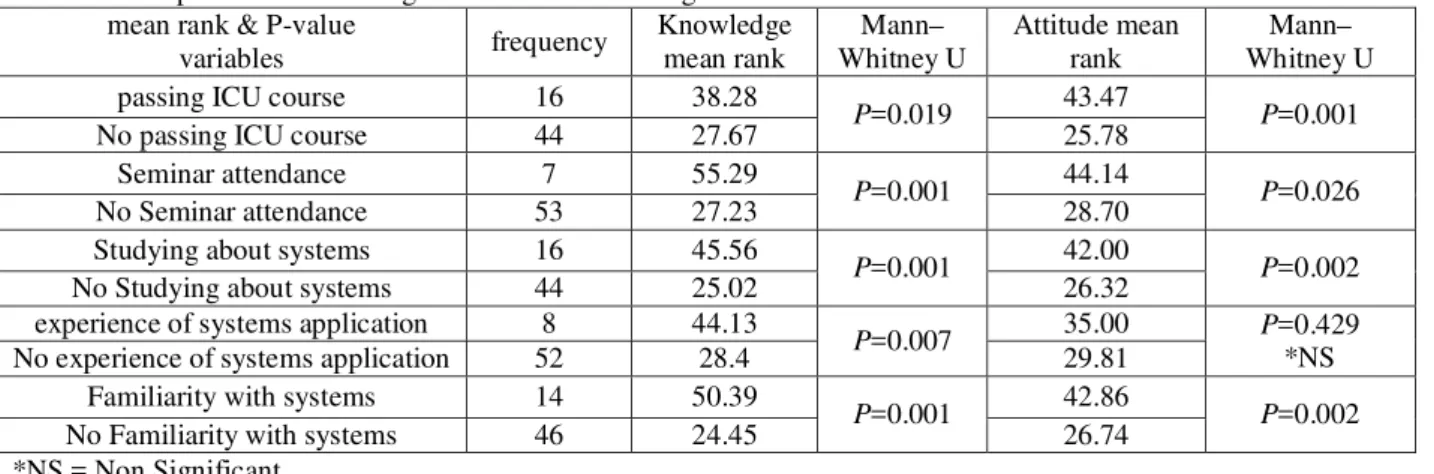
Results showed 43(71.7%) were female and 27 (28/3%) were male.The mean age of participants was 32.53 ± 7.3 years. Only 26.7% of participantspassedanICU course that most of them were physician and 23.3%of them were familiar with severity of illness scoring systems. Mann– Whitney U test showed mean rank of knowledge and attitude of participants that had passed ICU course ortook part in educating seminars or were familiar with thissystems before educationwere significantly higher than those without these
characteristics(Table 1).Greenhouse-Geisser
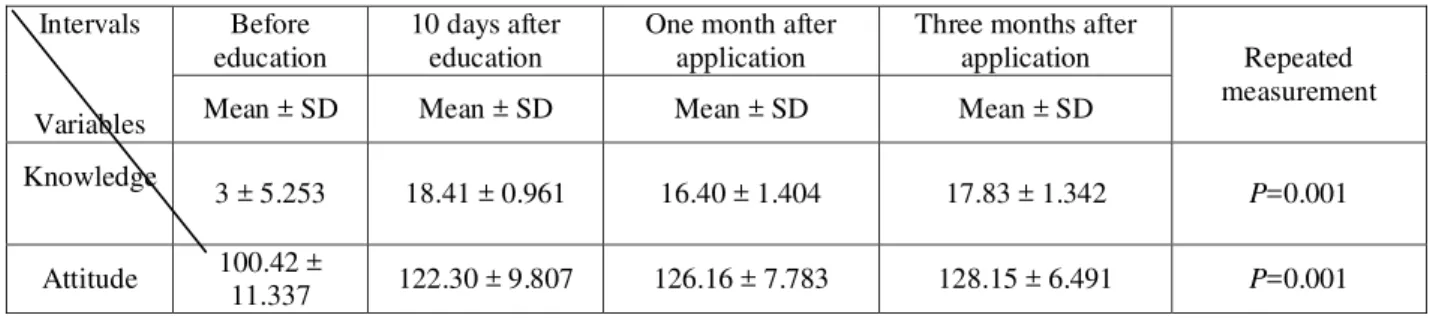
statistical test demonstrates significant increase in mean scores of knowledge over time (p=0.001). Also repeated measurement and fisher’s test illustrates significant statistical improvement in attitudes over time(p=0.001)(Table 2).
Table 1. Comparison of knowledge and attitude according to numberof mean rank & P-value
variables frequency
Knowledge mean rank
Mann– Whitney U
Attitude mean rank
Mann– Whitney U
passing ICU course 16 38.28
P=0.019 43.47 P=0.001
No passing ICU course 44 27.67 25.78
Seminar attendance 7 55.29
P=0.001 44.14 P=0.026
No Seminar attendance 53 27.23 28.70
Studying about systems 16 45.56
P=0.001 42.00 P=0.002
No Studying about systems 44 25.02 26.32
experience of systems application 8 44.13
P=0.007 35.00 P=0.429
*NS
No experience of systems application 52 28.4 29.81
Familiarity with systems 14 50.39
P=0.001 42.86 P=0.002
No Familiarity with systems 46 24.45 26.74
Table 2.The mean ± SD of knowledge and attitude of examinees in evaluated intervals.
Intervals
Variables
Before education
10 days after education
One month after application
Three months after
application Repeated
measurement
Mean ± SD Mean ± SD Mean ± SD Mean ± SD
Knowledge
3 ± 5.253 18.41 ± 0.961 16.40 ± 1.404 17.83 ± 1.342 P=0.001
Attitude 100.42 ±
11.337 122.30 ± 9.807 126.16 ± 7.783 128.15 ± 6.491 P=0.001
[IV]DISCUSSION
Our results from knowledge of participants before
educating severity of illness scoring
systemsindicated that most of them had very weak
knowledge.Also these findings were
associatedwith direct correlation with educational status of participants. A study in Taiwan showed that the nursing staff in the ICUs lacked sufficient knowledge and attitudes about APACHE[17]. Also another study in Iran showed that 54% and 39% of ICU nurses had weak and moderate knowledge about patient care respectively. Although it is expected that working in ICU should have resulted in increasingprofessional skills, but ICU personnel only became expert in activities that repetitively do them[18]. In our study 94% of the participants had Bachelor of Science degree in nursing and they were about 30 year old and 96% of them had very weak knowledge, it seems that non-specialized and inefficiency of undergraduate nursing education, inefficiency of their curriculum and absence of well-defined criteria for employment nurses in ICU cause to the young nurses who are our investments don’t have any motivation to maintain or improve their knowledge. Thus, the ICU nurses
should strive to gain more knowledge
corresponding to their field of activity.It seems that positive attitudes of participants concurrent with their weak knowledge imply this fact that they feelnecessity of these trainings.
Actually, we believe their active participation during the course of the study roots in this concept.However we believe this issue needs further etiologic investigation.Also we found that
the knowledge and attitudes of those with prior courses on ICU care were more than those who had not such courses. We believe that higher educational accomplishments sensitize individuals to dobetter quality care and lead to more study and attention to related topics, socause to better attitudes.On the other hand, other studies emphasize that nurses who passed ICU courses besides enhancing experience they have increased their knowledge[18]. Our findings about 10 days after teachingpredictive scoring systems showed that all of participants had excellent scores which clearly define the impact of education on increasing knowledge and attitude. Another study also found positive impact of the education on increasing knowledge and practice of nurses in neonatal ICU wards[19]. This conclusion was repeated in a study on knowledge and attitude of nursing students[20]. One distinguishing feature of the ICU nurses is need to comprehensive knowledge about theoretical and practical aspects of patient care to best satisfy patients’ needs[18]. The medical graduatesare among those groups that their knowledge deficiencies would adversely affect individuals and the health system[21]. So it
is suggested the nursing staff with
higherknowledge and positive attitudeare
pretest. But the knowledge scores were declined to moderate in 23.3% of them at the end of first month in comparison to 10 days after education. Nevertheless, at the end of third month the mean scores for knowledge was excellent in 96.7% which clearly demonstrates efficacy of SOFA
application in improving knowledge of
participants. Although this difference was not statistically significant it appears this low decrease resulted from the prolonged time after education and insufficient time for best application of these systems. Unfortunately,experience and practice is not considered in many educational courses which may result from deficiency of resources, inappropriate infrastructureand absence of skilled specialists for trainingand lack of financial support[23]. In one study that performed to assess the knowledge of ICU nurses and the effects of educational programs on their knowledge, the results two and 20 weeks after a training course showed that mean knowledge scores after two weeks was significantly more than pretest which confirms the positive role of education in improve of nurses knowledge, but after 20 weeks, the scores became similar to pretest[24]. Regarding our results if our examinees were evaluated in prolonged interval without any supervision on practical application of systems, their scores would have declined. The findings of current study emphasize the importance of education and
persistent training, planning, evaluation,
supervision and continuing application of learned knowledge to prevent decrement of knowledge and attitudes which is similar to other studies[25].
[V]CONCLUSIONS
According to our results, human resources training and application of learned knowledge is among the most confident ways to organizational optimization and not only develops individual talents, but also improves strategies and skills and can enhance occupational knowledge and skills and prevent wasting of human resources. Some of limitations of our study were possibility of sharing information between participants and the different
context of this ICU with other ICUs in city that caused we couldn’t set into two groups. Also negative attitude in some colleagues caused slow progress in study.
ACKNOWLEDGMENTS
This article is derived from the thesis for Master of Science degree in critical care nursing that approved as number 90-130 in Mazandaran University of Medical Sciences, 2011. We appreciate from deputy of research of University for funding. We also thank the professors who helped us for preparing the questionnaire. Also we are grateful from ICU staff of the educational hospital, Sari, who participated with great enthusiasm.
REFERENCES
1. Anamia EHT, Grionb CMC, Cardosob LTQ,
Kaussc IAM, Thomazinid MC, Zampad HB, et al,(2010), Serial evaluation of SOFA score in a Brazilian teaching hospital. Intensive and Critical Care Nursing. 26:75-82.
2. Norizad S. Tabesh H. Mahdian M. Akbari H.
Taghaddosi M, (2005), Determination of cause of mortality and morbidity neurology ICU patients in Naghavi hospital in Kashan during
1998-2001. Journal of Feyz.
34:15-20[Persian].
3. Mohammadi H. Haghighi M, (2006), Survey
relationship of mortality rate of hospitalized patients in ICU with different degrees of APACHE II. Journal of Guilan University of medical science.85:90-5[Persian].
4. Soleymani M. A. Masoudi R. Bahrami N.
Ghorbani M. Sadeghi T, (2009), Predicting mortality of ICU patients using APACHE II. Journal of Golestan University of medical science. 9:64-69[Persian].
5. Longo D. L. Kasper D. L. Jameson J. L. Fauci
A. S. Hauser S. L. Loscalzo J, (2012), Harrison's Principles of Internal Medicine: Approach to the Patient with Critical Illness In,
18th ed. United States of America: the
McGraw-Hill Companies.
6. Marino PL, (2007), ICU Book. 3rd ed. New
York: Lippincott Williams & Wilkins.
Http://www.uptodate.com/contentsunit?source =search.
8. Rahimzade P. TaghipourAnvari Z,Hasani V,
(2008), Estimation of mortality rate of patients in surgical intensive care unit of Hazrat-Rasul hospital of Tehran using the APACHE II standard disease severity scoring system. Hakim Research Journal. 11(1):22-8[Persian].
9. Hosseini M. Ramezani J, (2007), Evaluation of
APACHE II scoring system in predicting weaning from mechanical ventilation. Danesh & Tandorosti journal of Shahrood University of medical science. 3(2):1-6[Persian].
10.Hajimahmoodi M. Mojtahedzadeh M.
GhaffarNatanzi N. Sadrai S. Sadeghi N. Nadjafi A, (2009),Effects of vitamin E administration on APACHE II Score in ARDS patients. DARU. 17(1):24-8.
11.Rose L. Baldwin I. Crawford T, (2010),The
use of bed-dials to maintain recumbent positioning for critically ill mechanically ventilated patients (The RECUMBENT study): Multicentre before and after observational study. International Journal of Nursing Studies. 47(11):1425-31.
12.Hashemian S. M. R. Jamaati H. R.
Malekmohammad M. Afshar E. E. Alosh O.
Radmand G, (2010), Assessing the
Performance of Two Clinical Severity Scoring Systems in the ICU of a Tertiary Respiratory Disease Center. Tanaffos. 9(3):58-64[Persian].
13.Asgari M. Soleymani M, (2010),
Comprehensive nursing care book for ICU,
CCU, Dialysis. 16th ed. Tehran: Boshra
publication. [Persian].
14.Williams L, Gannon J, (2009), Use of the
SOFA score in pandemic influenza - a prospective study. JICS.10(3):179-82
15.Mohajer T, (2005), Principle of patient
education. 2nd ed. Tehran: Salemi publication.
16.Hejazi S, (2007), Understanding the principles
and methods of research in medical science. 1st
ed. Tehran: Islamic Azad University
publishing.[Persian].
17.Chen S-L, Wei I-L, Sang Y-Y, Tang F-I,
(2004), ICU nurses’ knowledge of, and
attitudes towards, the APACHE II scoring system. Journal of Clinical Nursing.13:287-96. 18.Lindberg E, (2007), Increased Job satisfaction
after small group reflection on an intensive care unit. Dimens Crit Care.26:163-7.
19.Hadian shirazi Z. Kargar M. Edraki M. Ghaem
H. Pishva N, (2010), The Effect of Instructing the Principles of Endotracheal Tube Suctioning on Knowledge and Performance of Nursing Staff Working in Neonatal Intensive Care Units in Shiraz University of Medical
Sciences. Iranian Journal of Medical
Education. 9(4):365-70[Persian].
20.Abbasi Dowlatabadi Z. Farahani B. Fesharaki
M. Najafi zade K, (2010), Effect of training about brain death and organ donation on attitude and knowledge of nursing students. Iranian Journal of Critical Care Nursing. 3(2):109-112[Persian].
21.Mohamad jafari H. Vahidshahi K. Mahmudi
M. Abbaskhanian A. Shahbaznejhad L. Ranjbar M. Ghorbani ghora R. Emadi A, (2008), Efficacy of continuing medical
education on knowledge of general
practitioners. Journal of Semnan University of Medical Sciences. 9(4):255-63[Persian].
22.Mohammadi G. Ebrahimian A. Mahmoudi H,
(2009), Evaluating ICU nurses knowledge. Iranian Journal of Critical Care Nursing. 2(1):41-6[Persian].
23.Omidifar N. Yamani A, (2006), Evaluation the
effectiveness of education and interpretation of ECG in workshop on knowledge of medical students. Journal of strides in development of medical education. 3(2):118-25[Persian].
24.Tweed C, Tweed M, (2008), Intensive Care
Nurses' Knowledge of Pressure Ulcers: Development of an Assessment Tool and Effect of an Educational Program. American Association of Critical-Care Nurses.17:338-46.
25.Wass V, Vleuten CVd, Shatzer J, Jones R,