_________________
Received: 21.3.2013/ Accepted: 1.3.2014 ISSN 2241-1925
© ISAST
Portuguese library assessment practices and
transitions: a meta-evaluation model for the
Information and Knowledge Society
Leonor Gaspar Pinto
1and Paula Ochôa
21Universidad de Alcalá de Henares (Spain), Universidade Nova de Lisboa (Portugal) 2
Universidad de Alcalá de Henares (Spain), Universidade Nova de Lisboa (Portugal) Abstract: The need for greater understanding of assessment practices and models highlights a deficit of an up-to-date meta-evaluation model, whilst articulating with new phases in Information and Knowledge Society (IKS) development. Current research carried out by each of the two authors led to a joint meta-evaluation study on the impact of main KIS transitions on performance evaluation models implemented in Portuguese libraries between 1970 and 2010. This paper aims to discuss the meta-evaluation model that was created in that context to explain the relations between IKS transitions and the development of library performance evaluation models.
After an initial review of European IKS policies and strategies targeted at libraries and the exploration of the transition and meta-evaluation concepts, a brief characterization of the Portuguese Library System introduces the cycles of recognition, reinforcement, uncertainty and weakness of European IKS strategies that were identified in the Portuguese library scene. Using the CLPET Model, the main types of performance evaluation approaches used in Portuguese libraries are identified and categorized. Based on the evidences gathered, the impacts of IKS transitions on library performance evaluation models in Portugal are then analysed and discussed.
Keywords: library assessment; meta-evaluation; Information and Knowledge Society; competency transitions; models; Portugal.
1. Introduction
In the last thirty years, both library assessment and Information and Knowledge Society (IKS) developments have experienced a great and long period of theory building and conceptualization. Among the Portuguese LIS professional and academic community some performance evaluation approaches and models became almost predominant, while other international trends failed to break through. Libraries are social organisations and, therefore, they can never be static entities. As the environment changes, so must libraries. This means that
library evaluation models must also keep pace with the rate of change and, consequently, they have multiple interactions with policy making transitions, suffering several moments of feedback, adjustment, learning and adaptation, all interacting in a variety of ways, risks and opportunities.
Influenced by eGovRTD2020 (Codagnone & Wimmer, 2007) recommendations to contemplate holistic research themes, actions and actors, current research carried out by each of the two authors1 led to a joint meta-evaluation study on the impact of main IKS transitions on performance evaluation models implemented in Portuguese libraries, providing evidencefor explorationof new scenarios for theoretical development. This project’s core research question was How did major Information and Knowledge Society transitions impact on library performance models in Portugal?
Moving beyond the scope of evaluation models in a single context, the following steps were taken:
1) Identification of the main Information Society Transitions in Portugal and its relation to library context
2) Identification of main library performance models – mapping using Categorization Matrix
3) Analysis and identification of IKS impacts on models adoption
Figure 1 presents the conceptual (meta-)model that was designed as an explicative hypothesis.
Fig. 1 – Meta-model of the transitions impact on library performance evaluation models
2. Information and Knowledge Society and library
performance evaluation models in Portugal
Evaluation can be considered an autonomous scientific field. In fact, it is a “transdiscipline” whose subject matter is the study and improvement of tools for other disciplines (Scriven, 1991, p.365). Decades of Evaluation Research applied to Library and Information Science have resulted in a multiplicity of theoretical and empirical studies, from the pioneer work of S. C. Bradford
Evaluation Process
Information & Knowledge Society
Evaluation Model Evaluation Outcomes LIBRARY IKS T ran sit io n s ENVIRONMENT
(1948) to the publication of the first international standard on library performance indicators (ISO 11620. 1998) and recent developments in the emergent area of library impact evaluation (Markless & Streatfield, 2006; Imholz & Weil, 2007; Streatfield & Markless, 2009; Mays, Tenopir & Kaufman, 2010;among others). Within the library evaluation research corpus, meta-evaluation2 is still an underexplored area (White, 2002; Calvert, 2008). As Calvert (2008) points out, “Some authors have described the variety of library evaluation methods in some detail (...) yet few have attempted to evaluate the variety of evaluation methods or to model library evaluation” (p.2). Based on Systems Theory, this author and, before him, Nicholson (2004) built a cell matrix to categorize the types of library performance evaluation. Ongoing research carried out by one of the authors led to the development of their proposals and to the creation of a new and enhanced matrix for categorizing types of library performance evaluation models/approaches – the CLPET
(Categorizing Library Performance Evaluation Typologies) Matrix. The categorization is framed by the Matrix’s axis: the y axis, which uses three possible Perspectives on evaluation (Internal, External and Holistic) and the x axis, which reflects the evaluation Topic – the Library itself or the Use made of its products and services.
This meta-evaluation approach was employed to identify main performance evaluation models and practices types used in Portuguese libraries from the 70s to 2010, as showed in Table 1. With the exception of statistics, which in its most rudimentary form can be traced back to the late 19th century, all library performance evaluation models that were categorized in the CLPET Matrix present their creation/start date.
Table 1 - Main performance evaluation models and practices types used in Portuguese libraries (1970-2010) TOPIC Library Use P E R S P E C T IV E Intern al (Librar y) Inputs Results- products Processes Goals Statistics Benchmarking Standards (1998) PLNN Model of Performance Information Management System (1993)
LMLN System for collecting and reporting performance information (1991)
KRCN Performance Evaluation Model (2001)
Results – library use
User Studies [focus on library use] Bibliometric studies Goals Statistics Benchmarking Standards (1998) PLNN Model of Performance Information Management System (1993)
LMLN System for collecting and reporting performance information (1991)
Adap. from Nicholson (2004) e Calvert (2008) Legend: PLNN – Public Libraries National Network
LMLN – Lisbon Municipal Libraries Network KRCN – Knowledge and Resources Centres Network
The longitudinal analysis of the context of library performance evaluation in Portugal highlights four main tendencies, which are reflected in the CLPET Matrix content (vid. Table 1):
1) Emergence of user primacy
In Portugal, the first reflexions and studies on library use and users’ profile can be traced back to the 70s. In the next decade, albeit with less vigour than before, User Studiesi continues to dominate the small Portuguese library performance evaluation corpus. Although there was an active interest in studying information use and its users in the 90s, it was only with the advent of the next century that user primacy was enhanced, boosted by theoretical and empirical research on users’digital environment interactions, bibliometrics and impact assessment. The ENTITLE-LMNL Impact
Assessment Framework Model reflects this increased attention to library
impact on individuals, bringing an extended user perspective into the
ISO 9001 certification (2004) Evaluation Model (2001)
Extern al (Users and other stakeho lders)
Needs and expectations of customers
KRCN Quality Observation Model (2001)
LMLN Service Quality Model
(2004)
Customers’ satisfaction Service Quality Impact on users
Social and economic impact
KRCN Quality Observation Model (2001)
LMLN Service Quality Model
(2004)
ENTITLE-LMNL Impact Assessment Framework
(2008)
Holistic (Total) Quality Management EFQM CAF BSC
Integrated Models MonitorDoc (1999) IU-ME
Quality Program (1996)
LMLN Performance Evaluation Integrated System (2003)
SIADAP+B Model (2004) Mix-model CAF-BSC(-AHP) (2005)
Digital Library Integrated Evaluation Model (2006)
School Libraries Self-assessment Model (2008)
assessment process. This Model was tested and implemented in Lisbon Municipal Libraries Network (LMLM) in the context of its participation in the ENTITLE (Europe’s New libraries Together In Transversal Learning Environments) Project, from 2008 to 2009 (Pinto 2009; ENTITLE, 2009).
2) Valorising library performance information
For quite a long time, Portuguese library performance measurement corresponded to irregular collections of input and output statistics which were considered end results with very fade connection to the management functions. This situation, which characterizes the primordial stage of library service assessment (Shy & Levy, 2005), started to be reversed in the early 90s dragged by two initiatives: the development in 1991 of the LMLN
System for collecting and reporting performance information and the
creation in 1993 the Public Libraries National Network (PLNN) Model of
Performance Information Management System. Both models were anchored
in an internal perspective on library performance evaluation centred on both Library and Use Topics. The model, as well as the development process and results of the second initiative were presented and discussed in 1997 at the IFLA Satellite Meeting on Performance measurement and quality
management in public libraries (Pinto, 1998) and at 2nd Northumbria International Conference on Performance Measurement, and were the main responsible for the score 3 (“Government-backed performance measures”) given to Portugal in a world-wide survey on Government interest in library performance measures (Winkworth & Gannon-Leary, 1999).
The first performance evaluation model specifically built for the LIS sector - the Knowledge Resources Centre Network (KRCN) Performance Evaluation
Model - was conceived in 2001. Developed and implemented by OQIKS -
Observatory of Quality in Information and Knowledge Services, this model was based on four referentials, being one of them the international library standards ISO 11620 and ISO 2789.
3) Quality
The introduction of Quality Management in Portuguese libraries is directly related to the evolution of quality in Public Administration, which was strongly conditioned by the accession of Portugal to the European Union in 1986. This quality path was pioneered in 1996 by the Information Unit of the General Secretariat of the Portuguese Ministry of Education (IU-ME) through the development of three main management strategies focused on clients’ needs within the context of an enduring Quality Programme (Ochôa e Pinto, 2006):
1996-2000: Fostering and adapting quality models and methods, namely EFQM – European Foundation for Quality Management excellence model and CAF – Common Assessment Framework, the self-evaluation framework recommended for European Public Administration Services. During this period, the IU-ME team carried out two administrative modernization research projects, one of which resulted in the creation of of a tailored self-assessment model for public administration information units – MonitorDoc.
2001-2002: Developing and implementing a quality concept linked to Knowledge Management.
2003-2006: Developing and implementing a quality concept linked to competencies management
If we exclude the distinctive case of the IU-ME, only at the dawn of the 21st century Portuguese LIS academics and practitioners started paying more attention to the external perspective on library performance evaluation, under the growing impetus of Quality. This trend was mainly rooted in two initiatives: the first, pursued by OQIKS between 2001 and 2003, was aimed at building KRCN’s quality concept and led to the development of KRCN
Quality Observation Model; the second one was part of a wider strategy
targeted at the construction of an evaluation culture in LMLN (2004-2006) and implemented through the LMLN Service Quality Model, a model adapted from Parasuraman, Zeithaml e Berry’s Gap Model (Vinagre, Pinto & Neves, 2011).
4) Integrated models
By capitalizing on previous experiences and reflections on the application of various models and management tools to the LIS field, a new trend centred on an holistic perspective on library performance evaluation uprose during the first decade of the 21st century. In fact, the groundbreaking appearance of MonitorDoc (1999) was followed by the design and implementation of several integrated performance evaluation models: LMLN Performance
Evaluation Integrated System (2003), SIADAP+B Model (2004), Mix-model CAF-BSC(-AHP) (2005 – Melo & Pires, 2008), Digital Library Integrated Evaluation Model (2006 - Pinto, Ochôa & Vinagre, 2009) and School Libraries Self-assessment Model (2008 - Portugal. Ministério da Educação e
Ciência. Gabinete da Rede Bibliotecas Escolares, 2011).
It was only after 1997 that Portugal developed the main measures towards IKS, with political attention to libraries gathered from strategical initiatives in Europe, library programmes and national developments of libraries automatisation. Over time and with guidance from e-Europe Action Plans, library services were measured and integrated in sectorial actions to develop citizenship, informational and digital literacy, e-science and digital libraries. Different phases were developed in order to implement IKS agenda, with cycles of technological investment and others of modernization initiatives. In cycles of technological changes, libraries were a fertile area for generating new services to citizens. In cycles of modernization, libraries were confronted with strategical changes and some uncertainty and risk in their outcomes. Some researchers see modernization cycles as exponential transformation in evaluation practices and a predominant feature of public services crossroad with New Management, influencing the choice of models and pathways.
The focus on meta-evaluation implies that researchers not only examine library actions but also their alignment with European orientations and the meanings that such actions hold for LIS professionals that underpin choices, interactions and use of models. Our research led to the identification of four major transitions in IKS library environmental scanning: Transition I - started with
Schwencke Resolution and its impacts on national library policies; Transition
II – started with Bangemman Report and its impacts on national IKS policies; Transition III – started with Lisbon Strategy and its impacts on quality
strategies and e-europe agenda; and Transition IV – started with European Digital Agenda, focused on new trends for services to citizens and enterprises.
3. Transitions and impacts on library performance
evaluation
models in PortugalAiming at a better understanding of the relationship between transitions and performance evaluation models (vid. Fig.1), the approach followed in this research proved to be useful to gather evidences of several impacts of IKS strategies on four major transitions in libraries’ evaluation models with cycles of
recognition, reinforcement, uncertainty and weakness (vid. Table 2): Transition I (1984-1994)
Cycle 1986-1994- transition to EU performance trends – We can find a phase of recognition of evaluation processes inspired by European libraries. All types of libraries are listened and participate in several plans. National Library has a special role as leader of change process. User needs and satisfaction methods are recognized as a management practice and several diagnostic studies about Portuguese libraries are carried out in order to collect information. One example isLMLN System for collecting and reporting performance information (1991).
However, uncertainty is assumed by the generality of LIS professionals.
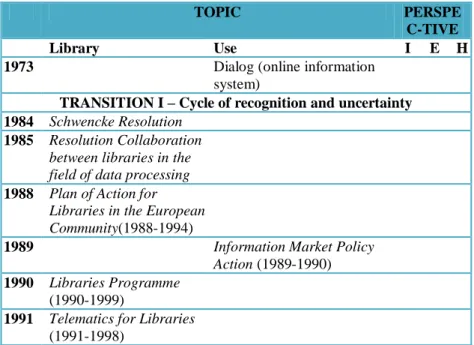
Table 2 - IKS landmarks and major transitions v/s main Portuguese performance evaluation models
TOPIC PERSPE
C-TIVE
Library Use I E H
1973 Dialog (online information system)
TRANSITION I – Cycle of recognition and uncertainty 1984 Schwencke Resolution
1985 Resolution Collaboration
between libraries in the field of data processing
1988 Plan of Action for
Libraries in the European Community(1988-1994)
1989 Information Market Policy Action (1989-1990)
1990 Libraries Programme
(1990-1999)
1991 Telematics for Libraries
LMLN System for collecting and reporting performance information
LMLN System for collecting and reporting performance information 1992 Maastricht Agreement 1993 PLNN Model of Performance Information Management System PLNN Model of Performance Information Management System 1994 Bangemman Report European Commission on Preservation and Access
TRANSITION II – Cycle of recognition 1996 IU-ME Quality Program
1997 Digital heritage and
Cultural Content Culture 2000
eTen (1997-2006).
Livro Verde para Sociedade da informação 1998 Information Society Technologies (1998-2002) Standards Standards 1999 MonitorDoc 2000 Lisbon Strategy CAF eEurope 2002 Culture 2000 (2000-2006) eContent (2000-2005)
TRANSITION III – Cycle of reinforcement
2001 TEL – European Library
KRCN Performance Evaluation Model KRCN Performance Evaluation Model KRCN Quality Observation Model KRCN Quality Observation Model 2002 eEurope 2005
European research area, 2002-2006
2003 LMLN Performance Evaluation Integrated System
2004 ISO 9001 certification LMLN Service Quality Model LMLN Service Quality Model SIADAP+B Model 2005 i2010 Europeana Mix-model CAF-BSC(-AHP)
2006 Digital Library Integrated Evaluation Model
2007 LIBER-EBLIDA
Digitisation Road Map
2008 School Libraries Self-assessment Model ENTITLE-LMNL Impact Assessment Framework
2010 European Digital Agenda
(2010-2020)
TRANSITION IV – Cycle of uncertainty and weakness
Legend: Perspectives on library performance evaluation: I-Internal, E – External, H – Holistic
Transition II (1994-2000)
Cycle 1998-2000 – transition to Information Society national agenda– recognition of libraries as partners in the process of building the Information Society in Portugal: public libraries have a strong participation in this phase; governmental libraries essay to explore quality models and benchmarking through Monitordoc self-evaluation model (1999).
Transition III (2000-2010)
Cycle 2002 -2005 – transition to e-government policy – libraries reinforce their role in the conceptualization and development of performance evaluation models. This emphasis is due to national policy on public services assessment and the creation of SIADAP+B model is one of its sectoral outcomes.
Cycle 2005-2010 – transition to Technological Plan and strong alignment with i2010 – libraries as resources of use. School libraries play an important role in the national pool of performance evaluation good practices.
Transition IV (2010- )
Cycle 2010- – transition for a digital agenda in time of financial crises. The role of libraries is uncertain and is dependent on performance evaluation orientation provided by national governmental structures. At the same time, opportunities to explore, develop and exchange experiences are scarce. Measuring quality is not as important as before and services are interested in developing approaches centered on resources to prove efficiency. Some signs of weakness in the application of evaluation models become progressively more evident.
To complement this analyse, we suggest the use of SWOT analysis to clarify and evaluate the importance and relevance of IKS developments identified in respect to assessment implementation modalities and PEST analysis to complement cross-border contexts and evidence-based practices.
4. Final remarks
IKS and library performance evaluation pathways can be seen as being separate areas of interest and separate lines of research. Our Meta-model aims to link different views as a tool for analyse cycles of public policies transitions and outline an agenda for joint research. On the other, following a longitudinal
approach to library performance evaluation, at national or international levels, gives LIS academics and practitioners a better understanding of the present situation, as well as a better chance of making in the future more informed decisions regarding library performance evaluation.
References
Calvert, P. J. (2008). Assessing the effectiveness and quality of libraries. Victoria University of Wellington.
Codagnone, C.; Wimmer, M.A. (2007). Roadmapping eGovernment research: visions
and measures towards innovative governments in 2020. Clusone: MY Print.
ENTITLE (2009). Impact Assessment Framework [Online]. Available at: http://entitlelll.eu/por/Assessment-Framework/Framework-to-Assess-Impact-of-Libraries-on-Learning.
Imholz, S.; Weil, J. (2007) - Worth their weight [Online]: an assessment of the evolving field of library valuation. New York: Americans for Libraries Council. Available at: http://www.ala.org/ala/research/librarystats/worththeirweight.pdf.
Markless, S.;Streatfield, D. (2006). Evaluating the impact of your library. London: Facet Publishing.
Mays, R.; Tenopir, C.; Kaufman, P. (2010). Lib-Value: measuring value and Return on Investment of academic libraries. Research library issues [Online]: a bimonthly report
from ARL, CNI, and SPARC. N. 271 (August 2010), p.36-40. Available at:
http://www.arl.org/resources/pubs/rli/archive/rli271.shtml.
Melo, L. B.; Pires, C. (2008). Performance evaluation of academic libraries: implementation model. In Hellenic Conference of Academic Libraries, 17, Ioanina (2008) - Academic library evaluation as a measure of institutional quality assessment
[Online]. Available at:
http://eprints.rclis.org/bitstream/10760/12374/1/b2.Melo_Pires.pdf.
Nicholson, S. (2004). A conceptual framework for the holistic measurement and cumulative evaluation of library services. Journal of documentation. V.60 n.2. Ochôa, P.; Pinto, L.G. (2006). Quality - an on-going practice and reflection in a
governmental library (1996-2006). In IFLA General Conference and Council, 72, Seul, 2006 [Online]. Available at http://www.ifla.org/IV/ifla72/index.htm.
Pinto, L. G. (1998). Portugal. In IFLA Satellite Meeting, Berlim, 1997 – Performance measurement and quality management in public libraries: proceedings. Berlim : Deutsches Bibliotheksinstitut. p. 110-119.
Pinto, L. G. (2009). Testing the Impact Assessment Framework in Lisbon Municipal Libraries Network [Online]. Available at: http://entitlelll.eu/hun/Meetings/Final-Conference/Presentations/Testing-the-Impact-Assessment-Framework-Lisbon. Pinto, L. G.; Ochôa, P.; Vinagre, M. H. (2009). Integrated approach to the evaluation of
digital libraries: an emerging strategy for managing resources, capabilities and results. In Heaney, Michael (ed.) Library statistics for the 21st century world. München: K. G. Saur. p. 273-288.
Portugal. Ministério da Educação e Ciência. Gabinete da Rede Bibliotecas Escolares (2011). Modelo de avaliação da biblioteca escolar [Online]. Lisboa: Gabinete RBE, actual. 19-09-2011. Available at: http://www.rbe.min-edu.pt/np4/83.html.
Scriven, M. (1991) - Evaluation thesaurus. London: Sage.
Shi, X.; Levy, S. (2005). A theory-guided approach to library services assessment.
Colledge & research libraries. V.66 n.3, p. 266-277.
Streatfield, D.; Markless, S. (2009). What is impact assessment and why is it important?
Vinagre, M. H.; Pinto, L. G.; Neves, J. (2011). Giving voice to children and young adults: a methodological approach to the evaluation of service quality in libraries. In NORTHUMBRIA International Conference on Performance Measurement in Libraries and Information Services (PM8), 8, Florence, 2009 - Libraries plus: adding value in
the cultural community: proceedings. Newcastle upon Tyne: Northumbria University
Press. p.340-358.
White, L. N. (2002). Does counting count: an evaluative study of the use and impact of
performance measurement in Florida public libraries. Tallahassee: Florida State
University.
Wilson, T. D. (2000). Recent trends in user studies: action research and qualitative methods. Information research. V.5 n.3.
Winkwoth, I.; Gannon-Leary, P. (2000). Library performance measures: government perspectives. In NORTHUMBRIA INTERNATIONAL CONFERENCE ON PERFORMANCE MEASUREMENT IN LIBRARIES AND INFORMATION SERVICES, 3, Northumberland, 1999 – Value and impact: proceedings. Newcastle: Information North. p.61-65
1
L.G. Pinto is investigating performance assessment impact on Portuguese Libraries and P. Ochôa is investigating professional trajectories in information society transitions as a PhD students.
2
Meta-evaluation is the evaluation of an evaluation or cluster of interconnected evaluations (Scriven, 1991).
3 According to Wilson (2000), «…'user studies' is a term which covers a very wide range of potential research, from the study of users' choices of books from a university library, through reactions to on-line search outputs, to the in-depth analysis of the underlying needs that result in information-seeking».