Relating to the wild: key actors’ values and concerns about lynx
reintroduction
1Lopes-Fernandes, M.1,2 e Frazão-Moreira, A.1
1
CRIA-FCSH, Universidade Nova de Lisboa, Faculdade de Ciências Sociais e
Humanas, UNL, Avenida de Berna, 26, 1069-061 Lisboa; [email protected]
2
Instituto da Conservação da Natureza e Florestas Divisão de Conservação
da Biodiversidade, Avenida da República, 16, 1069-040 Lisboa;
Corresponding author: [email protected];
Phone: 351 962800126
Abstract
Iberian Lynx reintroduction started in southern Portugal in 2015. As part of this project we have been following local key actors’ positions towards the process, including their perceptions about this threatened species and other predators. Using an ethnographic approach and conducting interviews we explored local discourses about nature, environmentalism, predators and reasons for positions towards reintroduction of a wild species.
We categorized the content of 95 interviews in terms of value orientations towards wildlife. We found that as well as dominion and utilitarian dispositions, other ways of relating to the wild could be found including ‘affection’, ‘attraction’, ‘environmental concerns’ and ‘symbolism’. In fact categories are not exclusive and there is a diversity of values towards wildlife in rural key actors. Environmental discourse is integrated in a local culture where being dominant over wildlife and nature is the main way of relating to it in particularly with respect to those related to hunting activities. However that was not a hindrance to being positive about reintroduction. Furthermore local memory about the historical presence of the lynx was significantly associated with the category ‘environmental concerns’.
1
Single-fixed categories are reductionist and limited for describing relationships with nature. Content analysis of spontaneous discourse and having knowledge about human practices proves to be important for an ethnoecological characterization of the coexistence of humans and lynx.
Appropriations by social groups of the lynx as a local theme are described and a reflection about wildlife ownership, human-predator competition and wildness meanings as well as ontologies is presented. Local perspectives have implications for conservation projects and must be incorporated into management decision-making.
Key words: wildlife value orientations, reintroduction, Iberian Lynx, environmental anthropology, Biophilia
Introduction
Attitudes towards wildlife have been continuously studied for some decades now (e.g. Bath, 1989) and social factors are nowadays recognized as determinant for the success of conservation projects or management of protected species and areas (e.g. Jiménez- Perez 2005). Several studies have demonstrated that attitudes as well as perceptions about wildlife vary between geographical areas, different times and contexts, not always depending on the same factors (e.g. Bath et al. 2008, Zimmerman 2015, Reddy e Yosef 2016). Intolerance towards wild predators has been a finding of some studies, and education campaigns are often recommended as an outcome (e.g. Gusset et al. 2008). Motivations behind negative attitudes are not yet well known and reason for certain behaviors remain unclear. Reasons for positions towards certain species might be embedded with other issues such as values towards wildlife and nature in general.
Biophilia was introduced by Wilson (1984) and is presently defined as a
“complex process encompassing an array of values and qualities that constitute a broader affiliation with nature” (Kellert 2012). Based on this concept some research has explored fundamental understanding of belief patterns that influence attitudes and resultant behavior towards wildlife (e.g. Jacobs 2007, Raadik & Cottrell 2007, Teel et
al. 2007). The Biophilia hypothesis has been criticized for assuming a universal
human need to relate to nature (or animals), a disposition with a genetic basis and evolutionary significance (e.g Bulbeck 2005, Joye 2011). However, the engagement of humans with the natural world has gained more attention among conservationists since this concept was advanced and several case studies became known. In these, wildlife value orientations of certain stakeholders have been examined but an approach to specific key actors in a reintroduction context has not yet been taken, despite the difference that such individuals make for local conservation success (Smith et al. 2009).
Anthropology has long studied human relationships with nature but more recently Environmental Anthropology and Ethnoecology have specialized in research on global conservation management and local groups’ positions (Brosius et al. 1986, Bellon 1990, Kottak 1999, Toledo 2002, Alves e Souto 2010). Values have been treated, in anthropology, as cultural phenomena, mostly learnt and culturally constructed (Bernard 2011), so research into value orientations towards wildlife can
be part of understanding a context and characterizing a social group. On the other hand, anthropologists also think of values constituted by cognitive and emotional elements (Nuckolls 1998 in Milton 2002). Under that perspective general environmental values have been analyzed (Strang 1997) and questions about what makes people care about the environment have been raised (Milton 2002). Nevertheless, case studies utilizing an anthropological approach, about the ways humans attach meaning to the natural world (as Kellert 2012 also mentions) are still uncommon, particularly in Western rural contexts. In the same way local discourses triggered by wildlife reintroductions have scarcely been explored (O’Rourke 2014).
The Iberian Lynx disappeared from most of its former range due to wild rabbit decline, habitat transformation and mortality induced by humans (Ferreras et al. 1992, Rodriguez e Delibes 2004). In Portugal, lynxes were shot and trapped until there were no resident populations (Ceia et al. 1998, Queiroz et al. 2005). Reintroduction has been taking place in Iberia through a transnational conservation project (LIFE+ Iberlince) and in Portugal lynxes started to be released in the southern Guadiana area in 2015. Although the lynx nowadays is a conservation emblem it can also be seen as ‘vermin’ (Lopes-Fernandes e Frazão-Moreira 2016) and cause conflict through damage in livestock and poultry (Garrote et al. 2013). The lynx reintroduction area of Guadiana valley is characterized by low population occupancy and multi-agro exploitation of cereals, livestock, cork oak forest and pine afforestation. Agriculture has been modernized but it has mainly an extensive character and hunting is practiced throughout the territory. The Natural Park of Guadiana was created in 1993 and tourism has been increasing due to the scenic and archeological relevance of the site and also the presence of rare species for birdwatching.
We designed an analysis of contents for interviews with key actors starting from the anthropological concept that meanings, beliefs and also emotions are part of the ways humans connect with the environment (Milton 2002), and we followed an ethnographic approach considering that practices in daily life strongly influence values. Building a reasonable understanding of the key actors’ context was therefore pertinent.
The main aim of the present study was to explore local discourses and reasons for positions held about the lynx as a wild predator and its reintroduction as a conservation process. We also examine the case study of relationships between
humans and nature in rural Portuguese areas selected for lynx reintroduction because that is a factor determining the success of local conservation actions. This research yielded information for a transnational LIFE+ project (Iberlince) and was therefore an opportunity for anthropology to highlight the perspectives of local actors. We also wanted to know what characterizes the human-environment social context in which humans and lynx are to coexist so we chose to focus on local key actors with different profiles. We departed from the following research questions: How is reintroduction imagined by key actors? What are the local public discourses about reintroduction? Which value orientations toward wildlife predominate among different types of key actors?
The research was conducted under an anthropological framework and “gaze”. In this case, the focus was upon the meanings that non-human entities (including ‘nature’ itself and the experience of natural physical elements) could have for humans which are necessarily engaged with them (e.g. Ingold e Palsson 2013). As Biophilia theory had produced several categories to characterize orientation values of humans towards wildlife and nature (‘animal orientations’ in Kellert 1984, ‘wildlife belief dimensions’ in Manfredo et al. 2003 and ‘biophilic values’ in Kellert 2012), we used similar categories and adapted them according to our discourse analysis as Bulbeck (2005) did (‘nature dispositions’). We do not intend to prove or discuss the Biophilia theory and its implications at an evolutionary level in this paper (e.g. Joyce 2011).
Methods
We conducted interviews as part of a broader ethnographic work during 2012-2014 in two adjacent protected areas in the south of Portugal – the historical lynx occurrence area of Moura-Barrancos Nature 2000 site (MB) (n=53) and the reintroduction site of the Natural Park of Guadiana (G) (n=42). The interviews, with duration of around one hour, included open-ended questions to evaluate key actors’ opinions and perceptions about Iberian Lynx reintroduction, but also addressed aspects such as knowledge, memory and practices with predators and land management. Card images were used to assess knowledge and interviewee familiarity with wild carnivore species. Key actors were chosen for their specific interests and decision capacity in lynx areas, and included: land owners (n=18), hunting and land
managers (n=13), hunting guards (n=11), technicians (administration and NGO) (n=14), nature activity users and promoters (n=13) and council representatives (n=16). Lynx observers, individuals who contacted directly with the species from the time lynx was present were also included (MB, n=10). For comparative reasons we divided all interviewees into hunters (n=55) and non-hunters (n=50).
We transcribed all interviews and analyzed the contents by using open coding. Observation notes from informal conversations, public positions about reintroduction were also analyzed, as well as participation in some local practices, such as hunts, hunting management, olive harvesting and livestock management. Triangulation of information was performed. Reintroduction of the lynx in Guadiana was announced in 2014 during the research period, which may have influenced reactive opinions.
Considering each interview as a whole, we did a content analysis and associated to each of the informants one or more categories according to his/her narrative, including the perceptions which characterized value orientations in their relationship with the natural world. Some of our categories had similar denominations to other studies, namely Dayer, Stinchfield e Manfredo (2007), but were adapted to encompass the variation we found in actors’ discourses (Table 1). Chi-square tests for exploring significance in associations between categories and other variables were performed using SPSS (version 20).
Results
Key actors’ values and orientations
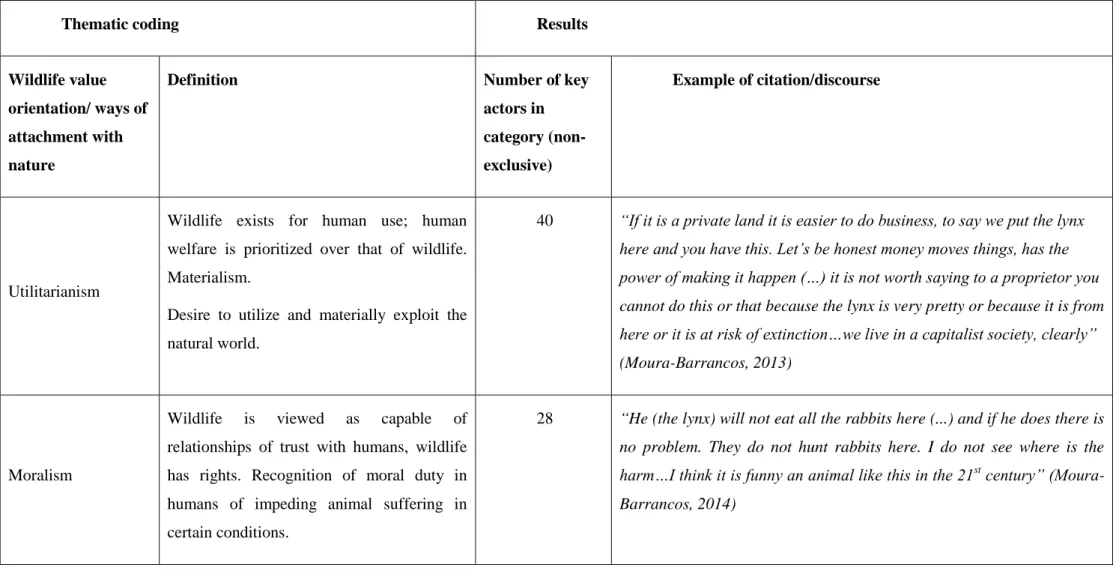
Portuguese key actors in lynx areas encompass all the diversity of categories for wildlife value orientation. In qualitative terms there are very many nature dispositions in the rural community studied making it heterogeneous and complex. Figure 1 show results quantified in terms of frequency of occurrence of orientation values in the sample of interviewees. With the exception of ‘spirituality’, the least common category, and ‘environmental concerns’, the only category present in nearly 50 interviewees, most other categories were equivalently represented with an occurrence of around 30. Together, ‘environmental concerns’ and ‘attraction’ surpassed utilitarian and dominion values (see also numeric results in table 1).
Table 11. 1 – ‘Relating to the wild’ categories classifying citations from key actors during interviews.
Thematic coding Results
Wildlife value orientation/ ways of attachment with nature
Definition Number of key
actors in category (non-exclusive)
Example of citation/discourse
Utilitarianism
Wildlife exists for human use; human welfare is prioritized over that of wildlife. Materialism.
Desire to utilize and materially exploit the natural world.
40 “If it is a private land it is easier to do business, to say we put the lynx
here and you have this. Let’s be honest money moves things, has the power of making it happen (…) it is not worth saying to a proprietor you cannot do this or that because the lynx is very pretty or because it is from here or it is at risk of extinction…we live in a capitalist society, clearly” (Moura-Barrancos, 2013)
Moralism
Wildlife is viewed as capable of relationships of trust with humans, wildlife has rights. Recognition of moral duty in humans of impeding animal suffering in certain conditions.
28 “He (the lynx) will not eat all the rabbits here (...) and if he does there is
no problem. They do not hunt rabbits here. I do not see where is the harm…I think it is funny an animal like this in the 21st
century” (Moura-Barrancos, 2014)
Thematic coding Results
Wildlife value orientation/ ways of attachment with nature
Definition Number of key
actors in category (non-exclusive)
Example of citation/discourse
Affection
Personal emotional attachment to animals and nature, animals make humans feel better; caring and feeling sorry for animals; love for nature.
27 “I prefer this (cork oak forest) to olive trees, I like to plant holm oaks
and then see them at a later stage...I don’t care too much for collecting fruits, I cannot explain…” (Moura-Barrancos, 2014)
Dominion
The urge to control and master the natural world, the environment.
Belief that humans can solve environmental problems.
36 “I don’t sympathize with radical discourses, I look at this as the creation
of habitat conditions which are important for man (…) good conditions and improvements so people stay (in the territory) (…) to create conditions so that all animals can exist, they will not exist if man is not present” (Moura-Barrancos, 2014)
Thematic coding Results
Wildlife value orientation/ ways of attachment with nature
Definition Number of key
actors in category (non-exclusive)
Example of citation/discourse
Intellectual Interest
Interest in and a desire to know more about wildlife, feeling that wildlife enhances life experiences.
Desire to know and intellectually
comprehend the world from basic facts to complex understanding.
24 “I have some doubts that reintroduction is studied enough to understand
that this is not a computer game (...) like the ecological game with rabbit and foxes (…) my doubt is that nature is not a game (…)” (Guadiana, 2014)
Aversion
Safety concerns related to interacting with wildlife because of the possibility of harm or contracting disease. Antipathy and fearful avoidance of nature or of a certain species.
28 “Predators are not useful for anything, we do not profit. They are
needed for equilibrium?! (ironizing) which equilibrium?” (Moura-Barrancos, 2012)
Thematic coding Results
Wildlife value orientation/ ways of attachment with nature
Definition Number of key
actors in category (non-exclusive) Example of citation/discourse Environmental concerns
General concern for protecting the
environment, preserving wildlife, feeling that humans are impacting the environment in a negative way through their actions e.g. mentioning excessive hunting.
48 “(..) Nature is composed of everything, nature controls everything.
Before, nature controlled everything, Man uncontrolled everything (...) this (the lynx) has a place as well (…) Man is the greatest predator on Earth” (Moura-Barrancos, 2014)
Spirituality
The pursuit of meaning and purpose through connection to the world beyond ourselves. Viewing wildlife and the environment as created and controlled by a higher power(s), explaining the workings of the natural world from a spiritual or religious viewpoint.
2 “Everything is entitled to live but we have the right to kill it because that
was something that God left destined: animals exist and we kill them for our food for a joy, a sport that we have (...) a way of living more with the soul, forgetting problems, hunting is something beautiful because of that” (Moura-Barrancos, 2013)
Thematic coding Results
Wildlife value orientation/ ways of attachment with nature
Definition Number of key
actors in category (non-exclusive) Example of citation/discourse Aesthetic appreciation
Appreciation of the aesthetic appeal of nature or a particular species. Attraction.
36 “The animal (lynx) impresses, because it is the most threatened felid in
the world....its walking is interesting; it looks like it is floating!” (Guadiana, 2014)
Symbolism
The symbolic representation of nature through image, language, etc.
Includes artistic representations, saying of proverbs and considering that the species can be an emblem.
15 “I think the lynx can be like a poster, nearly immaterial in terms of
In fact ‘environmental concerns’ was the orientation with the highest score and was often coded in specific opinions about the lynx. For instance, key actors mention that an advantage of reintroduction is saving the species globally and also that this predator will bring ecological balance to the ecosystem, both arguments demonstrating concerns about wildlife.
Figure 1 – Diversity of categories for wildlife value orientations among key actors in southern Portugal. Numeric scale refers to number of interviewees appointed to each category.
‘Affection’ was coded in parts of discourse that expressed emotional attachment to nature and a feeling of sympathy for animals. During informal conversations we registered reports of individual experiences of the wild landscape in which reverence toward nature was expressed: “the landscape fills the soul”, “it is
part of us”, “animals have a soul like us” (Guadiana 2014 and 2015). ‘Attraction’ as
well as ‘affection’ and ‘intellectual interest’ about nature is nowadays common 0 10 20 30 40 50 Utilitariani sm Moralism Affection Dominion Intelectual Interest Aversion Environme ntal concerns Spirituality Aesthetic appreciatio n Symbolism
Wildlife value orientation in lynx potential areas
(n=95)
Number of informants in category (non…
among rural residents. Some take a special interest in nature as leisure and in observing fauna or flora as a hobby. Recently local councils started to organize nature walks in which many residents participate also with a healthy lifestyle purpose.
Symbolism, in the 15 cases to which we attributed the category, was mainly related to representations of the lynx. The species is emblematic not only globally but also in the discourses of the rural key actors. In material terms we also found a local artistic representation of the lynx and recently several images and figurines have been used in local merchandising.
Utilitarianism was the second most frequent category. It was present in discourses about the hunting business, the ´natural resource’ exploitation and the importance of economic benefits that nature offers. Specifically concerning lynx, key actors contested “financial compensation” as a condition for reintroduction. One of the main potential advantages indicated was further development of nature tourism. Opposing opinions describing the lynx as “not useful”, “of no value at all” or “just another predator” express the other extreme of the utilitarian perspective:
“If they tell me let's put the lynx there, and it has something in its body mass that is useful for something….Now, if it's to not let the species come to an end… there were others that finished, nature is made like that, it's not up to us (…) I don’t see any advantage, unless it is for hunters to hunt” (council representative MB, 2013)
Although such specific views of the lynx do not seem common, the utilitarian point of view is a predominant way of relating to wildlife, namely in the exploitation of game, pelts (in the past) and predator control. Trapping and eliminating wild carnivores is a way of minimizing damage to livestock and humans. These practices as well as farming itself, and other traditional local ways of subsistence are also related to the dominion orientation, as they imply a certain control over nature and wild animals which are competitors.
Dominion was, in fact, the third most frequent category concerning discourses among key actors (figure 1). This orientation, based on the superiority of humans dominating nature and non-human animals, has been discussed as a common Judeo Christian idea from western contexts (e.g. Singer 1995). It is a category expected in our rural context given the traditional local economy and it showed significant associations with other variables. We explored different categories and associations
with other factors such as type of profile, hunting activity and position towards reintroduction (table 2). We found three significant associations (p<0.05) with the category ‘dominion’. Among key actors, being a hunting manager is associated with -hunters, we found a significant association of hu
Finally there was also a significant association between this orientation and key
the dominion perspective in our key actors was associated with being a hunter, being a hunting manager and holding a positive opinion about lynx reintroduction.
Apart from ‘dominion’, only ‘environmental concerns’ was a category with significant association to other variables (table 2). We further explored this orientation and the connotation of environmentalism locally.
Who are the environmentalists?
Results from two questions of the interview: “are there any environmentalists in the region?” indicated that most key actors do not see themselves as environmentalists. Key actors’ answers were divided between: “there are no environmentalists” (31%), “those individuals are fundamentalists” (10%), “[they] are the ones associated with animal rights and others” (18%) or “[they are] the ones who care for waste residues” (6%). Only 25% expressed “there are some individuals” or “we all are [environmentalists]!” (9%). Being an environmentalist is considered external to these rural areas. Simultaneously, excerpts from 51% of the interviews, not answering direct questions on this issue, expressed concern for the environment and for the human impacts on wild species.
In fact, ‘environmental concern’ was the most frequent category found among all key actors, except for one profile, the hunting guards. For conservationists high environmental concerns might look like an unexpected result in a rural context and contradictory given the high percentage of respondents that answered that there were no local environmentalists. We consider that as an important indicator of a local perspective on environmentalism and of the variety of ways of caring for the environment.
Table 11. 2 – Associations between wildlife orientation categories and other variables concerning sample such as type of key actors, their hunting activity and position facing reintroduction. Values refer to statistically significant chi-square tests (p<0.05), dark grey means a negative association. NS means non-significant association for that test.
Type of key actors Hunting activity Position facing reintroduction Historical presence of lynx
Propr. (n=18) Hunt. manag (n=14) Hunt. guards (n=11) Technic. (n=13) Nature activ. users and promot (n=13) Council repres. (n=16) Lynx observers (n=9) hunters (n=45) non- hunters (n=49) positive (n=57) ambiv (n=10) Does not know (n=11) negative (n=12) does refer it (n=32)
does not know it (n=62) Affection NS NS NS NS NS NS NS NS NS NS NS NS NS NS Aesthetic appreciation NS NS NS NS NS NS NS NS NS NS NS NS NS NS Aversion NS NS NS NS NS NS NS NS NS NS NS NS NS NS Dominion NS p=0.035 NS NS NS NS NS p=0.006 NS p=0.050 NS NS NS NS Environmental concerns NS NS p=0.026 NS NS NS NS NS NS p=0.057 NS NS p=0.029 NS Moralism NS NS NS NS NS NS NS NS NS NS NS NS NS NS Intellectual Interest NS NS NS NS NS NS NS NS NS NS NS NS NS NS Spirituality NS NS NS NS NS NS NS NS NS NS NS NS NS NS Symbolism NS NS NS NS NS NS NS NS NS NS NS NS NS NS Utilitarianism NS NS NS NS NS NS NS NS NS NS NS NS NS NS
Statistical results showed no association of environmental concerns with most profiles of key actors except for a negative association between this category and being a hunting guard. This profile was significantly associated with not expressing environmentalist values (p=0.026, = -0.239, table 2).
We also found a near-significant association (p=0.057) between the environmental concerns orientation and key actors’ holding a positive position about lynx reintroduction (=0.213). There was also a significant association between historical presence of lynx (in the interviewee’s area) and the category ‘environmental concerns’ (p=0.029, =0.234). This means that lynx observers, the holders of lynx local memory, are more likely to feel concern about human impact on the environment or are in favor of species conservation. These results indicate that the memory of predator coexistence and often ecological knowledge present in rural communities are important for conservation. Experience, and often older age, does not necessarily lessen environmental orientation, although values in these cases do not come from formal education.
One person, several orientations in relating to the wild
In terms of combination of categories in each key actor from these rural areas, most hold utilitarian and dominion values but also values of environmental concern and attraction. Table 3 presents co-occurrence of categories in the same interviewee. Overall most key actors simultaneously hold different types of relationship with the natural world, or in other words, the same person expresses several value orientations towards wildlife. For instance, interviewees who demonstrate love for nature in the form of attachment to animals or feeling sorry for animals also had affirmations which revealed an exploitative view of nature. In the same way, some expressions of dominion can also contain a moralistic element. For example:
“I think it was their right to live, like we do... they don’t stop existing, I think they are entitled to life (...) now for instance in the case that one of these animals exists, if in this area should be 30 and there are 300... there is a need for thinning...or just move them to those areas where there are not any, so they can produce, you see,
then they have the same right to life that we have, it’s like that.” (Lynx observer, MB, 2013)
Most categories co-occur in the same informant in different combinations. Spirituality, only coded in two cases, did not overlap with intellectual interest or utilitarianism.
These results reaffirm an important conclusion: each individual does not always show a total simplistic coherence; relationships with natural world are not necessarily contradictory and have subtlety and complexity. Given the results on the highest co-occurrence of categories (table 3) we might consider new categories to define ways of relating to nature. Environmental concerns appears in several combinations with other categories: 1. environmental concerns-attraction – people have aesthetical appreciation of certain aspects of the natural world, in our case, frequently the lynx, and also hold concerns about human impacts on the environment; 2. environmental concerns-utilitarian – people use natural resources and need to exploit them for their well-being and express concern for their continuing existence; 3. environmental concerns-intellectual interest – people have environmentalist concerns and hold a basic and scientific interest in discovering more about nature.
Considering this we further analysed some discourses and public positions about reintroduction itself.
Table 11. 3 – Co-occurrence of categories in same interviewee
Affection Attraction Concern for safety/ aversion Domin ion Environmental concerns Mora listic Intellec tual Interest Spiritu ality Symb olism Affection Aesthetic appreciation 14 Aversion 9 8 Dominion 7 13 10 1 Environmental concern 15 22 9 17 Moralistic 13 10 6 7 16 Intellectual interest 6 13 6 7 18 9 Spirituality 1 1 1 1 2 2 0 Symbolism 5 8 4 5 10 7 6 1 Utilitarianism 9 16 12 17 21 7 10 0 7
Concerns about lynx reintroduction - The wild, my backyard and other issues When asked about where Iberian Lynx reintroduction could take place in their region, some key actors (n=7) affirmed they would simply enjoy or would not mind having lynx on their propriety, council or hunting area (depending on whether they were land owners, council representatives or hunting managers). There were also key actors which were clearly uninterested in reintroduction or expressed the feeling “not in my backyard” (n=5) mentioning a neighboring council or another faraway region as better for lynx reintroduction. The idea that there is no place for a wild predator in an inhabited area or humanized landscape was even expressed:
“were there any lynxes here before?(doubting) In Portugal yes, in the Algarve hills maybe, away from villages…but where people still have activity in the field! I do not know how it will change the lifestyle, these are different territories (…) there is no dense area where the lynx can be integrated” (hunting manager G,2014)
This perspective on certain wildlife species which are seen as potentially damaging is one of the reasons for positions against lynx reintroduction. They express certain points of view which give primacy of human interests over nature. These discourses are related to value orientations such as utilitarianism presented herein, but they are not necessarily prevalent.
Concerning technical details about the reintroduction process most key actors had no information about it. In Guadiana, the need for a temporary acclimatizing fence was mentioned by people (n=7) (which was the technique later used to release the first animals). Interestingly, the possibility of releasing animals into permanent fenced areas was also advanced by informants (n=8): a ‘zoo model’ type of solution where predators are confined to a certain safe area, away from human activities, in a different domain. Certain predator species might not even be considered to have a place. In fact when asked, as a control question, if it was possible for wolf to come back to the region, 82% of respondents answered no, differentiating their position about the possibility of lynx being present in the future.
The suspicion that lynxes had already been released in a semi-secret process directed by the administration was also mentioned (n=4) and doubts about the capacity of captive-born animals to adapt to the wild and survive by themselves were expressed (n=8).
“Those are animals bred in captivity, which are different from what is really wild (…) although he is very astute, he will let himself be seen more easily (...) the closer an animal gets to Man, regarding damage to Man’s belongings, it just gets worse, because they have no fear, worse than the wild ones” (proprietor, G, 2014)
The key actors’ concerns about reintroduction are embedded with local concepts of what is ‘wild’. What is ‘wild’ is often associated with purity and what is considered ‘natural’. The “new” lynxes brought by human hands are not “really wild”, they cannot be genuine, authentic. We noted that admiration for what is considered wild, as opposed to domestic, is a common local discourse among key actors (n=16):
“I like untouched things. The purer the better, the more natural the better, the wilder the better. Let things take their course, nature will take care of adjustments, the replacements, making equilibrium.” (nature activities user, MB, 2013)
“I think the interest of the hunter is to have wild game…it has to have challenges, and also predators to be really wild!” (proprietor, G, 2014)
“ (…) after the opening of the fences, the animal comes out to nature in a completely pure state (…)” (hunting manager, G, 2013)
Certain hunters in the area prefer having a challenge during the act, not liking to kill animals “while standing still”, an implicit idea of the legitimacy of the practice (Marvin 2000) and mentioned by Hell (1996) when describing European hunting cultures. Authenticity is valued in our area and reintroduced animals are not recognized as totally wild. Some key actors (n=4) and others refer that it would be better if the lynxes would come back “by themselves” in a natural colonization process, that would be the choice of the animal itself, without manipulation by humans.
Conversely the “wild” element in a landscape dominated by agriculture is intrinsically devalued in most discourses, and in these rural areas is associated with useless, non-cultivated land. Informants as well as agriculture and forestry officers often refer to scrubland and to what conservationists call natural habitats, as “dirty lands”, as a negative sign of abandonment. “Mato” (Portuguese word), typical wildlife habitat and predator’s refuge, has a general negative meaning of “uncultivated” and with “coarse plants”. This perception is related to traditional clearances for agriculture, intensified, in the south of Portugal, for cereal production since the early 20th century. This historical negative association to scrubland, extensive to lynx habitat, can still be a potential
obstacle to lynx conservation. In the terms of Lescureux et al. (2011) it can be a “material and perceptual” obstacle, for understanding requisites for lynx conservation in rural areas and promoting financial support for it.
Another potential threat to individual lynx survival can be the local practice of managing predators by capturing them alive to eliminate authorized species. The trapping methods used can also capture threatened species including the lynx. Predator control is, in these areas, rooted in the perception that there are excessive numbers of foxes and mongooses which are currently hunting species of practically no economic interest. Informants described common fox battues of the past as a social important event which rarely occur nowadays because they are no longer appealing. Foxes, seen as merely vermin, as in the perspective of hunters in the UK (Marvin 2000), are known locally to be difficult to eliminate with authorized box traps, so other methods such as snares are tried. The use of poison to eliminate foxes and other predators, although illegal, is also an occasional response to losses in livestock. The activity of controlling predators has broad social approval as it is embedded in the local hunting tradition which, in turn, carries a strong group identity. Overall there is a belief in human efficiency in managing natural ecosystems, a facet of the dominion way of relating to nature referred to before. In that, the need for controlling wild predators, seen as competitors, is a continuity of the concept of vermin clearance and the practice of domination of land (lynx as vermin in Lopes-Fernandes and Frazão-Moreira 2015).
During local meetings in the reintroduction area with key actors, other residents and the administration, we registered mostly contestation by locals where discourses revealed the materialistic perspective of getting benefits to “receive the lynx” and that there would be restrictions in their activities. The idea was that the lynx is “theirs” (i.e. belongs to the administration), as it is a wild species and its conservation is the responsibility and interest of conservationists as a distinct group. Diverse positive opinions and values assumed during interviews were not publicly presented during these meetings. Reintroduction was appropriated as a negotiation between the administration and private land owners took place. The process was centered on “the hunters” as a group, however, this is not a socially homogeneous group or even unified in its positions towards wildlife and predators. In fact, a national hunting organization has raised public voices against reintroduction and lynx conservation investment since 2012:
“if each lynx eats one rabbit a day it would be 365 rabbits times the number of lynxes in the wild that will disappear, of which the costs of replacement are on the hunters and land owners (…) the funds for this project are being distributed by entities that will not contribute to the success of reintroduction” (Fencaça President online 28/10/2012).
This position was supported by Mértola’s council (reintroduction area) who claimed for guarantees before reintroduction. The appropriation of the lynx theme became a motif for the assumption of leadership and to draw attention for other contestations. The council of Mértola criticized the process of reintroduction when the first animals arrived there in 2014 - “there are still many questions unanswered which
can have implications in the activities of this territory” (CMM, press release online 17/12/2014) however, later, in 2015, they participated in one of the public lynx releases.
Another national organization which represents the interests of large estate land owners and game species producers positioned themselves in favor of the lynx with certain conditions ensured: “the pact (for lynx conservation) now subscribed, contemplates
initial proposals from ANPC, addressing the worries of the hunting sector and rural land owners” (ANPC online 2/07/2014).
It was however the signature of agreements between individual managers, land owners and the administration to use their lands which triggered the beginning of reintroduction. That has been happening under an atmosphere of peer pressure among key actors: some individuals have been criticized for collaboration with the reintroduction program and some even remain anonymous. This is part of the contestation we found in the study with emphasis on the need for material benefits in order to receive the lynx.
Public positions of national hunting organizations and their representativeness were not locally consensual and they received critics in some interviews (n=9). Some other interviewees presented other issues such as excessive attention and priority given to the lynx theme (n=6)
“(...) now first is the lynx!! Do not do things against people, do it with them, clarify to people, there is no hunter with self-respect that does not like nature, the ones who live here, were born here, there are those bandits who kill everything that shows up” (hunting manager, MB, 2013)
“the lynx is an utopia (…) nobody worries about our business, everyone is worried about the lynx (..) I have no hospital for my children (…) things have to be moderated in their importance” (proprietor, MB, 2013)
In summary, some of the conflicts that seemed to exist between people and lynx after all expressed different social interests among people. As Knight (2000 p. 22) puts it, “people-wildlife conflicts are vehicles for social aggregation as well as sources of social division”.
Discussion
In this paper we first aimed to characterize how our key actors in a reintroduction area experience the environment and we found high diversity and complexity in the multiple ways actors are attached to nature in a rural context. In terms of distribution among most value orientations, the high numbers of discourse coded as ‘environmental concerns’, ‘mutualism’, ‘moralism’ and ‘utilitarianism’ were similar to the study of Raadik e Cottrell (2007), in their case being respectively ‘environmental concerns’, ‘mutualism’, ‘respect’ and ‘hunting’.
The high occurrence of ´utilitarianism’ in our study was expected as exploitation of natural resources has always been an important way of life in rural contexts. Another common way of relating to nature in a Western context was ‘dominion’, related to the Judeo-Christian tradition towards animals (Singer 1995). European urban public follow a less dominionistic discourse towards nature (Van den Born et al. 2001) but for most rural people in southern Europe, control and exploitation of nature has always been fundamental for subsistence.
Compared to Kellert´s broad study of attitudes in the USA (details in Bulbeck, 2005) the numbers of actors in our study that were categorized as utilitarian, as moralistic and as concerned with environment were all higher. Rural key actors seem more engaged with the natural world and have a closer relationship with wildlife than urban Americans where indifference was found. General population in Denmark also revealed mostly mutualistic and distanced orientation types (Gamborg e Jensen, 2016).
In terms of dominion and in our case of hunters being more dominion orientated, Hell (1996), in referring to hunters also mentions “a certain form of mastery of the wild” as “a specific European concept of the ambiguous coexistence of nature and
culture” (p.206). Results of Manfredo et al. (2009) likewise pointed to ‘dominion’ being positively associated with hunting participation and with a set of materialistic values.
Non-materialistic values such as ‘spirituality’ were an important finding, as spiritual meaning of nature to a key actor is according to Milton (2002) a way of identifying with nature and valuing it. This was the least frequent orientation in our study as in Raadik e Cottrell (2007) but we consider it a value less easily expressed in an interview or during a limited ethnographic research.
In terms of differences among key actors, our second research question, we found that dominion could distinguish hunters from non-hunters and also that hunting guards and lynx observers were different in terms of environmental concerns. While hunting guards, who currently undertake vigilance and predator control, might be more distant from environmentalist values, the lynx observers, generally older hunters, who have experienced coexistence in the past with lynx and wolf, are closer to the environmental concerns orientation. Environmental concerns in rural populations are usually not recognized by conservationists. In that sense the results can be applied to communication of conservation projects with local populations being less ‘top down’, education orientated. Noteworthy, with respect to lynx reintroduction, was that we found that environmental concerns and dominion values were both associated with the holding of a favorable position by key actors to lynx presence in their region. That is contrary to other studies like Hermann etal. (2013) who found that the domination orientation was linked with a lower intention to support the return of wildlife and that “mutualism” (parallel to “moralism” in our study) plays a greater predictive role for the intention to protect wolves and bison. The differences to our study can be due to specificities related to the wildlife species. Perceptions about the wolf are different from how the lynx is perceived (Lescureux e Linnell 2010) and other non-predator species and, as those authors mention, the influence of orientation values is context specific.
Furthermore the implementation of protected areas in the studied areas restricted some activities such as intensification of agriculture and hunting certain threatened predators (such as raptors). Discourses of key actors in the context of reintroduction are influenced by fear of the impact such conservation decisions have on their territories. Certain values such as ‘dominion’, ‘utilitarianism’ and ‘aversion’ towards wildlife are likely to be expressed in a climate of contestation.
Until recently, the Portuguese rural lifestyle has maintained one of the highest biodiversity levels in Europe and allowed the presence of large predators, even if conflict, for instance with the wolf, based on economic damage, has been described since historical times (Lopes-Fernandes et al. 2016). Tolerance to predators that can cause damage decreased as the wolf, in southern Portugal, disappeared and livestock guarding practices have relaxed. Exploitation of natural resources has been intensified by the economic context of recent years: agricultural practices strongly depend on EU subsidies, and land management, including hunting, focuses on profitability. Nature commodification is a global trend and key actors in our study follow that by expecting a development of nature tourism around lynx reintroduction. Even conservationists’ discourses refer to ecosystems focusing on their services and doing a human-orientated evaluation (Spash 2008).
In terms of configuration, our results per interviewee show that several and contrasting orientations could be found in the same person. This is partly corroborated by other studies such as Bjerke et al. (1998) which found a correlation between domain and ecologist, moralistic and naturalistic values (parallel to dominion, environmental concerns and moralism in our case). Furthermore our results show that new combinations of categories can coexist in the same person and contribute to diversity and complexity in the local community.
We can relate discourses and practices and understand that some new local nature activities take place within the logic of collection. There is continuity between hunting and certain touristic photography – “capturing” nature either with a gun or with a camera – or in place of hunting, avoiding the killing of the animal. In fact, the testimonies of a few local hunters or ex-hunters described this change in the following terms:
“I am no longer a hunter (…) I became a civilized man (…) hunting was a
savage act (…)”.
The logic of continuity between photography and hunting is referred by Landau (2002: 149) “in both endeavours consumers stalked and stopped elements of the world” and both perspectives can be seen as utilitarian. Silva e Frazão-Moreira (2013) also point the logic of hunting tourism turning into photographic safaris in African protected areas.
The hunting culture is incorporated into Portuguese rural community, and used to be a practice passed from fathers to sons common to different social strata. Even if the majority of residents are non-hunters - for instance in the council of Mértola only 10% of inhabitants are hunters (ICNF data) - they frequently refer to hunters’ concerns as a powerful interest and associate it with large estate management.
The dominance of the wild is exerted by humans locally namely with predator control, a common practice which generates controversy among biologists (e.g. Reynolds e Tapper 1996, Virgos et al. 2016). Their advocacy in the studied area seems part of “being a hunter” and plays a role in the group identity and their way of relating to the wild:
“predator control is a basic tool to recover rabbit, hares, partridge, you will have many problems with hunters, if you forbid it they will not understand, nature has to be managed not sanctified (Fencaça hunting organization, Seminar meeting 2013)”
Local shepherds used to cull foxes to protect livestock as well and the activity had a broad social approval. The need to control wild carnivores is based on the experience and the view of these species as pests or competitors for game. It is a continuity of the ancient ideas of vermin, clearance and domination of land. Marchini et
al. (2012) mention the effect of social approval in jaguar killing in the Pantanal and how
that was justified by tradition. Hunting in our study area is presented as traditional and economically important and many benefit from the sale of hunts or game meat. This perspective is quite opposed to the romantic contemporary view of predators, what O’Rourke (2000) calls the urban fascination with emblematic animals that embody naturalness and freedom.
In sum, we found diverse values and local perspectives about predators such as dominion, aversion, affection and environmental concerns. As Hovardas e Stamou (2006) found with rural residents in a Greek Mediterranean forest reserve, the narrative scheme in the representations of wildlife contains both biophobic and biophilic depictions of nature. In their study there was also rural idyll and natural beauty as an example of nature characterized as friendly (a biophilic depiction) and living beings seen as hostile or fearful (biophobic depictions). This corresponds in our study to the coexistence of affection and aversion.
We advance that environmental concerns and affection values extant today in the rural context together with a certain tolerance for predators might have two origins: one in ancestral rural lifestyles where wildlife was closer to humans and tolerated and a second origin in more recent protectionist discourses about wildlife which were globalized. In fact, affection values and feeling sorry for wild animals might have always existed and now became legitimized by the global protectionist discourse. Kahn e Lourenço (2002) also mention these two pathways for the emergence of biocentric orientation in a culture: one from daily intimate contact with the land and a second one depending more on modern moral discourse.
Among hunters in our study area the way of relating with wild animals might relate to changes in the hunting activity. Capturing game used to be an important way of subsistence for the majority of residents who were poor rural workers few decades ago. Hunts for wolves and foxes involved most local men, had social importance and included blessing rituals. Hunters from those days describe animals and the act of hunting in a way that suggests they were able to change places with the predator. Descola defends that “anyone that hunts anywhere in the world puts himself in the position of the prey, so this ability to exchange positions, is the basis of perspectivism (…)” but while Amazonians developed it others have departed from it (Kohn 2009, p.146). Nowadays, hunting in southern Portugal became more business orientated, centered on wild boar hunts in predetermined and prepaid “hunting gates”. Hunters do it for recreational reasons and often mention they do it for “the contact with nature” and “being with friends and partners”. They might have lost, with this practice, the ability of attributing a subjective point of view to other non-humans.
Similarly, the early experience of ecotourism and its economic expectation might additionally have contributed to the presence of environmental discourses and reinforced the construction of a hedonistic image of nature as Horavas e Stamou (2006) describe. In fact, the adoption of environmental discourses locally, turned the lynx conservation theme into a concordant, “smooth” issue (Ogden 2008), i.e., even publicly contesting reintroduction nobody wants to assume a non-environmental discourse which excludes an emblematic threatened species:
“we don’t want you to get the idea that we, the hunters, do not like the lynx, it is the most threatened felid in the world…our problems are with the administration, we,
hunters, have been managing the rabbit with money from our pockets and sweat (Fencaça public declarations in seminar meeting 2013)
“the passion of hunting is a passion for nature; the governors ignore that the hunter is a defender of animal biodiversity (…..)” (Guadiana mayor’s speech Game Fair 2014)
The analysis of local public discourses, a research aim of this study, allowed us to understand that the subjacent idea of “restoring the natural ecosystem equilibrium” is, to a certain extent, secondary to rural communities. The wild is defined by opposition to the domestic and according to O’Rourke (2014) in areas with a strong agricultural heritage, such as in our case, there is a history of conflict specifically between the wild and the domestic. From this clear demarcation between the wild and the domestic comes the notion of some of our key actors that the wild needs to be confined as it is mentioned by Hell (1996).
Our results as a whole led us to conclude that interviewees generally have a dualistic perspective that opposes the realms of humans and nature. This is compatible with Naturalism as defined by Descola (2005) as an ontology present in western contexts and in which there is a clear separation between the cultural worlds of human beings, on the one hand, and the non-human elements of nature, on the other and to those is not recognized an interiority or intentionality. Moreover part of our rural key actors is educated and their activity integrated into economic markets for a long time.
However we point that several ontologies can coexist in a context. One interviewee classified himself as an animist, recognizing the presence of a soul in animals and having changed his lifestyle accordingly: he became vegetarian and a non-hunter. This way of relating to the wild is relatively common nowadays in urban settings and is even said to play a role against the alienation feeling caused by the rationalistic objectivity of the modern world (Charlton 2007). This ‘modern animism’ seems to be influencing rural contexts, although it collides with the local mainstream:
“it cost me (...) to stop being a hunter, it is something inside (…) I am an
animist (…) I think I evolved but I would be happier if I was like those who eat a bird with a glass of wine, they do not think that the animal has a soul”(nature activities user, MB, 2014).
Although this informant has a different experience of animism from people in several cultures around the world described by Descola (1996), Viveiros de Castro (1998) or Bird-David (1999), as Descola also says he has the possibility like others of “stepping into different ontologies, divorced from the one in which he was born” (Kohn 2009:142). Moreover, results concerning moralism and affection together were presented in more than half of our sample (n=55) and that fits in what Descola calls ‘eco-centric ethics’. This might be a trend in rural European contexts which will keep changing local perspectives and practices involving wildlife and nature in the near future.
Final remarks
The ethnographic approach used in this study allowed us to understand how diversely key actors experience the environment, their preconceptions about reintroductions of wild animals and describe the context in which humans and Iberian lynx will be able to coexist.
Environmental concerns, although the most frequent orientation towards wildlife among our key actors, has a different meaning locally from environmentalism, an external view that puts wildlife before people’s interests. As with ‘rewilding’, reintroductions and the protected areas management are imposed by administrations or others. In fact rural interviewees have concerns regarding the protection of wild species but they do not see themselves as part of what Milton (2013) distinguishes as a global social movement or ideology. As with the case of the white tailed sea eagle reintroduction in Ireland, rewilding and reintroduction are not embedded within the local cultural capital (O’Rourke 2014). In our case local constructed explanations about ecological dynamics prevail and are distant from techno-scientific conservation arguments. Ecologists might explain that the high abundance of red fox, in a protected area, is caused by the absence of top predators or lack of competitors. However the local explanation is that captive foxes have been released by the administration.
Individual value orientations are not necessarily coherent and predictable but rather complex. When approaching ways of attachment of humans to nature an emic point of view from local people is particularly valuable. Single category classifications used in many studies are reductionist and might not be relevant to understand and characterize social groups, cultures or local populations. The use of direct questions about environmentalism might not be adequate for certain actors. Categories such as
utilitarianism or dominion can be criticized for being deceptive and not very informative as most humans’ lives, even if indirectly in urban environments, depend on exploitation of nature. Rural contexts might be presented as a stereotype against wild species conservation or with just one dominant way of relating to nature ignoring heterogeneity among communities, diversity and coexistence of values. Fixed categories are very limited for describing relationships with nature and should be adapted to discourses and practices found in each context studied. Wildlife management should include diverse initiatives, taking into account the heterogeneity of values and interests in an area. In parallel policy formulation should not be generalist but should be as context specific as possible addressing different public services.
Individuals as well as communities might have biologically produced responses to environmental phenomena (Biophilia hypothesis) but their values have an important cultural origin (Milton 2013 and also discussed in Soulé 1993) and are permanently constructed. Studying value orientations has been planned in many studies based on direct questioning and pre-classifications of categories (e.g. Dayer et al. 2007) but ways of relating to nature are more completely drawn from content analysis of spontaneous discourses2 and are only possible in a emic perspective together with knowledge about the context of action of the key actors. The anthropological methodology of conducting open-ended interviews and, in some cases, exploring certain themes through additional questions (Bernard 2006), was an important and informative tool in our data collection. Discourses, orientations and values can be further explored, in the future, accompanying lynx reintroduction and monitoring changes in attitudes.
The variety and coexistence of values towards non-humans and relations with the “otherness” we found show a relationship which is dynamic and in constant change. Emotion is often present in relationships with non-human animals and it is a trend in urban (DeMello 2012) as well as rural places. Our study portrays rural key actors in dominionistic and utilitarian terms but reacting to novel situations in new ways and constantly renewing their attitude towards wildlife. As Milton (2002 p.28) says “individuals often appear inconsistent in their views. Beliefs are taken up or expressed within specific situations and change from one context to another.” Those orientations of key actors were not a hindrance to being positive about reintroduction. Humans, as
2
The use of cards with carnivore images revealed itself an efficient method to register spontaneous discourse and access perceptions and ways of relating to wildlife
Ingold e Palsson (2013, p. 7) indicate, seem to see themselves “on a pedestal, over and above the natural world that appears to unfold like a tapestry beneath its sovereign purview”. Ingold (2013, p. 8) proposes that we think of ourselves in terms not of what we are but of what we do. Individuals are not beings but “biosocial becomings” (…) “human becomings” continually forge their ways, and guide the ways of consociates, in the crucible of their common life”. This is a new perspective for conservation management and projects such as reintroductions. In a time when the definition of conservation is being discussed as “actions to improve or establish a good relation with nature” (Sandbrook 2015), studies on local perceptions and values, their complexity and how they change under certain global influences as well as the theme of relations with nature as a dynamic process, become more pertinent.
Acknowledgments
We thank all the informants who kindly shared their time, wisdom and opinions. Raquel Ventura, Teresa Silva, Pedro Rocha and Carlos Carrapato from ICNF were particularly helpful to identify and contact local key actors.
This work was supported by Fundação Ciência Tecnologia (Grant SFRH/BD/75769/2011 to MLF); Instituto da Conservação da Natureza e Florestas; Associação Iberlinx and Program LIFE + (10/NAT/ES/000570 – Iberlince).
Luka Clarke kindly revised the text of the manuscript and all original Portuguese quotes. We also acknowledge Clara Espirito-Santo, Hannah Parathian (CRIA-FCSH) and an anonymous referee for useful comments on an earlier version of the manuscript.
References
Alves, A. e Souto, F. (2010). Etnoecologias ou etnoecologia? Encarando a diversidade conceitual” In Alves, A., Souto, F. e Peroni, N. (orgs) Etnoecologia em perspectiva: natureza, cultura e conservação, Recife: NUPEEA, 19-39.
Bath, A. J. (1989). The public and wolf reintroduction in Yellowstone National Park. Society e Natural Resources 2(1): 297-306.
Bath, A., A. Olszanska, and H. Okarma (2008). From a human dimensions perspective, the unknown large carnivore: public attitudes toward Eurasian lynx in Poland. Human Dimensions of Wildlife 13(1): 31–46.
Bellon, M. (1990). The ethnoecology of maize production under technological change. PhD Thesis, Davis: University of California.
Bernard, H. R. (2011). Research methods in anthropology: Qualitative and quantitative approaches. Rowman Altamira.
Bjerke, T., Ødegårdstuen, T. S., e Kaltenborn, B. P. (1998). Attitudes toward animals among Norwegian adolescents. Anthrozoös, 11(2), 79-86.
Brosius, J. P., Lovelace, G. W., e Marten, G. G. (1986). Ethnoecology: An approach to understanding traditional agricultural knowledge. In Marten, C. G. (ed.), Traditional Agriculture in Southeast Asia: A Human Ecology Perspective, Boulder: Westview Press, 187-198.
Bulbeck, C. (2012). Facing the Wild: Ecotourism, Conservation and Animal Encounters. Routledge.
Ceia, H., L. Castro, M. Fernandes e Abreu, P. (1998). ‘Lince-ibérico em Portugal: Bases para a sua conservação’, in Relatório final do Projecto ‘Conservação do lince-ibérico’. ICNF, unpublished report.
Charlton, B. G. (2007). Alienation, recovered animism and altered states of consciousness. Medical hypotheses, 68(4), 727-731.
Dayer, A. A., Stinchfield, H. M., e Manfredo, M. J. (2007). Stories about wildlife: Developing an instrument for identifying wildlife value orientations cross-culturally. Human Dimensions of Wildlife, 12(5), 307-315.
De Castro, E. V. (1998) Cosmological deixis and Amerindian perspectivism. Journal of the Royal Anthropological Institute, 469-488.
Descola, P. (2005). Pardelà nature et culture. Gallimard, París.
Ferreras, P., Aldama, J. J., Beltrán, J. F., e Delibes, M. (1992). Rates and causes of mortality in a fragmented population of Iberian lynx Felis pardina Temminck, 1824. Biological conservation, 61(3), 197-202.
Gamborg, C e Jensen, F (2016). Wildlife Value Orientations: A Quantitative Study of the General Public in Denmark. Human Dimensions of Wildlife 21 (1):34-46.
Garrote, G., López, G., Gil-Sánchez, J. M., Rojas, E., Ruiz, M., Bueno, J. F., ... e García-Tardío, M. (2013). Human–felid conflict as a further handicap to the conservation of the critically endangered Iberian lynx. European journal of wildlife research, 59(2), 287-290.
Gusset, M., Maddock, A. H., Gunther, G. J., Szykman, M., Slotow, R., Walters, M., e Somers, M. J. (2008). Conflicting human interests over the re-introduction of endangered wild dogs in South Africa. Biodiversity and Conservation, 17(1), 83-101.
Hell, B. (1996). Enraged hunters: the domain of the wild in north-western Europe. Nature and society: Anthropological perspectives, 205-217.
Hermann, N., Voß, C., e Menzel, S. (2013). Wildlife value orientations as predicting factors in support of reintroducing bison and of wolves migrating to Germany. Journal for Nature Conservation, 21(3), 125-132.
Hovardas, T., e Stamou, G. P. (2006). Structural and narrative reconstruction of rural residents’ representations of ‘nature’,‘wildlife’, and ‘landscape’. Biodiversity e Conservation, 15(5), 1745-1770.
Ingold, T., e Palsson, G. (Eds.) (2013). Biosocial becomings: integrating social and biological anthropology. Cambridge University Press.
Jacobs, M. H. (2007). Wildlife value orientations in the Netherlands. Human Dimensions of Wildlife, 12(5), 359-365.
Jiménez Pérez, I. (2005). ¿Qué sabemos sobre los factores que afectan al. proceso de recuperación de fauna amenazada? In Jiménez Pérez e Delibes de Castro (eds.) al. borde de la extinción: una visión integral de la recuperación de fauna amenazada en España, Valencia, España: EVREN, 29-43
Joye, Y. e De Block, A. (2011). 'Nature and I are Two': A Critical Examination of the Biophilia Hypothesis. Environmental Values, 20(2), 189-215.
Kahn, P. H., e Lourenço, O. (2002). Water, air, fire, and earth a Developmental Study in Portugal of Environmental Moral Reasoning. Environment and Behavior, 34(4), 405-430.
Kellert, S.R. (1984). American attitudes toward and knowledge of animals: An update. In M.W. Fox e L.D. Mickley (Eds.), Advances in animal welfare science 1984/85 (pp. 177-213). Washington, DC: The Humane Society of the United States.
Kellert, S. R. (2012). Birthright: People and nature in the modern world. Yale University Press. New Haven.
Knight, J. (2000). Natural enemies: people-wildlife conflicts in anthropological perspective. Psychology Press. London and New York.
Kohn, E. (2009). A Conversation with Philippe Descola. Tipití: Journal of the Society for the Anthropology of Lowland South America, 7(2), 135.
Kottak, C. P. (1999). The new ecological anthropology. American Anthropologist, 101(1), 23-35.
Landau, P. S. (2002). Empires of the visual: photography and colonial administration in Africa. Images and empires: visuality in colonial and postcolonial Africa, 141-171.
Lescureux, N., e Linnell, J. D. (2010). Knowledge and perceptions of Macedonian hunters and herders: the influence of species specific ecology of bears, wolves, and lynx. Human ecology, 38(3), 389-399.