What Did the Composer Antonio de Ribera Learn from Alonso
Pérez de Alba at Seville Cathedral? A New Look at Ribera’s
Missa Sine Nomine and Devotional Motets
Esperanza Rodríguez-García
CESEM Faculdade de Ciências Sociais e Humanas Universidade NOVA de Lisboa [email protected]
Resumo
Este artigo analisa a obra sacra de Antonio de Ribera (m. 1527?) e a sua relação com a música de Alonso Pérez de Alba (m. 1504). Os dois compositores cruzaram os seus percursos na Catedral de Sevilha. Alba integrou a Catedral como cantor em 1482 e, mais tarde, tornou-se mestre de capela e mestre do coro, até à sua saída em 1497; e há registos de Ribera como jovem cantor da catedral entre 1496-8. A escassez de documentação dificulta a percepção sobre a real natureza da relação entre ambos. Contudo, tendo em conta que a carreira de Alba estaria numa fase mais avançada quando se conheceram, é seguro presumir que este terá influenciado Ribera.
A análise da música sacra preservada da autoria de Ribera (a Missa sine nomine e dois motetes devocionais) valida esta hipótese. O estilo dos dois compositores é consideravelmente semelhante no que se refere à linguagem de contraponto e aos detalhes de composição. Contudo, o tamanho limitado da amostra e a funcionalidade específica destas peças impede-nos de determinar até que ponto as semelhanças resultam da influência directa de Alba ou da tradição musical da Catedral de Sevilha. Para contextualizar a análise musical, este artigo revê numa perspectiva historiográfica a biografia de Ribera e as diversas atribuições (e falsas atribuições) das suas peças, no sentido de clarificar também alguns casos em que música será provavelmente da autoria do compositor mais tardio, Bernardino de Ribera.
Keywords
Antonio de Ribera; Bernardino de Ribera; Alonso Pérez de Alba; Missa sine nomine; Motete devocional;
Ave Maria; Oração votiva; Patris sapientia.
Abstract
This article examines the sacred output of Antonio de Ribera (d. 1527?) in relation to the music of Alonso Pérez de Alba (d. 1504). The two composers crossed paths at Seville Cathedral. Alba entered Seville Cathedral as a singer in 1482 and later became chapelmaster and master of the choirboys, departing in 1497; Ribera is recorded as a young singer at the cathedral in the years 1496-8. The scarcity of documentation hinders the understanding of the exact nature of their relationship. However, given Alba’s more advanced career position when they met, it can be safely presumed that he influenced Ribera.
The analysis of Ribera’s surviving sacred music (a Missa sine nomine and two devotional motets) supports this hypothesis. The style of the two composers is remarkably similar as regards contrapuntal language and compositional details. However, the restricted size of the sample and the specific nova série | new series 6/1 (2019), pp. 29-62 ISSN 2183-8410 http://rpm-ns.pt
functionality of the extant pieces prevent us from further determining the extent to which the similarities come from direct guidance from Alba or from the overall influence of the musical tradition at Seville Cathedral.
As a context for the analysis, the article revises the historiography of Ribera’s biography and the various attributions (and misattributions) to his pieces, also clarifying some instances where the music is most probably by the later composer Bernardino de Ribera.
Keywords
Antonio de Ribera; Bernardino de Ribera; Alonso Pérez de Alba; Sine nomine mass; Devotional motet;
Ave Maria; Votive prayer; Patris sapientia.
Introduction
HEN COMPILING HIS MAGISTERIAL SURVEY of Iberian music from around 1500, the widely read Spanish Music in the Age of Columbus (1960), Robert Stevenson faced a phenomenal challenge: he had to solve a puzzle consisting of a few discrete pieces of biographical information, each concerning a myriad of composers to whom only a handful of works could be securely attributed (with the exception of a number of better-documented composers such as Anchieta and Peñalosa). Among other hurdles, Stevenson had to deal with the existence of a large number of anonymous works, namesakes, conflicting and doubtful attributions, recomposed pieces, insufficient information about the music sources, the limitations of the reach of stylistic analysis due to function, and the like. Of course, these issues are not exclusive to Iberian music,1 but
the small size of this repertory turns them into pressing issues, so much so that Stevenson had to resort to reviewing these composers in alphabetical order.2
Much work has been done since 1960 and our knowledge of Iberian polyphony from around 1500 has substantially improved.3 However, establishing a connective narrative that shows
interrelations, overlaps, influences, and transformations within this repertory remains dependent on new discoveries and further results that new approaches to the study of this area yield. At this stage,
This research has been conducted within the project The Anatomy of Late 15th- and Early 16th-Century Iberian
Polyphonic Music, directed by João Pedro d’Alvarenga at the CESEM (Centre for the Study of the Sociology and
Aesthetics of Music), Universidade NOVA de Lisboa. It has received the financial support of the FCT (Portuguese Foundation for Science and Technology). An earlier version of this article was read at the 45th Medieval and Renaissance Music Conference (Prague, July 2017). I am grateful to the members of the team for their continuous support.
1 See Joshua RIFKIN, ‘A Black Hole? Problems in the Motet Around 1500’, in The Motet Around 1500: On the
Relationship Between Imitation and Text Treatment?, edited by Thomas Schmidt-Beste (Turnhout, Brepols, 2012),
pp. 21-82.
2 Robert STEVENSON, Spanish Music in the Age of Columbus (The Hague, Martinus Nijhoff, 1960).
3 For the sake of brevity, I will not list here the many contributions to this area. I have referred to them throughout the article and I apologize for any omissions. On account of its comprehensive scope, albeit limited to sacred music, I will make one exception: Kenneth KREITNER, The Church Music of Fifteenth-Century Spain (Woodbridge, Suffolk, The
Boydell Press, 2004).
concerted efforts aimed at understanding the repertory as a whole, such as the work developed within the aforementioned research project, seem to be the best course to shed more nuanced light on this music.
The focus of this article, the composer Antonio de Ribera, is an archetypical example of the research difficulties encountered by Stevenson: only two short periods in Ribera’s career (standing some twenty years apart) are documented, and his securely credited output amounts to just four works. Nonetheless, hints of his stature can be surmised from two facts: first, he belonged to two distinguished musical institutions in Spain (Seville Cathedral) and Italy (the Papal Chapel); and second, his music is transmitted by two of the most iconic Iberian manuscripts containing music from his age: manuscript 2/3 of Tarazona Cathedral (E-TZ 2/3) and the so-called Cancionero
Musical de Palacio, nowadays at the Royal Palace in Madrid (E-Mp II-1335) [henceforth referred
to as Tarazona 2/3 and CMP]. However, the case of Ribera illustrates that our knowledge of Iberian composers of this period is contingent and tentative. The discovery of new documents in 2007 places him in Seville Cathedral as a young singer. This not only doubles the amount of available biographical data, but also pushes back the start of his career by two decades. As a result, it calls for a full reassessment of the received view of his compositional style, which is what this article seeks to do. The article will also examine to what extent a possible professional relationship with the composer Alonso Pérez de Alba (master of the choirboys at Seville Cathedral during Ribera’s time there, and, later, chapelmaster),4 and the musical traditions of Seville Cathedral are present in
Ribera’s music.
Antonio de Ribera’s career
New biographical data uncovered by Juan Ruiz Jiménez place Ribera at Seville Cathedral in 1496, at the beginning of his career.5
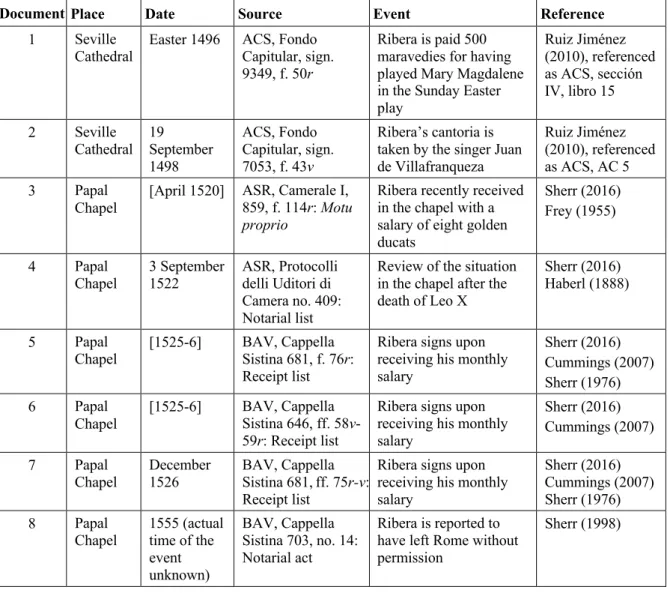
As per a record from 1496 in the cathedral’s financial books (libros de fábrica), we know that ‘antonio de ribera’ was paid 500 maravedies for having featured as ‘Mary on Easter Sunday’6 (see
Table 1, doc. 1). The play was in all likelihood directed by Alonso Pérez de Alba, who was the master of the choirboys. According to Ruiz Jiménez, the role of Mary Magdalene in the Easter play
4 Kenneth KREITNER, ‘The Music of Alonso de Alba’, Revista de Musicología, 37 (2014), pp. 389-421.
5 Juan RUIZ JIMÉNEZ, La librería de canto de órgano: Creación y pervivencia del repertorio del Renacimiento en la
actividad musical de la Catedral de Sevilla (Seville, Junta de Andalucía - Consejería de Cultura, 2007), pp. 154-5. The
most complete overview of Ribera’s biography prior to the publication of this information is Tess KNIGHTON, ‘Ribera
[Ribeira], Antonio de’, in Diccionario de la música española e hispanoamericana, edited by Emilio Casares (Madrid, SGAE, 1999-2002), vol. 9, pp. 170-1.
at Seville Cathedral was generally performed by either a young singer or a choirboy. Although the document does not mention Ribera’s status, we know that when he left the cathedral before 19 September 1498 (see Table 1, doc. 2), he was replaced by a new singer, Juan de Villafranqueza.7 It
is unlikely that Ribera was a choirboy in 1496 because we know he had a fully formed voice in 1498, which it would not have been possible to develop in two years. Therefore, it may be inferred that during the years documented at Seville Cathedral he was most probably hired as a young singer.
Document Place Date Source Event Reference
1 Seville
Cathedral Easter 1496 ACS, Fondo Capitular, sign. 9349, f. 50r
Ribera is paid 500 maravedies for having played Mary Magdalene in the Sunday Easter play Ruiz Jiménez (2010), referenced as ACS, sección IV, libro 15 2 Seville Cathedral 19 September 1498 ACS, Fondo Capitular, sign. 7053, f. 43v Ribera’s cantoria is taken by the singer Juan de Villafranqueza
Ruiz Jiménez (2010), referenced as ACS, AC 5
3 Papal
Chapel [April 1520] ASR, Camerale I, 859, f. 114r: Motu
proprio
Ribera recently received in the chapel with a salary of eight golden ducats Sherr (2016) Frey (1955) 4 Papal Chapel 3 September 1522 ASR, Protocolli delli Uditori di Camera no. 409: Notarial list
Review of the situation in the chapel after the death of Leo X
Sherr (2016) Haberl (1888)
5 Papal
Chapel [1525-6] BAV, Cappella Sistina 681, f. 76r: Receipt list
Ribera signs upon receiving his monthly salary Sherr (2016) Cummings (2007) Sherr (1976) 6 Papal Chapel [1525-6] BAV, Cappella Sistina 646, ff. 58v-59r: Receipt list
Ribera signs upon receiving his monthly salary
Sherr (2016) Cummings (2007)
7 Papal
Chapel December 1526 BAV, Cappella Sistina 681,ff. 75r-v: Receipt list
Ribera signs upon receiving his monthly salary Sherr (2016) Cummings (2007) Sherr (1976) 8 Papal Chapel 1555 (actual time of the event unknown) BAV, Cappella Sistina 703, no. 14: Notarial act Ribera is reported to have left Rome without permission
Sherr (1998)
ACS: Archivo de la Catedral de Sevilla ASR: Archivio di Stato di Roma BAV: Biblioteca Apostolica Vaticana
Table 1. Documents regarding Antonio de Ribera’s career
7 Juan RUIZ JIMÉNEZ, ‘“Sounds of the hollow mountain”: Musical Tradition and Innovation in Seville Cathedral in the Early Renaissance’, Early Music History, 29 (2010), pp. 189-239, at 237-8.
According to this information, Ribera’s date of birth could be established at c.1475 (assuming that he was in his early twenties when he left Seville Cathedral).8 Hence, his career would have
peaked in the 1510s rather than the 1530s, as traditionally stated.9
From this, it would be tempting to pin Ribera’s place of origin down to the Archdiocese of Seville, as Sherr assumes in his latest study about the Papal Chapel.10 As likely as this might look, it
cannot be directly presumed from this information, as not enough is known about the recruitment process of young singers (but it is worth remembering that even less specialised individuals such as choirboys were sometimes recruited from afar).11 Whatever his place of origin, though, Ribera’s
time at Seville Cathedral was surely instrumental in bolstering his connection to the institution, which would help to explain the presence of all his extant sacred works in Tarazona 2/3.12 More
crucially for this paper, it is more than likely that, being at an essential stage of his compositional development, he absorbed the tradition of Seville Cathedral and received direct stylistic influence from the composers who were active there.
After some years that are unaccounted for, Ribera reappears as a singer at the Papal Chapel around 1520 (see Table 1, docs. 3-8). Although better documented than his stay in Seville Cathedral, the details of Ribera’s tenure in the Papal Chapel are far from clear. This is owing to two factors. First, the information is scarce and scattered because of the loss of documentation (mainly as a result of the Sack of Rome in 1527, which might prevent us from ever obtaining an accurate account).13 Second, a few misreadings and misinterpretations of the available data have contributed
to muddling the narrative.
8 Seifert indicates that, in the Imperial Chapel, boys were admitted when they were six years old, and stayed there for ten or eleven years. When their voices changed, they were given free education for three years, so they could go to university. Herbert SEIFERT, ‘La institución de la Capilla Imperial de Maximiliano I a Carlos VI’, in La capilla real de
los Austrias: Música y ritual de corte en la Europa moderna, edited by Bernardo José García García and Juan José
Carreras Ares (Madrid, Fundación Carlos de Amberes, 2001), pp. 69-78, at 70. Ruiz Jiménez points out how Seville Cathedral’s choirboys in the mid 16th century continued their studies in the Colegio de San Miguel, keeping their residence in the choir for up to four years. Juan RUIZ JIMÉNEZ, ‘From Mozos de Coro towards Seises: Boys in the
Musical Life of Seville Cathedral in the Fifteenth and Sixteenth Centuries’, in Young Choristers, 650–1700, edited by Susan Boynton and Eric Rice (Woodbridge, Boydell and Brewer, 2008), pp. 86-103, at pp. 102-3.
9 RUIZ JIMÉNEZ, ‘“Sounds of the hollow mountain” (see note 7), p. 231.
10 Richard SHERR, The Papal Choir During the Pontificates of Julius II to Sixtus V (1503-1590): An Institutional History
and Biographical Dictionary (Palestrina, Fondazione Giovanni Pierluigi da Palestrina, 2016), pp. 138, 145, 281.
11 Anglés stated that Ribera came from Lérida, without further explanation. Higinio ANGLÉS, La música en la corte de
Carlos V. 2: Monumentos de la Música Española (Barcelona, Consejo Superior de Investigaciones Científicas-Instituto
Español de Musicología, 1944), p. 18. See also KNIGHTON, ‘Ribera’ (see note 5), p. 170.
12 The institution for which E-TZ 2/3 was copied and/or used is still unknown. In Ruiz Jiménez’s opinion, Seville Cathedral would be the likeliest one (Juan RUIZ JIMÉNEZ, ‘Infunde amorem cordibus: An Early 16th-Century Polyphonic
Hymn Cycle from Seville’, Early Music, 33 (2005), pp. 619-38, at pp. 637-8); Ros Fábregas favours Tarazona Cathedral instead (Emilio ROS-FÁBREGAS, ‘Manuscripts of Polyphony from the Time of Isabel and Ferdinand’, in Companion to
Music in the Age of the Catholic Monarchs, edited by Tess Knighton (Leiden, Brill, 2017), pp. 404-68, at pp. 447-51).
Irrespective of the manuscript’s origin, both a number of composers represented there, and a substantial part of the repertory are demonstrably connected to Seville Cathedral.
13 Richard SHERR, ‘New Archival Data concerning the Chapel of Clement VII’, Journal of the American Musicological
Society, 29 (1976), pp. 472-8, at p. 472; Anthony M. CUMMINGS, ‘Clement VII’s Musical Patronage: Evidence and
To begin with, his entry into the chapel is not precisely dated, but it is estimated to have occurred shortly before April 1520. This is inferred from a papal motu proprio where only the month (April) is given. In it, Pope Leo X indicates that Ribera had been ‘recently received’ in the Papal Chapel:
Motu proprio, etc, Our beloved son, cardinal Ferdinand, titular Presbyter of S. Pancrazio, our General Treasurer, we entrust and order that immediately after reading this you should pay or give the order to pay to (our) dear son Antonio Ribera, our singer recently received by us in our chapel, eight gold ducats from the gold of the Camera, for the salary of the present month of April, and that this continue for each single month, and follow in future times with the same salary that chaplain singers receive, as accustomed, (and that you do that) actually and effectively, irrespective of any contrary provision whatsoever.14
Frey established April 1520 as the likeliest entry date based on two facts. First, the document’s
terminus post quem is April 1518, as Cardinal Ferdinando Ponzetti was nominated Presbyter of
S. Pancrazio only on 6 July 1517; second, the motu proprio is bound in a volume, preceded by a document dated 15 March 1520 and followed by another from 5 July 1520.15 More crucially, Frey
refuted the date 2 August 1514 for Ribera’s entry in the chapel, which Franz Xavier Haberl had established in his pioneering article on the Papal Chapel.16 Frey showed how Haberl had conflated
the aforementioned motu proprio with an earlier document, also undated. The latter document does not mention Ribera and lists the singers Egidio Carpentier, Petro Jouault alias Brule, Bernardo Benedicti, Vincentio Nuzano, and Petro de Vian instead. Ferdinando Ponzetti is, again, the executor of Pope Leo X’s directive. On this occasion, he is named General Treasurer only. Based on Ponzetti’s biography,17 Frey dates the second document from between August 1514 and August
1516.18
14 ‘Motu proprio etc. Dilecto filio Ferdinando tituli Sancti Pancratii presbitero cardinali thesaurario nostro generali committemus et mandamus quatenus statim visis presentibus dilecto filio Antonio de Ribera cantori nostro nuper in capella nostra per nos recepto, ducatos octo auri in auro de camera pro presentis mensis aprilis, salario et alias continuando aliis singulis mensibus, et sequentis temporibus futuris eundem salarium per cantores cappellanos percipi solitum persolvere seu persolvi facere et mandare debeas realiter et cum effectu in contrarium faciendum non obstantibus quibuscumque.’ This transcription comes from SHERR, The Papal Choir (see note 13), p. 281. Partially published in Herman-Walther FREY, ‘Regesten zur päpstlichen Kapelle unter Leo X. und zu seiner Privatkapelle’, Die
Musikforschung, 8 (1955), pp. 58-73, at p. 63.
15 FREY, ‘Regesten zur päpstlichen Kapelle’ (see note 14), at pp. 62-3.
16 Franz Xavier HABERL, Die römische ‘schola cantorum’ und die päpstlichen Kapellsänger bis zur Mitte des 16.
Jahrhunderts, Bausteine für Musikgeschichte (offprint of Vierteljahrsschrift für Musikwissenschaft. Jahrgang III)
(Leipzig, Breitpkopf & Hartel, 1888), vol. 3, pp. 1-130, at p. 68-9.
17 Salvador MIRANDA (ed.), ‘Ponzetti, Ferdinando (1444-1527)’, in The Cardinals of the Holy Roman Church <http://web dept.fiu.edu/~mirandas/bios1517-ii.htm#Ponzetti> (accessed 1 October 2018).
From Frey’s article, Stevenson inferred that Ribera had belonged to Ponzetti’s chapel as a singer between April 1518 and April 1520, but the article does not suggest such a possibility.19
Another statement that needs rectifying is Cilliberti’s assertion that Ribera was amongst the singers in Pope Leo X’s retinue when he met King Francis I of France in Bologna in 1515. He misquotes Bragard, who does not make such a claim.20
The bulk of information about Ribera’s time in the Papal Chapel is found in the rolls of the chapel’s personnel. His name appears on a notarial list from 3 September 1522, which evaluates the situation of the chapel after the death of Pope Leo X (Table 1, doc. 4).21 The following three
documents concerning Ribera (docs. 5-7) are receipt lists from the years 1525 and 1526, on which the papal singers stamped their signature to certify that they had received their salaries (which, in Ribera’s case, continued to amount to eight gold ducats).22 The last list where his name appears is
dated December 1526. He is missing in the next payment record from 1529. This probably indicates that he died in the Sack of Rome in 1527, which was the fate of roughly half of the singers in the choir, from whom nothing was heard after the catastrophic event: of the twenty-four singers listed in 1526, fourteen disappear from the 1529 roster; in the years 1529-30 seventeen new singers were hired.23
The last document in Table 1 (doc. 8) mentions Ribera within a long legal process conducted in the Papal Chapel to confirm the pre-eminence and authority of the College of singers over the chapelmaster, as regards executive decisions. At an undetermined time in his tenure, Ribera is reported to have left Rome without permission, and, as a consequence, he was fined by the College without the intervention of the chapelmaster.24
This meagre harvest of information leaves some crucial questions unanswered: what did Ribera do in the period 1499-1520? He must have kept singing to a level that allowed him to join the Papal
19 STEVENSON, Music in the Age of Columbus (see note 2), p. 285.
20 See Galliano CILIBERTI, ‘Diffusione delle opere sacre dei compositori iberici e circolazione dei musicisti spagnoli nello stato pontificio nel XVI secolo’, Revista de Musicología, 16 (1993), pp. 2614-29, at p. 2617; and Anne-Marie BRAGARD, ‘Les musiciens ultramontains des chapelles du pape Médicis Leon X (1513-1521)’, Bulletin de l’Institut
historique belge de Rome, 50 (1980), pp. 187-216. There is no mention of him either in Lester D. BROTHERS, ‘“And They Vied with Each Other in Singing”: Francis I and Leo X, Music and Diplomacy at Bologna, 1515’, Explorations in
Renaissance Culture, 17 (1991), pp. 71-86.
21 Transcribed in HABERL, Die römische ‘schola cantorum’ (see note 16), pp. 70-1.
22 Documents 5 and 7, including Ribera’s autograph acknowledgment of the payment, are reproduced and transcribed in Richard SHERR, ‘New Archival Data concerning the Chapel of Clement VII’, Journal of the American Musicological
Society, 29 (1976), pp. 472-8.
23 CUMMINGS, ‘Clement VII’s Musical Patronage’ (see note 13), pp. 21-8.
24 The name appears in a declaration from 26 March 1550 by Witness 5, Giovanni Francesco Felici, dean of the Chapel, of more than 69 years old, and a member of the Chapel from 1518. Richard SHERR, ‘A Curious Incident in the Institutional
History of the Papal Chapel’, in Papal Music and Musicians in Late Medieval and Renaissance Rome, edited by Richard Sherr (Oxford, Clarendon Press, 1998), pp. 187-210, at p. 200.
Chapel in his forties (if my hypothetical date of birth is accurate)25 but did he keep composing
during this period and later on in the Papal Chapel, even though there is no trace of his music left there? This leads to a third question: when was his extant music composed? Until more contextual information is unearthed this thread is a dead end. I will therefore turn to examine his music instead, in search of elements that can illuminate this last question.
Attributions to Antonio de Ribera
Before dealing with the analysis of the music, however, it is necessary to appraise the reliability of the attributions (both coeval and modern) to the composer. As shown in Table 2, only four works can be securely credited to him (nos. 1-4).
There are two reliably attributed sacred compositions: a mass (Missa sine nomine) and a motet (Ave Maria), and two secular pieces: a villancico (Nunca yo, señora, os viera), and a romance (Por
unos puertos arriba). The musical sources (Tarazona 2/3 for the sacred music and the CMP for the
secular) unmistakably identify them, and no conflicting attributions exist.
A second group consists of four pieces (nos. 5-8) bearing conflicting attributions in sixteenth-century sources. The motet Patris sapientia (no. 5) is attributed to Ribera in Tarazona 2/3. It also appears in two Guatemalan manuscripts now held at the Lilly Library (Bloomington): Ms. 8 (US-BLl Music Ms. 8) and Ms. 9 (US-(US-BLl Music Ms. 9). In the Guatemalan sources, the motet has no text and is divided into two partes, each one considered as an individual piece. Ms. 8 transmits both
partes (with an anonymous Dominus regnavit cor meum in between) with attributions to ‘Alonso de
avilla’, and ‘Armiso’ respectively. Ms. 9 only copies part 2, with no attribution.26 The identity
behind the names in Ms. 8 is unclear. Paul W. Borg has suggested that Alonso de Ávila might be either Alonso Pérez de Alba or some other composer from Ávila. More importantly, he has pointed out the unreliability of the attributions in Ms. 8.27 This, along with the later date of this source,
which was copied from 1570 onwards, favours the attribution to Ribera, as found in Tarazona 2/3.
25 By modern standards, this may seem older than usual to enter a choir, but it was probably not that uncommon. Josquin was around 39 when he entered the choir and the aforementioned Giovanni Francesco Felici was at least 38. See Jesse RODIN, ‘“When in Rome...”: What Josquin Learned in the Sistine Chapel’, Journal of the American Musicological
Society, 61 (2008), pp. 307-72, at p. 308 and SHERR, ‘A Curious Incident’ (see note 24), p. 200.
26 Paul W. BORG, ‘The Polyphonic Music in the Guatemalan Music Manuscripts of the Lilly Library’ (PhD dissertation, Indiana University, 1985), p. 124.
no. Title Sources Attribution in the source Authorship: Accepted / Proposed ? Securely attributed
1 Missa sine
nomine, a 4 E-TZ 2/3, ff. 152v-160r An. de Ribera Antonio de Ribera P-Cug MM 12, ff. 91v-93r (Gloria) Ribeira (in Kyrie)
2 Ave Maria,
a 4 E-TZ 2/3, ff. 258v-259r An. de Ribera Antonio de Ribera
P-Cug MM 48, f. 39v Anonymous P-Ln CIC 60, ff. 1v-3r Anonymous US-BLl Ms. 1, ff. 3v-4r Anonymous 3 Nunca yo, señora, os viera, a 3
E-Mp II-1335, f. 117v Antonio de Ribera Antonio de Ribera
4 Por unos puertos arriba, a 4
E-Mp II-1335, f. 66v A. Ribera Antonio de Ribera
Conflicting attributions in sixteenth-century sources 5 Patris
sapientia, a 4 E-TZ 2/3, ff. 272v-273r Antonio de Ribera Antonio de Ribera US-BLl Music Ms. 8, ff. 41v-42r (pars
1) / 43v-44r (pars 2)
Alonso de Ávila / Armiso
US-BLl Music Ms. 9, ff. 21v-22r (pars
2) Anonymous 6 Missa sine nomine, a 4 (composite mass in P-Cug MM 12) E-TZ 2-3, ff. 191v-192r/194v-197r /198v-199r (Kyrie/Credo/Sanctus) Tordesillas Tordesillas (Kyrie/Credo/Sanctus) Antonio de Ribera (Gloria, from no. 1)
E-TZ 2-3, ff. 153v-155r (Gloria from
no. 1)
An. de Ribera (in
Kyrie) P-Cug MM 12, ff. 90v-93r (Kyrie/Gloria) / ff. 81v-88r (Credo/Sanctus) Ribeira 7 O bone Jesu,
a 4 E-Bbc 454, ff. 135v-136r Penyalosa Juan de Anchieta
E-Boc 5, f. 69r Anonymous
E-SE ss, ff. 100v-101r Johãnes Ancheta
E-TZ 2/3, ff. 273v-274 Antonio de Rra GCA-Jse 7, ff. 66v-68r Anonymous P-Cug MM 12 ff. 190v-191r Anonymous P-Cug MM 32 ff. 17v-18r Anonymous P-Cug MM 48 ff. 36r-36v Anonymous P-Cug MM 53 ff. 131v-132r Anonymous P-Ln CIC 60, ff. 14v-16r Anonymous US-BLl MS 8 ff. 26v-27r, 58v-59r Anonymous Petrucci, Motteti della Corona 3
(1519), no. 14
8 Ne proicias
me (lost) Tarazona Inventory 1: Fuente 14, item 406
28 Ribaflecha ?
Tarazona Inventory 2: Fuente 14, item 406 Ribera Doubtful Attributions
9 Beata es
Maria (lost) Tarazona Inventories 1 & 2: Fuente 5, item 109 Ribera Ribera, Bernardino de? or Antonio de? 10 O quam
speciosa Tarazona Inventory 3: Fuente 81, item 755 Rivera E-Tc 6, ff. 80v-84r (a 6) Bernardino de Ribera, Bernardino de
Ribera
E-Zac 34, TOC29: no. 49 (a 6) Berno Ribera
11 Rex autem
David
Tarazona Inventory 3: Fuente 81, item 754 Ribera Ribera, Bernardino de
E-Tc 6, ff. 103v-107r (a 5) Bernardino de Ribera
E-VAcp 20, pp. 45-6 (a 5) Bernardinus Ribera
E-Zac 34, TOC: no. 511 (a 5) Berno Ribera
12 Aquesta
gran novetat, a 3
El Misteri d’Elx, Consueta 1709, piece
2.21 Ribera (Consueta
1639-lost)
Ribera, Bernardino de? or
Pedro de? 13 Cantem
senyors, a 4
El Misteri d’Elx, Consueta 1709, piece
2.25 Ribera (Consueta 1639-lost) Contrafactum of Quedaos, adiós (CMP 158), Pedro de Escobar 14 Flor de virginal bellesa, a 4
El Misteri d’Elx, Consueta 1709, piece
2.20 Ribera (Consueta 1639-lost) Contrafactum of Non quiero que me consienta, Antico, Frottole Libro 2
(1516), Juan del Encina 15 Nosaltres
tots creiem,
4v
El Misteri d’Elx, Consueta 1709, piece
2.24 Ribera (Consueta
1639-lost)
Ribera, Bernardino de? or
Pedro de? 16 O Déu
adonai, a 4 El Misteri d’Elx, Consueta 1709, piece 2.22 Ribera (Consueta 1639-lost)
Ribera, Bernardino de? or
Pedro de? Anonymous, with stylistic similarities
1730 Rex autem
David, a 4 CH-Bu F.X 5-9, no. 29 CH-Bu F.X 5-9, no. 33 Anonymous Anonymous ?
CH-SGs 463, no. 108 Willaert
(spurious)
28 Numbering of items from Tarazona’s inventories follows Pedro C
ALAHORRA, ‘Los fondos musicales de la Catedral de
Tarazona’, Nassarre: Revista Aragonesa de Musicología, 8/2 (1992), pp. 9-56. It'll be necessary to adjust the full reference to this item, which appears later on.
29 Only the manuscript’s Table of Contents has been available for consultation. Therefore, I am indicating here the number
of the piece as given in the ToC, rather than the folios.
30 Concordances for this piece are extracted from H
CH-Sk 87-4 (1 v only) Anonymous
D-Mu 326, no. 22 Anonymous
D-Rp B220-222, no. 52 Anonymous D-Rp 940-941, no. 29 Anonymous I-Fn 27, ff. 149v-150r Anonymous I-VEcap 760, ff. 49v-50r Anonymous P-Cug MM 32, ff. 56v-57r Anonymous P-Cug MM 48, f. 54r Anonymous P-Cug MM 48, f. 123v Anonymous P-Ln CIC 60, ff. 12v-14r Anonymous PL-Kp 1716, ff. 253v-254r Anonymous
Rhau, Symphonia jucundae (1538), no. 41 Anonymous 18 Gabriel
angelus, a 4 P-Cug MM 12, ff. 200v-201r Anonymous ?
P-Cug MM 32, ff. 26v-27r Anonymous
Table 2. Works attributed to Antonio de Ribera (sources appear in alphabetical order)
The mass attributed to ‘Ribeira’ in manuscript Coimbra 12 is, in fact, a composite mass.31 The
Kyrie (ff. 90v-91r) comes from Tordesillas’ Missa sine nomine (as per Tarazona 2/3), and the Gloria (ff. 91v-93r) is from the aforementioned mass by Ribera (no. 1 in Table 2). These two movements are followed by the superius and the tenor of the Credo copied in f. 93v. In f. 94r an inscription points the reader to f. 81, where the complete Credo and the Sanctus (both by Tordesillas as per Tarazona 2/3) are copied. The inscription also states that there is no Agnus Dei. In their new location in the manuscript, the Credo and the Sanctus make up part of another composite mass (ff. 73v-89r) with a Kyrie (anonymous), a Gloria (anonymous), two Et incarnatus (anonymous) and an Agnus Dei (melodically related to Tordesillas’ Agnus but not the one in Tarazona 2/3).32
Kenneth Kreitner considers the attribution of the mass to Tordesillas in Tarazona 2/3 to be correct, and the same can be said of the attribution to Ribera (as discussed above). Kreitner explains that the
31 P-Cug MM12 is a manuscript from the monastery of Santa Cruz in Coimbra, nowadays at the Biblioteca Geral da Universidade, Coimbra. Images of the manuscript can be found in the database Portuguese Early Music <http://pemda tabase.eu/source/3069>. For an inventory see Owen REES, Polyphony in Portugal c.1530-c.1620: Sources from the
Monastery of Santa Cruz, Coimbra (New York - London, Garland, 1995), pp. 185-94.
32 I am grateful to Kenneth Kreitner for a stimulating exchange on this matter, and for pointing out that the Agnus Dei is not the same as in Tarazona 2/3. A clarifying overview of the layout can be found in Kenneth KREITNER, ‘Spain
Discovers the Mass’, Journal of the Royal Musical Association, 139 (2014), pp. 261-303, at p. 269, n. 33 (although the Agnus Dei is still attributed to Tordesillas there). I also would like to thank María Elena Cuenca, who in a separate exchange communicated the same conclusion about the Agnus Dei in Tarazona 2/3.
attributions are mismatched due to the reshuffling of the movements when copied in the Portuguese source (or its exemplar).It is not difficult to fathom how this kind of mistake could have been generated and perpetuated—in both the historical transmission and the modern reading of the attributions—given the fact that for masses the composer’s name generally appears only at the beginning of the whole mass (actually in the Kyrie), and/or at the manuscript’s table of contents, next to the name of the mass. Interestingly enough, Kreitner contends that the practice of combining mass movements into factitious cycles that suited institutional needs may have been more common than the sources now show.33 One is then left to wonder how many of these misattributions remain
undetected.
The motet O bone Jesu (no. 7) has been extensively discussed, given its wide circulation beyond the Iberian Peninsula in manuscripts and printed sources. The various attributions to Juan de Anchieta, Francisco de Peñalosa, Antonio de Ribera and Loyset Compère have been endorsed on codicological, stylistic and contextual grounds.34 Currently, the general consensus is that Anchieta
is the likeliest composer.35
The case of Ne proicias me (no. 8) is slightly different, because the piece is lost and the conflicting attributions come from two inventories of the music holdings of Tarazona Cathedral in the sixteenth century (that Pedro Calahorra labels Inventory 1 and 2). The motet was contained in a lost volume (item 14, f. 72, in both inventories) and it is attributed to ‘Ribaflecha’ (Inventory 1) and ‘Ribera’ (Inventory 2).36 According to Calahorra, Inventory 1 was created earlier than Inventory 2,
although its exact date is unknown. Emilio Ros-Fábregas has recently stated that, according to the paper watermarks, it was probably in use in the 1550s.37 Inventory 2 was put together in 1591,
planned as a replacement for an older inventory from 1570 (nowadays lost, and not to be mistaken for Inventory 1). The two extant inventories are quite similar, although Inventory 2 lists further pieces interspersed in the manuscripts (probably copied in blank folios in the interim between the compilation of the two inventories)38 and also additional volumes. Some divergences in attributions
33 KREITNER, ‘Spain Discovers the Mass’ (see note 29), at 269.
34 For an overview of the discussions see Tess KNIGHTON, ‘Francisco de Peñalosa: New Works Lost and Found’, in
Encomium Musicae: Essays in Memory of Robert J. Snow, edited by David Crawford and G. Grayson Wagstaff
(Hillsdale, NY, Pendragon Press, 2002), pp. 231-57, at pp. 250-2. See also KREITNER, The Church Music (see note 3),
pp. 119-22.
35 João Pedro D’ALVARENGA, ‘Juan de Anchieta and the Iberian Motet around 1500’, Acta Musicologica, 91/1 (2019), pp. 21-47.
36 See Pedro CALAHORRA, ‘Los fondos musicales de la Catedral de Tarazona’, Nassarre: Revista Aragonesa de
Musicología, 8/2 (1992), pp. 9-56, for a study and transcription of the inventories. A digital reproduction of Inventory 1
can be found in the database Books of Hispanic Polyphony, available at <https://hispanicpolyphony.eu/node/16447>. 37 ROS-FÁBREGAS, ‘Manuscripts of Polyphony’ (see note 12), pp. 404-68, at p. 449.
occur between the two inventories, as with Ne proicias me. The inventories only mention the composers’ surname. However, given that both Rivafrecha and the other composers in the lost manuscript were all active in the first half of the sixteenth century, it is reasonable to assume that the scribe was referring to Antonio de Ribera. In any case, with the piece missing and no further elements to support the authorship by one or the other composer, this conflicting attribution will have to remain unresolved for the moment.
The pieces in the next group (nos. 9-16) are all attributed to ‘Ribera’, but contextual elements point to the possibility of namesakes. The authorship of the lost motet Beata es Maria (no. 9 in Table 2) appears in item no. 5 (lost) from both Inventory 1 and Inventory 2 of Tarazona Cathedral. This volume featured composers slightly younger than Antonio de Ribera (such as Morales, Pastrana, and Basurto), but also others from Antonio de Ribera’s generation such as Peñalosa. Hence a motet by him would not have been totally out of place in the manuscript. However, the piece’s resulting length at three openings is much longer than Antonio de Ribera’s extant motets (nos. 2 and 5, which are copied in one opening each in Tarazona 2/3). Of course this does not preclude the possibility that Antonio de Ribera’s composed a longer piece, but it looks unlikely. This attribution will therefore have to remain open until further information becomes available.
The motets O quam speciosa (no. 10) and Rex autem David (no. 11) are attributed to ‘Ribera’ in item 81 (lost) of Inventory 3 of Tarazona Cathedral. This inventory was compiled in 1591, as a continuation of Inventory 2 and lists additional volumes. Item 81 collected pieces from composers from the second half of the sixteenth century, such as Palestrina, Guerrero, Victoria and Ruffo. For this chronological reason, the composer Bernardino de Ribera (d. 1580) is a better candidate than Antonio de Ribera to be the author of pieces 10 and 11. Geographical closeness and patterns of the repertory circulation also favour Bernardino: he was chapelmaster of Orihuela Cathedral in 1556 and of the nearby Murcia Cathedral in 1571-80.39 I have shown elsewhere the connections between
Orihuela Cathedral and the cathedrals of Saragossa and Tarazona, and how repertory from Orihuela might have reached Saragossa (and then Tarazona) in the second half of the sixteenth century through the manuscript E-Zac 34 (nowadays in Zaragoza, Archivo de Música de las Catedrales).40
This manuscript, of which only the tenor part is extant, contains music by Bernardino de Ribera, including the two aforementioned motets: O quam speciosa (6vv) and Rex autem David (5vv). They
39 Esperanza RODRÍGUEZ-GARCÍA, ‘El repertorio polifónico de la colegiata de Orihuela según un inventario de mitad del siglo XVI’, Anuario Musical, 63 (2008), pp. 1-23, at p. 21. See also Michael NOONE, ‘Ribera, Bernardino de’, in
Diccionario de la música española e hispanoamericana, edited by Emilio Casares (Madrid, SGAE, 1999-2002), vol. 9,
pp. 171-2.
are copied consecutively, following the same order as in Inventory 3.41 Moreover, the length of the
pieces as suggested in the inventory (O quam speciosa occupies four openings and Rex autem
David five) fits better the dimensions of the known motets by Bernardino.42
Rex autem David presents an additional point of interest, as there is a widely distributed
anonymous four-voice motet from around 1500 with this title (no. 17, Table 1).43 Despite a spurious
attribution to Willaert,44 Ham has established its probable Iberian origin, a hypothesis I agree with.45
For stylistic reasons he has tentatively suggested a few plausible composers (such as Antonio de Ribera and Juan de Anchieta).46 Nonetheless, it is important to remark that this is totally unrelated
to the attribution of Rex autem David to ‘Ribera’ in the Tarazona inventories, and it would be a mistake to use it as an additional piece of evidence to endorse Antonio de Ribera’s authorship of the anonymous motet, as, in my opinion, the attribution to ‘Ribera’ in the Tarazona inventories refers to the five-voice setting by Bernardino de Ribera.
The remaining five pieces are devotional compositions in Catalan (Table 2, nos. 12-6). They belong to the Mystery Play of Elx (Misteri d’Elx), a drama of medieval origin that continues to be performed annually in the city of Elx (Alicante) to celebrate the Assumption of Mary.47 The play
has undergone various interventions over the centuries, as shown in the different scripts (called
Consuetes).48 The earliest extant complete version with music is transmitted in the Consueta of
1709 (E-ELa U-24), which shows a mixture of monodic and polyphonic pieces (the latter allegedly added in the sixteenth century). The music in the Consueta of 1709 is anonymous, although three names are found in an earlier Consueta from 1636 (‘Vich’, ‘canonge Pérez’ and ‘Ribera’). This
41 These motets also exist in manuscript 6 of Toledo Cathedral, where Bernardino was a chapelmaster, and in manuscript 20 of the Colegio del Patriarca, in Valencia. This institution also belongs to Valencia Archbishopric.
42 Compare, for example, the 102 breves of Bernardino’s Rex autem David to the 62 breves of Antonio’s Ave Maria. 43 Martin HAM, ‘“Rex autem”: Another Iberian Lament in Rhau’s Symphoniae jucundae?’, in Pure Gold: Golden Age
Sacred Music in the Iberian World. A homage to Bruno Turner, edited by Tess Knighton and Bernadette Nelson
(Kassel, Edition Reichenberger, 2011), pp. 309-26. 44 HAM, ‘“Rex autem”’ (see note 40), pp. 323-4.
45 Manuel Pedro FERREIRA, though, notes that the motet text problably comes from non-Iberian sources. Manuel Pedro FERREIRA, ‘Recordando o Rei David: Vivência coral e criatividade musical na Europa pós-carolíngia’, Medievalista, 8
(2010), <http://www.fcsh.unl.pt/iem/medievalista/MEDIEVALISTA8/ferreira8005.html> (accessed 10 April 2018). 46 HAM, ‘“Rex autem”’ (see note 40), p. 326.
47 The bibliography on this topic is vast and tackles all aspects of the play beyond the music. The most complete studies on the music are Maricarmen GÓMEZ I MUNTANÉ, Consueta de 1709. II: Estudi crític de la música (Valencia, Generalitat
Valenciana, 1986); MaricarmenGÓMEZ I MUNTANÉ, ‘Al voltant de la música del Misteri d’Elx’, Món i Misteri de la
Festa d’Elx (Valencia, Conselleria de Cultura, Educació i Ciència, 1986), pp. 255-63; and José María VIVES RAMIRO, La
Festa o Misterio de Elche a la luz de las fuentes documentales (Valencia, Conselleria de Cultura, Educació i Ciencia de
la Generalitat Valenciana-Ajuntament d’Elx, 1998). For an overview of the play within the context of other Spanish Marian plays see MaricarmenGÓMEZ MUNTANÉ, La música medieval en España (Kassel, Reichenberger, 2001), pp.
89-96.
48 A detailed review of the Consuetes can be found in Francesc MASSIP and Maricarmen GÓMEZ I MUNTANÉ (eds.),
Consueta is lost nowadays, but it is known through partial copies made in the nineteenth century.49
There is some agreement on identifying ‘Vich’ with Lluís Vich (organist of the church of Santa María in Elx, and its first known chapelmaster in 1562-1594)50, and the ‘canonge Pérez’ with Ginés
Pérez (chapelmaster of Orihuela Cathedral in 1566-81, chapelmaster of Valencia Cathedral in 1581-95 and canon of Orihuela Cathedral in 151581-95-1600. The sobriquet ‘canonge’, canon in Catalan, surely came from this latter period).51 However, the identification of ‘Ribera’ has proved more
controversial. Felipe Pedrell considered that it referred to Antonio on stylistic grounds, hence discarding Bernardino as a more modern composer.52 However, style is not a helpful marker in this
case, as the music was intended for a play of popular nature, with a clear practical function:53 it
exhibits a plain homorhythmic style, undoubtedly tailored to the amateur local singers who, then and now, perform the music. It should not come as a surprise, then, that the music (both monodic and polyphonic) shows a strong dependence on contrafactum.54 Concerning the pieces attributed to
Ribera, this technique has been identified in two of them so far: Cantem senyors (contrafactum of
Quedaos, adiós by Pedro de Escobar) and Flor de virginal bellesa (contrafactum of Non quiero que me consienta by Juan del Encina). All things considered, in dealing with authorship in the Misteri, it
would be more useful to consider the individuals that put the music together as arrangers rather than composers.
On geographical grounds, I would contend that either Bernardino de Ribera or his father, Pedro de Ribera, is a better candidate for the authorship than Antonio de Ribera. Both of them were chapelmasters at Orihuela Cathedral (were they were surely acquainted with the Catalan language of the pieces) and later on at nearby Murcia Cathedral. Additionally, Bernardino was also a choirboy at Orihuela. The Church of Santa María of Elx (which belongs to the Archdiocese of Valencia) is 35.5 kilometres from Orihuela and 57 kilometres from Murcia. In contrast, there are no
49 The copy with the attributions was published as Roc CHABÀS I LLORENS,‘El drama sacro de la Virgen de Elche’, El
Archivo, 4 (1890), pp. 203-14. For other copies see Joan CASTAÑO GARCÍA, Aproximacions a la Festa d'Elx (Alacant,
Institut Alacantí de Cultura ‘Juan Gil-Albert’, 2002), especially pp. 38-50.
50 Joan CASTAÑO GARCÍA, ‘La música a l’església de Santa Maria d’Elx’, Cabanilles, 18-20 (1986), pp. 1-164, at p. 75. 51 Esperanza RODRÍGUEZ-GARCÍA, ‘A vosaltres venim pregar, del canonge Pérez’, in La Festa i Elx, edited by Josep Lluís
Sirera (Elx, Institut Municipal de Cultura, 2004), pp. 267-88. For an updated biography see RODRÍGUEZ-GARCÍA, ‘El
repertorio polifónico’ (see note 38), p. 22.
52 Felipe PEDRELL, La Festa de Elche o el drama lírico litúrgico de la muerte o la Asunción de la Virgen, translated by Antonio Agulló Soler (Elche, Librería Atenea, 1951), p. 48. First published as ‘La Festa d’Elche ou le drame lyrique liturgique “La Mort et l’Assomption de la Vierge”’, Sammelbände der Internationalen Musikgesellschaft, 2 (1901), pp. 203-52.
53 As Francesc Massip points out, the successive Consuetes show a tendency to simplify and save on the required means for performance. Francesc MASSIP, Consueta de 1709. I: Estudi crític del text (Valencia, Generalitat Valenciana, 1986),
p. xxii.
traceable links at present between Antonio and the Archdiocese of Valencia. However, it might be worth mentioning that Pedro de Ribera was of Sevillian origin and was a choirboy at Seville Cathedral, so a family relationship cannot be totally ruled out.55
Chronologically, if all the new polyphonic pieces were introduced at the same time (which would seem to be the logical procedure when overhauling such a long-lived play), then the 1570s would be the most obvious time and Bernardino the most likely composer: the three composers named in the Consueta were working as chapelmasters in close vicinity (Lluís Vich in Elx, Bernardino de Ribera in Murcia and Ginés Pérez in Orihuela). If the pieces were added at different times, then the attribution could refer to any of the three composers named Ribera (or, indeed, another musician with this surname).56
The last two pieces in the table are anonymous and have been loosely linked to Antonio de Ribera in musicological literature because of their stylistic compatibility. I have included them in this discussion so as to raise their visibility, but this does not imply any suggestion of attribution to Ribera on my part (or by the other scholars mentioned). The attribution of the four-voice Rex autem
David (no. 17) has been tackled above, within the discussion of piece no. 11, a five-voice Rex autem David. As for Gabriel angelus (no. 18), it appears in manuscripts Coimbra 12 and Coimbra
32 (P-Cug MM12 and MM32). Owen Rees notices this piece shares two features with Ribera’s Ave
Maria: the use of a refrain structure and the final pleas in litany style (see below).57 It is worth
mentioning, though, that these elements were most probably determined by the choice of text and are, therefore, undependable as stylistic markers.
Ribera’s sacred works
In this section, I will examine Ribera’s mass and two motets.58 For comparison, I will consider
analogous pieces by Alonso Pérez de Alba [one mass a 3, one Agnus Dei a 4 (part of the composite
Missa Rex virginum), and five motets, all of them in Tarazona 2/3].59 Alba’s biography is better
55 NOONE, ‘Ribera, Bernardino de’ (see note 38); François REYNAUD, La polyphonie tolédane et son milieu. Des premiers
témoignages aux environs de 1600 (Paris, CNRS Éditions, 1996), p. 123.
56 Rubio proposed a singer of the Imperial Chapel of Maximilian of Austria in 1566-a 67 as a candidate. Samuel RUBIO, ‘La música del Misterio de Elche’, Tesoro sacro musical, 4 (1965), pp. 61-71, at p. 63.
57 Owen REES, ‘The Coimbra Manuscripts and the “Spanish Court Repertory”: The Motet Peccavi Domini’, in Musical
Exchanges, 1100-1650: Iberian Connections, edited by Manuel Pedro Ferreira (Kasel, Edition Reichenberger, 2016),
pp. 191-208, at p. 193-4.
58 The edition of Ribera’s music is my own.
59 Alba’s total extant output amounts to twenty-two works, including other sacred works and one secular. KREITNER, ‘The Music of Alonso de Alba’ (see note 4), p. 390. I have used Higinio Anglés’s edition of Alba’s three-voice mass. Higinio ANGLÉS (ed.), La música en la corte de los Reyes Católicos. I. Polifonía religiosa. Monumentos de la Música Española
documented than Ribera’s, although some periods in his career are still obscure. He mainly worked for Seville Cathedral from 1482 onwards, first as a singer, and subsequently acting as master of the choirboys (1491-7) and chapelmaster (from January 1503 until his death in 1504). He might have been hired by the Castilian Royal Chapel in the 1490s, but it is unclear whether he took the post. Alba embodies the musical tradition that Ribera encountered at Seville Cathedral at the end of the fifteenth century, and, given the possibility that he taught Ribera either formally or informally, it is likely that he had an input into the latter’s style. His music epitomizes the Iberian style prior to Peñalosa, defined by short phrases differentiated by the use of contrasting textures, where imitation, although present, does not play a significant structural role (or, as Kreitner has put it, Alba was a musician who ‘helped to perfect an old style, and who experimented pretty successfully in the new style’).60
Missa sine nomine
Ribera’s mass is one of the four extant Iberian sine nomine cyclic masses in four voices (the others are by Escobar, Anchieta, and Tordesillas). All of them employ melodic material to create a thematic connection between the movements of each mass: in Ribera’s case, the head-motive appears only at the beginning of the Kyrie, Gloria, and Credo, as seen in Example 1.61 The
head-motive is made up of long notes that change into a faster pace before finishing on a fleeting cadence. It varies slightly in each movement, both rhythmically (becoming more compressed in each instance) and texturally (variously treated as homorhythm in four voices, embellished homorhythm in two voices, and homorhythm in two voices).
Example 1. Head-motive in Ribera’s Missa sine nomine
from the composite Missa Rex Virginum come from Kreitner’s unpublished edition, which he generously shared with me.
60 KREITNER, ‘The Music of Alonso de Alba’ (see note 4), p. 421.
61 Kreitner considers that the motive is also present (although more and more unrecognisable) in the Sanctus and Agnus Dei. KREITNER, ‘Spain Discovers the Mass’ (see note 29), pp. 284-6.
Alba’s mass, also sine nomine, is written in three voices. Only two other similar masses (by Quixada and Almorox) have survived in the Iberian repertory. They all appear copied in succession in Tarazona 2/3 and, given their technical similarities and overall style, they have been understood as constituting a separate group and, as such, tentatively dated from around 1500, and in any case earlier than extant Iberian masses in four voices.62 Alba’s mass displays an indistinct four-note
motive in the Gloria, ‘Qui cum Patre’, Sanctus, and Agnus Dei, which both Stevenson and Kreitner are disinclined to consider a proper head-motive.63 Although I largely agree with this view, it seems
to me that the motive is still noticeable (most of the time it is sung solo), and thus plays a role akin to Ribera’s head-motive.
Both masses make use of a low clef setting: C4 C4 F4 (Alba) and C2 C4 C4 F4 (Ribera). Kreitner ponders whether the uncommon presence of low clefs in the three-voice masses might suggest a particular context of use.64 This could also be the case with Ribera’s mass, which adds a
top voice in the range of an altus rather than a superius.
The Dorian mode (D-Dorian in Ribera; G-Dorian in Alba) is consistently applied in the two masses, which present a limited palette of cadences: all the movements end on the finalis, and only internal cadences fall on the fifth degree (as in the final cadence of Ribera’s Christe). The furthest (although admittedly modest) departure from the finalis is one single example of a cadence on F in bar 69 of Ribera’s Credo. It builds up some tension, which is counteracted by an anticlimactic and immediate return to D. Ribera generally omits the third (even when the sonority has five notes, as in the Kyrie, where the last note of the bassus divides into D and A). Alba, writing for three voices, ends all the movements on a hollow G sonority, which only includes the fifth in the Kyrie and Agnus Dei.
More interestingly, Ribera’s cadences have an archaic flavour, with a few octave-leap and under-third cadences (the two gestures appear together in the final cadence of the Agnus Dei in Example 2a). These cadential types are absent from Alba’s three-voice mass, but, interestingly enough, they appear in the final cadence of his four-voice Agnus Dei from the Missa Rex virginum (Example 2b). This suggests that the number of voices, rather than the style, might have determined the difference. In fact, it is worth noting the close resemblance of these two cadences in four voices (both in the preparation/resolution and the extension).
62 KREITNER, ‘Spain Discovers the Mass’ (see note 29), pp. 279-84.
63 STEVENSON, Music in the Age of Columbus (see note 2), p. 166, and KREITNER, ‘The Music of Alonso de Alba’ (see note 4), p. 404 n. 28.
Ribera pays careful attention to text setting: the constant change of textures, punctuated by cadences, provides textual clarity and structural soundness. This focus on textual intelligibility also links Ribera’s music to the tradition of the Iberian style represented by Alba.
Example 2a. Final cadence: Ribera, Missa sine nomine-Agnus Dei
Example 2b. Final cadence: Alba, Missa Rex virginum-Agnus Dei
One of the conspicuous dissimilarities between the two masses lies in the use of imitation, quantitatively more present in Alba’s mass. However, as with the cadences, this is probably on account of the differences between the two masses in the number of voices, and the more archaic style of imitation found in the three-voice masses.65 It is worth noting that Alba’s only mass
movement in four voices, his Agnus Dei from the composite Missa Rex Virginum, shows less imitation than Ribera’s Agnus Dei (see below for a comparison of the two movements).
In addition to a shared interest in clarity of text and structure, there are a few other remarkable structural similarities between the two masses, which might suggest that Ribera knew Alba’s mass.
The two Kyries in both masses start in blocks of long notes and move into more animated counterpoint after a brief cadential moment. Alba displays sequential imitation in the first Kyrie. Ribera does this in the second, combining three different motives, two of them sounding simultaneously (Example 3a and b). The sequential imitation reaches its peak in Alba’s Christe (bb. 38-50) and Ribera’s second Kyrie (Example 3c).
Example 3a. Alba, Missa sine nomine-Kyrie (bb. 1-8)
Example 3b. Ribera, Missa sine nomine-Kyrie (bb. 55-64)
Ribera’s Christe (a 3, like Alba’s) opens in imitative fashion with a motive in long notes, which is reminiscent of Alba’s opening (Example 4a and 4b).
Example 4a. Ribera, Missa sine nomine-Christe (bb. 25-31)
Example 4b. Alba, Missa sine nomine-Christe (bb. 23-32)
The beginning of each Christe is followed by loosely imitative counterpoint in both masses. Alba treats the motives sequentially, creating an impressive instance of four ascending consecutive steps, happening in imitation in two voices, while the third voice presents the sequence three times (in bb. 38-50, on the word ‘Christe’), while Ribera marks the second and third statements of the Christe with two less ambitious pseudo-points of imitation (as shown in Example 5).
Ribera’s Gloria and Credo put the emphasis on text declamation and structural clarity. The music displays a succession of clear-cut phrases, finalised by cadences and separated from the following sentence by rests or long notes. The Gloria makes an overwhelming use of homorhythm and full voicing: there is neither imitation (except for two short motives in bb. 100-1) nor free counterpoint, and the only music set in less than four voices amounts to 14 bars out of 103. Alba’s Gloria is totally different from Ribera’s and famously features a canon in the top two voices throughout the 155 bars of the movement.66
Ribera achieves variety and sense of structure in the Gloria through the use of held chords with fermatas on crucial words (twice on ‘Jesu Christe’, in bb. 42-6 and 95-8), and the introduction of ternary time (‘Filius Patris’, ‘Quoniam tu solus sanctus’ and ‘Cum Sancto Spiritu’). With these devices Ribera creates a sophisticated division of the Gloria into two parts of almost equal length (55 and 57 bars respectively), comprising similar elements: a homorhythmic start, which peaks on a succession of sustained chords highlighting the words ‘Jesu Christe’, and ends on a lighter texture in ternary time. Sustained chords used as a dramatic gesture within homorhythmic textures are a common feature in coeval European repertories of the time,67 and also appear profusely in the
Iberian repertory (as in Ribera’s Ave Maria; see below).68 In fact, Alba also employs them in his
Credo, and, interestingly, their structural role is equally important as they generate a bipartite movement that could have inspired Ribera.69
Ribera’s Credo shows a more balanced proportion of four-voice declamatory homorhythm and other voicings and textures. There are no full imitative entries in the whole movement and Ribera resorts to long stretches of imitation between two voices (either adjacent or non-adjacent).70 On the
occasions when the remaining two voices take on the previous ones, they always display a different melodic line. Example 6 shows the imitation between the bassus and tenor 1 (in ‘Et ex Patre’, bb. 32-8) followed by a new imitative pairing of the superius and tenor 2 (in ‘Deum de Deo’ from b. 39).
66 KREITNER, ‘The Music of Alonso de Alba’ (see note 4), pp. 405-6.
67 Drake connects them to the Italian lauda. Warren DRAKE (ed.), Ottaviano Petrucci, Motetti de Passione, de Cruce, de
Sacramento, de Beata Virgine et huiusmodi B: Venice, 1503 (Chicago - London, The University of Chicago Press,
2002), p. 57. However, Blackburn relates them to a new ‘devotional style’ in the composition of motets. Bonnie BLACKBURN, ‘The Dispute about Harmony c. 1500 and the Creation of a New Style’, in Théorie et analyse musicales
1450-1650, edited by Anne-Emmanuelle Ceulemans and Bonnie J. Blackburn (Louvain-la-Neuve, Département
d’histoire de l’art et d’archéologie - College Érasme, 2001) pp. 1-37, at pp. 16-32.
68 Tess KNIGHTON, ‘Music and Devotion at the Court of the Catholic Monarchs’, in The Spain of the Catholic Monarchs, edited by David Hook (Bristol, University of Bristol Press, 2008), pp. 207-25, at p. 212, n. 18.
69 Albas’s Credo lasts 303 bars, and the held chords appear in bars 112-7 (‘et homo factus’) and 280-2 (‘et vitam’). 70 Wagstaff considers imitation between non-adjacent voices as one of the distinctive traits of Iberian music. Grayson
WAGSTAFF, ‘A Re-Evaluation of Music Attributed to Pedro Fernández de Castilleja’, Revista de Musicología, 16 (1993),
pp. 2722-33, at 2733. However, Rifkin thinks that pairing voices in adjacent and non-adjacent voices happened in equal measure in the non-Iberian motet around 1500. RIFKIN, ‘A Black Hole?’ (see note 1), p. 24.
Example 6. Ribera, Missa sine nomine-Credo (bb. 32-46)
The Sanctus in Ribera’s mass is organized around a division into three subsections (‘Sanctus’, ‘Pleni sunt’ a 3, and ‘Osanna’) marked by cadences, and an intermittent but consistent melodic line in long values in the manner of a (not yet identified) cantus firmus vagans (in bb. 1-6, superius; 16-28, tenor 2; 62-9, superius; and 100-9, superius). Each subsection consists of segments in free counterpoint, enlivened by changes in the voicing and peppered with loose imitation that involves up to three of the four voices, as well as a single point of imitation on ‘Pleni sunt’ (bb. 90-3). Alba’s Credo is more articulated, displaying full-fledged points of imitation and internal cadences punctuating the text.
An analogous melodic line, also featuring as a cantus firmus vagans, is found in Ribera’s Agnus Dei (in bb. 1-6, superius; 15-24, tenor 2; 25-31, tenor 1; and 42-9, tenor 2). This texture is combined with imitation, which takes on a more prominent role. The movement is divided by a full cadence on A into two sections (‘Agnus Dei’ and ‘miserere nobis’). Each section starts with an imperfect point of imitation that involves three voices (with a long time interval between the entries). The fourth one is written in free counterpoint and accompanies one of the entries. Example 7 shows the beginning of the Agnus Dei, where the first entry (in the bassus) is paired with a free line in the tenor 1 (which happens to be the aforementioned cantus firmus-like melody).
The remainder of the movement explores motivic imitation. As shown in Example 8, this imitation occurs on a macro level (the long-value note melody that is stated in bb. 15-24 by the tenor 2, and repeated sequentially in bb. 25-31 by the superius) and also on a micro level (represented in the small motives repeated in all voices). The first level of imitation has a correspondence with the text, whereas this is not always the case at the second level. It is worth noting that the motive in the superius (bb. 14-5) reappears as the main motive in the imitative entry of the second section (on ‘miserere mei’).
Example 8. Ribera, Missa sine nomine-Agnus Dei (bb. 15-31)
The comparison between Ribera’s Agnus Dei and Alba’s Agnus Dei (a 3) shows Alba’s interest in more acute textural contrasts between phrases, enhanced by a higher occurrence of imitation. As mentioned before, the difference in the number of voices might account for this