www.elsevier.com/locate/physa
Constructal view of the scaling laws of street networks — the
dynamics behind geometry
A. Heitor Reis
∗Physics Department and Evora Geophysics Center, University of ´Evora, R, Rom˜ao Ramalho, 59, 7000-671, ´Evora, Portugal Received 17 August 2007; received in revised form 3 October 2007
Available online 7 October 2007
Abstract
The distributions of street lengths and nodes follow inverse-power distribution laws. That means that the smaller the network components, the more numerous they have to be. In addition, street networks show geometrical self-similarities over a range of scales. Based on these features many authors claim that street networks are fractal in nature. What we show here is that both the scaling laws and self-similarity emerge from the underlying dynamics, together with the purpose of optimizing flows of people and goods in time, as predicted by the Constructal Law. The results seem to corroborate the prediction that cities’ fractal dimension approaches 2 as they develop and become more complex.
c
2007 Elsevier B.V. All rights reserved.
PACS:89.20.-a; 89.75.Da; 89.75.Fb
Keywords:Street networks; Scaling laws; Constructal theory
1. Introduction
Cities are very complex systems that have developed in time under the influence of multiple factors (politics, social structure, defence, trade, etc). Even though the relative weights of these factors seem to vary very much from city to city, some features have been noticed that are common to all cities. For example, it has been verified that cities possess self-similar structures that repeat over a hierarchy of scales [1,2]. This provided the basis for many authors to claim that many aspects of cities allow a fractal description [3–9]. This observation, however, does not explain why cities do share this architectural similarity. Idealists would claim that, as cities are complex man-made systems this common aspect springs from the congenital ideas of beauty and harmony shared by mankind. On the other hand, constructal theory considers that dynamics is behind the geometry, such that geometry evolves just as the envelope of underlying dynamic processes. The Constructal law first put forward by Bejan [10] states that “for a finite-size system to persist in time (to live), it must evolve in such a way that it provides easier access to the imposed (global) currents that flow through it”.
Cities are living systems in the sense that they have proper “metabolism” driven by the activities of their inhabitants, are open to flows of goods and people and evolve in time. Lanes, roads, streets, avenues constitute the vascular network
∗Tel.: + 351 967324948; fax: +351 266745394.
E-mail address:[email protected].
0378-4371/$ - see front matter c 2007 Elsevier B.V. All rights reserved.
of cities. As with every living system, city networks have evolved in time such as to provide easier and easier access to flows of goods and people. Street networks of today’s cities tell the old story of the dynamics of the past. From the ancient to the newest district we can observe the development of streets of decreasing flow resistance, or, said another way increasing access for people and goods [11]. The street networks of the old parts of today’s cities are fossils that testify to the past dynamics of the city.
2. Fractal description
Hierarchically organized structures, in the sense that a structure of dimension x is repeated at the scales r x, r2x, r3x, . . . , where r is a scale factor, have been noticed in most of today’s cities. Structure self-similarity at various scales indicates that such structures allow fractal description if some propertyφ of the self-similar structure obeys the relationship
φ (rx) = rmφ (x) (1)
where m is the fractal dimension. Examples of repeated self-similar structures are some patterns of street networks that look the same at various scales.
In a city the number of pieces (e.g. streets) N(X) of size X seems to follow an “inverse-power distribution law” of the type
N(X) = C X−m (2)
where C is a constant and 1 ≤ m ≤ 2 [12]. Therefore, if XM is the dimension of the city, by using Eq.(1), the number
of pieces of dimension Xn=XMr−nis given by
N(Xn) = C XMr−nm. (3)
The rule conveyed by Eq.(3) is a distribution of geometrical patterns solely, and does not make clear why city structures organize in such a way. We sustain that the reasons for such a particular distribution grounds on the underlying city dynamics.
3. Flow structures in a city
Cities have their own metabolism that consists of people’s everyday activities. People exchange and consume goods and services in cities and, because cities are open systems, with the rest of the world. The various flows that cross the cities distribute people and goods to the proper places for daily activities.
By walking or by using means of transportation, people and goods flow through the inner vascular system that covers the city territory. Each of these means of transportation uses a proper channel to move in. People’s movements starts being unorganized (erratic when we consider a group of individuals) showing the characteristics of a diffusive flow, then becomes progressively organized (more and more people moving in the same ways) as people move into the larger ways. Public transportation exists because individuals agree in moving together in some direction. It is also a way of saving exergy and time. The speed of transportation increases as individuals proceed from home to the larger ways.
In some aspects, modelling flows of people is not the same as modelling flows of inanimate fluids. In fact, fluids are ensembles of particles that act in a purely mechanistic way, i.e. under the action of known external forces. In the later case, the Navier–Stokes equation, which equates driving against dissipation (brake) forces, together with boundary and initial conditions, is sufficient to predict the flow. However, in flows of people, the individuals are not only subjected to external forces as fluids are, but as living systems experience also “internal” forces, most known as desire, decision, etc. Then, how to physically model such biased forces? In fact we cannot, but instead we can model their effect by accounting for the resulting entropy generation rate. In this way we will be able to precisely define the resistance to flow.
For example, consider a street of width W, with spatial concentration of cars,σ (cars/m2), that flow with an average velocityv (m/s). If some car proceeds with a positive velocity difference of order 1v with respect to the next one, then its driver has to slow down on the same1v in order not to hit that car. Therefore, the exergy lost is the process
isε = −mv (1v), to which corresponds the entropy generation, sgen = −ε/T , where T is ambient temperature
(Guoy–Stodola theorem).
Letθi be the fraction of the number of cars in the control area W × L, with velocity difference1vi with respect
to the next car, and letλ be the safety distance between successive cars. Then, the total number of decelerations per second in the control area is given byσ Piθi(1vi) W L/λ, while the total power (exergy/s) lost ˙Ei is given by
˙
E =σX
i
θi(1vi) W (L/λ) miv (1vi) (4)
wherev is the average speed of the cars. According the Guoy–Stodola theorem the entropy generation rate ˙Sgen is
given by
T ˙Sgen = − ˙E. (5)
Then, Eq.(5)enables us to define the flow resistance, R, as
R = T ˙Sgen/I2 (6)
where I represents the car (people) flow rate in the street, which is given by
I =σvW. (7)
According to Eq.(6)the resistance to flow is proportional to the entropy generation rate per car (people) flow rate. Therefore, whatever the nature of the potential difference1V that drives the flow is, the end result is always exergy dissipation,(1V ) I , which balances entropy generation
1V = −T ˙Sgen/I. (8)
By considering the Eqs.(4)–(7)the flow resistance reads R =X
i
θimi(1vi)2L/ (σλvW) . (9)
It is commonly observed that the wider the street, the higher the average velocity of what flows in. We assume, as a first approach, that the average velocity is proportional to street width, i.e.v = kW, and therefore Eq.(9)reads
R =X
i
θimi(1vi)2L/(σ λkW2). (10)
The groupν = Piθimi(1vi)2/ ¯m(σλ2k), where m represents average mass of cars (people) has dimension of
viscosity and characterizes the “fluid” that flows in the street. Then, by insertingν in Eq.(10)it turns into
R/L = νλ/W2, (11)
which indicates that the flow resistivity is directly proportional to the “viscosity” of what flows and inversely proportional to the square of street width. The resistivity of the “street flows” shows the same dependence on channel width W as with “Hagen–Poiseuille flow” between parallel plates. This feature enables us to use the results of constructal optimizations previously carried out for river basins [13,14]. In fact, Chen and Zhou [15] had already noticed that the city scaling laws take the form of known laws of geomorphology, namely of river basins. What we show next is that as with the river basins also the scaling laws of city networks emerge from the underlying dynamics. 4. City networks and fractal dimension
Bejan [13] optimized flow trees for area-to-point flows, of resistivity R/L ∝ 1/W2, in two ways: (i) by minimizing global resistances under constant flow rate and “drainage area”; (ii) by minimizing the volume (area) allocated to channels (streets) in the tree subject to fixed global resistances and “drainage area”. Reis [14] showed that Bejan’s
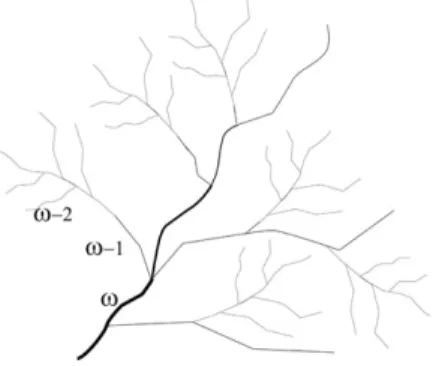
Fig. 1. River basin with streams up to orderω. Streams of order ω − n − 1 are tributaries of streams of order ω − n.
relations anticipate known scaling laws of river basins (Fig. 1). One of such laws tells us that the ratio of the average lengths of streams of consecutive hierarchical order is constant, i.e.
Ln
Ln−1
=RL (12)
where RL ∼2, while the same happens with the average number of streams of consecutive hierarchical order, i.e.
Nn−1
Nn
=RN (13)
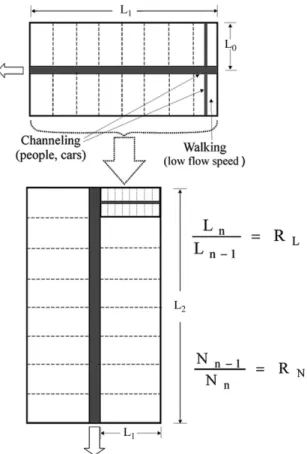
which is also a constant, RN ∼ 4 (seeFig. 2). Reis [14] showed that despite the relationships(12)and(13)have
been derived from constructs of regular geometry as those ofFig. 2, they hold for any hierarchical stream network irrespective to its particular geometry. Moreover, relationships(12)and(13)imply that they are self-similar in range of validity (see alsoFig. 2).
Because these scaling laws emerge from the optimization process carried out under the Eq.(11)that hold for both Hagen–Poiseuille flow and street flow (cars, people) it follows that Eqs. (12)and(13)must also hold for the city street networks. Therefore, if LM represents the scale of the largest stream in the city, from Eq.(12)one obtains the
following scaling law:
Ln =LM/RnL. (14)
Analogously, from Eq.(13)one obtains:
Nn=NMRnN. (15)
Taking into account Eq.(14), by denoting N(Ln) = Nnand N(LM) = NM and applying Eq.(1)(see also Eq.(3))
one has N(Ln) = N(LMR−nL ) = R mn L N(LM) (16) or, N(Ln) = (RmnL R −n N )N(LM)R n N. (17)
Then, by comparing with Eq.(15)one obtains the fractal dimension as
m = log RN log RL
∼2 (18)
which indicates that the fractal dimension must approach 2 for a city that developed its street network under the purpose of optimizing flows of people and goods. Of course many other factors do influence city development. However, if the purpose of making city flows easier and easier is the leading one, then we do expect that the fractal dimension gets closer to two.
Fig. 2. Hierarchy of streams in a city network. People living in the area of the smallest construct (top) walk “diffusively” before reaching the first channel where the flow becomes “organized”. Then, flows proceed to a larger channel (street) that is tributary of the next order channel (bottom). Known scaling laws (constant ratio between consecutive channel lengths and consecutive numbers of channels) emerge from flow access optimization.
Batty and Longley [4] have determined the fractal dimension of cities by using maps from different years. They found values typically between 1.4 and 1.9. London’s fractal dimension in 1962 was 1.77, Berlin’s in 1945 was 1.69, and Pittsburgh’s in 1990 was 1.78. Dimensions closer to two stand for denser cities.
Shen [7], carried out a study on the fractal dimension of the major 20 US cities and found that the fractal dimension, m, varied in between 1.3 for Omaha (population – 0.86 million) and 1.7 for New York City (population – 16.4 million). In the same study it is also shown that in the period 1792–1992 the fractal dimension of Baltimore has increased from 0.7 to 1.7, which indicates that the city network has been optimized in time.
Chen and Zhou [15] found that the fractal dimension of some German cities range from 1.5 (Frankfurt) to 1.8 (Stuttgart).
A systematic study on cities’ fractal dimension would be needed to fully confirm that cities street networks develop as predicted by the Constructal Law. However, the few results available all point to two as the limit of the fractal dimension of a city that would ideally develop in time with the purpose of better and better internal flow access. 5. Conclusions
Although few examples have been considered, we believe that city networks evolve in time as the result of the continuous search for better flow configuration, therefore being a manifestation of the Constructal Law.
Analogy has been established between the scaling laws of river basins and city street networks. It was shown that city flows are governed by a law that is similar to that of channel flow. This fact provided the basis for applying the constructal relations derived for river basins to city street configuration. It was found that self-similarity appears at the various scales while the fractal dimension must be two, ideally.
The results seem to corroborate that well developed cities tend to approach fractal dimension 2 as anticipated by the Constructal Law. More, as cities develop in time and become more and more complex the fractal dimension tends to increase.
These results add to many others that confirm that wherever something flows, flow architectures emerge, which can be understood in the light of Constructal Law. Transportation networks where goods and people flow have been developed for the purpose of maximum access or best performance in economics and for facilitating all human activities. Similarly, internal flow structures where energy, matter and information flow are at the heart of engineered systems. Everything that flowed and lived to this day to “survive” is in an optimal balance with the flows that surround it and sustain it. This balancing act – the optimal distribution of imperfection – generates the very design of the process, power plant, city, geography and economics.
References
[1] L. Krier, Architecture: Choice or Fate, Andreas Papadakis, Windsor, Berkshire, England, 1998.
[2] C. Alexander, S. Ishikawa, M. Silverstein, M. Jacobson, I. Fiksdahl-King, S. Angel, A Pattern Language, Oxford University Press, New York, 1977.
[3] N.A. Salingaros, The laws of architecture from a physicist’s perspective, Phys. Essays 8 (1995) 638–643. [4] M. Batty, P.A. Longley, Fractal Cities: A Geometry of Form and Function, Academic Press, 1994.
[5] M. Batty, Y. Xie, Preliminary evidence for a theory of the fractal city, Environ. Plann. A 28 (10) (1996) 1745–1762. [6] N.A. Salingaros, B.J. West, A universal rule for the distribution of sizes, Environ. Plann. B 26 (1999) 909–923. [7] G. Shen, Fractal dimension and fractal growth of urbanized areas, Int. J. Geogr. Inf. Sci. 16 (5) (2002) 419–437.
[8] R. Carvalho, A. Penn, Scaling and universality in the micro-structure of urban space, Phys. A, Stat. Mech. Appl. 332 (2004) 539–547. [9] N.J. Moura, M.B. Ribeiro, Zipf law for Brazilian cities, Phys. A, Stat. Mech. Appl. 367 (2006) 441–448.
[10] A. Bejan, Adv. Eng. Thermod., 2nd ed., Wiley, New York, 1997 (Chapter 13).
[11] A.H. Reis, Natural flow patterns and structured people dynamics — a Constructal view, in: A. Bejan, G. Merkx (Eds.), Constructal Theory of Social Dynamics, Springer, New York, 2007.
[12] N.A. Salingaros, Principles of Urban Structure, Techne Press, Amsterdam, Holland, 2005.
[13] A. Bejan, Shape and Structure, From Engineering to Nature, Cambridge University Press, Cambridge, UK, 2000. [14] A.H. Reis, Constructal view of scaling laws of river basins, Geomorphology 78 (2006) 201–206.
[15] Y.G. Chen, Y. Zhou, Reinterpreting central place networks using ideas from fractals and self-organized criticality, Environ. Plann. B — Planning & Design 33 (3) (2006) 345–364.