Universidade de Lisboa
Faculdade de Letras
Departamento de Estudos Anglísticos
Shell nouns
in a Systemic Functional Linguistics perspective
Ann Cecelia Henshall
Doutoramento no ramo de conhecimento de Linguística
Especialidade de Análise do Discurso
Universidade de Lisboa
Faculdade de Letras
Departamento de Estudos Anglísticos
Shell nouns
in a Systemic Functional Linguistics perspective
Ann Cecelia Henshall
Tese orientada pelas Profªs Doutoras Emília Pedro e Merja de
Mattos-Parreira especialmente elaborada para a obtenção do grau de doutor
em Linguística, especialidade de Análise do Discurso
iii
Resumo
“Shell nouns” numa perspectiva da gramática sistémica funcional
Esta tese visa desenvolver uma explicação de “shell nouns” (Schmid, 2000) com base na teoria da gramática sistémica funcional (Halliday & Matthiessen, 1999; 2004; Martin, 1992, Martin & White, 2005). Considera-se a teoria apropriada para o estudo de “shell nouns” dado que a língua é vista como um sistema semiótico e estratificado, construindo simultaneamente o significado em três metafunções (a ideacional, a interpessoal e a textual) e em estratos diferentes (e.g. o da léxico-gramática e do discurso semântico), e sendo um texto uma instância do sistema linguístico. A teoria fornece as ferramentas adequadas para analisar “shell nouns” uma vez que já se demonstrou que estes últimos podem exercer funções avaliativas (e.g. Schmid, 2000; Charles, 2003; 2007), funções textuais que promovem a coesão do texto (e.g. Schmid, 2000; Francis, 1994; Tadros, 1994), e funções cognitivas (Schmid, 2000). Define-se o “shell noun” pela capacidade do nome de entrar em um ou dois padrões léxico-gramaticais: construir Valor numa oração cujo Processo é realizado pelo verbo ‘ser’ e cuja Característica é realizada por uma oração de facto; e/ou construir Cabeça num grupo nominal, projectando uma oração como Qualificador. Quando um desses nomes encapsula informação complexa realizada por uma oração ou mais, considera-se que está a funcionar como um “shell noun”. As proposições encapsuladas no “shell noun” denominam-se lexicalização.
Opta-se por uma abordagem de corpus paralelo. O corpus é composto por cinco artigos científicos que estão prontos a submeter a publicação, escritos em inglês por professores portugueses na área de economia, e cinco artigos científicos escritos em inglês e já publicados sobre matérias comparáveis. A análise pretende responder a duas perguntas gerais:
1. Qual a contribuição do “shell nouns” para o significado ideacional, interpessoal e textual?
2. Qual a diferença no uso dos “shell nouns” nos artigos científicos publicados e nos manuscritos de submissão escritos por professores portugueses na área de economia?
iv
As duas perguntas permitem uma análise qualitativa e quantitativa, sendo feita a análise no estrato da léxicogramática e no estrato da semântica do discurso. Utilizando a versão 2.7.4 do Corpus Tool (O’Donnell, 2008), o corpus é anotado de acordo com sistemas linguísticos das metafunções nos dois estratos.
A conclusão principal do estudo é que os “shell nouns” são um recurso sistémico importante para um académico, que precisa de construir um argumento, posicionando-se e apresentando o estudo para convencer a comunidade do discurso de que o artigo faz um contributo ao conhecimento científico na sua área. Uma das maneiras em que os “shell nouns” contribuem a esse propósito é através da construção da posição dialógica do autor. São maioritariamente os “shell nouns” mentais, linguísticos e factuais que contribuem para esse efeito. Enquanto os “shell nouns” mentais e linguísticos, que muitas vezes são nominalizações de Processos mentais e de fala, normalmente expandem o espaço dialógico, os “shell nouns” factuais podem enquadrar uma proposição, fechando o espaço dialógico, muitas vezes construindo Valor numa oração de Processo relacional cuja Característica é realizada por uma oração de facto. Mais, a junção entre as seleções dos sistemas interpessoais e textuais permite que a informação da lexicalização seja avaliada de uma forma positiva ou negativa, assim aliando o leitor com uma visão em particular, e afastando o de outras. O elemento avaliativo pode ser isolado ou incorporado no “shell noun”. Enquanto outros estudos já notaram essas funções interpessoais (e.g. Francis, 1994; Charles, 2003; 2007; Kanté, 2010), a abordagem da gramática sistémico funcional explica como é construído o significado.
Uma segunda função dos “shell nouns” é textual. Funcionam para resumir informação realizada por uma oração ou mais e que se encontra noutro sítio do texto, podendo esta ser antes ou depois do “shell noun”. O acto de resumir é que permite o desenvolvimento do texto e contribui para a coesão do texto. O uso anafórico e catafórico torna-os um recurso importante na estrutura do texto, aparecendo nos macro-Temas, nos híper-Temas, nos híper-Novos, e na conjunção interna e externa no estrato da semântica do discurso. Nos híper-Temas e nos híper-Novos, é frequente que se junte com significado interpessoal. Num Adjunto de conjunção, um “shell noun” que
v
funciona como uma anáfora resumativa pode acrescentar significado interpessoal ou significado ideacional.
No estrato léxicogramatical, um “shell noun” com a função de anáfora resumativa tipicamente constrói Tema, sendo um ponto de partida partilhada da oração. Quando um “shell noun” com a função de anáfora resumativa constrói Caraterística numa oração relacional descodificadora cujo Processo é realizado por um verbo tal como ‘reveal’, ‘confirm’ ou ‘suggest’, funciona para construir explicitamente o argumento do escritor. É muito frequente encontrar nesse uso “shell nouns” que constroem o campo de investigação, tais como ‘resultados’.
Outra conclusão do estudo é que, ao contrário do que muitas vezes se assume, alguns “shell nouns” constroem um campo específico. É o caso dos “shell nouns” que pertencem ao campo de investigação: e.g. resultado, conclusão, análise. Mais ainda, embora a maioria dos “shell nouns” não construa um campo específico, as lexicalizações funcionam para tal. O “shell noun” pode projectar uma oração, criando entidades semióticas específicos a um campo, e instanciadas no discurso. Por exemplo, a junção de selecções do sistema de JULGAMENTO e uma figura do campo específico que constrói Qualificador ao “shell noun” permite que o investigador construa entidades que formam a base da investigação empírica porque podem ser testadas, quantificadas ou manipuladas. Assim, torna-se possível definir um valor para “a probabilidade de que w seja juntado a um parceiro pelo menos tão bom como v” ou medir “a capacidade de uma família de gerir as suas despesas gerais”1.
Sendo um elemento do grupo nominal, o “shell noun” consegue entrar em estratos e funções diferentes da léxicogramática. Embora nesse estudo se verifique que constroem mais frequentemente Participantes nos Processos relacionais, também se verifica que constroem Meta e Circumstância com frequência. Sendo um elemento funcional da oração, podem beneficiar dos sistemas de estrutura Temática e de estrutura Informacional.
1
“A probabilidade de que w seja juntado a um parceiro pelo menos tão bom com v” e “a capacidade de uma família de gerir as suas despesas gerais” são exemplos tirados do estudo.
vi
A capacidade do “shell noun” de funcionar nas maneiras descritas deriva do seu estatuto de abstracção semiótica, que tem a capacidade de se referir ao texto como um facto. Essa capacidade, por seu turno, tem origem no seu estatuto de metáfora gramatical, sendo um “shell noun” uma nominalização de um Processo ou Qualidade de projecção, uma nominalização de modalidade, um nome de expansão, um nome de facto ou uma nominalização de um verbo de conação. Quer isto dizer, os “shell nouns” juntam se como uma classe através do processo semogénico da nominalização, onde a metáfora gramatical neutraliza algumas das distinções na gramática entre as relações logico-semânticas de projecção e de expansão (Halliday & Matthiessen, 1999; 2004), mas também entre a modalidade e a projecção e entre a modalidade e a expansão. Pode-se representar os três sistemas – projecção, expansão e modalidade - por três círculos que se intersectam, as zonas do cruzamento sendo a zona da metáfora gramatical, e a zona central resultada do cruzamento dos três sistemas, o processo de nominalização, que cria um “shell noun”.
A tese visa também estabelecer se existem diferenças no uso dos “shell nouns” entre o corpus dos artigos científicos publicados e as submissões dos académicos portugueses. Embora se-verifique uma maior frequência de “shell nouns” no corpus das submissões, os escritores dos dois corpus tiveram recurso a todas as funções dos “shell nouns”. Não obstante, destaca-se uma diferença: a posição dialógica construída pelos “shell nouns”. Os autores portugueses utilizam os “shell nouns” na maior parte das vezes para expandir o espaço dialógico, apresentando as suas afirmações e a sua voz como uma voz entre muitas outras. Em contraste, os autores publicados utilizam os “shell nouns” na maior parte para reduzir o espaço dialógico, reconhecendo outras vozes quando atribuem os argumentos aos outros investigadores. Outra diferença é que o corpus publicado revela mais avaliação negativa do que o corpus das submissões. Juntando estes resultados, pode afirmar-se que a reacção do leitor possa ser influenciada pelas escolhas, os textos publicados podendo parecer ter mais autoridade, e os das submissões podendo parecer menos assertivos e mais experimentais.
PALAVRAS-CHAVE: gramática sistémica funcional; “shell nouns”; discurso académico; Inglês como língua adicional; metáfora gramatical
vii
Summary
Shell nouns in a Systemic Functional Linguistics perspective.
The aim of this thesis is to develop an account of shell nouns (Schmid, 2000) in a Systemic Functional Linguistics (SFL) perspective. Using a parallel corpus comprising five article submissions by Portuguese academics in the field of economics and five published articles on comparable topics, the ideational, interpersonal and textual functions of shell nouns are tagged at the strata of the lexicogrammar and discourse semantics using Corpus Tool version 2.7.4 (O’Donnell, 2008). The systems networks used to tag the corpus are grounded in SFL theory.
The analysis shows that shell nouns constitute an important systemic resource for the writers of research articles, who need to build an argument, positioning themselves and their study to convince the discourse community that their paper makes a contribution to knowledge in their disciplinary field. They enable a text to unfold by compacting information realised as a clause or more elsewhere in the text. Thus they can help scaffold a text through hyper-Themes, hyper-News and internal conjunction. At the stratum of the lexicogrammar, anaphorically referring nominal groups with a shell noun as Head often compose Theme, where they constitute a shared point of departure for the clause. In a decoding relational clause whose Process is realised by a verb such as reveal, confirm, or suggest, an anaphorically referring shell noun that construes Token helps to explicitly build the writer’s argument. Shell nouns that construe the field of research, such as results and findings are common in this function. Mental, linguistic and factual shell nouns contribute to construing dialogic position, and coupling between interpersonal systems and textual systems enables the writer to align the reader with certain positions and disalign with others. Although most shell nouns are not field specific, because they can project a figure that instantiates an entity, they contribute to construing field, for example instantiating entities as the object of study of the empirical research.
The capacity of shell nouns to function as described above derives from their status as semiotic abstractions, which can refer to text as fact or report and are grammatical metaphors. They can be seen as lying at the intersection of modality and
viii
the logico-semantic relations of projection and expansion, brought into being by the semogenic process of nominalisation.
The writers of the published articles and article submissions are found to use shell nouns in all of the functions above, but there are differences in the relative shares of the functions, which may affect reader reactions to the text.
KEYWORDS: Systemic Functional Linguistics; shell nouns; academic discourse; English as an additional language; grammatical metaphor
ix
Table of contents
1. Introduction ... 1
1.1. A preview of shell nouns ... 1
1.2. Motivation for and context of the study ... 2
1.2.1. The local context ... 3
1.2.2 Writing research articles in English for publication ... 4
1.3. The study ... 5
1.3.1. Data for the study and research questions ... 6
1.3.2. Significance of the study ... 7
1.3.3. Organisation of the thesis ... 7
2. A broad framework for the study... 9
2.1. A Systemic Functional Linguistics framework ... 9
2.1.1. A very brief overview of Systemic Functional Linguistics... 9
2.2. The stratum of the lexicogrammar ... 10
2.3. The stratum of discourse semantics ... 12
2.3.1. Ideation at the discourse semantics stratum ... 12
2.3.2. Interpersonal meaning at the discourse semantics stratum ... 13
2.3.3. Textual meaning at the discourse semantics stratum ... 18
2.4. Instantiation ... 20
2.5. Individuation and affiliation ... 21
2.6. The research article as genre ... 23
2.7. Register and scientific discourse ... 26
2.8. Grammatical metaphor ... 27
2.9. Summary of chapter 2 ... 35
3. Shell nouns ... 37
3.1. A brief definition of shell nouns ... 37
3.1.1. The functions of shell nouns ... 38
3.1.2. Lexicogrammatical patterns of shell nouns ... 40
3.1.3 Semantic classification of shell nouns ... 41
3.1.4. Pragmatic uses of shell nouns ... 43
3.2 Other research on shell nouns ... 45
3.2.1 Early approaches to shell nouns... 45
3.2.2. More recent studies on shell nouns ... 52
x
3.3. A Systemic Functional Linguistic Perspective ... 65
3.3.1. Shell nouns as a class ... 65
3.4. Shell nouns in the lexicogrammar ... 74
3.4.1. Shell nouns, projection and expansion ... 75
3.4.2. Shell nouns as Value in intensive indentifying relational Process clauses ... 80
3.4.3. Shell nouns and reference ... 83
3.4.4. Shell nouns and text reference ... 87
3.4.5. Summary of shell nouns at the stratum of the lexicogrammar ... 88
3.5. Shell nouns in the discourse semantics stratum ... 89
3.5.1. Shell nouns and textual patterning ... 89
3.5.2. Shell nouns and interpersonal meaning ... 96
3.5.3. Shell nouns and ideational meaning ... 100
3.5.4. Summary of shell nouns at the discourse semantics stratum ... 101
4. Methodology ... 103
4.1 Research questions ... 103
4.2. Selection of the corpus... 104
4.3. Corpus Tool ... 109
4.4. Identifying and tagging the shell nouns ... 109
4.5. Tagging the lexicogrammatical stratum ... 111
4.5.1. Tagging ideation at the lexicogrammatical stratum ... 111
4.5.2. Tagging the interpersonal metafunction in the lexicogrammar ... 123
4.5.3. Tagging the textual metafunction in the lexicogrammar ... 125
4.6. Tagging the corpus at the discourse semantics stratum... 130
4.5.1. Basic systems ... 131
4.5.2. Tagging the ideational function in discourse semantics ... 132
4.5.3. Tagging the textual function in discourse semantics ... 134
4.6.4. Tagging the interpersonal function in discourse semantics ... 139
4.7. Summary of Chapter 4 ... 144
5. Results and discussion for shell nouns at the stratum of the lexicogrammar ... 145
5.1. A brief global comparison ... 145
5.2. Shell nouns at the stratum of the lexicogrammar ... 147
5.2.1. Basic functions of shell nouns at the stratum of the lexicogrammar ... 147
5.3. Participants realised by shell nouns ... 149
xi
5.3.2. Shell nouns as Participants in verbal Process clauses ... 154
5.3.3. Shell nouns as Participants in mental Process clauses ... 156
5.3.4. Shell nouns as Participant in existential Process clauses ... 159
5.3.5. Shell nouns as Participant in relational Process clauses ... 161
5.3.6. Shell nouns as Medium ... 175
5.4. Modification to Participants realised with shell nouns ... 177
5.4.1. Modification realised by Post-Deictic ... 177
5.4.2. Modification by Numerative ... 178
5.4.3. Modification by Epithet ... 180
5.4.4. Modification by Classifier ... 181
5.4.5. Modification by Qualifier ... 182
5.5. Circumstances realised with shell nouns ... 187
5.6. Relators realised with shell nouns ... 193
5.7. Textual Themes with shell nouns ... 193
5.8. Summary and discussion ... 194
6. Results and discussion of shell nouns at the discourse semantics stratum ... 201
6.1. Shell nouns and textual meaning at the discourse semantics stratum ... 201
6.1.1. Reference ... 201
6.1.2. Macro-Themes, hyper-Themes and hyper-News ... 222
6.1.3. Internal conjunction ... 227
6.2. Shell nouns and experiential meaning at the discourse semantics stratum ... 230
6.2.1. Shell nouns as a resource for construing a specific field... 230
6.2.2 Non-field-specific shell nouns ... 232
6.3. Shell nouns and interpersonal meaning at the discourse semantics stratum ... 247
6.3.1 Shell nouns and dialogic positioning ... 247
6.3.2. Shell nouns as a resource for grading propositions ... 262
6.3.3. Shell nouns as a resource for Attitude ... 265
6.3.4. Modification of shell nouns by means of GRADUATION ... 281
6.4 . Summary of results and discussion ... 285
6.4.1. The contribution of shell nouns to textual meaning ... 285
6.4.2. The contribution of shell nouns to ideational meaning ... 289
6.4.3. The contribution of shell nouns to interpersonal meaning ... 291
6.4.4. Coupling among textual, ideational and interpersonal metafunctions ... 297
xii
7. Conclusions ... 303
Bibliography ... 309
Appendices ...323
xiii
List of figures
Figure 2.1 Ideational, interpersonal and textual metafuntions (Martin &
White, 2005: 8) ……….……… 9
Figure 2.2 Modelling of language in context adapted from Martin & White
(2005) in Hood (2010: 23) ………. 10
Figure 2.3 The system of Attitude (adapted from Martin & White, 2005) .. 14 Figure 2.4 Cline of interpersonal grammar and appraisal (adapted from
Martin & White, 2005:55) ……… 15
Figure 2.5 The system network of Graduation (Martin & White, 2005,
extended by Hood, 2010) ……… 16
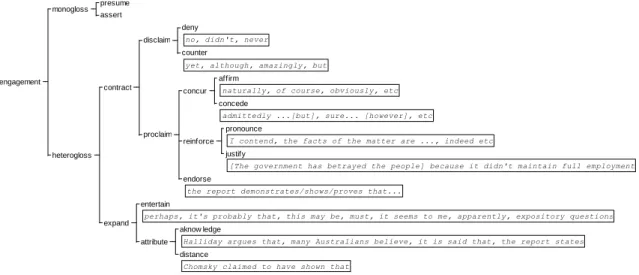
Figure 2.6 The system network of Engagement (Martin & White, 2005,
adapted) ………. 17
Figure 2.7 Sandwich texture in abstract written discourse (Martin
1992:456) ……….. 19
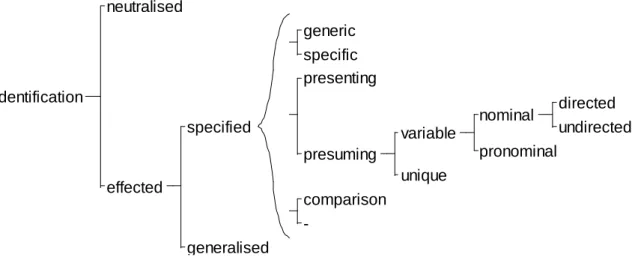
Figure 2.8 The system network of Identification – primary delicacy
(Martin, 1992: 120) ……… 20
Figure 2.9 Cline of instantiation (Martin & White, 2005: 25) ……… 20 Figure 2.10 Individuation and affiliation (Martin, 2010: 24) ……… 22 Figure 2.11 The three semohistories related (Halliday & Matthiessen, 1999:
18) ………. 26
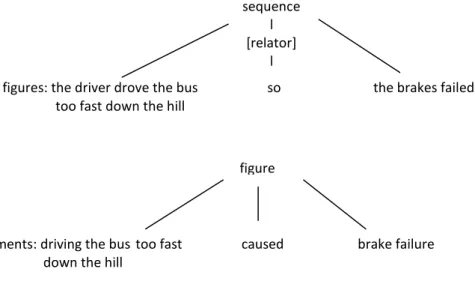
Figure 2.12 Grammatical metaphor: sequence reconstrued as figure
(adapted from Halliday, 1998: 190,191 ) ……… 27 Figure 2.13 Grammatical metaphor: figure reconstrued as element
(adapted from Halliday, 1998: 191) ……… 27
Figure 2.14 Evolution of grammatical pattern in scientific English (Halliday,
1988/1993: 66) ……….. 29
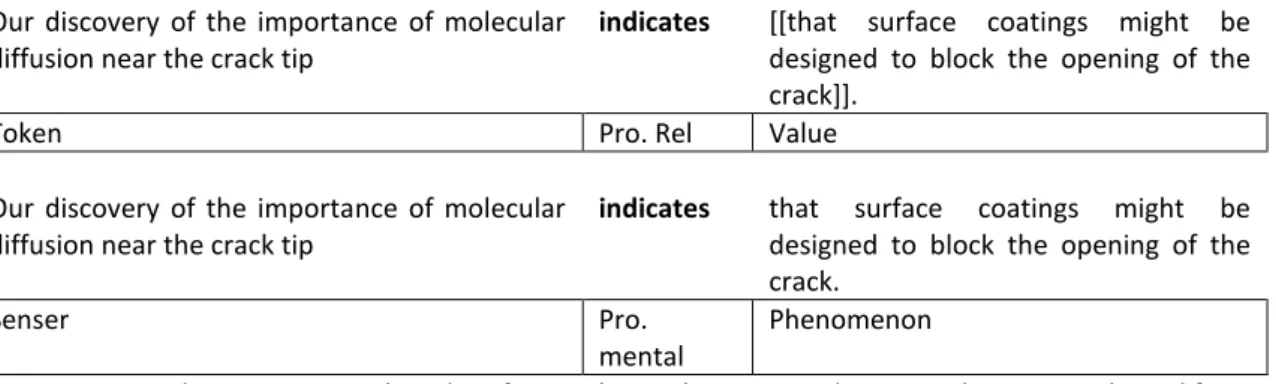
Figure 2.15. Indicate interpreted as identifying Relational Process and as
Mental Process (adapted from Halliday, 1988/1993: 65) ………… 31 Figure 2.16 The tension between literal and figurative readings of Gould’s
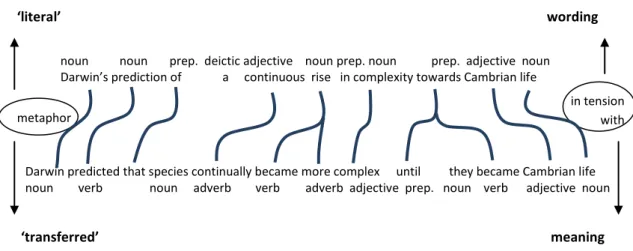
nominalisation of Darwin’s theory (Halliday, 1993b: 31) ………… 33 Figure 2.17 The tension between literal and figurative readings of Gould’s
nominalisation of Darwin’s prediction ……… 34 Figure 3.1 The converging balance of shell nouns (Schmid, 2000: 19) …….. 37 Figure 3.2 A general system for nouns (Halliday & Matthiessen, 1999: 190)
………. 66
Figure 3.3 Organising vocabulary (Ravelli, 2004: 117) ……….. 68 Figure 3.4 Congruent and metaphorical wordings of N-be-cl (Halliday &
xiv
Figure 3.5 Congruent and metaphorical wordings of N-cl ………... 71 Figure 3.6 Shell noun as Value / Identified in an encoding identifying
clause ………... 81
Figure 3.7 Shell noun as Token / Identified in a decoding identifying clause
………... 83
Figure 3.8 The system of DETERMINATION (Halliday & Mathiessen,
2004 :313)... 85 Figure 3.9 Dual facing of semiotic abstraction/shell noun in hyper-Theme
(adapted from Ravelli, 2004: 120) ……….... 90 Figure 3.10 Reconstrual of clause as Qualifier to shell noun ……… 92 Figure 3.11 Shell nouns and internal conjunction (adapted from Martin,
1992: 416-417) ………. 93
Figure 4.1 Primary systems for analysis at the stratum of the
lexico-grammar ………... 111
Figure 4.2 Basic systems for the analysis of the ideational metafunction at
the lexico-grammar stratum ……….. 112
Figure 4.3 Shell noun in Qualifier realised as prepositional phrase (P_CEO) 113 Figure 4.4 System network for experiential function at group level ………... 114 Figure 4.5 Primary systems for tagging experiential elements of the clause. 114 Figure 4.6 System network for PARTICIPANT ……….. 115 Figure 4.7 System network for CIRCUMSTANCE ……… 115 Figure 4.8 Transitivity analysis showing tagging of elements in an
embedded clause containing a shell noun (P_Econ) ………... 116 Figure 4.9 Transitivity analysis showing tagging of elements in a hypotactic
bound clause containing a shell noun (P_Econ) ……... 116 Figure 4.10 Transitivity analysis showing tagging of elements in a Qualifier
containing a shell noun (S_Rand) ………... 116 Figure 4.11 Transitivity analysis showing tagging of elements in a
conjunction (P_Pov) ……….... 117
Figure 4.12 Transitivity analysis showing tagging of elements in a
conjunctive Adjunct (P_Rand) ……….... 117 Figure 4.13 Identifying Intensive clause with agency ………... 120 Figure 4.14 Verbs realising intensive identifying relational processes graded
by degree of commitment to proof ………... 120 Figure 4.15 System network for tagging PROCESS ……….... 122 Figure 4.16 Transitivity analysis showing unmarked identifying intensive
xv
Figure 4.17 Transitivity analysis showing marked identifying intensive
Process relational clause (P_Net) ... 123 Figure 4.18 System for tagging the interpersonal metafunction in the
lexico-grammar ………... 123
Figure 4.19 Interpersonal analysis showing shell noun as Subject (P_Pov) ….. 124 Figure 4.20 Interpersonal analysis showing shell noun as Complement
(P_CEO) ……….... 124
Figure 4.21 Interpersonal analysis showing shell noun as Adjunct (P_CEO) ... 124 Figure 4.22 Basic systems for the analysis of the textual metafunction at the
stratum of the lexicogrammar. ………... 125 Figure 4.23 Textual analysis showing elements tagged unmarked Theme ….. 126 Figure 4.24 Textual analysis showing elements tagged marked Theme ……... 126 Figure 4.25 Textual analysis showing tagging of shell noun in Theme and in
Qualifier (S_Rand) ……….... 126
Figure 4.26 System network for THEME SELECTION ………... 127 Figure 4.27 Textual analysis showing clausal Theme (S_Rand) ……….... 127 Figure 4.28 Textual analysis showing Shell noun in Conjunction in clausal
Theme in clause nexus (S_Pov) ……… 127
Figure 4.29 Textual analysis showing Non-finite clausal Theme in clause
nexus (S_Pov) ………... 128 Figure 4.30 System network for tagging N-RHEME ……….. 128 Figure 4.31 Textual analysis showing elements tagged N- RHEME in clause
simplex (S_Rand) ………... 129
Figure 4.32 Textual analysis showing elements tagged N- RHEME, clause
complex internal (S_Rand) ………... 129 Figure 4.33 Textual analysis showing elements tagged (other) ………... 129 Figure 4.34 System for tagging the clausal environment in which a shell
noun appears ………... 129
Figure 4.35 Analysis showing tagging of dominant clause in hypotactic
sub-complex nested in paratactic clause nexus (P_CEO) ……….... 130 Figure 4.36 Primary systems for tagging at the discourse semantics stratum. 131 Figure 4.37 Systems network for tagging the lexicalisation of a shell noun ... 131 Figure 4.38 Tagging the elements in the system SEGMENT ... 132 Figure 4.39 Systems network for tagging ideational function in discourse
semantics ... 133 Figure 4.40 Analysis showing tagging of elements construing external
xvi
Figure 4.41 Analysis showing tagging of elements in SEGMENT and IDEATION .... 134 Figure 4.42 Analysis showing tagging of elements at and below clause rank
in IDEATION ... 134 Figure 4.43 Primary systems network for the textual function ... 134 Figure 4.44 Systems network for macro-Themes and hyper-Themes/News 135 Figure 4.45 Analysis showing tagging of macro-Theme ... 135 Figure 4.46 Analysis showing tagging of hyper-Theme ... 135 Figure 4.47 Analysis showing tagging of hyper-New ... 135 Figure 4.48 Analysis showing tagging of shell noun in INTERNAL CONJUNCTION .. 135 Figure 4.49 Systems network for analysis of IDENTIFICATION ………. 136 Figure 4.50 Systems network for tagging the relation of the shell noun to its
lexcialisation ... 137 Figure 4.51 Analysis showing tagging of element containing shell noun in
IDENTIFICATION ... 138 Figure 4.52 Analysis showing tagging of element containing esphorically
referring shell noun in IDENTIFICATION ... 139 Figure 4.53 Primary systems network for the interpersonal function in
discourse semantics ... 139 Figure 4.54 Analysis showing tagging of element with shell noun in
ENGAGEMENT ... 141 Figure 4.55 Analysis showing tagging of shell noun as APPRECIATION ... 142 Figure 4.56 Analysis showing tagging of shell noun as AFFECT ... 142 Figure 4.57 Analysis showing tagging of element with shell noun as invoked
ATTITUDE ... 142 Figure 4.58 Analysis showing tagging of element with shell noun as
downscaled actualisation ... 143 Figure 4.59 Analysis showing tagging of element with shell noun as
downscaled completion ... 143 Figure 4.60 Analysis showing tagging of element within nominal group with
shell noun as Head as GRADUATION: FOCUS ... 143 Figure 4.61 Analysis showing tagging of element within nominal group with
shell noun as Head as GRADUATION ... 143 Figure 7.1 The class of shell nouns in a Systemic Functional Linguistics
xvii
List of tables
Table 2.1 General options for external and internal conjunction (Martin and
Rose, 2003) ……….. 13
Table 2.2 Cline of instantiation – evaluation (Martin & White, 2005: 164)…….. 21
Table 2.3 Stages of the research article (Martin and Rose, 2008:207) ………. 24
Table 2.4 Generic structure of the research article introduction ………..……… 24
Table 2.5 Domains of elemental metaphors (Halliday & Matthiessen, 1999: 245). ……….. 28
Table 3.1 Shell noun patterns (Schmid, 2000) ... 41
Table 3.2 Semantic relations between classes of shell nouns (adapted from Schmid, 2000:300, examples added) ... 42
Table 3.3 Semantic features functioning as classifiers (Schmid, 2000:88, examples added) ... 44
Table 3.4 Alternative names for shell nouns ... 51
Table 3.5 Grammatical metaphor: nominalisation (adapted from Halliday & Matthiessen, 1999: 245) ... 69
Table 3.6 Kinds of entities (Martin & Rose, 2003:108) ... 73
Table 3.7 Nouns of projection and nouns of fact (adapted from Halliday and Matthiessen, 2004: 469) ... 78
Table 3.8 Evaluation nouns appearing in it is Attribute: noun that (adapted from Halliday & Matthiessen (2004: 475), added nouns in italics) ... 79
Table 3.9 Nouns of expansion (Halliday & Matthiessen, 2004:435) ... 80
Table 3.10 Other nouns of expansion that function as shell nouns ... 80
Table 4.1 Parameters for defining a corpus as specialised (Flowerdew, 2004: 21) ... 105
Table 4.2 Parameters of the corpus for the study of shell nouns ... 106
Table 4.3 Summary of characteristics of the two sub-corpora ... 108
Table 4.4 Shell noun patterns (Schmid, 2000) ... 109
Table 4.5 Verbs serving as intensive identifying relational Processes, adapted from Halliday and Matthiessen (2004) and Martin (1992) ... 118
Table 4.6 Cline of caused modality in relational Processes and fact nouns of the ‘evidence’ type ... 121
Table 4.7 Elements tagged NO INTERPERSONAL FUNCTION ... 124
Table 5.1 Frequency of shell nouns in Published and Submissions ... 146
xviii
Table 5.3 Ideational, interpersonal and textual functions of shell nouns at clause rank ... 148 Table 5.4 Distribution of Process types in clauses in which shell noun
construes a Participant ... 150 Table 5.5 Distribution of shell noun types construing Actor in Published and
Submissions ... 152 Table 5.6 Distribution of shell noun types construing Goal in Published and
Submissions ... 153 Table 5.7 Distribution of shell noun types construing Scope in Published and
Submissions ... 154 Table 5.8 Distribution of shell noun types construing Verbiage in Published
and Submissions ... 156 Table 5.9 Distribution of shell noun types construing Phenomenon in
Published and Submissions ... 159 Table 5.10 Distribution of shell noun types construing Existent in Published and
Submissions ... 160 Table 5.11 Distribution of shell noun types construing Token in Published and
Submissions ... 164 Table 5.12 Distribution of shell noun types construing Value in Published and
Submissions ... 170 Table 5.13 Distribution of shell noun types construing Carrier in Published and
Submissions ... 172 Table 5.14 Distribution of shell noun types construing Attribute in Published
and Submissions ... 174 Table 5.15 Distribution of shell noun types construing Medium in Published
and Submissions ... 176 Table 5.16 Distribution of shell noun types among Participants realised with
Post-Deictic in Published and Submissions ... 178 Table 5.17 Distribution of shell noun types among Participants realised with
Numerative in Published and Submissions ... 179 Table 5.18 Distribution of shell noun types among Participants realised with
Epithet in Published and Submissions ... 180 Table 5.19 Distribution of shell noun types among Participants realised with
Classifier in Published and Submissions ... 182 Table 5.20 Distribution of realisation types of projected Qualifiers for shell
nouns construing Participants ... 183 Table 5.21 Modification in cataphorically referring or lexicalised shell nouns in
Circumstances composing marked Theme ... 189 Table 5.22 Modification to shell nouns in Circumstances composing N-Rheme .. 190
xix
Table 5.23 Shell noun types in Circumstantial element at clause rank ... 192 Table 5.24 Textual Themes realised by conjunctive Adjuncts containing shell
nouns ……… 194
Table 6.1 Distribution of direction of LEXICALISATION of shell nouns in Published and Submissions ... 203 Table 6.2 Anaphorically lexicalised shell nouns as Attribute ... 206 Table 6.3 Textual reference to a superset with anaphorically lexicalised shell
nouns in Published and Submissions ... 208 Table 6.4 Anaphorically referring shell noun by shell noun type in Published
and Submissions ... 211 Table 6.5 Cataphorically lexicalised shell nouns that couple with resources
from APPRAISAL: FORCE in Published and Submissions ... 216 Table 6.6 Cataphorically lexicalised shell nouns coupling with resources from
GRADUATION: FOCUS ... 217 Table 6.7 Cataphorically lexicalised shell nouns coupling with ATTITUDE ... 217 Table 6.8 Cataphorically lexicalised shell nouns infused with prosodic value in
Published and Submissions ... 218 Table 6.9 Cataphorically lexicalised shell nouns with reference to a superset ... 220 Table 6.10 Distribution of shell noun types in cataphorically lexicalised shell
nouns in major clauses in Published and Submissions ... 221 Table 6.11 Distribution of shell nouns in anaphoric and cataphoric functions in
major clauses across whole corpus ... 221 Table 6.12 Shell nouns in headings composing macro-Themes in Published and
Submissions ... 223 Table 6.13 Esphorically referring shell nouns in hyper-Themes in Published and
Submissions ... 225 Table 6.14 Cataphorically lexicalised shell nouns in hyper-Themes in Published
and Submissions ... 225 Table 6.15 Shell nouns as a resource for internal conjunction in Published and
Submissions ... 228 Table 6.16 Anaphorically referring shell nouns combined with internal
conjunction in Published and Submissions ... 230 Table 6.17 Distribution of shell noun types as contribution to field in whole
corpus ... 230 Table 6.18 Distribution of field construed through shell nouns in Published and
Submissions ... 231 Table 6.19 Shell nouns that construe field as the object of study in Published
xx
Table 6.20 Realisation type of lexicalisations that construe field as the object of study in Published and Submissions ... 239 Table 6.21 Lexicalisations that construe field as methodology by realisation
type in Published and Submissions ... 240 Table 6.22 Shell nouns whose lexicalisations construe field as methodology ... 240 Table 6.23 Shell nouns whose lexicalisation construes the field of research
projecting the field of the object of research in Published and Submissions ... 244 Table 6.24 Field-specific modification to shell nouns in Published and
Submissions ... 246 Table 6.25 Shell nouns that expand discourse by attribution in Published and
Submissions ... 250 Table 6.26 Shell nouns endorsing other writers’ propositions in dialogically
contracting discourse in Published and Submissions ... 251 Table 6.27 Esphorically referring shell nouns (lexicalisation realised as fact
clause) that function to contract ... 253 Table 6.28 Shell noun matrices in expanding discourse: entertain ... 257 Table 6.20 Shell nouns in headings dialogically expanding discourse in
Published and Submissions ... 260 Table 6.30 Distribution of shell nouns functioning to contract or expand the
discourse in whole corpus ... 260 Table 6.31 Distribution of dialogic position by means of shell nouns in
Published and Submissions ... 261 Table 6.32 Shell noun types enacting CONTRACT in Published and Submissions .... 262 Table 6.33 Shell noun types enacting EXPANDING discourse in Published and
Submissions ... 262 Table 6.34 Instances of shell nouns that grade FULFILMENT of a proposition in
Published and Submissions ... 264 Table 6.35 Distribution of shell nouns contributing to GRADUATION: FULFILMENT in
Published and Submissions ... 265 Table 6.36 Attitudinally inscribed shell nouns enacting APPRECIATION in Published
and Submissions ... 267 Table 6.37 Inscribed ATTITUDE in shell nouns realised by Epithets in Published
and Submissions ... 270 Table 6.38 Distribution of shell nouns to enact APPRECIATION, inscribed and
infused, in Published and Submissions ... 272 Table 6.39 Shell nouns enacting JUDGEMENT: SOCIAL ESTEEM: capacity in Published . 274 Table 6.40 Shell nouns enacting JUDGEMENT: SOCIAL ESTEEM: capacity in
xxi
Table 6.41 Shell nouns enacting JUDGEMENT: SOCIAL SANCTION: propriety in Published and Submissions ... 276 Table 6.42 Shell nouns enacting JUDGEMENT: SOCIAL SANCTION: veracity in
Published and Submissions ... 278 Table 6.43 Distribution of shell nouns enacting JUDGEMENT in Published and
Submissions ... 278 Table 6.44 Shell nouns as AFFECT in Published and Submissions ... 280 Table 6.45 Distribution of shell nouns in APPRECIATION and JUDGEMENT in whole
1
Chapter 1. Introduction 1.1. A preview of shell nouns
In the Andrew V. McLaglen western, Chisum, (1970), the following dialogue between the hero, Chisum, played by John Wayne, and the baddie, Murphy, played by Forrest Tucker, takes place at a point where Chisum is about to leave town for a few days, leaving his ranch and the store unprotected.
Chisum: And if one of your men cross my land or even touch one of my cows, or do anything to that store, I’m not going to the sheriff, the governor or the president of the United States. I’m coming to see you.
Murphy: Mr Chisum, that sounds like a threat. [Chisum punches Murphy and knocks him down]
Chisum: Wrong word. Fact.
In this dialogue both ‘threat’ and ‘fact’ can be seen as referring to Chisum’s first utterance that he would be going to see Murphy if any of his men encroached on Chisum’s land or the store. While Murphy interprets the utterance as a threat, Chisum refutes the interpretation and recharacterises it as a fact; there is no doubt about the outcome. A little later in the film, another dialogue – this time between the Sheriff and Murphy – also involves interpretation of an utterance, but unlike the first excerpt where the interpretation follows the utterance, the interpretation precedes it:
Murphy: You just leave him [Chisum] alone. I’ll take care of Mr Chisum. Sheriff Brady: That ain’t gonna be easy.
Murphy: You’re right. But see, there’s a fundamental difference between Mr Chisum and me.
Sheriff Brady: Yeah, what’s that?
Murphy: Mr Chisum is a man who respects the law. [Murphy chuckles.] Around here, I’m the man who owns it.
Here, Murphy explains how, or perhaps why, he will be able to deal with Chisum; differences in their characters determine how they will behave. The difference between Chisum and Murphy is that Chisum respects the law but Murphy does not need to because he owns it.
Nouns like ‘fact’, ‘threat’ and ‘difference’ are the subject of this thesis. Other examples of nouns that function in similar ways include ‘idea’, ‘evidence’ or ‘possibility’ to name but a few. These nouns have been called ‘shell nouns’ because
2
they encapsulate another proposition and function as a ‘conceptual shell’ (Schmid, 2000: 6). In the excerpts above ‘threat’ and ‘fact’ encapsulate the idea that Chisum will come and see Murphy if anything happens to the store or his cows, while ‘difference’ encapsulates the idea that Chisum respects the law but Murphy owns it. In each case, the specific meaning of the noun – fact, threat, difference – depends on recovering meaning from the co-text. This feature is one of the reasons why shell nouns are interesting. Unlike technical vocabulary, shell nouns depend on the context in which they appear in order to be understood. They contribute to the cohesion of the text and offer insight into the way the writer builds the discourse.
1.2. Motivation for and context of the study
The motivation for this study of shell nouns stems from the context in which I work. As in many other universities that are undergoing a process of internationalisation (Brock-Utne; Gazzola, 2010; Ferguson, Perez-Llantada, & Plo, 2011; Curry and Lillis 2004:680), academics at Lisbon School of Economics and Management (ISEG) are required to carry out research and publish their results. Publishing research articles in high-standing journals in the field of economics is tremendously competitive (Klamer and Hendrik, 2002; Labarde, Tollison & Karahn, 2002), and, as in other academic fields, it usually involves a time-consuming process of negotiating the content and language of the text with various literacy brokers (Lillis & Curry, 2010), including peer reviewers, the editor, and, in some cases, copy editors (McAfee, 2010; Berkenkotter & Huckin, 1995; van Bergeijk et al. 1997; Curry & Lillis, 2004; Barbin, 2008; Flowerdew, 2000; Lillis & Curry, 2006). Even then, there is no guarantee of being published (Barbin, 2008). In the field of economics it has been found that the probability of being published depends on the perceived relevance of the topic of the study (Klamer & Hendrik, 2002; Barbin, 2008; McAfee, 2010), the methodological rigour of the study (Barbin, 2008; Stewart, 2008), and writing or language-related concerns, (Klamer & Hendrik, 2002; van Bergeijk et al. 1997; Barbin, 2008; Svensson & Helgerson, 2008). These critical features are evident in the information for reviewers in the publication process for Elsevier, a major editor of scientific articles in economics (Henshall, 2012). An initial screening can reject submissions on the basis of incorrect references or basic science. Accepted manuscripts are then reviewed by peers, and if
3
approved, they pass to a reviewer for English grammar and language. After authorial revision, the manuscript is reviewed again by the peers and language reviewer, and it may still be rejected at this point. The full process is detailed in Annex A. In addition to the hurdles inherent in the publication process, it has been noted that the United States of America is dominant in setting standards for the field of economics (Coupé, 2003; Frey & Eichenberger, 1997; Diamond, 1989).
1.2.1. The local context
At ISEG publishing research articles is linked to the performance evaluation of academics. The number of publications, whether they are co-authored or not and the standing of the journal in which they are published are some of the performance evaluation criteria. There is a list of journals, FIISEG, which are ranked and weighted for their contribution to the performance evaluation. Moreover, a prize is awarded annually to the academic who publishes the greatest number of research articles in the highest ranking journals. The FIISEG list is not without its critics. In particular it has been criticized for a bias towards the field of economics, and for not being representative of all the areas of research undertaken by ISEG academics. In fact, there is currently a move to restructure the list, but it is only in its early stages.
The FIISEG list in operation during the course of this study was the object of analysis in Henshall (2012). I found that the overwhelming majority of the journals publish in English only. This bias towards English in scientific publication has been well documented in many other fields (Barbin, 2008; Diamond, 1989; Swales, 1990; Hamel, 2007), even to the extent that English has been called ‘Tyrannosaurus rex’ (Swales, 1997). In addition, many of the economic journals – often those based in the United States – operate on unstated assumptions about the English language variety to be used while other journals hold normative language policies, where they accept British English norms or American English norms, but not a mixture. In many journals there is advice for non-native speakers to have their research articles edited by a native speaker to enhance the probability of acceptance (Henshall, 2012). Such a service is usually paid for and represents an added expense for the Portuguese academic (Barros, 2014), which, in the current economic downturn, may not always be possible to secure. Dueñas (2012), for example, has documented that Spanish academics do not
4
have their papers edited for language prior to submitting them to publication for reasons of expense. Advice to revise the English of a manuscript before submission implies potential discrimination against non-standard English in research articles, which makes the task of the English-as an additional language (EAL) academic more difficult.
1.2.2 Writing research articles in English for publication
The plight of scholarly writers whose first language is not English as they struggle to get their research results published has been highlighted in a lively debate between Flowerdew (2008; 2009a) and Casanave (2008). Despite their different views, both acknowledge that there may be real and perceived discrimination against EAL scholars partly as a result of their non-standard use of English, and certainly the feeling that having to write in English represents an additional burden for the EAL scholar has been reported in case studies of academics in different fields and countries (e.g. Curry & Lillis, 2004; Flowerdew, 2000; Lillis & Curry, 2006; 2010; Pérez-Llantada, Plo & Ferguson, 2011) as well as in a recent survey in Spain (Moreno et. al., 2012). Further support for this view comes from bibliometric studies that identify the onus of writing in English as a barrier to publication for some EAL countries (Barbin, 2008; Svensson, & Helgerson, 2008). Barbin, for example, posits that it may explain the US advantage in publishing in top-ranking journals in the field of marketing. Notwithstanding, it has been noted that academic literacy is not merely a question of English language competence for EAL scholars; it must be acquired by native speakers and EAL speakers alike (Ferguson, Perez-Llantada & Plo, 2011). Moreover, editors may be supportive of EAL scholars’ manuscript submissions (Lillis & Curry, 2010; Flowerdew, 2001).
Southern Europeans – Spanish and Portuguese – writing in the social sciences have in particular come under attack for language related issues. They have been accused of “severe wordiness” (Barbin, 2008: 379), writing “arguments [that] are vague and confusing” (Dueñas, 2012:148) or showing a “lack of elegance” (Parada, 2009), writing in a style that is “a little bit over the top and too pretentious” and “too Latin for a North-West European” (Lillis & Curry, 2010: 150), and using “weasel words (‘phenomena’, ‘approach’, ‘consideration’) [in a way that] is useless to the reader” (Lillis & Curry, 2010: 150). The last reviewer in question goes on to state that “Their
5
[the weasel words’] sole utility is to fill a void in the author’s mind”. Bennet (2012) offers a potential explanation for such criticisms. She argues that the Portuguese and English academic writing norms derive from different epistemological paradigms. The English style can be traced back to the ideology that emerged with the Scientific Revolution in the 17th century while the Portuguese retains the characteristics of the humanist traditions that came from Cicero and the classics, receiving further input with influences from the French poststructuralists in the early 20th century. She likens the English style to a ‘window pane’ in so far as it suggests clarity and transparency, unlike the aforementioned wordy, confusing style attributed to Southern European academics.
It is these ‘weasel words’ that are the object of this thesis. Like the nouns from the excerpt from Chisum, fact, threat and difference, the abstract nouns– phenomenon, consideration and approach can function as shell nouns. Perhaps somewhat perversely, words that function in the same way as these ‘weasel words’ are often encouraged in advice for students (Gray, 2010) as well as in submissions guidelines for scientific journals. For instance, the following advice is included in a list of requirements which was elaborated by the editor for publishing in the Journal of Business Research.
Avoid writing, “This results in three conclusions.” Add a noun after writing, “This.” For example, “This finding results in three conclusions.”
The requirement to “Add a noun after writing, “This”” will often result in the use of a shell noun. In the advice given, finding would refer to a preceding clause, and in doing so, it is functioning as a shell noun.
1.3. The study
The purpose of this study is to explore how shell nouns contribute to meaning in academic discourse. While shell nouns have been comprehensively identified and classified, and their functions described in Schmid (2000), his work draws on different linguistic theories, and he does not attempt to account for their use within a single theoretical framework. This thesis uses Systemic Functional Linguistic (SFL) to do so. SFL arises as an appropriate theory to examine shell nouns because it offers a functional view of discourse in which meaning is explored through a trinocular
6
perspective: the ideational metafunction explores the ways in which people, entities and processes are construed; the interpersonal explores the ways in which social relations are enacted; and the textual explores how the ideational and interpersonal functions are organised to create text. In addition, the theory is multi-level: it provides systematic ways of looking at language at the level of the clause – the stratum of the lexicogrammar – as well as beyond the clause – the stratum of discourse semantics. The latter is particularly important as many shell nouns, like those in the excerpts from Chisum, operate across sentence boundaries.
1.3.1. Data for the study and research questions
The study uses a parallel corpus of research articles from the field of economics. The corpus is made up of un-edited article submissions written by Portuguese speaking scholars and published articles on comparable topics. The motivation behind the use of un-edited article submissions is that it is not always possible to have an article proof-read before submitting it to a journal (Parada,2009), so the use of un-edited papers reflects the context in which many Portuguese scholars write. Moreover, unlike many studies of shell nouns (e.g. Aktas & Cortes, 2008; Hasselgård, 2012), the writers are not novice to writing for academia. Published articles have been taken as the reference for comparative purposes, given that Portuguese scholars are writing for an international audience, not only native speakers, and the peer reviewers are similarly international, not necessarily from an Anglophone background.
The analysis of shell nouns in the corpus is approached using two broad research questions:
1. In what ways do shell nouns contribute to ideational, interpersonal and textual meaning?
2. Are there significant differences in their use between published articles and article submissions by Portuguese academics in the field of economics?
The first research question is further broken down to elucidate the functions of shell nouns at the stratum of the lexicogrammar and that of discourse semantics.
7
i. What textual, ideational and interpersonal functions do shell nouns carry out in the lexicogrammar?
ii. What textual, ideational and interpersonal functions do shell nouns carry out in the discourse semantics?
To carry out the study, CorpusTool 2.7.4 (O’Donnell, 2008) is used to tag the corpus. The software incorporates tools for carrying out statistical analyses so that it is possible to make comparisons across texts, as well as compare the statistical likelihood that items are used in specified data segments. As a result, the study is both qualitative and quantitative.
1.3.2. Significance of the study
The study makes a contribution to knowledge by a) using an SFL framework to define shell nouns; b) examining their ideational, interpersonal and textual functions at the strata of the lexicogrammar and discourse semantics; c) using a corpus of established academics rather than novice or apprentice writers; and d) using a parallel corpus of published articles and article submissions by Portuguese academics. The latter contribution is important because in today’s university system, academics’ career prospects are dependent on publishing in internationally peer-reviewed journals and lack of mastery of a field’s preferred discourse may hinder access to publication. Greater knowledge about the use of shell nouns by Portuguese academic writers can then be used to inform academics writing for scientific publication.
1.3.3. Organisation of the thesis
The thesis is organised in six more chapters. Chapter 2 provides an overview of Systemic Functional Linguistics, which constitutes a framework for the analysis. The description is approached via the stratum of the lexicogrammar and discourse semantics. Special attention is given to the notion of grammatical metaphor, given its relevance to the study of shell nouns. Chapter 3 reviews the literature on shell nouns. After summarising Schmid’s (2000) treatment of shell nouns, I describe and compare other studies’ findings. I also include a brief description of how the concept of shell nouns is applicable to Portuguese. The final section of the chapter addresses how shell nouns fit into a Systemic Functional Linguistic framework. Chapter 4 explains the
8
methodology used for the analysis of shell nouns in the corpus. It details the characteristics of the corpus, and describes and exemplifies the metafunctional systems used to tag the corpus at the strata of the lexicogrammar and discourse semantics. Chapters 5 and 6 present and discuss the results of the study. Chapter 5 focuses on the analysis at the stratum of the lexicogrammar and Chapter 6 on that of discourse semantics. The results include both qualitative and quantitative analyses of the functions of shell nouns. At the end of each chapter there is a summary of the results and a discussion of how they relate to those of other studies. The conclusions are presented in Chapter 7.
9
Chapter 2. A broad framework for the study 2.1. A Systemic Functional Linguistics framework
This thesis is concerned with a functional class of nouns, shell nouns, and it studies them from a Systemic Functional Linguistics perspective. The aim of this chapter is to provide an initial theoretical framework that will underpin the study of the nouns. I shall start by overviewing the tenets of systemic functional linguistics, then look more closely at academic discourse, in particular the research article, and finish with a note on the relevance of grammatical metaphor as a resource in academic writing.
2.1.1. A very brief overview of Systemic Functional Linguistics
Systemic Functional Linguistics (SFL) considers language to be a social semiotic system; that is to say: “A language is resource for making meaning, and meaning resides in systemic patterns of choice” (Halliday & Matthiessen, 2004: 23). Through language we simultaneously construe experience and enact social relationships. These two functions are theorised in SFL as the ideational and interpersonal metafunctions respectively. A third metafunction – textual – enables the ideational and interpersonal metafunctions to be organised as text. Thus any text can be analysed from the perspective of each of the metafunctions, offering a trinocular perspective (figure 2.1), and the systemic choices are contrasted with other options from the system to explore meaning.
Figure 2.1 Ideational, interpersonal and textual metafuntions (Martin & White, 2005: 8) textual
ideational interpersonal
10
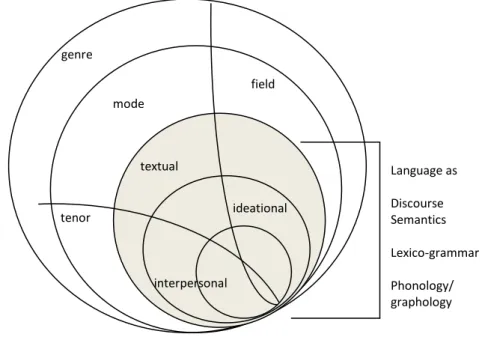
In addition to the three kinds of meaning of the metafunctions, SFL adopts a stratified view of content in which all strata realise meaning (figure 2.2). That is to say, each stratum encodes meaning at a different level of abstraction (Martin & White, 2005), and realisation is “the process of linking one level of organization with another” (Halliday & Matthiessen, 2004: 26). Although at first sight this model may suggest that there are clear boundaries between the different strata, there are not. Rather, as Halliday and Matthiessen (1999: 32) put it, “the ideation base is construed as a multidimensional, elastic semantic space”, organised as meaning potential. Of particular interest to this thesis are the stratum of the lexicogrammar, which focuses on meaning at the level of the clause, and that of discourse semantics, which explores meaning choices across longer stretches of discourse, i.e. beyond the clause. Beyond language lies the context, which encompasses register and genre. A brief overview of the systemic approaches to the strata of the lexicogrammar and discourse semantics follows.
Figure 2.2 Modelling of language in context adapted from Martin & White (2005) in Hood (2010: 23) 2.2. The stratum of the lexicogrammar
The lexicogrammar focuses on meaning at the level of the clause. At this stratum, ideational meaning is construed through the system of transitivity, which identifies Processes (the kind of happening – that of doing, being or having, existing,
Language as Discourse Semantics Lexico-grammar Phonology/ graphology genre mode tenor field textual ideational interpersonal
11
sensing, or saying), Participants (who/what is involved in the process) and any attendant Circumstances (e.g. when, where or how) (Halliday & Matthiessen, 2004).
The interpersonal metafunction is concerned with the semantic space between the speaker and listener that is opened up through language (Halliday & Matthiessen, 2004). The relevant system here is that of Mood. The grammar of the Mood includes the Subject and the Finite. The Subject is considered the one responsible for the validity of the proposition, and it can be identified by means of a tag question. The Finite indicates whether it is information (propositions) or goods-&-services (proposals) that are being exchanged. It also indicates reference with regard to the time of speaking and the speaker’s assessment of the likelihood or desirability of the proposition.
The textual metafunction is composed by means of the systems of Thematic structure and Information structure. Together these systems distribute the flow of information in the clause. Thematic structure is composed of the Theme and Rheme, where the Theme is taken to be the first element with a role in the transitivity structure (Halliday & Matthiessen, 2004; Thompson & Thompson, 2009). In some analyses Theme is considered to be up to and including the Subject (e.g. Cummings, 2005; Hood, 2010), as proposed by Ravelli (1995: 226). The Theme represents the starting point or departure for the clause (Halliday & Matthiessen, 2004), and in its unmarked status, it conflates with the Subject. A marked Theme might consist of an Adjunct, for example. Thematic structure also allows for multiple Themes where there can be a textual Theme (e.g. and), an interpersonal Theme (e.g. surely) and a topical Theme (the first element with an experiential function). While the function of Theme is to provide the point of departure for the message, the function of Information structure is to organise the information in terms of Given (already known by the listener) and New (what the listener is to pay attention to). Typically Given information conflates with Theme, and New is presented in the Rheme.
The selection of Theme is important in a text because it contributes to the method of development of the text (Fries, 1981 in Halliday & Matthiessen, 2004: 99), which Fries (1995, a; b) stresses is a semantic notion, not structural. For example,
12
selecting a Theme that is not subject – i.e. a marked theme – can serve to re-orient the development of the text by creating a local context for what follows in the Rheme (Halliday & Matthiessen, 2004). Notwithstanding, Fries (2009) warns against including too much in the concept of method of development at the risk of it becoming meaningless.
2.3. The stratum of discourse semantics
The stratum of discourse semantics looks at meaning-making resources beyond the level of the clause. Stratification of language makes it possible to deal with units larger than the clause such as semantic motifs like evaluation, which are realised by different kinds of resources of the lexicogrammar, as well as the layering of meaning introduced by means of grammatical metaphor and aspects of coherence and cohesion (Martin, 1992). Following the early work on cohesion (Halliday & Hasan, 1976), a significant body of work that lays the foundations for analyses at the discourse semantics stratum has been carried out by Martin (1992), Martin and Rose (2003), and Martin and White (2005). These works will be the main sources for this section. The main systems that are useful for the analysis of shell nouns will be examined from the perspectives of the three metafunctions.
2.3.1. Ideation at the discourse semantics stratum
Ideational meanings are characterised by a particulate structure (Martin & Rose, 2003). Martin (1995b: 13) describes the structure of ideational meaning as involving “a segmental construal of reality”. Experiential meaning is structured along a principle of part/whole relations while logical meaning follows a part/part structure, where the parts are dependent on each other (Halliday, 1993b: 38).
Analysis of experiential ideational meaning at the discourse semantics stratum focuses on the taxonomic relations between elements (entities and Processes) from clause to clause: nuclear relations and activity sequences (Martin & Rose, 2003). Nuclear relations refer to configurations of elements within each clause to show the roles of people and things in activity sequences. Activity sequences are glossed as “series of events that are expected by a field” (Martin & Rose, 2003: 101), the unmarked relation between events being ‘and’. Events that are related by cause and effect such as those found in science fields are termed implication sequences.
13
The logical relations between activity and implication sequences are construed through the resources of Conjunction. While external conjunction contributes to field by organising the activity or implication sequences, internal conjunction contributes to the organisation of the text and organises the rhetoric (Halliday & Hasan, 1976; Martin, 1992). Thus, while external conjunction enters into the logical system of ideation, internal conjunction is considered textual, not ideational. The four main categories of conjunction are given in table 2.1.
External and Internal Addition additive alternative Comparison similar different Time successive simultaneous External Consequence cause
means purpose condition Internal Consequence concluding
countering
Table 2.1 General options for external and internal conjunction (Martin and Rose, 2003) 2.3.2. Interpersonal meaning at the discourse semantics stratum
There is a considerable body of research outside SLF that studies interpersonal meaning in academic discourse. Hood (2010: 7) notes that it is impossible to reconcile the different approaches because they derive from different underlying theories of language, research interests, and developments in research and theory. She provides a synthesis of this research, in which she groups studies according to the way evaluation is treated: as grammar, lexis or discourse (Hood, 2010: 13-22); and although some of this work has informed studies on shell nouns, it will not be reviewed here. In SFL interpersonal meanings can be realised by different selections from the lexicogrammar. It is “strung throughout the clause as a continuous motif or colouring” (Halliday, 1979 cited in Martin & White, 2005: 19), it is diffused (Halliday & Matthiessen, 1999), it spreads (Martin, 1992), and it radiates (Hood, 2006) across clause boundaries and stretches of text. This patterning is referred to as prosody (Halliday, 1979 in Martin & White, 2005; Martin, 1992; Martin & Rose, 2003). Martin and White (2005: 19-24) identify three types of prosody: saturating prosody, where evaluative language is peppered throughout a stretch of discourse; intensifying prosody, where there is a build-up by means of repetitions of various kinds; and
14
dominating prosody, where the interpersonal meaning spreads to the surrounding discourse, imbuing it with interpersonal meaning. At the stratum of discourse semantics interpersonal meaning draws on the resources of the system of APPRAISAL (Martin, 2000; Martin & White, 2005).
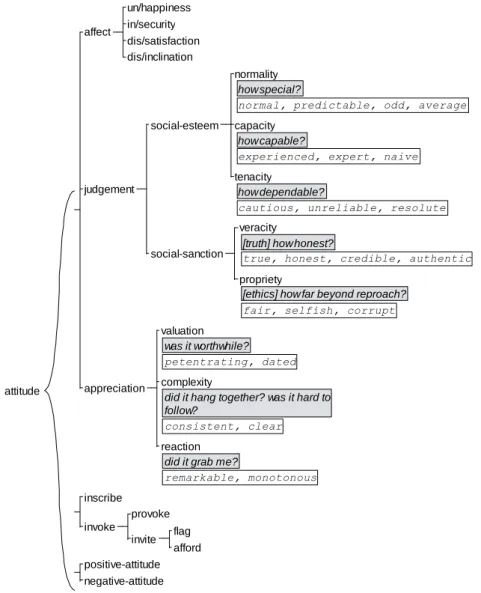
The system of APPRAISAL is a discourse semantic resource that construes power and solidarity. There are three interacting domains: ATTITUDE, GRADUATION and ENGAGEMENT. The domain of ATTITUDE is concerned with feelings: AFFECT deals with resources for expressing emotional reactions; APPRECIATION with how things – material or semiotic – are evaluated; and JUDGEMENT with assessments of behaviour or people (figure 2.3).
Figure 2.3 The system of ATTITUDE (adapted from Martin & White, 2005)
attitude affect un/happiness in/security dis/satisfaction dis/inclination judgement social-esteem normality
normal, predictable, odd, average how special?
capacity
experienced, expert, naive how capable?
tenacity
cautious, unreliable, resolute how dependable?
social-sanction veracity
true, honest, credible, authentic [truth] how honest?
propriety
fair, selfish, corrupt [ethics] how far beyond reproach?
appreciation valuation petentrating, dated was it worthwhile? complexity consistent, clear did it hang together? was it hard to follow?
reaction
remarkable, monotonous did it grab me?
inscribe invoke provoke invite flag afford positive-attitude negative-attitude
15
The system of JUDGEMENT is further broken down in delicacy such that it reflects grammatical distinctions in the systems of modalisation and modulation (Martin & White, 2005: 54). Within the subsystem of social esteem, normality is related to modalities of usuality, capacity to ability, and tenacity to modulations of inclination. Within social sanction, veracity is related to modalisations of probability, and propriety to modulations of obligation. (See Martin & White, 2005: 52-56.) On the basis of these relations Martin and White (2005: 55-56) posit a cline with grammaticalised realisations at one end and lexicalised realisations at the other. In between are modality metaphors. An example of such a cline for ability/capacity is given in figure 2.4.
Figure 2.4 Cline of interpersonal grammar and appraisal (adapted from Martin & White, 2005:55) While the system of JUDGEMENT construes evaluations of people or people’s behaviour, the system of APPRECIATION deals with the evaluation of things, both semiotic and material, abstract and concrete. There are three sub-types: reaction, composition and valuation. Realisations for reaction can be probed by prompts about the impact (did it grab me?) or quality (did I like it?) of the thing, while realisations for composition can be probed by prompts about the composition (did it hang together?) or the complexity (was it hard to follow?) of the thing. Martin and White (2005: 57)
He’s healthy enough etc He’s strong enough to go
He’s capable of going He’s able to go
He can go
Gramaticalised realisation [mood and modality]
Lexicalised realisation [judgement: capacity]