Bose Mott-Insulators as Closed Shells
A. F. R. de Toledo Piza
Departamento de F´ısica Matem´atica, Instituto de F´ısica, Universidade de S˜ao Paulo,C.P. 66318, 05315-970 S˜ao Paulo, S.P., Brazil
Received on 16 December, 2004
Properties of the ground-state, zero temperature ‘phase diagram’ of the Bose-Hubbard hamiltonian as under-stood by Fisher et al. [5] are studied using simple tools in the case of finite systems. The results obtained provide a transparent picture of the thermodynamic limit and reveal features reminiscent of shell structure in many-fermion systems. Independent sites and many-site correlations appear in correspondence with indepen-dent fermions and many-fermion correlations respectively. This paper is dedicated to Nicim Zagury, on the occasion of his seventieth birthday.
1
Introduction
Perhaps the most satisfying justification of the simplicity of dilute (gaseous), single species Bose-Einstein condensates (BEC’s) has been provided not more than a couple of years ago by Lieb and Seiringer[1], by proving that the ground state of a finite many-boson system confined to an external ‘trap’ represented by a confining potentialVtrap(r)is, in the
limit when the number of bosonsN increases to infinity in
such a way that the productN aremains constant,abeing the (positive) scattering length associated with a two-boson, purely repulsive interaction potential, is such that itsexact one body density matrix is of the form
ρ(r, r′) =N φ
0(r)φ∗0(r′).
The functionφ0(r)is the minimizer of the Gross-Pitaevski
functional
⌋
W[φ]≡
d3r φ∗(r)
−2∇2
2M +Vtrap(r) + λN
2 |φ(r)|
2
φ(r).
⌈
and this limit is accordingly called the Gross-Pitaevski (G-P) limit. The quantityλ≡4π2a/M plays the role of the
strength of an effective, zero range two-body interaction. Note that it is expressed in terms of the scattering length a, and is thus an object possessing the hierarchy of the two-body scatteringamplitude, as e.g. in Brueckner theory[2]. The confined many-boson ground state becomes therefore exactlya ‘single-mode’ state in this G-P limit. Even though the size of the system remains finite asN goes to infinity (since the mean field like contribution involving the product N λ remains constant, implying that the particle density ρ also becomes infinite), the system is in fact extremelydilute in the sense that the dimensionless quantityρa3goes to zero
asN−2. Now, at least qualitatively, this limit can be said to
be “close” to typical gaseous BECs now routinely produced in many laboratories, even though the precise meaning of being close (i.e., within the framework of ref.[1]) has still to be worked out. These gases are such that they satisfy the hierarchy of length scales
a ≪ ρ−1/3 ≪ (ρa)−1/2
i.e., the characteristic distance associated with the inter-action much smaller than the mean interparticle spacing, which is in turn much smaller than the so called ‘heal-ing length’[3]. These inequalities are in fact equivalent to ρa3≪1.
In the real life gaseous BECs one has typicallyρa3 ∼
10−6, so that corrections to the extreme single-mode, no
de-pletion picture for the condensate state are apt to be small. The correction for the energy per particle first derived by Lee and Yang in 1957[4] for a uniform system of particle densityρ,
E N =
1 2N λρ
1 + 128 15√π
ρa3
¯ N = 8N
3√π
ρa3
are consistent with the general picture of ref.[1] and may be taken at least as heuristic estimates of the deviations from the extreme single mode picture to be expected in the real gaseous systems. Note that in the G-P limit ρa3 → 0 as
N−2. It should also be kept in mind that the actual two-body
interaction is notpurely repulsive. As a result of this, the minimizer of the Gross-Pitaevski functional in fact approx-imates a state which is unstable against the so called three-body recombination processes. A relative slowness of the effects of such processes is therefore a crucial requirement in the handling of these Bose-Einstein condensed states.
The single mode picture emerging in the G-P limit ap-plies also to ground states in which the external trap poten-tial consists of a periodic array of local minima separated by quantum-mechanically permeable barriers. In this case, the single mode picture entails full delocalization of the trapped bosons. Note however that the mean occupation of any local minimum diverges in the G-P limit, so that one is led to ask what new physics gets deployed as one keeps short of it (i.e., finite, and possibly even small mean occupations of individ-ual minima), in the case of such traps. In this case an heuris-tic answer can be found in the context of the Bose-Hubbard (B-H) model, analyzed from the point of view of statisti-cal mechanics before the experimental achievement of di-lute atomic Bose-Einstein condensates, notably by Fisher et al.[5].
In fact, the Bose-Hubbard model can be seen as a many-mode approximation to the cold dilute system of bosonic atoms involving the states in the lowest band of the periodic potential array[6]. By using site-localized (Wanier) combi-nations of the lowest band modes as a single-boson basis, and noting that i) matrix elements of the one-body part of the effective hamiltonian are strongly dominated by nearest neighbor matrix elements, and ii) matrix elements of the ef-fective two-body interaction are strongly dominated by sin-gle site two-body matrix elements, one is led immediately to the Bose-Hubbard hamiltonian
HBH=−f
m,n
(a†man+a†nam) + J 2
n
a†na†nanan (1)
where the creation-annihilation operators correspond to the site localized single-boson states, the second sum runs over all the different sites while the first sum runs over nearest neighbor site pairs. The positive constantsfandJstand for the relevant one and two body matrix elements (a repulsive effective two body interaction being assumed).
In what follows the heuristic derivation of the “zero tem-perature phase diagram” of this model given by Fisher et al.[5] will be implemented in the case of a finite number M of sites and of small numbers of bosons per site. Many relevant properties of such a finite system actually be ob-tained analytically in a simple way, shedding revealing light
on some aspects of the corresponding thermodynamic limit, which consists in lettingM → ∞with constant number of bosonsper site. Some heuristic contact with the differ-entG-P limit will also be provided. The finite B-H system itself will be shown to admit an interpretation in terms of the physics of quantum shell effects, familiar in fermionic systems such as atoms and atomic nuclei. This paper is ded-icated to Nicim Zagury, on the occasion of his seventieth birthday.
2
Finite Bose-Hubbard ground states
In order to proceed with the analysis of properties of the ground states of the hamiltonian (1), periodic boundary con-ditions will be used for the one-dimensional array of M sites, so that the nearest neighbors of siten = M are the sitesn=M−1andn= 1. In this case the hopping term of HBH becomes diagonal if one introduces an alternate rep-resentation in terms of the “momentum” single boson states defined as
Aq ≡ √1 M
M
n=1
e2Mπinqan, q= 0, . . . , M−1. (2)
The hamiltonian (1) can then be rewritten as
HBH =−2f M−1
q=0
cos 2πq
M
A†qAq
+
qj
δM(q1+q2−q3−q4)A†q3A
†
q4Aq2Aq1 (3)
where the modular Kronecker deltaδM(q)is equal to one if q = 0,±M,±2M, . . . and zero otherwise. This shows moreover that, in addition to the total number of bosons N ≡
na†nan ≡qA†qAq, the total “momentum” is also a (modular) constant of motion and can be used to label the eigenstates ofHBH.
2.1
Independent sites
Following the analysis given in ref. [5] consider first the casef = 0. Here the representation in terms of the local-ized orbitals diagonalizes the hamiltonian, as
HBH → J
2
n
Nn(Nn−1), Nn≡a†nan.
Introducing the zero temperature grand potential Ω ≡
HBH−µN, whereµis the chemical potential, one has
Ω = J 2
n
Nn− µ J −
1 2
2
−M J2
µ J +
1 2
so that, for the case ofN = n0M +ν bosons,0 ≤ ν ≤
M −1, the value ofΩcorresponding to the lowest eigen-value ofHBH is
Ω0(N)
J =
M 2
n0−µ
J − 1 2
2
+νn0−
µ J
−M2
µ J + 1 2 2 .
The values ofΩ0(N)/J for given µ/J and varyingN lie
along a polygonal line with vertices at the “commensurate filling” valuesn0M and with the nonzero values ofνalong
the straight sides. The number of particles which minimizes Ω0(N)/Jis controlled by the chemical potentialµ/J. This
number is unique and corresponds to a commensurate fill-ing situation except when µ/J is an integern0, in which
case the two commensurate fillingsn0andn0+ 1together
with all the intermediate ν values correspond to the same minimum value ofΩ0(N)/J. This pattern is illustrated in
Fig. 1(a).
(N)
o
Ω
J
n −2o n −1o no n +1o n +2o N M
µ
J+ 1 2= no
µ
J+ 1 2= no+
1 4
µ
J+ 1 2= no
1 2 +
µ
J
no=1 no=2 no=3
N=3M N=2M N=M N=M 2M N=0 M N=2M 3M N=3M 4M 2 0 1 3 (a) (b)
Figure 1. (a)-values ofΩ0(N)/Jas a function of the number of
particlesN for different values of the chemical potentialµ. The minima (indicated by slanted arrows) are unique for each value of µand correspond to a commensurate filling situations except when µ/J has an integer value, in which case degeneracy occurs, as shown; (b)-alternate representation giving the number(s) of bosons which minimize(s)Ω0(N)/Jalong aµ/Jaxis.
The usual way to plot this result as part of a “zero tem-perature phase diagram” consists in marking along anµ/J axis the number of particles which minimizes the grand po-tential. This is shown in Fig. 1(b). The minimizing number N is clearly independent ofµ/Jin open intervals between successive integer values. In these intervals one gets there-fore the “incompressibility” relation
∂Nmin
∂µ = 0, Nmin=n0M, n0< µ
J < n0+ 1.
Note that an alternate way to describe this situation without explicit reference to the grand potential consists in evaluat-ing thef = 0ground state eigenvalues forN =n0M+ν
E(0f=0)(N) = J 2M
n0−
1 2
2
+νJn0−
J 8
and evaluating the one boson addition energy in units ofJ E0(f=0)(N+ 1)−E
(f=0) 0 (N)
J =n0
which shows unit jumps at successive commensurate fill-ings.
2.2
Perturbative effects of hopping
The ground states for commensurate fillingsn0in the limit
f = 0are non-degenerate and easily written down in terms of the localized creation operatorsa†
nas
|{n0}M=
M
n=1
a†n0
n
√
n0!
|0. (4)
The lowest order perturbative correction to the energy of these states due to hopping effects is clearly of orderf2. The
f = 0ground states forN =n0M±1, on the other hand,
areM-fold degenerate, allowing for non-vanishing first or-der hopping corrections to their energies. They can be writ-ten as
⌋
N =n0M+ 1 :
1
√
n0+ 1
a†n|{n0}M, n= 1, . . . , M;
N =n0M−1 :
1
√n
0
an|{n0}M, n= 1, . . . , M.
The diagonalization of the hopping (first) term of the hamiltonian (1) or (3) within these degenerate subspaces can be achieved in a straightforward way in terms of the momentum single boson states associated to the operators (2). In fact, direct calculations give
− 2f
n0+ 1
q
{n0}M|Ap1A
†
qAqA†p2|{n0}
Mcos2πq M
= −2f (n0+ 1) cos
2πp
1
M
δp1p2;
−n2f
0+ 1
q
{n0}M|A†p1A
†
qAqAp2|{n0}
Mcos
2πq
M
= −2f n0 cos
2πp1
M
so that the appropriate zeroth order eigenstates involve respectively the creation and the annihilation of one boson in a mo-mentum state on the commensurate occupation state. The first order ground state energy shifts correspond top1 = 0in each
case, leading to the first order corrections to the addition energies
E(n0M+ 1)−E(n0M)
J = n0−2 (n0+ 1) f J +O(f
2),
E(n0M)−E(n0M −1)
J = (n0−1) + 2n0
f J +O(f
2).
⌈
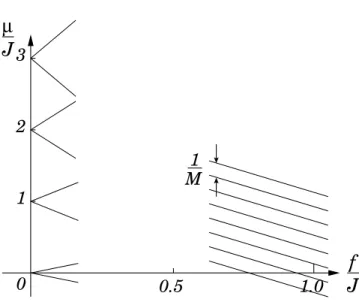
If one adds to the graph of Fig. 1(b) an additional axis for the scaled hopping parameterf /J, the linear terms define respectively minimal and maximal slopes of curves branch-ing out of the integer values of theµ/Jaxis. Note that when one more boson is added to a state with commensurate fill-ingn0, one obtains the minimal slope branching out of the
value of µ/J which constitutes theupperbound of the in-compressibility domain of this commensurate filling state; removal of one boson from the commensurate filling state n0, on the other hand, gives the maximal slope branching
out of thelowerincompressibility limit of this state. This is shown on the left hand side of Fig. 2, where one sees that the maximal and minimal slopes branching out of each in-teger valuen ≥1on theµ/J axis are in fact equal except for sign, and given by±2(n+ 1). These results are inde-pendent ofM, and therefore survive in the thermodynamic limitM → ∞with fixedn0.
M
1
J
f
µ
J
1
2
3
0.5
1.0
0
Figure 2. On the left hand side the calculated limiting slopes of µ/Jas a function off /Jat very small hopping are shown. On the right hand side the calculated slopes and spacings ofµ/Jcurves for large values off /Jare shown for several consecutive values of the total number of bosonsN. The number of sites isM.
2.3
The limit of very strong hopping
The situation prevailing at the far right along thef /J axis can also be easily worked out in closed form. Here the on site effective two-body interaction can be handled pertur-batively, the unperturbed, non-degenerateN boson ground state being given as the “pure hopping” Perron-Frobenius ground state
|Nhop=
1
√
N!
A†0N|0, (5)
for which the energy is, to first order inJ(see eq. (3)),
E(N) =−2f N+ J
2M N(N −1).
The properly scaled addition energies are therefore E(N+ 1)−E(N)
J =
1 MN−2
f J,
showing that all the staggering found in the small hopping limit has disappeared, leading to a family of equally spaced lines with slope−2, their spacing beingM-dependent and given by1/M. They become therefore more dense as one approaches the thermodynamic limit, where the spacing eventually vanishes. Updating Fig. 2 with this additional information leads to the picture shown, which now gives a fairly clear image of the complete diagram.
While this cannot be obtained analytically, the smooth-ness of the missing intermediate filling can be checked within computer workable limits of M and N by means of straight numerical diagonalization of the Bose-Hubbard hamiltonianHBH. Note that the dimensionality of the ma-trices that have to be handled can be significantly reduced by taking into account the constants of motion of this hamil-tonian. An example of the result of such numerical approach is shown in Fig. 3. Salient features are the progressive short-ening of the “incompressible lobes” in thef /J direction as n0 becomes larger, which is already indicated by the
0.1 0.2 0.3 0.4 0.5 f/J
-1 1 2 3 [E(N+1)-E(N)]/J
Figure 3. Numerical zero temperature “phase diagram” for the Bose-Hubbard hamiltonian withM = 5and periodical boundary conditions. The chemical potential is replaced by addition energies in units of the on-site two-body interaction parameterJ. The first three Mott-insulator lobes are shown.
It may be noted at this point that the Gross-Pitaevski limit of Lieb and Seiringer leads to an entirely different situ-ation when compared with the thermodynamic limit as used above. It corresponds in fact to lettingJ →0andN → ∞
in such a way as to preserve the Gross-Pitaevskifunctional, implying therefore constant, non-vanishingf when the dif-ferent sites are limited by barriers of finite height. The Gross-Pitaevski domain therefore lies at the extremeupper rightregion of the zero temperature phase diagram, where the delocalization of the bosons is always complete. In this region the ground state of the Bose-Hubbard model is essen-tially a pure condensate in the delocalized state (2) of zero “momentum” as written in eq. (5), in qualitative agreement with the result of Lieb and Seiringer.
3
One-body features of correlated
eigenstates
Except in the extreme limits f → 0(J = 0) andJ → 0 (f = 0) the eigenstates of the Bose-Hubbard hamiltonian for finite number of sitesmand of bosonsN contain non obvious many boson correlations due to the combined ef-fects of hopping and of on-site two body interactions. When periodic boundary conditions are used, however, the avail-able conserved quantities allow for a very simple general characterization of the effects of such correlations for body observables, in terms of properties of the reduced one-body densities associated with the energy eigenstates. In fact, from the conservation of total momentum (see eq. (3)) it follows that the energy eigenvectors can be chosen to be also eigenvectors of the total momentum, |En, Ptot, with
Ptot= 0, . . . , M−1. Consequently, the reduced one-body
density is diagonal in the momentum representation, i.e.
ρ(En,Ptot)
q1q2 =En, Ptot|A
†
q2Aq1|En, Ptot=νq1δq1q2.
In fact, the operatorsA†
q2Aq1withq2=q1change the value
of the total momentum and therefore have vanishing expec-tation value in states of good total momentum. Theνq are occupation numbers for the delocalized, momentum single boson states associated with the operators (2), which are therefore the natural orbitals of the reduced one body den-sity. The occupation numbers satisfy the usual trace relation for the one body density
M−1
q=0
νq=N.
A first, trivial example of this is the one body density associated with the commensurate ground state in thef = 0 limit, eq. (4), for which one easily obtains
{n0}M|Aq†2Aq1|{n0}
M=n
0δq1q2,
showing that the reduced one body density is in fact a mul-tiple of the unit matrix in this case (and therefore diagonal in any representation). Slightly less trivial cases are the nor-malized, commensurate filling states plus an added particle (or “hole”) with momentumq,
|{n0}M, q ≡
1
√
n0+ 1
A†q|{n0}M
and
|{n0}M,q¯ ≡
1
√n
0
Aq|{n0}M.
{n0}M, q|Aq†2Aq1|{n0}
M, q
= n0−
n0
M + (n0+ 1)δq1q
δq1q2,
{n0}M,q¯|A†q2Aq1|{n0}
M,q¯ =
n0−
n0+ 1
M +n0δq2q
δq1q2.
⌈
0.1 0.2 0.3 0.4 0.5 f/J
2 4 6 8
# N=9
0.1 0.2 0.3 0.4 0.5 f/J
2 4 6 8
# N=10
0.1 0.2 0.3 0.4 0.5 f/J 2
4 6 8 10
# N=11
Figure 4. Natural orbital occupation numbers # plotted againstf /J for the ground states of the Bose-Hubbard model withM= 5and the indicated total number of bosonsN. ThusN = 10 corre-sponds to commensurate filling withn0 = 2. In each case, the
upper branch corresponds to the zero “momentum” natural orbital, while the two lower branches are doubly degenerate corresponding to natural orbitals with “momenta”q= 1,4and2,3respectively, and must be counted twice to obtain the total number of bosons.
In both cases one gets for the one body density expressions which consist of the sum of a multiple of the identity matrix plusan additional pure density associated with the momen-tum state of the additional (or missing) particle. This addi-tional component isenhancedby the corresponding bosonic factors (respectivelyn0+ 1andn0), while the multiple of
identity is correspondinglydepleted, in order to make up for the required trace property.
The interest of these simple results consists in that they reveal the nature of the coherence properties of the states
which can be probed by one body observables. From the fact that the momentum states are the natural orbitals it fol-lows, in fact, that they will be related in general to the as-sociated, delocalized single particle states. For states such as the commensurate filling states the coherence properties are in fact rendered invisible by occupation degeneracy. On the other hand, the stationary states, at very small hopping, resulting from the addition (or removal) of a single particle from these states, will sustain coherence properties of the momentum single particle states enhanced by bosonic fac-tors, superimposed to an incoherent background associated with the “residual” component with degenerate occupancy.
It is a simple matter to evaluate reduced one-body den-sities numerically for stationary states involving a small enough number of sites and/or particles. Some sample re-sults for the ground states of a system with number of sites M = 5and withN= 9,10and11respectively are given in Fig. 4 for sequences of values of the relative strength of the hopping parameter,f /J. In the extremef /J = 0the com-mensurate filling case withN = 10shows a fully degener-ate occupancy, while the casesn= 9andN = 11clearly show the bosonic enhancement in the occupation number of the zero “momentum” natural orbital. Increasing the relative hopping parameter leads in all cases to strong dominance of zero momentum occupancy in the one-body density leading to near saturation for values off /Jin the range correspond-ing to the “closcorrespond-ing” of the correspondcorrespond-ing incompressibility lobe in the ground state phase diagram (see Fig. 3).
4
Alternate picture of the zero
tem-perature diagram related to “shell
effects”
N M N
∆
E
∆
1 J
N M
∆E
∆N
∆E
∆N 1
J smooth
N M
1 2 3
1 2 3
1 2 3
0 1 2 3
1 2 3
0 1 2 3
(c)
(d) (e)
(b) (a)
Shell correction
Figure 5. Plots of addition energies∆E/∆N=E(N+ 1)−E(N)in units ofJagainst the number of bosons per siteN/Mforf /J= 0 (a),f /Jsmall (b) andf /Jlarge (c). The top graphs in (d) and (e) show the “shell effect” corresponding to (a) and (b) respectively, obtained by subtracting the smoothened addition energies. The lower graphs in (d) and (e) show the qualitative behavior of the shell correction to the total energy, obtained by integrating the shell effect overN/M.
The “shell effect” can be extracted by plotting the dif-ference between the staggered addition energies and their smoothened average displaying simple ramp behavior. The “shell correction”, reflecting deviations of thetotal energy from the value obtained from the averaged addition energies is then obtained by integrating the shell effect with respect toN/M. An integration constant is chosen so that the shell correction has zero average. The behavior of these quanti-ties is illustrated in Fig. 5(d) and (e). The values ofN/M for which the shell correction is most negative correspond to “magic numbers”, which here correspond to commensurate filling situations (integer N/M), and hence to the incom-pressible Mott insulator phase.
We are thus led to a picture in which the incompress-ible lobes of the zero temperature phase diagram of Fisher correspond to the magic numbers of a many-boson system displaying shell effects to the extent that they occupy many independent (or nearly independent)sites. This, in particu-lar, provides the degeneracies (or near degeneracies) which generate the magic numbers. Increasing the relative hopping parameter reduces the independence of the sites by promot-ing many-site correlations eventually obliteratpromot-ing the shell structure. In contrast, shell effects in many fermion sys-tems signal independent (or nearly independent)particles, the magic numbers resulting from single particle level de-generacies (or near dede-generacies). Increasing many-particle correlations tends to obliterate the fermionic shell effects.
5
Concluding remarks
The Bose-Hubbard model for finite number of sites and of bosons is soluble, in the usual sense that exact solutions can be obtained by diagonalizing finite matrices. Numerical re-sults obtained by such means can be rendered quite transpar-ent by using elemtranspar-entary analytical perturbative techniques in the extreme domains in which one has eitherf ≪ J or, conversely,J ≪f, since the ’unperturbed’ problem admits simple analytical solutions in each of these two cases.
cases for not too large values off /J correspond to “closed shells”. This shell structure is related to nearly indepen-dentsitesand is obliterated by increasing the relative hop-ping parameter, so that the corresponding magic numbers are dictated by the number of sites. This is in correspon-dence with shell stricture in fermionic systems, related to the near validity of an independentparticlepicture which is obliterated by correlations induced by interparticle interac-tions, the magic numbers being dictated by energy bunching of single-fermion states.
References
[1] E. H. Lieb and R. Seiringer, Phys. Rev. Lett. 88, 170409 (2002).
[2] K. A. Brueckner and K. Sawada, Phys. Rev.106, 1117 and 1128 (1957); K. Sawada, Phys. Rev.116, 1344 (1959).
[3] A. J. Leggett, Revs. Mod. Phys.73, 307 (2001).
[4] T. D. Lee and C. N. Yang, Phys. Rev.105, 1119 (1957).
[5] Matthew P. A. Fisher, Peter B. Weichman, G. Grinstein, and Daniel S. Fisher, Phys. Rev. B40, 546 (1989).
[6] D. Jaksch, C. Bruder, J. I. Cirac, C. W. Gardiner, and P. Zoller, Phys. Rev. Lett.81, 3108 (1998).