Research Paper
Exploring Products’ Tetrad-Value Theory
João M. S. Carvalho *
ABSTRACT
It is well known that people buy products to meet their multiple needs and desires based on the value they attach to such products (goods, services, ideas, information, experiences). The tetrad-value theory includes economic, social, ecological and psychological values. Based on this theory, we developed a questionnaire to assess the perception of value in relation to 20 main groups of products. We used definitions of the four type of values, and we asked the participants from a convenience sample of 804 university students to tell us whether the product has that kind of value, absolutely, a lot, a little, or doesn’t have it at all. The results showed that is not indifferent the type of products under value evaluation. There are products with more impact on social level and other on psychological level with statistically significant differences. This study confirms that people are mainly concerned with the product value for themselves, based essentially in their own interest, showing that social value is not their fundamental criteria. This research also indicates that social products appear to be of greater value, whatever the type, in the participants' perception. Thus, scholars’ generalization about the way people assess product’s value, considering that the personal impact is a social issue, should be rethought at the light of tetrad-value theory.
Keywords: Tetrad-value theory, perception of value, psychological value, social value, distributed value.
* CICS.NOVA.UMinho, REMIT – Oporto Global University, Portugal. E-Mail: [email protected]
International Journal of Marketing, Communication and New Media. Special Issue 6 - Marketing, Entrepreneurship and Innovation, MAR 2020 75 Received on: 2019.11.22 Approved on: 2020.03.27
Evaluated by a double blind review system
1. INTRODUCTION
The possibility to customise the majority of the products (goods, services, ideas, information, experiences) led to realise that value theory should explicitly present the fact that is individual value perception that matters. Thus, and we think without surprise, it is expected that anyone will have the ability to distinguish between what they consider to be the product value for themselves, for the community, and for the preservation of the planet. We defend that traditional approaches, like Elkington’s (1997), missed this more detailed insight, because they only considered the economic, ecological and social values, i.e., this stream of research put together social and psychological aspects. However, we argue that the theoretical separation of those two types of values will be important to alert the entrepreneurs for particular approaches to a more and more segmented market.
Consequently, this study aims at knowing what a large group of persons think about a set of products in terms of economic, ecological, social and psychological value, which was theorised by Carvalho and Sousa (2015) as tetrad-value theory. Thus, this exploratory study presents the following research questions: (1) Can the respondents perceived the four types of values predicted? (2) Is there any type of products with a significant difference between people’s social and psychological value perception? and (3) Is there any significant difference between people’s perception of the products’ values considered in for profit and not for profit sector?
2. LITERATURE REVIEW
There are thousands of articles about value. Most of them are redundant. Nevertheless, we tried to be concise and objective about what is important in the concept of product value for the customer or user.
As King and McLure (2014) summarize, there are historically two major categories of value theories: the objective and the subjective. They are based, respectively, on the
conditions of production (e.g., works by Adam Smith, David Ricardo, and Karl Marx) and on the consumers’ preferences (e.g., works by Carl Menger, Léon Walras, and William Stanley Jevons). The approach most followed by economists is the latter. Thus, value creation can be defined as the utility that a product can have for customers. In this context, Carl Menger (1871) developed a subjective theory of value – the theory of marginal utility – linking it to the satisfaction of human desires. For him, a product has value only if it satisfies a human need, being different from its price, which is determined by the market, thus depending on competition and information. The utility that an individual derives from the consumption of a unit of a product is determined by his subjective assessment of the satisfaction derived from such consumption. Marginal utility refers to the satisfaction that an individual has in consuming an additional unit of the product in a given context, namely the fact that he has already consumed units of the product before.
In the field of the objective approach to value, Adam Smith (1776) postulated that value was created when the factors of production (capital, land and labour) were brought together to produce a useful object. He considered the value of a product to be an objective phenomenon, being its "natural price" or exchange value related to the cost of producing it. For him, demand did not influence the value of goods, but the cost of production, that is, wages, incomes and profits were the only determinants of value in the long run. He believed that competition would reduce prices to costs, including a normal profit and any increase in demand would not increase the value of the product, because the cost of production for each unit would remain unchanged at all levels of production. Smith was not aware of the problem of rising marginal costs.
In short, we can say that the utility or use value of a good is the satisfaction it provides to a person; and that the exchange value is its price in cash or other goods. Thus, a theory of value explains why goods have use value and how their prices are formed or determined.
Mooya (2016) summarised the approaches to the concept of value in three dualities. The first is about the nature of the value, whether the value is intrinsic (that is, in the good itself) or extrinsic (in the minds of those who contemplate the good). The intrinsic value is an objective conception, which views value as something that exists independently of human consciousness or opinion. The extrinsic conception of value, on the other hand, sees it as an entirely subjective phenomenon whose existence is purely outside the
International Journal of Marketing, Communication and New Media. Special Issue 6 - Marketing, Entrepreneurship and Innovation, MAR 2020
77
objects and within the consciousness of the human beings who collectively constitute the market. The second duality concerns the types of value, as reflected in the relationship between use value and exchange value. The first relates a product to the value it may provide in a use or to an individual user, while the second relates the product to the value it may provide to a set of uses or users (that is, the value to the market). These values do not need to be identical and often do not match. The third duality is an artifice of the need to quantify the value, as reflected in the relationship between price/cost and value. The search for a value measure (which is subjective) leads to prices (or costs, which are objective), which may occasionally be patently or intuitively out of step with some notion of the intrinsic value of the product.
The distributed value is perceived by the customer as the difference between the total value and the total cost of the product (good, service, idea, information, experience), also corresponding to the perceived value of use of the product, which includes experiences, sensations and mental states. Note that the total cost to the customer comprises all types of costs, financial (price, ability to pay, opportunity cost) and non-financial costs (physical, psychological and social aspects related to the use of the product, such as accessibility, embarrassment, usability, etc.), in which he expects to incur to evaluate, obtain and use the product. In this context, Zeithaml (1988, p. 14) defines perceived value as “the consumer's overall assessment of the utility of a product based on perceptions of what is received and what is given”.
Drucker (1985) warned that many knowledge-based and high-tech businesses fail because they are developed by entrepreneurs (scientists, engineers) with no management vision. They tend to despise anything other than "advanced knowledge" and, particularly, those who are not experts in their own field. They tend to fall in love with their own technology, often believing that "quality" means what is technically sophisticated, not what gives value to the user. Above all, entrepreneurs need to spend more time on the ground, with customers and their own salespeople, researching and listening. A new product is defined by the customer, and not by the producer (p.200). Porter (1985) proposed the value chain as a tool to identify ways to create more value for the customer. According to this model, each company is a synthesis of the activities carried out to design, produce, market, deliver and support its product. The value chain identifies nine strategically relevant activities – five primary activities and four support activities – that create value and cost in a specific business. The main activities are: (1)
incoming logistics or bringing materials to the business; (2) operations, or conversion of materials into final products; (3) outbound logistics or shipment of final products; (4) marketing, which includes sales; and (5) service. The specialized departments handle support activities: (1) acquisition, (2) technology development, (3) human resources management and (4) company infrastructure. The infrastructure covers the costs of general management, planning, finance, accounting, legal and government affairs. To be successful, a company also needs to seek competitive advantages in addition to its own operations, in the value chains of suppliers, distributors and customers. Today, many companies create partnerships with specific suppliers and distributors to create a superior value supply chain. This leads to the concept of a network that has the potential to create value, and to the idea of creating and capturing collective value in networked markets (Pitelis, 2009; Pitelis & Teece, 2009; Zott & Amit, 2009; Zott, Amit, & Massa, 2011). Thus, a value network is created by a group of economic and social actors who create value to be delivered to customers (Pagani, 2013) and themselves.
In this context, the marketer can increase the value of the offer to the customer, increasing the economic, functional or emotional benefits and/or reducing one or more costs. Too often, managers conduct a customer value analysis to reveal the company's strengths and weaknesses relative to those of the competition. Consequently, each market segment must have its specific value proposition, in order to satisfy the needs and desires of each group of customers.
In 1997, Elkington presented the so called ‘Triple Bottom Line’ theory, defending that the producers should consider in product development the creation of three types of value: economic, social, and ecological. As such, a product that is perceived by the customers as having those types of value will be considered more valuable and will get their preference. The tetrad-value theory (Carvalho & Sousa, 2015, 2018) enhance this traditional approach, differentiating four types of perceived value: economic, social, ecological and psychological, which are interconnected and interact with each other. The economic value exists in all type of products, being the basis for their existence in the market. For the organisation, this type of value consists of revenue and profit, which may not only be of a financial nature. For example, for an organisation with social purposes, non-financial profit goes through the effective fulfilment of its specific mission. The economic value for the customer has to do with the satisfaction of their need through the product acquired or through the adhesion to a social product. There
International Journal of Marketing, Communication and New Media. Special Issue 6 - Marketing, Entrepreneurship and Innovation, MAR 2020
79
may also be economic value for society, through job creation and wealth growth, as well as economic externalities, which are shared by various stakeholders.
There are definitions of social value that point to it as a non-financial value, which impacts the well-being of individuals and communities and the environment (Mulgan, 2010), i.e., as encompassing all kinds of value in addition to the economic. Certo and Miller (2008) argue that social value has to do with meeting basic and lasting needs, such as providing food, water, shelter, education and medical services to those members of society who are in need. We defend that social value may or may not exist in a product. It is closely linked to other types of values, manifesting itself in better processes of socialization, increased social inclusion, equal opportunities, increased health and/or safety in the community, or by increasing the quality of life of the society. Thus, this type of value is more common in social products linked to the activity of the third sector, although it also exists in many for-profit products. Thus, when the product has social value, then it will have an added value for the customers.
Other important value is ecological, which is related to natural environment, sustainability and protection of the planet. The concern with this type of value has become general, since our quality of life depends on how we produce the products and consume them, avoiding as much as possible a negative ecological footprint for life on the planet. Not all products have an ecological value, but it is an important asset when it is created.
The fourth value – psychological or transformational value – has been studied in a more particular way since the works of Carvalho & Sousa (2015) and Carvalho & Jonker (2015). It is often confused with social value, probably because it has a special impact on it, being integrated into that type of value in all models so far. This can be seen in assumptions such as that of Auerswald (2009), which combines the values related to finance, reputation, ethics, the consumer, positive economic externalities, and the improvement of human capacities as dimensions of creating social value. It should also be noted that Schumpeter (1909) said that the founders of the subjective concept of value (Jevons, Menger, Walras) never spoke of social, but only of individual value, because one only can measure product utility (value of use) individually. More, entrepreneurship scholars, who have investigated the context, politics, economic, cognitive, and disposition background for entrepreneurial behaviour, have included psychological value in their approaches (e.g., Hahn, Frese, Binnewies, & Schmitt, 2011;
Cohen & Winn, 2007; Venkataraman, 1997). Variables such as economic and financial aspects are crucial for survival and organisational sustainability. However, organisational activity affects many other spheres of life, viz. social, ecological and psychological. We argue that psychological value manifests itself on an individual level, namely in behavioural change, hence it is also presented as transformational value. When a product promotes a change in attitude and behaviours (e.g., additive behaviours, healthier or ecological lifestyle, awareness of various types of discrimination, change of mentality, openness to new ideas, more knowledge or new acquired competences, self-realization, sense of self-efficacy), then we are faced with an intrinsic psychological value to that person, and that may or may not have a social impact.
For example, statistics show that, despite all campaigns against alcohol, tobacco or other types of drugs, the social prevalence of these behaviours has remained stable over the years. That is, interventions with specific social products to address these problems have been successful on an individual level with some people (percentages vary widely from country to country), but without an effective impact on the society as a whole, as there are an increase of people having lifestyles with addictive behaviours. Moreover, the same product that is effective for one person may not be for another. An example of this, in addition to social products, it is also most medicines, which can achieve different results, leading to the saying that there are no diseases, but sick persons. Thus, this type of value has to be considered in the strategic analysis of an organisation and may even serve as market segmentation criteria. Organisations are most likely to succeed in the market segment where, in addition to the economic value to the customer (satisfaction of their need or desire), there is a high psychological value that transforms their mindset, skills and behaviours, increasing their self-esteem and social inclusion.
3. METHODS
On the basis of this theory, we develop a study to assess the perception of value in relation to main groups of products. These groups follow the Portuguese distribution of goods and services from National Institute of Statistics, and we choose 20 types of products: (1) food products, (2) tobacco, (3) clothing and footwear, (4) social reintegration services for ex-prisoners, (5) housing, (6) household appliances, (7) antibiotics, (8) anti-depressants and anxiolytics, (9) public transports, (10 mobile phone,
International Journal of Marketing, Communication and New Media. Special Issue 6 - Marketing, Entrepreneurship and Innovation, MAR 2020
81
(11) internet, (12) amusement park, (13) libraries and museums, (14) hotels, (15) schools, (16) cosmetic products, (17) foster care service for children at risk, (18) domiciliary support services for elderly, (19) disability support services, and (20) social cantina.
The participants were asked to express their perceptions about the four types of value for each group of products in this scale: 0 – No; 1 – Yes, a bit; 2 – Yes, a lot; 3 – Yes, completely.
They were used the following definitions to help the participants to express their perceptions about the products:
- Economic value: “The ability of the product (good, service, idea) to meet the human needs of the consumer for which it was designed, as well as to create financial or non-financial income for its producer or supplier.”
- Ecological value: “The ability of the product to contribute to the preservation of natural capital (environment, planet or biodiversity).”
- Social value: “The ability of the product to have a positive impact on the community (social welfare, nutrition, shelter, health, social equity or quality of life.”
- Psychological value: “The ability of the product to influence or transform the lives, mentalities, knowledge, skills or behaviours of some consumers.”
We have used a convenience sample of 804 university students (51% female; aged between 18 and 56 years old) to do this exploratory research.
Data were processed and analysed using IBM SPSS 26. We calculated descriptive statistics and we performed Wilcoxon tests to compare all ordinal variables.
4. RESULTS AND DISCUSSION
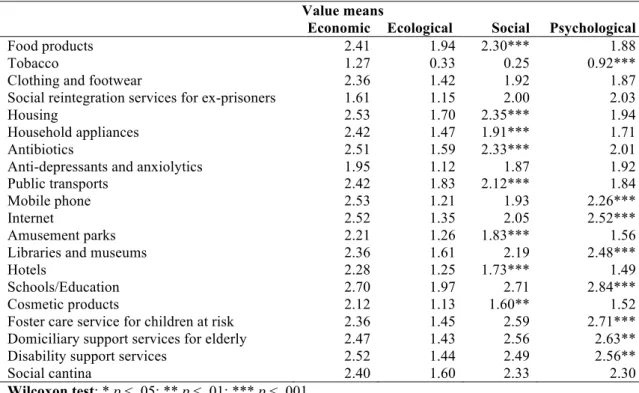
The results show that the products present different value profiles in the perception of the participants (Table 1). Of course, the economic value has the higher perception mean because this is the main purpose to exist in the market. Some products can have ecological value in the participants’ perception, but what is interesting is to notice the way they assess social and psychological values. There are products with more impact on social level and other on psychological level with statistically significant differences. The participants consider that tobacco, mobile phone, internet, libraries and museums,
schools/education, foster care, domiciliary support, and disability support services present more impact in their personal lives than in their social environment.
This exploratory study confirms that people are mainly concerned with the product value for themselves, based essentially in their own interest, showing that social value is not their fundamental criteria. Thus, we think that value theory should be equated at the light of this results. It seems that people don’t generalise their satisfaction to society and present different perceptions depending on the type of product.
Table 1 - Perception value means Value means
Economic Ecological Social Psychological
Food products 2.41 1.94 2.30*** 1.88
Tobacco 1.27 0.33 0.25 0.92***
Clothing and footwear 2.36 1.42 1.92 1.87
Social reintegration services for ex-prisoners 1.61 1.15 2.00 2.03
Housing 2.53 1.70 2.35*** 1.94
Household appliances 2.42 1.47 1.91*** 1.71
Antibiotics 2.51 1.59 2.33*** 2.01
Anti-depressants and anxiolytics 1.95 1.12 1.87 1.92
Public transports 2.42 1.83 2.12*** 1.84
Mobile phone 2.53 1.21 1.93 2.26***
Internet 2.52 1.35 2.05 2.52***
Amusement parks 2.21 1.26 1.83*** 1.56
Libraries and museums 2.36 1.61 2.19 2.48***
Hotels 2.28 1.25 1.73*** 1.49
Schools/Education 2.70 1.97 2.71 2.84***
Cosmetic products 2.12 1.13 1.60** 1.52
Foster care service for children at risk 2.36 1.45 2.59 2.71*** Domiciliary support services for elderly 2.47 1.43 2.56 2.63**
Disability support services 2.52 1.44 2.49 2.56**
Social cantina 2.40 1.60 2.33 2.30
Wilcoxon test: * p < .05; ** p < .01; *** p < .001
All the products presented in this research can be provided by private, public, profit and no-profit sectors. However, we put together the perceptions about all products that are commonly sold or delivered by profit firms (food, tobacco, cloths, footwear, houses, household appliances, antibiotics, anti-depressants, anxiolytics, public transportation, mobile phones, internet, amusement parks entrances, hotels, and cosmetics) and not for profit organisations from social sector or public sector (social reintegration services, libraries, museums, schools, foster care, domiciliary support, disability support, and social cantina). We discovered that there is a higher perception of all type of values in the items that were considered social products with statistical significance (Table 2).
International Journal of Marketing, Communication and New Media. Special Issue 6 - Marketing, Entrepreneurship and Innovation, MAR 2020
83
Table 2 - Perception value means by sector Value Profit sector Non-profit sector
Economic 2.27 2.35***
Ecological 1.36 1.52***
Social ***1.86 2.41***
Psychological 1.80 ***2.51***
Wilcoxon test: * p < .05; ** p < .01; *** p < .001 On the left: between social and psychological value. On the right: between profit and non-profit sector.
Probably, this can be explained by the fact that people consider the social products more adjusted and reliable because they are not for profit, thus designed for the well-being of the consumers or users. This assumption could be corroborated by other crucial result: the participants considered that profit products have more social value and not for profit products present more psychological value. This mean that social products are seen as possessing the capacity to influence or transform consumers/users’ lives, mentalities, knowledge, skills or behaviours.
5. CONCLUSION
All these comparisons between types of values are original.
In summary, it is possible to conclude that, in general, people perceive the four types of product value presented: economic, ecological, social, and psychological. This result confirms what is predicted by tetrad-value theory. All the products have economic value, and many of them also have ecological, social and psychological value. More, there are products that are perceived by the participants as more important at an individual level then at a social level, with statistically significant differences. Additionally, we found out that social products present higher scores in all types value then other products in this study.
There are several limitations in this study. It should be notice that we used a convenience sample of university students that don’t represent all population. We think that the written questionnaire, after pre-tests, may not present difficulties of interpretation, however, we used only a generalization in many of the products presented to the participants for evaluation.
This article presents several implications to theory and practice. It reinforces previous research about tetrad-value theory, showing that the concept of value can be more complex depending on the product and on the context of analysis. It shows that practitioners should take into account the individual impact of the products they sell. If a product has a great psychological impact, then it is crucial to use that characteristic in the positioning of the product, stressing its transformational power to the people’s life. This means that the practitioner should separate social from psychological value, because the latter is more specific for each person, leading one to realise that the product is made for them despite the social impact that it can have. This differentiation will be shown on marketing communication of the product where should be presented in an attractive way the value proposition of the organisation.
We proposed to increase the research about this subject, with other types of samples, namely in other countries, in order to assess possible cultural differences about perception of product value.
REFERENCES
Auerswald, P. (2009). Creating social value. Stanford Social Innovation Review, 7 (2), 50–55.
Carvalho, J. M. S., & Jonker, J. (2015). Creating a Balanced Value Proposition – Exploring the Advanced Business Creation Model. Journal of Applied Management and Entrepreneurship, 20 (2), 49-64. doi:10.9774/GLEAF.3709.2015.ap.00006
Carvalho, J. M. S., & Sousa, C. A. A. (2015). Social entrepreneurship, sustainability, and tetrad-value theory. Global Cleaner Production and Sustainable Consumption Conference 2015. 1-4 November, Sitges, Spain. Book of Abstracts, WS-32-02.
Carvalho, J. M. S., & Sousa, C. A. A. (2018). Is psychological value a missing building block to societal sustainability? Sustainability, 10 (12), 4550. doi:10.3390/su10124550 Certo, S.T., & Miller, T. (2008). Social entrepreneurship: Key issues and concepts. Business Horizons, 51 (4), 267–271.
Cohen, B., & Winn, M. I. (2007). Market Imperfections, Opportunity and Sustainable Entrepreneurship. Journal of Business Venturing, 22 (1), 29-49.
Drucker, P. (1985). Innovation & Entrepreneurship – Practices and Principles. HarperCollins Publishers, Inc.
Elkington, J. (1997). Cannibals with Forks: The Triple Bottom Line of Twenty-First Century Business. Oxford, UK: Capstone Publishing.
Hahn, V. C., Frese, M., Binnewies, C., & Schmitt, A. (2011). Happy and Proactive? The Role of Hedonic and Eudaimonic Well-Being in Business Owners’ Personal Initiative.
International Journal of Marketing, Communication and New Media. Special Issue 6 - Marketing, Entrepreneurship and Innovation, MAR 2020
85
Entrepreneurship Theory and Practice, 36, 97–114.
King, J. E., & McLure, M. (2014). Economics – History of the concept pf value. Discussion paper 14.06. The University of Western Australia.
https://pdfs.semanticscholar.org/b813/0aee7e700a44b31b3385a6fb1c1c25e509b1.pdf Menger, C. (1871). The Principles of Economics. J. Dingwall & B. F. Hoselitz (Trans.). New York: The Free Press, 1950.
Mooya, M. M. (2016). Real Estate Valuation Theory – A critical appraisal. Springer-Verlag. doi:10.1007/978-3-662-49164-5_2
Mulgan, G. (2010). Measuring Social Value. Stanford Social Innovation Review, (Summer), 38-43.
Pagani, M. (2013). Digital business strategy and value creation: framing the dynamic cycle of control points. MIS Quarterly, 37 (2), 617–632.
Pitelis, C. N. (2009). The co-evolution of organizational value capture, value creation, and sustainable advantage. Organization Studies, 30 (10), 1115–1139.
Pitelis, C. N., & Teece, D. J. (2009). The (new) nature and essence of the firm. European Management Review, 6 (1), 5–15.
Schumpeter, J. (1909). On the Concept of Social Value. The Quarterly Journal of Economics, 23 (2), 213-232.
Smith, A. (1776). Riqueza das Nações, 4ª ed. T. Cardoso & L. C. Aguiar (Trans.). Fundação Calouste Gulbenkian, 1999.
Venkataraman, S. (1997). The distinctive domain of entrepreneurship research: An editor’s perspective. In K. J. Growth & J. Brockhaus (Eds.), Advances in Entrepreneurship Firm Emergence (pp. 119-138). Greenwich, CT: JAI Press.
Zeithaml, V. A. (1988). Consumer Perceptions of Price, Quality and Value: A Means-End Model and Synthesis of Evidence. Journal of Marketing, 52 (July), 2-22.
Zott, C., & Amit, R. (2009). The business model as the engine of network-based strategies. In P.R. Kleindorfer & Y.J. Wind (Eds.), The Network Challenge (pp. 259– 275). Upper Saddle River, NJ: Wharton School Publishing
Zott, C., Amit, R., & Massa, L. (2011). The business model: recent developments and future research. Journal of Management, 37 (4), 1019–1042.
How to cite this article:
Carvalho, M. S. J. (2020). Exploring Products’ Tetrad-Value Theory. International Journal of Marketing, Communication and New Media, Special Issue 6 - Marketing, Entrepreneurship and Innovation, 74-85.