COMPETITION AND CAPABILITIES IN
BRITISH TELEVISION PRODUCTION1
Simon Deakina, Ana Lourençob and Stephen Prattenc March 2003
Abstract
We examine, through a sectoral case study, the effects of market liberalisation on production capabilities in the UK television industry. Two aspects of this process are examined: the growth of an „independent‟ programme production sector, and the introduction, development and transformation of an internal market system within the BBC. The paper looks at the extent to which a competitive and business-orientated independent sector can be said to be emerging, and considers the impact of the internal market on the BBC‟s efficiency and flexibility. In each case, market-driven reforms are seen to have a complex and ambiguous relationship to a continuing debate over the meaning of quality and innovation in television production.
a
Centre for Business Research Judge Institute of Management University of Cambridge Trumpington Street Cambridge CB2 1AG, UK E-mail: [email protected]
b
Faculty of Economics and Management Portuguese Catholic University
Rua Diogo Botelho, 1327 4169-005 Porto, Portugal
E-mail: [email protected], and Judge Institute of Management University of Cambridge
E-mail: [email protected]
c
Stephen Pratten Management Centre King‟s College, London Franklin Wilkins Building, 150 Stamford Street London SE1 9NN
E-mail: [email protected]
1
An earlier version of this paper was presented at the Portuguese Workshop in Law and
Economics, Universidade Nova de Lisboa, Lisbon. We are indebted to the participants in the
workshop for their comments and suggestions. Ana Lourenco is indebted to the Fundação para a Ciência e a Tecnologia and to the Cambridge European Trust for their financial support.
Competition and Capabilities in British Television Production 1. Introduction
For the past decade, British television programme production has been the subject of a novel experiment in the use of regulatory change to promote market liberalisation. Competition was intensified in the sector by parallel reforms: one, instigated by legislation, required terrestrial broadcasting companies to outsource a fixed proportion of their programming to external producers; the other, brought largely about by administrative action, led to the creation of an „internal market‟ inside the BBC, the principal custodian of the values of public service broadcasting. These developments took place against a background of technological changes (including the use of the spectrum for digital broadcasting) which provided opportunities for new entrants and upset the previous „duopoly‟ of the BBC and its main commercial sector rivals, the ITV companies. But at the same time, partly out of respect for the public service broadcasting ideal, complete marketisation, involving universal pay per view and the unbundling of production from broadcasting, was resisted.
The attempt to use markets or market-like relations to promote the effective delivery of public services is, of course, not an initiative restricted to broadcasting. Within the UK alone, substantial resources have been devoted to considering the effects of market-based reforms within the National Health Service and on the delivery of certain local authority services.2 Less attention, however, has been paid to their impact within the broadcasting sector.3 The analysis of so-called quasi-market reforms within broadcasting is important in its own right, however, not least because of the increasing emphasis placed by policy makers on the creative industries as an area where the UK may have a sustainable competitive advantage based on high-level „production capabilities‟ (ITC, 2002). Tracing the progress of these reforms within the broadcasting sector is also of interest as a basis for comparison with market based reform programmes in other sectors and related initiatives in other countries.4
In this paper we examine the trajectory of the sector since the introduction of the liberalisation process, building on an earlier study from the late 1990s (Deakin and Pratten, 2000). The period began as one of considerable turbulence as the independent production sector grew rapidly in response to the legal requirement of outsourcing by the main terrestrial broadcasting organisations. Only gradually, however, has a degree of
2
For one recent overview see Dixon, Le Grand and Smith, 2003.
3
There are important exceptions to this, including Born, 2002.
4
Similar reforms are being considered, or have already been introduced, in a number of comparable systems with a strong tradition of public service broadcasting, in particular elsewhere in Europe. In this context it is relevant that the EU Television Without Frontiers Directive (Directive 89/552/EC, as amended in 1997) aims to assure freedom of movement of information and ideas and free trade in the television broadcasting sector, to assure pluralism and freedom of speech, prevent acts (in particular the creation of dominant positions) that damage such values, and promote opportunities for creativity in the cultural professions. On perceptions among market actors of the role of EU-level regulation in the broadcasting sector, see Andersen, 2002.
consolidation emerged along with increasing maturity of some independent firms. Competition law rules have evolved to the point where they are now among the factors encouraging independents to claim residual property rights over the use and distribution of programmes, a process which is gradually leading to increased levels of investment from venture capitalists and other suppliers of external finance. The internal market of the BBC has also undergone substantial change. After a period of confusion when production and broadcasting functions were separated for internal management purposes, some stability was restored by the introduction of production guarantees for in-house suppliers in the late 1990s. Under Greg Dyke‟s tenure as Director-General, it seemed that the BBC had adopted an increasingly commercial orientation in its external relations in order, paradoxically, to defend its position as a public service broadcaster. When Dyke was forced to resign in January 2004 in the aftermath of the Hutton report,5 the strategy of the corporation was once again thrown into uncertainty.
We begin by providing a brief overview of the UK broadcasting sector and television programme production process and discuss the theoretical relevance in this context of the concept of capabilities, as well as outlining our methodology (section 2). We then analyse changes which have taken place in the independent sector in section 3 and the BBC in section 4. Section 5 concludes by discussing the relationship between the reforms and the continuing debate, which takes as its focal point the notion of public service broadcasting, over the meaning of quality and innovation in television production. 2. The UK broadcasting sector and programme production process in a capabilities perspective
2.1 The television broadcasting and programme production process
According to Barrowclough (1998), the television broadcasting and programme production process can be divided into a series of relatively discrete stages.
Figure 1: The broadcasting production process
1 2 3 4 5
Finance Resources Programme
production Channel Generation Channel distribution /Consumption
Adapted from Barrowclough, 1998
5
The criticism of the BBC by Lord Hutton in his report on the circumstances surrounding the death of Dr. David Kelly (http://www.the-hutton-inquiry.org.uk/content/report/) led to the resignation not just of Dyke but of the Chairman of the BBC Board of Governors, Gavyn Davies. These resignations coincide with, and are likely to further promote, the debates regarding the future strategy, organisation, funding and governance of the BBC associated with the corporations Charter Renewal due in 2006. For an initial indication of the scope of the Charter Renewal process see DCMS, 2003 and for one early contribution to the debate see Elstein et al, 2004.
Stage 1, finance, relates to the sources of funds required to begin and maintain the activity of programme production and channel transmission. In the UK context, there are four general types of funding: advertising, subscription or pay-per-view, direct grant, and the licence fee. Stage 2, resources, relates to the provision of the physical facilities, technologies and skilled personnel required for programme production (including studios, editing suites, camera crews, and sound engineers). Stage 3, programme production itself, involves combining the diverse physical facilities and technical skills with the creative ideas and resources (including agreement from specific rights holders) in order to generate programme material. Programme material may be produced in-house, as a vertically integrated activity within a television broadcasting organisation, in this case facilities owned by the organisation will be used and technical personnel and creative talent contracted to that organisation relied upon. Alternatively programming may be bought in via the market. Already-produced content may be purchased, typically from overseas, in particular from the US market, or „independent producers‟ can be commissioned to provide new programming.
In the case of independent production, programme material is commissioned by the broadcaster through a process that typically involves four stages: the proposal, whereby the independent producer submits an idea for a programme to a broadcaster; the
development, which relates to the concretization of particular aspects of the proposal,
such as budget and allocation of intellectual property rights; the approval, which involves the submission of the programme proposal to the broadcaster and the confirmation of the commission by the commissioning editor, and the contract, whereby the production agreement is finalised and key terms, such as rights, price, production fee and net profit share are made explicit (see ITC 2002, appendix 5). Independent production companies can vary considerably in size and when producing television content may themselves rely upon independent facilities houses.
Stage 4, channel generation, encompasses combining the completed programmes with other material to form a coherent schedule. This involves not simply the allocation of a date and time for transmission but the development of a scheduling strategy, that is, a rationale for the nature of the portfolio of programming offered on a particular channel and the placement of particular types of programmes in specific slots. This strategy will then feed back into the commissioning processes and purchasing decisions and will also need to be effectively communicated to potential audiences. In the UK some channels – BBC 1, BBC 2, ITV 1, Channel 4 and Channel 5 – are organised on a „free to air‟ basis, while others are „pay TV‟ or subscription channels.
Stage 5, channel distribution, relates both to the technical task of transmitting channels and also to the reception of the programmes by those households who will finally consume them. Traditionally television channels were distributed in the UK via an analogue system that was highly limited in terms of its capacity. In recent years, and specifically with the introduction of first satellite and then digital television, distribution systems that can more easily accommodate pay TV have emerged, and in this context the activity of channel distribution has taken on greater significance. Channel distributors bundle channels together into packages and retail these packages to the final consumer.
At the present time, in addition to analogue „free to air‟ distribution, there are also satellite, cable and terrestrial digital systems.
Once programming has had its first showing on a specific channel via a particular distribution system, it retains a value since programmes can, of course, be repeated and indeed shown on alternative channels both domestically and internationally. Which party retains rights in the programmes and how the value of television content is exploited in secondary markets varies greatly according to context and is currently the subject of much discussion and analysis within the sector. If the programme has been produced in-house, rights will be retained and the programme sold on to international television markets by the international sales or rights department of the relevant organisation. If the programme has been produced by an independent producer, the rights may in principle be retained by the independent itself, taken over by the broadcasting institution in question, or shared between them. In the case where the independent retains the rights, it may have its own distribution arm or use an independent distribution company. The perception of how a programme is likely to perform on international markets may in certain circumstances influence its chances of getting developed and commissioned in the first place and may affect the mode of financing it receives.
2.2 The structure and financial context of UK terrestrial broadcasting
The terrestrial television broadcasting sector in the UK includes four major business groups, which operate the 5 main national terrestrial channels broadcast free-to-air: the British Broadcasting Corporation (BBC), which operates BBC1 and BBC2; the ITV system which operates ITV1; Channel Four Television Corporation, which operates Channel 4, and Channel Five Broadcasting Ltd. (C5), which operates Channel Five.
The BBC is a publicly owned corporation established in 1922 and since then dedicated to public service broadcasting. Its status is governed by a Charter and Agreement that is periodically renegotiated with the government of the day. The BBC is regulated by a board of 12 governors who are meant to act as trustees of the public interest. The BBC is mainly funded by a licence fee that is levied as a flat-rate tax on all households using a television.6 The figure below illustrates the real growth in the BBC‟s license fee income since 1993.
6
Although it also receives grants for free television licenses issued to people aged 75 or over, as well as revenues from its commercial activities, linked to BBC Worldwide and BBC Ventures Group.
Figure 2: Real BBC Licence Fee Income, 1993-2003 (2002 prices)
BBC Licence Fee Income 2002 prices
0 500 1000 1500 2000 2500 3000 1993 1994 1995 1996 1997 1998 1999 2000 2001 2002 2003 Year £ m 2 0 0 2 p ric e s
Source: BBC Annual Reports and Davies Report (Davies, 1999)
In organisational terms the BBC is vertically integrated in the sense that it owns facilities and carries out programme production.7
ITV (sometimes referred to as Channel 3) is a network of 15 different broadcast licenses. ITV‟s constituent companies are commercial, private-sector broadcasters, but the network as a whole is subject to external quality regulation and is required to include certain types of programmes in its services. The network has been in existence since 1954, and is funded mainly by advertising. It is monitored and regulated by Ofcom.8 As a network, the ITV commissions television programmes from its licensees and from independent producers, so that each of its constituent companies may be considered to be a vertically integrated organisation for present purposes. In terms of ownership ITV has experienced a substantial degree of consolidation in recent years culminating in the recent merger of Granada and Carlton, which together account for 92% of the ITV Network.
Channel 4 is a public-sector corporation funded by advertising9 that has been broadcasting since 1982. It is regulated by Ofcom and is expected to meet a distinctive
7
Historically the BBC was also vertically integrated in the sense that it was responsible for the transmission of its Channels. However, the BBC‟s distribution activities were privatised in 1997 when a commercial operation Crown Castle obtained the contract for the transmission of BBC Channels.
8
Ofcom is the new UK communications‟ industry independent regulator that inherited the monitoring duties of the ITC on 29th December 2003.
9
The Channel Four Television Corporation is part of the Channel Four Group, which also includes Channel 4 International. This company is responsible for the commercial exploitation of
public service remit specifically providing innovative programme content. One of the main features of Channel 4 is that it is an exclusively „editorial‟ channel; in other words, it has no in-house production, its programming being sourced instead from the independent programme production sector and material purchased from international television markets.
Finally, Channel 5 is a private-sector corporation, owned by the RTL Group (with 64.6% of the capital) and the United Business Media plc (with the remaining capital). Although it is required to include certain types of programmes in its services, it is primarily a commercial operation, launched in 1997 and funded by advertising. As with Channel 4 and ITV, it is also monitored by Ofcom. RTL has various media interests including a television production capacity since its merger with Pearson TV in 2000 and is itself owned by Bertelsmann, the world‟s fourth-largest media company.
The financial environment facing those concerns (ITV, Channel 4 and Channel 5) which are dependent upon advertising can be volatile as advertising spend fluctuates with broader business and industrial trends (see Figure 3 below). It is also highly uncertain as a result of the rise of multi-channel television in the form of various satellite, cable and terrestrial digital television packages and the growing challenge posed by Rupert Murdoch‟s BSkyB (see Figure 4).10
Figure 3: Real Advertising and Sponsorship Revenue, 1993-2002
Advertising and Sponsorship Revenue at 2002 prices
0 500 1000 1500 2000 2500 3000 3500 1993 1994 1995 1996 1997 1998 1999 2000 2001 2002 Year £ m 2 0 0 2 p ric e s
Channel 4 ITV,GMTV,S4C and Channel 5 Total
Source: Channel 4 Annual Reports 2000-2002
programme rights acquired from the producers, meaning that the C4 as a business group is funded both by advertising and by commercial revenues.
10
The BBC, Channel 4 and ITV have each developed their own responses and strategies to the challenges and opportunities posed by digital television. See Born 2003 for discussion and evaluation of the strategies adopted by the BBC and Channel 4.
Figure 4: Real Turnover BSkyB, 1996-2003 BSkyB Turnover at 2002 prices
0 500 1000 1500 2000 2500 3000 3500 1996 1997 1998 1999 2000 2001 2002 2003 Year £ m 2002 p ri ces
DTH subscribers Cable and DTT subscribers Advertising Interactive
Other Turnover
Source: BSkyB Annual Reports 2000-2003
The growing significance of multi-channel television is also reflected in viewing shares, that is, the percentage of the viewing audience watching one channel rather than any of the others, over a given period of time. Figure 5 shows the relative growth of each of the five terrestrial channels and the combined share of all satellite and cable channels.
Figure 5: Annual percentage of shares of viewing (individuals) 1995-2002
Audience Share 1995-2002 0 5 10 15 20 25 30 35 40 1995 1996 1997 1998 1999 2000 2001 2002 Year % s h a re
BBC1 BBC2 ITV&GMTV C4 & S4C C5 Sat & Cable
Source: Channel 4 Annual Report 2002.
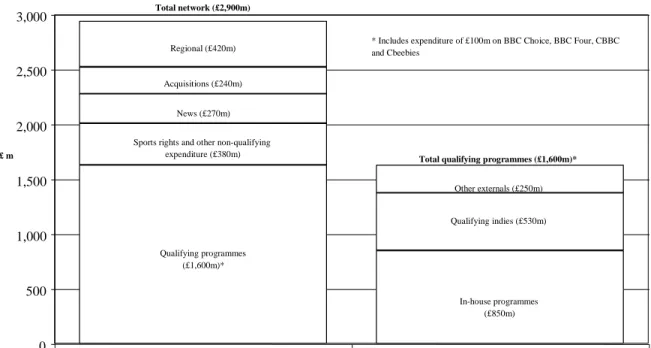
Despite the growing significance of multi-channel television in the UK it remains the case that the BBC, Channel 4, ITV and Channel 5 are crucial in providing a demand for domestically produced original programming. For example in 2001 it was estimated by the ITC that the terrestrial networks (BBC1, BBC2, ITV, Channel 4 and Channel 5) were responsible for two thirds of overall total programming spend by UK broadcasters. The majority of that spend was on original UK television content (see figure 5 below). Figure 6. ITC Analysis of Network Programming Expenditure in 2001
0 500 1,000 1,500 2,000 2,500 3,000
Network terrestrials' programming expenditure Network terrestrials' qualifying programming expenditure £ m Qualifying programmes (£1,600m)* In-house programmes (£850m) Qualifying indies (£530m) Other externals (£250m) Total network (£2,900m)
Total qualifying programmes (£1,600m)* Sports rights and other non-qualifying
expenditure (£380m) News (£270m) Acquisitions (£240m)
* Includes expenditure of £100m on BBC Choice, BBC Four, CBBC and Cbeebies
Regional (£420m)
Source: ITC, 2002.
*Reference to „qualifying programmes‟ relates to first run (that is, new and original programming) produced either in-house or by external UK based producers.
By contrast, the remaining one third of broadcasters‟ total programming expenditure, including spending by BSkyB, investment by the main network channels on their new digital services and expenditure by other multi-channel providers, was found to be dominated by spending on acquisitions, sports, movie rights and news.
2.3 The reform process within UK broadcasting
The current structure of UK terrestrial broadcasting is the result of considerable institutional and organisational change over the past two decades. A major issue has been the use of the mechanisms of competition law and economic regulation to open up the sector to increased choice and competition, in the process leading to varying degrees of vertical disintegration within the main broadcasting organisations: in effect, the
separations of stages 2-4 of the broadcasting and programme production process as outlined above.
The government-commissioned Peacock Report of 1986 led the way in advocating the introduction of competitive forces into British broadcasting. Peacock envisaged „a sophisticated system based on consumer sovereignty‟ in which it was recognised that „viewers and listeners are the best ultimate judges of their own interests, which they can best satisfy if they have the option of purchasing the broadcasting services they require from as many alternative sources of supply as possible‟ (Peacock, 1986: para. 592). The full application of this logic would have led to a system based on pay-per-view since this was the „only system‟ under which viewers could „register their preferences directly‟ for particular types of programming. On the supply side, liberalisation implied „freedom of entry for any programme maker who can cover his costs or otherwise finance his or her production‟ and the imposition of public utility-style common carrier obligation upon operators of transmission equipment (Peacock, 1986: paras. 547-8). But the report also found a place for public service broadcasting, arguing that consumers were willing to fund television production „in their capacity as voting taxpayers‟ in order to achieve greater diversity and quality of programme production, and that „public support of programmes of this type can be accepted by those who believe that viewers and listeners are in the last analysis the best judges of their own interest‟ (Peacock: paras. 550-551). The White Paper of 1988 and the Broadcasting Act 1990 therefore stopped short of imposing complete liberalisation. However, a key part of the new structure was a requirement that the BBC and ITV should contract out 25% of their programme making by volume to independent producers; as the White Paper put it, „independent producers constitute an important source of originality and talent which must be exploited and have brought new pressures for efficiency and flexibility in production procedures‟ (Home Office, 1988: para. 41).
Vertical separation within the BBC took the somewhat different form of internal administrative arrangements under which a series of producer-provider splits were implemented (see Deakin and Pratten, 2000). The context for these reforms was a perception by senior management, and in particular the then Director General John Birt, of the limitations of the traditional organisational structure of the corporation:
„the BBC developed an administrative – not a managerial – ethos of safety and solidarity and this, at its worst, brought waste and bureaucracy… [the BBC] became a vast command economy; a series of entangled, integrated baronies, each providing internally most of its needs; all the many faceted inputs to the complex business of programme making; programme departments, resource facilities and support services, all separately and directly funded. Within this highly complicated machine, bureaucrats … allocated resources and services to programme makers. Territorialism often stifled initiative. Nothing was transparent, everything opaque. It was Byzantine in many of its structures … Creative freedom was frustrated.‟ (Birt, cited in Spangenberg, 1998: 108.)
With this diagnosis of the problems facing the BBC, Birt entered into a two-phase programme of reform. The first stage, known as Producer Choice, was introduced in April 1993. It essentially took the form of a purchaser-provider split at the level of the relationship between programme makers and suppliers of production resources. The purpose was two-fold: to enable the BBC‟s management to obtain information on the indirect, overhead costs of its programmes, in particular accommodation and capital depreciation, and to benchmark the costs of internal resource provision against those of external providers, so making it possible to carry out market testing. By these means, potential inefficiencies would be identified and costs brought under control. The second stage involved the introduction of a number of separate internal units or „directorates‟ in the autumn of 1996. Programme makers were allocated to the Production directorate and commissioners to the Broadcast directorate. An internal commissioning system for television production was then put in place, to operate in addition to the 25% external quota which had been imposed by legislation. The imposition of the external quota was one of the principal factors behind the decision of BBC managers to introduce an internal market of their own:
„The point about Producer Choice was to clarify a number of issues lying behind the 25% independent quota. The BBC feared a dilution of standards in programme making. As it turned out, these fears were not well founded; the independents were seen to be making programmes of comparable quality to the in-house producers. But there was still concern over costs. We thought the independents were charging a premium, to cross-subsidise their activities, so they were more costly than the in-house producers. However, when the BBC came to cost its own programmes, it could not do so. How do you cost the canteen? So we had no handle on how we compared to the independents. Also we had no basis for improving our own efficiency. A market discipline would produce information about costs and enable us to push our costs down‟ (interview notes: BBC manager, interviewed by the authors, 2003.)
2.4 A capabilities approach to understanding market liberalisation
Virtually all sides in the debate concerning the structure of British broadcasting accept that the success or failure of the reforms cannot be judged solely by the extent to which market relations displace previously integrated organisational structures.11 The ITC, the predecessor to the industry regulator, Ofcom, stressed the importance of „production capabilities‟ (ITC, 2002: para. 12) which serve to enhance the sector‟s capacity for innovative programme making, and launched a debate on the meaning of „public service broadcasting‟ which has been phrased, in part, in terms of market failures of the kind
11
Even those industry participants and commentators most enthusiastic about the extension of market relations within the sector acknowledge the possibility of market failure and the legitimate role of public service broadcasting. Typically in these cases such an acknowledgement is rapidly accompanied by the observation that the scale of current support given to public service broadcasting is inadequately justified and excessive in relation to the degree of market failure in fact experienced, see Ball, 2003 and Veljanovski, 2001.
which may justify public intervention to ensure high quality programme production.12 What might have been a straightforward narrative of market liberalisation is qualified by a perception of the importance of common goods and resources at industry level.
The resource-based theory of the firm acknowledges the importance of „capabilities‟ which are tied up in intra-firm processes, routines and cannot be completely contracted for and or even, in some cases, made the subject of a market exchange. Hence „the competitive advantage of firms stems from dynamic capabilities rooted in high performance routines, embedded in the firm‟s processes, and conditioned by its history. Because of imperfect factor markets, or more precisely the non-tradability of “soft” assets like values, culture and organisational experience, these capabilities generally cannot be bought: they must be built‟ (Teece and Pisano, 1994: 553). The issue of „non-tradability‟ raises the question of what happens to resources of this kind when organisational routines are displaced, through regulation or bureaucratic action, by arms-length relations, and there is no option but to trade what formerly could not be traded. The possibility exists that market liberalisation, by disrupting existing organisational relations, undermines long-standing production capabilities which were tied up with the vertically integrated forms of organisation which formerly dominated the industry.
One of these capabilities is the trust and loyalty of employees who, under the former regime, had a confident expectation of job security, in return for which they were willing to transfer part of the value of tacit knowledge and expertise to the organisation and hence to the viewing public. The sociologist Tom Burn‟s longitudinal studies of the BBC, carried out in the 1960s and 1970s, argued that this was indeed the case with the pre-reform Corporation; Burns stressed the degree to which BBC staff during this period „seemed to be devoting themselves - and consciously so - to individual ends and values which were consistent with those of public service broadcasting without being necessarily derived from them‟, thereby creating what a personnel manager of that earlier era called „an increment you don‟t pay for‟ (Burns, 1994: 91). The nature of the issues involved here can be gauged by this comment on the 1990s reforms, made by an employee representative: „when the independent quota came in, and outsourcing of cleaning, catering and security began, most employees, far from saying “what an opportunity”, were fighting to hold on to their jobs,‟ with the result that „it was like working for any other broadcasting organisation; it didn‟t matter to the staff that it was the BBC any more‟ (interview notes, 2003).
Capabilities, in the sense described by Teece and Pisano, may also operate at the level of a sector, by virtue of the positive externalities generated by network relations between firms, or in the context of a region which is characterised by a shared technical or institutional resource (Lawson, 1999). Again, in this context, the impact of regulation aimed at promoting competition can be doubled-edged. Supporters of an active independent sector for programme production argue that
12
At the time of writing (February 2004), the inquiry into public service broadcasting which Ofcom inherited from the ITC is still going on This review runs alongside the debates associated with the BBC Charter Renewal instigated by the Department for Culture, Media and Sport, see DCMS 2003.
„the viewers, the punters, like sports, drama, news, but above all, innovation. If innovation is critical in the television production market, how do you get it? We think you get it by having a competitive programme supply market… How do you measure quality? You need to put in place the right creative and entrepreneurial production community, and then it‟s up to consumers to decide‟ (interview notes: industry representative, interviewed by the authors, 2003).
But here too there is a recognition that the success of the independent sector depends upon a range of factors apart from the intensity of competition: these include the types of contracting arrangements offered by broadcasters, the possibilities which are available for inter-firm collaboration, and the maintenance of a skilled workforce, but also the role of public intervention in preserving the large home market for qualifying programmes which is supported by the BBC licence fee and the regulatory commitment to public service broadcasting:
„pay per view would destroy PSB. We are not in favour of that. We support the license fee. £1.4 billion to spend on original programming – that is vital for the independent sector‟ (ibid.)
2.5 Methodology
We have been studying the development of the independent sector and the evolution of the BBC internal reform process since the mid-1990s. Our rresearch consists of a series of enterprise-based case studies forming, together, a longitudinal sector study. The factors that determine the quality of employment within television production companies and broadcasting institutions are numerous and often historically and geographically specific. The relationship between the nature of work in television and the quality of outputs produced is far from straightforward with complex and sometimes contradictory tendencies in play. The case study method allows, in our view, appropriate regard to be paid to issues of time and place and extended and repeated interviewing enables tensions between competing tendencies to be effectively captured. In the original research we carried out over thirty in-depth interviews in the period between 1996 and 1999 covering eighteen organisations in the UK media industries. In our current research, in the year to January 2004 we conducted a further round of twenty in-depth semi structured interviews with producers, commissioners, channel and business affairs executives, trade associations, unions, independent consultants and regulators. In some cases, we were able to revisit firms and individuals to whom we had spoken in the first wave of interviewing. While the advantages of the case study method are considerable, the adoption of this approach imposed certain limitations on the study. We continued to be constrained by our level of access, since only a limited number of interviews were possible in any one organisation. To fully understand organisations the size and complexity of, for example, the BBC or Channel 4, even under only one aspect of their development would require a far greater level of access than was possible within this study. More generally, as with all
case study work, care has to be taken in generalising the findings. This is particularly the case in a fluid, fast moving sector such as television. While the case study approach may be limited we also believe that it does make it possible to capture important organisational and sectoral trajectories and thereby usefully complement more quantitative approaches (see Dex, et al, 2000) to understanding structural change in the media industries.
3. The trajectory of the independent production sector 3.1 The 25% quota and the growth of the independent sector
The independent sector did not come into being with the market reforms of the 1980s; the main impetus behind its growth, to begin with, was the creation of Channel 4 as an editorial channel, with no in-house production facilities of its own. The statutory 25% production quota was intended to ensure, among other things, that vertically integrated companies, combining production and broadcasting, could more effectively benchmark the efficiency of their programme making capabilities against outside suppliers. Thus around the time of the 1990 ITV franchise auction13 several of the successful companies in that bidding process presented themselves as moving toward more of a publisher broadcaster model along the lines of Channel 4 pointing to the further potential expansion of the independent sector. Equally the arrival of Channel 5 promised to provide a further impetus to the growth of the independent sector.
In early 2004 there were around 700 television programme production companies in the UK, the vast majority of which can be classified as independent. Producers in the UK are not seen as independent if they are directly or indirectly controlled by a television broadcaster. Among the non independent producers are the production arms of the UK‟s publicly funded broadcaster the BBC, the regional license holders in the ITV network (who do not produce exclusively for the ITV) and finally, other producers who because of their links with broadcasting companies (through, for example, shareholdings) cannot be viewed as independent on current definitions.
The 25% quota was envisaged as a minimum level of outsourcing from broadcasters to the independent sector. A concern consistently expressed by the independent sector is that the broadcasters, or at least those with their own production arms, commission to the quota. For example, the BBC outsourcing of programming hovers just above the 25% minimum. Indeed, in 2001 and 2002 the BBC missed its statutory 25% quota obligations. During the 12 months ending 31 March 2002 only 21.8% of qualifying BBC output – the quota excludes news and current affairs – came from the independent sector. In the preceding 12 months the figure had been 23.7%. The BBC responded to the figures by highlighting their dependence on one key supplier who is not officially considered as an independent supplier. Endemol is responsible for a number of important BBC shows but is not regarded as an independent producer since
13
For further discussion of the ITV franchise auction and its impact on the sector see Deakin and Pratten, 2000 and Bonner, and Aston, 1998: chapters 10 and 11.
its parent company Telefonica owns a broadcaster in Spain.14 Independent producers point to this as evidence that a level playing field has yet to be established and commissioning decisions are not being driven purely by the quality of the proposals.
The 2002 ITC review of programme supply considered the future of the quota. It considered that „there remains for the time being an important role for an independent production quota in the UK‟ on the grounds that „the quota has created access to the main networks for a large number of new producers, and without it, there is a risk that the main broadcasters would once more favour in-house suppliers‟ (ITC, 2002: para. 32). But it also rejected calls for the quota to be extended, except to the extent of recognising that it should apply to the BBC‟s licence-fee funded digital channels, and to BBC1 and BBC2 separately (para. 37).
3.2 Terms of trade, broadcast rights and the form of production contracts
The issue of the relationship between the broadcasting institutions and the independent sector and the „terms of trade‟ between them became and remains a focus for debate. The expression „terms of trade‟ covers „the broadcaster‟s benchmark, framework and guide for the negotiation of production deals with independent producers; it embraces „the commissioning procedure, guidelines on development and approvals, along with the broadcaster‟s starting point on key issues such as rights, production fee, net revenue share, distribution etc.‟ (ITC, 2002: Appendix 5, para. 2). Each of the main broadcasters publishes its terms of trade, although the standard form contracts which constitute the basis of agreements with independents are not published (the terms of trade, as such, are not legally binding, and will not necessarily be incorporated into any contract).
Until recently the terms of trade between broadcasters and independents varied substantially across the sector. The main divergence was between models offering a „full funding‟ or „cost-plus‟ contract, under which the broadcaster paid in advance the full costs of production plus a fee for the producer, and a „licensing‟ option under which production costs were borne by the supplier. Under full funding, the broadcaster acquired all rights in relation to the programme, that is, not just the primary right to broadcast it in the UK, but all secondary rights relating to its rebroadcast on other channels and further exploitation in the UK or overseas, and tertiary rights relating to residual copyright and merchandising. The licensing variant, by contrast, allowed the producer to retain most secondary and tertiary rights, with the broadcaster licensed for a limited number of showings over a fixed period of time, sometimes with the option of an extension.
At one extreme of the spectrum were the ITV Terms of Trade, which provided that the ITV Network Centre, the body through which (among other things) agreements with independents were made, acquired only the right to UK terrestrial showings for a limited period, and which, in return, required the supplier to meet all production costs up front and to carry the risk of any shortfall between the agreed fee and actual costs. The
14
Endemol is now due to get its independent status restored this year after successfully arguing that it should not be excluded.
Network Centre had no funds of its own for programme development, so that a licensing model of this kind was its only viable option; however, the ITV Terms of Trade went further than this in seeking to protect the rights of independent producers, guaranteeing them equal access to the commissioning process with in-house ITV producers, and applying the same selection, commissioning and contracting procedures across the board.
By contrast, the BBC, Channel 4 and Channel 5 all operated some version of the fully-funded model, but with variations in the degree to which producers are allowed to retain certain rights. „Format rights‟, or „the rights to the idea, concept or other distinctive features of the programme, including remake rights and sequel rights‟, which are not normally protected by copyright law, were assumed by Channel 4 as part of the deal for funding, whereas the BBC and Channel 5 allowed them to remain with the programme maker. In other cases, the possibility of negotiation over the terms of the deal was explicitly acknowledged; thus Channel 4 maintained that it is prepared to negotiate on an individual basis with each independent producer it deals with (ITC 2002, Appendix 5: para. 36).
The ITC review of programme supply, conducted in 2002, came out strongly in support of the ITV model for terms of trade, arguing in favour of „a presumption… that producers retain rights in their programmes unless explicitly sold to broadcasters and other parties‟. In addition, the ITC recommended that there should be clear separation, within agreements, of primary, secondary and tertiary rights; that the terrestrial broadcasters should publish indicative tariffs for primary rights, so that producers would be aware in advance of the scale of funding available in return for the acquisition of such rights; and a clear demarcation should be drawn between negotiations with distributors over the content of secondary and tertiary rights and negotiations with broadcasters over primary rights. These principles should then be incorporated into Codes of Practice, published by the broadcasters, which it would be the responsibility of Ofcom to enforce. The Communications Act 2003 incorporated the recommendations of the ITC Programme Supply Review, and empowered Ofcom to issue guidance notes for Codes of Practice. The Ofcom guidance, also based largely on the earlier ITC Review, was published in early 2004 and the BBC and Channel 4 shortly afterwards published new Codes of Practice incorporating, in essence, the Ofcom recommendations.
The basis for the ITC‟s conclusion was, in part, the perception that the BBC had used its market power „to squeeze price and profit margins on primary rights‟, but even if this argument from abuse of a dominant position had not been available, the ITC would probably still have opted for the licensing model as a means of enhancing the sustainability of the independent sector: „unless changes are made to the framework within which commissions are negotiated, then it is unlikely that a strong independent sector, able to build long-term value and capable of attracting significant external finance, will emerge‟, in particular since the inability of independents to retain secondary and tertiary rights „reduces their attractiveness to external investors‟ (ITC, 2002: Appendix 5, para. 21).
The ITC‟s approach chimed in with the views of the large and more ambitious independents who saw their priority as orientating their operations toward markets where there is greater competition for television content. These are independents which have taken steps toward establishing themselves as sustainable enterprises capable of competing outside the „protected‟ regime instituted by the quota. In the mid to late 1990s it was argued that „because the independent producer doesn‟t have the capital to develop his business… independent production in this country is nothing more than a cottage industry‟ (Gutteridge, 1995: 7). One indicator of the precarious position of many television producers was their dependence upon commissions from one broadcaster and their exclusive expertise in one genre of programming. In 1997 a survey of UK television production found that 58% of officially independent production companies only produced for one channel during the four year period under scrutiny and 84% did not produce for more than two channels. Meanwhile the same survey found that 78 % only produced in one genre and 94 % did not produce in more than two genres.15
From that period onwards there has been a growing division in the sector between a small group of successful and growing businesses, engaging in take-over and merger activity, some attracting venture capital and increasingly adopting an international orientation and a larger group of smaller independents which remain heavily dependent on one or at most two commissions a year. In our current round of interviews, some respondents spoke of a generational shift which the sector has been going through, with the result that many of the original „cottage industry‟ producers are dying off. The changes introduced by the Communications Act 2003 are expected to accelerate this change. As more independents build up stocks of programmes in which they retain secondary and tertiary rights, they can use these assets to attract venture capital and other forms of external finance. For some in the industry, this is a major change: „it‟s never been a business sector before‟ (industry representative, interview notes, 2003).
However, the sector was not of one view. For the smaller independents the kind of contract which has long been typical within Channel 4, whereby programme costs are met by the channel and a production fee is paid on completion, carries advantages in terms of a guaranteed income over the ITV model where the company does not receive payments to cover costs until the programme is delivered. Moreover, some of the broadcasters (in particular Channel 4) have argued that to pursue the rights-based model at all would be to fail to recognise the creative contribution which the broadcasting institutions themselves made to the programmes they commission. According to a recent study based on extensive interviews with commissioning editors:
„The majority of programme ideas have some creative input from the commissioner, and a significant amount are being thought up in the first instance by them. Commissioners argue that they, not the indies, have most understanding of the Channel requirements, and so they find it more straightforward to undertake programme idea generation themselves. The practice is widespread. Many interviewees said that they thought up
15
„The Situation of Independent Television Producers in Great Britain, France and the Netherlands‟, The European Institute for the Media.
programme ideas themselves, seeing it as a very important aspect of their role. When asked about the approximate percentage of commissions that had such input, many put it between 20% and 50% of their commissions‟ (Preston, 2003: 18)
3.3 Output deals
A related issue is the growing reliance on long-term output deals between broadcasters and producers. For some considerable time it has been apparent that there exists a sub group of independents whom the broadcasters primarily rely upon: thus we learned from our current round of interviews that Channel 4 uses just 30 suppliers to supply it with 70% of its originally commissioned material. Moreover, these relationships with key suppliers have become formalised via the use of output deals sometimes lasting a number of years. Reputation and experience are of vital assistance to commissioners who are looking to establish a reliable source of supply. It is also in the interest of commissioners to build up particular relationships through repeat trading:
„Some of the more established documentary companies are much better at targeting their proposals at particular strands. Experience has given them a clear idea of what is suitable for the different strands. It has become a bit of a vicious circle. If they get more commissions, they spend more time with us and get to know our judgements better. They watch a lot of our output and target their ideas accordingly. If an untried person approaches us with a proposal we like, we may advise them to take the idea to one or two of these companies‟ (Channel 4 commissioning editor, quoted in Holland, 1997: 232)
As a Channel 4 commissioning editor recently put it to us:
„the output deals change the nature of the relationship with the company. The producer does not feel like he is selling. If there is an element of security in the deal, there is an element of collaboration. The proportion of commissioning deals on the basis of collaborative relations is about 10%, but can become higher‟ (interview notes, 2003).
This trend towards output deals may bring financial stability to producers, but for critics of the practice, it also weakens competition, thus contributing to the consolidation within the independent production sector. For those independents with capacity to trade in the international market for broadcast rights, output deals are not necessarily viewed positively, as they may imply giving up property rights.
It is important to recognise however that running alongside, sometimes intermingled within, these kinds of interpretation is a quite different view, which could be equally consistent and draws upon a more complex and sustainable account of market relations. This contrasting view emphasises the role of collaboration, long term relations and trust between commissioners and producers in providing quality programmes. Thus a
BBC manager commented to us that „the development of long term relationships has distinct advantages specifically in terms of quality. It is the combination of the delivery of quality product at reasonable cost‟ (interview notes, 2003). Similarly when announcing a series of output deals with independent documentary makers Channel 4‟s head of documentaries explained:
„The key thing is, how do we get our conversations to be more grown up rather than being slightly overselling sales person and suspicious reluctant buyer, which characterises a lot of the dealings. I want to have relationships with producers where we both look for the right things.‟ (Broadcast, 13 June 2003).
It has been suggested that „every commissioner who‟s got a good reputation has a super indie who‟s their first port of call‟ (commissioning editor, reported in Preston 2003: 22). 3.4 Training and labour supply
A wider issue is how far the growth of the independent sector has had system effects within the sector which have been detrimental to the sustainability of the industry in the longer term. It has been claimed that the growth of the independent sector in conjunction with the increase in the freelance labour market has undermined traditional training patterns and career paths to the detriment of the long term health of the sector (Saundry, 2003). As early as 1989, the „Skill Search‟ survey had reported that traditional routes to skill formation were being eroded as a result of the fragmentation of production in the sector. This led to a number of initiatives being undertaken to shore up training provision, including formation in 1993 of Skillset, an industry training organisation funded by the major unions and employers including the BBC and Channel 4, as well as the independent producers‟ association, PACT. However, Skillset‟s own research showed that, by the mid-1990s, there was growing reliance within the independent sector on an ageing workforce, previously trained by either the BBC or one of the ITV companies, but which was not being replenished. There is also evidence that the Producer Choice initiative in the BBC reduced the training received by freelances, as did the restructuring of many of the ITV companies following the introduction of auctioning of licences after 1990. In 2001, a report of the Audio Visual Industries Training Group, while asserting that the fragmentation of production had led to greater flexibility and hence to efficiency gains, also pointed to a „potential contradiction between companies‟ long-term investment in human capital and their need to adapt in the face of rapid technological change‟ (AVITG, 2001: 28).
Again, there are two views within the industry and amongst commentators. On the one hand there are those who argue that liberalisation, leading to fragmentation and decentralisation, has been associated with an erosion of training provision. Ursell for example suggests that exposure to market competition has significantly undermined the industry‟s ability to reproduce through on-the-job training the cultural values that ultimately underpin public service broadcasting. She writes:
„The loss of colleagues, particularly the older and more experienced ones, in the context of more pressurised production schedules, constitutes the erosion of relational structures and temporal space allowing journalists to think and to reflect on their practice. Simultaneously it substantially reduces the possibilities of “learning from Nelly” on the job. The older generation is in a much weaker position to educate and socialise the younger. The values of public service which have informed broadcast journalism practice since the 1920s are no longer conveyed via a social fabric of occupational community to the cohorts of new journalists entering broadcast news production. This is true even in the BBC, notwithstanding its continuing efforts to honour [public service broadcasting], since the organisation has also radically reduced its numbers of older and more professionally experienced staff‟ (2003: 41).
On the other hand, many independent companies argue that the extent of the problem has been overstated, and that changes in technology are making many of the traditional skills of technicians and others irrelevant. This was a consistent theme in our recent interviews, and one also reported by Saundry in his recent review. As Saundry accepts (2003: 22), „with film and television production at an all time high, convincing evidence has not yet been produced that demonstrates that the “skills crisis” has had a negative impact on either the bottom line or the quality of work produced in the UK‟.
4. The evolution of the BBC internal market 4.1 The unexpected effects of the internal market
The reforms within the BBC had unexpected effects on staff morale, innovation and even efficiency. While a greater awareness and sensitivity to issues of cost and efficiency was engendered by the introduction of internal trading, the form of the internal market brought new problems of its own. The resource-based directorates were expected to compete with external facilities providers yet, initially, were not themselves able to bid for outside work on any significant scale. They were also expected to help cover heavy corporate overheads which made it difficult for them to match the charges of the smaller independent providers. Moreover the charging structure which was implemented was rigid and took little account of high volume use. The limitations of the Producer Choice initiative were recognised by BBC executives themselves:
„in its first form [Producer Choice] was too complicated, with 485 business units and, in the first two years, a third of all transactions for less than £100. These were changed in time, but John Birt was firm on the rules and loath to relax them or intervene. He wanted the invisible hand to do its work….it was resources that took the hard hits, the job losses from Producer Choice. Capacity remained high and more closures were necessary. A few producers, including some vociferous about saving the BBC in house resources, acted capriciously once given the choice of
studios, OB vans, editors and camera crews elsewhere. „Playing shops‟ was the term the frustrated resources managers used. Most producers who went outside did so for particular talent or for price. BBC prices were uncompetitive because of the overhead.‟ (Wyatt, 2003: 276)
The implementation of Producer Choice led to debates within the corporation concerning which kinds of activities could benefit from market type co-ordination and which were perhaps too important to be left to this form of organisation. So, for example, Producer Choice was initially extended to the supply of Research and Development effort within the BBC. However it was quickly recognised that given the rapidly changing technical environment of broadcasting this was an area of such strategic significance that internal market provision was simply too risky an option (see Childs, 1997 for details).
The 1996 split between broadcast and production was also, in time, seen as generating certain tensions which limited its ability to deliver improvements. BBC Broadcast received the license fee income, while BBC production had no autonomous income. Production also had no official claim on rights, which were held and negotiated by BBC Worldwide with rights revenues returning to BBC Broadcast. Just as with the resource departments before them, in-house producers perceived that they were being treated unfairly and that the internal market was being structured in such a way that they could not compete effectively. Since the production directorate was not allowed to sell its programmes to outside commissioners, while the broadcast directorate could commission from the independent sector, production units were in a weak bargaining position. As one finance executive recalls:
„The split made life hard for Production. The fact that Broadcast could buy in programmes from the independent sector constrained BBC production. They had a certain capacity that they had to fill in order to break even. This gave Broadcast a great deal of negotiation power over prices. They would push down prices as far as possible because they knew Production had no alternative. They could not offer their production to another commissioning house. On balance, Production would rather have made the programme than not at all‟ (quoted in Hall, 2001: 51).
In similar vein, a former BBC broadcast manager told us in 2003:
„There was much to be said for the structural separation which John Birt introduced: organisational structure has had quite an influence. It led to specialisation in production and the development of core managerial skills; on the broadcast side, it led to a better understanding of what the audience wanted, and greater efficiency through market testing. However, in practice, the split was taken to an unproductive extreme. The commissioners behaved as if they were buying on a spot market. In time they came to learn that they should be developing long-term relationships with particular suppliers. But at the time, there was a serious loss of morale in the BBC‟ (interview notes)
The then head of BBC Broadcast has since acknowledged that „[t]he chief problem with the reorganisation was that once in existence, BBC broadcast was seen to be bigger and more powerful than anyone expected, creating an imbalance in the BBC. The result of this was that other parts of the organisation tried to claw back what they could. This wasted much energy and time on all sides‟ (Wyatt, 2003: 298).
Some of the internal producers also claimed that the split between broadcast and production inhibited the creative process involved in programme making.
„Overnight the Managing Directors of Television and Radio no longer sat at the top table of the BBC. Instead they reported to and were represented by, the Chief Executive of Broadcast. Producers in BBC Radio and BBC Television suddenly found that their world had been turned upside down as they had become part of a new bi-media division called Production …. The Broadcast/Production split … led to departments declaring war on each other, as they battled for commissions to survive. Science would try to get Religion‟s programmes and vice versa…. I think the uncertainty led to safe programming and abandonment of risk. Why risk a challenging idea which might not be commissioned, if a formulistic one guaranteed success? At least you kept your job.‟ (Abramsky, 2002)
As one Human Resources officer told us:
„Creativity should be a marriage between production and commissioning. And the split of these two areas meant a loss of confidence in production. After the split, production people found themselves in the position of resources people and hated it.‟ (BBC manager, interviewed by the authors: interview notes, 2003)
Similarly, Born suggests that the 1996 restructuring effectively disempowered BBC Production vis a vis BBC Broadcast:
„Relations between Production and Broadcast became troubled. Broadcast began to offer budgets for expensive commissions, such as high cost dramas, that were lower than their actual cost to in-house production departments, forcing them …. to seek co-production funds themselves from foreign broadcasters, in turn diluting their commitment to creative risk. The restructuring led also to greater centralisation and rationalisation in the commissioning of programs and less creative autonomy for production departments. Rather than each production department having a role in decisions about what would get made, now the Channel Controllers, supported by teams of market analysts, schedulers and audience researchers, issued commissioning booklets to in-house and independent producers containing strict templates for each schedule slot that set out precisely what was required in terms of genre, “feel” budget,
target demographic and rating. Producers henceforth pitched competitively to gain commissions for each centrally defined slot.‟ (2002: 73)
The malaise of in-house producers was said to partly explain the decision of the management to guarantee its in-house production directorate 60% of the annual programme expenditure of BBC1 and BBC2. This self-regulated quota reduced the area of competition between in-house producers and independents: competition between inside producers and independents was reduced to only 15% of the market, given the compulsory quota of 25%.
The implementation of the split between production and broadcast in the BBC therefore raised internal conflicts of interest, and the very responses which the BBC made to overcome these tensions called forth complaints from independent producers concerned that they could see access to potential commissions being once more curtailed. While Producer Choice and the extended internal market within the BBC did have the merit of allowing for greater awareness of the costs involved in television production and for enhanced accountability, they also had the side effect of increased bureaucracy, high co-ordination costs, and effectively inhibited innovation. In sum, it seemed that the merits of the internal market were overcome by the excessive costs of co-ordination.
4.2 Reconfiguring the BBC’s interface with the market
With the appointment of Greg Dyke as Director-General in 2000 the BBC was subject once more to a wave of organisational reform. The new reforms were in part a response to the perceived limitations of the earlier structural changes. However, whereas the 1996 reforms were responding to the problems of Producer Choice by taking the logic of the internal market further, the „One BBC‟ reforms introduced by Dyke could in certain respects be seen as abandoning at least some aspects of that logic.
The stated motivation for the reforms was similar to that which underpinned the earlier reforms. After the 1999 report on funding the BBC (the so-called „Davies Report‟, after the chairman of the committee, Gavyn Davies, who later became Chairman of the BBC), the pressure on the organisation to control its costs remained albeit in a rather different financial context from the 1990s. The report stated that „the BBC should retain a central role in the provision of public service broadcasting in the early years of the digital age, at least up to Charter Review in 2006‟, and that „the prime source of new funding for extra services should be self-help by the BBC, in the form of efficiency savings, commercial revenues and privatisation revenues‟ (our emphases) (Davies Report 1999: 6). Davies also recommended that „the Director-General (of the BBC) should ensure that expenses for the central management and bureaucracy of the BBC are commensurate with those of equivalent private sector organisations‟ (Davies Report 1999: 32). The Report also argued for the creation of a digital licence fee, so as to allow the BBC to compete in the digital age without cannibalising the terrestrial/analogue signal service. But this additional income should be secondary in face of the BBC‟s self raised funds.16
16
At the time of the Davis report, the BBC put forward its „full service vision‟. In this plan the BBC factored in an increase of £600 million every year from 2000 to 2006 to be channeled into