EUROPEAN ORGANIZATION FOR NUCLEAR RESEARCH (CERN)
CERN-PH-EP/2012-364 2013/02/18
CMS-EXO-12-015
Search for heavy narrow dilepton resonances in pp
collisions at
√
s = 7 TeV and
√
s = 8 TeV
The CMS Collaboration
∗Abstract
An updated search for heavy narrow resonances decaying to muon or electron pairs using the CMS detector is presented. Data samples from pp collisions at√s = 7 TeV and 8 TeV at the LHC, with integrated luminosities of up to 5.3 and 4.1 fb−1, respec-tively, are combined. No evidence for a heavy narrow resonance is observed. The analysis of the combined data sets excludes, at 95% confidence level, a Sequential Standard Model Z0SSM resonance lighter than 2590 GeV, a superstring-inspired Z0ψ lighter than 2260 GeV, and Kaluza–Klein gravitons lighter than 2390 (2030) GeV, as-suming that the coupling parameter k/MPlis 0.10 (0.05). These are the most stringent
limits to date.
Submitted to Physics Letters B
∗See Appendix A for the list of collaboration members
1
1
Introduction
A number of scenarios for physics beyond the standard model predict the existence of heavy narrow resonances that decay to lepton pairs. In this Letter, we report on a search for reso-nances with the Compact Muon Solenoid (CMS) detector at the CERN Large Hadron Collider (LHC) [1]. We consider the following three benchmark scenarios: the Sequential Standard Model Z0SSM with standard-model-like couplings [2], the Z0ψ predicted by grand unified theo-ries [3], and Kaluza–Klein graviton excitations in the Randall–Sundrum (RS) model of extra dimensions [4, 5]. The RS model has two free parameters. One parameter is the mass of the first graviton excitation, and the other is the coupling k/MPl, where k is the curvature of the extra dimension and MPlis the reduced Planck scale.
Previous searches for narrow Z0 → `+`−(` =
µ, e) resonances have been reported by the
CMS [6] and ATLAS [7] Collaborations, each based on integrated luminosities of 5 fb−1at√s=
7 TeV. The CDF and D0 experiments have published results based on integrated luminosities exceeding 5 fb−1of pp collisions at√s =1.96 TeV [8–13]. The best previous direct lower limits on the Z0SSM and Z0ψ masses are 2330 GeV and 2000 GeV [6], respectively. The best previous direct limits on RS graviton (GKK) production are 2160 GeV for k/MPl = 0.1 [7] and 1810 GeV
for k/MPl=0.05 [6]. Indirect constraints [14–17] are less stringent.
We use data samples from pp collisions at center-of-mass energy√s=8 TeV, corresponding to an integrated luminosity of 3.6±0.2 fb−1for the dielectron channel. The dimuon channel does not use information from the calorimeters and incorporates additional data from running peri-ods when the calorimeters were not fully operational. This increases the integrated luminosity of the sample to 4.1±0.2 fb−1. We combine the analysis of these data with previous results from the analysis based on an integrated luminosity of 5 fb−1 at √s = 7 TeV [6]. The recon-struction, selection criteria, efficiencies, and systematics for the two data sets are very similar. The results are applicable to any model with a narrow resonance that has equal dimuon and dielectron branching fractions. A resonance is considered narrow if the experimental width is dominated by the detector resolution.
We perform a shape-based analysis of the dilepton mass spectra searching for a peak on a smoothly falling distribution with the overall background normalization determined by an unbinned maximum likelihood fit. The data are consistent with expectations from the standard model. We report limits on the ratio (Rσ) of the production cross sections times branching
fractions of a heavy narrow resonance to that of the Z boson, at the 95% confidence level (CL). Many experimental and theoretical uncertainties cancel in this ratio. We further translate these limits into lower limits on the masses of new heavy narrow resonances, using next-to-next-leading-order (NNLO) cross section calculations [18] for the Z boson production.
2
The CMS detector
A detailed description of the CMS detector can be found in Ref. [19]. We briefly discuss the sys-tems most relevant to this analysis. The central feature of the CMS detector is an all-silicon in-ner tracker system, composed of silicon pixel and strip detectors. The tracker is surrounded by a lead-tungstate crystal electromagnetic calorimeter (ECAL) and a brass-scintillator hadron cal-orimeter (HCAL). The finely segmented ECAL consists of nearly 76000 lead-tungstate crystals which provide coverage up to pseudorapidity|η| =3.0. It is divided in the barrel (|η| <1.479)
and endcap (1.479 < |η| < 3.0) detectors. We define pseudorapidity as η = −ln[tan(θ/2)].
2 3 Event selection and object reconstruction
We use φ for the azimuthal angle of a track’s momentum at the point of closest approach to the beamline. The tracker and calorimeter systems reside within a 6 m diameter superconducting solenoid, which produces a 3.8 T axial magnetic field. Muons are detected by gas-ionization chambers embedded in the steel flux-return yoke.
The CMS experiment utilizes a two-level trigger system. The first level of the trigger (L1) selects events of interest using custom hardware processors [20]. It uses information from the muon and calorimeter systems to reduce the readout rate from the 20 MHz bunch crossing rate to a maximum rate of 100 kHz. The software based high-level trigger (HLT) further reduces the recorded event rate to a few hundred Hz by adding information from the inner tracker and analyzing event information in greater detail [21].
3
Event selection and object reconstruction
The event selection closely mirrors the one used for the √s = 7 TeV analysis. We briefly re-view the procedure here. Dimuon events are triggered by requiring at least one muon to be reconstructed by the HLT and to have transverse momentum pT > 40 GeV and|η| < 2.1.
Di-electron events are accepted by a double-Di-electron trigger requiring two clusters in the ECAL, each with transverse energy ET > 33 GeV. The trigger allows only small deposits of energy
in the HCAL to be associated with the ECAL clusters. HLT clusters are required to be loosely matched to the trajectories of tracks having hits in the pixel detector. The lepton trigger effi-ciencies are measured using a “tag-and-probe” technique at the Z resonance [6, 22, 23], up to transverse momenta of roughly 500 GeV for muons and 100 GeV for electrons. For higher trans-verse momenta, the electron efficiency is measured using a simple trigger which requires only an ECAL cluster with ET >300 GeV to directly monitor the trigger efficiency for selected high
mass events. In order to have a consistent trigger between the low-mass control region and the high-mass signal region, the simple ECAL trigger is used only to validate the efficiency of the primary trigger. The muon trigger efficiency is 97% for events with both muons within the trig-ger acceptance, across the entire range of dimuon invariant masses of interest. The efficiency of the electron trigger for dielectron candidates passing the analysis selection requirements in-creases from 80% at electron ET = 35 GeV to a 99% plateau at ET > 37 GeV. The efficiency
threshold curve of the trigger is measured using data collected by a lower threshold trigger that is applied to approximately every 5th event passing the L1 part of the trigger. Because the threshold behavior is well-determined, the offline ETselection cut can be placed at 35 GeV,
which improves the normalization to the Z peak. Both muon and electron trigger efficiencies are within 1–2% of those found in Ref. [6]. Standard CMS algorithms [6, 23, 24] are used to re-construct and select muon and electron candidates. Muon candidates are formed by matching tracks in the silicon tracker to tracks in the muon systems. Muon tracks are required to have hits in nine or more layers of the tracker and include at least one hit from each of the pixel and muon systems.
Muon candidates are required to be isolated in a cone about the muon direction of∆R < 0.3 in the tracker and to have pT > 45 GeV and|η| < 2.4. The quantity ∆R is defined as ∆R =
p
(∆η)2+ (∆φ)2, where ∆φ is in radians. The combined fit of the muon trajectory through
the tracker and muon systems provides a reliable measurement of muon momenta extending to order 1 TeV [23, 25]. Electron candidates are formed by matching ECAL clusters to recon-structed tracks, and are required to have|η| <1.442 and 1.560< |η| <2.5 for the ECAL barrel
and ECAL endcap regions, respectively. As in Ref. [6], electrons are additionally required to have little associated activity in the HCAL, have a shower shape consistent with that of an electromagnetic object, and be isolated in a cone about the electron direction of ∆R < 0.3 in
3
the calorimeter and tracker. To account for the contamination which varies with the number of additional proton-proton interactions per event, the calorimeter isolation of the electron is corrected for the average energy density in the event [26].
The ECAL is capable of measuring energies in a single crystal of up to approximately 1.7 TeV in the barrel region and 2.8 TeV in the endcap region. Saturation effects become an issue for resonance masses around 4 TeV, which are beyond the reach of the current analysis, within the framework of the models considered here. Occasionally, anomalously large signals are observed in the barrel ECAL due to the direct deposition of energy into the avalanche photo-diodes (APDs) by particles transiting the detector [27]. Since the APDs are normally used to detect the scintillation light produced by the crystals, the equivalent energies of these signals can reach into the TeV range. The deposits are generally in a single channel and have different pulse timings from scintillation signals. They are rejected by cutting on the timing of the pulse and the amount of energy recorded in neighboring crystals.
More than 99% of the anomalous clusters are rejected with a negligible loss of real electrons [27]. When combined with the requirement of a compatible track in the silicon tracker, this require-ment reduces background from anomalous clusters to a negligible level. However, the energy deposit pattern of all selected high energy electrons is scrutinized even further. There is no evidence that any of the remaining events is due to these anomalous signals.
Previously established techniques [6, 22, 23] are used to measure event reconstruction and se-lection efficiencies. The efficiencies for reconstructing and selecting leptons are roughly 90%, for both muons and electrons with pT > 100 GeV. The efficiencies include the isolation
re-quirements and are measured with total uncertainties of a few percent. Part of the systematic uncertainty cancels in the ratio of high-mass dilepton cross section to the Z boson cross section. Studies with Monte Carlo simulated samples predict both lepton reconstruction and selection efficiencies to be constant within 1% for transverse momenta pT ≥100 GeV.
Each dilepton candidate is required to have two isolated leptons of the same flavor that pass the identification criteria described above. When multiple dilepton candidates are present, the most energetic pair in the bunch crossing is selected. For dimuon events, one muon must have
|η| < 2.1 to satisfy the trigger requirements. For dielectron events, at least one electron must
have|η| < 1.442. This removes events in which both electrons are in the endcap, a topology
where little signal is expected but which has a significant background arising from misidenti-fied jets. Muons are required to have opposite charge, since a charge mis-assignment implies a large mismeasurement of momentum. The energy estimate for electrons is dominated by electromagnetic calorimeter information and is not sensitive the momentum mis-measurement indicated by a charge mis-assignment. The charge requirement would also result in a few per-cent efficiency loss in a region with little background and would degrade the sensitivity of the analysis. Therefore, we do not impose a charge requirement for dielectron candidates at high mass. Muon candidates are additionally required to originate from the same vertex. The χ2 per degree of freedom for the fit to a common vertex is required to be less than 10. The tracker-measured transverse impact parameter with respect to the beam spot must be less than 2 mm for each muon. The mass resolution of a dielectron candidate is predicted by Monte Carlo sim-ulation to be approximately 1.8% for masses above 800 GeV. The dimuon mass resolution is 5% (9%) at 1 TeV (2 TeV) and increases linearly with dimuon mass.
The opening angle of the muon pair is required to be less than π−0.02 radians. This re-quirement greatly reduces the cosmic ray background associated with muons traversing the detector.
4 5 Results
4
Backgrounds
The dilepton background in pp collisions at√s = 8 TeV is very similar to that found in√s =
7 TeV collisions [6] even though there were significantly more interactions per bunch crossing at the higher energy. The effect of this ”event pileup” is included in our simulations of back-ground processes and our data-driven estimates of the backback-ground from misidentified jets. The dominant standard model background is due to Drell–Yan production. The shape of this contri-bution is determined from Monte Carlo simulation using thePYTHIAv6.4 [28] event generator. The background contribution is normalized to the event count at the Z peak by counting same-flavor dilepton candidates within the mass window 60 < m`` < 120 GeV. The next largest
background contribution is due to other standard model processes that produce isolated dilep-tons. We consider the lepton flavor symmetric processes of tt, tW, Z → τ+τ−, and diboson
(WW, WZ, and ZZ) production when estimating this background component. The absolute normalization and shape for these backgrounds is taken directly from Monte Carlo simulation generated using MADGRAPH 5 [29], POWHEG [30–33], and PYTHIA. We validate this back-ground prediction by comparing the eµ dilepton mass spectra for data and simulation.
Track-based lepton isolation strongly suppresses backgrounds from jets misreconstructed as leptons. This background is almost negligible for the dimuon channel but is a significant por-tion of the non Drell–Yan background in the dielectron channel. Since misidentificapor-tion of jets as leptons is more likely to occur for electrons than for muons, electrons have additional iso-lation and jet discrimination requirements. In the dielectron channel, the main contributing processes apart from Drell–Yan are dijet, W+jet, and photon+jet production (where the photon is misidentified as an electron). The probability that a jet is misidentified as an electron is mea-sured in bins of ETand η, using a jet-dominated sample. This probability is then used to weight
events in which one electron satisfies all selection criteria and the other is a candidate for being a misidentified jet, to obtain the jet background prediction. The dimuon resonance search is susceptible to backgrounds from cosmic ray muons. The expected cosmic ray background for dimuons with mµµ > 200 GeV is determined from two complementary samples. For events
in the first sample, the requirement on the dimuon opening angle is removed. In the second sample, the impact parameter requirement on the muon tracks is not applied. From the popu-lations of these two samples, the remaining cosmic ray background contamination is estimated to be less than 0.2 events.
5
Results
The dilepton mass distributions for events passing all the selection criteria are shown in Fig. 1. The “jets” distribution illustrates the contribution of events in which at least one jet is misre-constructed as a lepton. This distribution is derived from data while all other components are derived from simulation. The relative fractions of the different background components are fixed to the ratios of their theoretical cross sections. The total simulated background is normal-ized to data at the Z peak (60 < m`` < 120 GeV). The expected yields in the control region
(120< m`` < 200 GeV) and in the search region (m`` > 200 GeV) are compared with observed
yields in Table 1. The observed mass spectra and event counts agree with standard model predictions both in shape and normalization.
We set a 95% CL limit on the ratio Rσof the product of the cross section and branching fraction
for each Z0 boson to that of the standard model Z boson. The cross section of the Z0 boson is calculated in a window of±40% about the on-shell mass of the resonance, while for the Z boson it is calculated in the peak window defined above. We follow the Bayesian procedure of
5 ) [GeV] -µ + µ m( 80 100 200 300 1000 2000 Events / GeV -4 10 -3 10 -2 10 -1 10 1 10 2 10 3 10 4 10 5 10 DATA -µ + µ → /Z γ τ τ , tW, WW, WZ, ZZ, t t jets -1 CMS, 8 TeV, 4.1 fb m(ee) [GeV] 80 100 200 300 1000 2000 Events / GeV -4 10 -3 10 -2 10 -1 10 1 10 2 10 3 10 4 10 5 10 DATA -e + e → /Z γ τ τ , tW, WW, WZ, ZZ, t t jets (data) -1 CMS, 8 TeV, 3.6 fb
Figure 1: The invariant mass spectrum of µ+
µ−(left) and ee (right) events for the
√
s = 8 TeV data set. The points with error bars represent the data. The solid histograms represent the standard model predicted background contributions.
Table 1: The dilepton event count in the control region 120<m`` <200 GeV and in the search
region m`` > 200 GeV for the
√
s = 8 TeV data set. The total background is the sum of the events for the standard model processes listed. Uncertainties represent a quadrature sum of statistical and systematic uncertainties.
Source Number of events
Dimuon sample Dielectron sample (120–200) GeV >200 GeV (120–200) GeV >200 GeV
Data 1381 3503 12030 2904
Total background 13010±590 3630±160 12240±590 2970±260 Z/γ∗ 11700±570 2920±140 10660±530 2200±220 tt + others 1280±150 698±78 1220±180 560±80 Jets 26±3 10±1 360±180 210±110
Ref. [6], which is based on an unbinned extended maximum likelihood analysis. We calculate the limits using the 8 TeV data alone, as well as from a combination of the 8 TeV and 7 TeV data sets. Mass-dependent ratios of parton distribution functions (PDF) at√s = 7 TeV and 8 TeV are used as an additional input to derive limits on Rσat 8 TeV, Rσ,8TeV, that combine both data
sets. The CTEQ6.1 LO PDF set [34] was used to calculate these ratios, and the result was cross-checked with the MSTW2008 PDF set [35]. The CTEQ and MSTW calculations agreed well and the uncertainty in this ratio does not significantly contribute to the final result. The most signif-icant uncertainty in the limit computation is associated with our understanding of the selection efficiency and detector acceptance ratio for Z0bosons relative to the Z, denoted Re. The
uncer-tainty in the total lepton selection efficiency at high mass dominates the Re uncertainty. The
lepton selection efficiencies are measured in data up to pT ∼ 500 GeV, but above 100 GeV the
uncertainties in these measurements become large. This leads to a total uncertainty in Reof 3%
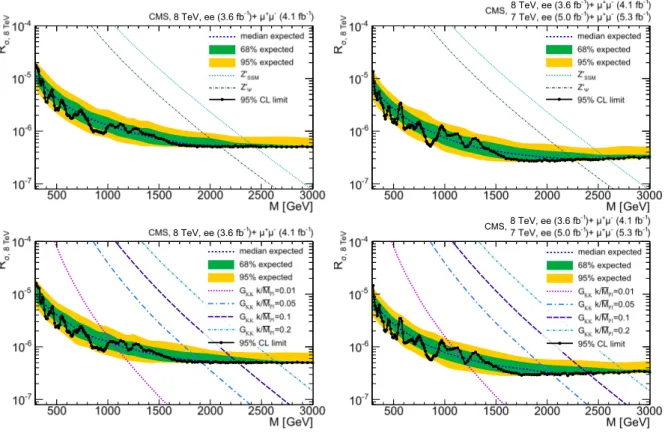
for the dimuon channel and 8% for the dielectron channel after including PDF uncertainties in the acceptance. The effects of misalignment, higher order corrections to the background shape, and the uncertainty in backgrounds due to jets misidentified as leptons have only negligible impact on the limits. The upper limits on the ratio Rσ for spin-1 and spin-2 particles obtained
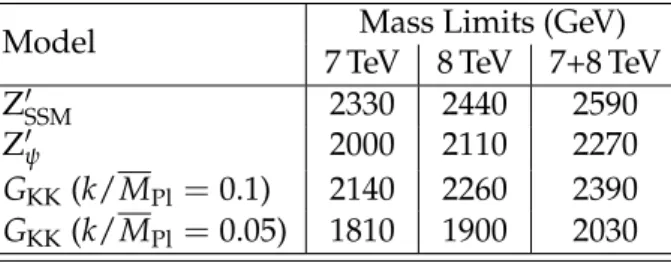
from the dilepton combined mass spectra are shown in Fig. 2. Table 2 shows the limits on Rσ
converted into mass limits on specific models. The resonance is assumed to be narrow, mean-ing that the detector resolution dominates the width of the peak. The Z0ψwith a relative width of 0.6% is therefore considered narrow. A wider resonance, such as the Z0SSM, which has a width
6 6 Summary
of 3%, will have more background under the peak. Consequently, we would set weaker limits on its production cross sections. The two cases provide similar results when there is very little background after all selection criteria have been imposed. This occurs around 1.4 TeV. For a res-onance below 1.4 TeV not to have been discovered, it must have a small coupling and therefore be narrow. For the spin-2 case an additional requirement is that the ratio of gg to qq production of the resonance must be the same as the ratio for an RS graviton. The combination of the 7 and 8 TeV data sets relies on this assumption, as gg and qq cross sections scale differently with√s. For the spin-1 case, no gg coupling is considered. The Z0 and RS Graviton cross sections are calculated using thePYTHIAevent generator with the CTEQ6.1 PDF set. The LO cross sections are corrected for next-to leading (NLO) or NNLO QCD contributions using the same k-factors as Ref. [6]. A mass dependent NNLO k-factor calculated withZWPRODP[36–38] is used for the Z0models. A flat NLO k-factor of 1.6 is applied to the RS graviton cross sections [39].
500 1000 1500 2000 2500 3000 -7 10 -6 10 -5 10 -4 10 M [GeV] , 8 Te V σ R Ψ Z' SSM Z' median expected 68% expected 95% expected 95% CL limit CMS,8 TeV, ee (3.6 fb-1)+µ+µ-(4.1 fb-1) 500 1000 1500 2000 2500 3000 -7 10 -6 10 -5 10 -4 10 M [GeV] , 8 Te V σ R CMS, ) -1 (5.3 fb -µ + µ )+ -1 7 TeV, ee (5.0 fb -1 (4.1 fb -µ + µ )+ -1 8 TeV, ee (3.6 fb ) Ψ Z' SSM Z' median expected 68% expected 95% expected 95% CL limit 500 1000 1500 2000 2500 3000 -7 10 -6 10 -5 10 -4 10 M [GeV] , 8 T eV σ R median expected 68% expected 95% expected =0.01 Pl M k/ KK G =0.05 Pl M k/ KK G =0.1 Pl M k/ KK G =0.2 Pl M k/ KK G 95% CL limit CMS,8 TeV, ee (3.6 fb-1)+µ+µ-(4.1 fb-1) 500 1000 1500 2000 2500 3000 -7 10 -6 10 -5 10 -4 10 M [GeV] , 8 T eV σ R CMS, ) -1 (5.3 fb -µ + µ )+ -1 7 TeV, ee (5.0 fb -1 (4.1 fb -µ + µ )+ -1 8 TeV, ee (3.6 fb ) median expected 68% expected 95% expected =0.01 Pl M k/ KK G =0.05 Pl M k/ KK G =0.1 Pl M k/ KK G =0.2 Pl M k/ KK G 95% CL limit
Figure 2: Upper limits on the ratio Rσof the production cross section times branching fraction
into lepton pairs to the same quantity for Z bosons, as a function of resonance mass M for spin-1 (top) and spin-2 (bottom) boson production. The left plots are for the 8 TeV data set while the right plots are for the combination of the 7 and 8 TeV data sets. For the spin-2 case, the 7 and 8 TeV data set combination is only valid for models that have the same fraction of qq to gg coupling as an RS graviton. For the spin-1 case no gg coupling is considered. Shaded bands identified in the legend correspond to the 68% and 95% quantiles for the expected limits, respectively.
6
Summary
The CMS Collaboration has searched for heavy narrow resonances in dimuon and dielectron invariant mass spectra. The search combined data samples from pp collisions at√s =7 TeV [6] and 8 TeV. The √s = 8 TeV data sets have integrated luminosities of 4.1 fb−1 (3.6 fb−1) for
References 7
Table 2: Mass lower limits at the 95% CL on specific models obtained using dilepton data at
√
s=7 and 8 TeV separately and combined. The 7 TeV results are taken from Ref. [6]. Model Mass Limits (GeV)
7 TeV 8 TeV 7+8 TeV Z0SSM 2330 2440 2590 Z0ψ 2000 2110 2270 GKK(k/MPl=0.1) 2140 2260 2390
GKK(k/MPl=0.05) 1810 1900 2030
the dimuon (dielectron) channel. The √s = 7 TeV data sets have integrated luminosities of 5.3 fb−1(5.0 fb−1) for the dimuon (dielectron) channel, and have been previously published [6]. The measured dilepton mass spectra are consistent with predictions from the standard model. Upper limits on the cross section times branching fraction for the production of new heavy narrow resonances relative to Z boson production are presented. The findings exclude, at 95% CL, a Z0SSMwith standard model-like couplings below 2590 GeV and the superstring-inspired Z0ψbelow 2260 GeV. An RS graviton with k/MPlof 0.1 (0.05) is excluded below 2390 (2030) GeV. These are the most restrictive limits to date for the classes of models considered.
Acknowledgements
We congratulate our colleagues in the CERN accelerator departments for the excellent perfor-mance of the LHC and thank the technical and administrative staffs at CERN and at other CMS institutes for their contributions to the success of the CMS effort. In addition, we gratefully ac-knowledge the computing centres and personnel of the Worldwide LHC Computing Grid for delivering so effectively the computing infrastructure essential to our analyses. Finally, we ac-knowledge the enduring support for the construction and operation of the LHC and the CMS detector provided by the following funding agencies: BMWF and FWF (Austria); FNRS and FWO (Belgium); CNPq, CAPES, FAPERJ, and FAPESP (Brazil); MEYS (Bulgaria); CERN; CAS, MoST, and NSFC (China); COLCIENCIAS (Colombia); MSES (Croatia); RPF (Cyprus); MoER, SF0690030s09 and ERDF (Estonia); Academy of Finland, MEC, and HIP (Finland); CEA and CNRS/IN2P3 (France); BMBF, DFG, and HGF (Germany); GSRT (Greece); OTKA and NKTH (Hungary); DAE and DST (India); IPM (Iran); SFI (Ireland); INFN (Italy); NRF and WCU (Re-public of Korea); LAS (Lithuania); CINVESTAV, CONACYT, SEP, and UASLP-FAI (Mexico); MSI (New Zealand); PAEC (Pakistan); MSHE and NSC (Poland); FCT (Portugal); JINR (Arme-nia, Belarus, Georgia, Ukraine, Uzbekistan); MON, RosAtom, RAS and RFBR (Russia); MSTD (Serbia); SEIDI and CPAN (Spain); Swiss Funding Agencies (Switzerland); NSC (Taipei); ThEP-Center, IPST and NSTDA (Thailand); TUBITAK and TAEK (Turkey); NASU (Ukraine); STFC (United Kingdom); DOE and NSF (USA).
References
[1] L. Evans and P. Bryant (editors), “LHC machine”, JINST 3 (2008) S08001, doi:10.1088/1748-0221/3/08/S08001.
[2] G. Altarelli, B. Mele, and M. Ruiz-Altaba, “Searching for new heavy vector bosons in pp colliders”, Z. Phys. C 45 (1989) 109, doi:10.1007/BF01556677.
8 References
[3] A. Leike, “The phenomenology of extra neutral gauge bosons”, Phys. Rept. 317 (1999) 143, doi:10.1016/S0370-1573(98)00133-1, arXiv:hep-ph/9805494. [4] L. Randall and R. Sundrum, “An alternative to compactification”, Phys. Rev. Lett. 83
(1999) 4690, doi:10.1103/PhysRevLett.83.4690, arXiv:hep-th/9906064. [5] L. Randall and R. Sundrum, “Large Mass Hierarchy from a Small Extra Dimension”,
Phys. Rev. Lett. 83 (1999) 3370, doi:10.1103/PhysRevLett.83.3370, arXiv:hep-ph/9905221.
[6] CMS Collaboration, “Search for narrow resonances in dilepton mass spectra in pp collisions at√s=7 TeV”, Phys. Lett. B 714 (2012) 158,
doi:10.1016/j.physletb.2012.06.051, arXiv:1206.1849.
[7] ATLAS Collaboration, “Search for high-mass resonances decaying to dilepton final states in pp collisions at√s=7 TeV with the ATLAS detector”, JHEP 11 (2012) 138,
doi:10.1007/JHEP11(2012)138, arXiv:1209.2535.
[8] CDF Collaboration, “Search for High-Mass e√ +e−Resonances in p ¯p Collisions at s =1.96 TeV”, Phys. Rev. Lett. 102 (2009) 031801,
doi:10.1103/PhysRevLett.102.031801, arXiv:0810.2059.
[9] CDF Collaboration, “Search for High-Mass Resonances Decaying to Dimuons at CDF”, Phys. Rev. Lett. 102 (2009) 091805, doi:10.1103/PhysRevLett.102.091805, arXiv:0811.0053.
[10] D0 Collaboration, “Search for Randall-Sundrum Gravitons in the Dielectron and
Diphoton Final States with 5.4 fb−1of Data from pp Collisions at√s =1.96 TeV”, Phys. Rev. Lett. 104 (2010) 241802, doi:10.1103/PhysRevLett.104.241802,
arXiv:1004.1826.
[11] D0 Collaboration, “Search for a heavy neutral gauge boson in the dielectron channel with 5.4 fb−1of pp collisions at√s=1.96 TeV”, Phys. Lett. B 695 (2011) 88,
doi:10.1016/j.physletb.2010.10.059, arXiv:1008.2023.
[12] CDF Collaboration, “Search for new dielectron resonances and Randall-Sundrum gravitons at the Collider Detector at Fermilab”, Phys. Rev. Lett. 107 (2011) 051801, doi:10.1103/PhysRevLett.107.051801, arXiv:1103.4650.
[13] CDF Collaboration, “Search for high mass resonances decaying to muon pairs in√ s =1.96 TeV pp collisions”, Phys. Rev. Lett. 106 (2011) 121801,
doi:10.1103/PhysRevLett.106.121801, arXiv:1101.4578.
[14] OPAL Collaboration, “Tests of the standard model and constraints on new physics from measurements of fermion-pair production at 189–209 GeV at LEP”, Eur. Phys. J. C 33 (2004) 173, doi:10.1140/epjc/s2004-01595-9, arXiv:hep-ex/0309053. [15] DELPHI Collaboration, “Measurement and interpretation of fermion-pair production at
LEP energies above the Z resonance”, Eur. Phys. J. C 45 (2006) 589, doi:10.1140/epjc/s2005-02461-0, arXiv:hep-ex/0512012.
[16] L3 Collaboration, “Measurement of hadron and lepton-pair production in e+e−collisions
at√s = 192–208 GeV at LEP”, Eur. Phys. J. C 47 (2006) 1,
References 9
[17] ALEPH Collaboration, “Fermion pair production in e+e−collisions at 189–209 GeV and constraints on physics beyond the standard model”, Eur. Phys. J. C 49 (2007) 411, doi:10.1140/epjc/s10052-006-0156-8, arXiv:hep-ex/0609051.
[18] R. Gavin et al., “FEWZ 2.0: A code for hadronic Z production at next-to-next-to-leading order”, Comput. Phys. Commun. 182 (2011) 2388, doi:10.1016/j.cpc.2011.06.008,
arXiv:1011.3540.
[19] CMS Collaboration, “The CMS experiment at the CERN LHC”, JINST 3 (2008) S08004, doi:10.1088/1748-0221/3/08/S08004.
[20] CMS Collaboration, “The TriDAS Project Technical Design Report, volume I: The trigger systems”, CMS TDR CERN/LHCC 2000-038, CERN, (2000).
[21] CMS Collaboration, “The TriDAS Project Technical Design Report, volume II: Data acquisition and high-level trigger”, CMS TDR CERN/LHCC 2002-026, CERN, (2002). [22] CMS Collaboration, “Measurements of inclusive W and Z cross sections in pp collisions
at√s=7 TeV”, JHEP 01 (2011) 080, doi:10.1007/JHEP01(2011)080, arXiv:1012.2466.
[23] CMS Collaboration, “Performance of CMS muon reconstruction in pp collision events at√ s = 7 TeV”, JINST 7 (2012) P10002, doi:10.1088/1748-0221/7/10/P10002, arXiv:1206.4071.
[24] CMS Collaboration, “Electron Reconstruction and Identification at√s=7 TeV”, CMS Physics Analysis Summary CMS-PAS-EGM-10-004, (2010).
[25] CMS Collaboration, “Measurement of the charge ratio of atmospheric muons with the CMS detector”, Phys. Lett. B 692 (2010) 83,
doi:10.1016/j.physletb.2010.07.033, arXiv:1005.5332.
[26] M. Cacciari and G. P. Salam, “Pileup subtraction using jet areas”, Phys. Lett. B 659 (2008) 119, doi:10.1016/j.physletb.2007.09.077, arXiv:0707.1378.
[27] D. A. Petyt, “Anomalous APD signals in the CMS Electromagnetic Calorimeter”, Nucl. Instr. Meth. A 695 (2012) 293, doi:10.1016/j.nima.2011.10.025.
[28] T. Sj ¨ostrand, S. Mrenna, and P. Z. Skands, “PYTHIA 6.4 physics and manual”, JHEP 05 (2006) 026, doi:10.1088/1126-6708/2006/05/026, arXiv:hep-ph/0603175. [29] J. Alwall et al., “MadGraph 5: Going Beyond”, JHEP 06 (2011) 128,
doi:10.1007/JHEP06(2011)128, arXiv:1106.0522.
[30] P. Nason, “A new method for combining NLO QCD with shower Monte Carlo algorithms”, JHEP 11 (2004) 040, doi:10.1088/1126-6708/2004/11/040, arXiv:hep-ph/0409146.
[31] S. Frixione, P. Nason, and C. Oleari, “Matching NLO QCD computations with parton shower simulations: the POWHEG method”, JHEP 11 (2007) 070,
doi:10.1088/1126-6708/2007/11/070, arXiv:0709.2092.
[32] S. Alioli et al., “A general framework for implementing NLO calculations in shower Monte Carlo programs: the POWHEG BOX”, JHEP 06 (2010) 043,
10 References
[33] E. Re, “Single-top Wt-channel production matched with parton showers using the POWHEG method”, Eur. Phys. J. C 71 (2011) 1547,
doi:10.1140/epjc/s10052-011-1547-z, arXiv:1009.2450.
[34] J. Pumplin et al., “New Generation of Parton Distributions with Uncertainties from Global QCD analysis”, JHEP 07 (2002) 012,
doi:10.1088/1126-6708/2002/07/012, arXiv:hep-ph/0201195.
[35] A. D. Martin et al., “Parton distributions for the LHC”, Eur. Phys. J. C 63 (2009) 189, doi:10.1140/epjc/s10052-009-1072-5, arXiv:0901.0002.
[36] E. Accomando et al., “Z’ physics with early LHC data”, Phys. Rev. D 83 (2011) 075012, doi:10.1103/PhysRevD.83.075012, arXiv:1010.6058.
[37] R. Hamberg, W. L. van Neerven, and T. Matsuura, “A complete calculation of the order
α2Scorrection to the Drell–Yan K factor”, Nucl. Phys. B 359 (1991) 343,
doi:10.1016/0550-3213(91)90064-5. Erratum: – ibid. B 644 (2002) 403.
[38] W. L. van Neerven and E. B. Zijlstra, “The O(α2S) corrected Drell–Yan K-factor in the DIS and MS schemes”, Nucl. Phys. B 382 (1992) 11,
doi:10.1016/0550-3213(92)90078-P. Erratum – ibid. B 680 (2004) 513.
[39] P. Mathews, V. Ravindran, and K. Sridhar, “NLO-QCD corrections to dilepton production in the Randall-Sundrum model”, JHEP 10 (2005) 031,
11
A
The CMS Collaboration
Yerevan Physics Institute, Yerevan, Armenia
S. Chatrchyan, V. Khachatryan, A.M. Sirunyan, A. Tumasyan
Institut f ¨ur Hochenergiephysik der OeAW, Wien, Austria
W. Adam, E. Aguilo, T. Bergauer, M. Dragicevic, J. Er ¨o, C. Fabjan1, M. Friedl, R. Fr ¨uhwirth1, V.M. Ghete, N. H ¨ormann, J. Hrubec, M. Jeitler1, W. Kiesenhofer, V. Kn ¨unz, M. Krammer1, I. Kr¨atschmer, D. Liko, I. Mikulec, M. Pernicka†, D. Rabady2, B. Rahbaran, C. Rohringer,
H. Rohringer, R. Sch ¨ofbeck, J. Strauss, A. Taurok, W. Waltenberger, C.-E. Wulz1
National Centre for Particle and High Energy Physics, Minsk, Belarus
V. Mossolov, N. Shumeiko, J. Suarez Gonzalez
Universiteit Antwerpen, Antwerpen, Belgium
M. Bansal, S. Bansal, T. Cornelis, E.A. De Wolf, X. Janssen, S. Luyckx, L. Mucibello, S. Ochesanu, B. Roland, R. Rougny, M. Selvaggi, H. Van Haevermaet, P. Van Mechelen, N. Van Remortel, A. Van Spilbeeck
Vrije Universiteit Brussel, Brussel, Belgium
F. Blekman, S. Blyweert, J. D’Hondt, R. Gonzalez Suarez, A. Kalogeropoulos, M. Maes, A. Olbrechts, S. Tavernier, W. Van Doninck, P. Van Mulders, G.P. Van Onsem, I. Villella
Universit´e Libre de Bruxelles, Bruxelles, Belgium
B. Clerbaux, G. De Lentdecker, V. Dero, A.P.R. Gay, T. Hreus, A. L´eonard, P.E. Marage, A. Mohammadi, T. Reis, L. Thomas, C. Vander Velde, P. Vanlaer, J. Wang
Ghent University, Ghent, Belgium
V. Adler, K. Beernaert, A. Cimmino, S. Costantini, G. Garcia, M. Grunewald, B. Klein, J. Lellouch, A. Marinov, J. Mccartin, A.A. Ocampo Rios, D. Ryckbosch, M. Sigamani, N. Strobbe, F. Thyssen, M. Tytgat, S. Walsh, E. Yazgan, N. Zaganidis
Universit´e Catholique de Louvain, Louvain-la-Neuve, Belgium
S. Basegmez, G. Bruno, R. Castello, L. Ceard, C. Delaere, T. du Pree, D. Favart, L. Forthomme, A. Giammanco3, J. Hollar, V. Lemaitre, J. Liao, O. Militaru, C. Nuttens, D. Pagano, A. Pin, K. Piotrzkowski, J.M. Vizan Garcia
Universit´e de Mons, Mons, Belgium
N. Beliy, T. Caebergs, E. Daubie, G.H. Hammad
Centro Brasileiro de Pesquisas Fisicas, Rio de Janeiro, Brazil
G.A. Alves, M. Correa Martins Junior, T. Martins, M.E. Pol, M.H.G. Souza
Universidade do Estado do Rio de Janeiro, Rio de Janeiro, Brazil
W.L. Ald´a J ´unior, W. Carvalho, A. Cust ´odio, E.M. Da Costa, D. De Jesus Damiao, C. De Oliveira Martins, S. Fonseca De Souza, H. Malbouisson, M. Malek, D. Matos Figueiredo, L. Mundim, H. Nogima, W.L. Prado Da Silva, A. Santoro, L. Soares Jorge, A. Sznajder, A. Vilela Pereira
Universidade Estadual Paulistaa, Universidade Federal do ABCb, S˜ao Paulo, Brazil
T.S. Anjosb, C.A. Bernardesb, F.A. Diasa,4, T.R. Fernandez Perez Tomeia, E.M. Gregoresb, C. Laganaa, F. Marinhoa, P.G. Mercadanteb, S.F. Novaesa, Sandra S. Padulaa
Institute for Nuclear Research and Nuclear Energy, Sofia, Bulgaria
V. Genchev2, P. Iaydjiev2, S. Piperov, M. Rodozov, S. Stoykova, G. Sultanov, V. Tcholakov, R. Trayanov, M. Vutova
12 A The CMS Collaboration
University of Sofia, Sofia, Bulgaria
A. Dimitrov, R. Hadjiiska, V. Kozhuharov, L. Litov, B. Pavlov, P. Petkov
Institute of High Energy Physics, Beijing, China
J.G. Bian, G.M. Chen, H.S. Chen, C.H. Jiang, D. Liang, S. Liang, X. Meng, J. Tao, J. Wang, X. Wang, Z. Wang, H. Xiao, M. Xu, J. Zang, Z. Zhang
State Key Laboratory of Nuclear Physics and Technology, Peking University, Beijing, China
C. Asawatangtrakuldee, Y. Ban, Y. Guo, W. Li, S. Liu, Y. Mao, S.J. Qian, H. Teng, D. Wang, L. Zhang, W. Zou
Universidad de Los Andes, Bogota, Colombia
C. Avila, C.A. Carrillo Montoya, J.P. Gomez, B. Gomez Moreno, A.F. Osorio Oliveros, J.C. Sanabria
Technical University of Split, Split, Croatia
N. Godinovic, D. Lelas, R. Plestina5, D. Polic, I. Puljak2
University of Split, Split, Croatia
Z. Antunovic, M. Kovac
Institute Rudjer Boskovic, Zagreb, Croatia
V. Brigljevic, S. Duric, K. Kadija, J. Luetic, D. Mekterovic, S. Morovic, L. Tikvica
University of Cyprus, Nicosia, Cyprus
A. Attikis, M. Galanti, G. Mavromanolakis, J. Mousa, C. Nicolaou, F. Ptochos, P.A. Razis
Charles University, Prague, Czech Republic
M. Finger, M. Finger Jr.
Academy of Scientific Research and Technology of the Arab Republic of Egypt, Egyptian Network of High Energy Physics, Cairo, Egypt
Y. Assran6, S. Elgammal7, A. Ellithi Kamel8, A.M. Kuotb Awad9, M.A. Mahmoud9, A. Radi10,11
National Institute of Chemical Physics and Biophysics, Tallinn, Estonia
M. Kadastik, M. M ¨untel, M. Murumaa, M. Raidal, L. Rebane, A. Tiko
Department of Physics, University of Helsinki, Helsinki, Finland
P. Eerola, G. Fedi, M. Voutilainen
Helsinki Institute of Physics, Helsinki, Finland
J. H¨ark ¨onen, A. Heikkinen, V. Karim¨aki, R. Kinnunen, M.J. Kortelainen, T. Lamp´en, K. Lassila-Perini, S. Lehti, T. Lind´en, P. Luukka, T. M¨aenp¨a¨a, T. Peltola, E. Tuominen, J. Tuominiemi, E. Tuovinen, D. Ungaro, L. Wendland
Lappeenranta University of Technology, Lappeenranta, Finland
A. Korpela, T. Tuuva
DSM/IRFU, CEA/Saclay, Gif-sur-Yvette, France
M. Besancon, S. Choudhury, M. Dejardin, D. Denegri, B. Fabbro, J.L. Faure, F. Ferri, S. Ganjour, A. Givernaud, P. Gras, G. Hamel de Monchenault, P. Jarry, E. Locci, J. Malcles, L. Millischer, A. Nayak, J. Rander, A. Rosowsky, M. Titov
Laboratoire Leprince-Ringuet, Ecole Polytechnique, IN2P3-CNRS, Palaiseau, France
S. Baffioni, F. Beaudette, L. Benhabib, L. Bianchini, M. Bluj12, P. Busson, C. Charlot, N. Daci, T. Dahms, M. Dalchenko, L. Dobrzynski, A. Florent, R. Granier de Cassagnac, M. Haguenauer,
13
P. Min´e, C. Mironov, I.N. Naranjo, M. Nguyen, C. Ochando, P. Paganini, D. Sabes, R. Salerno, Y. Sirois, C. Veelken, A. Zabi
Institut Pluridisciplinaire Hubert Curien, Universit´e de Strasbourg, Universit´e de Haute Alsace Mulhouse, CNRS/IN2P3, Strasbourg, France
J.-L. Agram13, J. Andrea, D. Bloch, D. Bodin, J.-M. Brom, M. Cardaci, E.C. Chabert, C. Collard, E. Conte13, F. Drouhin13, J.-C. Fontaine13, D. Gel´e, U. Goerlach, P. Juillot, A.-C. Le Bihan, P. Van Hove
Universit´e de Lyon, Universit´e Claude Bernard Lyon 1, CNRS-IN2P3, Institut de Physique Nucl´eaire de Lyon, Villeurbanne, France
S. Beauceron, N. Beaupere, O. Bondu, G. Boudoul, S. Brochet, J. Chasserat, R. Chierici2,
D. Contardo, P. Depasse, H. El Mamouni, J. Fay, S. Gascon, M. Gouzevitch, B. Ille, T. Kurca, M. Lethuillier, L. Mirabito, S. Perries, L. Sgandurra, V. Sordini, Y. Tschudi, P. Verdier, S. Viret
Institute of High Energy Physics and Informatization, Tbilisi State University, Tbilisi, Georgia
Z. Tsamalaidze14
RWTH Aachen University, I. Physikalisches Institut, Aachen, Germany
C. Autermann, S. Beranek, B. Calpas, M. Edelhoff, L. Feld, N. Heracleous, O. Hindrichs, R. Jussen, K. Klein, J. Merz, A. Ostapchuk, A. Perieanu, F. Raupach, J. Sammet, S. Schael, D. Sprenger, H. Weber, B. Wittmer, V. Zhukov15
RWTH Aachen University, III. Physikalisches Institut A, Aachen, Germany
M. Ata, J. Caudron, E. Dietz-Laursonn, D. Duchardt, M. Erdmann, R. Fischer, A. G ¨uth, T. Hebbeker, C. Heidemann, K. Hoepfner, D. Klingebiel, P. Kreuzer, M. Merschmeyer, A. Meyer, M. Olschewski, P. Papacz, H. Pieta, H. Reithler, S.A. Schmitz, L. Sonnenschein, J. Steggemann, D. Teyssier, S. Th ¨uer, M. Weber
RWTH Aachen University, III. Physikalisches Institut B, Aachen, Germany
M. Bontenackels, V. Cherepanov, Y. Erdogan, G. Fl ¨ugge, H. Geenen, M. Geisler, W. Haj Ahmad, F. Hoehle, B. Kargoll, T. Kress, Y. Kuessel, J. Lingemann2, A. Nowack, L. Perchalla, O. Pooth, P. Sauerland, A. Stahl
Deutsches Elektronen-Synchrotron, Hamburg, Germany
M. Aldaya Martin, J. Behr, W. Behrenhoff, U. Behrens, M. Bergholz16, A. Bethani, K. Borras, A. Burgmeier, A. Cakir, L. Calligaris, A. Campbell, E. Castro, F. Costanza, D. Dammann, C. Diez Pardos, T. Dorland, G. Eckerlin, D. Eckstein, G. Flucke, A. Geiser, I. Glushkov, P. Gunnellini, S. Habib, J. Hauk, G. Hellwig, H. Jung, M. Kasemann, P. Katsas, C. Kleinwort, H. Kluge, A. Knutsson, M. Kr¨amer, D. Kr ¨ucker, E. Kuznetsova, W. Lange, J. Leonard, W. Lohmann16, B. Lutz, R. Mankel, I. Marfin, M. Marienfeld, I.-A. Melzer-Pellmann, A.B. Meyer, J. Mnich, A. Mussgiller, S. Naumann-Emme, O. Novgorodova, F. Nowak, J. Olzem, H. Perrey, A. Petrukhin, D. Pitzl, A. Raspereza, P.M. Ribeiro Cipriano, C. Riedl, E. Ron, M. Rosin, J. Salfeld-Nebgen, R. Schmidt16, T. Schoerner-Sadenius, N. Sen, A. Spiridonov, M. Stein, R. Walsh, C. Wissing
University of Hamburg, Hamburg, Germany
V. Blobel, H. Enderle, J. Erfle, U. Gebbert, M. G ¨orner, M. Gosselink, J. Haller, T. Hermanns, R.S. H ¨oing, K. Kaschube, G. Kaussen, H. Kirschenmann, R. Klanner, J. Lange, T. Peiffer, N. Pietsch, D. Rathjens, C. Sander, H. Schettler, P. Schleper, E. Schlieckau, A. Schmidt, M. Schr ¨oder, T. Schum, M. Seidel, J. Sibille17, V. Sola, H. Stadie, G. Steinbr ¨uck, J. Thomsen, L. Vanelderen
14 A The CMS Collaboration
Institut f ¨ur Experimentelle Kernphysik, Karlsruhe, Germany
C. Barth, J. Berger, C. B ¨oser, T. Chwalek, W. De Boer, A. Descroix, A. Dierlamm, M. Feindt, M. Guthoff2, C. Hackstein, F. Hartmann2, T. Hauth2, M. Heinrich, H. Held, K.H. Hoffmann, U. Husemann, I. Katkov15, J.R. Komaragiri, P. Lobelle Pardo, D. Martschei, S. Mueller,
Th. M ¨uller, M. Niegel, A. N ¨urnberg, O. Oberst, A. Oehler, J. Ott, G. Quast, K. Rabbertz, F. Ratnikov, N. Ratnikova, S. R ¨ocker, F.-P. Schilling, G. Schott, H.J. Simonis, F.M. Stober, D. Troendle, R. Ulrich, J. Wagner-Kuhr, S. Wayand, T. Weiler, M. Zeise
Institute of Nuclear Physics ”Demokritos”, Aghia Paraskevi, Greece
G. Anagnostou, G. Daskalakis, T. Geralis, V.A. Giakoumopoulou, S. Kesisoglou, A. Kyriakis, D. Loukas, I. Manolakos, A. Markou, C. Markou, E. Ntomari
University of Athens, Athens, Greece
L. Gouskos, T.J. Mertzimekis, A. Panagiotou, N. Saoulidou
University of Io´annina, Io´annina, Greece
I. Evangelou, C. Foudas, P. Kokkas, N. Manthos, I. Papadopoulos
KFKI Research Institute for Particle and Nuclear Physics, Budapest, Hungary
G. Bencze, C. Hajdu, P. Hidas, D. Horvath18, F. Sikler, V. Veszpremi, G. Vesztergombi19,
A.J. Zsigmond
Institute of Nuclear Research ATOMKI, Debrecen, Hungary
N. Beni, S. Czellar, J. Molnar, J. Palinkas, Z. Szillasi
University of Debrecen, Debrecen, Hungary
J. Karancsi, P. Raics, Z.L. Trocsanyi, B. Ujvari
Panjab University, Chandigarh, India
S.B. Beri, V. Bhatnagar, N. Dhingra, R. Gupta, M. Kaur, M.Z. Mehta, M. Mittal, N. Nishu, L.K. Saini, A. Sharma, J.B. Singh
University of Delhi, Delhi, India
Ashok Kumar, Arun Kumar, S. Ahuja, A. Bhardwaj, B.C. Choudhary, S. Malhotra, M. Naimuddin, K. Ranjan, V. Sharma, R.K. Shivpuri
Saha Institute of Nuclear Physics, Kolkata, India
S. Banerjee, S. Bhattacharya, K. Chatterjee, S. Dutta, B. Gomber, Sa. Jain, Sh. Jain, R. Khurana, A. Modak, S. Mukherjee, D. Roy, S. Sarkar, M. Sharan
Bhabha Atomic Research Centre, Mumbai, India
A. Abdulsalam, D. Dutta, S. Kailas, V. Kumar, A.K. Mohanty2, L.M. Pant, P. Shukla
Tata Institute of Fundamental Research - EHEP, Mumbai, India
T. Aziz, R.M. Chatterjee, S. Ganguly, M. Guchait20, A. Gurtu21, M. Maity22, G. Majumder, K. Mazumdar, G.B. Mohanty, B. Parida, K. Sudhakar, N. Wickramage
Tata Institute of Fundamental Research - HECR, Mumbai, India
S. Banerjee, S. Dugad
Institute for Research in Fundamental Sciences (IPM), Tehran, Iran
H. Arfaei23, H. Bakhshiansohi, S.M. Etesami24, A. Fahim23, M. Hashemi25, H. Hesari, A. Jafari, M. Khakzad, M. Mohammadi Najafabadi, S. Paktinat Mehdiabadi, B. Safarzadeh26, M. Zeinali
INFN Sezione di Baria, Universit`a di Barib, Politecnico di Baric, Bari, Italy
15
Filippisa,c,2, M. De Palmaa,b, L. Fiorea, G. Iasellia,c, G. Maggia,c, M. Maggia, B. Marangellia,b, S. Mya,c, S. Nuzzoa,b, N. Pacificoa, A. Pompilia,b, G. Pugliesea,c, G. Selvaggia,b, L. Silvestrisa, G. Singha,b, R. Vendittia,b, P. Verwilligena, G. Zitoa
INFN Sezione di Bolognaa, Universit`a di Bolognab, Bologna, Italy
G. Abbiendia, A.C. Benvenutia, D. Bonacorsia,b, S. Braibant-Giacomellia,b, L. Brigliadoria,b, P. Capiluppia,b, A. Castroa,b, F.R. Cavalloa, M. Cuffiania,b, G.M. Dallavallea, F. Fabbria, A. Fanfania,b, D. Fasanellaa,b, P. Giacomellia, C. Grandia, L. Guiduccia,b, S. Marcellinia, G. Masettia, M. Meneghellia,b,2, A. Montanaria, F.L. Navarriaa,b, F. Odoricia, A. Perrottaa, F. Primaveraa,b, A.M. Rossia,b, T. Rovellia,b, G.P. Sirolia,b, N. Tosi, R. Travaglinia,b
INFN Sezione di Cataniaa, Universit`a di Cataniab, Catania, Italy
S. Albergoa,b, G. Cappelloa,b, M. Chiorbolia,b, S. Costaa,b, R. Potenzaa,b, A. Tricomia,b, C. Tuvea,b
INFN Sezione di Firenzea, Universit`a di Firenzeb, Firenze, Italy
G. Barbaglia, V. Ciullia,b, C. Civininia, R. D’Alessandroa,b, E. Focardia,b, S. Frosalia,b, E. Galloa, S. Gonzia,b, M. Meschinia, S. Paolettia, G. Sguazzonia, A. Tropianoa,b
INFN Laboratori Nazionali di Frascati, Frascati, Italy
L. Benussi, S. Bianco, S. Colafranceschi27, F. Fabbri, D. Piccolo
INFN Sezione di Genovaa, Universit`a di Genovab, Genova, Italy
P. Fabbricatorea, R. Musenicha, S. Tosia,b
INFN Sezione di Milano-Bicoccaa, Universit`a di Milano-Bicoccab, Milano, Italy
A. Benagliaa, F. De Guioa,b, L. Di Matteoa,b,2, S. Fiorendia,b, S. Gennaia,2, A. Ghezzia,b, S. Malvezzia, R.A. Manzonia,b, A. Martellia,b, A. Massironia,b, D. Menascea, L. Moronia,
M. Paganonia,b, D. Pedrinia, S. Ragazzia,b, N. Redaellia, T. Tabarelli de Fatisa,b
INFN Sezione di Napoli a, Universit`a di Napoli ’Federico II’ b, Universit`a della
Basilicata (Potenza)c, Universit`a G. Marconi (Roma)d, Napoli, Italy
S. Buontempoa, N. Cavalloa,c, A. De Cosaa,b,2, O. Doganguna,b, F. Fabozzia,c, A.O.M. Iorioa,b, L. Listaa, S. Meolaa,d,28, M. Merolaa, P. Paoluccia,2
INFN Sezione di Padovaa, Universit`a di Padovab, Universit`a di Trento (Trento)c, Padova,
Italy
P. Azzia, N. Bacchettaa,2, A. Brancaa,b,2, R. Carlina,b, P. Checchiaa, T. Dorigoa, F. Gasparinia,b, U. Gasparinia,b, A. Gozzelinoa, K. Kanishcheva,c, S. Lacapraraa, I. Lazzizzeraa,c, M. Margonia,b, A.T. Meneguzzoa,b, F. Montecassianoa, J. Pazzinia,b, N. Pozzobona,b, P. Ronchesea,b, F. Simonettoa,b, E. Torassaa, M. Tosia,b, S. Vaninia,b, P. Zottoa,b, A. Zucchettaa,b, G. Zumerlea,b
INFN Sezione di Paviaa, Universit`a di Paviab, Pavia, Italy
M. Gabusia,b, S.P. Rattia,b, C. Riccardia,b, P. Torrea,b, P. Vituloa,b
INFN Sezione di Perugiaa, Universit`a di Perugiab, Perugia, Italy
M. Biasinia,b, G.M. Bileia, L. Fan `oa,b, P. Laricciaa,b, G. Mantovania,b, M. Menichellia, A. Nappia,b†, F. Romeoa,b, A. Sahaa, A. Santocchiaa,b, A. Spieziaa,b, S. Taronia,b
INFN Sezione di Pisaa, Universit`a di Pisab, Scuola Normale Superiore di Pisac, Pisa, Italy
P. Azzurria,c, G. Bagliesia, J. Bernardinia, T. Boccalia, G. Broccoloa,c, R. Castaldia,
R.T. D’Agnoloa,c,2, R. Dell’Orsoa, F. Fioria,b,2, L. Fo`aa,c, A. Giassia, A. Kraana, F. Ligabuea,c, T. Lomtadzea, L. Martinia,29, A. Messineoa,b, F. Pallaa, A. Rizzia,b, A.T. Serbana,30, P. Spagnoloa, P. Squillaciotia,2, R. Tenchinia, G. Tonellia,b, A. Venturia, P.G. Verdinia
16 A The CMS Collaboration
INFN Sezione di Romaa, Universit`a di Romab, Roma, Italy
L. Baronea,b, F. Cavallaria, D. Del Rea,b, M. Diemoza, C. Fanellia,b, M. Grassia,b,2, E. Longoa,b, P. Meridiania,2, F. Michelia,b, S. Nourbakhsha,b, G. Organtinia,b, R. Paramattia, S. Rahatloua,b, L. Soffia,b
INFN Sezione di Torino a, Universit`a di Torino b, Universit`a del Piemonte Orientale
(No-vara)c, Torino, Italy
N. Amapanea,b, R. Arcidiaconoa,c, S. Argiroa,b, M. Arneodoa,c, C. Biinoa, N. Cartigliaa, S. Casassoa,b, M. Costaa,b, N. Demariaa, C. Mariottia,2, S. Masellia, E. Migliorea,b, V. Monacoa,b, M. Musicha,2, M.M. Obertinoa,c, N. Pastronea, M. Pelliccionia, A. Potenzaa,b, A. Romeroa,b, M. Ruspaa,c, R. Sacchia,b, A. Solanoa,b, A. Staianoa
INFN Sezione di Triestea, Universit`a di Triesteb, Trieste, Italy
S. Belfortea, V. Candelisea,b, M. Casarsaa, F. Cossuttia, G. Della Riccaa,b, B. Gobboa, M. Maronea,b,2, D. Montaninoa,b,2, A. Penzoa, A. Schizzia,b
Kangwon National University, Chunchon, Korea
T.Y. Kim, S.K. Nam
Kyungpook National University, Daegu, Korea
S. Chang, D.H. Kim, G.N. Kim, D.J. Kong, H. Park, D.C. Son, T. Son
Chonnam National University, Institute for Universe and Elementary Particles, Kwangju, Korea
J.Y. Kim, Zero J. Kim, S. Song
Korea University, Seoul, Korea
S. Choi, D. Gyun, B. Hong, M. Jo, H. Kim, T.J. Kim, K.S. Lee, D.H. Moon, S.K. Park, Y. Roh
University of Seoul, Seoul, Korea
M. Choi, J.H. Kim, C. Park, I.C. Park, S. Park, G. Ryu
Sungkyunkwan University, Suwon, Korea
Y. Choi, Y.K. Choi, J. Goh, M.S. Kim, E. Kwon, B. Lee, J. Lee, S. Lee, H. Seo, I. Yu
Vilnius University, Vilnius, Lithuania
M.J. Bilinskas, I. Grigelionis, M. Janulis, A. Juodagalvis
Centro de Investigacion y de Estudios Avanzados del IPN, Mexico City, Mexico
H. Castilla-Valdez, E. De La Cruz-Burelo, I. Heredia-de La Cruz, R. Lopez-Fernandez, J. Mart´ınez-Ortega, A. Sanchez-Hernandez, L.M. Villasenor-Cendejas
Universidad Iberoamericana, Mexico City, Mexico
S. Carrillo Moreno, F. Vazquez Valencia
Benemerita Universidad Autonoma de Puebla, Puebla, Mexico
H.A. Salazar Ibarguen
Universidad Aut ´onoma de San Luis Potos´ı, San Luis Potos´ı, Mexico
E. Casimiro Linares, A. Morelos Pineda, M.A. Reyes-Santos
University of Auckland, Auckland, New Zealand
D. Krofcheck
University of Canterbury, Christchurch, New Zealand
17
National Centre for Physics, Quaid-I-Azam University, Islamabad, Pakistan
M. Ahmad, M.I. Asghar, J. Butt, H.R. Hoorani, S. Khalid, W.A. Khan, T. Khurshid, S. Qazi, M.A. Shah, M. Shoaib
National Centre for Nuclear Research, Swierk, Poland
H. Bialkowska, B. Boimska, T. Frueboes, M. G ´orski, M. Kazana, K. Nawrocki, K. Romanowska-Rybinska, M. Szleper, G. Wrochna, P. Zalewski
Institute of Experimental Physics, Faculty of Physics, University of Warsaw, Warsaw, Poland
G. Brona, K. Bunkowski, M. Cwiok, W. Dominik, K. Doroba, A. Kalinowski, M. Konecki, J. Krolikowski, M. Misiura
Laborat ´orio de Instrumenta¸c˜ao e F´ısica Experimental de Part´ıculas, Lisboa, Portugal
N. Almeida, P. Bargassa, A. David, P. Faccioli, P.G. Ferreira Parracho, M. Gallinaro, J. Seixas, J. Varela, P. Vischia
Joint Institute for Nuclear Research, Dubna, Russia
I. Belotelov, P. Bunin, M. Gavrilenko, I. Golutvin, I. Gorbunov, A. Kamenev, V. Karjavin, G. Kozlov, A. Lanev, A. Malakhov, P. Moisenz, V. Palichik, V. Perelygin, S. Shmatov, V. Smirnov, A. Volodko, A. Zarubin
Petersburg Nuclear Physics Institute, Gatchina (St. Petersburg), Russia
S. Evstyukhin, V. Golovtsov, Y. Ivanov, V. Kim, P. Levchenko, V. Murzin, V. Oreshkin, I. Smirnov, V. Sulimov, L. Uvarov, S. Vavilov, A. Vorobyev, An. Vorobyev
Institute for Nuclear Research, Moscow, Russia
Yu. Andreev, A. Dermenev, S. Gninenko, N. Golubev, M. Kirsanov, N. Krasnikov, V. Matveev, A. Pashenkov, D. Tlisov, A. Toropin
Institute for Theoretical and Experimental Physics, Moscow, Russia
V. Epshteyn, M. Erofeeva, V. Gavrilov, M. Kossov, N. Lychkovskaya, V. Popov, G. Safronov, S. Semenov, I. Shreyber, V. Stolin, E. Vlasov, A. Zhokin
Moscow State University, Moscow, Russia
A. Belyaev, E. Boos, V. Bunichev, M. Dubinin4, L. Dudko, A. Ershov, V. Klyukhin, O. Kodolova,
I. Lokhtin, A. Markina, S. Obraztsov, M. Perfilov, S. Petrushanko, A. Popov, L. Sarycheva†, V. Savrin, A. Snigirev
P.N. Lebedev Physical Institute, Moscow, Russia
V. Andreev, M. Azarkin, I. Dremin, M. Kirakosyan, A. Leonidov, G. Mesyats, S.V. Rusakov, A. Vinogradov
State Research Center of Russian Federation, Institute for High Energy Physics, Protvino, Russia
I. Azhgirey, I. Bayshev, S. Bitioukov, V. Grishin2, V. Kachanov, D. Konstantinov, V. Krychkine, V. Petrov, R. Ryutin, A. Sobol, L. Tourtchanovitch, S. Troshin, N. Tyurin, A. Uzunian, A. Volkov
University of Belgrade, Faculty of Physics and Vinca Institute of Nuclear Sciences, Belgrade, Serbia
P. Adzic31, M. Djordjevic, M. Ekmedzic, D. Krpic31, J. Milosevic
Centro de Investigaciones Energ´eticas Medioambientales y Tecnol ´ogicas (CIEMAT), Madrid, Spain
M. Aguilar-Benitez, J. Alcaraz Maestre, P. Arce, C. Battilana, E. Calvo, M. Cerrada, M. Chamizo Llatas, N. Colino, B. De La Cruz, A. Delgado Peris, D. Dom´ınguez V´azquez, C. Fernandez
18 A The CMS Collaboration
Bedoya, J.P. Fern´andez Ramos, A. Ferrando, J. Flix, M.C. Fouz, P. Garcia-Abia, O. Gonzalez Lopez, S. Goy Lopez, J.M. Hernandez, M.I. Josa, G. Merino, J. Puerta Pelayo, A. Quintario Olmeda, I. Redondo, L. Romero, J. Santaolalla, M.S. Soares, C. Willmott
Universidad Aut ´onoma de Madrid, Madrid, Spain
C. Albajar, G. Codispoti, J.F. de Troc ´oniz
Universidad de Oviedo, Oviedo, Spain
H. Brun, J. Cuevas, J. Fernandez Menendez, S. Folgueras, I. Gonzalez Caballero, L. Lloret Iglesias, J. Piedra Gomez
Instituto de F´ısica de Cantabria (IFCA), CSIC-Universidad de Cantabria, Santander, Spain
J.A. Brochero Cifuentes, I.J. Cabrillo, A. Calderon, S.H. Chuang, J. Duarte Campderros, M. Felcini32, M. Fernandez, G. Gomez, J. Gonzalez Sanchez, A. Graziano, C. Jorda, A. Lopez Virto, J. Marco, R. Marco, C. Martinez Rivero, F. Matorras, F.J. Munoz Sanchez, T. Rodrigo, A.Y. Rodr´ıguez-Marrero, A. Ruiz-Jimeno, L. Scodellaro, I. Vila, R. Vilar Cortabitarte
CERN, European Organization for Nuclear Research, Geneva, Switzerland
D. Abbaneo, E. Auffray, G. Auzinger, M. Bachtis, P. Baillon, A.H. Ball, D. Barney, J.F. Benitez, C. Bernet5, G. Bianchi, P. Bloch, A. Bocci, A. Bonato, C. Botta, H. Breuker, T. Camporesi,
G. Cerminara, T. Christiansen, J.A. Coarasa Perez, D. D’Enterria, A. Dabrowski, A. De Roeck, S. Di Guida, M. Dobson, N. Dupont-Sagorin, A. Elliott-Peisert, B. Frisch, W. Funk, G. Georgiou, M. Giffels, D. Gigi, K. Gill, D. Giordano, M. Girone, M. Giunta, F. Glege, R. Gomez-Reino Garrido, P. Govoni, S. Gowdy, R. Guida, S. Gundacker, J. Hammer, M. Hansen, P. Harris, C. Hartl, J. Harvey, B. Hegner, A. Hinzmann, V. Innocente, P. Janot, K. Kaadze, E. Karavakis, K. Kousouris, P. Lecoq, Y.-J. Lee, P. Lenzi, C. Lourenc¸o, N. Magini, T. M¨aki, M. Malberti, L. Malgeri, M. Mannelli, L. Masetti, F. Meijers, S. Mersi, E. Meschi, R. Moser, M. Mulders, P. Musella, E. Nesvold, L. Orsini, E. Palencia Cortezon, E. Perez, L. Perrozzi, A. Petrilli, A. Pfeiffer, M. Pierini, M. Pimi¨a, D. Piparo, G. Polese, L. Quertenmont, A. Racz, W. Reece, J. Rodrigues Antunes, G. Rolandi33, C. Rovelli34, M. Rovere, H. Sakulin, F. Santanastasio, C. Sch¨afer, C. Schwick, I. Segoni, S. Sekmen, A. Sharma, P. Siegrist, P. Silva, M. Simon, P. Sphicas35, D. Spiga, A. Tsirou, G.I. Veres19, J.R. Vlimant, H.K. W ¨ohri, S.D. Worm36, W.D. Zeuner
Paul Scherrer Institut, Villigen, Switzerland
W. Bertl, K. Deiters, W. Erdmann, K. Gabathuler, R. Horisberger, Q. Ingram, H.C. Kaestli, S. K ¨onig, D. Kotlinski, U. Langenegger, F. Meier, D. Renker, T. Rohe
Institute for Particle Physics, ETH Zurich, Zurich, Switzerland
F. Bachmair, L. B¨ani, P. Bortignon, M.A. Buchmann, B. Casal, N. Chanon, A. Deisher, G. Dissertori, M. Dittmar, M. Doneg`a, M. D ¨unser, P. Eller, J. Eugster, K. Freudenreich, C. Grab, D. Hits, P. Lecomte, W. Lustermann, A.C. Marini, P. Martinez Ruiz del Arbol, N. Mohr, F. Moortgat, C. N¨ageli37, P. Nef, F. Nessi-Tedaldi, F. Pandolfi, L. Pape, F. Pauss, M. Peruzzi,
F.J. Ronga, M. Rossini, L. Sala, A.K. Sanchez, A. Starodumov38, B. Stieger, M. Takahashi,
L. Tauscher†, A. Thea, K. Theofilatos, D. Treille, C. Urscheler, R. Wallny, H.A. Weber, L. Wehrli
Universit¨at Z ¨urich, Zurich, Switzerland
C. Amsler39, V. Chiochia, S. De Visscher, C. Favaro, M. Ivova Rikova, B. Kilminster, B. Millan Mejias, P. Otiougova, P. Robmann, H. Snoek, S. Tupputi, M. Verzetti
National Central University, Chung-Li, Taiwan
19
National Taiwan University (NTU), Taipei, Taiwan
P. Bartalini, P. Chang, Y.H. Chang, Y.W. Chang, Y. Chao, K.F. Chen, C. Dietz, U. Grundler, W.-S. Hou, Y. Hsiung, K.Y. Kao, Y.J. Lei, R.-W.-S. Lu, D. Majumder, E. Petrakou, X. Shi, J.G. Shiu, Y.M. Tzeng, X. Wan, M. Wang
Chulalongkorn University, Bangkok, Thailand
B. Asavapibhop, N. Srimanobhas, N. Suwonjandee
Cukurova University, Adana, Turkey
A. Adiguzel, M.N. Bakirci40, S. Cerci41, C. Dozen, I. Dumanoglu, E. Eskut, S. Girgis, G. Gokbulut, E. Gurpinar, I. Hos, E.E. Kangal, T. Karaman, G. Karapinar42, A. Kayis Topaksu,
G. Onengut, K. Ozdemir, S. Ozturk43, A. Polatoz, K. Sogut44, D. Sunar Cerci41, B. Tali41,
H. Topakli40, L.N. Vergili, M. Vergili
Middle East Technical University, Physics Department, Ankara, Turkey
I.V. Akin, T. Aliev, B. Bilin, S. Bilmis, M. Deniz, H. Gamsizkan, A.M. Guler, K. Ocalan, A. Ozpineci, M. Serin, R. Sever, U.E. Surat, M. Yalvac, E. Yildirim, M. Zeyrek
Bogazici University, Istanbul, Turkey
E. G ¨ulmez, B. Isildak45, M. Kaya46, O. Kaya46, S. Ozkorucuklu47, N. Sonmez48
Istanbul Technical University, Istanbul, Turkey
H. Bahtiyar, E. Barlas, K. Cankocak, Y.O. G ¨unaydin49, F.I. Vardarlı, M. Y ¨ucel
National Scientific Center, Kharkov Institute of Physics and Technology, Kharkov, Ukraine
L. Levchuk
University of Bristol, Bristol, United Kingdom
J.J. Brooke, E. Clement, D. Cussans, H. Flacher, R. Frazier, J. Goldstein, M. Grimes, G.P. Heath, H.F. Heath, L. Kreczko, S. Metson, D.M. Newbold36, K. Nirunpong, A. Poll, S. Senkin, V.J. Smith, T. Williams
Rutherford Appleton Laboratory, Didcot, United Kingdom
L. Basso50, K.W. Bell, A. Belyaev50, C. Brew, R.M. Brown, D.J.A. Cockerill, J.A. Coughlan,
K. Harder, S. Harper, J. Jackson, B.W. Kennedy, E. Olaiya, D. Petyt, B.C. Radburn-Smith, C.H. Shepherd-Themistocleous, I.R. Tomalin, W.J. Womersley
Imperial College, London, United Kingdom
R. Bainbridge, G. Ball, R. Beuselinck, O. Buchmuller, D. Colling, N. Cripps, M. Cutajar, P. Dauncey, G. Davies, M. Della Negra, W. Ferguson, J. Fulcher, D. Futyan, A. Gilbert, A. Guneratne Bryer, G. Hall, Z. Hatherell, J. Hays, G. Iles, M. Jarvis, G. Karapostoli, L. Lyons, A.-M. Magnan, J. Marrouche, B. Mathias, R. Nandi, J. Nash, A. Nikitenko38, J. Pela, M. Pesaresi,
K. Petridis, M. Pioppi51, D.M. Raymond, S. Rogerson, A. Rose, C. Seez, P. Sharp†, A. Sparrow,
M. Stoye, A. Tapper, M. Vazquez Acosta, T. Virdee, S. Wakefield, N. Wardle, T. Whyntie
Brunel University, Uxbridge, United Kingdom
M. Chadwick, J.E. Cole, P.R. Hobson, A. Khan, P. Kyberd, D. Leggat, D. Leslie, W. Martin, I.D. Reid, P. Symonds, L. Teodorescu, M. Turner
Baylor University, Waco, USA
K. Hatakeyama, H. Liu, T. Scarborough
The University of Alabama, Tuscaloosa, USA
20 A The CMS Collaboration
Boston University, Boston, USA
A. Avetisyan, T. Bose, C. Fantasia, A. Heister, J. St. John, P. Lawson, D. Lazic, J. Rohlf, D. Sperka, L. Sulak
Brown University, Providence, USA
J. Alimena, S. Bhattacharya, G. Christopher, D. Cutts, Z. Demiragli, A. Ferapontov, A. Garabedian, U. Heintz, S. Jabeen, G. Kukartsev, E. Laird, G. Landsberg, M. Luk, M. Narain, M. Segala, T. Sinthuprasith, T. Speer
University of California, Davis, Davis, USA
R. Breedon, G. Breto, M. Calderon De La Barca Sanchez, S. Chauhan, M. Chertok, J. Conway, R. Conway, P.T. Cox, J. Dolen, R. Erbacher, M. Gardner, R. Houtz, W. Ko, A. Kopecky, R. Lander, O. Mall, T. Miceli, D. Pellett, F. Ricci-Tam, B. Rutherford, M. Searle, J. Smith, M. Squires, M. Tripathi, R. Vasquez Sierra, R. Yohay
University of California, Los Angeles, USA
V. Andreev, D. Cline, R. Cousins, J. Duris, S. Erhan, P. Everaerts, C. Farrell, J. Hauser, M. Ignatenko, C. Jarvis, G. Rakness, P. Schlein†, P. Traczyk, V. Valuev, M. Weber
University of California, Riverside, Riverside, USA
J. Babb, R. Clare, M.E. Dinardo, J. Ellison, J.W. Gary, F. Giordano, G. Hanson, H. Liu, O.R. Long, A. Luthra, H. Nguyen, S. Paramesvaran, J. Sturdy, S. Sumowidagdo, R. Wilken, S. Wimpenny
University of California, San Diego, La Jolla, USA
W. Andrews, J.G. Branson, G.B. Cerati, S. Cittolin, D. Evans, A. Holzner, R. Kelley, M. Lebourgeois, J. Letts, I. Macneill, B. Mangano, S. Padhi, C. Palmer, G. Petrucciani, M. Pieri, M. Sani, V. Sharma, S. Simon, E. Sudano, M. Tadel, Y. Tu, A. Vartak, S. Wasserbaech52,
F. W ¨urthwein, A. Yagil, J. Yoo
University of California, Santa Barbara, Santa Barbara, USA
D. Barge, R. Bellan, C. Campagnari, M. D’Alfonso, T. Danielson, K. Flowers, P. Geffert, C. George, F. Golf, J. Incandela, C. Justus, P. Kalavase, D. Kovalskyi, V. Krutelyov, S. Lowette, R. Maga ˜na Villalba, N. Mccoll, V. Pavlunin, J. Ribnik, J. Richman, R. Rossin, D. Stuart, W. To, C. West
California Institute of Technology, Pasadena, USA
A. Apresyan, A. Bornheim, Y. Chen, E. Di Marco, J. Duarte, M. Gataullin, Y. Ma, A. Mott, H.B. Newman, C. Rogan, M. Spiropulu, V. Timciuc, J. Veverka, R. Wilkinson, S. Xie, Y. Yang, R.Y. Zhu
Carnegie Mellon University, Pittsburgh, USA
V. Azzolini, A. Calamba, R. Carroll, T. Ferguson, Y. Iiyama, D.W. Jang, Y.F. Liu, M. Paulini, H. Vogel, I. Vorobiev
University of Colorado at Boulder, Boulder, USA
J.P. Cumalat, B.R. Drell, W.T. Ford, A. Gaz, E. Luiggi Lopez, J.G. Smith, K. Stenson, K.A. Ulmer, S.R. Wagner
Cornell University, Ithaca, USA
J. Alexander, A. Chatterjee, N. Eggert, L.K. Gibbons, B. Heltsley, W. Hopkins, A. Khukhu-naishvili, B. Kreis, N. Mirman, G. Nicolas Kaufman, J.R. Patterson, A. Ryd, E. Salvati, W. Sun, W.D. Teo, J. Thom, J. Thompson, J. Tucker, J. Vaughan, Y. Weng, L. Winstrom, P. Wittich
Fairfield University, Fairfield, USA
21
Fermi National Accelerator Laboratory, Batavia, USA
S. Abdullin, M. Albrow, J. Anderson, L.A.T. Bauerdick, A. Beretvas, J. Berryhill, P.C. Bhat, K. Burkett, J.N. Butler, V. Chetluru, H.W.K. Cheung, F. Chlebana, V.D. Elvira, I. Fisk, J. Freeman, Y. Gao, D. Green, O. Gutsche, J. Hanlon, R.M. Harris, J. Hirschauer, B. Hooberman, S. Jindariani, M. Johnson, U. Joshi, B. Klima, S. Kunori, S. Kwan, C. Leonidopoulos53, J. Linacre, D. Lincoln, R. Lipton, J. Lykken, K. Maeshima, J.M. Marraffino, V.I. Martinez Outschoorn, S. Maruyama, D. Mason, P. McBride, K. Mishra, S. Mrenna, Y. Musienko54, C. Newman-Holmes, V. O’Dell, O. Prokofyev, E. Sexton-Kennedy, S. Sharma, W.J. Spalding, L. Spiegel, L. Taylor, S. Tkaczyk, N.V. Tran, L. Uplegger, E.W. Vaandering, R. Vidal, J. Whitmore, W. Wu, F. Yang, J.C. Yun
University of Florida, Gainesville, USA
D. Acosta, P. Avery, D. Bourilkov, M. Chen, T. Cheng, S. Das, M. De Gruttola, G.P. Di Giovanni, D. Dobur, A. Drozdetskiy, R.D. Field, M. Fisher, Y. Fu, I.K. Furic, J. Gartner, J. Hugon, B. Kim, J. Konigsberg, A. Korytov, A. Kropivnitskaya, T. Kypreos, J.F. Low, K. Matchev, P. Milenovic55, G. Mitselmakher, L. Muniz, M. Park, R. Remington, A. Rinkevicius, P. Sellers, N. Skhirtladze, M. Snowball, J. Yelton, M. Zakaria
Florida International University, Miami, USA
V. Gaultney, S. Hewamanage, L.M. Lebolo, S. Linn, P. Markowitz, G. Martinez, J.L. Rodriguez
Florida State University, Tallahassee, USA
T. Adams, A. Askew, J. Bochenek, J. Chen, B. Diamond, S.V. Gleyzer, J. Haas, S. Hagopian, V. Hagopian, M. Jenkins, K.F. Johnson, H. Prosper, V. Veeraraghavan, M. Weinberg
Florida Institute of Technology, Melbourne, USA
M.M. Baarmand, B. Dorney, M. Hohlmann, H. Kalakhety, I. Vodopiyanov, F. Yumiceva
University of Illinois at Chicago (UIC), Chicago, USA
M.R. Adams, I.M. Anghel, L. Apanasevich, Y. Bai, V.E. Bazterra, R.R. Betts, I. Bucinskaite, J. Callner, R. Cavanaugh, O. Evdokimov, L. Gauthier, C.E. Gerber, D.J. Hofman, S. Khalatyan, F. Lacroix, C. O’Brien, C. Silkworth, D. Strom, P. Turner, N. Varelas
The University of Iowa, Iowa City, USA
U. Akgun, E.A. Albayrak, B. Bilki56, W. Clarida, F. Duru, S. Griffiths, J.-P. Merlo, H. Mermerkaya57, A. Mestvirishvili, A. Moeller, J. Nachtman, C.R. Newsom, E. Norbeck,
Y. Onel, F. Ozok58, S. Sen, P. Tan, E. Tiras, J. Wetzel, T. Yetkin, K. Yi
Johns Hopkins University, Baltimore, USA
B.A. Barnett, B. Blumenfeld, S. Bolognesi, D. Fehling, G. Giurgiu, A.V. Gritsan, Z.J. Guo, G. Hu, P. Maksimovic, M. Swartz, A. Whitbeck
The University of Kansas, Lawrence, USA
P. Baringer, A. Bean, G. Benelli, R.P. Kenny Iii, M. Murray, D. Noonan, S. Sanders, R. Stringer, G. Tinti, J.S. Wood
Kansas State University, Manhattan, USA
A.F. Barfuss, T. Bolton, I. Chakaberia, A. Ivanov, S. Khalil, M. Makouski, Y. Maravin, S. Shrestha, I. Svintradze
Lawrence Livermore National Laboratory, Livermore, USA
J. Gronberg, D. Lange, F. Rebassoo, D. Wright
University of Maryland, College Park, USA
22 A The CMS Collaboration
Y. Lu, M. Marionneau, A.C. Mignerey, K. Pedro, A. Peterman, A. Skuja, J. Temple, M.B. Tonjes, S.C. Tonwar
Massachusetts Institute of Technology, Cambridge, USA
A. Apyan, G. Bauer, J. Bendavid, W. Busza, E. Butz, I.A. Cali, M. Chan, V. Dutta, G. Gomez Ceballos, M. Goncharov, Y. Kim, M. Klute, K. Krajczar59, A. Levin, P.D. Luckey, T. Ma, S. Nahn, C. Paus, D. Ralph, C. Roland, G. Roland, M. Rudolph, G.S.F. Stephans, F. St ¨ockli, K. Sumorok, K. Sung, D. Velicanu, E.A. Wenger, R. Wolf, B. Wyslouch, M. Yang, Y. Yilmaz, A.S. Yoon, M. Zanetti, V. Zhukova
University of Minnesota, Minneapolis, USA
S.I. Cooper, B. Dahmes, A. De Benedetti, G. Franzoni, A. Gude, S.C. Kao, K. Klapoetke, Y. Kubota, J. Mans, N. Pastika, R. Rusack, M. Sasseville, A. Singovsky, N. Tambe, J. Turkewitz
University of Mississippi, Oxford, USA
L.M. Cremaldi, R. Kroeger, L. Perera, R. Rahmat, D.A. Sanders
University of Nebraska-Lincoln, Lincoln, USA
E. Avdeeva, K. Bloom, S. Bose, D.R. Claes, A. Dominguez, M. Eads, J. Keller, I. Kravchenko, J. Lazo-Flores, S. Malik, G.R. Snow
State University of New York at Buffalo, Buffalo, USA
A. Godshalk, I. Iashvili, S. Jain, A. Kharchilava, A. Kumar, S. Rappoccio, Z. Wan
Northeastern University, Boston, USA
G. Alverson, E. Barberis, D. Baumgartel, M. Chasco, J. Haley, D. Nash, T. Orimoto, D. Trocino, D. Wood, J. Zhang
Northwestern University, Evanston, USA
A. Anastassov, K.A. Hahn, A. Kubik, L. Lusito, N. Mucia, N. Odell, R.A. Ofierzynski, B. Pollack, A. Pozdnyakov, M. Schmitt, S. Stoynev, M. Velasco, S. Won
University of Notre Dame, Notre Dame, USA
D. Berry, A. Brinkerhoff, K.M. Chan, M. Hildreth, C. Jessop, D.J. Karmgard, J. Kolb, K. Lannon, W. Luo, S. Lynch, N. Marinelli, D.M. Morse, T. Pearson, M. Planer, R. Ruchti, J. Slaunwhite, N. Valls, M. Wayne, M. Wolf
The Ohio State University, Columbus, USA
L. Antonelli, B. Bylsma, L.S. Durkin, C. Hill, R. Hughes, K. Kotov, T.Y. Ling, D. Puigh, M. Rodenburg, C. Vuosalo, G. Williams, B.L. Winer
Princeton University, Princeton, USA
E. Berry, P. Elmer, V. Halyo, P. Hebda, J. Hegeman, A. Hunt, P. Jindal, S.A. Koay, D. Lopes Pegna, P. Lujan, D. Marlow, T. Medvedeva, M. Mooney, J. Olsen, P. Pirou´e, X. Quan, A. Raval, H. Saka, D. Stickland, C. Tully, J.S. Werner, S.C. Zenz, A. Zuranski
University of Puerto Rico, Mayaguez, USA
E. Brownson, A. Lopez, H. Mendez, J.E. Ramirez Vargas
Purdue University, West Lafayette, USA
E. Alagoz, V.E. Barnes, D. Benedetti, G. Bolla, D. Bortoletto, M. De Mattia, A. Everett, Z. Hu, M. Jones, O. Koybasi, M. Kress, A.T. Laasanen, N. Leonardo, V. Maroussov, P. Merkel, D.H. Miller, N. Neumeister, I. Shipsey, D. Silvers, A. Svyatkovskiy, M. Vidal Marono, H.D. Yoo, J. Zablocki, Y. Zheng