
Rural tourism and the development of less favoured areas - between rhetoric and practice
25
0
0
Texto
(2) Summary. Due to its potentialities as to employment and income creation and the synergies it is able to generate in other sectors of activity, tourism has, in recent times, being currently advocated as a particularly efficient alternative to promote the development of the so called less favoured regions, mostly inland and mountain ones. Based in the results of empirical research carried out in two distinct inland zones of Portugal, we’ll try to show and to illustrate that a wide gap and considerable contradictions are emerging between the contents of the rhetoric and the real benefits tourism has been producing in the local societies and economies of those regions. Keywords:. less favoured areas; rural tourism; regional development. 2.
(3) INTRODUCTION. The general pattern developing in the rural areas, throughout the European Union, during the last two/three decades, has been a more or less extensive and deep situation of crisis, whose most immediate and direct roots have to do with either excessive agriculture or insufficient agriculture. In the so called less favoured regions, such a crisis has been closely associated with the scarce opportunities locally available to make a living, and has, therefore, expressed itself most clearly in an intense demographic exodus. A systematic and substantial decrease in the resident population, as well as, its increasing ageing have become common and distinctive features in large parts of the European rural territories. In Portugal, such processes affect all the inland and mountain regions, where demographic erosion has already led to the partial or, in many cases, even to the complete desertification of hundreds of villages. The detrimental effects these trends of rural decline are visible in the most varied domains — social, economic, environmental, cultural, etc. — and have therefore been forcing society in general, and governments in particular, to recognise the development problems of the less favoured areas as being of central and decisive importance, not just in regional or even national terms, but above all, for the sake of territorial equilibrium, as well as the future survival of society as a whole. Although of recent date, this recognition has been giving way to a growing concern over these regions, as manifested in national and supranational governments' proliferation. 3.
(4) both of proposals, programs and plans for development alternatives, as well as the means to implement them. TOURISM AND THE DEVELOPMENT OF LESS FAVOURED AREAS. In the context of the economic diversification principle underlying most development proposals, tourism has been presented as, and has assumed the role of, the pivotal activity that will achieve the socio-economic revitalisation of less advanced regions. By virtue of its ostensibly general applicability and, therefore, the synergies it is able to generate in a wide range of sectors and activities; the local resources it is able to promote; the income and employment multiplier effects it is able to produce, tourism has been gradually converted by the majority of politicians, technical advisors and many academics, into the most effective, hence the prior “prescription” to reverse the negative trends that the less favoured areas have been registering. This idea that tourism is/could be the key to the future of these regions has been gaining more and more adherents, particularly among the governmental authorities. From the European Union down to the local level administrators, that is to say, leaders of local and city authorities, this idea, this conviction has become recurrent and insistent in all types of official speeches and in a vast range of written documents. -. Once again attention is focussed on the extremely positive role of tourism in the less favoured regions of the Community both as an economic activity and as a source of employment. …tourism continues to offer perspectives for a healthy and appropriate socio-economic development in the less favoured regions of the Community… (CCE, 1992:80). 4.
(5) -. Tourism seems to be a natural way to the development of the rural areas in Europe, most particularly of the less favoured ones. (LEADER 1993:6). -. Rural tourism is a very promising activity that will favour the growth and the local economies…(Filipe, 1990:58). -. The importance of tourism appears quite clearly… in the opinions expressed by entrepreneurs and local public administration officers who present it as the activity with the highest potential in Trás-os-Montes and Alto Douro. (AMTAD, 1997:36). An impressive amount of rhetoric is been being produced around the topic “Tourism and the Development of Less Favoured Regions”. The predominantly apologetic tone of most of this rhetoric makes plausible the idea that a sort of tourism canonisation is taking place. Therefore, it is perhaps time to look behind the rhetoric; better still, to ask what is really going on /happening in practice? Based on the results of the empirical research carried out in recent years in two regions of the interior northern part of Portugal 2, this paper attempts to illustrate that, as far as the Portuguese case is concerned, the gap and the contradictions between that apologetic rhetoric and the practice are still considerable. The paper will approach the forms, the content and the extent of these divergences and contradictions, by looking at some thematic pairs, selected as the most relevant, from a socio-economic perspective: 2. Peneda-Gerês National Park (PNPG) and Douro region — See map in Annex 1.. 5.
(6) -. Tourism and Agriculture/Farming Families. -. Tourism and Employment. -. Tourism and Income. The empirical data on rural tourism, in Portugal officially labelled as TER (Tourism in Rural Space), with which we’ll deal in the following sections, are, for the most part, related to the accommodation sector, which has been considered as the very essence of the TER and the sector that has registered the most impressive growth over the very few decades of rural tourism in Portugal. In 1998, a total of 569 TER houses were functioning all over the country, representing an accommodation capacity of 2727 rooms and 5375 beds. TOURISM AND AGRICULTURE/FARMING FAMILIES. Agriculture (agrarian activities) traditionally provides the basic reference points for social and economic life in the less favoured regions in general and the mountain areas in particular and is characterised by many natural and social constraints. As a result, agriculture in these areas continues to be an insufficient income generator and nowadays has no more economic centrality than it had in the past. Despite this loss of economic importance agrarian activities still act as an important source of local employment and occupation. In addition to this, they are also being more and more recognised as the main source of “tourist attraction” in the less favoured areas, in the sense that they are the direct producers of some of the items most valued by the tourists; first of all the landscape and other environmental aspects, but also, the many. 6.
(7) and unique food products making up the usually rich and particular gastronomy of such regions. In spite of all these above mentioned reasons, in Portugal the farmers and the farming families, despite the economic hard times they have been experiencing, have not been officially identified as prior or even preferential targets for the supportive governmental measures and initiatives directed towards the implementation of economic activities in the field of rural tourism. The absence of explicit and direct reference to farmers, to farming families and to the farming crisis in the preambles to the main Portuguese legislation concerning rural tourism 3, can, in our opinion, be taken as evidence of the essentially tourism orientation of the official strategy's prevailing options and philosophy. Indeed it can be said, that from its very beginning in the late 70’s, government concern in relation to rural tourism appeared to have much more to do with “tourism” than with “rural”. A clear intention to intervene in order to improve the enormous quantitative and qualitative lack of tourist accommodation facilities, that to a large extent still characterise the interior regions of the country, as compared to the high-demand tourist destinations such as the Algarve, Costa de Estoril / Lisboa, Oporto and Madeira 4, was deliberately assumed to be the main reason behind the governmental policy measures,. 3. Dec.-Lei 251/84: July, 25; Dec.-Lei 256/86: August, 27; Dec.-Reg. 5/87: January, 14; Dec.-Lei 169/97:. July, 4; Dec._Reg. 37/97: September, 25. 4. In 1986 the regional distribution of the hotels, in Portugal, was as follows: Algarve - 15%; Costa de. Estoril – 6%; Lisbon and Oporto - 28%; Madeira - 7%; the rest of the country - 44%.. 7.
(8) namely the very beneficial financial ones set in place to stimulate the development of rural tourism. … to enlarge tourist accommodation capacity in those areas where the hotel supply does not exist or is scarce, constitutes the basic objective stated in the first legal instrument framing “Turismo de Habitação” 5, the designation initially given to this new type of tourism product, subsequently designated as “TER — Turismo em Espaço Rural”. An illustration of what we consider to be the rural tourism policies’ principle of "putting tourism's interests first", is among others, the very high quality standard required by the successive legislation on TER, regarding the architectural characteristics of the buildings, their dimensions, and their furniture, facilities and interior decoration in general. These requirements apply, in different degrees, to all the three officially defined TER accommodation units: TH- Turismo de Habitação; TR- Turismo Rural; AT- Agroturismo 6. The existence of such demanding criteria has obviously favoured the well-to-do strata. That is to say, the old aristocratic families and/or the old and new bourgeoisie, their descendants and heirs, those who are nowadays the owners of the best rural properties and residences – the biggest farms, the old large mansions, the rural palaces, etc., the type of houses that Portuguese legislators have considered as more appropriate to function as tourism accommodation units.. 5. Dec.-Lei 14/78: May, 12.. 6. The most recent legislation on TER (Dec.-Lei 169/97: July, 4) includes already two new forms: TA -. Turismo de Aldeia (Village Tourism) and CC - Casas de Campo (Rural Houses).. 8.
(9) The findings of a study 7 profiling TER owners/operators carried out in the middle of the 90’s, in both the Douro and the Peneda-Gerês National Park (PNPG), provided manifest indications about the bias of rural tourism legislation towards the upper social strata. An inquiry involving 37 TER house owners found that, in terms of some of the most significant socio-economic variables, they presented the following distribution: -. School Education Levels 20 with university degrees 11 with high school 4 with basic (primary school). -. Main Professional Occupation 8 in the TER unit, from whom 3 are already retired from other main occupational activities, and 4 identified themselves as housewives 10 in the farm and TER unit, 5 of them being already retired from activities in the secondary and tertiary sectors 17 in secondary and tertiary sectors.. -. Main Source of Household Income 6 from the TER activity 3 from farming 3 from farming and TER activities 19 from outside the farm and TER unit 4 from other sources (pensions, etc.). 7. Synergistic Pluriactivity — The Development of Agrotourism and Related Activities as an Adjustment. Strategy for Disadvantaged Rural Areas. Research Project (AIR3). 9.
(10) If to these elements we add the abundance of long and complex family surnames presented by the majority of the interviewees, then it is clear its upper social class origin. However, these characterisation elements also revealed the very slight direct linkages of the great majority of these TER unit owners, both to agriculture/farming activities and, very often, even to the local rural communities themselves. Besides the requirements as to the buildings and their interior decoration and other equipment, rural tourism legislation also demands special personal abilities considered as indispensable to an efficient reception of the tourists, such as knowledge of local and regional history, culture, cuisine, the ability to speak foreign languages, etc. All these legal requirements can’t help constituting powerful restricting factors on the possibility of the large majority of Portuguese farming families, most particularly those in the less favoured areas, being able to engage in tourism accommodation activities. Most probably, it is here that a plausible explanation may be found to the general underrepresentation of Agrotourism units, as compared to the other two TER forms (Figure 1). <INSERT FIGURE 1 ABOUT HERE> Officially defined as the tourism accommodation facilities that can be provided by active farming families, Agrotourism is the TER form more strictly linked to the farming sector, hence it seems logical to expect it to be more highly represented, particularly in the northern interior regions of the country, where agriculture continues to be, to a considerable extent, the predominant sector of activity. This apparent contradiction will necessarily rely in great part, on the fact that in this part of Portugal,. 10.
(11) the average physical and economic size of farms is small, often very small. Consequently, the economic level of the local farming families tends to be low, their material conditions of life very modest, the average quality and the comfort of their houses are in general very far from the conditions defined by the official rules regulating the exercise of TER accommodation. RURAL TOURISM AND EMPLOYMENT. There is a wide social and political consensus about the need for, and the urgency of employment creation in order to offer the population in the less favoured regions the option to stay there, and as a necessary condition to reverse the decline that these regions have been registering in the last few decades. Taking the question of direct employment as an immediate object of analysis, we can say that the available statistical data raise considerable questions as to the real contribution tourism in general and TER in particular have given to the creation of paid jobs in those regions and, more specifically, in their rural areas. With regard to this point, rural tourism (according to data based on the findings of current research), creates in each TER accommodation unit, on average, two new jobs, of which only one is a paid job, the other post being occupied by a family member, usually the housewife. Moreover, whilst being very small in volume, employment in the TER accommodation is also characterised by being barely, if at all, professionalised, as can be concluded from the results of the above-mentioned inquiry of 37 TER house owners/direct managers. From this total, only 5 declared that they had attended any type of professional training on tourism. With regard to their employees, all the interviewees. 11.
(12) recognised they had no kind of professional diploma, and moreover, that the greatest percentage of them had very low levels of schooling, only a few having gone further than primary school. Such a situation patently contrasts the EU recommendations about these matters, contained in a 1990 document, in which it is textually stated that the quality of the accommodation unit itself and of the correspondent services require efforts to be made as to the professional training of the managers of the enterprises and their workers. The lack of professionalisation affects the quality of the services, the efficiency of the business, and last but not the least, provides justification for the low salaries that are being paid. These three aspects create a quite paradoxical/contradictory situation: -. On the one hand, the owners/operators of the TER accommodation units are constantly complaining about how difficult it is to recruit local workers properly able to fulfil the requirements of the jobs related to the tourism accommodation activity, while. -. On the other hand, the same owners/operators are constantly stressing they have insufficient economic scale, hence they lack financial capacity to be able to pay higher salaries, the salaries professionals deserve and demand.. Small, barely professionalised and low-paid, the employment in the TER accommodation units is also determined by the seasonality of the demand, which strongly reinforces the two other aspects above analysed. Besides constituting, for obvious reasons, a powerful disincentive to contract professionals, seasonality increases the precarious nature of employment. Almost all the. 12.
(13) owners of the TER houses interviewed admitted to recruit temporary additional workers during seasonal peaks. This recruitment assumes, quite often, the form of a mere transfer of the worker from the farm to tourist-related activities in the house. Such a work relationship between the farm and the house is also frequently referred to in relation to those paid workers identified as permanent tourist accommodation workers, to whom farming jobs are assigned during the low season. A great part of the problems posed by the TER labour statistics, are precisely rooted in this situation. RURAL TOURISM AND INCOME. Most of the rhetoric about rural tourism and the development of less favoured regions has been built around the economic potential of tourism. To generate direct and indirect income, to transfer wealth from richer regions to the poorer ones, to bring money into the local economies, are, among others, common expressions used to translate the belief about the contributions to income creation that can be expected from rural tourism. To a large extent, such expectations, rather than of a simply speculative character, count on the type of people who are nowadays demanding rural, remote and mountain areas as tourist destinations. The majority of the studies that have been done on the rural tourism demand agree in concluding that, in average terms, rural tourists present a socio-economic profile, which quite clearly and convincingly suggests that their economic capacity and purchasing power are high. In line with this, it is logical to say that the ability of rural tourists to spend money in the regions visited really exists.. 13.
(14) However, and as many of the same studies have also found, the economic impact of the rural tourism tends to be modest, the average level of the rural tourists’ local expenditures tends to be relatively low, in a way, contradicting the indications implicit in their socio-economic profile. In other words, it can be said that the flows related to the new rural tourism are predominantly due to medium and high-class people, who, however, spend little money in their rural destinations. Such a statement can be, by and large, illustrated by the figures from 1995, as to the direct expenditures made in the Douro region by two types of tourists, those who arrived in the region by car or by train and were accommodated in TER houses, and those who came by cruise boats operating along the river Douro. Based on records of their direct expenditures made by the tourists themselves over the preceding 24 hours, we concluded that: -. The average amount of daily spending per tourist accommodated in a TER house tends to be low, at around 12,000 escudos (60 €), a value that was even inferior to the similar one estimated by the National Institute of Statistics (INE, 1994) in relation to the whole foreign tourists visiting Portugal in the same year (namely 13,600 escudos or 68 €).. -. Besides being low, it also tends to concentrate in a reduced number of categories: -. Most of the total daily expenditure (56.5%) was absorbed by the accommodation unit.. 14.
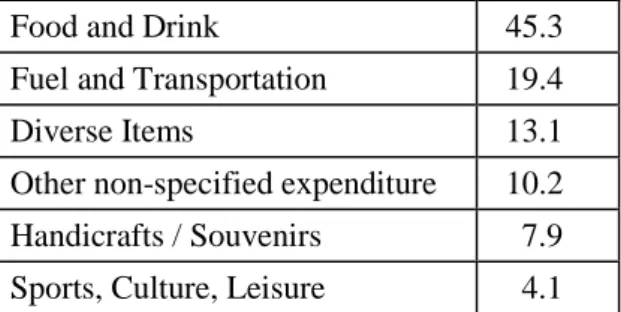
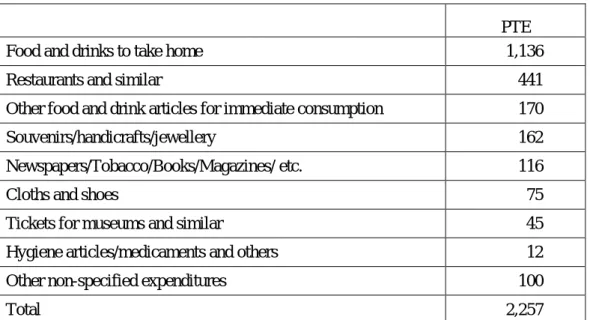
(15) -. A very substantial percentage (82%) of what we can call “internal” spending, that is, the money spent within the accommodation sector, was due to the “bed and breakfast” category. This means that the other internal consumption, namely meals, drinks, leisure services, etc., were rather irrelevant.. -. In relation to the spending outside the accommodation unit, our data (Table 1) shows that nearly 2/3 of the total (more precisely 65%) covers the fields directly related to maintenance needs – food and drinks – and car fuel and transport costs. <INSERT TABLE 1 ABOUT HERE>. With regard to the cruise boat passengers, the extent of the average daily direct expenditure each one makes in the region is smaller still. Buying the complete tourism package in Lisbon, Oporto or quite frequently in London or other foreign places, including travel, accommodation, on and off the boats, meals (most of which are served onboard), the visits to monuments and other sites, transportation on land to visit local towns etc., tourists coming up to Douro by boat have neither the opportunity nor the necessity to spend extra money in the region. As the figures in the Table 2 show, they spend, in fact, very little money off the boats. <INSERT TABLE 2 ABOUT HERE> The replication of the same inquiry to the same type of tourists in 1997 confirmed that despite the spectacular increase in the number of tourists arriving at the Douro destination by boat (360% between the two surveys), the trend towards low levels of direct spending by tourists in the region still persists (Table 3). 15.
(16) <INSERT TABLE 3 ABOUT HERE> Among the various factors behind this weak, general pattern of rural tourists’ direct spending, we find that the most important and most determining ones are located within the less favoured regions themselves, rather than on the tourists, that is to say, such a pattern is much more due to the inability and incapacity of these regions to induce tourists spend money, rather than with the tourists’ own capacity and availability to spend (Ribeiro and Diniz, 1995; Ribeiro, 1998b). Unfortunately due to lack of time, this argument cannot be developed here. The empirical findings about tourists’ spending have been leading researchers to conclude that the social and political expectations recently created around the potential of tourism to promote the revitalisation of rural economies, are too high. - The motivations currently used to justify the economic exploitation of the so called “turismo em espaço rural” [tourism in rural space — TER] appear, very often, largely overestimated. Such a fact, understandable in a context of locally non-available economic alternatives, cannot, however, lead people to build illusion scenarios. (Umbelino, 1998). - If, theoretically, tourism in the rural space (TER) appears as a tool to promote local and even regional development, in practice, and in relation to the specific territorial area we selected to study 8, the results are quite below. 8. Two counties in Minho (See map in Annex 1).. 16.
(17) the expected ones; in terms of the local economy, the effects are still very small. (Robalo, 1999). SOME FINAL REMARKS. The reflective exercise done along this text is not to be seen as a sort of an anti-rural tourism manifest, but only as a call of attention for the need to moderate the general optimism, frequently even euphoria, that permeates the abundant rhetoric about the role of tourism in the development of less favoured regions. Implicitly it is also a call of attention for the need of intensifying empirical research on the subject. As a matter of fact, from our empirical findings we have been progressively led to formulate as quite plausible the working hypothesis that the chief role that rural tourism can play /has been playing in the less favoured areas, is not to be expected at the level of the direct and immediate effects on income and employment, but as Andrez (1999) puts it, the tourism impact in these regions will have, above all, to do with the dynamics of development, that is to say with, the activation of attitudes and motivations, the catalysis of ideas, initiatives and energies, the integration of processes and procedures, the formatting of actions and interventions.. 17.
(18) REFERENCES. AMTAD 1997. Estudo Estratégico para o Desenvolvimento de Trás os Montes e Alto Douro. Associação de Municípios de Trás os Montes e Alto Douro: Vila Real. Andrez J. 1999. O Turismo e o Desenvolvimento Regional. Ideias para Discussão. Comunicação apresentada ao Encontro Que Turismo para o Douro? Balanço e Perspectivas. Círculo Cultural Miguel Torga, Casa da Calçada, Provezende, 29 de Maio. Barde M. P. 1984. Réflexions sur le Tourisme en Milieu Rural comme Activité Complémentaire de l’Activité Agricole et Élément d’Animation Culturelle. Congresso Le Tourisme en Milieu Rural. Madrid, 19 y 20 de Octubre. Bornet B. 1992. Le Tourisme Rural en Tant que Facteur Socio-économique de Stabilisation de Population Rural et Alternative Appropriée aux Pressions dans les Zones Touristiques Actuellement Surchargées. Revue de Tourisme 3:2-7. Capucha L. M. A. 1996. Fazer Render o Belo — Questões à Volta do Turismo e do Desenvolvimento em Zonas Rurais. Sociologia. Problemas e Práticas. 21:29-46. Cavaco C. 1995. Turismo Rural e Desenvolvimento Local. in As Regiões de Fonteira: Inovação e Desenvolvimento na Perspectiva do Mercado Único Europeu. Estudos para o Desenvolvimento Regional e Urbano 43. Centro de Estudos Geográficos: Lisboa: 351-408. CCE 1988. O Futuro do Mundo Rural. Boletim das Comunidades Europeias 4/88 (suplemento). CCE 1990. Acções Comunitárias a Favor do Turismo Rural. Serviço das Publicações Oficiais das Comunidades Europeias: Luxemburgo. CCE 1992. Proposta Alterada do Conselho Relativa a um Plano de Acções Comunitárias — Medidas Comunitárias a favor do Turismo. Jornal Oficial das Comunidades Europeias 12(5):13-93.. 18.
(19) CCE 1995. O Papel da União em Matéria de Turismo. Livro Verde da Comissão. Bruxelas. CCE 1998. Desenvolvimento Rural. Comissão Europeia Direcção Geral de Agricultura: Bruxelas. CCRN 1980. Contribuição para a Definição duma Política de Desenvolvimento do Turismo Rural na Região Norte. Ministério da Administração Interna – Comissão Coordenadora da Região Norte: Porto . Filipe J. L. 1990. Turismo no Espaço Rural. Técnicas e Equipamentos Municipais 13:58-62. INE 1994. Gastos dos Estrangeiros não Residentes. INE: Lisboa. LEADER 1993. LEADER Magazine 4. Ribeiro M, Diniz F, Carqueja C. 1994. Annual Reports for Year 2 — Agrotourism and Synergetic Pluriactivity. Contract nº AIR3 - CT92 - 0477. Ribeiro M, Diniz F. 1995. Turismo Rural Enquanto Alternativa de Desenvolvimento de Regiões Desfavorecidas Potencialidades e Limites. 3rd International Congress of the Mediterranean Association of Tourism. Estoril: 20-22 April. Ribeiro M. 1998b. Turismo Rural e Desenvolvimento na Região do Douro — Processos e (alguns) Resultados da Evolução Recente do Sector. Douro. Estudos & Documentos 6:25-50. Ribeiro M. 1998a. Turismo Rural em Portugal — Dos seus Protagonistas Principais e da sua Configuração. in Anécio J, Froehlich J. M, Riedl M. [orgs] Turismo Rural e Desenvolvimento Sustentável. Departamento de Educação Agrícola e Extensão Rural, Centro de Ciências Rurais, Universidade Federal de Santa Maria:169-190. Ribeiro M. 1999. Agricultura e Ambiente em Regiões Desfavorecidas: Expressão de Subdesenvolvimento, recursos para o Desenvolvimento. Paper presented to the workshop Impacte do Sector agrícola e Pecuário no Ambiente. UTAD: Vila Real, March 24-25.. 19.
(20) Robalo F. 1999. Turismo em Espaço Rural: o estudo de caso dos concelhos de Póvoa de Lanhoso e Vieira do Minho [abstract]. Paper presented to the VI Encontro Nacional da APDR, Braga. Slee B et al. 1996. The Economic Impact of Differential Styles of Tourism on Rural Areas of Europe. STB Newsletter 6: 57-65. Umbelino J. 199). Turismo em Espaço Rural: da Utopia à Realidade. In Turismo: Horizontes Alternativos. Colibri: Lisboa:175-188.. 20.
(21) Figure 1 – Number of TER houses and beds in Portugal, by the three main TER forms (1998). Source: DGT – Direcção-Geral de Turismo. 21.
(22) Table 1- Percentage distribution of tourist spending outside the accommodation unit Food and Drink. 45.3. Fuel and Transportation. 19.4. Diverse Items. 13.1. Other non-specified expenditure. 10.2. Handicrafts / Souvenirs. 7.9. Sports, Culture, Leisure. 4.1. 22.
(23) Table 2- Average daily expenditures made by tourists on land by categories of expenditure (1995). PTE. %. Handicrafts and Souvenirs. 780.2. 41.2. Food and Drink. 573.7. 30.3. Diverse Items. 312.8. 16.5. Other non-specified expenditure. 118.8. 6.3. Transportation. 68.9. 3.6. Sports, Culture, Leisure. 39.6. 2.1. 1894.0. 100.0. Total. 23.
(24) Table 3- Average daily expenditures made by tourists on land by categories of expenditure (1997). PTE 1,136. Food and drinks to take home Restaurants and similar. 441. Other food and drink articles for immediate consumption. 170. Souvenirs/handicrafts/jewellery. 162. Newspapers/Tobacco/Books/Magazines/ etc.. 116. Cloths and shoes. 75. Tickets for museums and similar. 45. Hygiene articles/medicaments and others. 12. Other non-specified expenditures. 100. Total. 2,257. 24.
(25) Annex 1: Map of touristic regions of mainland Portugal and the destinations of Porto e Norte de Portugal. 25.
(26)
Imagem


Documentos relacionados
gold(III) by ethylenediamine modified persimmon tannin adsorbent (EPPFR). The same type of behaviour was observed between the authors study and the present one: Au recovery
De fato, no esquema que propõe para a explicação da queda da fecundidade (Figura 7.1), Therborn inclui algo que não me parece muito usual nos esquemas explicativos da fecundidade
Defini como objetivos específicos: o conhecimento e fluidez na realização da entrevista clínica e exame objetivo; o diagnóstico, abordagem e gestão das patologias
a j Also at Department of Physics, California State University, Sacramento CA, United States of America ak Also at Moscow Institute of Physics and Technology State
Os números demonstrados nas coletas deste estudo e os estudos presentes hoje na literatura indicam que ainda hoje a melhor estratégia para a regularização dos níveis bioquímicos
A realização das entrevistas possibilitou verificar as práticas educativas quotidianas utilizadas no lar familiar, tais como hábitos de estudo, de leitura e escrita,
Relativamente às verdascas que são desejáveis num pomar existem diferenças significativas entre o sistema em Tatura que foi submetido ao tratamento com Regalis, com o maior número de
The organic solutes content was altered by water deficit (Table 3), presenting increased (p<0.05) leaf soluble sugar, protein and free amino acid contents in both species..
