INTRODUCTION
In 1630’s to 1750’s (the early Edo period), the HIZEN colored porcelains were produced at Arita and Imari areas,
which were under the rule of Nabeshima domain in HIZEN-Han at that time of the Edo period (at present, Arita and Imari areas in Saga prefecture of Kyushu island, Japan). Korean potters discovered raw materials for the porcelain ceramics of
Correlation between glaze-colors and structural properties
of the HIZEN celadons produced in the Edo period of Japan,
by means of X-ray diffraction (
І
)
(Correlação entre cores de esmaltes e propriedades
estruturais de celadons Hizen produzidos no período Edo do Japão,
por meio de difração de raios X (
І
))
M. Hidaka1, K. Ohashi2, R. P. Wijesundera1,6, L. S. R. Kumara1, M. Watanabe3, K. Koga4, Jae-Young Choi5, N. E. Sung5, Y. J. Park5
1Department of Physics, Graduate School of Science, Kyushu University, Fukuoka 812-8581, Japan
2The Kyushu Ceramic Museum, Arita, Saga, 844-8585, Japan
3Center of Advanced Instrumental Analysis, Kyushu University, Fukuoka 819-0395, Japan
4Advanced Instruments Centre, Kyushu Sangyo University, Japan
5Beamline Department, Pohang Accelerator Laboratory, Pohang University of Science and Technology, San31,
Hyoja-doing, Pohang, 790-784, Korea
6Department of Physics, University of Kelaniya, Kelaniya, Sri Lanka
Abstract
HIZEN celadons produced at Arita and Imari areas in Japan from 1630’s to 1790’s (Edo period) have been investigated by means of X-ray fl uorescence analysis, and X-ray diffraction and X-ray absorption spectra using synchrotron radiation. It is found that, in the HIZEN celadons, the color brightness of the celadon glazes depends on the structural property of the raw basic ceramics taken at Imaizumi (Arita) and Ohkwachi (Imari), where the former is mainly Quartz-SiO2, and the later is Sanidine ((K,Na)Si3O8). It is confi rmed that CaCO3 of natural wood ash added artifi cially into the raw celadon ceramics makes a glassy glaze on the surface of the basic body of the HIZEN celadons. Transition-metal ions (Cr, Cu, Zn) of very small amount are detected in the celadon glazes, in addition to Fe and Mn of small amount. It is considered that Cu and Cr are related to the color brightness of green-brown and blue-green in the HIZEN celadon glazes, respectively.
Keywords: HIZEN celadons, celadon glaze, microstructure.
Resumo
Celadons (http://www.ceramicanorio.com/aprendendoourelembrando/celadon/celadon.html) Hizen produzidos nas áreas de Arita e Imari no Japão nos anos de 1630 a 1790 (período Edo) foram investigados por meio de análise de fl uorescência de raios X, difração de raios X e espectros de absorção usando radiação síncrotron. Foi descoberto que nos celadons Hizen o brilho na coloração dos esmaltes celadon depende da propriedade estrutural da matéria-prima cerâmica extraída em Imaizumi (Arita) e Ohkwachi (Imari), onde a primeira é principalmente quartzo-SiO2, e a última é um feldspato ((K,Na) Si3O8). Foi confi rmado que CaCO3 da cinza da madeira natural adicionada artifi cialmente na matéria-prima cerâmica celadon produz um esmalte vítreo na superfície do corpo básico dos celadons Hizen. Uma quantidade muito pequena de íons de metal de transição (Cr, Cu, Zn) foi detectada nos esmaltes de celadons, alem de pequeno teor de Fe e Mn. Considera-se que Cu e Cr estão relacionados com o brilho na coloração verde-marron e azul-verde nos esmaltes do celadon Hizen, respectivamente.
high-quality at Arita area in 1610’s. The porcelain ceramics of white-color is ferromagnetic, called Hakujikou, and collected specially at a small mountain, Izumiyama, sited in the center of Arita. The HIZEN colored porcelains show elegant and bright patterns (fl owers, weedy grasses, threes) on the white or milky-white porcelain basic body with several kinds of colored enamels in the overglazes and with blue enamel on the transparent underglaze. Especially, the colored patterns were distributed non-symmetrically in the widely white or milky-white space on the porcelain surface. It is known that the HIZEN colored porcelains are classifi ed by four kinds of porcelains: Shoki-Iroe (Kokutani-style), Kakiemon-style, Kinran-style, and Nabeshima ware [1-8]. The HIZEN colored porcelains had been exported from the later 17th century and were estimated to be very famous for interior decorations and dinner-sets in Europe, as Chinese porcelains.
At Arita, porcelains, called “Shoki-Imari”, were produced by a Korean porcelain technique in 1610~1640’s. From 1640~1650’s, the porcelains having the blue-colored underglazes and the overglazes of several colors were produced by the porcelain technique due to Keitokuchin-kiln (China). At the time, celadons were also made due to Ryusen-kiln (China) [9, 10]. The HIZEN celadons were produced at Arita area in 1630~1660’s, and the celadon glaze was completed in 1670’s [11]. In 1630~1650’s, MITUNOMATA celadons having the elegant and bright glaze were also produced at Mitunomata of Hasami, which is about 10 km away from Arita [12, 13]. After 1700’s, the quality of celadon glaze was gradually declined [14]. In order to do quickly the mass production of the exporting HIZEN colored porcelains at the Arita areas, the Nabeshima domain gathered special kilns, called AKAEYA, at AKAE-MACHI localized at a small area in the center of Arita in 1660’s. The AKAEYA carried out professionally to paint the overglazes and heat the colored porcelains at high-temperature. Thus, it was deduced that the declination of the celadon technique was affected by the mass production of the HIZEN colored porcelains at Arita. However, the Nabeshima-domain kiln, called Odougu-yama, was transferred from Nangawara (Arita) to Okawachi (Imari) in 1673-1681’s, where the later is about 10 km away from Arita. The HIZEN celadons of high-quality were continuously produced at Imari, and the celadon technique has been succeeded to the modern Nabeshima celadons, as Choshun kiln sited at Ohkawachi.
The HIZEN celadons are grouped by a monochromatic glaze and a blue-color underglaze or a rust glaze on the basic body of the porcelain ceramics [3, 8, 11-13]. However, the glazes of the HIZEN celadons produced in the early 17th century are semitransparent, non-uniform, and show wider color from light green-brown, black green-brown, dark brown, green-brown, green. This means that the thermal treatment at high-temperature of about 1200 to 1250 °C was not stable in the used kilns. It is interested that, from 1630’s, some HIZEN celadons show the underglaze patterns painted on the basic body. It was considered that Japanese porcelains are always based on progenitor styles of Chinese and Korean ones. However, progenitor styles of the celadons, which were
combined with underglazed cobalt-blue color or lapis color, were produced in the middle 17th century [3, 4, 8, 11-13, 15]. Such celadons cannot be clearly found in China and Korea at that time.
It is empirically known that the iron oxides in the celadon glaze show blue-green color under the deoxidizing thermal treatment at high-temperature of about 1200 to 1250 °C. The celadon glaze changes gradually its color from yellow-brown to black color, as increasing the iron oxides under the deoxidizing thermal treatment. J. S. Larid (1918) [16] and R. R. Hunghan (1950) [17] reported that the blue-green color of the celadon glazes is induced by chemical reaction from Fe2O3 to FeO in the celadon glazes under the deoxidizing thermal treatment.
Recently, we have studied the structural and electronic properties of the red-colored overglazes on the HIZEN colored porcelains, produced at Arita areas from the 17th to 18th century, by means of X-ray diffraction (XRD) and X-ray absorption spectrum (XAS), using synchrotron radiation [18-20]. In the present paper, we report the technical and historical correlations among the celadon glazes of the HIZEN celadons produced in the Edo period by means of the same methods of the XRD and XAS using synchrotron radiation, in addition to X-ray fl uorescence analysis.
MATERIALS
As described above, the HIZEN celadons were produced at the Arita areas of Arita, Hasami, and Ohkwachi in the north region of Kyushu island (Japan), and are closed to neighbor country of Korea. The areas are localized in the small area of about 20km in diameter, and geologically give the raw ceramics having similar oxides of mainly SiO2 and Al2O3 and a small amount of other extra oxides K2O, Na2O, CaO, MgO, Fe2O3. Thus, it is expected that the difference of the extra oxides partially relates to characteristic color modulation of the HIZEN celadons. In the present investigations, the oxide components of the raw ceramics were studied by means of X-ray fl uorescence emitted from the ceramics, when the X-ray beams were emitted from a Cr-target of the ordinary X-ray source (50 kV, 50 mA). Table I shows a ratio (wt.%) of the oxide components in the raw basic ceramics and the raw celadon ceramics at Izumiyama (Arita), Mitunomata (Hasami), and Ohkawachi (Imari), where we will describe about a material of Isubai later. It is found that the raw ceramics include mainly SiO2 and Al2O3, in addition to the extra oxides, though each ratio depends on the mining place of the raw ceramics. The amount of Fe2O3 in the Izumiyama celadon ceramics is slightly larger than its basic-body ceramics of white-color, called “Hakujikou”.
fl ower vase, (n): tea pot. The HIZEN celadons in Photo 1(a) and (ℓ) were collected at the ancient kilns of Kamanotsuji (Yamauchi), Hyakuken (Yamauchi), Chokichidani (Arita), Maruo (Arita), Shimoshirakawa (Arita), Higuchi (Arita), and Nabeshima-domain kiln called Nabeshima Odougu-yama (Ohkwachi at Imari). All of the kilns are famous and historical kilns in the Edo period. Ohkawachi (Imari) is about 10 km away from Arita, while Yamauchi is about 5km away
from Izumiyama at Arita. After Korean potters discovered the high-quality porcelain ceramics at the small mountain of Izumiyama, which is sited at the center of Arita in 1610’s, it was considered that the kilns at Yamauchi area used the Izumiyama ceramics. The broken pieces of the Nabeshima celadons in Photo 1(i) and (j) were made at Ohkawachi Odougu-yama. The Nabeshima wares including the celadons show excellently elegance and brightness, since the wares were gifts only to the Tokugawa Shogun (Edo period) [3, 8]. In Photo 1, the glazes of the HIZEN celadons (Yamauchi) produced before 1650’s show partially light-shade color and non-uniform to those of the HIZEN celadons (Arita) produced in 1650’s−1660’s. On the other hand, the glaze color of the HIZEN celadons (Ohkawachi) is blue-green and is also different to those of the celadons produced at Yamauchi and Arita. It is deduced that the glaze color and its uniformity depend on the raw materials of the used raw ceramics or the technical difference among the potters working at each kilns. However, in Table I, there is not so large difference of the oxide components in the celadon ceramics and the basic-body ceramics of Izumiyama and Ohkawachi, as shown in Table I.
The broken pieces of the HIZEN celadons in photo 1 were rented from at the public museum are very important cultural assets in Japan. Thus, in the present investigations, we were strongly requested to use nondestructive methods for studying the structural and electronic properties of the present celadons. In order to study the oxide components in the celadon glazes, we used an energy dispersive-type X-ray fl uorescence analyzer (Simazu−EDX 800) having lower current, of which power was (Rh)15 kV, 230 to 500 A in the Na−Sc region and 50 kV, 25 to 70 A in the Ti−U region. The exposed area of the ceradon glazes was 10 mm in diameter. We confi rmed that the exposed areas in the celadon glazes did not show the color change. The results are listed in Table II. It is considered that the glazes of the HIZEN celadons are consisted of the similar oxide components of the raw celadon ceramics in Table I, except CaO and Fe2O3. It is known that Isubai (natural wood ash) including much CaCO3 is traditionally added into the raw ceramics of the HIZEN celadon glazes. At the fi rst stage of
wt.% SiO2 Al2O3 K2O Na2O CaO MgO Fe2O3
Izumiyama basic-body ceramics
(Hakujikou) 79.1 14.0 2.76 0.42 0.12 0.06 0.56
Izumiyama celadon ceramics 73.4 15.1 4.05 3.64 0.55 − 1.52
Mitunomata basic-body ceramics 73.6 18.4 5.58 1.10 0.24 − 0.98
Mitunomata celadon glaze 63.1 15.4 5.28 0.67 12.5 0.93 1.73
Ohkawachi celadon Ceramics 67.1 21.1 5.04 1.25 0.81 0.34 4.21
Isubai 28.7 1.43 1.72 0.60 37.8 1.29 0.32
Table I - Compositions of the raw porcelain ceramics and the raw celadon ceramics at the Arita areas of Izumiyama, Mitunomata, and Ohkawachi.
[Tabela I - Composições das cerâmicas de porcelana e de celadon das áreas Arita de Izumiyama, Mitunomata, e Ohkawachi.]
the celadon production, the ceramic basic-body was heated at about 850 °C. After that, the celadon glaze should be heated at more higher-temperature to make a glassy-phase on the surface of the ceramic basic-body of the HIZEN celadons. The ordinary temperature in the celadon kilns was about 1200-1250 °C in 1630’s to 1790’s. However, the raw ceramics were not in the glassy state at the temperature region. Thus, CaCO3 is chemically changed to CaO at about 825 °C, and CaO has a catalytic function to reduce the glassy temperature of the raw celadon ceramics.
It is known that the characteristic green-brown and blue-green colors of the celadon glaze in photo 1 are induced by chemical reaction from Fe2O3 to FeO in the celadon glazes under the deoxidizing thermal treatment [16, 17]. As for the present X-ray fl uorescence analysis, we can estimate only the atoms emitting X-ray fl uorescence, but not electronic valence of its atom for instance Fe2+ and Fe3+. As reported in our other paper [21], we found that, for the HIZEN celadons, there is no chemical reaction from α-Fe2O3 to FeO structure under the deoxidizing thermal treatment at high-temperature of about 1200 to1250 °C. Thus, in Table II, we analyzed the ion oxide as Fe2O3 in the celadon glazes. It is also found in Table II that there is a content transition of Fe2O3 and MnO at Arita and Ohkawachi areas between Photo 1(a)-(h) and (i)-(m), that is before and after 1690’s year. After 1700’s, the technique was gradually declined [14] by the mass production of the HIZEN colored porcelains at the Arita areas. It is considered that the celadon declination after 1700’s induced originally the elegant celadon glaze of white-green-brown at Arita and of blue-green at Ohkawachi. However, the color difference can not be confi rmed in Table II, as Photo 1(i), (j); Nabeshima-domain kiln (Ohkawachi, 1690-1720’s), (k), (ℓ); Higuchi (Arita, 1760-1790’s), and (m), (n); Choshun kiln (2007).
EXPERIMENTAL
In order to study the structural properties of the HIZEN celadons, we used a high resolution 4-circle X-ray diffractometer using synchrotron radiation at the Pohang Light Source (2.5 GeV) of the Pohang Accelerator Laboratory (Korea). After setting the broken piece of the HIZEN celadons in photo 1 on the specimen stage of the 4-circle X-ray diffractometer, we irradiated its glaze with the incident monochromatic X-ray beams of about 1 mm in diameter. As described before, all of the used pieces of the HIZEN celadons in photo 1 were rented from the public museum. Thus, we preliminary checked the color modulation of the irradiated celadon glaze, induced by strongly high-bright X-ray of the incident synchrotron radiation. It was experimentally confi rmed that its X-ray photon energy of about 8.0457 keV (1.5412 Ǻ) did not effect any color change of the irradiated galze. The used X-ray diffraction method was a 2θ scan with each stepping angle of Δ2θ = 0.03 degrees in the region of 2θ = 10.00 to 70.00 degrees, where the specimen was always
fi xed at an incident angle θs of about 5 degrees to the incident X-ray beams during measurements.
RESULTS AND DISCUSSION
Figs. 1a and b show the X-ray diffraction patterns of the raw celadon ceramics, called celadon ceramics, taken at Izumiyama (Arita) and Ohkawachi (Imari), respectively. The diffraction patterns are largely different, though the component ratio of the oxides between both areas is not so largely changed in Table I.
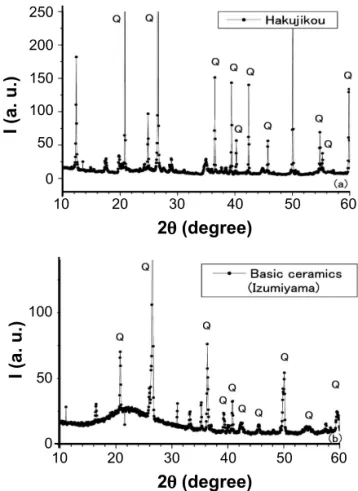
In Fig.1a peaks denoted by “Q” result from refl ections of the quartz-SiO2 structure and show a similar intensity
kiln remain SiO2 Al2O3 CaO K2O Na2O MgO Fe2O3 MnO TiO2
a Kamanotsuji 67.3 14.2 8.41 5.68 1.96 ─ 2.15 0.15 ─
b Kamanotsuji 65.5 15.9 8.68 5.31 1.57 0.73 2.06 0.24 ─
c Hyakuken 62.8 14.9 11.8 5.39 0.78 0.86 2.73 0.32 0.18
d Hyakuken 64.8 15.0 11.0 5.08 1.09 ─ 2.35 0.32 0.17
e Nagayoshidani 64.5 15.8 10.8 4.06 0.57 1.39 2.85 0.28 0.26
f Nagayoshidani 65.0 15.6 10.4 4.61 0.68 0.94 2.44 0.28 ─
g Maruo 63.2 16.5 9.32 5.06 1.29 1.50 2.55 0.23 0.19
h Shimoshirakawa 67.3 15.2 9.42 3.91 0.35 1.44 2.02 0.26 ─
i Nabeshima kiln 68.8 14.6 8.62 4.86 1.28 ─ 1.60 0.11 ─
j Nabeshima kiln 69.3 16.2 5.79 5.61 1.32 ─ 1.59 0.07 ─
k Higuchi 68.6 15.3 6.83 5.43 1.88 ─ 1.73 0.06 ─
ℓ Higuchi 66.6 15.4 8.13 5.74 2.02 ─ 1.89 0.07 ─
m Choshun kiln 75.1 12.8 4.51 4.53 2.06 ─ 0.96 0.03 ─
Table II - Oxide compositions (wt.%) of the celadon glazes of the HIZEN celadons, Seiji (a)-(ℓ) and the modern Nabeshima celadon (Choshun kiln), Seiji (m).
distribution of the SiO2 structure. However, the other observed peaks could not be related to the component oxides of Al2O3, CaO, K2O, Na2O, MgO, while some weak peaks result from the Fe2O3 structure. We also confi rmed that the observed peaks are not related to feldspar complexes of (SiO2-Al2O3) system; KAlSi3O8 (orthoclase), KAlSi3O8 (microcline), NaAlSi3O8 (albite), (K,Na)Si3O8 (sanidine), (Na,K)Si3O8 (anorthoclase), CaAl2Si2O8 (anorthite), of which volcanic minerals are universally included in the earth crust. Thus, it is considered that the Izumiyama ceramics has a characteristic structure of (SiO2-Al2O3) complex, in which the main oxide is Quartz-SiO2. However, at a moment, we cannot analysis all of the observed peaks in Fig.1a, except the Fe2O3 peaks. In Fig.1b, peaks denoted by “Q” result from refl ections of the quartz-SiO2 structure. However, the intensity of the SiO2 peaks is not refl ected on the intensity taken by the quartz-SiO2 structure. Thus, we consider that the quartz fi ne crystals are distributed under the disorder orientation in the Ohkawachi ceramics. The other observed peaks, except peaks denoted by “U”, result from the (K,Na) Si3O8 (sanidine) structure and show a similar intensity distribution of the sanidine structure. The U peaks could not be identifi ed by the component oxides and the feldspar complexes.
As described before, the glaze color of the HIZEN celadons is slightly different between the Yamauchi and
Arita areas and the Ohkawachi area. In photo 1 the former is green-brown while the later is blue-green. We suspect that the difference depends on the structural property of the raw ceramic materials. When producing the HIZEN celadons at
Arita, the basic body was made from Hakujikou, Izumiyama basic ceramics of high-quality, by heating at about 850 °C. Fig. 2a shows the X-ray diffraction patterns of Hakojikou. The raw material is mainly the quartz-SiO2, as the Izumiyama Seiji ceramics in Fig.1a. Fig. 2b shows the X-ray diffraction patterns of the basic body of the HIZEN ceradon. We found that the 850 °C thermal treatment increases the quartz-SiO2 structure in the basic-body ceramics. Furthermore, the diffraction patterns of halo-like scattering also indicate a glass state in the basic body. The glass state is made of the other oxides, except quartz-SiO2.
The white-color of the basic-body ceramics increases optically the brightness of the ceramic glaze. However, the raw celadon ceramics are not melted even at about 1200-1250 °C. At that time, the potters used empirically a ceramic technique to make the glaze of glassy phase on the ceramic basic-body of the HIZEN celadons. They added Isubai, including much CaCO3, into the raw ceramics in Table II. In order to study the structural property of the glazes of the present celadons by means of the nondestructive method, we carried out measurements of the X-ray diffraction patterns using the
Figure 1: X-ray diffraction patterns of the raw celadon ceramics;(a) Izumiyama at Arita and (b) Ohkawachi at Imari.
[Figura 1: Difratogramas de raios X da matéria-prima cerâmica celadon; (a) Izumiyama em Arita e (b) Ohkawachi em Imari.]
200
150
100
50
1200
1000
800
400 600
200
0 10 10
2θ (degree)
2θ (degree)
I (a. u.)
I (a. u.)
30 30
50 50
20 20
40 40
60 60
Figure 2: X-ray diffraction patterns of Izumiyama ceramics; (a) Hakujikou and (b) the basic-body ceramics.
[Figura 2: Difratogramas de raios X das cerâmicas Izumiyama; (a) Hakujikou e (b) cerâmica base.]
250
200
150
100
50
0
100
50
0 10 10
2θ (degree) 2θ (degree)
I (a. u.)
I (a. u.)
30 30
50 50
20 20
40 40
synchrotron radiation. The diffraction method was a 2θ scan with each stepping angle of Δ2θ = 0.03 degrees in the region of 2θ = 10.00 to 60.00 degrees, where the specimen was always
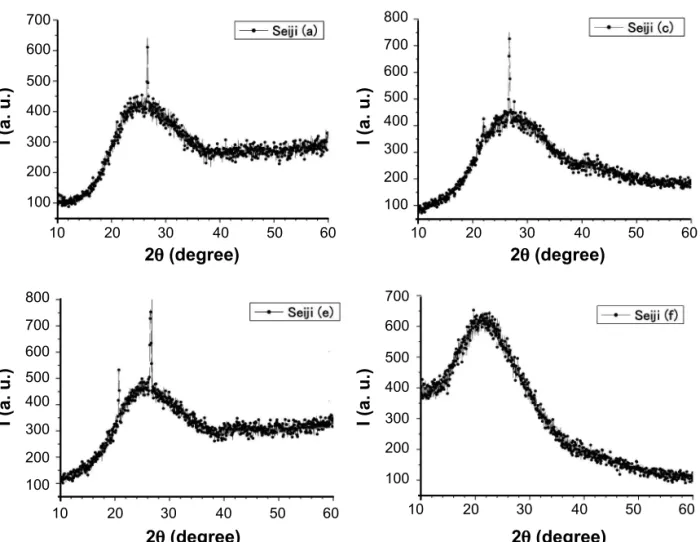
fi xed at an incident angle θs of about 5 degrees to the incident monochromatic X-ray beams during the measurements. Fig. 3 shows X-ray diffraction patterns of the HIZEN celadon glazes; Seiji (a), (c), (e), and (f), which are in photo 1 (a), (c), (e) and (f), respectively. Seiji (a) and (c) were produced in 1630-1640’s, while Seiji (e) and (f) in 1655-1660’s. All of the diffraction patterns show halo-like scatterings. This suggests that the celadon glazes are in glassy state. Thus, the component oxides in Table II are melted and/or resolved to make the short-range order of atoms in the celadon glazes, by heating at about 1200 to 1250 °C. However, we observed the peaks of the quartz-SiO2 structure for Seiji (a), (c) and (e), but not (f) in Fig. 3. We suspect that the short-range order of component atoms and the quartz-SiO2 fi ne crystals in the celadon glazes affect the color of green-brown and the color uniformity in Seiji (a), (c), (e), and (f).
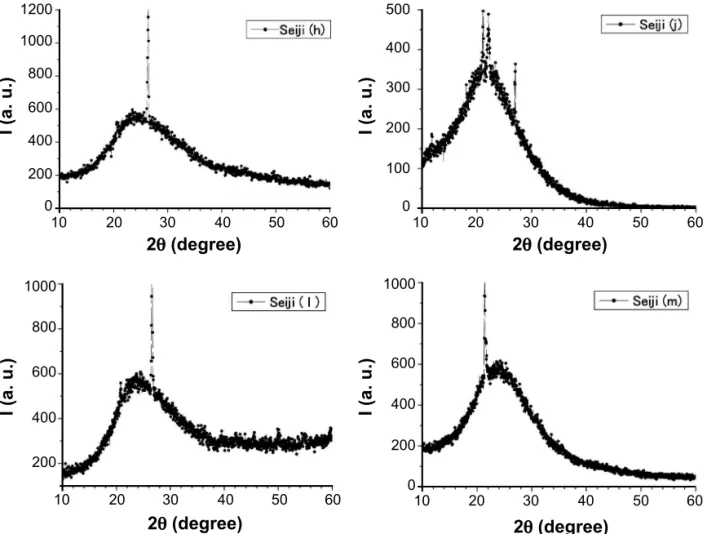
Fig. 4 shows X-ray diffraction patterns of the HIZEN celadon glazes; Seiji (h), (j), (ℓ), and (m), which are in photo 1 (h), (j), (ℓ), and (m), respectively. Seiji (h), (j), and (ℓ) were produced in 1655-1660’s, 1690-1720’s, 1760-1790’s,
respectively, while Seiji (m) in 2007. Seiji (h) and (ℓ) were produced at Arita, while Seiji (j) and (m) at Ohkawachi. All of the diffraction patterns show halo-like scatterings. This suggests that the celadon glazes are in glassy state. We also observed the peaks of the quartz-SiO2 structure for Seiji (h) and (ℓ). However, the peaks of Seiji (j) and (m) does not result from quartz-SiO2. After identifying the peaks with the feldspar complexes of (SiO2-Al2O3) system, we consider that the peaks of Seiji (j) and (m) result from the orthoclase structure of KAlSi3O8 or the sanidine structure of (K,Na) Si3O8. Thus, we suspect that, in photo 1, the glassy glaze-color of the HIZEN celadons depends on the raw basic ceramics taken at Izumiyama and Ohkawachi, where the farmer is mainly quartz-SiO2 and the later is sanidine as a main oxide component.
Table I shows the oxide components in the glazes of the HIZEN celadons. The component ratios do not give information of the color brightness of the celadon glaze. On the other hand, the X-ray diffraction patterns suggest the structural information of the basic-body ceramics and the glassy celadon glazes. It is known that the glaze color depends on the very small amount transition-metal ions of (Cr, Mn, Cu, Zn), called the extra transition-metal ions,
Figure 3: X-ray diffraction patterns of the HIZEN celadon glazes; Seiji (a), (c), (e), and (f), which are in photo 1 (a), (c), (e) and (f), respectively.
[Figura 3: Difratogramas de raios X dos esmaltes de celadons HIZEN; Seiji (a), (c), (e), e (f), que são na foto 1 (a), (c), (e) e (f), respectivamente.]
2θ (degree) 2θ (degree)
2θ (degree) 2θ (degree)
I (a. u.) I (a. u.)
I (a. u.) I (a. u.)
700
700 700
700
800
800 500
500 500
500 300
300 300
300 600
600 600
600 400
400 400
400 200
200 200
200 100
100 100
100 10
10 10
10 20
20 20
20 30
30 30
30 40
40 40
40 50
50 50
50 60
60 60
in the celadon glazes, in addition to Fe ions. However, the component oxides were melted or resolved to make the glassy short-range order of the ions in the celadon glazes, except the small amount fi ne crystals of quartz-SiO2 (Izumiyama celadon ceramics) and feldspar of orthoclase or sanidine (Ohkawachi celadons ceramics) in Figs. 3 and 4. Thus, we can only estimate whether the impurity-like extra transition-metal ions exist in the glassy celadon glaze. If so, we deduce that, in 1630’s to 1790’s (the Edo period), the potters added naturally or artifi cially the extra transition-metal oxides into the raw basic ceramics, to induce the elegant and bright color of the celadon glaze. As in Table II, it is not easy to detect the very small amount of the extra transition-metal ions by means of the present ordinary X-ray fl uorescence analyzer. Thus, we carried out measurements of X-ray absorption spectrum XAS in the wider energy region of the monochromatic incident X-ray beams of synchrotron radiations, in order to detect the transition metal ions of (Cr, Mn, Co, Ni, Cu, Zn) in the glassy celadon glazes.
We measured XAS of the HIZEN celadons and the modern Nabeshima-Choshun celadons in photo 1, by using synchrotron radiation at the Pohang Light Source (2.5 GeV). A double crystal monochromator of Si (111) gave a relative energy resolution ΔE to be less than about 0.2 eV at the
respective monochromatic incident X-ray beams. The incident X–ray photons (Io) were detected with an ionic chamber set before the specimens of the broken pieces in photo 1, while the X–ray fl uorescence photons (IF) emitted from the front surface of the specimens were simultaneously detected with an X–ray
fl uorescence detector. The surface was always set with about 45.0° to the incident X-ray beam, of which the size was about 1 to 3 mm in horizontal and 1 mm in vertical on the specimen surface to the electron orbital of the accelerator. Figs. 5 a, b, c show the XAS of Seiji (g) measured in the wider region of 5900 to 8000 eV. The large change of the spectrum occurs at 7120 eV to be a Fe-K edge, while there are two other small changes denoted by arrows at about 5993 and 6547 eV to be Cr-K and Mn-K edges, respectively. In Fig.5 the gap of the detected X-ray photon counts (IF/Io) is about 0.403, 0.020, 0.0011 to Fe, Mn, Cr-K edge, respectively. On the other hand, Figs. 6 a, b, c show the XAS of Seiji (g) measured in the wider region of 8400 to 10200 eV. There are two small changes at about 8988 and 9661 eV to be Cu-K and Zn-K edges, respectively. In Fig. 6 the gap of the detected X-ray photon counts (IF/Io) is about 0.0012, 0.0007 to Cu, Zn-K edge, respectively. Thus, it is found that Seiji (g) includes naturally or artifi cially the very small amount of Cr, Cu, and Zn, in addition to the small amount Fe and Mn.
Figure 4: X-ray diffraction patterns of the HIZEN celadon glazes ; Seiji (h), (j), ℓ), and the modern Nabeshima celadon (Choshun kiln), Seiji (m).
[Figura 4: Difratogramas de raios X dos esmaltes dos celadons HIZEN; Seiji (h), (j), ℓ), e os modernos celadons Nabeshima (forno Choshun), Seiji (m).]
2θ (degree) 2θ (degree)
2θ (degree) 2θ (degree)
I (a. u.) I (a. u.)
I (a. u.) I (a. u.)
1200
1000 400
800
500
1000 800
600 200
400 400
200 0 1000
800 300
600 600
400 100
200 200
0 10
10 10
10 20
20 20
20 30
30 30
30 40
40 40
40 50
50 50
50 60
60 60
kiln place year transition metal glaze color
a Yamauchi 1630-1640’s Mn, Fe, Cu white-green-brown
b Yamauchi 1630-1640’s Mn, Fe, Cu, Zn white-green-brown
c Yamauchi 1630-1640’s Mn, Fe, Cu, Zn black-green-brown
d Yamauchi 1630-1640’s Mn, Fe, Cu, Zn black-brown
e Arita 1655-1660’s Mn, Fe, Cu green-brown
f Arita 1655-1660’s Mn, Fe, Cu white-green-brown
g Arita 1650-1660’s Cr, Mn, Fe, Cu, Zn white-green-brown
h Arita 1655-1660’s Cr, Mn, Fe, Cu, Zn white-green-brown
i Ohkawachi 1690-1720’s Cr, Mn, Fe blue-green
j Ohkawachi 1690-1720’s Cr, Mn, Fe blue-green
k Arita 1760-1790’s Cr, Mn, Fe, Cu, Zn white-blue- green-brown
ℓ Arita 1760-1790’s Cr, Mn, Fe, Cu, Zn white-blue- green-brown
m Ohkawachi 2007 Cr, Mn, Fe white-blue-green
n Ohkawachi 2007 Cr, Mn, Fe white-blue-green
Table III - Correlation between the colored brightness and the transition metal ions included in the glazes of the HIZEN celadons Seiji (a)-(ℓ), and the modern Nabeshima celadon (Choshun kiln), Seiji (m),(n). [Tabela III - Correlação entre o brilho da coloração e os íons de metal de transição incluídos nos esmaltes dos celadons HIZEN Seiji (a)-(ℓ), e o moderno celadon Nabeshima (forno Choshun), Seiji (m),(n).]
Figure 6: X-ray absorption spectrum in the wider region of 8400 to 10200 eV for the HIZEN celadon glaze, Seiji (g). [Figura 6: Espectros de absorção de raios X na larga região de 8400 a 10200 eV do esmalte de celadon HIZEN, Seiji (g).]
0.12 0.088 0.104
0.10 0.084
0.100
0.11 0.086 0.102
0.09 0.082
0.098
0.08 0.080
0.096
0.07 0.078
0.06 0.076
8400 8800 9200 9600 1000010400 8800 8900 9000 9100 9200 9500 9600 9700 9800
E (eV) E (eV) E (eV)
I F /I 0
I F /I 0
I F /I 0
Figure 5: X-ray absorption spectra in the wider region of 5900 to 8000 eV for the HIZEN celadon glaze, Seiji (g). [Figura 5: Espectros de absorção de raios X na larga região de 5900 a 8000 eV do esmalte de celadon HIZEN, Seiji (g).]
0.7 0.048 0.11
0.5 0.046
0.09
0.6 0.047 0.10
0.4
0.045
0.08 0.3
0.044
0.07 0.2
0.043
0.06 0.1
0.042
5920 6300
6000 6500 7000 7500 8000 5960 6000 6040 64006500 66006700 6800 0.0
E (eV) E (eV) E (eV)
I F
/I 0 I/I F
0
IF /I0 We also carried out measurements of the XAS in the
wider energy region of 5900 to 10200 eV for the HIZEN celadons, Seiji (a) to (n) in photo 1 (a) to (n). The results
emission of the HIZEN celadon glazes in photo 1. Table III suggests that, after about 1660’s year, Cr of very small amount is contained in the celadon glaze at Arita, as those of the Nabeshima celadon glazes; Seiji (i), (j) of Nabeshima-domain kiln (1690-1720’s) and Seiji (m), (n) of Choshun kiln (2007). Thus, we also suspect that the glaze colors of green-brown and blue-green depend partially on the content of Cu and Cr, respectrively, in addition to the structural properties of the raw basic ceramics and the glassy celadon glazes.
CONCLUSIONS
In order to study the historical and geometrical correlation among the glazes of the HIZEN celadons including the modern Nabeshima celadon (Choshun kiln), we carried out the X-ray fl uorescence analysis, the X-ray diffraction, and the measurements of the X-ray absorption spectra near the X-ray K-edge of the transition metal ions in the wider energy region of the incident X-ray photons, by using the synchrotron radiation. The X-ray fl uorescence analysis in Table II suggested that, in 1630’s to 1790’s, the potters added the Isubai (natural wood ash) including much CaCO3 into the raw ceramics of the HIZEN celadon at Izumiyama (Arita) and Ohkawachi (Imari), to make the glassy celadon glaze coated the surface of the celadon basic body. We found from the X-ray diffraction patterns that the CaO, changed chemically from CaCO3 at about 825 °C, certainly reduced the glassy temperature of the raw celadon ceramics at about 1200−1250 °C in the ancient HIZEN kilns. We suspected that the glaze color of the HIZEN celadons strongly depends on the structural property of the Izumiyama basic ceramics and the Ohkawachi ones, where the former was mainly Quartz-SiO2, and the later was Sanidine ((K,Na)Si3O8).
The X-ray absorption spectra in the wider energy region (Table 3) suggested that the characteristic color of the present celadons is related to the contained transition metal ions (Cr, Cu, Zn) of very small amount in the glazes, in addition to Fe and Mn of small amount. We suspected that, for the glaze of the HIZEN celadons, Cu partially gives the green-brown color, while Cr induces the blue-green color. It is possible to considered that the potters added naturally or artifi cially the extra transition-metal (Cr, Mn, Cu, Zn) oxides into the raw basic ceramics of the HIZEN celadons, to induce the elegant and bright color of the celadon glaze. However, at a moment, we could not identify the chemical format of the extra oxides, because their amounts are very small amount in the glassy glazes of the present celadons. The other reason is as follows; in the present investigations, we were strongly requested to use nondestructive methods for studying the structural and electronic properties of the present celadons. Thus, we could not take out the partial glazes from the HIZEN celadons for the chemical analysis.
REFERENCES
[1] I. Ogi, From Early Imari to Kokutani-style, Soujusha Bijutushuppan (1990).
[2] The Kyushu Ceramic Museum, Polychrome porcelain in Hizen − its early type and change of style (1991).
[3] H. Nishida, Y. Ohhashi, Old Imari ware, The Sun special issue 63, Autum ’88, Heibonsha (1994).
[4] I. Ogi, Imari, Ribun Shuppan (2000).
[5] C. Shimizu, La Porcelaine Japonaise, Massin (2002). [6] The Society of Kyshu Early Modern Ceramic Studies, Hizen Porcelains in Japan (2002).
[7] K. Ohashi, M. Arakawa, Early Imari, the origins of Underglaze Cobalt-blue and Overglaze Polychrome Enamels, Japan Broadcasting Corporation (NHK) (2004).
[8] The Kyushu Ceramic Museum, Nabeshima, Porcelain for the Shogunate (2006).
[9] A. Imai, Celadon, Issue 4, Chinese wares, Heibonsha (2002).
[10] Wang Qing-zheng, Fan Dong-quing, Zhou Li-li, The Discovery of Ru Kiln, a Famous Song-ware Kiln of China, The Woods Piblishing Co. (1991).
[11] K. Ohashi, HIZEN celadons, Japanese Seiji, The Kyushu Ceramic Museum (1989).
[12] K.Takeuchi, T. Nobayashi, S. Morokuma, H.Tsuzuki, Development of old-fashined porcelain with traditional raw material II – Characteristic feature on the body and glaze of Hasami celadon, Annual Report of Ceramic Reserch Center of Nagasaki 48 (2001).
[13] Y. Nakano, MITUMATA Seiji Kiln, Hasami Cultural properties report 10, Hasami-cho Boad of Education (1998). [14] K. Ohashi, Arita and Imari porcelains, Tankosha (2002). [15] Y. Suzuta, IMARI CERADON, Old Imri Series Π, Ko-Imari Publication (1991).
[16] J. S. Larid, The composition of Chinese celadon pottery, J. Am. Ceram. Soc. 1 (1918) 675-678.
[17] R. R. Hunghan, Early Chinese ceramics glazes, Ceram. Age 56 (1950) 40.
[18] M. Hidaka, K. Ohashi, S. Kajihara, R. P. Wijesundera, L. S. R. Kumara, Jae-Young Choi, Nark Eon Sung, Structural properties of the red-color overglaze for the HIZEN porcelains produced in the early Edo period of Japan, Ceram. Int. 35 (2009) 875-886.
[19] M. Hidaka, H. Horiuchi, K. Ohashi, R. P. Wijesundera, L. S. R. Kumara, Jae-Young Choi, Yong Jun Park, Structural properties of the red-color overglazes on the Kakiemon-style porcelains produced in the later 17th century by means of X-ray diffraction (І), Cerâmica 55, 334 (2009) 120-127. [20] M. Hidaka, H. Horiuchi, K. Ohashi, R. P. Wijesundera, L. S. R. Kumara, Nark Eon Sung, Local structures and electronic band states of α−Fe2O3 polycrystalline particles included in the red-color overglazes and the transparent glazes of the Kakiemon-style porcelains by means of X-ray absorption spectra (II), Cerâmica 55, 335 (2009) 223-232.
[21] M. Hidaka, K. Ohashi, R. P. Wijesundera, L. S. R. Kumara,S. Sugihara, N. Momoshima, Nark Eon Sung, Local structures and electronic band states of α−Fe2O3 polycrystalline particles in the glazes of the HIZEN celadons produced in the Edo period of Japan,by means ofX-ray absorption spectra (II), to be submitted Cerâmica (2009).