*e-mail: [email protected]
Aluminium Matrix Composites Reinforced with Co-continuous
Interlaced Phases Aluminium-alumina Needles
Elvio de Napole Gregolina, Hélio Goldensteina*, Maria do Carmo Gonçalvesb and Rezende Gomes dos Santosc
a Escola Politécnica da USP, Departamento de Engenharia Metalúrgica e de Materiais
Av. Prof. Mello Moraes 2463, Cidade Universitária, 05508-900 São Paulo - SP, Brazil b Universidade Estadual de Campinas, Instituto de Química, Departamento de Físico-Química,
Cidade Universitária Zeferino Vaz, Barão Geraldo, 13083-970 Campinas - SP, Brazil c Universidade Estadual de Campinas, Faculdade de Engenharia Mecânica - DEMA
Cidade Universitária Zeferino Vaz, Barão Geraldo, 13083-970 Campinas - SP, Brazil
Received: September 27, 2001; Revised: July 10, 2002
An Al-5SiO2 (5 wt% of SiO2) aluminium matrix fiber composite was produced where the reinforcement consists of fossil silica fibers needles. After being heat-treated at 600 °C, the origi-nal fiber morphology was retained but its microstructure changed from solid silica to an intercon-nected (Al-Si)/Al2O3 interlaced structure named co-continuous composite. A technique of powder metallurgy, using commercial aluminium powder and the silica fibers as starting materials, fol-lowed by hot extrusion, was used to produce the composite. The co-continuous microstructure was obtained partially or totally on the fibers as a result of the reaction, which occurs during the heat treatment, first by solid diffusion and finally by the liquid Al-Si in local equilibrium, formed with the silicon released by reaction. The internal structure of the fibers was characterized using field emission electron microscope (FEG-SEM) and optical microscopy on polished and fractured samples.
Keywords:co-continuous structure, silica needles, metal matrix composite
1. Introduction
In the production of metal matrix composite, one of the subjects of interest when choosing the suitable matrix/rein-forcement is the interaction in its interface. In some cases, reactions that occur in the interface between a matrix and its reinforcement have been considered harmful to the final mechanical properties and are usually avoided. In others, the interfacial reactions are intentionally induced when the new layer formed at the interface acts as a strong bonder between the phases1.
Many works on MMC’s published in the last years aimed to obtain a suitable matrix/reinforcement system, that pro-vides minimum and controlled reaction and fine and ther-mally stable ceramic particulates dispersed uniformly in the metal matrix. These works led to the development of in situ composites, in which the reinforcements are synthesized in
a metal matrix by chemical reactions between elements during the composite fabrication. As a result of the process the in situ reinforcement is more thermodynamically sta-ble, the interface between the materials is clean and a strong interfacial bonding is obtained2.
of the reaction between silica and aluminium and the micro-structure of the new layer formed in the silica surface re-mained unsolved until recent works intentionally induced the reaction by immersing a solid silica body into molten aluminium8-11. These works showed that the reaction layer has the form of an interpenetrating metal-ceramic compos-ite, made of an α-Al2O3 skeleton filled with an intercon-nected metal phase that is mostly aluminium with some sili-con crystals that remained from the silica reduction and were retained into the alumina channels12. Usually this interpen-etrating metal-ceramic is known as co-continuous micro-structure, in a reference to the continuity of both phases. A well-defined interface is usually observed between the phases Al-Al2O3 and between reacted and non-reacted ar-eas (between Al-Al2O3 and SiO2 untransformed). These properties are responsible for elastic-plastic deformations on the composite where the elastic deformation in the ce-ramic is accommodated by plastic deformation in the metal phase, without significant microcracking13.
In this study an aluminium matrix composite Al-5SiO2 was produced using powder aluminium and fossil silica fiber by mixing and hot extruding the mixed components. The bars obtained, after heat treatment in temperatures that did not melt the phases, showed a transformation in the fiber morphology identical to the co-continuous previously dis-cussed. By choosing different heat treatment times, the trans-formation was induced totally or partially and the micro-structure results were compared with the published co-con-tinuous structures obtained by immersion of solid silica bodies into the melted aluminium.
2. Experimental
The mineral silica fiber needles used in this work are cylindrical, tubular, transparent and sharp in both extremi-ties. These fibers are not synthetic, being obtained from natural geological deposits found in abundance in Brazil, named spongilites. Their measured diameter and length pre-sented a large normal distribution and were respectively 15.8 µm (standard deviation = 3.2 µm) and 220 µm (s.d. = 125 µm). Its use, in the last few years, has been re-stricted to the role of filler in the ceramic industry. As the fibers are a result of geological deposits, their composition and crystallography change according to the place where they are taken from in the mine. They are composed pre-dominantly by SiO2 (> 99.00%), Al2O3 (< 0.50%) and Fe2O3
The Al-5SiO2 fiber composite used in this study was prepared by a method previously reported. In this method, the mineral silica fibers (5% in weight) and Al powder were mixed together in a conical blender until the mixture was homogeneous. This aluminium/fibers mixture was condi-tioned in a commercial aluminium cylinder by cold press-ing at approximately 100 MPa, to accommodate the largest amount of material in this recipient and both sides were covered with the same aluminium. After 4.5 h at 450 °C in an electric furnace, the cylinder was hot extruded and its diameter reduced from 100 to 18 mm.
The bar obtained in hot extrusion was heat treated at 600 °C for different periods of time and water-cooled to induce an aggressive interfacial reaction between the ma-trix and its reinforcements. Heat-treated tests were per-formed to get a little reaction at the fiber’s surface (1 to 2 µm), while the central fiber remained unchanged, or a fully reaction occurred that changed completely the fiber micro-structure.
To analyze the reaction induced by heat-treatment, pol-ished samples (grade 400, 600 and 1000 SiC paper, fol-lowed by diamond polish in 6, 1 and 0.25 µm and finally polished with colloidal silica) taken from the composite were studied by optical microscopy, SEM (with gold sputtering) and field emission electron microscope FEG-SEM (with carbon sputtering). Additionally, the fracture surface of the composite was analyzed by SEM to show details of the re-acted interface. Energy dispersive spectroscopy (EDS) microanalyses were carried out to detect the transformation of silica fiber’s composition at the reacted region.
3. Results and Discussion
The extruding process used to obtain the composite was responsible for the alignment of the fibers in the extrusion direction. Sections from the bars in the transversal direc-tion show perfects circular secdirec-tions and their good distribu-tion in the matrix.
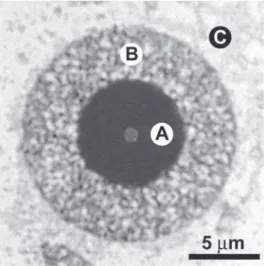
(about 4 µm). This region shows the presence of two very refined interlaced phases composed mainly by a metal phase (white phase) and a ceramic phase (dark phase). This re-acted region usually has a homogeneous width around the fiber center. The C region indicates the aluminium matrix and some gray phases not sharp in this picture are eutectic Al-Si composition, intermetallic Al-Fe-Si or iron spikes. The picture suggested that there is a good interface between the reacted zone and the matrix and between reacted zone and untransformed silica, but these considerations are restricted by the loss of resolution in the optical magnification.
Figure 2, obtained by SEM, shows a detail of the trans-versal polished section with a fiber completely reacted. In this picture, the matrix around the fiber was suppressed to clarify the visualization. In the image both phases are clearly seen respectively as a dark phase (metal) and a white phase (ceramic). The appearance of the phases suggest that these microstructures are in agreement with the co-continuous alumina-aluminium micro constituent described in the arti-cles mentioned in the introduction, but in this work their morphology is finer as the temperature used to induce the silica reduction in this work is about a from the ones. The EDS microanalyses at this interconnected micro constitu-ent shows that the SiO2 original composition was trans-formed mainly. The picture shows that near the fiber-ma-trix interface, the new ceramic phase formed is finer with small channels that could connect the metals inside the fiber and the metal from the matrix. The quantity of ceramic frac-tion could be measured in this picture by image analysis.
Figure 3 obtained by SEM in a fiber surface completely reacted after removal of the metal phase by HCl
immer-sion, shows the typical surface morphology with the chan-nels (dark) that were formerly filled with the metal phase. The ceramic phase visualized shows an arms width of about 0.25 µm and homogeneous in the entire fiber surface. Oth-ers fibOth-ers analyzed show arms approximately between 0.10 to 0.50 µm. This variation suggests that the reaction differ from one fiber to another, probably because of the varia-tions in Fe2O3 content previously mentioned.
Figure 4, obtained in FEG-SEM, shows 3 distinct re-gions in a completely reacted fiber. The black A region in Figure 1. Optical microscopy in a polished sample showing a
de-tail of a fiber partially reacted (B), the center fiber with untrans-formed silica (A) and the matrix aluminium (C).
Figure 2. SEM microscopy of transversal polished fiber showing the ceramic phase (white) and the metal phase (dark) with the co-continuous morphology.
be seen at the fiber-matrix interface, suggesting that a liq-uid Al-Si composition was responsible for infiltrating the channels and that after the reaction is complete some re-sidual Al-Si remains at the interface without diffusing to the matrix.
Figure 5 and 6 were taken from a fractured composite after some reaction was induced. The Fig. 5 shows a fiber strong inserted in the dimple and no pullout occurred. No pull out of the fibers was a usual observation in all fibers analyzed. In this picture the reacted zone can be seen clearly and the 2 phases appear distinct because of the different fracture mechanisms associated. At the left side of this fiber a debonding occurs. Debonding of the fibers occurred in some situations, but the reason for this remains unsolved by this work. Probably some fragile iron-rich phases formed, prevented a good bonding between the metal phases inside and outside the fiber co-continuous zone. Figure 6 is a de-tail taken from Fig. 5 at the region with good interfacial bonding. The regions A, B and C are respectively the alu-minium matrix, the reacted co-continuous region and the silica untransformed. The reacted region shows a good bond-ing between the aluminium matrix and the co-continuous
Figure 6. Detail of reaction taken from figure 5 showing aluminium matrix (A), reacted co-continuous region (B) and silica untransformed (C).Some necking of metal phase inside the B re-gion can be see.
Figure 5. SEM microscopy on fractured composite showing a fiber partially reacted and strong inserted into the dimple. No pullout occurred.
Figure 4. FEG-SEM in transversal polished fiber completely re-acted showing the presence of higher Si content at the channels inside the continuous ceramic phase (dark gray at region B) and between matrix (C) and reacted fiber (B).
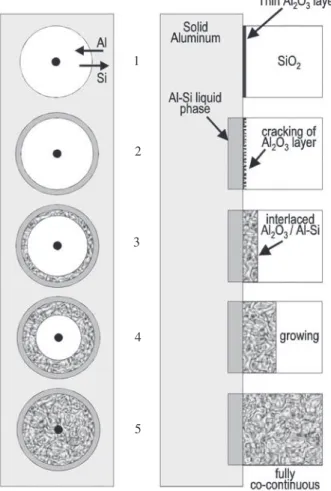
Figure 7. Schematic model of the changes observed in the fiber microstructure during the heat treatment showing the 5 steps that explain the evolution with time of co-continuous morphology.
layer of alumina is formed at the fiber’s surface, while some silicon is released to the aluminium matrix direc-tion. At the second stage, the thin alumina layer cracks, as a result of the high tensile stresses induced by the trans-formation of 3 moles of silica in 2 moles of alumina. At the same time, the silicon released forms, with the alu-minium. The liquid Al-Si starts infiltrating the cracks or channels in the alumina and the reaction is accelerated by the liquid dynamic. In stage 3, the thin alumina layer grows and transforms into a co-continuous layer of alumina and Al-Si liquid alloy as the channels create two complex three-dimensional networks. Channels are responsible for the Al transport from the fiber interface to the reaction front and for the silicon transport from the silica into the ma-trix. Stages 4 and 5 show the growing of co-continuous Al-Al2O3 until the fiber is fully transformed and the reac-tion stops.
4. Conclusions
The possibility of obtaining a co-continuous composite using powder metallurgy as alternative routes has been in-vestigated. The experiments showed that an extruded mix-ture of fossil silica fibers and commercial powder aluminium heat treated at 600 °C promote a reduction reaction of the silica and the formation of a liquid Al-Si alloy phase, lead-ing to an Al-Si/Al2O3 co-continuous structure formed at the original fiber morphology. The well-defined interface present in the composites before the heat treatment was eliminated by this method and the metal occupied the con-tinuous channels created in the new interconnected fiber morphology, promoting a strong bonding between the rein-forcements as the matrix metal was connected to the metal infiltrated. The co-continuous obtained showed alumina arms width lower than those obtained by others authors in the immersion of solid silica body in the melted aluminium at higher temperatures and it is affected, probably, by the different Fe2O3 content in the fibers.
Acknowledgments
This work was supported by FAPESP under contract n. 00/11374-9. The authors thank Cepali and Alcoa that sup-plied the silica fibers and 101-P powder aluminium respec-tively. One of the authors (HG) acknowledge partial sup-port through the Conselho de Desenvolvimento Científico e Tecnológico - CNPq.
References
1. Rajan, T.P.D.; Pillai, R.M.; Pai, B.C. J. of Materials Sci-ence, v. 33, p. 3491-3503, 1998.
2. Tjong, S.C.; Ma, Z.Y. Materials Science and Engineer-ing, v. 29, p. 29-113, 2000.
3. Kaczmar, J.W.; Pietrzak, K.; Wlosinski, W. J. of Mat. Proc. Tech., v. 106, p. 58-67, 2000.
4. Brondike, K.J. J. of The American Ceramic Society, v. 36, n. 5, p. 171-174, 1953.
5. Standage, A.E.; Gani, M. J. of The American Ceramic Society, v. 50, n. 2, p. 101-105, 1967.
6. Baker, A.A.; Jackson, P.W. Glass Technology, v. 9, n. 2, p. 36-41, 1968.
7. Cratchley, D.; Baker, A.A. Metallurgia, p. 153-159, 1964. 8. Breslin, M.C. US Patent No. 5.214.011, 1993.
9. Breslin, M.C. et al. Ceramic Eng. and Science Proceed-ings, v. 15, n. 4, p. 104-112, 1994.
10. Breslin, M.C. et al.Materials Science and Engineering A195, p. 113-119, 1995.
11. Liu, W.; Köster, U. Journal of Materials Science Let-ters, v. 15, p. 2188-2191, 1996.
12. Saiz, E. et al. Composites: Part A, v. 30, p. 399-403, 1999. 13. Daehn, G.S. et al.Acta Materiallia, v. 44, n. 1, p.
249-1
2
3
4
16. Gregolin, E.N.; Goldenstein, H.; Santos, R.G. Proc. of AMME’2000, Gliwice, Poland, p. 219-222, 2000.