Materials Research, Vol. 8, No. 2, 113-116, 2005 © 2005
*e-mail: [email protected]
Structure and Properties of Selected Cemented Carbides and Cermets Covered
with TiN/(Ti,Al,Si)N/TiN Coatings Obtained by the
Cathodic Arc Evaporation Process
Leszek A. Dobrzañski*, Klaudiusz Golombek
Division of Materials Processing Technology and Computer Techniques in Materials Science, Institute of Engineering Materials and Biomaterials, Silesian University of Technology,
44-100 Gliwice, ul. Konarskiego 18A, Poland
Received: November 23, 2003; Revised: February 1, 2005
This study presents the results of microstructural examinations, mechanical tests and service performance tests carried out on thin TiN/(Ti,Al,Si)N/TiN wear resistance coatings obtained by the CAE process on cermet and cemented carbide substrates. Microstructural examinations of the applied coatings and the substrate were made with an OPTON DSM 940 SEM and a LEICA MEF4A light microscope. Adhesion of the coatings on cemented carbides and cermets was measured using the scratch test. The cutting properties of the materials were determined from service tests in which continuous machining of C45E steel was carried out. The hardness of the substrate and the microhardness of the coatings were determined with a DUH 202 SHIMADZU ultra microhardness tester with a load of 70 mN. Roughness tests were also carried out before applying the coatings and after the PVD process. Cutting tests confirmed the advantages of the TiN/(Ti,Al,Si)N/TiN type coatings obtained using the PVD method in the CAE mode on cemented carbides and cermets, as a material that undergoes very low abrasive, thermal and adhesion wear. These coatings extend tool life compared to commercially available uncoated tools with single and multi-layer coatings deposited using PVD/CVD methods.
Keywords:PVD coatings, cermets, cemented carbides, cutting ability test
1. Introduction
The increased pace of development in manufacturing technol-ogy leads to a corresponding increase in requirements regarding working properties of current sintered tool materials. Deposition of hard wear resistance coatings based on carbides, nitrides, or transi-tion metal oxides feature one of the fastest developing directransi-tions of research, stimulated by growth in service requirements of machines and equipment, generating improvements in sintered tool materials (sintered high speed steels, cemented carbides, cermets, ceramics). The wide choice of coatings available nowadays and technologies for their deposition is the result of the growth in the current demand for state-of-the-art surface modification methods. There has been increased interest in coatings having a combination of properties like resistance to tribological wear and corrosion. Tools covered with coatings based on carbides, borides, nitrides, and oxides can be used under more demanding service conditions (temperature, load, etc.). Moreover, the multilayer and multicomponent coatings developed recently enable control of the properties of the entire coating as well as that of the transition layer, ensuring thereby good adhesion, compensation of internal stresses, and transmission of external loads. Tools with such coatings have significantly extended service life compared to uncoated tools or those coated with simple coatings based on mononitrides or carbonitrides. These coatings also exhibit improved tribological contact in the tool-chip-machined material contact zone, and protection of the tool edge from oxidation and extensive overheating. Many aspects pertaining to the forma-tion of coatings, including the effect of process condiforma-tions on their properties still remain unexplained in spite of the enormous interest at many industrial centres and research laboratories. Moreover, each combination of substrate material – coating type – deposition method, calls for the determination of properties of the coated material and the definition of a range of potential applications. Research in this
area is concentrated on finding new composite coatings, both multi-component and multilayer ones, and on studying the effect of adding new elements to coatings that have been used for many years, like silicon or vanadium to TiAlN1-5.
Cemented carbides coated with a composite multilayer (III gen-eration) coating of TiN/(Ti,Al,Si)N/TiN by the PVD method in the cathode arc evaporation (CAE) mode were studied in this investiga-tion. The coated carbides were compared with commercially avail-able uncoated tool materials and those coated by the PVD and CVD processes with single and multilayer wear resistant coatings.
2. Experiments
Investigations were carried out with uncoated and coated ce-mented carbides and cermets. The PVD method in the CAE mode was used to coat the cemented carbides and cermets with wear resist-ant TiN/(Ti,Al,Si)N/TiN coatings. The following parameters were used to deposit the coatings: substrate polarisation - 200 V, substrate temperature 550 °C, pressure in the chamber 0.2 Pa. Commercially available cemented carbides and cermets used for similar applications, according to the ISO classification, were coated using both the PVD or CVD processes, for comparison. Specifications of the materials studied in this investigation are presented in Table 1.
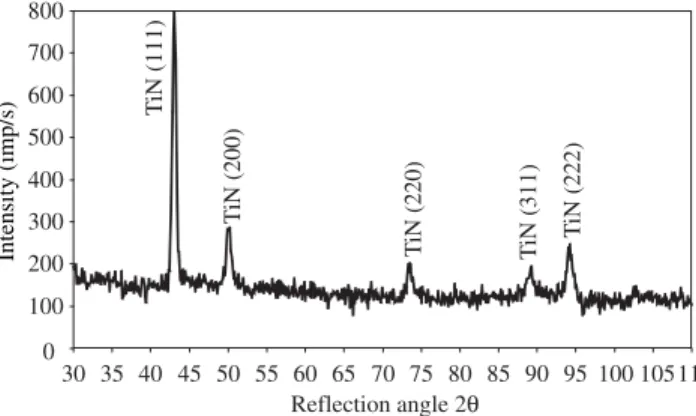
Evaluation of phase composition of the coatings was carried out with a DRON 2.0 X-ray diffractometer, using filtered cobalt rays, voltage of 40 kV and heater current of 20 mA. Measurements were made with 2Q angle in the range 30-115°.
114 Dobrzañski & Golombek Materials Research
Microscopic examinations of the substrates and the coatings were made with a LEICA MEF4A light microscope. Cross-sectional frac-ture surfaces of the coatings were examined in a Philips XL-30 SEM. Secondary electron (SE) and the back scattered electron (BSE) im-ages of the fracture surfaces were obtained at accelerating voltim-ages in the range 15-20 kV.
Vickers micro-hardness was measured with a Shimadzu DUH 202 tester. A load of 70 mN was used to reduce, to a large extent, the influence of the substrate material on the micro-hardness values of the coating.
The adhesion of the coatings to the substrates was tested using the scratch test, which is routinely used in the case of coatings obtained using PVD. Tests were carried out in the CSEM Revetest device with the following test conditions: load range 0-200 N, load increase rate (dL/dt) 100 N/min, indenter speed (dx/dt) 10 mm/min, sensitivity of the acoustic emission detector AE 1.2.
The service performance of the coatings was evaluated from cutting tests carried out at room temperature. These tests, carried out with the cemented carbides and cermets, consisted of continuous dry turning of quenched and tempered C45E steel in a HH V630N lathe at 30 kW power rating. Multipoint SNMG 120408 (designation according to ISO 1832:1991) inserts were used for the continuous turning and these were fixed in a universal tool post to preserve the geometrical features of the cutting insert. The following parameters were used in the cutting tests: feed f = 0.1 mm/rev, depth of cut ap=1 mm, cutting speeds vc=250; 315; 400 m/min.
3. Results and Discussion
Using X-ray qualitative phase analysis it was shown that coat-ings containing the TiN type phase and, most probably, the complex TiAlSiN nitride phase formed on the surface of coated cemented carbides, as originally assumed, (Figure 1). Distinguishing the TiN and TiAlSiN phases using diffraction methods is impossible, due to their isomor-phous nature. The TiAlSiN phase is the secondary solid solution based on TiN. Moreover, reflections from the cemented carbide substrate were found in the X-ray diffraction patterns, originating probably from the macro-particles deposited on the coating surface.
Scanning electron microscopic examinations of fracture surfaces revealed that the TiN/(Ti,Al,Si)N/TiN coatings deposited on the cermets and cemented carbides have a laminar packing. The TiN/ (Ti,Al,Si)N and TiN interlayers have a pore less structure and adhere well to each other, and the entire multi-layer coating adheres well to
Table 1. Specification of the investigated materials.
Designation Material type
Coating Coating thickness,
(Mm)
Process type
W1 Cementedcarbide - -
-W2 Cementedcarbide - -
-C1 Cermet - -
-C2 Cermet - -
-W3 Cementedcarbide TiN 2.0 PVD
W4 Cementedcarbide TiCN/Al2O3/TiC 12.5 CVD
W5 Cementedcarbide TiCN/Al2O3/TiN 8.0 CVD
C3 Cermet TiN/TiC/TiN 5.0 PVD
Q
Figure 1. X-Ray diffractions pattern of the W1 type cemented carbides with the TiN/(Ti,Al,Si)N/TiN.
the substrate (Figure 2). The scanning electron microscopic examina-tions also revealed that the single and multi-layer coatings obtained by PVD or CVD processes were even on the commercial cemented carbide and cermet surfaces. The coatings were compact without vis-ible pores and cracks and adhered well to the substrates (Figure 3). Only in the case of the single-layer TiN coating deposited using the PVD method on the W3 cemented carbide substrate, the coating thickness was uneven. The roughness of the coatings, defined by Ra , was in the range 0.60-0.67 µm and was significantly higher than that of the uncoated surface. The surface roughness parameter Ra of the cermets and the cemented carbides were in the ranges 0.20-0.22 µm and 0.35-0.36 Mm respectively. The increase in surface roughness that resulted with deposition of the TiN/(Ti,Al,Si)N/TiN coatings can be attributed to the PVD process characteristics in the CAE mode, and the formation of characteristic micro-particles (Figure 4), due to deposition of pure titanium droplets from the sputtered disk, and the development of pits due to drop out of the titanium micro-particles immediately after the coating process. Hence the coating surfaces revealed heterogeneities that were droplet shaped and in the form of elongated micro-particles, that originated probably due to splattering on the substrate surface during coating deposition.
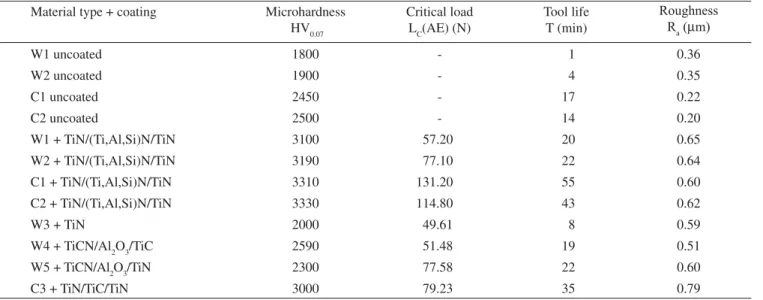
Deposition of the TiN/(Ti,Al,Si)N/TiN coating on cemented carbide and cermet substrates resulted in a significant increase in hardness of the surface layer, in the range 3100-3330 HV0.07. The increase in hardness of the surface layer, compared to that of the uncoated substrate was about 40%. Therefore, deposition of wear resistant coatings onto cermet and cemented carbide tool substrates results in a significant increase in microhardness of the surface layer, contributing to decrease in wear intensity of cutting tool flanks made from both, cemented carbides and cermets.
Vol. 8, No 2, 2005
Structure and Properties of Selected Cemented Carbides and Cermets Covered with
TiN/(Ti,Al,Si)N/TiN Coatings Obtained by the Cathodic Arc Evaporation Process 115
Table 2. Comparison of properties of investigated cemented carbides and cermets.
Material type + coating Microhardness HV0.07
Critical load LC(AE) (N)
Tool life T (min)
Roughness Ra (Mm)
W1 uncoated 1800 - 1 0.36
W2 uncoated 1900 - 4 0.35
C1 uncoated 2450 - 17 0.22
C2 uncoated 2500 - 14 0.20
W1 + TiN/(Ti,Al,Si)N/TiN 3100 57.20 20 0.65
W2 + TiN/(Ti,Al,Si)N/TiN 3190 77.10 22 0.64
C1 + TiN/(Ti,Al,Si)N/TiN 3310 131.20 55 0.60
C2 + TiN/(Ti,Al,Si)N/TiN 3330 114.80 43 0.62
W3 + TiN 2000 49.61 8 0.59
W4 + TiCN/Al2O3/TiC 2590 51.48 19 0.51
W5 + TiCN/Al2O3/TiN 2300 77.58 22 0.60
C3 + TiN/TiC/TiN 3000 79.23 35 0.79
Figure 3. Fracture surface of the TiCN/AlTiCN/Al2O3/TiC coating deposited on the coating deposited on the W4 type commercial cemented carbide surface.
Figure 2. Fracture surface of the TiN/(Ti,Al,Si)N/TiN coating deposited on the W2 type cemented carbide surface.
Figure 4. Topography of the TiN/(Ti,Al,Si)N/TiN coating surface, deposited on the W2 type cemented carbide substrate.
of coating failure were the conformal cracks resulting from tension, which turned into isolated spallings at the bottom of the developing crevice and in the coating-crevice contact zone. Chipping and spalling failures developed in the central zones of the crevices and at its edges in the form of fine arc-shaped craters. Similar effects were observed
at the edges in the end part of the crevice. Single failures are often connected, forming bands of local coating delamination. Along with the plastic strain of the substrate caused by the moving indenter, semicircles connected with conformal cracks occurred at the crevice bottom at higher loads indicating fragmentation, local delamination,
(a)
116 Dobrzañski & Golombek Materials Research
and consequent relocation of torn coating fragments. Figures 5 and 6 reveal defect characteristics of the coatings.
Correlations between hardness of the investigated materials and between hardness of the investigated materials and their service performance as multipoint inserts were made from single point turning tests. All the service tests results are comparative, i.e., the life of the inserts was determined based on wear land width measurements on the tool flank after machining, for similar turning parameters and for a predetermined period of time. Deposition of TiN/(Ti,Al,Si)N/TiN wear resistant coatings on both cemented carbides and cermets resulted in increased wear resistance, and consequent increase in tool flank life (Figure 7). Therefore deposition of coatings on the investigated materials and consequent significant increase in microhardness of the surface layer resulted in reduced wear rate of tool flanks made from these tool materials. The best machined surface quality was obtained when machining was done with C2 type cermets coated with TiN/(Ti,Al,Si)N/TiN, whereas the worst machined surface quality was obtained upon machining with uncoated cemented carbide or cermet tools.
4. Summary
Coatings of the TiN/(Ti,Al,Si)N/TiN systems deposited using the PVD method in the CAE mode onto cermet and cemented carbide substrates demonstrated improved service properties compared to commercially available tool materials with single and multiple-layer, as well as single and double component coatings deposited using both the PVD or CVD processes. Cutting tests confirmed the advantages of the TiN/(Ti,Al,Si)N/TiN type coatings obtained with the PVD method in the CAE mode on cemented carbides and cermets, as a material with significantly reduced abrasive, thermal and adhesion wear, which has a direct influence on extending tool life, compared to wear of com-mercially available uncoated tools or tools with single and multi- layer coatings deposited by PVD/CVD methods.
Acknowledgments
This investigation was carried out partially in cooperation with Prof. J. Kopac and Prof. M. Sokoviæ from the Faculty of Mechani-cal Engineering of the University of Ljubljana (Slovenia), and also with Dr J. Holubar from SHM-Šumperk (Czech Republic). The investigations were partially financed within the framework of the Scientific and Technology Cooperation Joint Project “COAT-CUT” titled “New generation PVD coatings on tools for dry high speed cut-ting processes” between the Governments of the Republic of Poland and the Republic of Slovenia, headed by Prof. L.A. Dobrzañski and Prof. J. Kopac.
References
1. DobrzaĔski LA. Fundamentals of materials science and physical metal-lurgy. Engineering materials with the fundamentals of materials design. Warszawa: Wydawnictwo Naukowo-Techniczne; 2002.
2. DobrzaĔski LA, Golombek K, Kopac J, Sokovic M. Structure and proper-ties of TiN/TiAlSiN/TiN PVD coatings on cemented carbides and cermets.
Materials Science Forum. 2003; 437-438:41-44.
3. DobrzaĔski LA, Golombek K, Kopac J, Sokovic M. Proceedings of the Sixteenth Brasilian Congress of Mechanical Engineering COBEM; 2001
Nov 26-30; Uberlandia - Minas Gerais, Brasil. Uberlandia: The Federal University of Uberlandia; 2001. [CD-ROM].
4. Golombek K, DobrzaĔski L.A, Sokovic M. Properties of the wear resistant coatings deposited on the cemented carbides substrates in the cathodic arc evaporation process. Journal of Materials Processing Technology.
2004; 157-158:341-347.
5. Hogmark S, Hedenqvist P. Tribological characterization of thin, hard coatings.Wear. 1994; 179(1-2):147-154.
6. Navinsek B. Hard coating of cutting tools. Ljubljana: Institute of Jože
Stefan; 1993.
Figure 5.Defects characteristic of the TiN/ (Ti,Al,Si)N/TiN coating surfaceDefects characteristic of the TiN/ (Ti,Al,Si)N/TiN coating surface deposited onto the W2 type cemented carbide.
Figure 6. Defects characteristic of the TiN/ (Ti,Al,Si)N/TiN coating surface
deposited onto the C1 type cermet.
Figure 7. Comparison of tool life of tools made from cemented carbides