ISSN 0104-6632 Printed in Brazil
www.abeq.org.br/bjche
Vol. 28, No. 04, pp. 575 -584, October - December, 2011
Brazilian Journal
of Chemical
Engineering
PRODUCTION OF NATIVE FLAGELLIN FROM
Salmonella Typhimurium IN A BIOREACTOR AND
PURIFICATION BY TANGENTIAL
ULTRAFILTRATION
B. H. Oliveira
1, M. R. Silva
2, C. J. M. Braga
3,
L. M. Massis
3, L. C. S. Ferreira
3,
M. E. Sbrogio-Almeida
2and M. Takagi
2*1
Departamento de Engenharia Química, Universidade Federal do Paraná, Curitiba - PR, Brasil.
2Laboratório de Fermentação, Centro de Biotecnologia, Instituto Butantan, Phone: + (55) (11) 3726-7222,
Fax: + (55) (11) 3726-1505, Av. Vital Brasil 1500, CEP: 05503-900, São Paulo - SP, Brazil. E-mail: [email protected]
3Departamento de Microbiologia, Instituto de Ciências Biomédicas, Universidade de São Paulo, São Paulo - SP, Brasil.
(Submitted: April 9, 2011 ; Revised: July 14, 2011 ; Accepted: July 22, 2011)
Abstract - Flagellin is the structural protein and most abundant component of bacterial flagella. The flagellum filament contains around 20,000 – 100,000 subunits of 50 kDa flagellin that can have diverse biotechnological applications such as vaccine adjuvant and cellular protector during chemo- and radiotherapy. The main aim of this work was to study a production process of purified native FliC flagellin of Salmonella
Typhimurium. The culture conditions in shakers were established with medium devoid of animal-derived components. In bioreactors, culture conditions were established in order to obtain flagellin from the culture supernatant by tangential ultrafiltration (TUF). The concentrated 750 kDa cut-off TUF fraction had a purification factor of 1.5 and a recovery yield of 52.2% for flagellin. The volumetric production of flagellin using the described procedure achieved around 307 mg/L of culture, which represented a significant improvement over previously reported methods. These results permit the development of production and purification processes that can be easily scaled up.
Keywords: Flagellin; Purification; Tangential ultrafiltration; Salmonella Typhimurium.
INTRODUCTION
The bacterial flagellum is a complex structure that allows movement and survival of bacteria. Flagella are vital structures for pathogens, promoting cell adhesion and invasion (Ramos et al., 2004). The bacterial flagella consist of three different parts: the basal body (driving force); the hook (works as a universal joint) and the filament (the long helical tubular filament). The flagellar filament is composed of a single protein, flagellin. About 20,000 – 100,000 flagellin subunits are polymerised with the aid of a tip chaperone to form the long filament shaft on the cell surface that can extend
In addition, flagellin (Figure 1) is also a potent activator of innate immune responses. Its effects are mediated by the specific binding of the D1 domain (blue rectangle) to Toll-like receptor 5 (TLR5) (Smith, 2003). In mammals, this interaction triggers a signaling cascade that results in expression of co-stimulatory molecules and production of cytokines by cells like macrophages and dendritic cells, leading to a more efficient activation of adaptive immune responses (Didierlaurent, 2004). Indeed, Salmonella flagellin, both as native or recombinant protein, has been intensively studied as an adjuvant in different vaccine formulations via parenteral or mucosal routes, either admixed or genetically fused to the target protein antigen (Gerwitz et al., 2001a; Gerwitz et al., 2001b; Hayashi et al., 2001; Moors et al., 2001; Liaudet et al., 2002; Huleatt et al., 2007; Uematsu et al., 2008; Bargieri et al., 2008; Bargieri et al., 2010; Braga et al., 2010;). Salmonella flagellin has been successfully tested as a cell protector, both in vitro and
in vivo, against the toxic effects of chemical and
radiological procedures commonly used in the treatment of cancer (Ramos et al., 2004; Vijay-Kumar et al., 2008; Sanders et al., 2008; Wang et al., 2008).
The need for new and safe vaccine adjuvants requires the generation of flagellin with a high degree of purification. Only a few previous studies reported the purification of Salmonella flagellin
under well-defined experimental conditions and none of them focused on the establishment of procedures allowing downstream upgrade of the purification process (Montie et al., 1983; Ibrahim et al., 1985; Logan et al., 1987). Basically, the reported small-scale procedures involve cultivation of the microorganism in shake flasks or bioreactors and purification of flagellin based on mechanical shearing of flagella, differential centrifugation, depolymerization and repolimerization of flagella by pH changes, followed by precipitation with ammonium sulphate and dialysis or acetone precipitation (Ibrahim et al., 1985; Braga et al., 2008). These processes are laborious, time-consuming, have low recovery yields and result in material highly contaminated with endotoxin.
Our group has successfully applied tangential ultrafiltration, with different cut-off sizes, to the purification of various biomolecules derived from microorganisms (Gonçalves et al., 2003; Takagi, et
al., 2008; Oliveira et al., 2010). In the present report
we describe conditions that allow production of
Salmonella FliCi flagellin in bioreactors with
subsequent purification in high yields by tangential ultrafiltrafiltration. The reported procedure proved to be simple and fast, and permit easy scale-up optimization that attends the demand of highly purified Salmonella flagellin.
MATERIAL AND METHODS
Strain
Attenuated Salmonella enterica sv Typhimurium LDV 322 strain, derived from aro A SL3261 strain, expresses only FliC as phase 1 H antigen (Massis et al., 2008).
Culture Medium
Two complex media were used: 1) LB: Tryptone (BD) – 10 g/L; Yeast Extract (BD) – 5 g/L and NaCl – 5 g/L and 2) Soy peptone - Soytone (BD) – 20 g/L; Yeast Extract (BD) – 20 g/L and NaCl – 5 g/L.
Growth of Cultures in Shakers
The experiments were carried out in a New Brunswick shaker (Shaker series 25) with different media. Cultivation was performed in 2 L flasks containing 1 L of LB medium or Soytone-yeast extract medium kept at 240 rpm for 16 h at 35ºC.
Growth of Cultures in Bioreactors
The experiments were carried out in a Bioflo 3000 bioreactor (New Brunswick Scientific) in 2 L of Soytone-yeast extract medium, pH 7.0 (pH probe – L3580 – Mettler Toledo), adjusted with addition of
5 N NaOH, at 35°C and pO2 (probe: SN0473419 -
Mettler Toledo) controlled at 30% of air saturation. Glucose was added when the pH started to increase, indicating that the carbohydrates present in the medium had been consumed.
Flagellin Purification
Two procedures were tested according to the cultivation of the cells. For cultures prepared in shake flasks, cells were centrifuged (Avanti™ centrifuge J-251 - Beckmann) at 11,325 g during 30 min, resuspended in 25 mM Tris-HCl buffer, pH 7.0, containing 150 mM of NaCl and incubated for 30 min at 37 ºC under 150 rpm (New Brunswick Shaker series 25). The cells were then submitted to homogenisation using a bench mixer (homogeniser model X-520 - Schaft T10F -Ingenieurbüro CAT, M.Zipperer GmbH), in order to release the flagellar filaments and then centrifuged at 5,000 g for 30 min. The flagellin-containing supernatant was submitted to tangential ultrafiltration with a 100 kDa cut-off
membrane (PLCHK 100 –50 m2 Cat. No
PXC100C50 – Millipore ®) to eliminate molecules with less than 100 kDa from the culture medium or metabolites produced by the bacterial strain (Figure 2). Flagellin production was also determined by precipitation with 4 volumes of acetone, incubation at -20°C for 1 h and centrifugation. The recovered pellet was suspended in 500 μL of 150 mM NaCl.
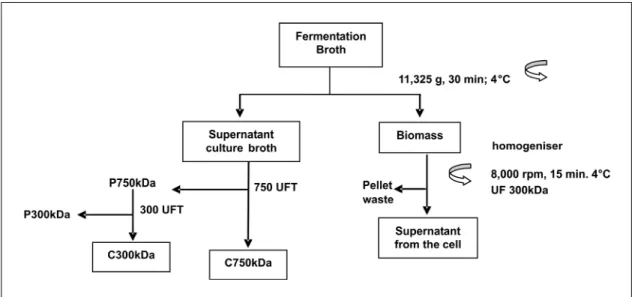
Cultures prepared in the bioreactor were submitted to centrifugation (Avanti™ centrifuge J-251 - Beckmann) at 11,325 g for 30 min at 4°C. The resulting supernatant was saved and named supernatant medium broth. The cell pellet was suspended in 25 mM Tris HCl, pH 7.5, and submitted to flagellin extraction with a Sorvall homogeniser Omni Mixer, Model 17220, centrifuged at 5,000 g for 30 min at 4°C. The collected supernatant from the cell was frozen for subsequent measurement of the flagellin content. The supernatant medium broth was concentrated with a tangential ultrafiltration membrane of 750 kDa cut-off (UFP-750-E-8A GE Healthcare®) and washed with 6 volumes of 25 mM Tris-HCl buffer, pH 7.0. This step resulted in two fractions: 750 kDa concentrate (750 kDa) and 750 kDa ultrafiltrate (UF750 kDa). The fraction UF750 kDa was concentrated with a tangential ultrafiltration membrane with a cut-off of 300 kDa (PELLICON 2 – 300 K -
PTMK-C – 0.5M2 CAT SK1P041W8 - Millipore®),
resulting in a 300 kDa concentrate and 300kDa ultrafiltrate, identified as 300kDa and UF300kDa, respectively (Figure 3). All samples were analyzed by SDS-PAGE and Western Blotting.
SDS-PAGE
Sodium dodecyl sulphate-polyacrylamide gel electrophoresis (SDS-PAGE) was performed with a
mini-slab gel apparatus (Bio Rad) according to the Laemmli method. Proteins were stacked in 4.5% acrylamide gel and sorted in 12% acrylamide gel submitted to a constant voltage of 150 V. Proteins were stained with Coomassie blue (Laemmli, 1970). Protein contents were determined by
Lowry's method (Lowry et al., 1951), and
densitometry by using GS-800 Densitometer and Quantity one software. The flagellin concentrations (mg/L) were determined after multiplying the percentage of relative protein (calculated from densitometry) and the protein concentration determined by Lowry`s method.
Western Blotting
The proteins were transferred to nitrocellulose membrane (Hybond-C Extra; Amersham) at 1 A for 2 h using the buffer conditions described by Towbin
et al. (1979). The membrane was blocked with 5%
low-fat milk in PBS for 1 h at room temperature and incubated for 1 h with rabbit antiserum against
Salmonella FliC antigen. After washing with 0.05%
Tween-20 in PBS (PBS-T), bound antibodies were reacted with goat anti-rabbit IgG conjugated with peroxidase (Sigma). After incubation for 1 h with the conjugate and washing with PBS-T, bound antibodies were detected with o-phenylenediamine (Sigma).
RESULTS AND DISCUSSION
The first critical step in Salmonella flagellin isolation was the extraction of the flagellar filaments from the bacterial cell surface. Previous attempts to obtain flagellin from S. Typhimurium cultures employed low speed agitation (80 rpm) followed by cell shearing in a bench mixer (Vortex) and precipitation of released flagellar fragments with cold acetone (Braga et al., 2008). However, our previous observations indicated that the cultivation of bacteria at higher agitation speed (240 rpm) increased both cell growth and flagellin expression (Oliveira et al., 2010). In order to increase the shearing forces required to detach flagellin from the bacterial cell without promoting significant cell lysis, we tested two blender type homogenisers: the model X-520 homogeniser (Schaft T10F -Ingenieurbüro CAT, M.Zipperer GmbH) and the Omni Mixer
(Sorvall) with the helical axis fitted into a hermetic reservoir (Figure 4). For flagellin removal, the S. Typhimurium LDV322 strain was cultivated in LB medium at 35°C for 18 h using an agitation speed of 240 rpm. The flagellin isolation procedure was conducted using both homogenisers according to the flowchart presented in Figure 2. As shown in Figure 5, the flagellin recovery yields obtained after extraction with both homogenisers were similar. The following experiments were carried out with the Omni Mixer Sorvall due to the safer handling procedures regarding manipulation of bacterial cells. In addition, cultivation at a higher agitation speed (240 rpm) resulted in increased amounts of flagellin released by the bacterial cells into the growth medium. Indeed, flagellin was detected in Comassie blue-stained polyacrylamide gels even without concentration of flagellin by acetone precipitation (Figure 5 lane 5).
1 2 3 4 5 6 7 8 66
45 97
14 31
1 2 3 4 5 6 7 8
66
45 97
14 31
Figure 5: S. Typhimurium FliC flagellin obtained by different procedures. Samples: 1) Flagellin extracted using the CAT blender; 2) Flagellin extracted using the CAT blender and precipitated with acetone; 3) Flagellin extracted using the Sorvall Omni Mixer; 4) Flagellin extracted using Sorvall Omni Mixer and precipitated with acetone; 5) Cell-free culture supernatant concentrated using an Ultrafiltration membrane with 100 kDa cut-off; 6) Cell-free culture supernatant concentrated using a Ultrafiltration membrane with 100 kDa cut-off and precipitated with acetone; 7) Purified FliC flagellin; 8) Molecular weight markers. Each lane contains approximately 7.5 μg of protein.
In a second step, we evaluated whether FliC flagellin production by the S. Typhimirium LDV322 strain would be affected after cultivation of the strain using an alternative culture medium without animal-derived components (tryptone). Such an alternative culture would fit into the WHO recommendation for production of microbial-derived vaccine-components [WHO, 2006]. For this purpose, experiments were carried out in Soytone medium (2%), containing no animal-derived components, supplemented with yeast extract (2%) and sodium chloride. Cell growth was higher in Soytone medium (DO600nm of 6.0)
when compared with cell cultures prepared with LB medium (DO600nm of 2.5). Similarly, expression of
flagellin was also higher in cells cultivated in Soytone medium when compared to cells cultivated under the same experimental conditions in LB medium (Oliveira et al., 2010).
The next step in the improvement of the flagellin purification procedure was the replacement of the aerated shaker flasks by cultures prepared in a bioreactor, in which significantly higher cell densities can be achieved. The experiment in the bioreactor was
carried out with Soytone medium using a discontinuous cultivation mode with intermittent glucose pulses. The culture pH was kept at 7.0 with addition of sodium hydroxide and the pO2 controlled at 30% of air
saturation at a temperature at 35ºC. Figure 6 shows the cell growth profile with a maximum specific growth rate of 0.7 h-1 and a biomass of 8.5 g/L reached at the end of cultivation in the bioreactor. During cultivation, the agitation speed increased up to a maximum value of 900 rpm at the 8th hour, which remained constant until the end of the cultivation period (10 h). From the 8th hour onward, cell growth was limited by oxygen and pO2 decreased to 5%. Consequently, cell growth was
limited by oxygen restriction after 8 h of cultivation. Production of flagellin was affected by the oxygen limitation and the maximal value achieved was 300 mg/g protein (Table 1). As shown by the SDS-PAGE analysis, flagellin was released into the culture supernatant during cultivation in the bioreactor (Figure 7). The high concentration of flagellin in the culture supernatant permitted the purification of the protein directly from the spent medium without the need to remove flagella from the cells.
Table 1: Kinetics parameters in batch cultivation of S. Typhimurium SDV 322
Maximum specific growth rate, μmax(h−1) 0.7 ±0.02
Maximum flagellin concentration - Pmáx (mg/L) 1490 ±0.50
Maximum Biomass concentration - Xmáx (gDCW/L) 12.5 ±0.15
Specific production of flagellin (mg flagellin/g DCW) 117.30± 0.2 Relative purity (mg flagellin/ g total protein) 330.00±0.25
Figure 6: Biomass ( ), relative purity of flagellin (✯), pH (Δ), agitation (▲), pO2
(%) (●) in the batch cultivation of S. Typhimurium SDV 322 strain. The arrows show the glucose addition.
1 2 3 4 5 6 7 8 9 10 1 2 3 4 5 6 7 8 9 10
66 kDa
45 kDa 97 kDa
14 kDa 31 kDa
66 kDa
45 kDa 97 kDa
14 kDa 31 kDa
A B
1 2 3 4 5 6 7 8 9 10 1 2 3 4 5 6 7 8 9 10
66 kDa
45 kDa 97 kDa
14 kDa 31 kDa
66 kDa
45 kDa 97 kDa
14 kDa 31 kDa
A B
1 2 3 4 5 6 7 8 9 10 1 2 3 4 5 6 7 8 9 10
1 2 3 4 5 6 7 8 9 10
1 2 3 4 5 6 7 8 9 10 1 2 3 4 5 6 7 8 9 10
66 kDa
45 kDa 97 kDa
14 kDa 31 kDa 66 kDa
45 kDa 97 kDa
14 kDa 31 kDa
66 kDa
45 kDa 97 kDa
14 kDa 31 kDa
A B
Figure 7: Flagellin released in the culture supernatant of S. Typhimurium cultivated in bioreactor using Soytone broth. (A) SDS-PAGE. (B) Western Blotting developed with anti-flagellin antibody. Samples sorted according to the incubation time in the bioreactor: 1- 2 h; 2- 4.3 h; 3- 5.3 h; 4- 6.3 h; 5- 7.2 h; 6- 8.2 h; 7- 9.2 h; 8- 10.2 h; 9- 11.2 h; 10- Molecular weight markers.
Flagellin purification was initiated after centrifugation of the bacterial culture at 11,325 g for 30 min at 4°C. The cell-free supernatant was saved and submitted to the tangential ultrafiltration steps with different molecular weight cut-off filters, as indicated in the flowchart depicted in Figure 3.
The flagellin purification steps based on S. Typhimurium cultures prepared in bioreactors are
listed in Table 2. The relative purity of flagellin with regard to contaminating proteins (PRprot) and the corresponding purification factor (PF) are indicated. The tangential ultrafiltration step with a 750 kDa cut-off membrane eliminated most of the contaminating
1 2 3 4 5 6
1 2 3 4 5 6
(A) (B) Figure 8: Purification of FliC flagellin using tangential ultrafiltration. (A) SDS-PAGE and B) Western
Blotting Samples: 1) Supernatant; 2) C750kDa; 3) P750kDa; 4) C300kDa; 5) P300kDa; 6) Purified FliC; 7) Molecular weight markers.
Table 2: Purification of flagellin FliC.
Purification Steps
Total Protein (mg)
*FliC (mg)
RPprot mgFliCi/ mg Protein
•PF global
♦PF Step
Rec (%)
Supernatant broth 2,097±0.20 1,030±0.11 0.49 1.0 1 100
C750kDa 744±0.10 537±0.10 0.72 1.5 1.5 52.2
P750kDa 1,154±0.25 167±0.05 0.15 0.30 0.3 16.3
C300kDa 506±0.12 20±0.10 0.04 0.10 0.3 1.9
P300kDa 802±0.15 0 0.00 0.00 0.0 0
Average of total protein and FliC protein in mg. All values are the average of two experiments
Relative purity: RP = mg Flagellin/mg Total protein
• Global purification factor: PFglobal = RPstep/RPinitial
♦ Step purification factor: PFstep = RPstep/RPprevious step
Smith et al. (2003) have purified flagellin through shearing of flagellar filaments and ultracentrifugation. The pellets were suspended in PBS and the flagellar filaments then submitted to exhaustive dialysis by tangential ultrafiltration with a 300 kDa cut-off membrane, which achieved high purity. However, no information was given about the final flagellin yield or the volumetric production. The results obtained in this study show that replacement of an animal-derived medium by a soybean-based culture medium resulted in an improved flagellin production. In addition, the use of the bioreactor for growth of the S. Typhimurium strain further enhanced the flagellin recovery yield based on a single-step procedure. The high speed agitation condition increased cell growth and release of flagellin into the growth medium, making the purification step simpler, faster and safer regarding handling of the bacterial cells. The
procedure described here represents, therefore, a significant improvement over previously described flagellin purification methods, allowing application of additional purification steps, such as ion exchange chromatography, to achieve WHO standards for bacterial-derived products for vaccine use and further scale-up.
ACKNOWLEDGMENTS
REFERENCES
Adkins, J. N., Mottaz, H. M., Norbeck, A. D., Gustin, J. K., Rue, J., Clauss, T. R. W., Purvine, S. O., Rodland, K. D., Heffron, F. and Smith, R.
D., Analysis of the Salmonella typhimurium
Proteome through Environmental Response toward Infectious Conditions. Molecular & Cellular Proteomics, 5, (8), 1450-1461 (2006). Bargieri, D. Y., Leite, J. A., Lopes, S. C.,
Sbrogio-Almeida, M. E., Braga, C. J., Ferreira, L. C., Soares, I. S., Costa, F. T., Rodrigues, M. M., Immunogenic properties of a recombinant fusion protein containing the C-terminal 19 kDa of Plasmodium falciparum merozoite surface protein-1 and the innate immunity agonist FliC flagellin of Salmonella typhimurium.Vaccine, 28, (16), 2818-26 (2010).
Bargieri, D. Y., Rosa, D. S., Braga, C. J., Carvalho, B. O., Costa, F. T., Espíndola, N. M., Vaz, A. J., Soares, I. S., Ferreira, L. C., Rodrigues, M. M., New malaria vaccine candidates based on the Plasmodium vivax Merozoite Surface Protein-1 and the TLR-5 agonist Salmonella typhimurium FliC flagellin. Vaccine, 26, (48), 6132-42 (2008). Braga, C. J., Massis, L. M., Sbrogio-Almeida, M. E.,
Alencar, B. C., Bargieri, D. Y., Boscardin, S. B., Rodrigues, M. M., Ferreira, L. C., CD8+ T cell adjuvant effects of Salmonella FliCd flagellin in live vaccine vectors or as purified protein. Vaccine, 28, (5), 1373-82 (2010).
Braga, C. J. M., Massis, L. M., Alencar, B. C. G., Rodrigues, M. M., Sbrogio-Almeida, M. E. and Ferreira, L. C. S., Cytotoxic T Cell adjuvant effects of three Salmonella enterica flagelins. Brazilian Journal of Microbiology, 39, 44-49 (2008).
Chng, C. P and Kitao, A., Mechanical unfolding of bacterial flagellar filament protein by molecular dynamics simulation. Journal of Molecular Graphics and Modelling, 28, 548-554 (2010). Didierlaurent, A., Ferrero, I., Otten, L.A., Dubois,
B., Reinhardt, M., Carlsen, H., Blomhoff, R., Akira, S., Kraehenbuhl, J. P. and Sirard, J. C., Flagellin promotes myeloid differentiation factor 88-dependent development of Th2-type response. Journal Immunology, 172, (11), 6922-30 (2004). Gerwitz, A. T., Navas, T. A., Lyons, S., Godowski,
P. J. and Madara, J. L., Bacterial flagellin activates basolaterally expressed TLR5 to induce epithelial proinflammatory gene expression. Journal of Immunology, 167, 1882-1885 (2001a). Gerwitz, A. T., Simon, P. O., Schmitt, C. K., Taylor,
L. J., Hagedorn, C. H., O’Brien, A. D., Neish, A. S. and Madara, J. L., Salmonella typhimurium
translocates flagellin across intestinal epithelia inducing a proinflammatory response. Journal of Clinical Investigation, 107, 99-109 (2001b). Gonçalves, V. M., Takagi, M., Lima, R. B.,
Massaldi, H., Giordano, R. C., Tanizaki, M. M., Purification of capsular polysaccharide from
Streptococcus pneumoniae serotype 23F by a
procedure suitable for scale-up. Biotechnology Applied Biochemistry,37, 283-287 (2003) Hayashi, F., Smith, K. D., Ozinsky, A., Hawn, T. R.,
Yi, E. C., Goodlett, D. R., Eng, J. K., Akira, S., Underhill, D. M. and Aderem, A., The innate immune response to bacterial flagellin is mediated by Toll-like receptor 5. Nature, 410, 1099-1103 (2001).
Huleatt, J. W., Jacobs, A. R., Tang, J., Desai, P., Kopp, E. B., Huang ,Y., Song, L., Nakaar, V. and Powell, T. J., Vaccination with recombinant fusion proteins incorporating Toll-like receptor ligands induces rapid cellular and humoral immunity. Vaccine, 25, 763-75 (2007).
Ibrahim, G. F., Fleet, G. H., Lyons, M. J. and Walker, R. A., Method for the isolation of highly purified Salmonella Flagellins. Journal of Clinical Microbiology, 22, (6), 1040-1044 (1985).
Laemmli, U. K., Cleavage of structural proteins during the assembly of the head of bacteriophage-T4. Nature, 227, 680-685 (1970).
Liaudet, L., Murthy, K. G. K., Mabley, J. G., Pacher, P., Soriano, F. G., Salzman, A. L. and Szabó, C., Comparison of inflammation, organ damage, and oxidant stress induced by Salmonella enterica serovar Muenchen flagellin and serovar Enteritidis lipopolysaccharide. Infection and Immunity, 70, 192-198 (2002).
Logan, S., Harris, L. and Trust, T. J., Isolation and characterization of Campylobacter Flagellins. Journal of Bacteriology, 169, (11), 5072-5077 (1987).
Lowry, O. H., Rosbrough, N. J., Farr, A. L. and Randall, R. J., Protein measurement with the
Folin phenol reagent. Journal of Biological
Chemistry, 193, 265-275 (1951).
Massis, L. M., Braga, C. J. M., Sbrogio-Almeida, M. E., Lauand. C., Newton, S. M. C., Klebba, P. E. and Ferreira, L. C. S., Anti-flagellin antibody responses elicited in mice orally immunized with
attenuated Salmonella enterica serovar
Typhimurium vaccine strains. Memorias do Instituto. Oswaldo Cruz, 103, (6), 606-610 (2008). Montie, T. C. and Stover, G. B. Isolation and
Moors, M. A., Li, L. and Mizel, S. B., Activation of interleukin-1 receptor-associated kinase by gram-negative flagellin. Infection and Immunity, 69, 4424-4429 (2001).
Oliveira, B. H., Silva, M. R., Braga, C. J. M., Massis, L. M., Ferreira, L. C. S., Sbrogio-Almeida, M. E. and Takagi, M., Salmonella enterica Typhimurium: Establishment of cultivation condition on shake flask and flagellin isolation strategy by using tangential ultrafiltration. In: Microorganisms in Industry and
Environment. Editor: Antonio Mendez Vilas,
Publisher: World Scientific Pub. Co, 348-351 (2010).
Ramos, H. C., Rumbo, M. and Sirard, J. C., Bacterial flagellins: mediators of pathogenicity and host immune responses in mucosa. Trends in Microbiology, 12, (11), 509-517 (2004).
Sanders, C. J., Moore, D. A. 3rd, Williams, I. R. and Gewirtz, A. T., Both radioresistant and hemopoietic cells promote innate and adaptive immune responses to flagellin. Journal of Immunology, 180, (11), 7184-92 (2008).
Smith K. D., Andersen-Nissen, E., Hayashi, F., Strobe, K., Bergman, M. A., Barrett, S. L. R., Cookson, B. T. and Aderen, A., Toll-like receptor 5 recognizes a conserved site on flagellin required for protofilament formation and bacterial motility. Nature Immunology, 4, (12), 1247-1253 (2003).
Takagi, M., Lima, R. B., Albani, S. M. F., Zangirolami, T. C., Tanizaki, M. M. and Cabrera-Crespo, J., Purification of capsular polysaccharide
produced by Haemophilus inXuenzae type b
through a simple, efficient and suitable method
for scale-up. Journal of Industrial and Microbiology Biotechnology, 35, 1217-1222 (2008).
Towbin, H., Staehelin, T. & Gordon, J., Electrophoretic transfer of proteins from polyacrylamide gels to nitrocellulose sheets: procedure and some applications. Proceedings of
the National Academy of Sciences USA, 76,
4350-4354 (1979).
Uematsu, S., Fujimoto, K., Jang, M. H., Yang, B-G., Jung, Y-J., Nishiyama, M., Sato, S., Tsujimura, T., Yamamoto, M., Yokota, Y., Kiyono, H., Miysaka, M., Ishii, K. J. and Akira, S., Regulation of humoral and cellular gut immunity by lamina propria dendritic cells expressing Toll-like receptor 5. Nature Immunology, 9, (7), 769-76 (2008).
Vijay-Kumar, M., Aitken, J. D., Sanders, C. J., Frias, A., Sloane, V. M., Xu, J., Neish, A. S., Rojas, M. and Gerwitz, A. T., Flagellin Treatment protects against chemicals, bacteria, viruses, and radiation. The Journal of Immunology, 180, 8280-8285 (2008).
Wang, R-F., Miyahara, Y. and Wang, H. Y., Toll-like receptors and immune regulation: implication for câncer therapy. Oncogene, 27, 181-189 (2008).
WHO, Guidelines on Tissue Infectivity Distribution in Transmissible Spongiform Encephalopathies 1-53. (2006).
Yonekura, K., Maki-Yonekura, S. and Namba, K., Growth mechanism of the bacterial flagellar filament. Research in Microbiology, 153, 191-197 (2002).