ISSN 0104-6632 Printed in Brazil
www.abeq.org.br/bjche
Vol. 28, No. 04, pp. 659 - 667, October - December, 2011
Brazilian Journal
of Chemical
Engineering
RECOVERY OF HYDROCARBON LIQUID FROM
WASTE HIGH DENSITY POLYETHYLENE BY
THERMAL PYROLYSIS
Sachin Kumar
*and R. K. Singh
Department of Chemical Engineering, National Institute of Technology, Phone: 91-6612462260, Fax: 91-6612462022, Rourkela, Orissa, 769008, India.
E-mail: [email protected]
(Submitted: February 22, 2011 ; Revised: May 12, 2011 ; Accepted: August 23, 2011)
Abstract - Thermal degradation of waste plastics in an inert atmosphere has been regarded as a productive method, because this process can convert waste plastics into hydrocarbons that can be used either as fuels or as a source of chemicals. In this work, waste high-density polyethylene (HDPE) plastic was chosen as the material for pyrolysis. A simple pyrolysis reactor system has been used to pyrolyse waste HDPE with the objective of optimizing the liquid product yield at a temperature range of 400ºCto 550ºC. Results of pyrolysis experiments showed that, at a temperature of 450ºC and below, the major product of the pyrolysis was oily liquid which became a viscous liquid or waxy solid at temperatures above 475ºC. The yield of the liquid fraction obtained increased with the residence time for waste HDPE. The liquid fractions obtained were analyzed for composition using FTIR and GC-MS. The physical properties of the pyrolytic oil show the presence of a mixture of different fuel fractions such as gasoline, kerosene and diesel in the oil.
Keywords: Pyrolysis; Waste HDPE; FTIR; GC-MS; Alternative fuel.
INTRODUCTION
Plastics are one of the most widely used materials due to their various advantages and numerous applications in our day to day life. Plastics production has increased by an average of almost 10% every year on a global basis since 1950. The total global production of plastics has grown from around 1.3 million tonnes (MT) in 1950 to 230 MT in 2009 (Plastic-The facts 2010). HDPE is the third-largest commodity plastic material in the world, after polyvinyl chloride and polypropylene in terms of volume. According to a British market-research consulting agency, “Merchant Research & Consulting Ltd.” High density polyethylene (HDPE) has accounted for a major share of ethylene consumption in the recent years. The demand for HDPE has increased 4.4% a year to 31.3 million MT in 2009 (CEH report). The increased demand and
production of waste HDPE has led to the accumulation of large amount of its waste in the final waste stream due to its low useful life.
Recycling of plastics already occurs on a wide scale. Extensive recycling and reprocessing of plastics are performed on homogeneous and contaminant free plastic wastes. Most recycling schemes require a feedstock that is reasonably pure and contains only items made from a single polymer type, such as high density polyethylene (HDPE) commonly used to make milk bottles, or polyethylene terephthalate (PET) soft drink bottles. However, a substantial fraction of the plastics in municipal waste still ends up in landfills. Realistically, most post-consumer wastes contain a mixture of plastic types and are often contaminated with non-plastic items (Hegberg et al., 1992).
chemical recycling. This term has been used to describe a diversity of techniques, including pyrolysis, hydrolysis, hydrogenation, methanolysis and gasification. Some of these techniques are suitable for use only with homogeneous polymer wastes but others can accept a feed of mixed wastes. The most attractive technique of chemical feedstock recycling is pyrolysis. Thermal cracking or thermal pyrolysis involves the degradation of the polymeric materials by heating in the absence of oxygen. Unlike mechanical recycling techniques, in which the long polymeric chains of the plastic are preserved intact, pyrolysis produces lower molecular weight fragments The process is usually conducted at temperatures between 500-800°C and results in the formation of a carbonized char and a volatile fraction that can be separated into condensable hydrocarbon oil and a non-condensable high calorific value gas. The proportion of each fraction and their precise composition depend primarily on the nature of the plastic waste, but also on process conditions. The effect of temperature and the type of reactor on the pyrolysis of waste HDPE studied by different researchers are summarised below.
Wallis et al. (2007) performed the thermal degradation of high density polyethylene in a reactive extruder at various screw speeds with reaction temperatures of 400°C and 425°C. A continuous kinetic model was used to describe the degradation of the high density polyethylene in the reactive extruder. Conesa et al. (1994) studied the production of gases from polyethylene (HDPE) at five nominal temperatures (ranging from 500°C to 900°C) using a fluidized sand bed reactor. From the study of HDPE pyrolysis in a fluidized sand bed reactor, they have found that the yield of total gas obtained increased in the range 500°C – 800°C from 5.7 to 94.5%, at higher temperatures. Walendziewski
et al. (2001) reported the thermal degradation of
polyethylene in the temperature range 370–450°C. In the case of thermal degradation of polyethylene, an increase in degradation temperature led to an increase of gas and liquid products, but a decrease of residue (boiling point >360°C).
The thermal degradation of waste HDPE can be improved by using suitable catalysts in order to obtain valuable products. The most common catalysts used in this process are: zeolite, alumina, silica–alumina, FCC catalyst, reforming catalyst etc. The effects of various catalysts on the pyrolysis of HDPE studied by different investigators are summarized below. Beltrame et al. (1989) have studied polyethylene degradation over silica, alumina, silica–alumina and zeolites in a small Pyrex
vessel reactor without stirring, in the temperature range 200–600°C.
The catalytic upgrading of the pyrolysis gases derived from the pyrolysis of polyethylene over zeolite in the temperature range 400–600°C has been investigated by Bagri et al. (2002). As the zeolite bed temperature was increased, the gas yield increased with a decrease in oil and coke yield. Venuto et al. (1979) also showed that, as the catalyst temperature was increased from 480 to 590°C, coke formation in the zeolite catalytic cracking of petroleum was reduced and also alkene gases increased in the gas product. Sharratt et al. (1997) carried out the catalytic degradation of high-density polyethylene using ZSM-5 zeolite. As the reaction temperature was increased from 290 to 430°C, the gas yield was increased, whereas the oil yield was decreased. The oil obtained in the thermal pyrolysis of polyethylene contained a low concentration of aromatic compounds. The liquid-phase catalytic degradation of waste polyolefinic polymers such as HDPE, LDPE, and PP over spent fluid catalytic cracking (FCC) catalyst was carried out at atmospheric pressure in a stirred semi-batch operation by Lee et al. (2003). The difference in the product yields between thermal and catalytic degradation of waste HDPE using spent FCC catalyst in a stirred semi-batch reactor on a laboratory scale was studied by Lee et al. (2003). As compared with thermal degradation, the catalytic degradation showed an increase of liquid yield, whereas that of residue was reduced due to the decomposition of heavier residues into lighter oil product.
Miskolczi et al. (2008) studied the catalytic degradation of waste high density polyethylene with three different catalysts (equilibrium FCC, HZSM-5 and clinoptilolite). Seo et al. (2003) studied the catalytic degradation of waste high density polyethylene to hydrocarbons by ZSM-5, zeolite-Y, mordenite and amorphous silica-alumina in a batch reactor and investigated the cracking efficiency of catalysts by analyzing the oily products, including paraffins, olefins, naphthenes and aromatics, with gas chromatography/mass spectrometry (GC/MS).
temperature, ratios of HDPE to catalyst feed, and flow rates of fluidizing gas, was examined.
Manos et al. (2000) studied the catalytic degradation of high density polyethylene to hydrocarbons over different zeolites. The product range was typically between C3 and C15 hydrocarbons.
The catalytic pyrolysis of high density polyethylene was studied at different times using different types of reactors: a pyroprobe apparatus, where the volatile residence time is in the range of few milliseconds, and a fluidized bed reactor, where the secondary reactions take place to a larger extent using HZSM-5 catalyst (Hernandez et al., 2006). Garforth et al. (1998) studied the catalytic pyrolysis of high density polyethylene in a laboratory fluidized bed reactor operating in the 290°C-430°C range under atmospheric pressure. The catalysts used were HZSM-5, Silicalite, HMOR, HUSY and SAHA and the yield of volatile hydrocarbons (based on the feed) was typically HZSM-5>HUSY≈HMOR>SAHA.
The catalytic degradation of high density polyethylene (HDPE) under nitrogen using a laboratory fluidized bed reactor operating at 360°C with a catalyst to polymer feed ratio of 2:1 and at 450°C with a catalyst to polymer feed ratio of 6:1 under atmospheric pressure using ZSM-5, US-Y, ASA, fresh FCC (fluid catalytic cracking) commercial catalyst (Cat-A) and equilibrium FCC catalysts with different levels of metal poisoning were studied. (Ali et al., 2002). Mastral et al. (2006) studied the catalytic degradation of high density polyethylene in a laboratory fluidized bed reactor at mild temperatures, between 350°C and 550°C. The catalyst used was nanocrystalline HZSM-5 zeolite.
Lin et al. (2004) studied the pyrolysis of high density
polyethylene over various catalysts using a laboratory fluidized-bed reactor operating isothermally at ambient pressure. Karagoz et al. (2003) studied the conversion of high density polyethylene in vacuum to fuels in the absence and presence of five kinds of metals supported on active carbon catalysts (M-Ac) and acidic catalysts {HZSM-5 and DHC (Distillate Hydro Cracking-8)} catalyst. Jan et al. (2010) studied the degradation of waste high density polyethylene into a liquid fraction thermally and catalytically using MgCO3 at 450°C in a batch reactor. Different conditions like temperature, time and catalyst ratio were optimized for the maximum conversion of HDPE into a liquid fraction.
In the present study, waste high density poly ethylene was pyrolyzed in a batch reactor at a temperature of 400°C to 550°C at a heating rate of 20°C/min. The effect of pyrolytic temperature and
holding time on the reaction time and yield of liquid product, char, and gaseous product were studied. The fuel properties of the oil (obtained at a temperature of 450°C from pyrolysis of waste HDPE) such as kinematic viscosity, flash point, fire point, cloud point, pour point, specific gravity, and water content were determined using standard test methods. The chemical compositions of the waste HDPE pyrolytic oil were investigated using FTIR and GC/MS.
MATERIALS AND METHODS
Waste HDPE was collected from the National Institute of Technology Rourkela, Orissa, India campus waste yard and used in this experiment. The plastic waste was cut into small pieces (approx. 1 cm2) and used in the thermal pyrolysis reaction. The proximate analysis of waste HDPE was done by ASTM D3173-75 and the ultimate analysis was done by using a CHNS analyzer (ELEMENTAR VARIO EL CUBE CHNSO). Calorific value of the raw material was found by ASTM D5868-10a.
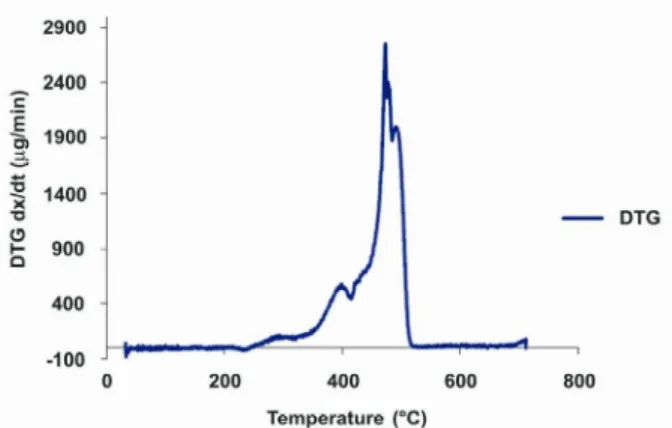
Thermogravimetric analysis of the waste HDPE sample was carried out with a SHIMADZU DTG-60/60H instrument. A known weight of the sample was heated in a silica crucible at a constant heating rate of 20°C/min operating in a stream of air with a flow rate of 40ml/min from 35°C to 600°C.
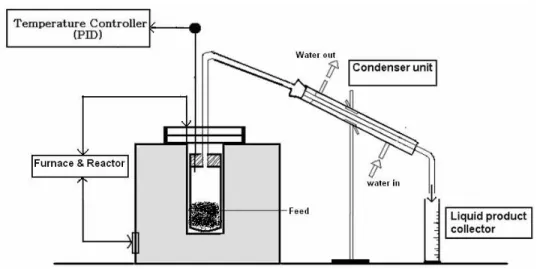
The pyrolysis setup used in this experiment is shown in Figure 1. It consists of a semi batch reactor made of stainless steel tube (length- 145 mm, internal diameter- 37 mm and outer diameter- 41 mm) sealed at one end and an outlet tube at other end. The reactor is heated externally by an electric furnace, with the temperature being measured by a Cr-Al: K type thermocouple fixed inside the reactor, and temperature is controlled by an external PID controller. 20g of waste plastics sample were loaded in each pyrolysis reaction. The condensable liquid products/wax were collected through the condenser and weighed. After pyrolysis, the solid residue left inside the reactor was weighed. Then the weight of gaseous/volatile product was calculated from the material balance. Reactions were carried out at different temperatures ranging from 400-550°C.
Figure 1: Pyrolysis setup
RESULTS AND DISCUSSION
Proximate and Ultimate Analysis of Waste HDPE
The proximate and ultimate analyses of waste HDPE sample are shown in Table 1. The volatile matter is 100% in the proximate analysis, due to the absence of ash in waste HDPE sample; its degradation occurs with minimal formation of residue. The oxygen is 5.19% in the ultimate analysis of waste HDPE. The oxygen in the waste HDPE sample may not be due to the fillers but rather to other ingredients that are added to the resin in the manufacturing of HDPE.
Table 1: Proximate and ultimate analysis of waste HDPE
Properties Present study (Waste HDPE)
(HDPE) (Parikh et al.,
2009)
(Mixed Plastics) (Kim et al.,
2010)
Proximate analysis
Moisture content 0.00 0.00 1.37
Volatile matter 100 100 92.90
Fixed carbon 0.00 0.00 1.14
Ash content 0.00 0.00 4.59
Ultimate analysis
Carbon (C) 80.58 84.95 79.9
Hydrogen (H) 13.98 14.30 12.6
Nitrogen (N) 0.60 0.55 -
Sulphur (S) 0.080 - -
Oxygen (O)/Others 5.19 0.20 5.10
Chlorine 1.13
GCV (Mj/Kg) 45.78 - 44.40
TGA and DTG Analysis of the Waste HDPE Sample
Thermogravimetric analysis (TGA) is a thermal analysis technique that measures the weight change
Figure 2: TGA curve of waste HDPE Figure 3: DTG curve of waste HDPE
Effect of Temperature on Product Distribution
The pyrolysis of HDPE yielded four different products, i.e., oil, wax, gas, and residue. The distributions of these fractions are different at different temperatures and are shown in Table 2.
Table 2: Distribution of the different fractions at different temperatures in the HDPE pyrolysis
Temperature (°C)
Oil (wt.%)
Wax (wt.%)
Gas/ volatile (wt.%)
Residue (wt.%)
Reaction time (min)
400 11.2 0 84.2 4.6 760
450 23.96 0 72.24 3.8 290
500 21.87 50.38 24.75 3 68
550 7.86 71.22 18.42 2.5 54
The condensable oil/wax and the non-condensable gas/volatiles fractions of the reaction constituted the major product as compared to the solid residue fractions. The condensable product obtained at low temperature (400°C and 450°C) was low viscous liquid. With an increase in temperature, the liquid became a viscous/wax at and above 475°C. The formation of a viscous and waxy product was due to improper cracking of the plastic to high molecular mass hydrocarbon components. The recovery of the condensable fraction was very low at low temperature, i.e., at 400°C, and increased with a gradual increase of temperature. From the table, it is observed that, at low temperature, the reaction time was longer, due to secondary cracking of the pyrolysis product that occurred inside the reactor, which resulted in highly volatile product. Similarly, the low liquid yield at high temperature was due to
the formation of less-cracked high molecular weight wax and more non-condensable gaseous/volatile fractions due to rigorous cracking.
Effect of Temperature on Reaction Time
The effect of temperature on the reaction time for the pyrolysis of waste HDPE plastic is shown in Figure 4. The pyrolysis reaction rate increased and the reaction time decreased with an increase in temperature. High temperature supports the easy cleavage of bonds and thus speeds up the reaction and lowers the reaction time. HDPE, with a long linear polymer chain with low branching and a high degree of crystallinity, led to high strength properties and thus required more time for decomposition. This shows that temperature has a significant effect on reaction time and yield of liquid, wax and gaseous products.
Effect of Holding Time on Yield of Oil
400 450 500 550 150
300 450 600
750 Reaction Time
weight of Oil/wax
Temperature (°C)
R
e
act
ion Ti
m
e
(
m
in
s)
5 10 15 20 25 30
W
t. %
o
f O
il
0 2 4 6
100 150 200 250
Reaction Time weight of Oil
Holding Time (hrs) at Temperature 400°C
React
io
n Tim
e
(
m
in
s)
30 35 40 45 50 55
We
ig
h
t %
o
f O
il
Temperature= 450°C
Figure 4: Effect of temperature on the reaction time Figure 5: Effect of holding time on the yield of the oil.
FTIR of Oil Samples
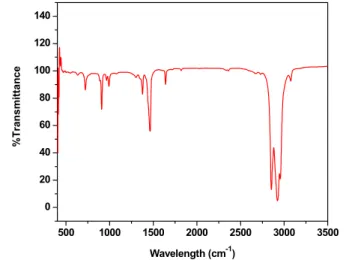
Fourier Transform Infrared spectroscopy (FTIR) is an important analysis technique that detects various characteristic functional groups present in oil. Upon interaction of infrared light with oil, chemical bonds can absorb infrared radiation in specific wavelength ranges regardless of the structure of the rest of the molecules. Figure 6 shows the FTIR spectra of waste HDPE oil. The different assignments of the FTIR spectra of waste HDPE oil are summarized in Table 3, which shows the
presence of mostly alkanes and alkenes. The results were consistent with the results of GC-MS.
GC-MS of the Oil Sample
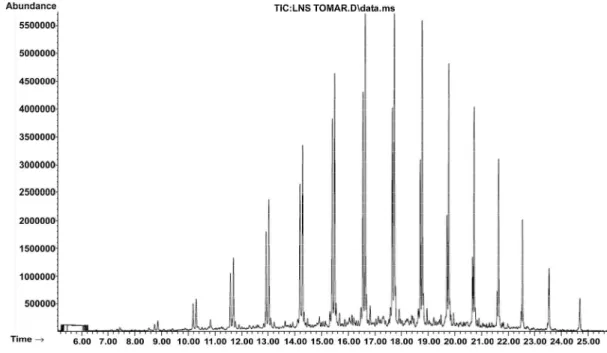
The GC-MS analysis of the oil sample obtained from waste HDPE was carried out to verify the exact composition of the oil (Figure 7) and is summarized in the Table 4. The components present in HDPE are mostly aliphatic hydrocarbons (alkane and alkenes) with carbon number C9-C24.
500 1000 1500 2000 2500 3000 3500 0
20 40 60 80 100 120 140
%T
ra
nsm
it
tan
ce
Wavelength (cm-1)
Figure 6: FTIR spectrum of the oil that was obtained at 450°C
Table 3: FTIR assignments of waste HDPE oil obtained at 450°C
Wave number (cm -1) Type of vibration Nature of functional group
2955/2916 C-H stretching Alkane
1373 C-H Scissoring and Bending Alkane
2851 C-H stretching Alkane
1642 C=C stretching Alkene/fingerprint region
1462 C=C stretching Alkene/fingerprint region
991 C-H Bending Alkene
908 C-H out-of-plane bending Alkene
Figure 7: GC/MS chromatogram of the oil that was obtained at 450°C
Table 4: GC-MS composition of oil obtained at 450°C
R. Time (min) Area % Name of compound Molecular formula
3.051 1.55 1-Nonene C9H18
3.152 0.93 Nonane C9H20
4.435 2.63 1-Decene C10H20
4.463 1.23 Decane C10H22
5.974 3.02 1-Undecene C11H22
6.106 1.74 Undecane C11H24
7.505 3.34 1-Dodecene C12H24
7.629 2.27 Dodecane C12H26
8.962 3.90 1-Tridecene C13H26
9.076 2.51 Tridecane C13H28
10.336 4.73 1-Tetradecene C14H28
10.440 2.87 Tetradecane C14H30
11.628 4.86 1-Pentadecene C15H30
11.724 3.22 Pentadecane C15H32
12.848 5.00 1-Octadecene C18H36
12.934 3.70 Hexadecane C16H34
14.001 4.94 1-Heptadecene C17H34
14.082 3.65 Hexadecane C16H34
15.098 4.71 1-Nonadecene C19H38
15.170 3.74 Hexadeane C16H34
16.141 4.38 1-Nonadecene C19H38
16.207 3.65 Hexadecane C16H34
17.133 3.79 1-Nonadecene C19H38
17.194 3.21 Eicosane C20H42
18.083 3.15 1-Nonadecene C19H38
18.140 2.92 Heneicosane C21H44
18.991 2.51 1-Nonadecene C19H38
19.042 2.48 Docosane C22H46
19.863 1.95 1-Nonadecene C19H38
19.909 1.95 Tricosane C23H48
20.699 1.26 1-Nonadecene C19H38
20.740 1.29 Tetracosane C24H50
21.502 0.92 1-Nonadecene C19H38
21.539 0.64 Docosane C22H46
22.275 0.47 n-Tetracosanol-1 C24H50O
22.308 0.37 Tetracosane C24H50
23.019 0.28 1-Nonadecene C19H38
Table 5: Physical properties of HDPE pyrolytic oil sample
Tests Results Obtained Test method
Specific Gravity @ 15°C /15°C 0.7835 IS:1448 P:16
Density @ 15°C in kg/cc 0.7828 IS:1448 P:16
Kinematic Viscosity @ 40°C in Cst 1.63 IS:1448 P:25
Kinematic Viscosity @ 100°C in Cst 0.89 IS:1448 P:25
Viscosity Index Not Available IS:1448 P:56
Conradson Carbon Residue 0.01% IS:1448 P:122
Flash Point by Abel Method Plus 1°C IS:1448 P:20
Fire Point Plus 7°C IS:1448 P:20
Cloud Point Minus 4°C IS:1448 P:10
Pour Point Minus 15°C IS:1448 P:10
Gross Calorific Value in Kcal/Kg 10244 IS:1448 P:6
Sulphur Content 0.019% IS:1448 P:33
Calculated Cetane Index (CCI) 61 IS:1448 P:9
Distillation: IS:1448 P:18
Initial Boiling Point 82°C
10% Recovery 126°C
30% Recovery 188°C
50% Recovery 226°C
70% Recovery 278°C
90% Recovery 320°C
95% Recovery 340°C
Final Boiling Point 352°C
Residue 1.50 mL
Loss 0.50%
Physical Properties of the Oil Sample
Table 5 shows the results of physical property analysis of the oil obtained from pyrolysis of waste HDPE. The appearance of the oil is dark brownish free from visible sediments. From the distillation report of the oil it is observed that the boiling range of the oil is 82-352°C, which suggests the presence of a mixture of different oil components such as gasoline, kerosene and diesel in the oil. The oil obtained from the pyrolysis was fractionated to two fractions by distillation and the fuel properties of the different fractions were studied. From this result, it is observed that the fuel properties of the thermal pyrolysis oil match the properties of petroleum fuels.
CONCLUSION
The liquid yield is highest at 450°C. Highly volatile products are obtained at low temperature. The products obtained at 500°C and 550°C are viscous liquid and wax and the product obtained at 600°C is only wax. Liquid yield increases as the holding time increases from 1 hr to 4 hr at temperatures from 400°C to 450°C, but as the holding time increases from 4 hr to 6 hr, the liquid yield decreases. Reaction time decreases with an increase in temperature. It has been shown that a simple batch pyrolysis method can convert waste
HDPE to liquid hydrocarbon products with a significant yield, which varies with temperature.
REFERENCES
Aboulkas A., Harfi, K. El., Bouadili, A. El, Nadifiyine, M., Benchanaa, M., Study on the pyrolysis of Moroccan oil shale with poly (ethylene terephthalate). Journal of Thermal Analysis and Calorimetry, 91, 737 (2008).
Ali, S., Garforth, A. A., Harris, D. H., Rawlence, D. J., Uemichi, Y., Polymer waste recycling over used catalysts. Catalysis Today, 75, 247-255 (2002).
Bagri, R., Williams, P. T., Catalytic pyrolysis of polyethylene. Journal of Analytical and Applied Pyrolysis, 63, 29-41 (2002).
Beltrame, P. L., Carniti, P., Audisio, G., Bertini, F., Catalytic degradation of polymers: Part II-Degradation of polyethylene. Polymer II-Degradation and Stability, 26, 209-20 (1989).
CEH, report on high density polyethylene resins, (www.sriconsulting.com/CEH/Public/Reports/58 0.1340/) (Accessed in August, 2010).
Consea, J. A., Font, R., Marcilla, A., Garcia, A. N., Pyrolysis of polyethylene in a fluidized bed reactor. Energy and Fuels 8, 1238-46 (1994). Garforth, A. A., Lin, Y. H., Sharratt, P. N., Dwyer, J.,
Production of hydrocarbons by catalytic degradation of high density polyethylene in a laboratory fluidised-bed reactor. Applied Catalysis A: General, 169, 331-342 (1998).
Hegberg., B. A., Brenniman, G. R., Hallenbeck, W. H., Mixed plastics recycling technology. Noyes Data Corporation, New Jersey (1992).
Hernandez, M. R., Garcıa, A. R., Gomez, A., Agullo, J., Marcilla, A., Effect of and absence of HZSM-5. Industrial and Engineering Chemistry Research, 45, 8770-78 (2006).
Hwang, G., Kim, K., Bae, S., Yi, S., Kumazawa, H., Degradation of high density polyethylene, polypropylene and their mixtures in supercritical acetone. Korean Journal of Chemical Engineering, 18, (3), 396 (2001).
Jan, M. R., Shah, J., Gulab, H., Degradation of waste high-density polyethylene into fuel oil using basic catalyst. Fuel 89, 474-80 (2010).
Karagoz, S., Yanik, J., Uçar, S., Saglam, M., Song, C., Catalytic and thermal degradation of high-density polyethylene in vacuum gas oil over non-acidic and non-acidic catalysts. Applied Catalysis A: General, 242, 51-62 (2003).
Kim, J. S., Cho, M. H., Jung, S. H., Pyrolysis of mixed plastic wastes for the recovery of benzene, toluene and xylene (BTX) aromatics in a fluidized bed and chlorine removal by applying various additives. Energy Fuels, 24, 1389-1395 (2010).
Lee, K., Shin, D., Catalytic degradation of waste HDPE over acidic catalysts with different pore sizes. Korean Journal of Chemical Engineering, 20, (1), 89 (2003).
Lee, K. H., Shin, D. H., Catalytic degradation of waste polyolefinic polymers using spent FCC catalyst with various experimental variables. Korean Journal of Chemical Engineering, 20, (1), 89-92 (2003).
Lee, K. H., Jeon, S. G., Kim, K. H., Noh, N. S., Shin, D. H., Park, J., Seo, Y. H., Yee, J. J., Kim, G. T., Thermal and catalytic degradation of waste high-density polyethylene using spent FCC catalyst. Korean Journal of Chemical Engineering, 20, (4), 693-97 (2003).
Lin, Y. H., Yang, M. H., Yeh, T. F., Ger, M. D., Catalytic degradation of high density polyethylene over mesoporous and microporous catalysts in a fluidized-bed reactor. Polymer
Degradation and Stability, 86,121-128 (2004). Manos, G., Garforth, A., Dwyer, J., Catalytic
degradation of high-density polyethylene over different zeolitic structures. Industrial and Engineering Chemistry Research, 39, 1198-1202 (2000).
Mastral, J. F., Berrueco, C., Gea, M., Ceamanos, J., Catalytic degradation of high density polyethylene over nanocrystalline HZSM-5 zeolite. Polymer Degradation and Stability, 91, 3330-38 (2006).
Miskolczi, N., Bartha, L., Investigation of hydrocarbon fractions form waste plastic recycling by FTIR, GC, EDXRFS and SEC techniques. Journal of Biochemical and Biophysics Methods, 70, 1247-53 (2008).
Parikh, P. A., Parekh, D. B., Rotliwala, Y. C., Synergetic pyrolysis of high density polyethylene and Jatropha and Karanj cakes: A thermogravimetric study. Journal of Renewable and Sustainable Energy, 1, 033107 (2009).
Park, J. W., Kim, J. H., Seo, G., The effect of pore shape on the catalytic performance of zeolites in the liquid-phase degradation of HDPE. Polymer Degradation and Stability, 76, 495-501 (2002). Plastic - the Facts, (www.plasticseurope.org/.../
06091310-final_plasticsthefacts_28092010_lr.pdf (Accessed in November, 2010)
Seo, Y. H., Lee, K. H., Shin, D. H., Investigation of catalytic degradation of high-density polyethylene by hydrocarbon group type analysis. Journal of Analytical and Applied Pyrolysis, 70, 383-98 (2003).
Sharratt, P. N., Lin, Y. H., Garforth, A. A., Dwyer, J., Investigation of the catalytic pyrolysis of high-density polyethylene over a HZSM-5 catalyst in a laboratory fluidized-bed reactor. Industrial and Engineering Chemistry Research, 36, 5, 118-124 (1997).
Venuto, P. B., Habib, E. T., Fluid Catalytic Cracking with Zeolite Catalysts, Marcel Dekker Inc., New York (1979).
Walendziewski, J., Steininger, M., Thermal and catalytic conversion of waste polyolefins. Catalysis Today, 65, 323-30 (2001).
Wallis, M. D., Bhatia, S. K., Thermal degradation of high density polyethylene in a reactive extruder. Polymer Degradation and Stability 92, 1721-29 (2007).