ABSTRACT: In the last decades, hybrid rocket engines have been increasingly studied and used in space vehicles. However, the low regression rates and speciic impulses still represent major drawbacks to this technology. The objective of this study was to quantify the relative improvement of regression rate values with the use of a swirling low injector in comparison to an axial injector. Seven tests were conducted with axial injection and seven with swirl injection. Regression rate results were compared, and it was found that swirl injection improved regression rates in 50% for mass luxes higher than 45 kg∙s–1∙m–2. It was possible to see radiation, kinetic and diffusion theory on the logarithmic plot of regression rate per oxidizer lux yielded by both injectors. A strong agreement with experimental indings of regression rates in the literature parameters is reported.
KEYWORDS: Hybrid rocket motor, Swirl injector, Solid fuel regression rates.
Swirl Injection Effects on Hybrid Rocket Motors
Susane Ribeiro Gomes1, Leopoldo Rocco2, José Atílio Fritz F. Rocco3
INTRODUCTION
In the quest for a novel propulsion technology, the hybrid rocket engine draws attention due to features such as thrust tailoring and lower investment costs in comparison to solid motors and liquid engines (Pastrone 2012). Nevertheless, combustion inefficiencies and low regression rates are the major weaknesses of this technology. his research aims to contribute to the improvement of the regression rates with the use of swirl injectors.
he combustion in a hybrid motor follows a non-premixed pattern and visually is a macroscopic difusion lame. he lame zone is established within the boundary layer, in which the solid fuel has to melt and vaporize or pyrolyze as well as mix with the oxidizer in the lame zone as shown in Fig. 1 (Marxman and Gilbert 1963). In this way, hybrid combustion phenomena difer from what occurs in liquid and solid motors, where the lame is pre-mixed and no relevant energy is spent mixing fuel and oxidizer.
he regression rate is a parameter deined to quantify the amount of fuel transferred from the solid grain into the lame zone. hermal energy must be transferred to the solid fuel surface to change the physical phase, thus it follows that one of the most important parameters to improve regression rates is heat lux from the lame to the surface.
Right above the surface of the solid grain, a layer of melted or gasiied fuel is formed; this layer is cooler than the lame and acts as a thermal isolator, hindering the heat transfer from the lame to the solid surface. his phenomenon is documented in the literature as blowing efect.
he regression rate depends primarily on the convective heat transfer from the lame to the fuel surface; hence the whole combustion process will be affected severely by
1.Departamento de Ciência e Tecnologia Aeroespacial – Instituto Tecnológico de Aeronáutica – Divisão de Propulsão – São José dos Campos/SP – Brazil. 2.Flowtest Pesquisa Aeroespacial – Caieiras/SP – Brazil. 3.Departamento de Ciência e Tecnologia Aeroespacial – Instituto Tecnológico de Aeronáutica – Divisão de Ciências Fundamentais – São José dos Campos/SP – Brazil.
Author for correspondence: Susane Ribeiro Gomes | Departamento de Ciência e Tecnologia Aeroespacial – Instituto Tecnológico de Aeronáutica – Departamento de Propulsão | Praça Marechal Eduardo Gomes, 50 – Vila das Acácias | CEP: 12.228-901 – São José dos Campos/SP – Brazil | Email: [email protected]
the incoming oxidizer flow pattern as it alters the flow dynamics on the grain surface (Carmicino and Russo Sorge 2005a; Yuasa et al. 2012).
Given the importance of the regression rate improvement, several methodologies have been tested to increase this parameter. he literature conirms that swirl injection is one of the most eicient means to increase the regression rates of a given fuel (Pastrone 2012; Carmicino and Russo Sorge 2007; Knuth et al. 1998; Imamura et al. 1996).
Yuasa et al. (2001) tested swirl injectors at the grain head end and report results for different grain lengths, geometric turbulence factor and flow of oxidant. The intensity of rotation and oxidant mass flow were varied independently. Swirl GOX injection yielded 2.7 times greater regression rate than axial injection of polymethylmethacrylate (PMMA).
Another research shows that while the local fuel regression rate at the rear region decreased slightly with the increasing of the burning time, local regression at the leading edge was independent of burn time (Hirata
et al. 2011). These results suggested that the combustion mechanisms at the leading edge and the rear region are differed (Hirata et al. 2011).
he injection efect, indeed, is expected to be more important when the extent of the impinging region is larger compared to the grain length (Carmicino and Russo Sorge 2005b). he high-velocity, swirling oxidizer near the fuel surface induced high convective heat luxes, which sustained the large regression rates (Knuth et al. 2002).
Relevant work has been done in hybrid rocket simulation. Researchers were able to simulate the low inside a hybrid rocket chamber with CFD and compared it to experimental results (Bellomo et al. 2011, 2013).
CFD investigations are now able to point out that swirl improves regression rate and combustion when compared to axial injector (Bellomo et al. 2011, 2013). Swirl injectors can
also be used with liquefying fuels; in such case parain fuel burns about twice as fast by swirling GOX (Hikone et al. 2010).
In accordance to Kumar and Kumar (2013), swirl is more efective in improving the average regression rate of short grains (total length over inner diameter, L/D < 5) and large diameters as opposed to longer grains. From the research of Kumar and Kumar (2013) and Carmicino and Russo Sorge (2005b), it follows that the swirl efect is more pronounced on short grains.
Another research captured the liquid layer on the surface of a high-density polyethylene grain burning with axial injector (Chandler et al. 2012). It is expected that polyethylene form a liquid layer, but due to the high viscosity, entrainment efect is unlikely. Nevertheless, they were able to visualize droplets above the fuel.
With visualization techniques, scientists were able to see that, when swirl injector is used, the lame is driven close to the surface, resulting in an increase of the regression rates. his happens due to the centrifugal force of the swirling low of oxidizer (Masugi et al. 2010). Swirl efect is so noticeable that conventional combustion regression rate equation using the oxidizer mass flux based on the grain port area is not well applied, due to diferent lows in the rear and at regions of the grain (Yuasa et al. 2012).
The present paper will discuss the regression rate improvements with the use of swirl injector in comparison to the results of the axial injector. his research was also able to verify the efects of radiation, kinetic and difusion theory on the logarithmic plot of regression rate per oxidizer lux yielded by both injectors.
EXPERIMENTAL SETUP
he baseline engine design was developed from a need for simplicity and lexibility; therefore a modular design was incorporated. he set could be assembled and disassembled in minutes allowing the practice of many tests per session. he case and the langes were made from stainless steel. he case was machined to it between the steel langes. he nozzle was adapted in the at lange, to avoid nozzle exit during irings. A hydraulic system was settled to perform the thrust measurements. A schematic diagram of the test facility is exposed in Fig. 2.
he pressure was taken in the oxidizer feedline before the injector. he measurements were the feedline pressure, regression rates, oxygen and fuel mass before and ater tests. he chamber was designed to withstand up to 70 atm.
Velocity profile
Temperature profile
T e
Y 0 = 1 U
e
Tb
Ta T
s
Concentration profiles
Diffusion flame Fuel + Products
Oxidizer + Products
Fuel grain
x
(a)
(a)
(b)
(b) Compression fitting valves were used in the oxygen feed line, in order to disengage if the pressure rises above 60 atm. A pyrotechnic method was used to achieve ignition. he chamber’s length is 215 mm with an inner diameter of 68.3 mm. he grains are 195 mm long. he at-chamber has a span of 15 mm and the pre-chamber is 5 mm long. Two injectors were developed, one axial and one swirl. A view of the motor attached to the test bench is shown in Fig. 3.
Figure 4 show different sides of the injectors. The easy interchange of injectors in the head flange and effortless alteration in the oxygen feed line due to the compression it
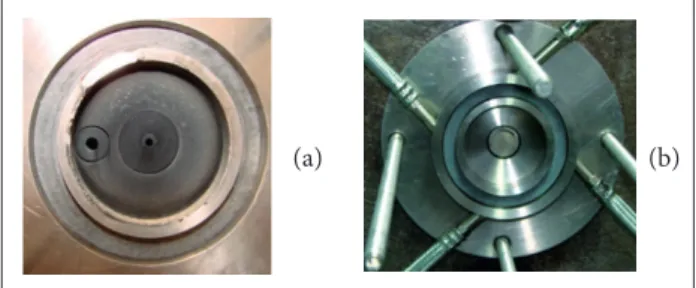
valves connections contribute to the trouble-free experimental apparatus. Figure 4 display the injectors attached to the head lange of the test bench. Figure 4a shows two holes, one for the axial injector and the other for a pressure transducer, which was not functional at the time of the tests.
All injection exits and entrances are identical to guarantee homogeneous low and regular burning along the port. he large injector outlet area works like an additional pre-chamber, enhancing the uniformity of the incoming low conditions.
In the beginning of the research, the maximum pressure of injection was set at 40 atm; this is the pressure taken right before the low enters the injector. his value was chosen to investigate the security of the apparatus and whether the hoses would release before the 60 atm chamber pressure limit. Once many tests were accomplished without failure or damage, the maximum injection pressure was gradually increased to 46, 52, and 58 atm.
In this manner, a total of 7 tests were done for each injector (4 with 40 atm and 3 with 46, 52, and 58 atm). he maximum injection pressure was set manually by an electron valve. he masses of the oxygen cylinder and of the case were taken before and ater each test. he tests began with ignition using a pyrotechnic ignitor, also known as squib. Then, the flow of oxygen was switched on for 10 s; this was controlled with LabView. Ater the iring the inner diameter of the grain was measured in ive diferent locations to calculate the average regression rates as will be explained in the next section.
RESULTS AND DISCUSSION
he key purpose of the regression rate analysis is to determine the correlation between regression rates and easily controlled parameters along with experimentally derived constants; in this work the average regression rate, as deined by Marxman and Gilbert (1963), is used, once it provides good correlations. Correlation patterns were determined by making scatter plots and applying correlation analysis to the cluster of data points provided by the test irings.
Average regression rate is deined in Eq. 1:
Figure 4. (a) Axial injector mounted on the test bench; (b) Large swirl attached to the test bench with the four oxidizer supply entrances.
Figure 2. Diagram of the experimental apparatus. It is possible to see the data acquisition (DAQ); the control panel (PC), and the needle and solenoid valves (vlv).
PC
DAQ
Spark plug
Solenoid vlv
Load Cell
Balance
Data line Control line Oxigen flow line
P P
Needle vlv Control
Figure 3. (a) Side view of the labscale hybrid rocket motor on the test bench. (b) Firing test.
(1)
a0 is the regression rate experimental coeicient incorporating grain length; Goxmeans the average oxidizer mass lux rate;
n is the experimental regression rate exponent.
Assuming a uniform inner diameter growth, the average oxidizer mass lux is experimentally deined as Eq. 2:
Tables 1 and 2 show that, when mass luxes are smaller than 45 kg/sm2, swirl regression rates are 25% higher than the
values yielded by the axial injector. However, for mass luxes higher than 45 kg/sm2, the regression rates increase at least
50%, in respect to the values obtained with the axial injector. Fuel regression rate yielded by axial and swirl injection methods is presented in Fig. 6. he analysis of Fig. 6 shows that, for the same mass low of oxidant, the large rotational swirl yielded higher regression rates.
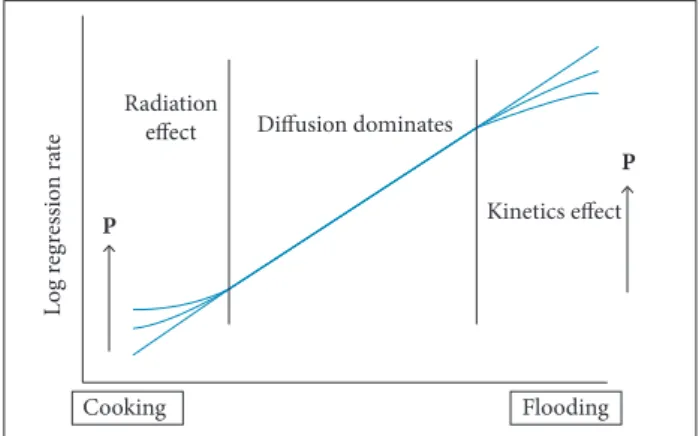
he difusion-controlled model has two assumptions. he irst is that the reaction rates are faster than the rates of the difusion of the chemical species, and the second assumption refers to the thickness of the boundary layer, which is supposed to be orders of magnitude larger than the combustion zone thickness; this means that Eq. 1 works perfectly. herefore the logarithms of regression rate and of mass lux form a line, the center line of Fig. 7. his theory can be further understood reading the original article by Marxman and Gilbert (1963).
It is observed that, at constant pressure, whentheoxidizer mass lux decreases, the regression is likely to vary and depend on the radiation environment, becoming larger than the extrapolated values (Altman 2001; Marxman and Gilbert 1963). his happens because in low oxidizer concentrations the burning is not complete, and species from the incomplete where:
Di is the initial port diameter; Dfis the inal port diameter;
mox is the average oxidizer mass low rate.
Using experimental data, the average regression rate is calculated as follows:
where:
Δt is the burn time.
he initial port diameter of all grains is 20 mm. In this study, the inal diameter is deined as the average value of the diameters of 5 cross-sections, as shown in Fig. 5.
Tables 1 and 2 present the regression rates and oxidizer lux of HDPE fuel with the use of axial and swirl injectors.
Figure 5. Cross-sections for the calculation of mean regression rate.
Gox [kg/sm2] r [mm/s]
33.3 1.20614
41.9 1.07427
42.9 1.15134
49.5 1.4145
52.0 1.57644
54.8 1.59653
79.9 1.70432
Table 1. Axial injector.
Gox [kg/sm2] r [mm/s]
33.0 0.85
33.1 0.84
41.0 0.86
50.4 0.88
52.6 0.91
89.3 1.12
131.1 1.15
Table 2. Swirl injector.
1 .8 Axial
Swirl
1.4
1
0.6
20 60 100
Gox [kg/sm2]
r [mm/s]
140
.
Figure 6. Regression rate versus oxidizer mass lux for each
injection method. 9.5
mm
9.5 mm 44
mm 44 mm
44 mm
44 mm
(2)
(3)
.
Figure 7. Diagram of the inluence of radiation and kinetics effects on regression rates adapted from Altman (2001) and Pastrone (2012).
Figure 8. Scattered data with smooth lines.
Table 3. Regression rate experimental parameters.
Injector a
0 n R
2
Axial 0.339 0.259 0.772
Swirl 0.182 0.521 0.636
Diffusion dominates
L
og r
eg
res
sio
n ra
te
Flooding Cooking
Kinetics effect Radiation
effect
P
P
combustion, such as carbon black, increase the radiative heat exchange, improving the regression rates. hese results are consistent with other indings in the literature.
One study shows that thermal radiation was found to expressively inluence the regression rates (Chiaverini et al.
2000). To quantify the importance of radiative heat lux, a study found that the diference of regression rate when single port and multiport are used is due to the radiative heat lux as the port number increases, and there are more species from incomplete combustion (Kim et al. 2013).
Differently, at high mass fluxes or low pressure, the hypothesis that reaction rates are higher than velocity of difusion is not valid anymore. It is observed that the reactions become the slow stage of the burning process; this is why it is called kinetic dependent, and the values are lower than the extrapolation (Fig. 7).
Figure 8 shows the logarithm of the regression rate versus
logarithm of oxidizer mass lux. It is clear that both curves follow the theory graphically presented in Fig. 7, once the middle section
is lat, low values of oxidizer lux yield higher regression rates than extrapolated and high values of oxidizer lux yield lower values than extrapolated. herefore, the inluence of radiation and of kinetics on the regression rates can be viewed in the curves of both injectors.
The next analysis should deal with the difference in regression rates results. It is reasonable to assume that the diference is due to the injection methodology, more precisely the velocity proiles.
The swirl injector inserts the oxidizer with basically two velocity components: axial and tangential. The axial flow mixes in a less efficient way than the tangential flow. It is know in the literature that tangential velocities on the grain surface flatten the boundary layer and, therefore, the flame zone (Yuasa et al. 1999) and increase the heat transfer (Carmicino and Russo Sorge 2007), which in turn increases the regression rates in comparison to the axial flow. The regression equation for each configuration is shown in Table 3.
The typical exponent of the mass flow mentioned in the literature has values smaller than 0.8, corresponding to correlation with the turbulent boundary layer fully established (Marxman and Gilbert 1963). High values of n imply signiicant dependence of mean regression with the low of oxidant. Values of n close to 0.4, which is the theoretically expected value for kinetically controlled regime, mean the combustion is kinetically controlled and less dependent on the oxidizer incoming lux (Pastrone 2012).
he values obtained in the literature for the experimental parameter n from the regression rate equation are listed in Table 4. The experimental parameter n found in this study (0.5 mm/s) is in accordance with the values found in the literature of 0.5; these values are marked in bold.
All tests with axial injector harmed the injector material as shown in Fig. 9, the integration of a long pre-chamber was imperative. The flow downstream the injector exit forms a recirculation zone, which blocks heat transfer from the lame to the bulkhead. herefore, there is no need for insulation in the swirl case. he same barrier efect was obtained and documented by Jones et al. (2009). This is one additional reason to use swirl injector.
Log ( Oxidizer flux)
0 .2 5
0 .2
0 .1 5
0 .1
0 .0 5
0
–0 .0 5
–0 .1
1 .5 1 .6 1 .7 1 .8 1 .9 2 2 .1 Axial
Large s wirl
2 .2
L
o
g (R
eg
ress
io
n r
at
Figure 9. Comparison between injector cross-sections after irings. (a) Axial test; (b) Large swirl test.
(a) (b)
than the axial one, which is in accordance with the literature data (Carmicino and Russo Sorge 2005b; Knuth et al. 2002; Kumar and Kumar 2013). he experimental parameters of the regression rate equations were compared to the literature. It was found that the results are again in accordance with the literature. he theory of difusion was applied, and it was possible to correlate the regression rate plot to the three main phenomena: radiation, difusion and kinetic efects (Marxman and Gilbert 1963).
ACKNOWLEDGMENTS
he research for this paper was inancially supported by the National Counsel of Technological and Scientiic Development (CNPq). he company Flowtest Aerospace provided the facilities to develop this research.
REFERENCES
Altman D (2001) Rocket motors, hybrid. In: Meyers RA (Ed.) Encyclopedia of Physical Science and Technology. 3rd ed. Vol. 14. Elsevier. p. 303-321.
Bellomo N, Barato F, Faenza M, Lazzarin M, Bettella A, Pavarin D (2011) Numerical and experimental investigation on vortex injection in hybrid rocket motors. Proceedings of the 47th AIAA/ASME/SAE/ ASEE Joint Propulsion Conference & Exhibit; San Diego, USA.
Bellomo N, Barato F, Faenza M, Lazzarin M, Bettella A, Pavarin D (2013) Numerical and experimental investigation of unidirectional vortex injection in hybrid rocket engines. J Propul Power 29(5): 097-1113.
Carmicino C, Russo Sorge A (2005a) Inluence of a conical axial injector on hybrid rockets performance. Proceedings of the 41st AIAA/ASME/ SAE/ASEE Joint Propulsion Conference & Exhibit; Tucson, USA.
Carmicino C, Russo Sorge A (2005b) Role of injection in hybrid rockets regression rate behavior. J Propul Power 21(4):606-612. doi: 10.2514/1.9945
Table 4. Constant n found experimentally for the regression rate equation.
Reference Injector Oxidizer/fuel n
Myre et al. (2010) Swirl GOX/PE 0 .5
Carmicino and Russo Sorge (2005a) Swirl GOX/PE 0 .5
Carmicino and Russo Sorge (2005b) Axial GOX/PE 0.371
Carmicino and Russo Sorge (2005b) Swirl GOX/PE 0 .5
Knuth et al. (2002) Swirl GOX/HTPB 0.54
Yuasa et al. (2001) Swirl GOX/PMMA 0.641
Nagata et al. (2011) Swirl CAMUI 0.8
Present research Swirl GOX/PE 0 .5 2
Present research Axial GOX/PE 0.26
CONCLUSIONS
he objective of this research was to evaluate and compare the regression rates of polyethylene fuel grains under swirl and axial oxidizer injection methods. Swirl injector yielded better conditions
Carmicino C, Russo Sorge A (2007) Performance comparison between two different injector conigurations in a hybrid rocket. Aerospace Science and Technology 11(1):61-67. doi: 10.1016/j. ast.2006.08.009
Chandler A, Jens E, Cantwell BJ, Hubbard GS (2012) Visualization of the liquid layer combustion of parafin fuel for hybrid rocket motors. Proceedings of the 48th AIAA/ASME/SAE/ASEE Joint Propulsion Conference & Exhibit; Atlanta, USA.
Chiaverini MJ, Serin N, Johnson DK, Lu YC, Kuo KK, Risha GA (2000) Regression rate behavior of hybrid rocket solid fuels. J Propul Power 16(1):125-132. doi: 10.2514/2.5541
Hikone S, Maruyama S, Isiguro T, Nakagawa I (2010) Regression rate characteristics and burning mechanism of some hybrid rocket fuels. Proceedings of the 46th AIAA/ASME/SAE/ASEE Joint Propulsion Conference & Exhibit; Nashville, USA.
hybrid rocket engines. Proceedings of the 47th AIAA/ASME/SAE/ ASEE Joint Propulsion Conference & Exhibit; San Diego, USA.
Imamura T, Shimada O, Yuasa S (1996) Effects of swirling oxygen low on the performance of a hybrid rocket engine. Proceedings of the 36th Conference on Aeroespace Propulsion; Tokio, Japan.
Jones CC, Myre DD, Cowart JS (2009) Performance and analysis of vortex oxidizer injection in a hybrid rocket motor. Proceedings of the 45th AIAA/ ASME/SAE/ASEE Joint Propulsion Conference and Exhibit; Denver, USA.
Kim S, Lee J, Moon H, Kim J, Sung H, Kwon OC (2013) Regression characteristics of the cylindrical multiport grain in hybrid rockets. J Prop Power 29(3):573-581. doi: 10.2514/1.B34619
Knuth WH, Chiaverini MJ, Gramer DJ, Sauer JA (1998) Experimental investigation of a vortex-driven high-regression rate hybrid rocket engine. Proceedings of the 34th AIAA/ASME/SAE/ASEE Joint Propulsion Conference & Exhibit. AIAA; Cleveland, USA.
Knuth WH, Chiaverini MJ, Sauer JA, Gramer DJ (2002) Solid-fuel regression rate behavior of vortex hybrid rocket engines. J Prop Power 18(3):600-609. doi: 10.2514/2.5974
Kumar CP, Kumar A (2013) Effect of swirl on the regression rate in hybrid rocket motors. Aerosp Sci Technol 29(1):92-99. doi: 10.1016/j.ast.2013.01.011
Marxman GA, Gilbert M (1963) Turbulent boundary layer combustion in the hybrid rocket. Symp Int Combust 9(1):371-383. doi: 10.1016/ S0082-0784(63)80046-6
Masugi M, Ide T, Yuasa S, Sakurai T, Shiraishi N, Shimada T (2010) Visualization of lames in combustion chamber of swirling-oxidizer-low-type hybrid rocket engines. Proceedings of the 46th AIAA/ASME/ SAE/ASEE Joint Propulsion Conference & Exhibit; Nashville, USA.
Myre DD, Caton P, Cowart JS, Jones CC (2010) Exhaust gas analysis of a vortex oxidizer injection hybrid rocket motor. Proceedings of the 46th AIAA/ASME/SAE/ASEE Joint Propulsion Conference & Exhibit; Nashville, USA.
Nagata H, Hagiwara S, Totani T, Uematsu T (2011) Optimal fuel grain design method for CAMUI type hybrid rocket. Proceedings of the 47th AIAA/ ASME/SAE/ASEE Joint Propulsion Conference and Exhibit; San Diego, USA.
Pastrone D (2012) Approaches to low fuel regression rate in hybrid rocket engines. Int J Aerosp Eng 2012(2012):Article ID 649753.
Yuasa SS, Imamura T, Tamura T, Yamamoto K (1999) A technique for improving the performance of Hybrid Rocket Engines. Proceedings of the 35th Joint Propulsion Conference and Exhibit, AIAA/ASME/SAE/ ASEE; Los Angeles, USA.
Yuasa S, Shirashai N, Hirata K (2012) Controlling parameters for fuel regression rate of swirling-oxidizer-low-type hybrid rocket engine. Proceedings of the 48th AIAA/ASME/SAE/ASEE Joint Propulsion Conference & Exhibit. Atlanta, USA.

![Figure 5. Cross-sections for the calculation of mean regression rate. Gox [kg/sm 2 ] r [mm/s] 33.3 1.20614 41.9 1.07427 42.9 1.15134 49.5 1.4145 52.0 1.57644 54.8 1.59653 79.9 1.70432](https://thumb-eu.123doks.com/thumbv2/123dok_br/18889433.424652/4.892.460.809.664.857/figure-cross-sections-calculation-mean-regression-rate-gox.webp)