Assessing glomerular iltration rate in patients with severe
heart failure: comparison between creatinine-based formulas
Avaliação da taxa de iltração glomerular em pacientes com insuiciência cardíaca
grave: comparação entre fórmulas baseadas na creatinina
Alexandre Libório
I, Russian Uchoa
II, João Neto
III, Juan Valdivia
IV, Elizabeth De Francesco Daher
V, Juan Mejia
VIHospital de Messejana, Fortaleza, Ceará, Brazil
ABSTRACT
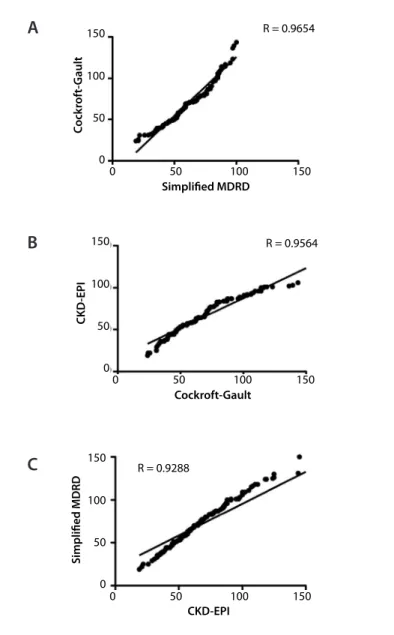
CONTEXT AND OBJECTIVE: Severe heart failure is highly associated with chronic kidney disease (CKD). Serum creatinine is a poor indicator of renal function and glomerular iltration rate (GFR) estimation is an accessible method for assessing renal function. The most popular formulas for GFR estimation are the Cockcroft-Gault (CG), the four-variable Simpliied Modiication of Diet in Renal Disease (sMDRD) and the recently introduced CKD-Epidemiology Collaboration (CKD-EPI). The objective of the study was to analyze the cor-relation between these three equations for estimating GFR in patients with severe heart failure. DESIGN AND SETTING: Cross-sectional observational study at a university reference center.
METHODS: GFR was estimated in patients with severe heart failure who were awaiting heart transplanta-tion, using the CG, sMDRD and CKD-EPI formulas. These estimates were analyzed using Pearson’s correla-tion and Bland-Altman analysis.
RESULTS: This study included 157 patients, of whom 32 (20.3%) were female. Normal serum creati-nine concentration was observed in 21.6%. The mean GFR according to CG, sMDRD and CKD-EPI was 70.1 ± 29.5, 70.7 ± 37.5 and 73.7 ± 30.1 ml/min/1.73 m2; P ≥ 0.05. Pearson’s coeicient demonstrated good correlations between all the formulas, as did Bland-Altman. However, the patients presented GFR < 60 ml/ min more frequently with the sMDRD formula (54.1% versus 40.2% for CG and 43.2% for CKD-EPI; P = 0.02). CONCLUSION: Despite the good correlation and agreement between the three methods, the sMDRD formula classiied more patients as presenting GFR less than 60 ml/min.
RESUMO
CONTEXTO E OBJETIVO: Insuiciência cardíaca grave tem elevada correlação com doença renal crôni-ca. Creatinina sérica é um indicador pobre da função renal e a estimativa da taxa de iltração glomerular (TFG) é um método acessível para avaliar a função renal. As fórmulas mais populares estimadoras da TFG são a Cockcroft-Gault (CG), a modiicação de dieta simpliicada em doença renal (Simpliied Modiica-tion of Diet in Renal Disease, sMDRD) com quatro variáveis, e a recentemente introduzida Colaboração Epidemiológica na Doença Renal Crônica (Chronic Kidney Disease-Epidemiology Collaboration, CKD--EPI). O objetivo foi analisar a correlação entre essas três equações estimadoras da TFG em pacientes com insuiciência cardíaca grave.
TIPO DE ESTUDO E LOCAL: Estudo transversal observacional em centro de referência universitário. MÉTODOS: Pacientes com insuiciência cardíaca grave em ila para transplante cardíaco tiveram a TFG estimada pelo CG, sMDRD e CKD-EPI. Essas estimativas foram analisadas pela correlação de Pearson e análise de Bland-Altman.
RESULTADOS: Foram incluídos 157 pacientes: 32 (20,3%) mulheres. Creatinina sérica normal foi ob-servada em 21,6%. TFG média de acordo com CG, sMDRD e CKD-EPI foi 70,1 ± 29,5, 70,7 ± 37,5 e 73,7 ± 30,1 ml/min/1.73 m2; P ≥ 0,05. Coeiciente de Pearson mostrou boa correlação entre todas as fór-mulas, assim como Bland-Altman. Entretanto, os pacientes apresentaram TFG < 60 ml/min mais frequen-temente com a fórmula sMDRD (54,1% versus40,2% para CG e 43,2% para CKD-EPI; P = 0,02).
CONCLUSÃO: Apesar da boa correlação e concordância entre os três métodos, a fórmula do sMDRD clas-siicou mais pacientes com TFG menor que 60 ml/min.
IMD, PhD. Professor, Postgraduate Program on Public Health, Universidade de Fortaleza (Unifor), Fortaleza, Ceará, Brazil.
IIMedical student. Universidade de Fortaleza (Unifor), Fortaleza, Ceará, Brazil.
IIIMD. Cardiologist, Cardiac Transplantation Service, Hospital Messejana, Fortaleza, Ceará, Brazil. IVMedical Student. Universidade de Fortaleza (Unifor), Fortaleza, Ceará, Brazil.
VMD, PhD. Professor, Department of Clinical Medicine, Universidade Federal do Ceará (UFC), Fortaleza, Ceará, Brazil.
VIMD. Coordinator of the Heart Transplantation Program, Hospital Messejana, Fortaleza, Ceará, Brazil.
KEY WORDS:
Heart failure.
Glomerular iltration rate. Kidney failure, chronic. Heart transplantation. Renal insuiciency.
PALAVRAS-CHAVE:
INTRODUCTION
Renal dysfunction is highly prevalent in patients with heart dis-ease, mainly as a result of concomitant diabetes mellitus, hyper-tension or congestive heart failure.1 Moreover, development of chronic kidney disease (CKD), i.e. a glomerular iltration rate (GFR) < 60 ml/min, is predictive of premature cardiovascular death.2 Heart transplantation is the deinitive treatment for eli-gible patients with end-stage heart failure, but the immunosup-pressive therapy that is required, especially calcineurin inhibi-tors, represents an additional risk factor for renal failure.3,4
Regimens containing calcineurin inhibitors are not used in individuals with severe renal impairment, in order to avoid addi-tional drug-induced nephrotoxicity. hus, GFR monitoring is an important tool in managing heart failure patients, both before and ater heart transplantation.
Serum creatinine is a poor indicator of renal function, and GFR estimation is preferred in assessing renal function.5 he for-mulas for GFR estimation typically include age and gender, in order to accommodate diferences in creatinine generation. he most popular formulas include Cockcrot-Gault (CG) and the four-variable Simpliied Modiication of Diet in Renal Disease (sMDRD).4,6,7 Over recent years, this simpliied formula has been introduced into clinical practice, and it is currently considered to be the best available formula.8 Generalization of these formulas to specific populations (e.g. heart failure or liver disease patients) is troublesome, mainly because of poor nutritional status, low muscle mass, edema and weight loss. Recently, a new equation, the Chronic Kidney Disease-Epidemiology Collaboration (CKD-EPI), was proposed for estimating GFR. here have been claims that it is as accurate as sMDRD for diagnosing cases of GFR less than 60 ml/min and that its performance among patients with GFR greater than 60 ml/min is better.9 However, no study has compared the CKD-EPI, CG and sMDRD equations in a speciic population with severe heart failure awaiting orthotopic heart transplantation.
OBJECTIVE
he aim of this study was to analyze the correlations between cre-atinine-based equations for estimating GFR, among patients with severe heart failure who were awaiting heart transplantation.
METHODS
his was a correlation study that included 157 consecutive patients who underwent orthotopic heart transplantation in a tertiary center in northeastern Brazil between 2004 and 2010. Patients under 18 years of age and those who had needed hos-pitalization during the preceding month were excluded. Ater recruitment for heart transplantation, demographic data and venous blood samples were obtained. Serum creatinine was mea-sured by using a kinetic alkaline picrate assay validated against isotope dilution mass spectrometry (IDMS).
The estimated GFR was obtained through three methods (equations):
(1) sMDRD equation: GFR (expressed in ml/min/1.73 m2) = 186 x [cr] -1.154 x [age] -0.203 x [0.742 if patient was female];
(2) CG formula normalized to a body surface area of 1.73 m2, with creatinine clearance expressed in ml/min/1.73 m2: GFR (males) = 1.23 x weight (kg) x [140-age]/plasma creatinine (μmol/l) x 1.73/BSA; GFR (females) = 1.03 x weight (kg) x [140-age]/plasma creatinine (μmol/l) x 1.73/BSA, where BSA (m2) = [weight (kg) x height (cm)/3600];
(3) CKD-EPI formula using the following equations: For women with creatinine < 0.7 mg/dl (62 mmol): GFR = 144 x (cr/0.7)-0.329 x (0.993) x age.
For women with creatinine > 0.7 mg/dl (62 mmol): GFR = 144 × (cr/0.7)-1.209 x (0.993) x age.
For men with creatinine < 0.9 mg/dl (80 mmol): GFR = 141 x (cr/0.9)-0.411 x (0.993) x age.
For men with creatinine > 0.9 mg/dl (80 mmol): GFR = 141 × (cr/0.9)-1.209 x (0.993) x age.
All the patients were considered to be non-black because of the special miscegenation of the Brazilian population. he data were expressed as the mean ± standard deviation (SD). he unpaired t test or one-way analysis of variance (ANOVA) were used to compare means between pairs of groups or more than two groups, respectively. he chi-square test was used for categorical variables. Pearson’s correlation coeicient was obtained using log-transformed data. he means of the absolute diferences between pairs of methods were obtained. Bland-Altman plots were con-structed to illustrate the degree of agreement between each pre-diction equation and the measured GFR. GraphPad Prism ver-sion 5.0 was used for the statistical analysis.3
RESULTS
the level of agreement between the methods was signiicant, especially between sMDRD and CKD-EPI, across the entire mean spectrum. Analysis on the graphs using the CG formula (Figures 2a and b) showed that there was greater disagreement when the GFR was greater than 70 to 80 ml/min. here was greater bias between the CG and sMDRD formulas (Table 1).
Although there were good correlations and low bias between these creatinine-based formulas, it was seen that when the patients were distributed according GFR levels as presented in Table 2, the sMDRD equation was signiicantly more sensitive for classifying patients with GFR < 60 ml/min, i.e. 54.1% versus 40.2% for CG and 43.2% for CKD-EPI; P = 0.02 from the chi-square test. Moreover, disagreement occurred in 40 (25.5%) of the patients when sMDRD and CKD-EPI were compared, and in 47 (30%) when sMDRD and CG were compared. In contrast, only 18 patients (11.46%) were in diferent stages when CG and CKD-EPI were compared.4
DISCUSSION
To the best of our knowledge, this is the irst study evaluating the new CKD-EPI equation among patients with severe heart failure who were awaiting heart transplantation. We found acceptable agreement in comparing the CKD-EPI values with both the CG and the sMDRD equations, but sMDRD was more sensitive for classifying patients with GFR < 60 ml/min.
Kidney disease afects cardiac performance through elec-trolyte imbalance, volume overload and negative inotropy.10 In a retrospective analysis within the Studies of Let Ventricu-lar Dysfunction (SOLVD) trial, even moderate degrees of renal insuiciency, as measured using the CG equation, were inde-pendently associated with an increased risk for all-cause mor-tality in patients with heart failure.11 Correct identiication and classiication of renal failure in patients with advanced heart fail-ure also has central importance in choosing immunosuppressive therapy, especially regarding decisions about calcineurin inhibi-tors. MDRD was proposed by Levey et al.6 and, since then, many studies have demonstrated its accuracy for estimating GFR. In patients with advanced heart failure, MDRD was found to pres-ent better performance than shown by CG, for predicting GFR less than 60 ml/min, using 51Cr-EDTA measurements as a ref-erence.12 In the same study, the simpliied MDRD formula had a mean bias of only 10.9 ml/min, compared with 51Cr-EDTA. In our data, the greatest mean bias between the methods was found between the CG and sMDRD formulas and was similar to the previous inding (9.06 ml/min).
he CKD-EPI equation was proposed recently as a more accurate method for estimating GFR than MDRD.9 Even among patients with GFR above 60 ml/min, for which MDRD has poor performance, CKD-EPI has been demonstrated to be more accu-rate in other studies. In patients with advanced heart failure, we
Table 1. Estimated glomerular iltration rate (GFR) using the Cockcroft-Gault (CG), simpliied Modiication of Diet in Renal Disease (sMDRD) and Chronic Kidney Disease-Epidemiology Collaboration (CKD-EPI) formulas
Mean absolute diference ± SD
Median absolute diference
CG versus sMDRD 9.06 ± 11.53 5.59 CG versus CKD-EPI 4.02 ± 10.05 0.81 sMDRD versus CKD-EPI -2.98 ± 14.74 -5.00 SD = standard deviation.
demonstrated that the mean bias diference between MDRD and CKD-EPI was only -2.98 ml/min. Moreover, almost all the points are within the agreement limits (Figure 2c). With regard to spe-cial populations, CKD-EPI has been used among diabetics,13
Figure 1. Pearson’s correlation using: (A) Cockcroft-Gault and simpliied Modiication of Diet in Renal Disease (sMDRD), (B) Cockcroft-Gault and Chronic Kidney Disease-Epidemiology Collaboration (CKD-EPI) equation and (C) simpliied MDRD and CKD-EPI.
0 0 50 100 150
50
Simpliied MDRD
C
ock
rof
t-G
ault
100
R = 0.9654
150
0 0 50 100 150
50
Simpliied MDRD
C
ock
rof
t-G
ault
100
R = 0.9654
150
0 50 100 150
Cockroft-Gault
CKD
-EPI
0 50 100 150
R = 0.9564
0 50 100 150
Cockroft-Gault
CKD
-EPI
0 50 100 150
R = 0.9564
0 50 100 150
CKD-EPI
Simpliied MDRD
0 50 100 150 R = 0.9288
0 50 100 150
CKD-EPI
Simpliied MDRD
0 50 100 150 R = 0.9288
A
B
preeclamptic women,14 elderly patients,15 candidates for liver transplantation16 and individuals who have undergone ortho-topic heart transplantation.17 he National Kidney Foundation5 has created an operational deinition and classiication of chronic kidney disease stages that provides estimates of disease preva-lence according to stage, thus making it possible to develop a broad overview for a “clinical action plan” to evaluate and man-age each stman-age of chronic kidney disease, and to deine the indi-viduals who are at greater risk of developing chronic kidney dis-ease. his classiication is largely based on the GFR.
Although our patients could not be diagnosed as having CKD because they did not have a second GFR measurement ater an interval of least three months, precise staging is needed in order to correctly manage these patients. Hence, accuracy of GFR measurements becomes an important endpoint when ana-lyzing diferent methods for estimating GFR.
Among heart transplant recipients, the prevalence of CKD is high and probably underappreciated.18 Malyszko et al.17 used the MDRD formula and found that 63% of the patients had GFR less than 60 ml/min ater heart transplantation. he results were similar when CKD-EPI was used. In our data, there was no agreement between GFR formulas in determining renal failure prevalence: there was a considerable difference in allocating patients with signiicant renal failure (GFR < 60 ml/min): 54.1% from sMDRD and only 43.2% from CKD-EPI (P < 0.05). his inding may have important implications with regard to select-ing the appropriate strategy for individually tailored therapy in order to achieve the best possible outcomes in relation to renal function ater transplantation.
While the MDRD formula is a good method for estimating GFR, it has not been a useful tool in predicting outcomes among patients with heart failure. Gardner et al. reported that N-termi-nal prohormone brain natriuretic peptide (NT-proBNP) was a better prognostic marker than GFR from MDRD, among patients with advanced chronic heart failure.19 Scrutinio et al.20 studied a population with normal serum creatinine and also demon-strated that the CG equation was better than MDRD for predicting heart failure-associated outcomes. he question of whether the greater sensitivity of MDRD for classifying advanced heart fail-ure patients with renal failfail-ure relects progressive decline in renal function or greater mortality among this population ater heart transplantation remains to be addressed.
he present study has several limitations, including the relative small numbers of patients, which is counterbalanced by their homogeneity: all the patients had New York Heart Association (NYHA) class IV heart failure. he main limitation was the lack of a gold standard for measuring GFR, which made it impossible to determine which method is best for determining renal func-tion among this populafunc-tion.
GFR Cockcroft-Gault Simpliied MDRD CKD-EPI
> 90 ml/min 32 (20.3%) 13 (8.3%) 27 (17.2%) 60-89 ml/min 62 (39.5%) 59 (37.6%) 62 (39.6%) 45-59 ml/min 29 (18.5%) 49 (31.2%) 34 (21.5%) 30-44 ml/min 29 (18.5%) 27 (17.1%) 25 (15.9%) 15-29 ml/min 5 (3.2%) 9 (5.8%) 9 (5.8%) Table 2. Distribution of patients according to chronic kidney disease (CKD) stages
MDRD = Modiication of Diet in Renal Disease; CKD-EPI = Chronic Kidney Disease-Epidemiology Collaboration.
0
-20 20 40
Average
C
G-sMDRD
50 100 150
CG-sMDRD = Cockcroft-Gault versus Simpliied Modiication of Diet in Renal Disease.
Average
100
50 150
0
-20 20 40
C
G-CKD
-EPI
CG-CKD-EPI = Cockcroft-Gault versus Chronic Kidney Disease-Epidemiology Collaboration.
Average
100
50 150
0
-20 20 40
MDRD - CKD
-EPI
sMDRD - CKD-EPI = Simpliied Modiication of Diet in Renal Disease versus Chronic Kidney Disease-Epidemiology Collaboration.
Figure 2. (A, B and C) Bland-Altman plots comparing each of the prediction equations studied.
A
B
CONCLUSION
We described the correlations and agreements using three equa-tions to estimate GFR in a special population with advanced heart failure. Despite good correlations and agreements in com-paring all three methods, the MDRD equation was more sensi-tive for identifying patients with GFR less than 60 ml/min than was either the CG or the new CKD-EPI formula.
REFERENCES
1. Udani SM, Koyner JL. The efects of heart failure on renal function.
Cardiol Clin. 2010;28(3):453-65.
2. Patel UD, Greiner MA, Fonarow GC, et al. Associations between
worsening renal function and 30-day outcomes among
Medicare beneiciaries hospitalized with heart failure. Am Heart J.
2010;160(1):132-138.e1.
3. Balfour IC, Srun SW, Wood EG, et al. Early renal beneit of rapamycin
combined with reduced calcineurin inhibitor dose in pediatric heart
transplantation patients. J Heart Lung Transplant. 2006;25(5):518-22.
4. Bestetti R, Theodoropoulos TA, Burdmann EA, et al. Switch from
calcineurin inhibitors to sirolimus-induced renal recovery in heart
transplant recipients in the midterm follow-up. Transplantation.
2006;81(5):692-6.
5. National Kidney Foundation. K/DOQI clinical practice guidelines for
chronic kidney disease: evaluation, classiication, and stratiication.
Am J Kidney Dis. 2002;39(2 Suppl 1):S1-266.
6. Levey AS, Bosch JP, Lewis JB, et al. A more accurate method to
estimate glomerular iltration rate from serum creatinine: a new
prediction equation. Modiication of Diet in Renal Disease Study
Group. Ann Intern Med. 1999;130(6):461-70.
7. Cockcroft DW, Gault MH. Prediction of creatinine clearance from
serum creatinine. Nephron. 1976;16(1):31-41.
8. Stevens LA, Schmid CH, Greene T, et al. Comparative performance of
the CKD Epidemiology Collaboration (CKD-EPI) and the Modiication
of Diet in Renal Disease (MDRD) Study equations for estimating GFR
levels above 60 mL/min/1.73 m2. Am J Kidney Dis. 2010;56(3):486-95.
9. Levey AS, Stevens LA, Schmid CH, et al. A new equation to estimate
glomerular iltration rate. Ann Intern Med. 2009;150(9):604-12.
10. Scrutinio D, Passantino A, Santoro D, Catanzaro R. The cardiorenal
anaemia syndrome in systolic heart failure: prevalence, clinical
correlates, and long-term survival. Eur J Heart Fail. 2011;13(1):61-7.
11. Dries DL, Exner DV, Domanski MJ, Greenberg B, Stevenson LW. The
prognostic implications of renal insuiciency in asymptomatic and
symptomatic patients with left ventricular systolic dysfunction. J Am
Coll Cardiol. 2000;35(3):681-9.
12. O’Meara E, Chong KS, Gardner RS, et al. The Modiication of Diet
in Renal Disease (MDRD) equations provide valid estimations of
glomerular iltration rates in patients with advanced heart failure. Eur
J Heart Fail. 2006;8(1):63-7.
13. Camargo EG, Soares AA, Detanico AB, et al. The Chronic Kidney
Disease Epidemiology Collaboration (CKD-EPI) equation is less
accurate in patients with Type 2 diabetes when compared with
healthy individuals. Diabet Med. 2011;28(1):90-5.
14. Alper AB, Yi Y, Rahman M, et al. Performance of estimated glomerular
iltration rate prediction equations in preeclamptic patients. Am J
Perinatol. 2011;28(6):425-30.
15. Corsonello A, Pedone C, Lattanzio F, et al. Chronic kidney disease
and 1-year survival in elderly patients discharged from acute care
hospitals: a comparison of three glomerular iltration rate equations.
Nephrol Dial Transplant. 2011;26(1):360-4.
16. Tinti F, Lai S, Umbro I, et al. Chronic kidney disease-epidemiology
formula and model for end-stage liver disease score in the assessment
of renal function in candidates for liver transplantation. Transplant
Proc. 2010;42(4):1229-32.
17. Malyszko J, Przybylowski P, Malyszko JS, et al. Prevalence of
chronic kidney disease in orthotopic heart transplant recipients
and kidney allograft recipients using the new Chronic Kidney
Disease Epidemiology Collaboration formula. Transplant Proc.
2010;42(10):4251-4.
18. Przybylowski P, Malyszko J, Malyszko J. Chronic kidney disease in
prevalent orthotopic heart transplant recipients using a new
CKD-EPI formula. Ann Transplant. 2010;15(1):32-5.
19. Gardner RS, Chong KS, O’Meara E, et al. Renal dysfunction, as
measured by the modiication of diet in renal disease equations,
and outcome in patients with advanced heart failure. Eur Heart J.
2007;28(24):3027-33.
20. Scrutinio D, Passantino A, Catanzaro R, Guida P. Clinical utility of
diferent estimates of renal function for predicting mortality in
chronic heart failure. Int J Cardiol. 2012;157(1):24-30.
Sources of funding: None Conlict of interest: None
Date of irst submission: July 27, 2011 Last received: February 24, 2012 Accepted: March 5, 2012
Address for correspondence: Alexandre Liborio
Av. da Abolição, 4.043 — apto 1.203
Mucuripe — Fortaleza (CE) — Brasil
CEP 60165-082