Psychosocial care center users and their
experience of living with a mental illness
*O
riginal
a
r
ticle
USUÁRIOS DE UM CENTRO DE ATENÇÃO PSICOSSOCIAL E SUA VIVÊNCIA COM A DOENÇA MENTAL
USUARIOS DE UN CENTRO DE ATENCIÓN PSICOSOCIAL Y SU VIVENCIA CON LA ENFERMEDAD MENTAL
1 M.Sc. in Psychiatric Nursing, University of São Paulo at Ribeirão Preto College of Nursing. Ribeirão Preto, SP, Brazil. [email protected] 2 Full Professor, Psychiatric Nursing and Human Sciences Department, University of São Paulo at Ribeirão Preto College of Nursing. Ribeirão Preto, SP, Brazil.
RESUMO
Tendo em vista as mudanças na atenção psiquiátrica, este estudo teve por objeivo conhecer a opinião da população atendida em um CAPS sobre o tratamento, a convi-vência com a doença mental e suas impli-cações psicossociais, relacionando estes in-dicadores com seu peril sociodemográico e clínico. Realizou-se um estudo explorató-rio descriivo, onde 65 portadores de trans -tornos mentais em tratamento no CAPS de Pindamonhangaba-SP e 53 familiares responderam a um quesionário semi-es -truturado. Os resultados mostraram que portadores de transtornos mentais e fami -liares reconhecem o quanto a doença mu-dou suas vidas, mas as opiniões divergem quanto ao grau de diiculdade na realiza -ção das aividades diárias. Apesar dos anos de tratamento desta atenção individualiza-da extra hospitalar, os usuários conhecem pouco sobre sua doença. Observou-se que 62% têm doenças severas, porém, ambos os grupos manifestam uma capacidade especial para enfrentar as adversidades. O estudo contribui com informações impor -tantes para a práica da enfermagem em saúde mental.
DESCRITORES
Transtornos mentais Serviços de Saúde Mental Enfermagem psiquiátrica Família
ABSTRACT
With a view to the changes in psychiatric care, the objecive of this study was to learn about the opinion of paients, users of a Psychosocial Care Center, about their treatment, their experience of living with a mental illness and its psychosocial im -plicaions. The results were then matched with their social-demographic and clinic proile. A descripive exploratory study was performed, where 65 paients with mental illnesses being treated in a center in Pinda -monhangaba-SP and 53 of their relaives answered a semi-structured quesionnaire. The results showed that paients with mental illnesses and family problems rec -ognize that the disease has changed their lives, but their opinion difer about the de -gree of diiculies they have in doing their everyday aciviies. Although they have been treated for years through this extra-hospital individualized system, they know litle about their disease. It was observed that 62% of them have severe diseases, but both groups showed a special abil -ity of dealing their adversiies. This study contributes with important informaion for mental health nursing praciioners.
DESCRIPTORS
Mental disorders Mental Health Services Psychiatric nursing Family
RESUMEN
Tomando nota de los cambios en la aten-ción psiquiátrica, este estudio objeivó conocer la opinión de la población aten-dida en un CAPs respecto a tratamiento, convivencia con la enfermedad mental y sus implicaciones psicosociales, rela -cionando estos indicadores con su peril sociodemográico y clínico. Se realizó un estudio exploratorio descripivo, donde 65 enfermos mentales en tratamiento en el CAPs de Pindamonhangaba-SP y 53 fa -miliares respondieron a un cuesionario semiestructurado. Los resultados mostra-ron que portadores de transtorno mental y familiares reconocen cuánto cambió sus vidas la enfermedad mental, las opiniones divergen en cuanto al grado de diicultad de realización de las acividades diarias. A pesar del iempo de tratamiento de aten -ción individual extrahospitalaria, los usua-rios conocen poco sobre su enfermedad. Se observó que 62% iene enfermedades severas, sin embargo ambos grupos mani -iestan especial capacidad para enfrentar la adversidad. El estudio contribuye con informaciones importantes para la prácica de enfermería en salud mental.
DESCRIPTORES
Trastornos mentales Servicios de Salud Mental Enfermería psiquiátrica Familia
INTRODUCTION
Psychiatric disorders entail a range of prejudices and discredits that end up afecing everyone. Therefore, for a long ime, mental disorder paients were locked up in asy
-lums, where their idenity, family contact, social and civil rights were lost, together with the right to express their needs and desires. They were exposed to care and treat
-ment forms that other people were in charge of formulat
-ing and decid-ing on.
The Brazilian Psychiatric Reform Movement, resuling from criicism against psychiatric care systems in England, France, the United States and Italy in the last 60 years, quesioned knowledge, psychiatric insituions and asy
-lums, afecing current health systems all over the world. The term deinsituionalizaion is emphasized, not only as dehospitalizaion, but also as deconstrucion, i.e. over
-coming the asylum model. The new perspecive considers subjects in their existence and in relaion with their con
-crete living condiions, construcing possibiliies(1-3).
The changes produced in the Brazilian Mental Health care model in Brazil and in many countries
around the world increasingly value com
-munity-based treatments, seeking, besides symptom remission, social reinserion and improved living condiions for vicims. This has resulted in services like Psychosocial Care Centers (CAPS), semi-hospitalizaions, outpaient clinics, therapeuic residences, community centers integrated into the healthcare network(4-6).
Mental disorder paients turn into the subjects of their existence, acive with re
-gard to their treatment and assume co-re
-sponsibility for maintaining and managing care spaces. The family becomes an important resources in the reha
-bilitaion of mental disorder paients. In view of these changes, partnerships should be established between the paient, family, community resources and the enire health service network(7).
Studies have been accomplished to get to know these new services’ eicacy, considering both professionals’ clinical perspecive and user saisfacion(8-12).
Care delivery to individuals and their families is in
-herent in the nursing profession, so as guarantee good physical and mental condiions, with a view to valuing mechanisms to cope with adversiies, pain and sufer
-ing. Therefore, nursing should be privy to new concepts, be open to new inquiries, discoveries and acion propos -als(13-14).
With a view to furthering knowledge for nursing care to achieve mental disorder paients’ actual adherence to their therapeuic project, this study aimsto idenify the socio-demographic and clinical proile of users at a CAPS
and their opinion on the disease, treatments and psycho
-social implicaions, correlaing these indicators.
METHOD
An exploratory and descripive research was carried out at the CAPS in Pindamonhangaba-SP, which welcomes in
-dividuals with mental disorders and simulates their social and family integraions through individual psychiatric care, expression workshops, handicrat, paining, videos, literacy, psychodrama, dancing, resocializaion, hygiene and cele
-braion of special dates. All of these serve as spaces for cre
-aion, expression and communic-aion, contribuing to the construcion and/or recovery of their history and idenity.
This CAPS ofers 3 treatment modes: Intensive (daily and full ime); Semi-intensive (3 imes per week): Non-intensive (up to 3 imes per month, including a psychiat
-ric consultaion), in compliance with Ministry of Health orientaions(6).
The team includes two psychiatrists, three nursing technicians, one cleaning aid, one occupaional therapist,
one social worker and three psychologists.
The sample included mental disorder
paients treated at the CAPS for more than
one month, under intensive and
semi-inten-sive treatment, older than 18 years, able to answer the quesionnaire. Subjects under
non-intensive treatment were excluded due
to their distancing from service rouine, as their disease was beter controlled and did not demand daily care.
Relaives were considered who, at the ime of data collecion, atended the service together with the paient, during the medi
-cal appointment or for a group acivity.
Two quesionnaires were constructed and tested (one for the paient and another for the relaive), containing paired structured quesions, according to the study vari
-ables (ideniicaion of all subjects, socio-demographic and clinical data of mental paient, as well as both groups’ views on the disease, treatment and their psychosocial implicaions).
In compliance with ethical and legal research premis
-es, approval for this project was obtained from an Insitu
-ional Review Board (Process No 0942/2008).
The researcher applied the quesionnaires at the CAPS according to the funcioning hours and workshops, with
-out hampering the service rouine.
Data were processed and results were submited to staisical analysis, comparing the paients and their relaives’ posiions towards care, regarding clinical, de
-mographic and psychosocial implicaions. Fisher’s and
Chi-square tests were applied to compare both subject Mental disorder
patients turn into the subjects of their
existence, active with regard to their treatment and assume
groups. The discussion was based on literature about de
-insituionalizaion and psychiatric care.
RESULTS AND DISCUSSION
Ideniicaion
At the ime of data collecion, 137 paients with mental disorders were registered at the CAPS, 31 under intensive care, 50 under semi-intensive and 56 under non-intensive care. Hence, the 56 non-intensive paients were excluded from the sample. Out of 81 eligible paients, 3 had been treated for less than one month and 6 were sufering an episode, making them unable to answering the quesion
-naire. In addiion, 7 paients could not be contacted. Among the 81 relaives, 3 refused to answer the ques
-ionnaire, 13 refused to paricipate or did not atend the ser
-vice on the scheduled date and 12 could not be contacted. Thus, 65 mental disorder paients and 53 relaives par
-icipated in the study, in compliance with pre-established criteria. One neighbor’s answers were processed as he was considered a relaive and the subject acknowledged him as such. This kind of subject is accepted when the per
-son interacts, experiences daily situaions, has perspec
-ives and develops skills to assume the caregiver role. Paients (50% men) were between 19 and 61 years old. The majority (80%) was between 31 and 60 years old. Among the relaives, most were women (77%). Ages ranged from 21 to 79 years, with a majority (75%) over 46 years of age.
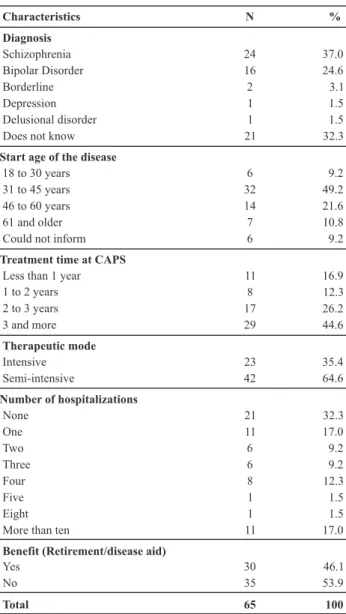
Two groups stood out regarding the type of illness reg
-istered in the ile, schizophrenia (37%) and bipolar disor
-der (25%) paients, totaling 62% of the sample. It should be highlighted that 32% of the mental disorder paients said they did not know their own diagnosis.
When comparing the paients and relaives’ answers regarding their knowledge level on the disease, the re
-sults of Fisher’s test were posiive (0.013). Among family members, 43% said they knew a lot or everything about the disease. Among paients, on the other hand, 49% said they knew litle or nothing about their own disease, inde
-pendently of their educaion level.
The mental disorder entails relaionship and memori
-zaion diiculies, mood swings, signs and symptoms that hamper geing or keeping a ixed job. They also carry prejudice and discredit, besides medicaion side efects, such as sleepiness, shivering, intesinal discomfort, exces
-sive salivaion and others.
In view of these limitaions, job losses, deriving from the diagnosis treatment and the number of hospitaliza
-ions, it is observed that 46% of the subjects receive some kind of beneit, considering disability reirement or disease aid. In the schizophrenic populaion, that rate increases to
54%. This group shows the highest hospitalizaion frequen
-cies (25% were hospitalized more than 10 imes). Age also inluences the receipt of beneits, that is, 60% of paients receiving beneits are over 46 years of age (c2 test=0.017).
Table 1 - Characterization of mental disorder patients –
Pindamo-nhangaba, SP - 2008
Characteristics N %
Diagnosis Schizophrenia Bipolar Disorder Borderline Depression Delusional disorder Does not know
Start age of the disease
18 to 30 years 31 to 45 years 46 to 60 years 61 and older Could not inform
Treatment time at CAPS
Less than 1 year 1 to 2 years 2 to 3 years 3 and more
Therapeutic mode
Intensive Semi-intensive
Number of hospitalizations
None One Two Three Four Five Eight More than ten
Benefit (Retirement/disease aid)
Yes No Total 24 16 2 1 1 21 6 32 14 7 6 11 8 17 29 23 42 21 11 6 6 8 1 1 11 30 35 65 37.0 24.6 3.1 1.5 1.5 32.3 9.2 49.2 21.6 10.8 9.2 16.9 12.3 26.2 44.6 35.4 64.6 32.3 17.0 9.2 9.2 12.3 1.5 1.5 17.0 46.1 53.9 100
Only 6% of paients work, a fact appointed as a heavy burden of frustraion for them and the family.
Disease and treatment
The CAPS ofers individual therapeuic projects, aiming to atend to each paient’s paricular needs. Nevertheless, despite years of treatment (70.8% have been under treat
-ment for more than two years) and individualized care, al
-most half of the paients (49%) answered knowledge litle or nothing about their disease.
Psychiatric nursing care should involve not only the paient as a person, but everything around him/her. Pro
experience, that is, should help them gain knowledge on their disease and treatments and to ind ways to cope
with them(13-14).
Both relaives and paients agree that, when paients agree that, the more the treatment helps the paient, the more it helps the family (c2 test = 0.000). Likewise, the
more supported the family feels, the more the paient feels saisied with the received care (c2 test = 0.000).
Psychosocial care is part of a new care model, which is hence under construcion, and supports paients and rela
-ives to recover their self-esteem and autonomy, reinforc
-ing their condiion as ciizens(12).
Table 2 - Mental disorder patients attended at CAPS II –
Pinda-monhangaba, SP - 2008
Characteristics
Treatment helps the patient
Nothing Little More or less A lot Completely
Treatment helps the family
Total
Nothing Little More or less A lot Completely
Patients Family
N % N %
1 1.5 0 0.0
2 3.1 1 1.9
9 13.9 6 11.3
39 60.0 31 58.5
14 21.5 15 28.3
4 6.1 0 0.0
3 4.6 4 7.5
6 9.2 3 5.7
43 66.2 31 58.5
9 13.9 15 28.3
65 100 53 100
Bonding facilitates the partnership among team, pa
-ients and families. With a view to care delivery closer to the needs of mental disorder paients and their relaives, aciviies like workshops, home visits, events and celebra
-ions improve the rela-ions and permit the exchange of experiences and help. The aitude expected from the team is more sensiive to listening, understanding and the construcion of individual therapeuic intervenions, re
-specing each stakeholder’s speciic reality(8).
When the household rouine includes a mental disor
-der paient, the family gains new responsibiliies, such as accompanying him/her to the health service, administering his medicaion, coordinaing his daily aciviies, giving social support, dealing with his problemaic behavior and crises, which can represent a huge burden for the family(15-18).
When comparing data on family burden in relaion to paient treatment needs, the c2 test also showed a
posi-ive result (0.013). In other words, the more the relaposi-ives feel overloaded, the more they believe that the paient
needs treatment.
Both family members and paients agree that, the more treatment helps the paient, the more it helps the
family (c2 test = 0.000). Likewise, the more supported the
family feels, the more saisied the paient gets with the
care received (c2 test = 0.000).
Only one third of the relaives work and, although most of them work as autonomous professionals, only 55% paricipate in some acivity at the CAPS, especially in family meeings (with and without the paient’s presence) and medical appointments. Despite acknowledging the beneits of treatment, the family sill faces diiculies to
interact with the service.
This is also the case due to the fact that, besides the diiculies the disease creates and the resuling economic burdens, the family sill needs ime to atend the service. Besides transportaion diiculies, it should be taken into account that most of them (75%) are older than 46 years.
The large majority of subjects, both paients (86%) and relaives (91%), feel totally or very saisied with the care they receive from CAPS professionals, which can entail im
-provements for their quality of life.
The c2 test (0.032) also showed that a treatment that
helps the family inluences the paient’s saisfacion with life. Although most paients agree that the disease chang
-es their daily life quite a lot, they indicate that they are saisied with life.
When the family and paient feel members, paricipants and inserted in the service, saisfacion increases, in com
-pliance with the premises of the Psychiatric Reform(4,11).
Mental health professionals need to be ready to sup
-port both relaives and paients, for them to ind mean
-ings in their experiences, accept the disease and be able
to cope with it(13). Help, support and contact with CAPS
professionals were menioned as decisive factors for posiive assessments of health services in a study accom
-plished in the states of Paraná, Santa Catarina and Rio
Grande do Sul(10).
Professionals also face diiculies in their pracice, as they are assimilaing new pracices, in direct contact with the new and the unknown, construcing work more aric
-ulated with professionals from other areas and in need of a new meaning for their own knowledge(11).
Psychosocial implicaions
Disease is an unforeseen event that can disorganize family funcioning.
Alteraions in mental disorder paients’ behavior interfere in their daily aciviies, relaionships and leisure. These transformaions alternate with needs that arouse stress and burden, mainly for relaives (62% feel very or totally overloaded). The family sufers from the power
Despite these changes, 41% of paients said they make the most or a lot of life and 68% airm facing litle or no dii
-culty to perform their daily aciviies, which difers from 51% of relaives’ opinions, who airm that paients face diicul
-ies to accomplish daily acivi-ies, which entail dependences, concerns, insecuriies towards the future. They feel frustrat
-ed due to the belief that paients make nothing of life (66%). When the disease appeared, 59% of relaives started to believe that religion inluenced their lives more. Religious involvement is associated with psychological wellbeing and this type of support is more relevant in stressed persons(18).
Out of paients who declared believing in some re
-ligion, 57% airmed saisfacion with life, against 43% among those who do not atend any religion.
Brazil is a country of religious people and knowledge on the impact of religious beliefs on disease eiology, di
-agnosis and the evoluion of psychiatric disorders can help health professionals to understand their paients beter. Professionals need to take into account when religious be
-liefs are used to deal with the mental illness beter and when they may be exacerbaing that disease(19).
Most family members (62%) indicate being very or to
-tally overloaded. Knowing the burden relaives experience allows the team to design intervenions that can help to improve relaionships, contribute to assess the weight of tasks, facilitate cooperaion, decrease stressors, or even the manifestaion of somaic or psychological disorders in family members(15-18). A study in the South of Brazil found that teams achieve solid results in mental health care, but
should atempt to interact more with the family(17).
It is important to grant family members the opportuni
-ty to be heard regarding their anguish about mental disor
-der paients and service funcioning, thus seeking beter coping forms(11).
It was observed among mental disorder paients as well as relaives, a special capacity to overcome adversi
-ies (resilience) was observed. This aitude should not be mixed up with invulnerability, because this is not about absolute resistance to adversiies, but a construcion and reconstrucion process of a person’s life history through muliple interpretaions of daily life(20).
CONCLUSION
Mental disorders are accompanied by signs and symp
-toms that hamper these paients’ performance, entail botlenecks and prejudices in society and even inside the family.
This study evidences that families feel overloaded, not only due to the fact of having to see to paients’ daily dif
-iculies, but also due to the insecurity and unpredictabil
-ity of their behaviors and reacions, besides the idea that paients make litle or nothing of life.
The results showed that mental disorder paients and family members acknowledge the extent to which the disease changed their lives, but opinions diverge on the degree of diiculty to accomplish aciviies of daily living. Despite the severity of the diagnoses and years under treatment, users know litle about the disease.
It was observed that, despite all changes and diicul
-ies both paients and relaives face, both groups were saisied with life and opimisic towards the future.
This study contributes through knowledge and con
-cepions on care delivery and mental health care that are important for nursing pracice, with a view to greater treatment eicacy and mental disorder paients’ efecive social inserion, with quality of life.
REFERENCES
1. Amarante P, coordenador. Loucos pela vida: a trajetória da re
-forma psiquiátrica no Brasil. Rio de Janeiro: FIOCRUZ; 1995.
2. Lüchmann LHH, Rodrigues J. O movimento animanicomial no Brasil. Ciênc Saúde Coleiva. 2007;12(2):399-407.
3. Amarante P, coordenador. Archivos de saúde mental e
aten-ção psicossocial. Rio de Janeiro: Nau; 2005.
4. Brasil. Ministério da Saúde. Secretaria de Atenção à Saúde.
Saúde Mental no SUS: acesso ao tratamento e mudança do modelo de atenção: Relatório de Gestão 2003-2006. Brasília; 2007.
5. Organización Mundial de la Salud (OMS). Manual de recursos sobre salud mental, derechos humanos y legislación de La OMS. Genebra; 2006.
6. Brasil. Ministério da Saúde. Secretaria de Atenção à Saúde. Legislação em Saúde Mental: 1990-2004. Brasília; 2004.
7. Amarante P. Novos sujeitos, novos direitos: o debate em torno
da reforma psiquiátrica. Cad Saúde Pública. 1995;11(3):491-4.
8. Schrank G, Olschowsky A. O Centro de Atenção Psicossocial
e as estratégias para inserção da família. Rev Esc Enferm USP. 2008;42(1):127-34.
9. Leão A, Barros S. As representações sociais dos proissionais
de saúde mental acerca do modelo de atenção e as
possibili-dades de inclusão social. Saúde Soc. 2008;17(1):95-106.
10. Kantorski LP, Jardim VR, Wetzel C, Olschowsky A, Schnei
11. Schneider JF, Camata MW, Nasi C, Kantorski LP, Wetzel C.
Uilização da avaliação de quarta geração em um centro de atenção psicossocial. Rev Gaúcha Enferm. 2009;30(1):54-61.
12. Teixeira JS, Kantorski LP, Olschowsky A. O Centro de Atenção Psicossocial a parir da vivência do portador de transtorno psíquico. Rev Gaucha Enferm. 2009;30(3):453-60.
13. Travelbee J. Intervención em enfermeria psiquiátrica. Carva
-jal: OPAS/OMS; 1982.
14. Waidman MAP, Elsen I, Marcon SS. Possibilidades e lim
-ites da teoria de Joyce Travelbee para a construção de uma metodologia de cuidado à família. Rev Eletr Enferm [Inter
-net]. 2006 [citado 2008 nov. 25];8(2):282-91. Disponível em: htp://www.fen.ufg.br/revista/revista8_2/pdf/v8n2a13.pdf
15. Barroso SM, Bandeira M, Nascimento E. Fatores predispo
-nentes da sobrecarga subjeiva de familiares de pacientes
psiquiátricos atendidos na rede pública de Belo Horizonte,
Minas Gerais, Brasil. Cad Saúde Pública. 2009;25(9):1957-68.
16. Borba LO, Schwartz E, Kantorski LP. A sobrecarga da famí -lia que convive com a realidade do transtorno mental. Acta
Paul Enferm. 2008;21(4):588-94.
17. Bandeira M, Barroso SM. Sobrecarga das famílias de pacien
-tes psiquiátricos. J Bras Psiq. 2005;54(1):34-46.
18. Koga M, Furegato ARF. Convivência com a pessoa es
-quizofrênica: sobrecarga familiar. Ciênc Cuidado Saúde. 2002;1(1):69-73.
19. Koenig HG. Religião, espiritualidade e psiquiatria: uma nova era na atenção à saúde mental. Rev Psiq Clín. 2007;34(1):5-7.
20. Pinheiro DPN. A resiliência em discussão. Psicol Estudo. 2004;9(1):67-75.
Support