Laypeople and basic life support
** Extracted from the Scientific Initiation study “O leigo em situações de emergência e o suporte básico de vida”, 2005. 1 Nursing masters graduate, Nursing
Department, Faculty of Medical Sciences, State University of Campinas. Campinas, SP, Brazil. [email protected] 2 Doctor Professor of the Nursing
O
RIGINAL
A
R
TICLE
O LEIGO E O SUPORTE BÁSICO DE VIDA
EL LEGO Y EL SOPORTE BÁSICO DE VIDA
RESUMO
A capacitação do leigo para o atendimento precoce em situações de emergência e ins-tituição do suporte básico de vida (SBV) é fundamental para salvar vidas e preve-nir seqüelas. O objetivo foi identificar o co-nhecimento dos leigos sobre SBV. Utililizou-se entrevista estruturada em linguagem não-técnica. A amostra compreendeu 385 sujeitos, a maioria (57,1%) do sexo femi-nino com ensino médio completo e supe-rior incompleto (53,7%). Verificou-se ape-nas 9,9% conhecem a manobra de respira-ção boca-a-boca; 84,2% conhecem a técni-ca de compressão torácitécni-ca externa (CTE), e destes, 79,9% sabem sua finalidade. Ape-nas 14,5% sabem posicionar a vítima para realizar a CTE; 82,4% referem uma freqüên-cia menor que 60 CTE/minuto. Por não apresentarem adequada informação e fun-damentação das etapas do SBV, os leigos podem prestar atendimento incorreto à ví-tima de emergência, acarretando prejuízos à reanimação.
DESCRITORES
Ressuscitação cardiopulmonar. Parada cardíaca.
Educação em saúde. Emergências. Aline Maino Pergola1, Izilda Esmenia Muglia Araujo2
ABSTRACT
Training laypeople to give first aid in emer-gency situations and offer basic life support (BLS) is crucial in order to save lives and avoid sequelae. The objective was to iden-tify laypeople's knowledge about BLS. Structured interviews were performed us-ing non-technical language. The sample consisted of 385 subjects. Most (57.1%) were women with complete secondary-level education and incomplete higher edu-cation (53.7%). It was verified that only 9.9% know the mouth-to-mouth ventilation maneuver; 84.2% knew the chest compres-sion technique (CCT), and 79.9% of these knew its purpose. Only 14.5% know how to position the victim to perform CCT; 82.4% reported a frequency below 60 CCT minute. Since they do not have adequate informa-tion and foundainforma-tions regarding the stages of BLS, laypeople can give incorrect first aid to victims, which can harm resuscitation.
KEY WORDS
Cardiopulmonary resuscitation. Heart arrest.
Health education. Emergencies.
RESUMEN
La capacitación del lego para la atención precoz en situaciones de emergencia e apli-cación del soporte básico de vida (SBV) es fundamental para salvar vidas y prevenir secuelas. El objetivo fue identificar el co-nocimiento de los legos sobre SBV. Se utililizó la entrevista estructurada en un lenguague no técnico. La muestra com-prendió 385 sujetos, la mayoría (57,1%) del sexo femenino con enseñanza media com-pleta y superior incomcom-pleta (53,7%); Los que conocen la maniobra de respiración boca a boca son apenas 9,9%; 84,2% co-nocen la técnica de compresión toráxica externa (CTE) y de estos, 79,9% saben su finalidad. Apenas 14,5% saben posicionar a la víctima para realizar la CTE, 82,4% re-fieren una frecuencia menor que 60 CTE/ minuto. Por no presentar adecuada infor-mación y fundamentos de las etapas del SBV, los legos pueden prestar una aten-ción incorrecta a la víctima de emergencia, oca-sionando perjuicios en la reanimación.
DESCRIPTORES
Resucitación cardiopulmonar. Paro cardíaco.
INTRODUCTION
Cardiovascular disease is the major cause of deaths in Bra-zil and worldwide every year(1-4). The majority of causes are a result of ischemic heart disease(5). Lack of recognition of symp-toms and overstatement of identified situations lead to 80% of deaths outside the hospital, due to delays in the assistance(6). Therefore, the relevance of assistance during cardiac arrest (CRA) is paramount, the lack of which corresponds to tragic events that advance the end of life (sudden death)(6).
Recently, a national study mapped a training program aimed at quality improvement, and the costs of cardiopul-monary resuscitation (CPR) for practitioners in adult inten-sive and semi-inteninten-sive care units(7).
Basic life support (BLS) programs encompass phases that can begin outside the hospital environment(1,3,6-8) and can be performed by properly trained and informed laypeople, thus increasing survival and reducing sequelae of CRA vic-tims’(1,4,9). BLS is defined as the first approach to the victim and entangles the patency of airways, ventilation, and arti-ficial circulation(3,9). Advance access to
emer-gency services and assistance, as well as early defibrillation are added to these maneuvers(9).
The simple action of a layperson that rap-idly recognizes a CRA and calls for specialized help prevents myocardial and cerebral dete-rioration. There is evidence of mortality re-duction for CRA victims that were immedi-ately assisted by CPR performed by volun-teers, showing that cardiac and cerebral func-tions were preserved(3).
Besides lack of knowledge, there are other factors that hinder or delay appropriate help.
The performance of mouth-to-mouth resuscitation is one of the reasons rescuers refuse to comply with BLS(3,9,11). However, intrathoracic pressure generated by external tho-racic compression (ETC) is believed to be sufficient to dis-place an obstructive body in the airways(9,11). Besides, posi-tive pressure ventilation is not crucial during the first min-utes of CRA, as the spontaneous gasping process maintains partial pressures of both oxygen and carbonic gases close to normal levels(3,11-12).
We should keep in mind that CPR’s main objective is to promote an artificial circulation of oxygen throughout the body, especially the brain and heart, until the spontaneous return of all vital functions(13).
Training laypeople about CRA is vital, providing them with information of all LBS phases, as a way to mechanize the process, thus preventing either a waste of time in think-ing about the next step, or the gridlock caused by the emo-tions in such an urgent situation(9).
Justification of this is evident in the direct relation be-tween time and myocardial and cerebral function
preser-vation, in addition to reducing morbidity and mortality in-dexes, as well as their influence on survival and quality of life(4,6,12).
Due to a lack of awareness and fear of social disapproval in the event of failure, initial basic maneuvers are still mis-handled, despite of the existing training courses on BLS for laypeople(7).
Thus, if CRA victims’ survival depends upon how fast BLS is implemented, some questions arise: What do laypeople know about BLS? How do laypeople execute BLS maneuvers?
Taking into account the importance of such activity, the present study intended to check the knowledge level of laypeople on BLS, as well as possible failures on the imple-mentation of maneuvers for further interventions.
OBJECTIVE
Considering the importance of BLS, the present study intended to check the knowledge of laypeople about BLS, as well the possible fail-ures on the implementation of maneuvers for further interventions and thus to pinpoint the knowledge of BLS by a sample lay population living in the countryside of the State of Sao Paulo.
METHOD
This descriptive study was analyzed by the Institution’s Ethics Committee on Research, and approved under the legal opinion CEP number 552/2004.
The sample consisted of subjects age 18 or older, who agreed to take part in the research performed on the streets of a city in the countryside of the State of Sao Paulo.
Sample size was based on the assessment of correct and positive answers; a pilot study was carried out in 58 indi-viduals, and the highest score among all achieved results was taken into consideration, which reached n=385 indi-viduals, with a 5% level of significance and 5% sample er-ror (d=0.05). Individuals under 18 years of age, health pro-fessionals (nursing teams and doctors), and those belong-ing to the fire brigade were excluded. The justification for the age group resolution lies on the legality for interview authorization, and because the above-mentioned profes-sionals are expected to be knowledgeable of the issue.
The questionnaire (Appendix I) was elaborated after the reading and analysis of the reviewed bibliography, basically approaching the BLS survival and sequence chain(4,9,11). The Appendix was split into two parts: identification and basic life support, comprised of open and closed multiple choice questions.
There is evidence of mortality reduction for CRA victims that were immediately assisted by CPR performed by
volunteers, showing that cardiac and cerebral functions
In order to validate the instrument, seven experts and six laypeople examined the text, considering the scope, objectivity, and pertinent criteria. The experts included three doctors, three nurses, and one fire fighter; the laypeople group was comprised of two representatives of each educational degree: elementary, high school, and uni-versity. After being analyzed, the instrument was restruc-tured according the critiques and suggestions observed and accepted by the researchers.
Data were collected in structured interviews, after ex-planations and signature of the Informed Consent docu-ment (TCLE). Subjects were questioned without reading the alternatives in order to avoid interference in their answers; the answers were categorized in accordance with the es-tablished alternatives. Answers were considered correct, partially correct, incorrect, or lack of response, indicated by the alternative I don’t know. Responses categorized as other corresponded to distinct answers to the established alternatives. Answers considered correct are found on the two first links of the survival chain: access and early CPR.
Fisher’s exact test was used in the analysis to correlate the possibility of performing ETC without artificial ventila-tion and the knowledge of its objective, and the chi-square test was used in to compare the knowledge between the mouth-to-mouth respiration technique and the possibility of implementing it.
RESULTS
In the analysis of the expert judges, the instrument was considered as wide-ranging (85.7%), objective, and perti-nent (100%) for the identification. Regarding the question on basic life support, the scope and objective reached 57.1%, and pertinence reached 85.7%. Layman judges’ analysis was unanimous towards positive responses con-cerning the three adopted criteria.
The sample included 385 interviewees averaging 35.4 (+ 14.55) years of age, the majority being females (57.1%) who attended high school (46.5%) and university degrees (34.8%). Most worked in administrative areas (19.7%), manual activities (15.6%), and commercial areas (14%).
In assessing BLS respiratory movements, 75.8% of an-swers were correct, 2.6% partially correct, 11.7% incorrect, and 9.9% were not able to respond.
On the performance of maneuvers to make respiration easier, 16.4% responded correctly, 50.1% incorrectly, and 33.5% were not able to respond. Only 16.4% knew that rais-ing the victim’s chin (alternative A) facilitates respiration, and 11.5% believed that lifting the victim’s head could make it easier for the victim to breath (alternative B).
Laypeople’s responses concerning mouth-to-mouth res-piration reached 9.9% correct, 41.2% partially correct, 9.1% incorrect, and 39.5% were not able to respond. Alternative D was chosen by 39.5%, while C was elected by 21%.
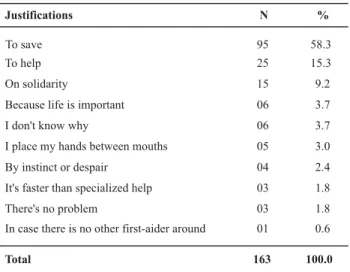
The possibility of performing mouth-to-mouth respi-ration on an unknown person, without the use of protec-tive equipments, obtained 42.3% affirmaprotec-tive and 57.7 negative answers. Justification for non-performance of mouth-to-mouth respiration are shown in Table 1 and jus-tification for performance of the maneuver are displayed in Table 2.
Table 1 – Laypeople’s justifications for non-performance of
mouth-to-mouth respiration on an unknown person, without the use of protective equipment – Campinas, SP – 2005
Justifications N %
Possible transmission of diseases 73 32.9 Fear or disgust 29 13.1 Unpredictable situations 06 2.7 Unknown victim 03 1.3 Prejudice 03 1.3 I don't know what to do 77 34.7 I don't know why 31 14.0
Total 222 100.0
Table 2 – Laypeople’s justifications for performance of
mouth-to-mouth respiration on an unknown person, without the use of protective equipment – Campinas, SP – 2005
Justifications N %
To save 95 58.3
To help 25 15.3
On solidarity 15 9.2
Because life is important 06 3.7
I don't know why 06 3.7
I place my hands between mouths 05 3.0 By instinct or despair 04 2.4 It's faster than specialized help 03 1.8 There's no problem 03 1.8 In case there is no other first-aider around 01 0.6
Total 163 100.0
Over 50% of interviewees who responded incorrectly on the mouth-to-mouth respiration maneuver would per-form it on unknown victims. Of those who knew the tech-nique, 54.8% would also perform it on unknown people. Of those who said they did not know, 65% would not per-form it and the 55% who responded said they would not perform it.
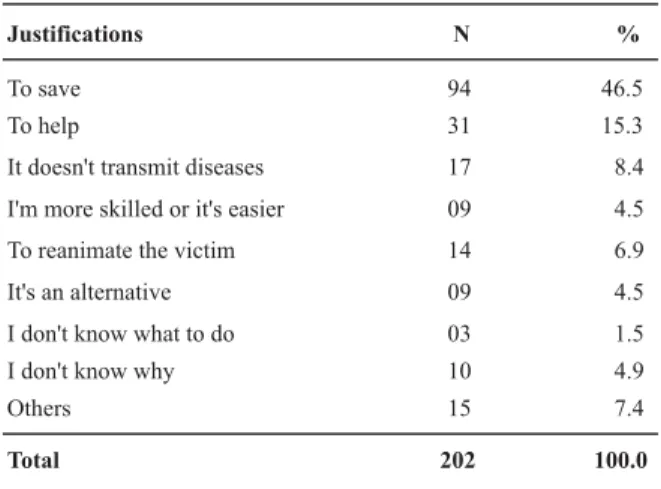
Table 3 - Justifications for the performance of isolated cardiac massage - Campinas, SP - 2005
Justifications N %
To save 94 46.5
To help 31 15.3
It doesn't transmit diseases 17 8.4 I'm more skilled or it's easier 09 4.5 To reanimate the victim 14 6.9 It's an alternative 09 4.5 I don't know what to do 03 1.5
I don't know why 10 4.9
Others 15 7.4
Total 202 100.0
Table 4 - Justifications for the non-performance of isolated cardiac
massage - Campinas, SP - 2005
Justifications N %
It must be associated with mouth-to-mouth respiration 32 17.5 It can bring injury to the victim 09 4.9 I don't know what to do 97 53.0
I don't know why 36 19.7
Others 09 4.9
Total 183 100.0
Regarding the interviewees’ knowledge on what cardiac massage is and what it is for, 15.8% did not know how to answer, and 84.2% affirmed to know it. Table 5 shows the responses obtained on the ETC’s objective.
Table 5 - Laypeople’s responses on the objective of cardiac massage
- Campinas, SP - 2005
Justifications N %
Reanimation / resuscitation 96 29.6 Bring cardiac beat back 75 23.1 To stimulate the heart; to make it work again 55 17.0 To help circulation 32 9.9 To bring respiratory movements back 23 7.1 To treat cardiac problems 08 2.5 To help cardiac and pulmonary functions 06 1.8 To balance the heart beats 04 1.2
I don't know 05 1.5
Others 20 6.2
Total 324 100.0
Nearly 75% of interviewees who would not perform ETC are aware of its objectives; 69% of those who would per-form it are also aware of its objectives. However, approxi-mately 25% of those who would not perform it in isolation are also people who are not aware of it; 88% of those who affirmed they would perform it said they were aware of it.
On the positioning of the victim for the ETC perfor-mance, 14.5% of responses were correct; 71.7% were par-tially correct and 2.1% were incorrect. Among interview-ees, 11.7% said they didn’t know how to do it.
As per the region of the body in which the compression should be located, 8.8% responded correctly; 63.4% were partially correct; 18.4% were incorrect; and 9.4% said they did not know.
Regarding the amount of ETCs performed per minute, 64.7% said they did not know, and 35.3% responded affir-matively. From the collected answers, 8.1% were partially correct, and 91.9% were incorrect. No interviewee knew the number of compressions per minute, and 82.4% be-lieved that this frequency was lower than 60.
Taking into account the total amount of seven possible corrections for the questions of the interview, 76.6% of the interviewees scored from zero to two; 22.6% from three to five; and 0.8% scored six to seven.
DISCUSSION
CRA victim’s rehabilitation success points out to the need of a skilled person to trigger CPR maneuvers as soon as cardiac arrest is identified(4,9,14). Hence, the participation of laypeople is critical to the assistance process during the event(1,4,9), since it can reduce time between the arrest and the onset of the interventions(1-2,4,15).
Therefore, educating laypeople is important, in such a way to enhance survival(4) , since the early access to spe-cialized services can be delayed by the people’s inability to assess CRA and begin first-aid processes(1). It should be noted, however, that this must be performed by skilled trainers, so that the application of the knowledge is allowed whenever necessary. Thus, informing and training popula-tion to assist CRA, and preventing first-aid gridlocks at the moment of making the decision on the next step to be fol-lowed, is vital(3).
In emergency situations, assessment of and assistance to the victim must be effective actions, allowing for a bet-ter chance of survival and reduction of sequelae(3). The victim’s survival is directly related to the proper applica-tion of basic life support: CRA recogniapplica-tion, CPR maneuvers, and access to advanced life support(9).
BLS phases include the recognition of the arrest, CPR maneuvers, and fast access to advanced life support(1-4,8,15). Therefore, the immediate action of a layperson who as-sesses a CRA and calls for specialized help prevents myo-cardial and cerebral sequelae(3).
victim’s breath during respiration processes; and FEEL if there is air flow. To make this process happen, the first-aider must draw his ear close to the victim’s mouth and nose(2-3,13,16).
In this study, 75.8% of the sample responded correctly to the above-mentioned practice. However, 14% showed other ways of identifying whether or not the person is breathing; among them, some pointed to the need of check-ing the victim’s pulse. This fact indicates that laypeople’s knowledge about it is confused, and that can put special-ized help at risk.
It is worth emphasizing that the tongue is the most com-mon cause of airways obstruction in unconscious victims, and when there is no evidence of backbone trauma, one must lift the person’s chin in order to open the airways(3,16). However, this study revealed that a considerable portion of interviewees (33.2%) are not acquainted with this ma-neuver, and over 50% had incorrect responses when asked how to facilitate an unconscious person’s respiration. Over 33% of respondents quoted other ways of making respira-tion easier, including mouth-to-mouth resuscitarespira-tion, again demonstrating confusion.
Almost 40% of the sample did not know how to perform mouth-to-mouth respiration; 41.2% partially
knew the technique; and less than 10% knew how to do it adequately. As per the perfor-mance of mouth-to-mouth respiration on un-known people without the use of protection equipment, 42.3% of interviewees said they would perform it; 73.6% justified it as an ac-tion that can save or help the victim. It shows that a considerable portion of the population opts for assisting unconscious people moved by solidarity impulses.
However, over 55% of interviewees would not perform artificial respiration on unknown people without protec-tion. One of the reasons was the possibility of disease trans-mission (32.9%), and the lack of knowledge on how to per-form the technique (34.7%).
Over 50% of interviewees who provided incorrect re-sponses to the proper maneuver to mouth-to-mouth res-piration would perform it on unknown victims, and the same percentage of those who provided correct answers would also perform it. Those who do not know how to per-form it (65%), and those who partially know how to do it (55%), otherwise, would not perform it.
Although CPR is deemed as a safe, effective technique capable of saving lives, many rescuers fail in performing CPR due to fear of acquiring infectious-contagious diseases by means of mouth-to-mouth respiration(3,9,10). In fact, sev-eral infectious diseases can be transmitted during any mouth-to-mouth contact, but in spite of the transmissibil-ity potential, literature records very rare cases of effective contagious processes during the execution of CPR maneu-vers in over 250 years(10).
However, spontaneous gasping and ETC are capable of keeping the levels of oxygen during the first resuscitation minutes, with no meaningful alteration in survival in-dexes(3,9,12). Besides, compression without ventilation makes BLS sequence simpler, facilitating learning, assimilation, and performance(11). With no regard to the importance of artifi-cial ventilation during the resuscitation maneuver, rescu-ers who would not be willing to perform it must trigger, in an immediate basis, an ETC process in the occurrence of a CPR, so that assistance is not endangered(2,8,10-12,17).
When questioned on the possibility of performing iso-lated thoracic compression, almost 48% of interviewees affirmed they would not do it, and from these, 17.5% justi-fied such an attitude by its connection with mouth-to-mouth respiration. Thus, the lay population should be in-formed of the possibility of performing compression with-out ventilation, since they associate ETC with artificial ven-tilation, and the non-performance of both maneuvers in-hibits the implementation of any assistance measure, even among trained lay rescuers(11).
Considering the same question, over 50% of respondents said that they would perform ETC without ventilation, and as a justification, almost 62% affirmed that it is a way of helping or saving the victim.
The objective of CPR is to artificially pro-mote the circulation of oxygenated blood through the body, thus preventing injuries provoked by prolonged ischemia, until spon-taneous breathing and cardiac functions re-turn. Compression, along with the artificial ventilation, is a basic reanimation maneu-ver(12). Regarding compression, most of in-terviewees (84.2%) were aware of its objec-tives and of these, almost 80% responded correctly to the question. Of those who understood the objective, almost 30% responded resuscitation/reanimation, while 23.1% re-ported that ETC functions are aimed at bringing heart beats back; 17% said that it is aimed at stimulating the heart; and 9.9% indicated that it spins the circulation.
However, knowledge on compression seems to be limited to its objective, since over 70% of respondents know how to position the victim to the performance in a partially correct way, once they only consider that the victim has to be laid in a supine position. But for an ETC to be effective, for example, the victim has to be laid in a supine position under a rigid surface(11,16).
As per the region of the body on which compression must be applied, over 60% of interviewees provided partially correct replies and 18.4% gave incorrect replies. The appropriate location for hand positioning was indicated as being two fingers above the xiphoid process(3,12,16). It is important to point out that this study was carried out under the guidelines from 2000(4,9), and according to the new guidelines, the correct location is on the lower half of the sternum(17).
Over 55% of interviewees would not
The indicated frequency per minute for the performance of ETC is 100 times per minute(3,9,12,16-18). In this research, almost 65% of respondents were not able to provide an answer to that question, and 35.3% said they were knowl-edgeable of the frequency. Among those who said they knew of the frequency, 92% provided an incorrect response, and 83% reported that the frequency is lower than 60/ minute. None of the interviewees were able to respond correctly.
Stimulated by solidarity impulses, a meaningful portion of the population, with no adequate skill to first-aid prac-tices, helps CRA victims, disrespecting BLS established norms, and thus put post-arrest rehabilitation at high risk. However, people still fail at the first stages of basic maneu-vers due to a lack of awareness and fear of social disap-proval for an eventual failure(8).
CONCLUSION
The results showed that the lay population has insuffi-cient knowledge of BLS. Besides being incomplete, knowl-edge is sometimes incorrect, thus putting the victim at risk. Approximately 75% of respondents know how to check the
presence of respiratory movements, but over 80% do not know how to perform maneuvers that make respiration easier. Only 10% are knowledgeable of the mouth-to-mouth respiration performance technique, and 14.5% know how to position the victim for the performance of ETC, but 63.4% of respondents were partially correct on the proper body location, while none was able to report on the correct fre-quency per minute. Another lack of knowledge is shown regarding the performance of external thoracic compres-sion isolated from ventilation.
Without adequate understanding and information on BLS, laypeople can incorrectly render assistance to victims, thus causing them damage. Countless rescuers are deemed to act only on a solidarity feeling, sometimes with virtually no training.
One of the limitations of this study was to carry out only a theoretical approach to the theme, leaving practical abilities aside.
Given the occurrence of emergencies outside the hos-pital, and the need for fast and adequate intervention, it is fundamental to train the lay population. This will likely be the objective of another study.
REFERENCES
1. Ferreira DF, Timerman A, Stapleton E, Timerman S, Ramires JAF. Aplicação prática do ensino em emergências médicas. Rev Soc Cardiol Estado São Paulo. 2001;11(2):505-11.
2. Montaña R. Reanimación cardiopulmonar: novedades. Rev Chil Anest [periódico na Internet]. 2005 [citado 2007 jan. 11];34(1): [cerca de 8 p.]. Disponível em: http://www.socanestesia.cl/ rev_anestesia/0506/01-reanimacion.asp
3. Ferreira AVS, Garcia E. Suporte básico de vida. Rev Soc Cardiol Estado São Paulo. 2001;11(2):214-25.
4. Canesin MF, Cardoso LTQ, Soares AE, Moretti MA, Timerman S, Ramires JAF. Campanhas públicas de ressuscitação cardiopul-monar: uma necessidade real. Rev Soc Cardiol Estado São Pau-lo. 2001;11(2):512-8.
5. Zimerman LI. Morte súbita. In: Castro I, organizador. Cardiologia: princípios e práticas. Porto Alegre: Artes Médicas Sul; 1999. p. 595-9.
6. Mesquita ET. Parada cardiorrespiratória e ataque cardíaco: no-vas estratégias na prevenção e na abordagem inicial. Rev SOCERJ. 1999;12(1):444-5.
7. Follador NN, Castilho V. O custo do programa de treinamento em ressuscitação cardiopulmonar em um hospital universitá-rio. Rev Esc Enferm USP. 2007;41(1):90-6.
8. Timerman A, Santos ES. Parada cardiorrespiratória. In: Timerman S, Ramires JAF, Barbosa JLV, Hargreaves LHH. Suporte básico e avançado de vida em emergências. Brasília: Câmara dos Depu-tados, Coordenação de Publicação; 2000. p. 50-67.
9. Ferreira DF, Qüilici AP, Martins M, Ferreira AV, Tarasoutchi F, Timerman S, et al. Essência do suporte básico de vida: pers-pectivas para o novo milênio: chame primeiro - chame rápido. Rev Soc Cardiol Estado São Paulo. 2001;11(2):209-13.
10. Arend CF. Transmission of infectious diseases through mouth-to-mouth ventilation: evidence-based or emotion-based medicine? Arq Bras Cardiol. 2000;74(1):73-85.
11. Kern KB. Cardiopulmonary resuscitation without ventila-tion. Crit Care Med. 2000;28(11 Suppl):N86-9.
12. Araujo S, Araujo IEM, Carieli MCM. Ressuscitação cardior-res-piratória. Rev Bras Cli Terap. 2001;27(2):80-8.
13. Baeriswyl CT, Ostermann PW, Fuentes RH. Reanimación cardiopulmonar. Rev Chil Anest. [periódico na Internet]. 2003 [citado 2007 jan. 15];32(1):[cerca de 8 p.]. Disponível em: http:/ /www.socanestesia.cl/rev_anestesia/0306/10-reanimacion.asp
15. Isbye DL, Rasmussen LS, Lippert FK, Rudolph SF, Ringsted CV. Laypersons may learn basic life support in 24 min using a personal resuscitation manikin. Resuscitation. 2006; 69(3):435-42.
16. Sociedade Brasileira de Cardiologia. Comissão Nacional de Ressuscitação Cardiorespiratória. Consenso Nacional de Res-suscitação Cardiorrespiratória. Arq Bras Cardiol. 1996;66 (6):375-402.
17. International Consensus on Cardiopulmonary Resuscita-tion and Emergency Cardiovascular Care Science with Treatment Recommendations. Part 2: Adult basic life support. Resuscitation. 2005;67(2/3):187-201.
18. Zago AC, Nunes CE, Cunha VR, Manenti E, Bodanese LC. Cardiopulmonary resuscitation: update, controversies and new advances. Arq Bras Cardiol [periódico na Internet]. 1999 [citado 2006 out. 10];72(3):[cerca de 23 p.]. Disponível em: http://www.scielo.br/pdf/abc/v72n3/a09v72n3.pdf
Support
Fundação de Amparo a Pesquisa do estado de São Paulo (State of São Paulo Research Foundation) - FAPESP
APPENDIX I
DATA COLLECTION INSTRUMENT BASIC LIFE SUPPORT
Campinas, ____ / ____ / ____ Number: ______
I. Identification Initials: _____ Age: ____ years
Gender: ( ) F ( ) M Education: ______________
Origin: ___________ Occupation: __________
II. Basic life support
1. How to verify if the victim is breathing?
A- ( ) looking at the chest or belly movement and/or drawing the hand or the face close to the mouth/nose of the person in order to feel air flows.
B- ( ) closing nose and check if the person reacts.
C- ( ) I don't know
2. How is it possible to facilitate the victim's respiration in case backbone damage is not under suspicion?
A- ( ) raising the victim's chin
B- ( ) raising the victim's head
C- ( ) lowering the victim's head
D- ( ) sitting the person down
E- ( ) I don't know
3. How is the mouth-to-mouth respiration performed?
A- ( ) leaning the victim's head backwards and opening his mouth. After filling the chest with air, to blow in the victim's mouth.
B- ( ) leaning the victim's head backwards, closing his nose and opening his mouth. After filling the chest with air, to blow in the victim's mouth, protecting my mouth.
C- ( ) to blow inside the person's mouth.
4.Would you perform mouth-to-mouth respiration in an unknown person, without protection equipments?
( ) yes ( ) no Why? ____________________________________________________
__________________________________________________________________________________________________
5. Would you perform a cardiac massage, even not having performed mouth-to-mouth respiration?
( ) yes ( ) no Why? ____________________________________________________
__________________________________________________________________________________________________
6. Do you know what is and what is the function of the cardiac massage?
___________________________________________________________________________________________________________________________
7. In what position must the victim be so that a cardiac massage is performed?
A- ( ) laid on his back, on a plan and rigid surface, with his head slightly inclined backwards.
B- ( ) laid on his back
C- ( ) in any position
D- ( ) he must remain in the same position after passing-out
E- ( ) I don't know
8. What is the appropriate body location for the performance of a cardiac massage?
A- ( ) two fingers before the edge of the middle-chest bone
B- ( ) on the heart
C- ( ) on the middle chest
D- ( ) anywhere
E- ( ) I don't know
9. Do you know how many times the cardiac massage should be performed, per minute, on an adult?