VENTRICULAR ASSIST DEVICES AND NURSING CARE
Virna Ribeiro Feitosa Cestari1, Vera Lúcia Mendes de Paula Pessoa2, Thereza Maria Magalhães Moreira3, Raquel Sampaio Florêncio4, Islene Victor Barbosa5, Silvania Braga Ribeiro6
1 Master’s student in Nursing, Universidade Estadual do Ceará (UECE). Fortaleza, Ceará, Brazil. E-mail: [email protected] 2 Ph.D. in Nursing. Professor, Department of Nursing, UECE. Fortaleza, Ceará, Brazil. E-mail: [email protected] 3 Ph.D. in Nursing. Professor, Department of Nursing, UECE. Fortaleza, Ceará, Brazil. E-mail: [email protected] 4 Ph.D. in Collective Health, UECE. Fortaleza, Ceará, Brazil. E-mail: [email protected]
5 Ph.D. in Nursing. Professor, Department of Nursing, Universidade de Fortaleza. Fortaleza, Ceará, Brazil. E-mail: islenevictor@ hotmail.com
6 Master’s student in Nursing. Coordenator of Transplantation Nursing, Dr. Carlos Alberto Studart Gomes Hospital. Fortaleza, Ceará, Brazil. E-mail: [email protected]
ABSTRACT
Objective: describing the functioning, beneits and complications associated with the use of ventricular assist devices and identifying the interventions performed by nurses in the care of patients using this device, according to presented evidence.
Method: an integrative review of articles collected in health databases conducted in February 2015. The descriptors used were heart diseases,
heart-assist devices and nursing. We identiied 34 articles, which were then submitted to thematic analysis.
Results: ventricular assist devices function as mechanical pumps promoting adequate cardiac output. Their main beneit is hemodynamic stabilization. The most common complication is infection. Health education, emotional support, outpatient care and curative care are the main care actions performed by nurses.
Conclusion: evidence conirms improvement in survival rates of patients with severe heart failure with the use of ventricular assist devices, reiterating the importance of expanding this technology in Brazil as a possibility for treatment.
DESCRIPTORS: Cardiac disorders. Cardiac insuficiency. Artiicial heart. Nursing. Cardiovascular nursing. Nursing care.
DISPOSITIVOS DE ASSISTÊNCIA VENTRICULAR E CUIDADOS DE
ENFERMAGEM
RESUMO
Objetivo: descrever o funcionamento, os benefícios e as complicações associadas ao uso de dispositivos de assistência ventricular e identiicar as intervenções realizadas por enfermeiros no cuidado ao paciente com este dispositivo, de acordo com as evidências.
Método: revisão integrativa, com artigos coletados em bases de dados da saúde, em fevereiro de 2015. Os descritores utilizados foram heart diseases, heart-assist devices e nursing. Identiicaram-se 34 artigos, os quais foram submetidos à análise temática.
Resultados: os dispositivos de assistência ventricular funcionam como bombas mecânicas promotoras de débito cardíaco adequado. Seu principal benefício é a estabilização hemodinâmica. A complicação mais comum é a infecção. Educação em saúde, suporte emocional, cuidados com sítio de saída e realização de curativo são os principais cuidados realizados por enfermeiros.
Conclusão: as evidências comprovam a melhoria da sobrevida de pacientes com insuiciência cardíaca grave com o uso dos dispositivos de assistência ventricular, reiterando a importância da ampliação dessa tecnologia no Brasil como possibilidade de tratamento.
DESCRITORES: Cardiopatias. Insuiciência cardíaca. Coração artiicial. Enfermagem. Enfermagem cardiovascular. Cuidados de enfermagem.
DISPOSITIVOS DE ASISTENCIA VENTRICULAR Y CUIDADOS DE
ENFERMERIA
RESUMO
Objetivo: describir el funcionamiento, los beneicios y las complicaciones asociadas con el uso de dispositivos de asistencia ventricular e identiicar las intervenciones de enfermería en la atención al paciente con este dispositivo, de acuerdo con la evidencia.
Método: revisión integrativa, con los artículos recolectados en las bases de datos de salud en febrero de 2015. Los descriptores utilizados fueron heart deseases, heart-assist devices e nursing. Se identiicaron 34 artículos, que fueron sometido al análisis temático.
Resultados: los dispositivos de asistencia ventricular actúan como bombas mecánicas que promueven gasto cardíaco adecuado. Su ventaja principal es la estabilización hemodinámica. La complicación más común es la infección. educación para la salud, el apoyo emocional, la atención y la realización de vendajes del oriicio de salida son la atención primaria por parte de enfermería.
Conclusión: la evidencia apoya la mejora de la supervivencia de los pacientes con insuiciencia cardíaca grave con el uso de dispositivos de asistencia ventricular, reiterando la importancia de la expansión de esta tecnología en Brasil como un posible tratamiento.
DESCRIPTORES: Trastornos cardíacos. Insuiciencia cardíaca. Corazón artiicial. Enfermería. Enfermería cardiovascular. Cuidados de enfermería.
INTRODUCTION
Chronic heart failure is a syndrome charac-terized by reduced cardiac output resulting from hemodynamic and neurohormonal responses.1-3 It is
a public health problem with high global morbidity and mortality. It affects about one million people in Europe, and it is estimated that 5.8 million adults live with the disease in the United States.4 Data
are even more alarming in Brazil, as chronic heart disease accounts for 15.9 million deaths, and projec-tions indicate that the country will have the sixth largest elderly population by 2025, which should result in multiplying the number of cases of this disease.5
In view of the above, the use of technologies becomes an important strategy for effectively man-aging this pathological condition. Cardiac trans-plantation is indicated for patients with a terminal diagnosis.3 However, given the lack of knowledge
about donations,6 the mismatch between potential
donors and effective donations, as well as the need for immediate correction of hemodynamic insta-bility, transplantation becomes unviable. In turn, this determines the use of mechanical circulatory support, which in many cases is the only chance of survival.
Ventricular Assist Devices (VAD) are me-chanical heart pumps that promote circulatory support for malfunctioning ventricles. Since car-diac failure results in reduced performance and (impaired) ventricular function as a pump, VAD assumes this function, providing adequate cardiac output. Therefore, it reduces the preload, cardiac workload and neurohormonal response, and in
turn, increases systemic circulation and tissue perfusion.7-8
Considering the complexity of this procedure, assistance based on completeness and interdisci-plinarity becomes essential for health promotion, preventing diseases and improving the quality of life of these patients. In this context, the importance of nurses having solid knowledge of the techniques and handling of these devices is relevant, since this technology is already available in Brazil and is mostly used as a bridge for either paracorporeal or fully implantable heart transplantations. However, as this is a differentiated technology used in many speciic groups, we point out that little has been discussed about nursing care directed at patients using these devices, and Brazilian publications on the subject are scarce.7,9-10
The proposed article aims to develop criteria relevant to an extended discussion around this theme. We believe that this body of theoretical knowledge on the paths covered by national and international scientiic production on VAD implantation through summarizing published research will support diagnostic and therapeutic decision processes related to the roles of health professionals, and especially nurses, thus consti-tuting a relevant source of research to assist in care, and thereby guaranteeing a higher quality of care.
METHOD
This is an integrative literature review, which is a method that aims to synthesize results obtained in research on a topic or issue in a systematic, or-derly and comprehensive manner through careful fulillment of six stages: identiication of the research question; deinition of the characteristics of the pri-mary studies of the sample; selection in pairs of the studies that composed the sample; analysis of the indings of the articles; and results interpretation and publication of the review, providing a critical examination of the indings.11
Considering these steps, the analysis of the selected studies was guided by the research ques-tions: how does a VAD work? What are the beneits and complications associated with implanting this device? What care (actions) do nurses provide to patients with VAD implants?
The following databases were chosen for de-veloping this study: Latin American and Caribbean Literature in Health Sciences (LILACS), Spanish Bibliographical Index of Health Sciences (IBECS), Scientiic Electronic Library Online (SciELO), Medical
Literature Analysis and Retrieval System on-line (MED-LINE) and the National Library of Medicine (PubMed), using the descriptors heart diseases, heart-assist devices
and nursing, according to the MeSH terminology. The search equation was “heart diseases” (MeSH Terms) AND “heart-assist devices” (MeSH Terms) OR “heart-assist devices” (MeSH Terms) AND “nursing” (MeSH Terms).
The deined inclusion criteria for pre-selection of the studies were: articles produced by health professionals; published in periodicals, establish-ing the period of publication year in the last six years (2010-2015); that contemplated the proposed objectives; in English, Portuguese or Spanish; and electronically available in full. Editorials, letters to the editor and articles of relection were excluded.
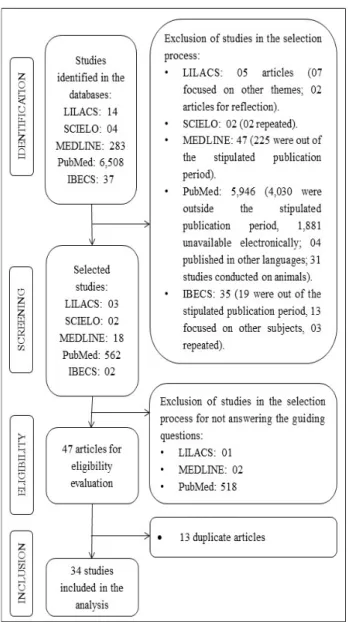
The Preferred Reporting Items for Systematic Review and Meta-Analyses (PRISMA) was used for describing the searches and selection of studies, according to the following lowchart (Figure 1).
Figure 1 - Process of study selection in the LILACS, SciELO, IBECS, MEDLINE and PubMed databases. Fortaleza, CE, Brazil, 2015
The corpus of the integrative review was
composed of 34 articles, tabulated according to the following categories: title, periodical and year of publication, type/approach of the study and level of evidence (LE).
Classiication from the experimental design12
in ive levels was used for the level of evidence, namely: Level I - the evidence comes from a sys-tematic review of randomized controlled studies or comes from systematic reviews of randomized controlled trials; Level II - evidence derived from individual or observational randomized systematic reviews; Level III - evidence obtained from studies without randomized controlled, cohort or follow-up studies; Level IV - well-delineated case-control evidence, case studies and longitudinal studies; and Level V - evidence originating from descrip-tive studies.
The information was consolidated by categoriz-ing the data, divided into: functioncategoriz-ing, beneits and complications of the VAD, and interventions per-formed by nurses in caring for patients using VAD.
RESULTS
The inal sample consisted of 34 publications (Table 1) from international (91.2%) and national journals (8.8%), with emphasis on the Progress in Transplantation journal, with a quantity of 13 (38.2%)
studies. The countries of publication origin of the studies that composed the sample were: United States - 24 (70.6%); Canada and Brazil - 3 publica-tions each (8.8%); Australia - 2 (5.9%); and Korea and China - 1 (2.9%). We observed that the year with the highest number of publications in the last ive years was 2013 with 12 (35.3%) articles.
Chart 1 - Characteristics of reviewed studies, Nurse’s actions and justiication for their actions towards
patients with ventricular assist devices. Fortaleza, CE, Brazil, 2015.
Study Journal/ year
Methodological design
LE Topic approached Nursing actions Justiication for Nursing actions A113 Prog
Transpl/ 2010
Experience
Report V Preparing nurses for the Total Artiicial Heart Program (TAH-t)
Creation/implementation of protocols and standard care; knowledge regarding the ethical aspects that involve the theme
Development and main-tenance of professional competence
A214 J Card
Surg/ 2010 Review V Expansion of scientiic knowledge about the use of VAD: components, associ-ated beneits and complica-tions
-
-A315 Prog Transpl/
2010
Hermeneutic phenomenology
V Emotional experiences of caregivers of patients with VAD
Evaluation of the perception of patients, family members, caregivers and nurses
Possibility of interventions based on the actual situation
A48 Prog
Transpl/ 2010
Case study IV Expansion of scientiic knowledge about the use of VAD: components, associ-ated beneits and complica-tions
-
-A516 Medical-Surgical Nurs/ 2011
Descriptive V The use of VADs and ethical aspects
Creation/implementation of protocols and standard care; knowledge of the ethical aspects involving the theme
Development and main-tenance of professional competence
A617 J Card
Surg/ 2011 Case-control study
IV Re-evaluation of VAD
pa-tients eligible for transplant -
-A718 Mayo Clin
Proc/ 2011 Retrospective V Implementation of palliative medicine consultations - -A819 Pediatr
Cardiol/ 2011
Descriptive V Children’s experience await-ing transplant with VAD and family members
Evaluation of the perception of patients, family members, caregivers and nurses
Possibility of interventions based on the actual situation
A920 Prog
Transpl/ 2011
Longitudinal IV Sleep pattern and quality Analysis of sleep quality and pattern
Reduction of complications and health promotion
A1021 Prog Transpl/
2011
Hermeneutic phenomenology
V Lifestyle adjustments of caregivers of adults with VAD
Evaluating the perception of patients, family members, care-givers and nurses
Study Journal/ year
Methodological design
LE Topic approached Nursing actions Justiication for Nursing actions A1122 Prog
Transpl/ 2012
Experience
Report V Alteration of body self-per-ception imposed by VAD
Evaluating the perception of patients, family members, care-givers and nurses
Possibility of interventions based on the actual situation
A1223 Prog Transpl/
2012
Descriptive V Nurses health care practice in caring for the patient with VAD
Assessment and management of health problems: interpreta-tion/request for laboratory tests and other diagnostic proce-dures; realization of physical examination; monitoring vital signs; patients admissions and discharges; home visits
Patient monitoring to prevent or diagnose early complications associated with the use of VAD
A1324
Circula-tion/ 2012 Case-control study
IV Beneits: reduction of myocardial lipotoxicity, reversing insulin resistance and cardiac metabolism nor-malization in patients with advanced heart failure
-
-A1425 Prog Transpl/
2012
Exploratory and descriptive
V Deinition of existing practices (standardization or protocol based on experts’ opinions) to prevent infec-tions
-
-A1526 Int J Artif Organs/
2012
Exploratory and descriptive
V Sleep pattern and quality Analysis of sleep quality and pattern
Reduction of complications and health promotion
A168 Arqu Bras
Cardiol/ 2012
Review V Expansion of scientiic knowledge about the use of VAD: components, associ-ated beneits and complica-tions
-
-A1727 Rev Bras
Cirur Car-diovasc/
2013
Case study IV Use of ventricular assistance after refractory cardiogenic
shock -
-A1828 J Clin
Nurs/ 2013 phenomenologyHermeneutic
V Alteration of body self-per-ception imposed by VAD
Evaluating the perception of patients, family members, care-givers and nurses
Possibility of interventions based on the actual situation
A1929 Heart
Ves-sels/ 2013 Case-control study
IV Effects of VAD in carotid
artery compliance -
-A209 Prog
Transpl/ 2013
Systematic
review II Expansion of scientiic knowledge about the use of VAD: its components, associated beneits and complications
-
-A2130 Int J Med
Sci/ 2013 Case-control study
IV Complications: oxidative stress, DNA damage and repair
-
-A2231 Prog Transpl/
2013
Descriptive V Nurses health care practice in caring for the patient with VAD
Evaluating the perception of patients, family members, care-givers and nurses
Possibility of interventions based on the actual situation
A2332 Clin Infect
Dis/ 2013 Retrospective V Manifestations and actions associated with the occur-rence of infections
-
-A2433
Circula-tion/ 2013 Prospective V Risk factors for infection in the pre-, intra-and post-operative periods of VAD implantation
-
-A2534 J Emerg
Nurs/ 2013 Case study IV Management of patients with VAD in the emergency department
Intervention in emergency situ-ations and complicsitu-ations related to VAD
Control of complications and improved survival
A2635 Mayo Clinic Proc/ 2013
Retrospective V Management of patients with VAD in the periopera-tive period
-Study Journal/ year
Methodological design
LE Topic approached Nursing actions Justiication for Nursing actions A2736 Prog
Transpl/ 2013
Review V Expansion of scientiic knowledge about the use of VAD: components, associ-ated beneits and complica-tions
Assessment and management of health problems: interpretation/ request for laboratory tests and other diagnostic procedures; realization of physical examina-tion; monitoring vital signs; pa-tient admissions and discharges; home visits
Patient monitoring to prevent or diagnose early complications associated with the use of the VAD
A2837 Prog
Transpl/ 2013
Review V Complications: intestinal
bleeding -
-A2938 Med Sci
Monit/2014 Case-control study
IV Beneits: hemodynamic
effects -
-A3039 Am J
Nephrol /2014
Retrospective V Complications: kidney
damage -
-A3140 Int J Artif
Organs/ 2014
Exploratory and descriptive
V Nurses health care practice in caring for the patient with VAD
Assessment and management of health problems: interpretation/ request for laboratory tests and other diagnostic procedures; realization of physical examina-tion; monitoring vital signs; pa-tient admissions and discharges; home visit
Patient monitoring to prevent or diagnose early complications associated with the use of VAD
A3241 J Korean Med Sci /2014
Case study IV Beneits: cardiac
rehabilita-tion -
-A3342 Prog Transpl
/2014
Hermeneutic phenomenology
V Perception of caregivers of
adults with VAD Evaluating the perception of patients, family members, care-givers and nurses
Possibility of interventions based on the actual situation
A3443 Arqu Bras Cardi-ol/2015
Case study IV VAD implant for heart
transplantation -
-Regarding the methodological design of the selected studies, there was a predominance of biblio-graphic reviews, case-control studies and case stud-ies, with ive (14.7%) publications of each; followed by four (11.8%) descriptive, phenomenological and retrospective studies; three (8.8%) exploratory-descriptive studies; two (5.9%) experience reports; and one (2.9%) systematic review, longitudinal and prospective study. Regarding the implemented ap-proach, the qualitative approach was predominant with 19 (55.9%). Only one (2.9%) study with a mixed approach was found. In analysis of the professional category, we veriied a predominance of studies carried out by physicians - 19 (55.9%), followed by nurses - 15 (44.1%). In addition, we also observed that most publications (64.8%) presented an evi-dence Level V; followed by IV (32.3%) and II (2.9%). The care provided to patients was summarized in studies published by nurses, whose most evi-denced behaviors were: evaluating the perception of patients, relatives, caregivers and nurses who deal with individuals with VAD implants, and evalua-tion and management of health problems.
DISCUSSION
Functioning, beneits and complications of
ventricular assist devices
cardiac function.4 In Brazil, the availability of fully
implantable devices partially subsidized by private health plans is evident.43 However, there is a need
to better organize outpatient services, taking into account implementation of nursing care systemati-zation to make management more effective in the care provided to patients using VAD. In the United States, there is the position of the Ventricular Assist Device (VAD) coordinator/management, whose primary function is to take care of these patients.
In mechanical ventricular assist, types of devices are applied with the purpose of partially or totally replacing the heart’s pumping function, and they are classiied according to the pumping mechanism, location and action/drive types. These devices reduce left ventricular effort through the actual pumping of blood, removing venous blood from the circulation and returning it under pressure to the arterial circuit.
VAD therapy has three indications: a bridge for recovery, another for heart transplantation and as a deinitive therapy. It consists of three parts: inlet and outlet cannulae, the blood pump and external power supply. The heart is attached to the inlet can-nula which in turn is attached to the blood pump. The pump is then attached to the outlet cannula, which is anastomosed to the ascending aorta or pulmonary artery, depending on the side receiving the support.7,17
Artiicial ventricles may be paracorporeal or implantable. Implantable ones are used in the as-sistance of the left heart care and have high costs. They are indicated as deinitive therapy in case of clinical contraindication for heart transplantation, allowing the maintenance of patients in care for periods longer than one year. Moreover, they have the advantage of providing less chances of infection or contamination. Paracorporeal devices can be used to assist systemic circulation. Despite having a lower cost, they are associated with higher rates of infection, since paracorporal implants have the device externalized through cannulas, resulting in places where contamination can iniltrate. Another disadvantage is that their use requires that patients remain in the hospital environment.17
Patients considered for VAD therapy undergo an extensive and thorough evaluation to verify pre-existing conditions that could increase the risk of complications. The evaluation includes diagnostic tests, laboratory tests and general clinical evaluation (nephrology, pneumology, infectious and oncotic diseases) for the treatment of signiicant conditions of comorbidities.9
After VAD implantation, the patient receives specialized care in the Intensive Care Centers where they are strictly monitored in order to prevent atrial and ventricular arrhythmias, bleeding, hyperglyce-mia, renal, hepatic and neurological infections and dysfunctions. Nutrition should be started as soon as possible to avoid postoperative morbidity and mortality.35
VAD therapy improves the quality of life of patients with chronic heart failure, which is assessed by different aspects such as physical, psychological, social and general well-being.7-8,27 A recent case-control study analyzed the beneits achieved by VAD in 61 patients with heart failure compared with nine patients without VAD. The results showed that the device promoted improved insulin resistance throughout the body and decreased levels of dia-cylglycerol and ceramide in the heart muscle. The content of fatty acid and triglycerides remained unchanged.24
Another benefit reported in the literature involves hemodynamic stabilization. The choice of an appropriate blood low support collaborates for positive hemodynamic effects, as evidenced in a study carried out in China which found that continuous VAD low control is a strategy that al-lows constant pressure, allowing optimal pulsation, optimizing the vascular function.38
A study carried out in Korea showed that the beneits of VAD implantation as the inal therapy in a 75 year old patient, classiied according to NYHA with functional class III-IV due to severe left ventricular systolic dysfunction, and provided improvement in this patient up to NYHA-II. This demonstrates the importance of appropriate cardiac rehabilitation, along with patient training for proper device management and potential emergency situ-ations.41
Regarding the microorganisms present in the infections associated with the device in the same study, Gram-positive cocci (45%) were predomi-nant, followed by Gram-negative Staphylococci and nosocomial bacilli (27%). The indings corroborate a multicentric, prospective type study, in which the occurrence of infection was observed in 57% of the patients.33
The clinical manifestations of infections may vary depending on the type of infection and pathogen; however, it is known that they are directly related to a high mortality rate, evidenc-ing the importance of elaboratevidenc-ing an algorithm for managing these infections, which may aid in the decision making of professionals involved in patient care.
Another study conducted at 38 centers in the United States through a series of conference calls, discussed variability in patient care with VAD for infection prevention/control. A total of 16 questions were developed, including questions about preop-erative antibiotic recommendations, transmission line placement, and exit site. From this study, it was possible to deine a standard practice protocol based on the opinion of VAD specialists for general care of the equipment and patients.25
Another complication associated with the use of this device is the occurrence of bleeding, which is caused by several factors such as coagu-lation disorders and hepatic dysfunction.37 In ad-dition, we can highlight complications including DNA damage and oxidative stress;30 lower carotid artery complacency and distensibility, which can lead to pressure on the left ventricle;29 multiple organ failure; neurological events9 (long-term embolic or hemorrhagic events can occur); renal failure;39 mechanical dysfunction; and psychologi-cal changes.22
Due to the technological complexity, adverse events caused by the use of VAD, as well as the required care and need for constant monitor-ing, some patients may request the removal of the device and/or may become psychologically shaken, at risk of developing Burnout Syndrome and isolation.12,22
Thus, medical palliative consultations are em-phasized to address end-of-life preferences, facili-tate care planning, symptom control, and maximize quality of life. A retrospective survey conducted by American physicians and nurses to evaluate the beneit of medical palliative care in 19 VAD patients found improvement in overall patient care, meeting the goals of care and management of symptoms.18
Nursing conduct in care of patients using
ventricular assist devices
With increasing numbers of VAD patients, nurses and other health professionals are challenged to develop interventions that can provide patients and their families with quality care. For the success of this device in the long term, the multidisciplinary team must be in a constant training process, prepar-ing to perform comprehensive care that is compat-ible with the demands of the patient.
Based on this premise, intensive care nurses from an American hospital created a program to develop clinical knowledge and promote continu-ous competence for those involved in VAD and total artiicial heart care. The program is based on real-life training, and covers device-related care including emergency management, speciicities for obtaining blood samples, catheter care, documentation of key parameters and ECG interpretation.13
Regarding nursing care, the literature shows the importance of nursing care as a whole, in the face of all its complexity. Evaluating the patient for the management of health problems is useful to prevent or to early diagnose the complications associated with the use of VAD.20,34-36
Essential care involves the orientation of the patient and caregiver regarding the anatomy and functioning of the device; reviewing external com-ponents; instructing them to use VAD accessories; care with the exit site; performing dressing changes; daily follow-up documentation (vital signs and device parameters); identifying and responding to emergency situations and emergency contacts; fol-lowing a healthy diet with sodium restriction and an exercise regiment; regarding physical activities, not practicing those that involve immersion in wa-ter (swimming pools) and avoiding contact sports or touching static electricity (computer screen and television).23,36,40 We can also add the preparation of the patient in the preoperative period, performing admissions and discharge of patients, listing pa-tients for transplantation, performing psychosocial and sexual counseling of these patients.34
the connection to sleep pattern and quality of life in this population deserve attention in the clinical practice.
From the above, we identiied the importance of nurses understanding the existing technologies and care strategies to carry out a comprehensive care practice. However, it is urgent to carry out educational strategies, considering that these are valuable as they allow the union between theoretical knowledge and practice, promoting more eficient care among team members. For this, understanding the ethical issues involved with this therapeutic modality is also important.
Qualitative studies on patients with VAD point to the ethical obligation of nurses to provide emotional support to patients and their families, as well as specialized care.15,19,21-22,28,31,42 Feelings and perceptions of family members and caregiv-ers of VAD patients, such as: anxiety and initial shock, loss of a loved one, of their own life, of their freedom and independence; (physical) burden and responsibility, accepting faith, empathy and social support, and lifestyle changes have been described in three studies, evidencing the need for a closer look at them and elaborating strategies that aim at emotional support.15,21,42
From the patient’s perception, research re-veals the complexity of implanting this device, seen under two meanings: a new chance to live and the desire to be normal in public. Noting, therefore, the importance of trying to change the self-concept and showing them how changes in their bodies and their daily lives will be, as self-concept awareness is a vital component in maintaining health and well-being.19,22,28
In order to achieve this, nurses must be psy-chologically prepared to deal with these emotional reactions of patients and family members. A study conducted in Canada with six nurses specialized in patient care with VAD revealed the need for the nurse-patient relationship and the ethical issue as essential elements in care practice. Thus, the insti-tution should consider implementing programs that aim at providing emotional support to these professionals.31
Despite the above, it is important to highlight that the main limitation of the study is the dificulty of accessing publications in their entirety. This fact lowers the levels of scientiic evidence, since studies that have high evidence are usually in high impact factor journals, which are mostly not freely available in the databases.
CONCLUSION
This study has presented a characterization of national and international studies on the imple-mentation of VADs. We found a predominance of international articles carried out by medical profes-sionals/physicians and low national production,
with no studies carried out by Brazilian nurses. Despite the majority of the studies present-ing low levels of evidence, the results provided important information for management of patients with VAD implants in order to improve survival. Most of the analyzed articles emphasize a concern to diffuse the knowledge regarding the function-ing of these devices, highlightfunction-ing the beneits and stressing the complications. Regarding the articles produced by nurses, the perception of patients, fam-ily members, caregivers and nurses regarding the care and lifestyle changes incurred by the implant was the most evaluated.
Among international studies carried out by nurses, we observed that none of them involved the Nursing Process, which is an essential practice that elevates this professional category and allows for implementing comprehensive, holistic, and systematic care directed towards the real needs of patients. Thus, there is a great gap presented in the scientiic production on this subject. The use of ventricular devices has been focused on a little in the Brazilian nursing reality, however, we have noticed that it is still lacking in regards to disseminating this knowledge in published works in national journals.
In the articles analyzed, we noticed a lack of discussion about the economic impact that the use of VADs would generate on the Brazilian health system. Despite an advantage in the quality of life and the prolonged survival of patients with chronic heart failure, we recommend further discussions regarding the cost-effectiveness of the treatment in patients using VAD as a bridge for transplantation or as a deinitive therapy.
Based on evidence of improved survival with VADs, the scientiic community should expand the use of these devices in patients with severe heart failure. Integrating the results evidenced in daily practice is essential, since this technology is effec-tive and safe, in addition to providing functional capacity and hemodynamic recovery.
REFERENCES
1. Schneider KLK, Martini JGM. Daily life for adolescents
with chronic disease. Texto Contexto Enferm [Internet]. 2011 [cited 2016 Aug 12]; 20(esp):194-204. Available from: http://www.scielo.br/pdf/tce/ v20nspe/v20nspea25.pdf
2. Nicholson C. Chronic heart failure: pathophysiology,
diagnosis and treatment. Nurs Older People [Internet]. 2014 [cited 2016 Aug 12]; 26(7):29-38. Available from: http://journals.rcni.com/doi/abs/10.7748/ nop.26.7.29.e584
3. Ramani GV, Uber PA, Pharm D, Mehra MR. Chronic heart failure: contemporary diagnosis and
management. Mayo Clin Proc [Internet]. 2010 [cited 2016 Aug 13]; 85(2):180-95. Available from: http:// www.mayoclinicproceedings.org/article/S0025-6196(11)60393-5/pdf
4. Dunlay SM, Pereira NL, Kushwaha SS. Contemporary strategies in the diagnosis and management of
heart failure. Mayo Clin Proc [Internet]. 2014 [cited 2016 Aug 11]; 89(5):662-76. Available from: http:// www.mayoclinicproceedings.org/article/S0025-6196(14)00053-6/abstract?cc=y
5. Rodriguez-Gázquez MA, Arredondo-Holguin E,
Herrera-Cortés R. Effectiveness of na educational
program in nursing in the self-care of patients
with heart failure: randomized controlled trial. Rev Latino-Am Enfermagem [Internet]. 2012 [cited 2016 Aug 10]; 20(2):[11 telas]. Available from: http://www.scielo.br/scielo.php?script=sci_ arttext&pid=S0104-11692012000200012
6. M e r c a d o - M a r t í n e z F J , P a d i l l a - A l t a m i r a C , Díaz-Medina B, Sánchez-Pimienta C. Visão dos
proissionais de saúde com relação à doação de órgãos
e transplantes: revisão de literatura. Texto Contexto
Enferm [Internet]. 2015 [cited 2016 Aug 10]; 24(2):574-83. Available from: http://www.scielo.br/pdf/tce/ v24n2/pt_0104-0707-tce-24-02-00574.pdf
7. Kurien S. Ventricular assist device: saving the failing heart. Prog Transpl [Internet]. 2010 [cited 2016 Aug 10]; 20(2):134-41. Available from: https://www.ncbi. nlm.nih.gov/pubmed/20642171
8. Gelape CL; Pham SM. Os avanços no suporte circulatório mecânico no tratamento da insuiciência cardíaca. Arq Bras Cardiol [Internet]. 2012 [cited 2016 Aug 11]; 8(2):36-43. Available from: http://www. scielo.br/scielo.php?script=sci_arttext&pid=S0066-782X2012000200018
9. Aggarwal A, Kurien S, Coyle L, Siemeck R, Tatooles
A, Pappas P, et al. Evaluation and management of
emergencies in patients with mechanical circulatory support devices. Prog Transpl [Internet]. 2013 [cited 2016 Aug 10]; 23:119-27. Available from: http://pit. sagepub.com//doi/abs/10.7182/pit2013848 10. Amestoy SC, Cestari ME, Thofehrn BM, Leopardi MT,
Milbrath VM, Arrieira ICO. Insercíon del cuidado terapéutico en la construcción del conocimiento
enfermero. Enferm glob [Internet]. 2010 [cited 2016 Aug 13]; 18:1-7. Available from: http://revistas. um.es/eglobal/article/view/93771
11. Souza MT, Silva MD, Carvalho R. Revisão integrativa:
o que é e como fazer. Einstein. [Internet]. 2010 [cited 2016 Aug 09]; 8(1):102-6. Available from: http:// www.scielo.br/pdf/eins/v8n1/pt_1679-4508-eins-8-1-0102.pdf
12. Howick J, Chalmers I, Glasziou P, Greenhalgh T,
Heneghan C, Liberati A, et al. The Oxford Levels of Evidence 2 [Internet]. Oxford Centre for Evidence-Based Medicine The Oxford 2011 Levels of Evidence; 2011 [cited 2016 Aug 29]. Available from: http:// www.cebm.net/ocebm-levels-ofevidence
13. Savage L, Murphey J, Joyce K. Developing and main
-taining competency with circulatory assist device: how to meet the challenge. Prog Transpl [Internet]. 2010 [cited 2016 Aug 09]; 20:125-8. Available from: https://www.ncbi.nlm.nih.gov/pubmed/20642169
14. Ziemba EA, John R. Mechanical circulatory support
for bridge to decision: which device and when to decide. J Card Surg [Internet]. 2010 [cited 2016 Aug 12]; 25:425-33. Available from: https://www.ncbi. nlm.nih.gov/pubmed/20412350
15. Kaan A, Toung QR, Cockell S, Mackay M. Emotional
expereriences of caregivers of patients with a ventricular assist device. Prog Transpl [Internet]. 2010 [cited 2016 Aug 12]; 20:142-7. Available from: https:// www.ncbi.nlm.nih.gov/pubmed/20642172
16. Lachman VD. Left ventricular assist device deactivation: ethical issues. Medical-Surgical Nurs
[Internet]. 2011 [cited 2016 Aug 11]; 20(2):98-100. Available from: https://www.ncbi.nlm.nih.gov/ pubmed/21560962
17. Elhenawy AM, Algarni KD, Rodger M, Maclever J, Maganti M, Cusimano RJ, et al. Mechanical circulatory
support as a bridge to transplant candidacy. J Card
Surg [Internet]. 2011 [cited 2016 Aug 15]; 26:542-7. Available from: https://www.ncbi.nlm.nih.gov/ pubmed/21883463
18. Swetz KM, Freeman MR, AbouEzzeddine OF, Carter KA, Boilson BA, Ottenberg AL, et al. Palliative
medicine consultation for preparedness planning in patients receiving left ventricular assist devices as
destination therapy. Mayo Clin Proc [Internet]. 2011 [cited 2016 Aug 14]; 86(6):493-500. Available from: https://www.ncbi.nlm.nih.gov/pubmed/21628614 19. Gilmore H, Newall F. The experience of parentes
and children where children have been supported with a ventricular assist device as a bridge to heart transplantation. Pediatr Cardiol [Internet]. 2011 [cited 2016 Aug 12]; 32:772-7. Available from: https://www. ncbi.nlm.nih.gov/pubmed/21479667
20. Casida JM, Davis JE, Brewer RJ, Smith C, Yarandi H. Sleep and daytime sleepiness of patients with left
ventricular assist devices: a longitudinal pilot study.
21:131-6. Available from: https://www.ncbi.nlm.nih. gov/pubmed/21736242
21. Marcuccilli L; Casida JM. From insiders’ perspectives:
adjusting to caregiving for patients with left ventricular assist devices. Prog Transpl [Internet]. 2011 [cited 2016 Aug 20]; 21:137-43. Available from: https://www. ncbi.nlm.nih.gov/pubmed/21736243
22. Marcuccilli L; Casida JJ. Overcoming alterations in body image imposed by the left ventricular assist
device: a case report. Prog Transpl [Internet]. 2012 [cited 2016 Aug 15]; 22:212-6. Available from: http:// journals.sagepub.com/doi/abs/10.7182/pit2012579
23. Casida JM, Pastor J. Practice pattern and professional issues of nurse practitioners in mechanical circulatory support programs in the United States: a survey
report. Prog Transpl [Internet]. 2012 [cited 2016 Aug 14]; 22:229-36. Available from: https://www.ncbi. nlm.nih.gov/pubmed/22951499
24. Chokshi A, Drosatos K, Cheema FH, Ki R, Khawaja T, Yu S, et al. Ventricular assist device implantation corrects myocardial lipotoxicity, reverses insulin resistance, and normalizes cardiac metabolismo in
patients with advanced heart failure. Circulation [Internet]. 2012 [cited 2016 Aug 12]; 125:2844-53. Available from: https://www.ncbi.nlm.nih.gov/ pmc/articles/PMC3464497/pdf/nihms386125.pdf
25. Cannon A, Elliott T, Ballew C, Cavey J, O’Shea G,
Franzwa J, et al. Variability in infection control
measures for the percutaneous lead among programs implanting long-term ventricular assist devices
in the United States. Prog Transpl [Internet]. 2012 [cited 2016 Aug 16]; 22:351-9. Available from: http://journals.sagepub.com/doi/abs/10.7182/ pit2012612?journalCode=pitb
26. Casida JM, Brewer RJ, Smith C, Davis JE. An exploratory study of sleep quality, daytime function,
and quality of life in patients with mechanical circulatory support. Int J Artif Organs [Internet]. 2012 [cited 2016 Aug 16]; 35(7):531-7. Available from: https://www.ncbi.nlm.nih.gov/pubmed/22661110 27. Breda JR, Gaia DF, Macedo M, Motta P, Martins M,
Alves D, et al. Ventricular assist device implantation
with CentriMag VAS for biventricular mechanical support. Braz J Cardiovasc Surg [Internet]. 2013 [cited 2016 Aug 10]; 28(3):401-4. Available from: http:// www.scielo.br/pdf/rbccv/v28n3/v28n3a16.pdf 28. Marcuccilli L, Casida J, Peters RM. Modiication of
self-concept in patients with a leftventricular assist
device: an initial exploration. J Clin Nurs [Internet].
2013 [cited 2016 Aug 9]; 22:2456-64. Available from: https://www.ncbi.nlm.nih.gov/pubmed/23506318 29. Teempleton DL, John R, Painter P, Kelly AS, Dengel
DR. Effects of the left ventricular assist device on the
compliance and distensibility of the carotid artery.
Heart Vessels [Internet]. 2013 [cited 2016 ago 15]; 28:377-84. Available from: https://www.ncbi.nlm. nih.gov/pubmed/22875409
30. Mondal NK, Sorensen E, Hiivala N, Feller E, Grifith B, Wu ZJ. Oxidative stress, DNA damage and repair in
heart failure patients after implantation of continuous
flow left ventricular assist devices. Int J Med Sci [Internet]. 2013 [cited 2016 Aug 11]; 10(7):883-93. Available from: http://www.jhltonline.org/article/ S1053-2498(13)00440-3/pdf
31. Gibson JA, Henderson A, Jillings C, Kaan A.
Nursing patients with ventricular assist devices: an
interpretive description. Prog Transpl [Internet].
2013 [cited 2016 Aug 13]; 23:147-52. Available from: http://journals.sagepub.com/doi/abs/10.7182/ pit2013766?journalCode=pitb
32. Nienaber JJC, Kusne S, Riaz T, Walker RC, Baddour
LM, Wright AJ, et al. Clinical manifestations and
management of left ventricular assist device:
associated infections. Clin Infect Dis [Internet]. 2013 [cited 2016 Aug 10]; 57(10):1438-48. Available from: https://www.ncbi.nlm.nih.gov/pmc/articles/ PMC3805171/pdf/cit536.pdf
33. Gordon RJ, Weinberg AD, Pagani FD, Slaughter MS,
Pappas PS, Naka Y, et al. Prospective, multicenter,
study of ventricular assist device infections. Circulation
[Internet]. 2013 [cited 2016 Aug 12]; 127:691-702. Available from: https://www.ncbi.nlm.nih.gov/ pmc/articles/PMC3695607/pdf/nihms440295.pdf
34. Kroekel PA, George L, Eltoukhy N. How to manage
the patient in the emergency department with a left ventricular assist device. J Emerg Nurs [Internet]. 2013 [cited 2016 Aug 12]; 39:447-53. Available from: http:// www.jenonline.org/article/S0099-1767(12)00013-X/
35. Barbara DW, Wetzel DR, Pulido JN, Pershing BS,
Park SJ, Stulak JM. The perioperative management of patients with left ventricular assist devices undergoing noncardiac surgery. Mayo Clin Proc [Internet]. 2013 [cited 2016 Aug 12]; 88(7):674-82. Available from: https://www.ncbi.nlm.nih.gov/pmc/articles/ PMC5070328/pdf/ACA-19-676.pdf
36. O’Shea G, Teuteberg JJ, Severyn DA. Monitoring pa
-tients with continuous-low ventricular assist devices
outside of the intensive care unit: novel challenges to
bedside nursing. Prog Transpl [Internet]. 2013 [cited 2016 Aug 16]; 23:39-46. Available from: http://jour
-nals.sagepub.com/doi/abs/10.7182/pit2013494 37. Ballew CC, Surratt JF, Collins TL, Shah N.
Gastrointestinal bleeding in patients with ventricular assist devices: what every cardiac nurse should know. Prog Transpl [Internet]. 2013 [cited 2016 Aug 13]; 23:229-34. Available from: http://journals.sagepub. com/doi/pdf/10.7182/pit2013954
38. Song Z, Gu K, Gao B, Wan F, Chang Y, Zeng Y.
Hemodynamic effects of various support modes
of continuous low LVADs on the cardiovascular
system: a numerical study. Med Sci Monit [Internet].
39. Naik A, Akhter SA, Fedson S, Jeevanandam V, Rich JD, Koyner JL. Acute kidney injury and following
ventricular assist device implantation. Am J Nephrol
[Internet]. 2014 [cited 2016 Aug 9]; 39(3):195-203. Available from: https://www.ncbi.nlm.nih.gov/ pmc/articles/PMC4000722/pdf/nihms559256.pdf 40. Prichard RA, Juul M, Gazibarich G, Davidson
PM, Mason C, Keogh AM, et al. Six-minute walk distance predicts VO2(max) in patients supported with continuous low left ventricular assist devices. Int J Artif Organs [Internet]. 2014 [cited 2016 Aug 15]; 37(7):539-45. Available from: http://www.
artificial-organs.com/article/six-minute-walk-
distance-predicts-vo2--max--in-patients-supported-with-continuous-low-left-ventricular-assist-devices
41. Lee GY, Park S, Kim S, Choi N, Jeong DS, Jeon E, et
al. The successful implantation of continuous-low
left ventricular assist device as a destination therapy
in Korea: echocardiographic assessment. J Korean Med Sci [Internet]. 2014 [cited 2016 Aug 14]; 29:137-40. Available from: https://www.ncbi.nlm.nih.gov/ pmc/articles/PMC3890465/pdf/jkms-29-137.pdf
42. Marcuccilli L, Casida JJ, Bakas T, Pagani FD. Family caregivers’ inside perspectives: caring for an adult
with a left ventricular assist device as a destination therapy. Prog Transpl [Internet]. 2014 [cited 2016 Aug 13]; 24:332-40. Available from: https://www.ncbi. nlm.nih.gov/pubmed/25488555
43. Biselli B, Ayub-Ferreira SM, Avila MS, Gaiotto FA, Jatene FB, Bocchi EA. Dispositivo de assistência ven-tricular esquerda seguido de transplante cardíaco.
Arq Bras Cardiol [Internet]. 2015 [cited 2016 Aug 15]; 104(3):e22-e24. Available from: http://www.scielo.br/ pdf/abc/v104n3/pt_0066-782X-abc-104-03-0e22.pdf
Correspondence: Virna Ribeiro Feitosa Cestari Rua Rafael Carlos Medeiros, 240, Bairro Tamatanduba 61760-000 - Eusébio, Ceará, Brasil.
E-mail: [email protected]