Original Article
Artigo Original
Study of the kinematic variables of
unilateral and habitual mastication of
healthy individuals
Estudo das variáveis cinemáticas da mastigação
unilateral e habitual de indivíduos saudáveis
Fernanda Pasinato1Andréia Gussi de Oliveira2 Clarissa C. Santos-Couto-Paz2 Jorge Luis Lopes Zeredo2 Geovana de Paula Bolzan1 Sergio Bruzadelli Macedo2 Eliane C. R. Corrêa1
Keywords
Mastication Mandible Movement Assessment Biomechanical Phenomena Stomatognathic System
Descritores
Mastigação Mandíbula Movimento Avaliação Fenômenos Biomecânicos Sistema Estomatognático
Correspondence address
Fernanda Pasinato
SQN 204, Bloco I, apto 402, Brasília (DF), Brazil, CEP: 70842-090. E-mail: [email protected]
Received: April 22, 2016
Accepted: September 30, 2016
Study carried out at Laboratório de Análise de Movimento e Processamento de Sinais, Faculdade de Ceilândia, Universidade de Brasília – UnB - Brasília (DF), Brazil.
1 Universidade Federal de Santa Maria – UFSM - Santa Maria (RS), Brazil. 2 Universidade de Brasília – UnB - Brasília (DF), Brazil.
Financial support: Scholarship granted by the “Programa Institucional de Bolsas de Iniciação Cientíica
(PIBIC/CNPq, processo n. 101759/2014-2)” to the second author of this manuscript. Conlict of interests: nothing to declare.
ABSTRACT
Purpose: To describe and compare the temporal-spatial kinematic variables of mandibular movement during deliberate unilateral and habitual mastication in healthy young-adult individuals. Methods: The study sample was composed of eight male healthy volunteers aged 19 to 24 years. The kinematic data were obtained using
a motion analysis system - Qualisys Track Manager (QTM) ProRelex MCU. Recordings were performed during deliberate unilateral mastication (UM) and habitual mastication (HM) of irm-consistency gummy candy.
The following variables were analyzed: (1) masticatory sequence: duration, number of masticatory cycles, and chewing rate; (2) masticatory cycle: duration, vertical and medial-lateral mandibular range of motion in relation
to the skull, and maximum velocity during the opening and closing phases. Data of the variables were compared
during UM and HM by the paired t test, and the effect sizes (‘d’ Cohen) were calculated. Results: Regarding the variables of the masticatory sequence, smaller chewing rate was observed for UM compared with that for HM (1.19±0.21Hz and 1.29±0.16Hz, respectively, p=0.004, d=0.53). Smaller values of maximum velocity
during the opening (MU=67.4 mm/s and MH=80.02, p=0.053, d=0.80) and closing (MU=71.77±9.35mm/s and MH=3.51±7mm/s, p=0.014, d=0.79) phases of the masticatory cycle were observed in deliberate unilateral mastication compared with those in habitual mastication. Conclusion: Kinematic variables associated with the
sequence and cycle of mastication are inluenced by the chewing pattern adopted - deliberate unilateral or habitual.
RESUMO
Objetivo: Descrever e comparar as variáveis cinemáticas temporoespaciais do movimento mandibular durante a mastigação unilateral deliberada e habitual de indivíduos saudáveis. Método: Participaram do estudo 8 voluntários
saudáveis, do gênero masculino, com faixa etária entre 19 e 24 anos. Os dados cinemáticos foram obtidos através
do sistema de análise de movimento Qualysis (QTM - Qualisys Track Manager). Foram realizados registros
de mastigação unilateral direita (MU) e habitual (MH) de bala de goma de gelatina de consistência irme.
Foram analisadas variáveis relacionadas à (1) sequência mastigatória (duração, número de ciclos e frequência mastigatória); (2) ciclo mastigatório: duração do ciclo mastigatório, amplitude de movimento mandibular vertical
e médio-lateral durante o ciclo mastigatório, velocidade máxima durante as fases de abertura e fechamento.
A comparação das variáveis durante a MU e MH foi realizada por meio do teste t pareado (p<0,05) e os tamanhos de efeito (‘d’ de Cohen) foram calculados. Resultados: Em relação à sequência mastigatória, observou-se menor frequência mastigatória durante MU comparada à MH (1,19±0,21 e 1,29±0,16Hz, respectivamente,
p=0,004, d=0,53) e menores velocidades máximas de abertura (MU=67,4 mm/s e MH=80,02; p=0,053;
d=0,80) e fechamento (MU=71,77±9,35mm/s e MH=83,51±17 mm/s, p=0,014, d=0,79) do ciclo mastigatório.
Conclusão: As variáveis cinemáticas relacionadas à sequência e ao ciclo mastigatório foram inluenciadas pelo
INTRODUCTION
Mastication is the irst stage of the human digestive system.
It involves several motor processes simultaneously with the objective of generating the masticatory torque necessary for the
mechanical reduction of food and eficient formation of food
bolus(1,2). The masticatory sequence is composed of a series of masticatory cycles which comprise spatially synchronized events, such as alternating contraction of the mandibular elevator and depressor muscles, and movements of the tongue and craniocervical segments(1,3).
Thus the stomatognathic system continuously receives
intra- and extra-sensory stimuli, which inform the characteristics
of the food and interferences on the system. This information provides feedback to the system on the need for adaptations, generating intra- and inter-individual variability in each food bolus chewing phase(2).
In this context, various extrinsic factors can interfere with
the masticatory pattern, including size and consistency of the bolus(4-6). An increase in consistency may lead to increased duration and number of cycles during the masticatory sequence, greater vertical and medial-lateral mandibular range of motion, longer duration of the occlusal phase of the cycle(4), and increased chewing velocity(5). Furthermore, the inluence of bolus size and thickness on the craniocervical range of motion during chewing has also been observed(6).
Several factors can lead to compensations observed during the chewing function. The masticatory pattern may be altered, with unilateral predominance or chronic unilateral mastication(7), which are often found in individuals with temporomandibular disorders (TMD)(8,9). This masticatory pattern promotes differentiated stimuli between the working side and the balance side of chewing, and may be associated with inharmonic development of the facial skeleton and with imbalance of the masticatory musculature(9,10).
The typical masticatory pattern involves alternate bilateral
chewing, with labial occlusion, without exaggerated participation
of the perioral musculature(7). Physiologically, during opening, there are opening movements inclined toward the balance side and closing movements directed toward the working side, concomitantly to mandibular protrusion during food ingestion(7,10). Predominant movement of the mandible on the vertical plane is observed during food crushing(7). Therefore, the mandibular movement is three-dimensional, with rotation and translation of the temporomandibular joints (TMJ), which work simultaneously although not presenting identical movements(11).
Alternate bilateral mastication is the ideal pattern to stimulate the structures that support the chewing function, allowing broad
excursions, physiological occlusal contacts, bilateral synchronous
muscle activity, and uniform force for crushing food(10). As other vital cyclical functions (breathing and gait), the
basic pattern of mastication is explained by the rhythmic
activation of different muscle groups controlled by a central pattern generator (CPG). The CPG is composed of a neural network located in the brainstem, associated with the trigeminal neurons(1), capable of producing rhythmic activity even in the absence of descending or sensory afferent stimuli(2). Habitual mastication occurs when individuals can select a preferential
and comfortable chewing pattern, with lower probability of error and least conscious involvement(12).
To select the set of motor responses appropriate to the masticatory function, the central nervous system needs information on the position and velocity of the mandible, the forces acting on the mandible and teeth, and the length and activation of the involved muscles, including in the craniocervical region.
This can be particularly evidenced by veriication of much lower neuromuscular activity in ictitious mastication (mandibular
movements without the presence of food bolus between the teeth) compared with that in natural chewing(13).
Motion capture systems have been widely used in the biomechanical assessment and detailing of the movements involved in human gait(14). However, their use in the analysis of the kinematic variables of mastication is still recent, and further research on this theme should be conducted to identify and characterize the different masticatory patterns.
Understanding the characteristics of mastication depends on a detailed description of its movement patterns(1). Mandibular movement variables have been associated with masticatory performance. Better masticatory performance has been related to greater vertical mandibular range of motion, higher closing velocity, and shorter duration of the masticatory cycle closing phase(15,16).
The study of the behavior of the kinematic variables of deliberate unilateral and habitual mastication in healthy individuals can contribute to the understanding of the possible impact of the pattern adopted on masticatory performance in cases of disorders that interfere with the chewing function, such as TMD, oral breathing, and occlusal alterations.
Therefore, the objective of this study was to describe and compare the temporal-spatial kinematic variables of mandibular movement associated with masticatory sequence (duration, number of cycles, and chewing rate) and masticatory cycle (vertical and medial-lateral mandibular range of motion and
maximum velocity during the opening and closing phases)
during deliberate unilateral and habitual mastication in healthy individuals.
METHODS
The present research was conducted at the “Laboratório de Análise de Movimento da Faculdade de Ceilândia - Universidade de Brasília (DF)”. The survey was approved by the Human Research Ethics Committee of the aforementioned Institution under protocol no. 16626913.4.0000.0030. All participants signed an Informed Consent Form (ICF) prior to study commencement.
The study sample was composed of eight healthy, male
individuals aged 19 to 24 years, with body mass index (BMI)
up to 30 kg/m2, mesomorph facial type, and typical mastication
(bilaterally alternate, with labial occlusion, and without exaggerated participation of the perioral musculature). Exclusion criteria
comprised individuals with temporomandibular disorders
(TMD); self-reported bruxism and oral breathing; history of
girdle. Exclusion criteria considered Angle class II and III
malocclusion(17), open bite, cross bite, overbite, presence of
dental laws, and use of orthodontic appliance.
An interview was conducted with all volunteers to meet
the inclusion and exclusion criteria of the study. The presence
of signs and symptoms of TMD was assessed by means of the
clinical examination recommended by the Research Diagnostic
Criteria for Temporomandibular Disorders (RDC/TMD)(18). The following measures were determined in this evaluation: opening pattern; mandibular displacements; presence of joint noises (cracking, crackling); pain sensitivity to palpation of the temporal mandibular joint and masticatory muscles (masseter, temporal, suprahyoid, medial and lateral pterygoid).
To evaluate the presence of malocclusions and dental laws, three intraoral photographs, at maximum intercuspation, were performed with the aid of external retractors for better visualization of the relationship between maxillary and mandibular irst
molars(17). The photographs were later analyzed by an orthodontist. Assessment of masticatory function and facial type was
performed based on the analysis of ilming and photographic records (frontal and proile views). In these procedures, the
camera was positioned on a tripod at a distance of 50 cm, centralized by the volunteers’ Frankfurt plane while they remained seated upright (without head rest) and performed three ingestions followed by chewing and swallowing of pieces of a French roll. The recorded images were digitally stored
and analyzed by a speech-language therapist with expertise in orofacial motricity examination. Facial type was classiied by
means of antroposcopic analysis(19) and masticatory function was assessed according to the criteria established in the Orofacial Myofunctional Evaluation - MBGR protocol(20).
The kinematic data were obtained using a motion analysis system - Qualisys Track Manager (QTM), which provides absolute positions of the body segments during the trajectory
of movements by means of retro-relective spherical markers identiied by the cameras. Eight cameras, with sampling rate
of 250Hz, positioned around the volunteer’s seat were used.
The relective markers (12 mm in diameter) were placed at the
tip of the chin and over the glabella region of the frontal bone and attached using standard hypoallergenic adhesive tape(21).
The system was calibrated using the Ward Kit 300 mm. This calibration kit consists of an “L” shaped metal structure
to which relective markers are attached indicating the x
(anterior-posterior), y (lateral-medial), and z (inferior-superior)
axes, allowing determination of the global reference coordinates.
From calibration, the location and orientation of the working plane and volume are generated, used as reference for the three-dimensional reconstruction of the positions of the markers by the QTM system.
The recordings were performed during habitual (HM) and deliberate unilateral (UM) right-sided mastication of
irm-consistency gummy candy (Fini; 30×10×15 mm)(5,22). This food model was chosen because it provides a bolus of
elastic resistance suficiently tough to promote some dificulty
during chewing. Two masticatory recordings were performed for each test situation, with an interval of 30 s to 1 min between them. During the recordings, the individuals remained seated
with their back fully supported, open eyes facing the horizon,
parallel feet resting on the loor, and upper limbs resting on a table.
Study participants were instructed to keep dental occlusion before they initiated mastication. After three seconds in this position, upon hearing a command, they were instructed to put the candy in their mouths and began to chew. They were
also requested to maintain maximum comfortable gape after swallowing to indicate that they had inished chewing. These
procedures allowed the researchers to create a reference position for the analysis.
Processing of kinematic data was performed in a routine developed in the Matlab R2012a software so that the masticatory movements could be analyzed. The following variables were investigated: (1) masticatory sequence: duration, number of masticatory cycles, and chewing rate; (2) masticatory cycle: duration, vertical and medial-lateral mandibular range of
motion in relation to the skull, and maximum velocity during
the opening and closing phases.
The variables associated with the mandibular range of motion during chewing were assessed from the displacement of the chin marker (movement of the mandible) in relation to the reference marker located on the frontal bone of the skull (movement of the head) in the vertical and medial-lateral dimensions. The masticatory sequence begins when the chin marker starts its vertical downward displacement from the
position of occlusal contact. The masticatory sequence inishes
when the chin marker reaches the position of occlusal contact immediately before swallowing.
The irst cycle, in which the candy was transferred from the tongue to the dental arch, was excluded from the analysis(22). For the assessment of the variables associated with the masticatory
cycle, the irst 10 masticatory cycles of the masticatory sequences
in the habitual (HM) and deliberate unilateral (UM) right-sided chewing situations were considered. After plotting the graphs of the masticatory sequences and selecting the 10-cycle interval,
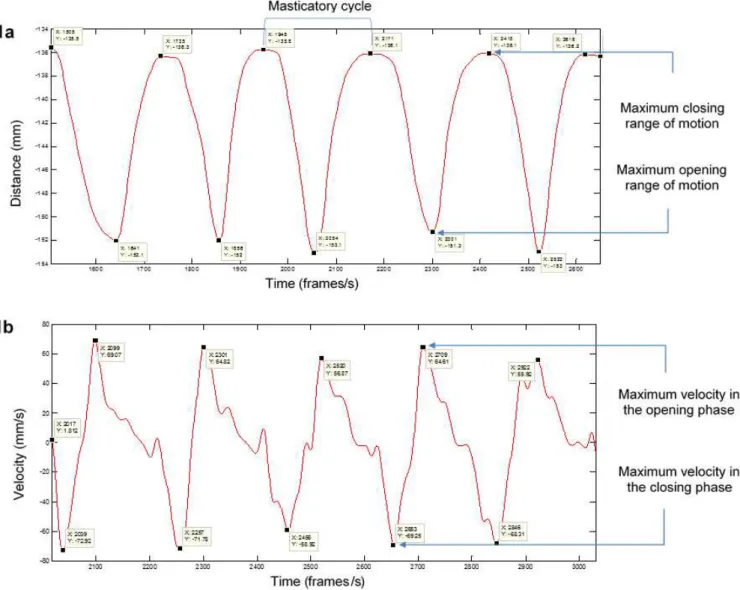
we deined the peaks of vertical mandibular range of motion for the opening (maximum gape of the chin tip) and closing (minimum gape of the chin tip from the maximum gape) phases,
as well as the peaks of opening and closing velocity in the vertical dimension (Figure 1).
The selection of valid masticatory cycles and the deinition of mandibular opening and closing peaks, as well as maximum
and minimum velocity peaks in each cycle of the analyzed segment were conducted visually in the corresponding graphs (Figure 1). To analyze the variables associated with the masticatory sequence, the entire mastication period was considered - from
the irst to the last pre-deglutition cycle (Figure 2). As the data of the outcome variables were normal (Shapiro-Wilk test), the paired t test was used to compare the data recorded during UM and HM. The data were compared using the Graphpad Prisma
6.0 software. The signiicance level α<0.05 was adopted for
all statistical analyses.
Cohen’s d effect size and the statistical power of the test were calculated post-hoc for the paired variables using the G*Power
3.1.9.2 software. Effect size is deined by the magnitude of the
distance between two means in terms of standard deviations,
The magnitude of effect size has been interpreted as an
index of clinical relevance. Thus the larger the effect size, the
greater the difference between the groups, and the greater the relevance of the results. Effect sizes of 0.2, 0.5, and 0.8 have been described as small, moderate, and large, respectively(23). However, these values are only guidelines for decision making and should consider the characteristics of the variable under study(23,24). In this survey, effects sizes >0.4 were considered moderate and clinically relevant(24).
RESULTS
The study sample was composed of eight volunteers with mean age (mean±SD) of 21.12±1.64 years and BMI of 21.76±8.26 kg/m2.
Regarding the variables of masticatory sequence, smaller chewing rate was observed for deliberate unilateral mastication (UM) compared with that for habitual mastication (HM) and the effect size of this difference was moderate (>0.5). However, no differences were observed between the chewing patterns for the variables associated with duration and number of cycles during the masticatory sequence (Table 1).
With respect to the kinematic variables of the masticatory
cycle, no differences were observed for maximum vertical
and medial-lateral mandibular range of motion (mm) and
cycle duration. In contrast, smaller maximum velocity values
in the opening and closing phases were found during UM compared with those during HM. Moderate and large effect sizes (>0.5 and >0.8, respectively) were observed for these
variables; however, statistical signiicance was not reached
(Table 2) for the opening phase.
DISCUSSION
In the present study, we compared the mandibular kinematic variables associated with masticatory sequence and cycles during deliberate unilateral (UM) and habitual (HM) mastication. The data herein presented can contribute to the understanding of how the chewing function can be reorganized in response to
extrinsic factors, such as the imposition of an artiicial masticatory
pattern, in healthy individuals. In addition, our results suggest
that the adoption of the deliberate unilateral masticatory pattern interferes with mastication performance.
The present outcomes show that chewing rate was smaller for UM compared with that for HM and that the effect size of this difference was moderate (>0.5); however, the adopted pattern had no effect on the duration or number of masticatory cycles.
The masticatory sequence is composed of a set of movements that occur from food ingestion to food bolus swallowing. The number of masticatory cycles required to prepare the same
Figure 2. Graphic representation of vertical mandibular range of motion in a typical masticatory sequence. The blue arrows indicate the beginning and finish times of the masticatory sequence
Table 1. Description of chewing rate, number of masticatory cycles, and duration of masticatory sequence during habitual and deliberate unilateral mastication
Variables of masticatory sequence Habitual Deliberate Unilateral p value d P(%) Mean (SD) Mean (SD)
Chewing rate (Hz) 1.29 (0.16) 1.19 (0.21) 0.004* 0.53 0.25
Duration (s) 21.27 (7.17) 21.17 (5.98) 0.942 0.02 0.05
No. of masticatory cycles 26.88 (7.84) 24.44 (5.28) 0.146 0.35 0.14
*Statistically significant values (p<0.05) - paired t test
Caption: SD = standard deviation; d = Cohen’s d, effect size; P = statistical power
Table 2. Temporal-spatial kinematic parameters of the masticatory cycle during habitual and deliberate unilateral mastication Kinematic parameters of the
masticatory cycle
Habitual Deliberate Unilateral
p d P(%)
Mean (SD) CI 95% Mean (SD) CI 95%
Duration (s) 0.76 (0.14) 0.65-0.88 0.73 (0.34) 0.44-1.01 0.745 0.10 0.06
Vertical range of motion (mm) 12.43 (3.11) 9.83-15.03 12.21 (2.34) 10.25-14.17 0.575 0.08 0.05 Medial-lateral range of motion (mm) 9.49 (0.87) 8.75-10.22 9.61 (1.77) 8.13-11.09 0.843 0.08 0.05 Maximum velocity in the OP (mm/s) 80.02 (17.87) 65.08-94.96 67.4 (11.96) 57.39-77.4 0.053 0.80 0.50 Maximum velocity in the CP (mm/s) 83.51 (17.2) 69.13-97.89 71.77 (9.35) 63.95-79.59 0.014* 0.79 0.48
*Statistically significant values (p<0.05) - paired t test
Caption: SD = standard deviation; CI = confidence interval; d = Cohen’s d, effect size; P = statistical power; OP = masticatory cycle opening phase; CP = masticatory
type of food for swallowing is relatively constant for the same individual. In contrast, large variations are observed between individuals when comparing the number of masticatory cycles until swallowing(13). In this context, it is worth considering that
chewing rate is a variable that expresses the normalization of the number of masticatory cycles by the time spent for execution.
It is possible that this normalization process evidenced more subtle differences associated with the masticatory sequence which were not perceptible in absolute variables such as duration
or number of cycles. In this study, to eliminate the inluence of
running time on the kinematic variables (which varies between
individuals), chewing rate was investigated during the irst
10 cycles. In addition, the analysis of the initial cycles of the masticatory sequence allows better assessment of the immediate (or acute) effect of attention on the chewing pattern.
Task-speciic skills are progressively learned in response to
afferent information about the direction, range and duration of occlusal loads during mandibular movement, as well as to the location of the food bolus in the oral cavity(25). Therefore, an
explanation for the smaller chewing rate during UM would be the
need for adjustments for which individuals are not functionally prepared, that is, considering that their usual UM pattern, it can be performed with faster opening and closing phases.
Regarding the variables of the masticatory cycle, no differences were found for duration as well as for vertical and medial-lateral mandibular range of motion in the comparisons conducted. The mean duration of the cycle observed in this study is consistent with those described in previous surveys, which showed variations ranging from 0.61 to 1.04 s(3,5). In order to maintain the total duration of the cycle stable, the neuronal control of the masticatory movements - central pattern generator (CPG) - can act by modulating the duration of the opening, closing and occlusal phases of the masticatory cycle(26). Although these modulations were not investigated in the present study, it is possible that they have contributed to the absence of effects on temporal variables such as number of cycles and duration of the sequence and the masticatory cycle.
The speciic scientiic literature describes values of mandibular
range of motion between 10 and 13 mm during the masticatory cycle(27,28), similar to those observed in this study. The masticatory
pattern adopted did not inluence the mandibular range of motion evaluated. A possible explanation for this result may be the fact
that there is no musculoskeletal restriction that can interfere with the amount of movement required to perform the proposed task, although the deliberate unilateral masticatory pattern is not physiological in these individuals.
Even though the values for vertical and medial-lateral
mandibular range of motion were not altered, those for maximum
vertical velocity during the mandibular opening and closing phases were lower during UM compared with those during HM. Moreover, the effect size of these variables (0.8 and 0.79)
indicates the clinical relevance of this inding for the kinematic
assessment of mastication in individuals who chronically adopt the deliberate unilateral masticatory pattern.
Habitual mastication occurs when the individual can select a preferred and comfortable chewing pattern with minimal conscious involvement. This chewing pattern is described as a series of unilateral masticatory strokes in which the food bolus is randomly displaced between the right and left sides(12). The CPG enables mastication with automatic muscle movement
and activation patterns, which provide more eficient chewing function and lower energy expenditure(2). A previous study reported smaller range of electromyographic (EMG) activation of the masticatory muscles on the work side during UM compared with that during HM(12). This inding suggests more vigorous
chewing during habitual performance, and it may also explain the higher values of maximum velocity achieved during HM
observed in this study.
Corroborating these results, previous studies have shown positive correlation between mandibular movement velocity and chewing performance(15,16). This fact suggests that higher velocity during the closing phase of the masticatory cycle transmits a greater amount of energy to the food bolus, consequently allowing
more eficient crushing. Therefore, it would be possible to infer
that the unilateral masticatory pattern, in which lower closing
velocity is developed, could bring losses to masticatory eficiency.
In contrast, the reduction in the chewing rate and in the
maximum velocity achieved during the opening and closing
phases in UM indicates that, in the adoption of this masticatory pattern, which is not automated for the individual, there may
be greater awareness of the task. This can be explained by
the cortical involvement associated with the use of cognitive attention strategies during this task.
Brandini et al.(29) reported that, during standardized chewing, there is greater involvement of voluntary motor areas of the
cerebral cortex which act by modulating the CPG in the generation
of the involved movements. Conversely, during HM there is greater relative participation of the CPG brainstem.
In this sense, UM can be understood as an extrinsic masticatory
factor which is imposed on the individual. In view of the need to maintain the food bolus in one of the dental arches, new oral sensory-motor information about the position of the food bolus and the tongue must be processed. In response to that, adaptation occurs in the velocity reached during the opening and closing phases of the masticatory cycle, with possible impact on the chewing rate.
Effect size calculation is one of the methods utilized to determine
the clinical relevance of the indings of a scientiic research(24), which also allows comparison of the effect observed on variables that have different measurement units(30). The outcomes of this survey showed moderate effect size for changes in the chewing rate of the masticatory sequence (d=0.53) and moderate-to-large
effect size for maximum velocity during the opening and closing
phases of the masticatory cycles (d=0.8 and 0.79). These
indings indicate acute and clinically signiicant inluence of
lead to long-term elastomechanical modiications of the tissue,
generating musculoarticular stiffness and losses in masticatory performance.
CONCLUSION
Kinematic variables associated with the sequence and
cycle of mastication are inluenced by the chewing pattern
adopted - deliberate unilateral or habitual. The results suggest that during deliberate unilateral mastication, not automated for the individual, a greater cortical involvement during this task
inluenced the kinematic variables of mandibular range of motion.
The effect of the unilateral chewing pattern on mandibular
velocity may indirectly inluence masticatory performance
when this pattern is adopted chronically.
ACKNOWLEDGEMENTS
The authors are grateful to the research volunteers and collaborators and to the “Programa Institucional de Bolsas de
Iniciação Cientíica (PIBIC/CNPq)” for the scholarship granted
to the second author of this study.
REFERENCES
1. Lund JP. Mastication and its control by the brain stem. Crit Rev Oral Biol Med. 1991;2(1):33-64. PMid:1912143. http://dx.doi.org/10.1177/104544 11910020010401.
2. Morquette P, Lavoie R, Fhima M-D, Lamoureux X, Verdier D, Kolta A. Generation of the masticatory central pattern and its modulation by sensory feedback. Prog Neurobiol. 2012;96(3):340-55. PMid:22342735. http://
dx.doi.org/10.1016/j.pneurobio.2012.01.011.
3. Ferrario VF, Piancino MG, Dellavia C, Castroflorio T, Sforza C, Bracco P. Quantitative analysis of the variability of unilateral chewing movements in young adults. Cranio. 2006;24(4):274-82. PMid:17086857. http://dx.doi. org/10.1179/crn.2006.043.
4. Peyron MA, Lassauzay C, Woda A. Effects of increased hardness on jaw movement and muscle activity during chewing of visco-elastic model
foods. Exp Brain Res. 2002;142(1):41-51. PMid:11797083. http://dx.doi. org/10.1007/s00221-001-0916-5.
5. Piancino MG, Bracco P, Vallelonga T, Merlo A, Farina D. Effect of bolus hardness on the chewing pattern and activation of masticatory muscles in subjects with normal dental occlusion. J Electromyogr Kinesiol. 2008;18(6):931-7. PMid:17616401. http://dx.doi.org/10.1016/j.jelekin.2007.05.006. 6. Hãggman-Henrikson B, Eriksson PO. Head Movements during chewing:
relation to size and texture of bolus. J Dent Res. 2004;83(11):864-8.
PMid:15505237. http://dx.doi.org/10.1177/154405910408301108. 7. Whitaker ME, Trindade Júnior AS, Genaro KS. Proposta de protocolo de
avaliação clínica da função mastigatória. Rev CEFAC. 2009;11:311-23.
http://dx.doi.org/10.1590/S1516-18462009005000030.
8. Weber P, Corrêa ECR, Bolzan GP, Ferreira FS, Soares JC, Silva AMT. Mastigação e deglutição em mulheres jovens com desordem temporomandibular. CoDAS. 2013;25(4):375-80. PMid:24413427. http://dx.doi.org/10.1590/ S2317-17822013005000005.
9. Felício CM, Melchior MDO, Da Silva MAMR, Celeghini RMDS. Desempenho mastigatório em adultos relacionado com a desordem temporomandibular e com a oclusão. Pró-Fono R. Atual. Cient. 2007;19(2):151-8.
10. Pignataro G No, Bérzin F, Rontani RMP. Identificação do lado de preferência
mastigatória através de exame eletromiográfico comparado ao visual. Dental
Press Ortodon Ortop Facial. 2004;9(4):77-85. http://dx.doi.org/10.1590/ S1415-54192004000400008.
11. Okeson JP. Tratamento das desordens temporomandibulares e oclusão. 7. ed. São Paulo: Elsevier; 2013. 515 p.
12. Stohler CS. A comparative eletromyographic and kinesiographic study of deliberate and habitual mastication in man. Arch Oral Biol. 1986;31(10):669-78. PMid:3477211. http://dx.doi.org/10.1016/0003-9969(86)90096-8. 13. van der Bilt A, Engelen L, Pereira LJ, van der Glas HW, Abbink JH. Oral
physiology and mastication. Physiol Behav. 2006;89(1):22-7. PMid:16564557.
http://dx.doi.org/10.1016/j.physbeh.2006.01.025.
14. Haggerty M, Dickin DC, Popp J, Wang H. The influence of incline walking on joint mechanics. Gait Posture. 2014;39(4):1017-21. PMid:24472218.
http://dx.doi.org/10.1016/j.gaitpost.2013.12.027.
15. Yoshida E, Fueki K, Igarashi Y. Association between food mixing ability
and mandibular movements during chewing of a wax cube. J Oral Rehabil.
2007;34(11):791-9. PMid:17919244.
http://dx.doi.org/10.1111/j.1365-2842.2007.01743.x.
16. Komagamine Y, Kanazawa M, Minakuchi S, Uchida T, Sasaki Y. Association between masticatory performance using a colour-changeable chewing gum and jaw movement. J Oral Rehabil. 2011;38(8):555-63. PMid:21314707.
http://dx.doi.org/10.1111/j.1365-2842.2011.02204.x.
17. Ferrario VF, Tartaglia GM, Galletta A, Grassi GP, Sforza C. The influence of occlusion on jaw and neck muscle activity: A surface EMG study in healthy young adults. J Oral Rehabil. 2006;33(5):341-8. PMid:16629892.
http://dx.doi.org/10.1111/j.1365-2842.2005.01558.x.
18. Dworkin SF, Le Resche L. Research diagnostic criteria for temporomandibular
disorders: review, criteria, examinations and specifications, critique. J
Craniomandib Disord. 1992;6(4):301-55. PMid:1298767.
19. Cattoni DM, Fernandes FD, Di Francesco RC, Latorre MRDO. Características do sistema estomatognático de crianças respiradoras orais: enfoque antroposcópico. Pró-Fono R. Atual. Cient. 2007;19(4):347-51. PMid:18200382. http://dx.doi.org/10.1590/S0104-56872007000400004. 20. Genaro KF, Berretin-Felix G, Rehder MIBC, Marchesan IQ. Avaliação miofuncional orofacial: protocolo MBGR. Rev CEFAC. 2009;11(2):237-55. http://dx.doi.org/10.1590/S1516-18462009000200009.
21. Häggman-Henrikson B, Eriksson PO, Nordh E, Zafar H. Evaluation of skin- versus teeth-attached markers in wireless optoelectronic recordings of chewing movements in man. J Oral Rehabil. 1998;25(7):527-34. PMid:9722099. http://dx.doi.org/10.1046/j.1365-2842.1998.00292.x. 22. Piancino MG, Isola G, Merlo A, Dalessandri D, Debernardi C, Bracco P.
Chewing pattern and muscular activation in open bite patients. J Electromyogr Kinesiol. 2012;22(2):273-9. PMid:22236764. http://dx.doi.org/10.1016/j. jelekin.2011.12.003.
23. Dancey CP, Reidy J. Estatística sem matemática para psicologia. 5. ed. Porto Alegre: Artmed; 2013. 608 p.
24. Armijo-Olivo S, Warren S, Fuentes J, Magee DJ. Clinical relevance vs. statistical significance: using neck outcomes in patients with temporomandibular
disorders as an example. Man Ther. 2011;16(6):563-72. PMid:21658987.
http://dx.doi.org/10.1016/j.math.2011.05.006.
25. Yashiro K, Fukuda T, Takada K. Masticatory jaw movement optimization after introduction of occlusal interference. J Oral Rehabil. 2010;37(3):163-70. PMid:19968764. http://dx.doi.org/10.1111/j.1365-2842.2009.02034.x. 26. Crane EA, Rothman ED, Childers D, Gerstner GE. Analysis of temporal variation in human masticatory cycles during gum chewing. Arch Oral Biol. 2013;58(10):1464-74. PMid:23915677. http://dx.doi.org/10.1016/j. archoralbio.2013.06.009.
27. Youssef RE, Throckmorton GS, Ellis E 3rd, Sinn DP. Comparison of habitual masticatory patterns in men and women using a custom computer program. J Prosthet Dent. 1997;78(2):179-86. PMid:9260136. http://dx.doi. org/10.1016/S0022-3913(97)70123-9.
28. Sae-Lee D, Whittle T, Peck CC, Forte ARC, Klineberg IJ, Murray GM.
Experimental jaw-muscle pain has a differential effect on different jaw
movement tasks. J Orofac Pain. 2008;22(1):15-29. PMid:18351031. 29. Brandini D, Benson J, Nicholas MK, Murray GM, Peck CC. Chewing in
temporomandibular disorder patients: an exploratory study of an association
30. Tomlinson JD, McClure P. Understanding the concept of effect size to guide clinical decisions about treatment. J Hand Ther. 2007;20(3):277-9. PMid:17658422. http://dx.doi.org/10.1197/j.jht.2007.04.018.
Author contributions
FP was responsible for the study design, collection and analysis of data, and writing of the manuscript; AGO collaborated in the collection of data and writing of the manuscript; CCSCP collaborated in the methodological
issues related to the Qualisys motion analysis system and in the inal revision of the manuscript; JLLZ participated in the study design and revision of the
manuscript; GPB collaborated in the collection and analysis of the data related to the competencies of Speech-language Pathology and in the writing of the manuscript; SBM participated in the collection of the data related to the competencies of Odontology and in the writing of the manuscript; ECRC