- 561 - Experiment Reports
THE ES/CICAD/OAS SCHOOLS OF NURSING PROJECT: A MODEL OF
EXCELLENCE FOR PROFESSIONAL AND SCIENTIFIC DEVELOPMENT ON
DRUG RELATED ISSUES IN LATIN AMERICA
Maria da Gloria Miotto Wright1, Maria Juliana Lujan2
1 Ph.D. Public Health Nurse. Drug Specialist. Coordinator Educational Development Program (EDP) – Demand Reducion
Section (DRS) of the Interamerican Drug Abuse Control Commission (CICAD) of the Secretariat for Multidimensional Security (SMS) of the Organization of American States (OAS). Washington, DC, United Sates. E-mail: [email protected]
2 BS. Political Science, Drug Specialist, Project Assistant of EDP/DRS/CICAD/SMS/OAS, Washigton, DC, United States.
E-mail: [email protected]
ABSTRACT: This paper presents the Executive Secretariat of Interamerican Drug Abuse Control Commission (ES/CICAD)’s successful experience introducing drug related content into nursing curricula, fostering the implementation of outreach activities at the community level, and promoting research studies on drug issues in Latin America. The “Critical-holistic international health model applied to the drug phenomenon” is used as the project’s theoretical framework. The three basic components of the project are education, outreach activities, and drug research studies, which provide the scientiic basis for the development and advancement of future nursing professionals to work and study drug issues in Latin America. Through this project, more than 50,000 nursing students have been or are being educated on drug-related issues; the participating schools have implemented 400 outreach activities, developed more than 500 research studies on drug-related issues, and published more than 270 articles in national and international peer-reviewed journals. The ES/CICAD Schools of Nursing Project has served as a model to address the drug phenomenon from an international health perspective for other academic areas such as medicine, public health, education, psychology, social work, social communication, and law in Latin America.
DESCRIPTORS: Universities. Schools. Nursing. Drugs. Latin America.
O PROJETO DA SE/CICAD/OEA COM AS ESCOLAS DE ENFERMAGEM: UM
MODELO DE EXCELÊNCIA PARA O DESENVOLVIMENTO PROFISSIONAL E
CIENTÍFICO COM TEMAS RELACIONADOS SOBRE DROGAS NA AMÉRICA
LATINA
RESUMO: Este trabalho apresenta uma experiência de sucesso da Secretaria Executiva da Comissão Interamericana para o Controle do Abuso de Drogas (SE/CICAD) relacionado com a introdução do conteúdo de drogas nos currículos de enfermagem, além da implementação das atividades de extensão ao nível da comunidade, e promover o desenvolvimento de pesquisas na temática de drogas. O modelo “Crítico-holísitico de saúde internacional aplicado ao fenômeno das drogas” foi utilizado como referencial teórico para o projeto. Os três compentes básicos do projeto são educação, atividades de extensão, e pesquisa sobre drogas, o que oferece as bases cientíicas para o desenvolvimento e avance do futuro professional de enfermagem para trabalhar e estudar os problemas relacionados com drogas na América Latina. Através deste projeto, mais de 50.000 estudantes de enfermagem foram educados em temas relacionados com drogas, as escolas participantes do projeto tem implementado mais de 400 atividades de extensão, mais de 500 pesquisas foram realizadas relacionadas com os diferentes aspectos das drogas, e mais de 270 artigos cientíicos foram publicados em revistas nacionais e internacionais. O projeto das escolas de enfermagem da SE/CICAD tem servido de modelo para analisar o fenômeno das drogas desde a perspectiva de saúde internacional em outras áreas acadêmicas como medicina, saúde pública, educação, psicología, serviço social, comunicação social e direito na América Latina.
DESCRIPTORES: Universidades. Escolas. Enfermagem. Drogas. América Latina.
EL PROYECTO DE LA SE/CICAD/OEA CON LAS ESCUELAS DE ENFERMERÍA:
UN MODELO DE EXCELENCIA PARA EL DESARROLLO PROFESSIONAL
Y CIENTÍFICO EN TEMAS RELACIONADOS CON DROGAS EN AMÉRICA
LATINA
RESUMEN: Este trabajo presenta la experiencia exitosa de la Secretaria Ejecutiva da Comisión Interamericana para el Control del Abuso de Drogas (SE/CICAD) de introducir el contenido de drogas en los currícula de enfermería, además de la implementación de actividades de extensión a nivel de la comunidad, y promover estudios de investigación en la temática de drogas. El modelo “Crítico-holístico de salud internacional aplicado al fenómeno de las drogas” fue utilizado como referencial teórico para el proyecto. Los tres componentes básicos del proyecto son educación, actividades de extensión, y estudios de investigación en drogas, lo cual ofrece las bases cientíicas para el desarrollo y avance del futuro profesional de enfermería para trabajar y estudiar problemas relacionados con drogas en América Latina. A través de este proyecto, más de 50,000 estudiantes de enfermería fueron educados en temas relacionados con drogas; las escuelas participantes del proyecto han implementado más de 400 actividades de extensión, más de 500 estudios relacionados con los diferentes aspectos de las drogas y han publicado más de 270 artículos cientíicos en revistas nacionales o internacionales. El proyecto de las escuelas de enfermería de la SE/CICAD ha servido como modelo para mirar el fenómeno de las drogas desde la perspectiva de salud internacional en otras áreas academica como la medicina, salud pública, educación, psicología, servicio social, comunicación social y derecho en América Latina.
INTRODUCTION
Among the lingering challenges and unre-solved problems of the 21st century are a complex maelstrom of issues revolving around controlled substances. For years, countries have faced
many dificulties when dealing with the control
of production, transport and consumption of illicit and licit drugs. Drug use and abuse have become important issues on the international and national agendas as a consequence of the damage they cause to the social, economic and political fabric in really all the countries of the hemisphere.
Illicit drugs problems have been studied in many research projects while international, gov-ernmental and non-govgov-ernmental organizations, and professional associations have conferred on the issue.1 Inter-American Drug Abuse Control Commission (CICAD) Multilateral Evaluation Mechanism (MEM)2 has implemented ive rounds of analysis in which member countries of the Or-ganization of American States (OAS) have been evaluated by their peers on their implementation of national drug policies and strategies. In the last round of evaluation more than 300 recom-mendations for policy changes in the areas of institutional building, demand reduction, supply reduction and control measures were issued to 34 members states.
As we continue to evolve into a global community, one nation’s public health issues, such as drug abuse, become the concern of all nations. The scope and consolidation of a new economic paradigm encompasses the process of globalization, which involves an increased integration of diverse economies and societies
as a result of greater lows of goods, capital,
people, and ideas. This integration has economic
beneits, as well as consequences for health and
drug issues.3-4
Many of the current and future drug related health problems will continue to be global or multinational in nature. Some of the challenges in dealing with these problems require innovative initiatives, partnerships and approaches to the education of health-related professionals.
This paper presents the Executive Secretariat of Interamerican Drug Abuse Control Commission (ES/CICAD)’s successful experience of partner-ship with universities in Latin America to intro-duce drug-related content into undergraduate and graduate university nursing curricula, fostering
the implementation of extension activities at the community level, and promoting the development of research studies on drug issues, as a model for other academic areas such as medicine, public health, education, psychology, social work, and law in Latin America.
JUSTIFICATION
Recent social and technological develop-ments have directly or indirectly abetted the production, trade and consumption of illicit and licit drugs in the Americas and in the world. To overcome this situation, in 1986, the member states of the OAS created the CICAD, ten years later, CICAD adopted the Anti-Drug Strategy in the hemisphere as an expression of the need for shared responsibility to deal with drug issues in the Americas. This integrated approach has fa-cilitated the design of international and national policies of shared interest to reduce the supply and consumption of drugs in the Americas.5 On May 2010, in Washington, DC, the CICAD/OAS approved a new version of the Anti-Drug Strat-egy entitled “Hemispheric Drug StratStrat-egy”, and on June 5th, 2010, it was adopted by the General Assembly of the OAS in its 40th regular session, Lima, Peru. In May 2011, the CICAD/OAS, in Paramaribo/Suriname approved the “Plan of Action 2011-2015” for the new Hemispheric Drug Strategy.6
Around the world, national governments are emphasizing increasingly the importance of the development of activities related to drug
abuse reduction, paying speciic attention to the
preparation of human resources for the promotion of healthy and sustainable lifestyles, prevention, treatment, rehabilitation, and social integration. Health professionals are key actors to work and perform research in this area.
Taking into consideration this situation, in 1997, ES/CICAD/OAS presented to the Gov-ernment of Japan a proposal to initiate a pilot to work with Latin American schools of nursing. The project aimed to introduce drug-related course content into undergraduate and graduate nurs-ing curricula, develop extension activities at the community level and carry out research studies on drug-related problems, so the schools could prepare future nursing professionals with
scien-tiic knowledge and technical skills to work and
The nursing profession constitutes the single largest segment of the health care work force. Nurses maintain close contact with individuals, families, and communities; therefore, they are best able to identify the variety of problems related to illicit drugs.7
Investing in the development of future nurs-ing professionals in the areas of promotion of healthy and sustainable lifestyles, prevention of drug use and abuse, treatment, rehabilitation, and social integration, requires designing international and national policies to support such initiatives, as well as the development of new models of partnership to carry out the necessary activities. Hereby, we present an overview of ES/CICAD/ OAS Schools of Nursing Project in Latin America as a model of professional excellence in the area of drug demand reduction.
ES/CICAD/OAS UNIVERSITY
PARTNER-SHIP PROJECT IN LATIN AMERICA
The ES/CICAD/OAS University Partner-ship Project uses the Critical-Holistic International Health Framework Applied to the Drug
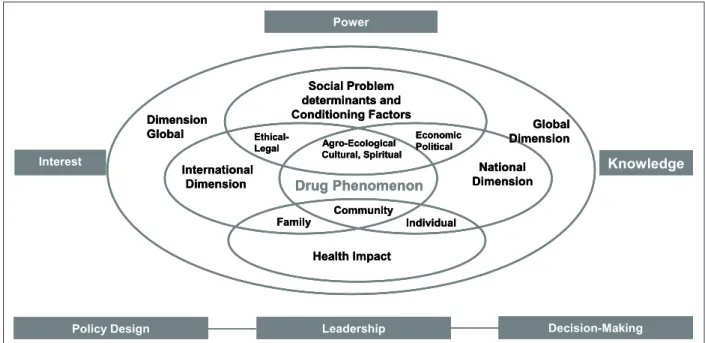
Phenome-non.8-9 This framework uses a dialectical approach for the analysis of drug issues in the Americas, including macro and micro dimensions. The meth-odology provides the foundation to bring together international and national participants to provide
scientiic and technological support for the devel -opment of educational curricula with drug content (and faculty development), extension activities at the community level, and implementation of research studies on drug issues.
Figure 1 summarizes the structure of the model. In the macro-political context, the model addresses the dimension of power, interest, knowl-edge, and leadership regarding drug issues in in-ternational relations. In the micro-political context, the model is concerned with: (i) the international dimension of drug issues at the domestic level; and (ii) the strategic development of the country regarding drug control and the impact of drug abuse on the health of individuals, families, and communities. The Critical-holistic international health model applied to the drug phenomeon has supported the design of the entire project, as well as its operationalization at ES/CICAD/OAS and at the universities.10
Global Dimension Dimension
Global
Power
Knowledge Interest
Leadership
Social Problem determinants and Conditioning Factors
National Dimension International
Dimension
Health Impact
Family Individual
Community Drug Phenomenon
Policy Design
Ethical-Legal Agro-Ecological Cultural, Spiritual
Decision-Making Economic
Political
Global Dimension Dimension
Global
Power
Knowledge Interest
Leadership
Social Problem determinants and Conditioning Factors
National Dimension International
Dimension
Health Impact
Family Individual
Community Drug Phenomenon
Policy Design
Ethical-Legal Agro-Ecological Cultural, Spiritual
Decision-Making Economic
Political
Global Dimension Dimension
Global
Power
Knowledge Interest
Leadership
Social Problem determinants and Conditioning Factors
National Dimension International
Dimension
Health Impact
Family Individual
Community Drug Phenomenon
Policy Design
Ethical-Legal Agro-Ecological Cultural, Spiritual
Decision-Making Economic
Political
Figure 1 - Critical holistic international-health model applied to study drug phenomenon in the Americas (Wright, 1999)
At ES/CICAD/OAS, the project is managed at the Demand Reduction Section through the Educational Development Program (EDP). At the
Picture 1 - Structure of project at university level
Items Composition
Project Coordinator Dean of the School of Nursing.
Academic Committee Constituted by the academic coordinators of the Schools of Nursing. Ad Hoc Scientiic Committee Representatives from other scientiic areas of university, health secretariat,
national drug control commissions, and experts on drug issues, etc. Secretary Part-time administrative support for the activities of the project.
Project’s basic components
The three basic components of the project
provide the scientiic basis of future nursing pro
-fessionals to develop an understanding of drug is-sues in Latin America. The three basic components are presented in picture 2.
Picture 2 - Basic components of the project
Areas Activities
Education activities
a) Faculty training seminars on drug issues.
b) Nursing curriculum development with drug-related content at undergraduate and graduate levels.
c) Development of an evaluation and monitoring system of the curricula and graduates from these nursing curricula.
Outreach activities Implementation of outreach educational activities at the community level for high-risk groups or speciic population groups.
Drug research studies Implementation of drug-related studies according to the priorities of the countries.
The steps of implementing the activities of the project at the university level include is
pre-sented in picture 3.
Picture 3 - Steps to implementing the activities of the project
Steps Activities
Step I Socializing the project at the school of nursing and at the university environment. Step II Providing drug-related faculty educational training seminars.
Step III Developing drug-related nursing curricula for undergraduate and graduate programs. Step IV Implementing drug-related nursing curricula at undergraduate and graduate levels. Step V Implementing drug-related outreach activities and drug research studies.
Step VI Evaluating and monitoring the program and graduates.
Step VII Disseminating and exchanging scientiic knowledge and experiences among the schools of nursing in the Americas.
Research capacity-building programs
During 2002-2008, ES/CICAD developed
a specialized technical and inancial cooperation
agreement with the University of São Paulo - School of Nursing of Riberão Preto (Brazil) to implement the “Regional research capacity-building program for nurses and health related professionals to study drug related issues in Latin America.”11-13 This pro-gram is currently carried out by the Secretaria Na-cional Antidrogas (SENAD/Brazil) and the Escola de Enfermagem de Ribeirão Preto (EERP) da Uni-versidade de São Paulo (USP) - Brazil. From 2003
to the present, ES/CICAD has been implementing another advanced research capacity-building pro-gram entitled “International research capacity-building program for health related professionals to study drug issues in Latin America and the Caribbean”(IRCBP), which has been carried out in partnership with the University of Alberta-Faculty
of Nursing in Edmonton/Canada (irst offer
ACHIEVEMENTS
Since its inception in 1997, the ES/CICAD/ OAS Schools of Nursing Project in Latin America, has achieved many successful outcomes in the ar-eas of education, outreach activities, and research. The results of these achievements are presented bellow with some concrete examples of the differ-ent activities developed in the areas of education, outreach and research.
Education area
Since 1997, more than 50,000 nursing students have been educated through ES/CICAD/OAS School of Nursing Project-sponsored curricula with drug-related content; more than 1000 nursing school faculty members have been trained on pro-motion of healthy and sustainable lifestyle, drug use and abuse prevention, treatment, rehabilita-tion, and social integration. More than 200 nursing professors/ researchers have received specialized training in research methodology applied to the study of drug issues in Latin America. This project has served as a model for subsequently initiated projects with the schools of medicine, public health, education, psychology, social work, and law.17-18
Working with more than 100 schools in 20 countries today, the ES/CICAD/OAS project is
transitioning away from a single school or fac-ulty model (nursing, education, etc.), toward an “integrated project” approach that draws on all relevant academic disciplines (law, sociology, and psychology, for instance) and has the broad sup-port of the university administration.
Pictures 4 and 5 indicate the recommended hours for nursing drug curricula at undergraduate and graduate levels that came from the 2004 and 2010 ES/CICAD/OAS University Partnerships Meetings. The Schools of Nursing involved in the project, have prepared a recommendation report to CICAD/OAS, entitled “Basic competencies for nursing professional in the area of drug demand reduction in Latin America” for the Schools of Nursing in Latin America to follow and adjust the numbers of hours related to drug issues at undergraduate and graduate levels according to the new recommendations.17-19
Picture 4 indicates the increased numbers of hours related to drug content for undergraduate and specialization programs, from a minimum of 270 hours in 2004 to 312 hours in 2010 at under-graduate level, especially in the areas of treatment and rehabilitation. At specialization level, the increased was from 35 hours in 2004 to 257 hours in 2010, especially in the areas of treatment, reha-bilitation and social integration.
Picture 4 - Recommended hours for the nursing drug curricula at undergraduate and specialization levels
Area 2004 Rio de Janeiro meeting recommendations
2010 Panama meeting recommendations Undergraduate
Health promotion
Use and abuse prevention
80 100
142
Treatment 35 80
Rehabilitation 15 60
Social integration 40 30
Total 270 hours 312 hours
Specialty Any specialty Mental health and drugs specialty
Health promotion 8 8
Use and abuse prevention 10 10
Treatment 7 175
Rehabilitation 3 24
Social integration 7 40
Total 35 hours 257 hours
Note: The total number of hours recommended by each of the programs is to be distributed in the total years of each of the programs. For the specialty programs it includes also the development of the monograph.17-19
Picture 5 indicates also the changes in numbers of hours for drug content for graduate
2004 to 90 hours in 2010 at Masters level, and for a minimum of 45 hours in 2004 to 108 hours in 2010 at Doctoral level. The increase in hours
were especially in the areas of rehabilitation and social integration in Masters and Doctoral degree programs.
Picture 5 - Recommended hours for nursing drug curriculum at masters and doctoral levels
Area 2004 Rio de Janeiro meeting recommendations
2010 Panama meeting recommendations Masters Nursing masters degree general Nursing masters degree with
emphasis on drugs
Health promotion 10 10
Use and abuse prevention 15 15
Treatment 7 10
Rehabilitation 3 45
Social integration 10 10
Total 45 hours 90 hours
Doctoral Nursing doctoral program Nursing doctoral program with an emphasis on drugs
Health promotion 8 8
Use and abuse prevention 15 15
Treatment 10 10
Rehabilitation 5 30
Social integration 7 45
Total 45 hours 108 hours
Note: The total number of hours recommended is to be distributed in the total years of each masters and doctoral programs. It also includes the development of the Thesis and Dissertation.17-19
Outreach activities
The Schools of Nursing involved in the ES/ CICAD/OAS project in Latin America have imple-mented more than of 400 outreach activities at the community level. The majority of the activities targeted high-risk populations, students from the public educational system and university, as well as the general population, parents, health profes-sionals from hospitals and health centers, drug users, retired population, and clients of non-gov-ernmental organizations. The activities focused on promotion of a healthy and sustainable lifestyle, prevention of drug abuse, and social integration. Some Schools of Nursing in Latin America have invested much more in this area than in previous years of the project, specially the schools of nurs-ing from Argentina, Bolivia, Brazil, Colombia, Honduras, Mexico, and Peru. The ES/CICAD/ OAS has facilitated and encouraged publications of these experiences conducted by the Schools of Nursing in Latin America.18, 20-21
Drug research studies
The Schools of Nursing involved in the ES/ CICAD/OAS project have implemented more than 500 research studies on drug-related issues,
and published more than 270 scientiic articles in peer reviewed journals from the research ind -ings. The majority of the studies were related to promotion of a healthy and sustainable lifestyle, and risk prevention, with some other studies re-lated to treatment and rehabilitation. The sample populations studied were: women, school chil-dren, adolescents, adults, industrial and assembly plant workers, addicts, high school and university students, faculty, and health professionals. The
research indings have been incorporated into
clinical protocols and technological processes, and used to support curriculum development, out-reach activities aimed at the community, the development of new research proposals on drug related issues, and drug policy design. The schools of nursing who have contributed more in this area are from Brazil, Mexico, Colombia, and Peru. The other schools of nursing from the other countries have contributed also but in less percentage.18-20
Other activities
faculty related to drugs issues, where the results of the activities from the education, outreach, and re-search areas where presented and shared with the participants from the Americas and the Caribbean. ES/CICAD/OAS also organized three inter-national nursing research with the participation of nurse researchers from Latin America, Canada, and the United States.
Six supplements of the Latin-American Journal of Nursing were published by ES/CICAD and EERP-USP/Brazil, 2004; 2005 (2); 2008; 2010;
2011, containing articles from the indings of the
research studies conducted by the participants in the regional and international research capacity-building programs in Brazil and Canada.
One supplement of Nursing Text & Context Journal was published by ES/CICAD/OAS and UFSC/DENF/Brazil in 2012 containing articles
from the indings of the research studies conduct -ed by the participants of the international research capacity-building program in Canada.
The indings from multicenter and individ -ual drug research studies done by nursing faculty and researchers have been presented in national and international Nursing conferences, inside and outside of the nursing discipline in the Americas and Europe.
The Schools of nursing havealso published
educational lyers and drug prevention material
used in educational activities at the community level. ES/CICAD/OAS has created the “Schools of nursing drug addiction prevention network-ing – REEPA(Spanish acronym) hosted by the Faculty of Nursing at University of Nuevo Leon, Monterrey, Mexico. This ES/CICAD/OAS Schools
of Nursing Network is afiliated to the PAHO
International Nursing Networking.
ES/CICAD/OAS has facilitated the partici-pation of nursing faculty from Latin America in the preparation of chapters of two books published in the United States, and one book in Brazil:
− Wright MGM, Almeida MCP, Padilha
MICS, David HMSL, Albuquerque GL, Silva J. Nursing in Brazil - Chapter 5. In: Breda KL, editor. Nursing and globalization in the Americas: a criti-cal perspective. Amityville, New York: Baywood Publishing Company, Inc; 2009. p.137-83.
− Duque-Paramo MC, Padilha MICS, Sa -nhueza OA, Castillo MMA, Castellanos FS, Lopez KSG, Flores YP. Qualitative nursing research in Latin America: the cases of Brazil, Chile, Colombia and Mexico. In: Beck CT, editor. Routledge
Inter-national handbook of qualitative nursing research. New Yourk: Routledge; 2013. p.478-99.
− Comisión Interamericana para el Control
del Abuso de Drogas de la Secretaria para la Se-guridad Multidimensional de la Organización de los Estados Americanos, University of São Paulo, School of Nursing of Ribeirão Preto/Brazil. El fenómeno de las drogas: implicaciones para la salud internacional e investigación. Ribeirão Preto (BR): University of São Paulo, School of Nursing of Ribeirão Preto; 2012.
Outcomes
The outcomes of ES/CICAD/OAS Schools of Nursing Project in Latin America can be seen in the following areas:
A d v a n c e m e n t o f n u r s i n g e d u c a t i o n ,
professional leadership, and the work force
in Latin America
ES/CICAD/OAS recognizes the importance and contribution of nursing professional in the areas of promotion of healthy and sustainable lifestyles, drug abuse prevention, treatment, reha-bilitation, and social integration, and has provided
technical and inancial support to advance nursing
education in Latin America.
ES/CICAD/OAS has expanded the Schools of Nursing Project to other Schools of Nursing in each of the participant countries through a partnership with the National Association of Schools of Nursing.
The ES/CICAD/OAS Schools of Nursing Project has facilitated the integration of efforts and expertise from multiple disciplines and from the health sector to discuss drug related issues in the university environment.
New models of nursing leadership were created in Latin America at international, national and university levels.
Advancement of nursing scientiic knowledge,
dissemination exchange and policy design
related to drug issues in Latin America
A movement was initiated among universi-ties and nursing professional associations to base
social practice on scientiic evidence to improve the
quality of care within the health care system and drug treatment centers in Latin America.
tech-nologies to improve the services provided to people with drug addictions.
A multi-centric pilot study related to “Drug, women and violence in the Americas” involving 22 universities (19 Schools from Latin America and three from the United States), was developed, implemented and used as a reference for follow up studies in this issue in other countries in Latin America and the Caribbean.
The number and dissemination of scientiic
nursing publications concerning drug related is-sues increased in both Latin America and in the Caribbean.
The contribution of this project to reduc-tion of drug use and abuse on countries of Latin America remain a long term goal to be measured.
FINAL CONSIDERATIONS
The ES/CICAD/OAS Schools of Nursing Project has proved to be a successful initiative. Through this project, the ES/CICAD/OAS has developed a process and methodology to work with universities in Latin America that has no other precedent. The model for curriculum development with drug-related content has been used as a guide for other schools of nursing in Latin America and the Caribbean. The experience that ES/CICAD/ OAS has acquired in working with the universities and schools of nursing has facilitated the expansion of this tool to other academic areas such as: schools of medicine, public health, education, psychology, social science, social communication, and law.
ES/CICAD/OAS developed with the uni-versities a unique approach to introducing drug-related content in undergraduate and graduate curricula, as well as outreach activities and drug research studies on issues that are very important to CICAD member states.
The expansion of this experience to other schools of nursing in Latin America and in the Caribbean, as well as to other academic areas such as medicine, public health, education, etc, has al-lowed ES/CICAD/OAS to work with the univer-sities to develop interdisciplinary and integrated projects that involve all academic areas. Models of integrated projects have been implemented at universities in El Salvador, Nicaragua, Paraguay, Peru, and in the Caribbean.
The international and regional research capacity-building programs for nurses and health related professionals to study drug-related issues
in Latin America and in the Caribbean has dem-onstrated the importance of the continuing need to develop human resources in this area to sup-port policy design, decision-making, and project
development based on scientiic evidence.
RECOMMENDATIONS
ES/CICAD/OAS should develop strategies to facilitate knowledge transfer/exchange among all universities/schools and national drug control commissions, as well as research centers, to sup-port policy design and decision-making.
ES/CICAD/OAS should continue to sup-port the development and implementation of more interdisciplinary and integrated drug related issues projects within the universities in Latin America and the Caribbean;
ES/CICAD/OAS should provide incentives for National Drug Commissions in partnership with the Ministries of Education to develop and implement “National drug strategic plan for the universities” in Latin America and the Caribbean.
ACKNOWLEDGMENTS
We would like to thank the Governments of Japan, United States, Canada, and Brazil for their steadfast support for this project; the former Ex-ecutive Secretaries of CICAD, Ambassador David Beall, and Ambassador James Mack; former Head of Demand Reduction Section of CICAD, Dr. Anna McG Chisman, and Embassador Paul Simons, the new Executive Secretariat of CICAD, Rafael Fran-zini, Adjunct Executive Secretariat of CICAD, and the new Head of Demand Reduction Section of CICAD, Alex Hill for their technical support and collaboration; the authorities of all universities, professors and students involved in the project in Latin America and the Caribbean. A special thanks
goes to Dr. Karen L. Breda for the inal revision of
the English language of the paper.
REFERENCES
1. World Health Organization. World Health Report: working together for health. Geneva (CH): World Health Organization; 2006.
2. Inter-American Drug Abuse Control Commission (CICAD). Multilateral Evaluation Mechanism (MEM). Washington, DC (US): Rounds; 2009. 3. Cornia GA. Globalization and health: results and
options. Bull WorldHealthOrgan. 2001;
4. Dollar D. Is globalization good for your health?
Bull WorldHealthOrgan. 2001; 79(9):827-33. Epub
2001 Oct 23.
5. OAS/CICAD. Challenges for a new future-1999-2004.
Washington, DC (US):OAS;2004
6. CICAD/SSM/OAS. Hemispheric drug strategy - plan of action 2011-2015. Washington, DC (US): CICAD; 2011.
7. Spricigo JS, Rdünz V, Fenili RM, Souza ML. The role of the nursing profession in the area of drug demand reduction. In: Wright MGM, Chisman AMcG, Padilha MICS, Gelbcke FL, Spricigo JS,
Pires DEP, et al, editores.The role of the nursing
profession and the drug phenomenon in Latin America. Florianópolis (SC): OAS/CICAD/UFSC; 2006. p.93-102.
8. Wright MGM. A critical-holistic paradigm for an
interdependent world. Am Behav Sci. 2000 Feb;
43(5):808-24.
9. Wright MGM. The contribution of Graduate-Degree Nursing Programs and the drug phenomenon in Latin America: a critical-holistic analysis. In: Wright MGM, Chisman AMcG, Padilha MICS, Gelbcke FL, Spricigo JS, Pires DEP, et al, editores. The role of the nursing profession and the drug phenomenon in Latin America. Florianópolis (SC): OAS/CICAD/ UFSC; 2006. p.15-22.
10. Wright MGM. El análisis crítico-holístico de los programas de postgrado de enfermería frente a los desafíos de la reducción de la demanda de drogas en América Latina. In: Wright MGM, Chisman AMcG, Padilha MICS, Gelbcke FL, Pires DEP, Radunz V, et al, editores. La situación de los Programas de Postgrado de Enfermería en nueve países de América Latina frente a los desafíos de la reducción de la demanda de drogas. Florianópolis (SC): OAS/ CICAD/UFSC; 2003. p. 15-22.
11. Mendes IAC, Luis MAV. (Editorial). Uso de Substancias psicoactivas, un nuevo viejo desafío. Rev Latino-Am Enfermagem. 2004; 12(Esp):295-6. 12. Wright MGM, Chisman AMcG, Mendes IAC, Luis
MAV, Carvalho EC, Mamede MV. El papel de la
cooperación técnica & inanceira para el avance de
la profesión de enfermería en el área de reducción de la demanda de drogas en América Latina: desafíos y perspectivas. Rev Latino-Am Enfermagem. 2004; 12(Esp):301-6.
13. Luis, MAV, Mendes, IAC, Carvalho, EC, Mamede, MV, Wright, MGM, Chisman, AmcG. Experiência
de parceria entre universidade e organismo internacional capacitando enfermeiros docentes da América Latina para la investigación del fenomeno de las drogas. Rev Latino-Am Enfermagem. 2004; 12(Esp):307-15.
14. Wright MGM, Caufield C, Gray G, Olson J. International research capacity-building programs for nurses to study the drug phenomenon in Latin America: challenges and perspectives. Rev Latino-Am Enfermagem. 2005; 13(Esp):1095-101.
15. Wright MGM, Cauield C, Gray G, Olson J, Ludeña
AC, Oblitas FYM, et al. International nursing leadership related to the drug phenomenon: a case study of the partnership experience between the Inter-American Drug Abuse Contyrol Commission (CICAD) and the University of Alberta-Faculty of Nursing. Rev Latino-Am Enfermagem. 2005; 13(Esp):1102-17.
16. Wright MGM, Cumsille F, Khenti A, Padilha MI. Editorial. Texto Contexto Enferm. 2012; 21(Esp):11-2. 17. Wright MGM, Stein A, Galvis MB, Rodrigues BMRD,
Oliveira SA, Henriques RLM, et al. El currículo de enfermería con el contenido de drogas para los programas de pregrado y ostgrado: la experiencia de la CICAD en América Latina. Rio de Janeiro (BR): ES/CICAD/OAS, UERJ; 2004.
18. Wright MGM. Luján MJ, Oblitas FYM, Alayo M. La contribución de las escuelas de enfermería en el área de reducción de la demanda de drogas en América Latina. Washington, DC (US): ES/CICAD/OAS, Mosaic Express; 2012
19. Wright MGM, Luján MJ, Alonso MM, Esparza SE, editores. Competencias básicas del profesional de enfermería en el área de la reducción de la demanda de drogas en América Latina. Washington, DC(US): Mosaic Express, ES/CICAD/OAS; 2012.
20. Wright MGM, Chisman AM, Sarmiento MA, Salaza, MC, Phum ET, editors. La contribución de las escuelas de enfermería en el campo del fenómeno de las drogas en América Latina: un proceso en construcción liderado por la CICAD/OEA. Lima (PE): ES/CICAD/OAS, Universidad Peruana Cayetano Heredia; 2005.