Rev Odontol UNESP. 2016 May-June; 45(3): 171-176 © 2016 - ISSN 1807-2577
ORIGINAL ARTICLE
Doi: http://dx.doi.org/10.1590/1807-2577.21215
Inluence of diameter and intraradicular post in the
stress distribution. Finite element analysis
Inluência do diâmetro e do retentor intrarradicular na distribuição de tensões. Análise pelo
método dos elementos initos
Cleidiel Aparecido Araujo LEMOS
a, Daniel Augusto de Faria ALMEIDA
b,
Victor Eduardo de Souza BATISTA
a, Carol Cantieri MELLO
a, Fellippo Ramos VERRI
a*,
Eduardo Piza PELLIZZER
a, José Vitor Quinelli MAZARO
aaFaculdade de Odontologia de Araçatuba, UNESP – Universidade Estadual Paulista, Araçatuba, SP, Brasil bFaculdade de Odontologia, UNIFAL – Universidade Federal de Alfenas, Alfenas, MG, Brasil
Resumo
Introdução: O comportamento biomecânico de dentes tratados endodonticamente é variável conforme o material
restaurador selecionado e situação do dente a ser restaurado. Objetivo: Analisar por meio do método dos elementos finitos bidimensional o comportamento biomecânico de diferentes retentores intrarradiculares e diâmetros em dentes com 2mm de remanescente coronário. Material e método: Foram confeccionados seis modelos com três tipo de retentores: pino de fibra de vidro, pino de fibra de carbono e núcleo metálico fundido, ambos com diâmetro #1 (1,1mm de diâmetro) e #2 (1,3mm de diâmetro). A modelagem foi realizada através do programa Rhinoceros 4.0, e em seguida nos programas FEMAP 10.2 e NeiNastran 9.2 para desenvolvimento d os modelos de elementos finitos. Nos carregamentos foram utilizadas forças de 100N axial e oblíquo. Os resultados foram visualizados pelo mapa de tensão von Mises, e pela análise de variância (ANOVA) e pós-teste Tukey, com nível de significância à 5%. Resultado: O carregamento oblíquo apresentou maiores valores de tensões (p<0,001). O pino de fibra de vidro apresentou menores concentrações de tensões em ambos os carregamentos (p<0,001). O pino de fibra de carbono apresentou diferença significativa em relação ao núcleo metálico somente no carregamento oblíquo (p=0,007). O diâmetro não influenciou para o aumento de tensões dos retentores avaliados (p=0,302). Conclusão: Os pinos de fibras são mais favoráveis para restaurações de dentes tratados endodonticamente; O aumento do diâmetro não influenciou no aumento de tensões; A carga oblíqua é mais prejudicial à tanto para o retentor quanto para a estrutura dentária.
Descritores: Prótese dentária; técnica para retentor intrarradicular; prótese parcial fixa.
Abstract
Introduction: The biomechanical behavior of endodontically treated teeth depending on the selected restorative
material and tooth situation to be restored. Objective: To analyze by the two-dimensional finite element method the biomechanical behavior of different diameters in intraradicular posts and teeth with coronal remaining of 2mm.
Material and method: Six models were made with three types of posts, as follows: Glass fiber post, carbon fiber
post, and cast metal post, both with diameter # 1 (1.1 mm in diameter) and # 2 (1.3 mm of diameter). The modeling was performed using the Rhinoceros 4.0 program. The FEMAP 10.2 and NEiNastran 9.2 programs were used to develop finite element models. The loading used was 100N for axial and oblique forces. The results were visualized using the von Mises stress map. The statistical analysis was made using analysis of variance (ANOVA) and Tukey post-test, with a significance level of 5%. Result: The oblique loading stress values were higher than the axial loading (p<0.001) for both situations. The glass fiber post showed the lowest concentrations of stress on both loads (p<0.001). The carbon fiber post presented significant difference compared to the cast metal post, only in the oblique load (p=0.007). The diameter did not increase the stress of the evaluated posts (p=0.302). Conclusion: The fiber posts were more favorable for restoration of endodontically treated teeth; the increase of diameter did not influence the increase of tension; the oblique load was more harmful for both posts and tooth structure.
INTRODUCTION
he use of an intraradicular post for endodontically treated teeth has been indicated frequently in the clinical routine for ixed restorations, since the tooth becomes more fragile and susceptible to fracture ater endodontic treatment1, especially in teeth with small amounts of coronal structure2.
Among the methods used for the restoration of endodontically treated teeth, the methods that can be highlighted uses cast metal and prefabricated posts, particularly glass iber and carbon iber posts3, and the choice of the retainer is usually based on the amount of remaining crown to be restored4, and aesthetic in the rehabilitation of the anterior teeth.
In situations where there is only a small amount of remaining crown, the use of a cast metal post is preferred5. he high elastic modulus of the metal alloys used for casting could contribute to increased root fracture rates3. However, studies have reported that the use of a cast metal post has a similar success rate to the use of prefabricated iber posts6,7.
Currently, prefabricated posts have been increasingly used among clinicians and are considered favorable from an aesthetic point of view. hey also reduce the treatment time because they eliminate the laboratory stage6. Fiber posts have the advantage of having an elastic modulus that is similar to the dentine8 and translucency that favors cementing adhesive with a dual resin cement, which is capable of enhancing the retentivity within the root9. Another important feature is the preservation of the dentinary structure during the endodontic removal procedure, as the reduction of the dentinal wall could increase the chances of irreparable fractures10. However, few studies have investigated the inluence of the diameter of the post for tooth resistance, and there is no consensus about this in the literature.
hus, the aim of this study was to evaluate, using two-dimensional (2D) inite element analysis, the stress distribution in the use of a cast metal post, a glass iber post, and a carbon iber post of diferent diameters. he null hypotheses were tested: (1) there is no diference between intraradicular retainers evaluated in relation
to stress distribution; and (2) there is no diference between the diameters of the diferent retainers in terms of stress distribution.
MATERIAL AND METHOD
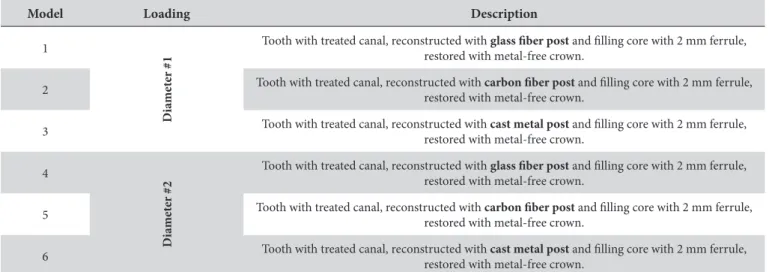
Six models were simulated with the natural proportions of an upper central incisor and its constituent parts (crown / root) and the periodontal structure (alveolar bone and periodontal ligament). he bone tissues were obtained through a CT scan processed in InVesalius sotware (CTI, Campinas, SP, Brazil). he simpliication of surfaces was realized through the Rhinoceros 4.0 sotware (Seattle, WA, USA), varying the retainer (glass iber post, carbon iber post, and cast metal post) and the diameter of the post (# 1 and # 2) (Table 1).
he diferent simulated retainers (glass iber post, carbon iber post, and cast metal post) showed similar preparations, with endodontic treatment without excessive wear on the internal walls of the dentine, with preparation of 2/3 length of root canal, leaving 3mm obturation of gutta-percha. he interfaces between the post, the restoration, and the coronal structure were illed with resin cement of a 0.1 mm thickness11.
he diameter of the retainer used was simulated with thickness size #1 (1.1 mm in diameter and 0.7 mm in the apical tip) and #2 (1.3 mm in diameter and 0.9 mm at the apical tip) with dimensions obtained from a post Angelus (Reforpost - Angelus, Londrina / PR, Brazil). All simulated teeth had coronary remaining ferrule of 2 mm.
he coronal restoration was simulated with an injectable ceramic material (lithium disilicate - IPS Empress II) built from the outer contour of the natural crown of the dental element. Full peripheral preparation was performed with a wide chamfer and with a conventional thickness of this type of restoration (2 mm to the incisal, 1.5 mm to the vestibular, and 1.2 mm to the palatal portion).
Ater preparation of the drawings, they were exported to FEMAP 11.0 sotware (Siemens PLM Sotware, Plano, TX, USA) for incorporation of the attributes according to the mechanical properties of each material (Table 2). Moreover, the meshes of the inite element models were generated, with all the materials
Table 1. Speciication of the models used in this study
Model Loading Description
1
Di
ame
te
r #1
Tooth with treated canal, reconstructed with glass iber post and illing core with 2 mm ferrule, restored with metal-free crown.
2 Tooth with treated canal, reconstructed with carbon iber post and illing core with 2 mm ferrule, restored with metal-free crown.
3 Tooth with treated canal, reconstructed with cast metal post and illing core with 2 mm ferrule, restored with metal-free crown.
4
Di
ame
te
r #2
Tooth with treated canal, reconstructed with glass iber post and illing core with 2 mm ferrule, restored with metal-free crown.
5 Tooth with treated canal, reconstructed with carbon iber post and illing core with 2 mm ferrule, restored with metal-free crown.
considered homogeneous, isotropic, and linearly elastic ater analysis in a plane state of tension.
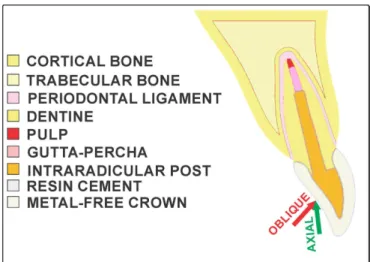
Loads were simulated in the axial and oblique directions, with 100N load applied approximately 2 mm below the incisal edge (natural point of contact) in both situations. he axial load was applied parallel to the simulated tooth, while the oblique loading was undertaken at a 30º angle related to the long axis of the tooth. he models were ixed in the upper base of cortical bone in the x and y directions, preventing the movement of this base. he stress generated by loading applications were distributed internally in the simulated structures (Figure 1). Ater generating the analyses in the inite element sotware, they were calculated using NEiNastran 9.2 (Noran Engineering, Inc., Westminster, CA, USA) sotware. he results were then imported again into the inite element sotware for plotting the maps of the von Mises stress.
hree-way (retainer, diameter, and loading) analysis of variance (ANOVA) and the Tukey post-hoc test were used to analyze the interactions between the main results with the statistical sotware (Sigma Plot 13; Systat Sotware, Inc) (p<0.05).
RESULT
Concerning simulated loading, the oblique loading showed higher stress values in comparison with the axial load (p<0.001). he glass iber post showed lower stress concentrations in comparison with the carbon iber post and the cast metal post for both loads (p<0.001). Under the axial load, there was no signiicant diference between the carbon iber post and the cast metal post (p=0.133), but with the oblique loading, the carbon iber post showed better stress distribution than the cast metal post (p=0.007). he diameter
showed no signiicant inluence on the stress distribution of the retainers (p=0.302) (Figure 2).
DISCUSSION
he irst null hypothesis was rejected, because better stress distribution was observed in the glass iber post models. his result corroborates other studies that have demonstrated advantages to the use of the glass iber post under diferent biomechanical tests2,17-20, reinforcing the assertion that in clinical situations, such as those simulated in this study (coronal structure with ferrule of 2 mm), the ferrule presence was an essential condition for the success of the prosthetic restoration2,5.
here are some factors that may have contributed to this more homogeneous tension distribution in the glass iber post. he main factor relates to the elastic modulus of this material, which is closer to the dentine structure19. hus, when material shows higher elastic modulus, as the cast metal post and the carbon iber post there is stress concentration in the retainer21. In addition, the low modulus of elasticity could inluence the greater stress transferred to the tooth structure8. However, in this study, higher stresses were not observed in the root region when the tooth was restored with the glass iber post.
In this context, besides the better stress distribution along the glass iber post, some authors have found that the fracture of the glass iber post, which is due to the lexibility of the material, is more favorable in terms of avoiding catastrophic failures such as fractures in the middle or apical dental root. he latter commonly occur in materials with a high modulus of elasticity2,20,21. It should be emphasized, however, that, in this study, the simulation was performed only on a single restoration unit considering a single unit of restoration. Factors such as the increased load on the tooth, which is observed in retainers of removable dentures, can increase this stress distribution. hus, it is important the performance of new studies to evaluate these situations.
he stress distribution on the carbon iber post showed similarity with that of the cast metal post under axial loading. hese results may have been inluenced by the use of a metallic alloy such as
Table 2. Mechanical properties of simulated materials
Structure/ Materials Elastic Modulus (GPa) Poisson Ratio References
Enamel 41.0 0.30 Ko et al.12
Dentine 18.6 0.31 Ko et al.12
Pulp 0.0005 0.45 Genovese et al.13
Periodontal
ligament 68.9 × 10 –3 0.45 Ko et al.
12
Cortical bone 13.7 0.30 Ko et al.12
Trabecular bone 1.37 0.30 Ko et al.12
Gutta-percha 0.69 × 10 –3 0.45 Ko et al.12
Resin cement
and Filling core 7.0 0.30 Genovese et al.
13
Glass iber post 40.0 0.22 Durmus et al.8
Carbon iber
post 125.0 0.25 Chuang et al.
14
Cu-Al alloy 109.08 0.33 Coelho et al.15
IPS Empress 65.0 0.30 Imanishi et al.16
copper-aluminum, which exhibits an elastic modulus close to that of the carbon iber post14,15. herefore, it is recommended to avoid the use of an alloy that has a high elastic modulus, such as the Ni-Cr2, as this has approximately twice the stifness. he high elastic modulus could enhance the stress concentrations for the retainer and the tooth, especially in the case of oblique loading, as a signiicant diference was observed for the cast metal post compared to the other retainers.
he second hypothesis was accepted, as there was no observed inluence of the diameter of the post on the stress distribution of the retainers. In this study, the intraradicular wear were considered with standardized dimensions, as there was no inluence of the root resistance (maximum 1/3 of the buccolingual diameter)10. Furthermore, the increase in the diameter of the retainers was only 0.2 mm (diameter # 1 to # 2). In situations where the dentin structure exhibits greater wear (more than 0.2 mm), it would be necessary to use a post with a larger diameter, and this could directly inluence the stress distribution22.
hus, for the glass iber post, the clinician should be expected to use the diameter that best its the root canal, whereas, when the prepared root canal it is greater than diameter of the post, the most suitable method is to use accessories post or to use the technique of relining post10. For the cast metal post, on the other hand, a suitable preparation (2/3 of the root implantation) and a minimum axial thickness of the walls is essential to avoid catastrophic failure10.
he inite element method has been used to identify the selection of the post, to perform the failure analysis, and consequently, to facilitate the treatment prognosis. However, the limitations of this methodology must be recognized. Although the three-dimensional method is preferable to more complex structures, the two-dimensional method is efective when it comes to comparing the biomechanical aspect of a single unit tooth, which is acceptable for analyzing the results23,24. his can be done without depending on the computational capacity of high-performance processing due to the simpliication of the mathematical calculation25.
CONCLUSION
Within the limitations of this study, the following conclusions can be drawn: 1) The glass fiber post showed better stress distribution when compared with other retainers; 2) the increase of the simulated diameter showed no signiicant inluence on the stress distribution; and 3) the oblique loading was more harmful to the root and the retainers.
ACKNOWLEDGEMENTS
Research Foundation of the State of São Paulo – FAPESP
#Grant:11/20947-7.
REFERENCES
1. Al-Omiri MK, Mahmoud AA, Rayyan MR, Abu-Hammad O. Fracture resistance of teeth restored with post-retained restorations: an overview. J Endod. 2010 Sep;36(9):1439-49. http://dx.doi.org/10.1016/j.joen.2010.06.005. PMid:20728706.
2. Verissimo C, Simamoto PC Jr, Soares CJ, Noritomi PY, Santos-Filho PC. Effect of the crown, post, and remaining coronal dentin on the biomechanical behavior of endodontically treated maxillary central incisors. J Prosthet Dent. 2014 Mar;111(3):234-46. http://dx.doi. org/10.1016/j.prosdent.2013.07.006. PMid:24199605.
3. Zhou L, Wang Q. Comparison of fracture resistance between cast posts and fiber posts: a meta-analysis of literature. J Endod. 2013 Jan;39(1):11-5. http://dx.doi.org/10.1016/j.joen.2012.09.026. PMid:23228250.
4. Torbjörner A, Fransson B. Biomechanical aspects of prosthetic treatment of structurally compromised teeth. Int J Prosthodont. 2004 Mar-Apr;17(2):135-41. PMid:15119862.
5. Clavijo VG, Reis JM, Kabbach W, Silva AL, Oliveira OB Jr, Andrade MF. Fracture strength of flared bovine roots restored with different intraradicular posts. J Appl Oral Sci. 2009 Nov-Dec;17(6):574-8. http://dx.doi.org/10.1590/S1678-77572009000600007. PMid:20027429. 6. Figueiredo FE, Martins-Filho PR, Faria e Silva AL. Do metal post-retained restorations result in more root fractures than fiber post-retained
restorations? A systematic review and meta-analysis. J Endod. 2015 Mar;41(3):309-16. http://dx.doi.org/10.1016/j.joen.2014.10.006. PMid:25459568.
7. Sarkis-Onofre R, Jacinto RC, Boscato N, Cenci MS, Pereira-Cenci T. Cast metal vs. glass fibre posts: a randomized controlled trial with up to 3 years of follow up. J Dent. 2014 May;42(5):582-7. http://dx.doi.org/10.1016/j.jdent.2014.02.003. PMid:24530920.
8. Durmus G, Oyar P. Effects of post core materials on stress distribution in the restoration of mandibular second premolars: a finite element analysis. J Prosthet Dent. 2014 Sep;112(3):547-54. http://dx.doi.org/10.1016/j.prosdent.2013.12.006. PMid:24630398.
9. Sumitha M, Kothandaraman R, Sekar M. Evaluation of post-surface conditioning to improve interfacial adhesion in post-core restorations. J Conserv Dent. 2011 Jan;14(1):28-31. http://dx.doi.org/10.4103/0972-0707.80728. PMid:21691501.
10. Barcellos RR, Correia DP, Farina AP, Mesquita MF, Ferraz CC, Cecchin D. Fracture resistance of endodontically treated teeth restored with intra-radicular post: the effects of post system and dentine thickness. J Biomech. 2013 Oct;46(15):2572-7. http://dx.doi.org/10.1016/j. jbiomech.2013.08.016. PMid:24055192.
11. Chang YH, Lin WH, Kuo WC, Chang CY, Lin CL. Mechanical interactions of cuspal-coverage designs and cement thickness in a cusp-replacing ceramic premolar restoration: a finite element study. Med Biol Eng Comput. 2009 Apr;47(4):367-74. http://dx.doi.org/10.1007/ s11517-008-0379-y. PMid:18679734.
12. Ko CC, Chu CS, Chung KH, Lee MC. Effects of posts on dentin stress distribution in pulpless teeth. J Prosthet Dent. 1992 Sep;68(3):421-7. http://dx.doi.org/10.1016/0022-3913(92)90404-X. PMid:1432755.
13. Genovese K, Lamberti L, Pappalettere C. Finite element analysis of a new customized composite post system for endodontically treated teeth. J Biomech. 2005 Dec;38(12):2375-89. http://dx.doi.org/10.1016/j.jbiomech.2004.10.009. PMid:16214485.
14. Chuang SF, Yaman P, Herrero A, Dennison JB, Chang CH. Influence of post material and length on endodontically treated incisors: an in vitro and finite element study. J Prosthet Dent. 2010 Dec;104(6):379-88. http://dx.doi.org/10.1016/S0022-3913(10)60171-0. PMid:21095401. 15. Coelho CS, Biffi JC, Silva GR, Abrahão A, Campos RE, Soares CJ. Finite element analysis of weakened roots restored with composite resin
and posts. Dent Mater J. 2009 Nov;28(6):671-8. http://dx.doi.org/10.4012/dmj.28.671. PMid:20019417.
16. Imanishi A, Nakamura T, Ohyama T, Nakamura T. 3-D Finite element analysis of all-ceramic posterior crowns. J Oral Rehabil. 2003 Aug;30(8):818-22. http://dx.doi.org/10.1046/j.1365-2842.2003.01123.x. PMid:12880406.
17. Torres-Sanchez C, Montoya-Salazar V, Cordoba P, Velez C, Guzman-Duran A, Gutierrez-Perez JL, et al. Fracture resistance of endodontically treated teeth restored with glass fiber reinforced posts and cast gold post and cores cemented with three cements. J Prosthet Dent. 2013 Aug;110(2):127-33. http://dx.doi.org/10.1016/S0022-3913(13)60352-2. PMid:23929374.
18. Santos AF, Meira JB, Tanaka CB, Xavier TA, Ballester RY, Lima RG, et al. Can fiber posts increase root stresses and reduce fracture? J Dent Res. 2010 Jun;89(6):587-91. http://dx.doi.org/10.1177/0022034510363382. PMid:20348486.
19. Dejak B, Mlotkowski A. Finite element analysis of strength and adhesion of cast posts compared to glass fiber-reinforced composite resin posts in anterior teeth. J Prosthet Dent. 2011 Feb;105(2):115-26. http://dx.doi.org/10.1016/S0022-3913(11)60011-5. PMid:21262409. 20. Silva NR, Raposo LH, Versluis A, Fernandes-Neto AJ, Soares CJ. The effect of post, core, crown type, and ferrule presence on the biomechanical
behavior of endodontically treated bovine anterior teeth. J Prosthet Dent. 2010 Nov;104(5):306-17. http://dx.doi.org/10.1016/S0022-3913(10)60146-1. PMid:20970537.
21. Kaya BM, Ergun G. The effect of post length and core material on root fracture with respect to different post materials. Acta Odontol Scand. 2013 Sep;71(5):1063-70. http://dx.doi.org/10.3109/00016357.2012.741706. PMid:23163305.
22. Wang CH, Du JK, Li HY, Chang HC, Chen KK. Factorial analysis of variables influencing mechanical characteristics of a post used to restore a root filled premolar using the finite element stress analysis combined with the Taguchi method. Int Endod J. 2015 In press. http://dx.doi. org/10.1111/iej.12499. PMid:26172249.
23. Romeed SA, Fok SL, Wilson NH. A comparison of 2D and 3D finite element analysis of a restored tooth. J Oral Rehabil. 2006 Mar;33(3):209-15. http://dx.doi.org/10.1111/j.1365-2842.2005.01552.x. PMid:16512887.
25. Holmgren EP, Seckinger RJ, Kilgren LM, Mante F. Evaluating parameters of osseointegrated dental implants using finite element analysis--a two-dimensional comparative study examining the effects of implant diameter, implant shape, and load direction. J Oral Implantol. 1998;24(2):80-8. http://dx.doi.org/10.1563/1548-1336(1998)024<0080:EPOODI>2.3.CO;2. PMid:9835834.
CONFLICTS OF INTERESTS
he authors declare no conlicts of interest.
*CORRESPONDING AUTHOR
Fellippo Ramos Verri, Departamento de Materiais Odontológicos e Prótese Dentária, Faculdade de Odontologia de Araçatuba, UNESP – Universidade Estadual Paulista, Rua José Bonifácio, 1193, 16015-050 Araçatuba - SP, Brasil, e-mail: [email protected]