Mario Vianna VettoreI
Silvana Granado Nogueira da GamaII
Gabriela de Almeida LamarcaII Arthur Orlando Corrêa SchilithzII
Maria do Carmo LealII
I Instituto de Estudos em Saúde Coletiva. Universidade Federal do Rio de Janeiro. Rio de Janeiro, RJ, Brasil
II Programa de Pós-Graduação de Epidemiologia em Saúde Pública. Escola Nacional de Saúde Pública Sergio Arouca. Fundação Oswaldo Cruz. Rio de Janeiro, RJ, Brasil
Correspondence: Mario Vianna Vettore
Instituto de Estudos em Saúde Coletiva Universidade Federal do Rio de Janeiro Praça Jorge Machado Moreira, Ilha do Fundão Cidade Universitária
21944-970 Rio de Janeiro, RJ, Brasil E-mail: [email protected] Received: 10/29/2009 Approved: 4/26/2010
Article available from: www.scielo.br/rsp
Housing conditions as a social
determinant of low birthweight
and preterm low birthweight
Condições de moradia como
determinante social de baixo peso ao
nascer e prematuro de baixo peso
ABSTRACT
OBJECTIVE: To assess the relationship between housing conditions and low
birthweight and preterm low birthweight among low-income women.
METHODS: A case-control study was conducted with post-partum women
living in the city of Rio de Janeiro, Southeast Brazil, in 2003-2005. Two groups of cases, low birthweight (n=96) and preterm low birthweight infants (n=68), were compared against normal weight term controls (n=393). Housing conditions were categorized into three levels: adequate, inadequate, and highly inadequate. Covariates included sociodemographic and anthropometric characteristics, risk behaviors, violence, anxiety, satisfaction during pregnancy, obstetric history and prenatal care.
RESULTS: Poor housing conditions was independently associated with low
birthweight (inadequate – OR 2.3 [1.1;4.6]; highly inadequate – OR 7.6 [2.1;27.6]) and preterm low birthweight (inadequate – OR 2.2 [1.1;4.3]; highly inadequate – OR 7.6 [2.4;23.9]) and factors associated with outcomes were inadequate prenatal care and previous preterm birth. Low income and low maternal body mass index remained associated with low birthweight.
CONCLUSIONS: Poor housing conditions were associated with low
birthweight and preterm low birthweight.
DESCRIPTORS: Housing. Premature Birth. Infant, Low Birth Weight.
The conceptual framework of social determinants of health suggests that distal causes of diseases, i.e., “causes of the causes,” should be addressed.14 They include
the nature of social conditions that affect health and mechanisms through which these conditions produce their effects.14 Social determinants include
unemploy-ment, unsafe workplaces, poor urban living conditions, globalization and lack of access to health care.23 Poor
housing conditions refl ect social deprivation and can be considered a cause and a consequence of poverty. Low birth weight (LBW) preterm, defi ned as birth weigh <2,500 g and gestational age at birth <37 weeks, are an important cause of morbidity and mortality in newborns in Latin America. Developing countries have focused their efforts on maternal and child health issues. Despite extensive research on LBW etiology, it remains unknown in over 30% of clinical cases.3 Studies have mainly focused on the
relation-ship between undesirable pregnancy outcomes and parental education level, family income, father’s occu-pational status and marital status.1,2,8,10 Few studies on
social determinants of pregnancy outcomes have been conducted, especially in developing countries. Most
RESUMO
OBJETIVO: Avaliar a relação entre condições de moradia e baixo peso ao
nascer e prematuridade associada ao baixo peso ao nascer nos fi lhos de mulheres de baixa renda.
MÉTODOS:Foi realizado estudo caso-controle com mulheres no pós-parto
residentes no município do Rio de Janeiro, RJ, em 2003–2005. Dois grupos de casos foram comparados com controles a termo e com peso normal (n = 393): baixo peso ao nascer (n = 96) e prematuridade associada ao baixo peso ao nascer (n = 68). As condições de moradia foram consideradas nos níveis: adequadas, inadequadas e muito inadequadas. As covariáveis investigadas foram características sociodemográfi cas, antropométricas, hábitos de risco, violência, ansiedade, satisfação com a gravidez, história obstétrica e cuidados pré-natais.
RESULTADOS: Condições de moradia inadequadas foram independentemente
associadas com baixo peso ao nascer (Inadequadas – OR = 2,3 (1,1;4,6) e muito inadequadas – OR = 7,6 (2,1;27,6) e com prematuridade associada ao baixo peso ao nascer (inadequadas – OR = 2,2 (1,1;4,3) e muito inadequadas – OR = 7,6 (2,4;23,9). Fatores associados com os desfechos incluíram cuidados pré-natais inadequados e prematuridade prévia. Baixa renda e baixo índice de massa corporal materno foram associados com baixo peso ao nascer.
CONCLUSÕES: Condições de moradia inadequadas foram associadas com
baixo peso ao nascer e prematuridade associada ao baixo peso ao nascer.
DESCRITORES: Habitação. Nascimento Prematuro. Recém-Nascido
de Baixo Peso. Fatores de Risco. Fatores Socioeconômicos. Estudos de Casos e Controles.
INTRODUCTION
Brazilian studies have included women receiving care in both private and public hospitals with signifi cantly different social factors.2,10 Positive associations between
social characteristics and pregnancy outcomes have been described;2,10 however, no study has addressed
the potential effect of inadequate social conditions on LBW of infants born to low-income women.
Differences in socioeconomic condition might affect health outcomes, even in deprived areas where people seem to be exposed to the same risks. This hypothesis is consistent with Wilkinson’s theory, which suggests that, within societies, health is affect by social condition rather than extremes of wealth and poverty. There is a continuous gradient in health outcomes that runs across the whole society.23 Studies in Britain17 and US15 have
evidenced a gradient in health within countries. A theoretical framework of LBW and preterm low birth-weight (PTLBW) determinants is presented in Figure. Since housing conditions is a stable proxy measure of material status and social deprivation16 we decided to
by socioeconomic variables; level 2 – anthropometric characteristics, psychosocial factors and prenatal care; and level 3 – demographic characteristics, unhealthy behaviors and satisfaction during pregnancy, obstetric history and diseases during pregnancy.
The present study aimed to assess the relationship between housing conditions and LBW and PTLBW among low-income women.
METHODS
A case-control study was carried out including births recorded at four public maternity hospitals in the city of Rio de Janeiro, Southeastern Brazil, between July 2003 and June 2005. The research study was focused on determinants of undesirable pregnancy outcomes and related aspects of access to health care.
The power of the study was 75% based on the ratio of 1:3 case-controls to detect a 10% difference between groups at a 5% signifi cance level. The sample size was estimated to allow comparing proportions in different-size samples24 given a 15% rate of women living in
poor housing conditions (non-urbanized area/no sewage system) in the reference population.10
The inclusion criteria included women aged 30 years or more who delivered a liveborn infant in the preceding three days. The criterion of 30 years of age was used based on the assumption that pregnant adolescents are often single and tend to move from their usual home during pregnancy; and thus the potential effect of housing condition on birth weight would be biased if they were included in the study. In addition, the prevalence of LBW and PTLBW are high among those younger than 18 and older than 30.
The exclusion criteria were: preterm births, HIV infec-tion, and hypertension and diabetes mellitus before pregnancy.
Infants born before 37 completed weeks of pregnancy were considered preterm.24 The estimated gestational
age was assessed using the last menstrual period (LMP),4
calculated by subtracting the last menstrual period from the delivery date reported by the mother. The Naegele’s rule was applied by subtracting three months and adding seven days to the fi rst day of the last menstrual period to calculate the expected date of delivery. Only full weeks were considered. When there was no information avail-able on the last menstrual period, Capurro6 score was
used to estimate gestational age. The reliability analysis between LMP and Capurro score was tested by intraclass correlation coeffi cient. The intraclass correlation
coef-fi cient of agreement was 0.92.
LBW newborns were those weighing less than 2,500 g at birth. All newborns were weighed immediately after delivery using calibrated scales. Infant weight data were
obtained from medical records. Two groups of cases were included: LBW and PTLBW infants.
A pre-test study was conducted including 40 puerperal women to test the study questionnaire. We decided to collect information on mother’s income because most women were not able to provide information on family income. A pilot study was then carried out by six trained investigators to check the fi nal version of the study questionnaire and to assess the feasibility of using the inclusion criteria set for the study in the same maternity hospitals.
The interviewers examined all medical records and those mothers eligible were invited to participate in the study. A questionnaire was applied to the mothers who accepted to participate to exclude those who did not meet the inclusion criteria.
Of 1,467 puerperal women assessed for eligibility, 172 (11.7%) refused to participate. Of 1,295 who agreed to participate, 806 were excluded for the following reasons: preterm births (N=110), HIV infection (N=26), chronic hypertension (N=574), and diabetes mellitus before pregnancy (N=96).
Data were collected on infants born to 489 mothers aged between 30 and 47 years: 96 LBW, 68 PTLBW, and 393 normal weight term. Around 45% of the sample were living in inadequate housing conditions (levels 1 and 2), which resulted in a statistical power greater than 75%. We collected data from 489 puerperal women randomly selected among those who delivered liveborn infants in public maternity hospitals in Rio de Janeiro. The maternity units involved are referral centers for high-risk pregnancies and are managed by the Brazilian National Health System (SUS).
Housing conditions and covariate data were obtained from structured interviews and medical records. Housing conditions were categorized into three levels according to internal and external characteristics: adequate (refer-ence level) – internal and external housing conditions were adequate; inadequate (level 1) – either internal or external housing conditions were inadequate; and highly inadequate (level 2) – both internal and external housing conditions were inadequate. Internal housing characteristics were inadequate when it included all the following: overcrowding; non-carpet fl oor covering; walls made of clay, straw, wood, plastic or metal; and no fl ush toilet in the bathroom. Inadequate external housing characteristics included no sewage system or pit and open sewage pit on the street.
Sociodemographic and anthropometric characteristics included age, skin color, maternal schooling, marital status, work status, mother’s income and body mass index (BMI). Skin color was self-referred by mothers. BMI was used to classify the mothers as low weight (BMI <18.5 kg/m2) and non-low weight (BMI ≥18.5
kg/m2). Self-reported smoking during pregnancy
was recorded. Alcohol abuse during pregnancy was assessed using the Tolerance, Annoyed, Cut down and Eye-opener (T-ACE) questionnaire.20
Mothers were asked if they experienced physical violence during pregnancy. Anxiety was assessed with the Trait Anxiety Inventory,21 and they were asked about
their satisfaction during pregnancy and feelings about being pregnant.
Prenatal care attendance was assessed based on the number of prenatal care visits. Prenatal care was consid-ered inadequate when women had less than four visits. Self-reported information on hypertension, anemia, gestational diabetes and infections during pregnancy was also collected. Obstetric history included parity and previous preterm.
All statistical analyses were carried out using SPSS 13.0. The signifi cance level established for all analyses was 5%. Internal consistency for the anxiety scales were evaluated using Cronbach’s alpha coeffi cient. Covariates were assessed for each subject and then by group. Bivariate analysis was performed to identify signifi cant associations of a series of independent variables with LBW and PTLBW through crude odds ratios.
Hierarchical multivariate logistic regression was performed to examine the association of poor housing conditions with LBW and PTLBW, adjusting for covariates. The covariates with p≤0.20 in the bivariate analysis were included in the logistic regression. The stepwise forward selection of risk factors in different blocks was used according to the theoretical framework presented in Figure. The fi rst block included socioeco-nomic variables; the second block included anthro-pometric characteristics, psychosocial factors and prenatal care; and the third block included demographic characteristics, unhealthy behaviors and satisfaction during pregnancy, obstetric history and diseases during pregnancy. The signifi cance of additional variables was tested at each stage and non-signifi cant ones (p>0.20) were excluded to reduce discrepancy between the data and the model and reach an economic model with relatively few parameters.9
The study was approved by the Research Ethics Committee of the Escola Nacional de Saúde Pública Sérgio Arouca Fiocruz, protocol no. 78/02, 12/26/2002, and all participants signed an informed consent form.
RESULTS
The descriptive characteristics of housing conditions and covariates and the associations of those variables with LBW and PTLBW are presented in Tables 1 and 2. Most women had low income and low education level. The prevalence of women living in inadequate housing conditions was 43.5%. Inadequate housing conditions and being divorced/widowed were signifi cantly associ-ated with LBW.
Mean age of the sample population was 34.1 (SD 3.6) years and the predominant self-reported skin color was mixed. Few women reported alcohol abuse and physical violence during pregnancy. The majority of mothers were satisfi ed during the current pregnancy, but less than half of them were planned pregnancies. The LBW and PTLBW group had a signifi cantly higher proportion of women smoking during pregnancy. The rates of alcohol abuse, physical violence, and contraceptive use were not statistically different between cases and controls. Although few women were low weight at the beginning of their pregnancies (8.2%), low weight predominated among mothers who delivered LBW newborns. Higher anxiety scores and inadequate prenatal care were more common among mothers of LBW and PTLBW infants (p<0.005). The Cronbach’s alpha coeffi cient for the anxiety questionnaire was 0.84.
Although parity was similar between cases and controls, LBW and PTLBW cases were more likely to have had previous preterm infants. There were no differences in the proportions of anemia, gestational diabetes and infections between LBW mothers and controls.
Figure. Theoretical framework of the determinants of low birth weight and preterm low birth weight. Rio de Janeiro, Southeastern Brazil, 2005.
Societal processes
Anthropometric characteristics, psychosocial factors and prenatal care
Demographic characteristics, harmful habits and satisfaction with pregnancy, obstetric
history and diseases during pregnancy
The fi rst characteristics included in the model were housing conditions, marital status, work during preg-nancy and mother’s income. The relationship between work during pregnancy and LBW was not signifi cant when the variables from the fi rst block were added. Housing conditions, marital status and mother’s income remained signifi cantly associated with LBW. At level 2, the positive associations of anxiety and marital status with LBW disappeared when socioeconomic variables, prenatal care and BMI were included in the model. However, prenatal care and BMI (low weight) remained positively associated with LBW after adjusting for variables at this level and the lower one. At level 3, previously signifi cant variables remained associated
with LBW. In addition, the positive association between previous preterm birth and LBW remained.
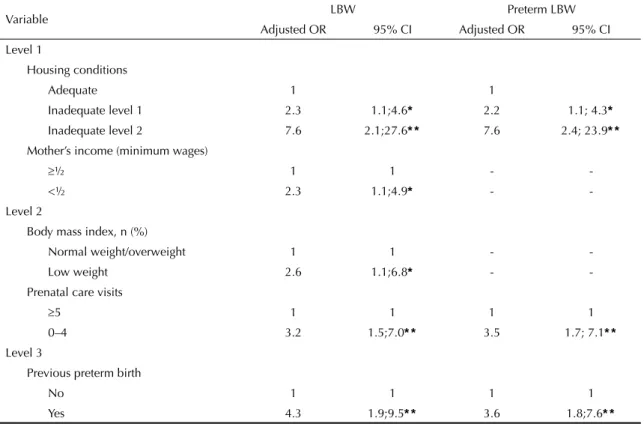
After adjustment for independent variables, the following variables were more strongly associated with LBW (95% CI): inadequate housing conditions level 1 (OR=2.3; 95% CI 1.1;4.6) and highly inadequate housing conditions level 2 (OR=7.6; 95% CI =2.1;27.6), mother’s income (OR=2.3; 95% CI 1.1;4.9), mother’s low weight (OR=2.6; 95% CI 1.1;6.8), inadequate prenatal care (OR=3.2; 95% CI 1.5;7.0) and previous preterm birth (OR=4.3; 95% CI 1.9;9.5) (Table 3). At level 1, the variables housing conditions, marital status, work during pregnancy and mother’s income
Table 1. Association of low birthweight with socioeconomic, anthropometric and anxiety and prenatal care characteristics. Rio de Janeiro, Southeastern Brazil, 2005.
Variable Control LBW OR (95% CI)a PTLBW OR (95% CI)a
n % n % n %
Socioeconomic characteristics Housing conditions
Adequate 229 59.8 39 42.9 1 22 34.4 1
Inadequate level 1 140 36.5 41 45.0 1.7 (1.1;2.8) 32 50.0 2.4 (1.3;4.3)
Inadequate level 2 14 3.7 11 12.1 4.6 (2.0;10.9) 10 15.6 7.4 (3.0;18.7)
Maternal schooling (years)
> 8 years 165 42.2 45 46.9 1 35 61.5 1
≤ 8 years 226 57.8 51 53.1 0.8 (0.5;1.3) 33 48.5 0.7 (0.4;1.2)
Marital status
Married/living with a partner 320 82.3 73 76.1 1 51 75.0 1
Single 57 14.7 15 15.6 1.2 (0.6;2.2) 11 16.2 1.2 (0.6;2.5)
Divorced / Widowed 12 3.1 8 8.3 2.9 (1.2;7.4) 6 8.8 3.1 (1.1;8.7)
Work during pregnancy
Employed/Homemaker 359 93.2 87 90.6 1 59 86.8 1
Unemployed 26 6.8 9 9.4 1.4 (0.7;3.2) 9 13.2 2.1 (0.9;4.7)
Mother’s income (minimum wages)
≥ ½ 186 47.3 37 38.5 1 28 41.2 1
< ½ 207 52.7 59 61.5 1.4 (0.9;2.3) 40 58.8 1.3 (0.8;2.2)
Anthropometric characteristics, anxiety and prenatal care
Body mass index
Normal/overweight 251 93.7 65 85.5 1 47 88.7 1
Low weight 17 6.3 11 14.5 2.5 (1.1;5.6) 6 11.3 1.8 (0.7;5.0)
Trait anxiety
Score 20-37 139 35.4 23 24.0 1 15 22.1 1
Score 38-44 130 33.1 30 31.3 1.4 (0.8;2.5) 21 30.8 1.5 (0.7;3.0)
Score > 44 124 31.5 43 44.7 2.1 (1.2;3.7) 32 47.1 2.4 (1.2;4.6)
Prenatal visits
≥ 5 348 88.5 69 71.9 1 48 70.6 1
0-4 45 11.5 27 28.1 3.0 (1.8;5.2) 20 29.4 3.2 (1.8;5.9)
LBW: Low birthweight; LBW/PT: Low birthweight and preterm; Control: Normal weight term.
Table 2. Association of low birthweight with demographic, behavioral and clinical characteristics. Rio de Janeiro, Southeastern Brazil, 2005.
Variable Control LBW OR (95% CI)a PTLBW OR (95% CI)a
Demographic, unhealthy behaviors and satisfaction during pregnancy
Mothers’ age (years)
30-34 250 63.6 59 61.5 1 44 64.7 1
≥ 35 143 36.4 37 38.5 1.1 (0.7;1.7) 24 35.3 0.95 (0.6;1.6)
Skin color
White 123 31.8 30 31.6 1 19 28.4 1
Mixed 185 47.8 46 48.4 1.0 (0.6;1.7) 33 49.3 1.2 (0.6;2.1)
Black 79 20.4 19 20.0 1.0 (0.5;1.9) 15 22.3 1.2 (0.6;2.6)
Alcohol abuse
No 376 95.7 91 94.8 1 64 94.1 1
Yes 17 4.3 5 5.2 1.2 (0.4;3.4) 4 5.9 1.2 (0.4;3.4)
Smoked during gestation
No 321 91.2 72 83.7 1 50 82.0 1
Yes 31 8.8 14 16.3 2.0 (1.0;4.0) 11 18.0 2.3 (1.1;4.8)
Physical violence during pregnancy
No 379 96.7 91 94.8 1 65 95.6 1
Yes 13 3.3 5 5.2 1.6 (0.6;4.6) 3 4.4 1.4 (0.4;4.9)
Pregnancy intention
Yes 357 93.2 84 89.4 1 61 91.0 1
No 26 6.8 10 10.6 1.6 (0.8;3.5) 6 9.0 1.4 (0.5;3.4)
Mother’s feeling about pregnant
She was trying to get pregnant 183 46.8 47 49.0 1 34 50.0 1
She would like to wait for a while 69 17.6 16 16.7 1.0 (0.6;2.0) 12 17.6 0.9 (0.5;1.9)
She did not want to get pregnant 139 35.5 33 34.4 1.0 (0.6;1.7) 22 32.4 0.9 (0.5;1.5)
Obstetric history and diseases during pregnancy
Parity
0-1 129 32.8 41 42.7 1 31 45.6 1
2 89 22.6 17 17.7 0.6 (0.3;1.2) 12 17.6 0.6 (0.3;1.2)
≥ 3 175 44.6 38 39.6 0.7 (0.4;1.1) 25 36.8 0.6 (0.3;1.1)
Previous preterm
No 295 88.9 46 61.3 1 35 64.8 1
Yes 37 11.1 29 38.7 5.0 (2.8;9.0) 19 35.2 4.3 (2.3;8.3)
Hypertension
No 315 80.6 68 71.6 1 46 68.7 1
Yes 76 19.4 27 28.4 1.6 (1.0;2.8) 21 31.3 1.9 (1.1;3.4)
Anaemia
No 253 64.9 58 61.7 1 43 65.2 1
Yes 137 35.1 36 38.3 1.2 (0.7;1.8) 23 34.8 1.0 (0.6;1.7)
Gestational diabetes
No 372 95.6 89 93.7 1 61 91.0 1
Yes 17 4.4 6 6.3 1.5 (0.6;3.9) 6 9.0 2.2 (0.8;5.7)
Infections
No 281 72.6 64 68.1 1 46 69.7 1
Yes 106 27.4 30 31.9 1.2 (0.8;2.0) 20 30.3 1.2 (0.7;2.0)
LBW: Low birthweight; PTLBW: Low birthweight and preterm; Control: Normal weight term.
Table 4. Improvement of goodness-of-fi t of logistic regression model for low birth weight by adding variables groups stepwise (n=489). Rio de Janeiro, Southeastern Brazil, 2005.
Variable groups of factors in the model Log likelihood Difference of deviance df pa
1 -225,17308 2
2 -218,2787 6,89438 6 0.008
3 -134,3458 83,9329 9 < 0.001
4 -130,26701 4,07879 10 0.004
5 -132,51039 2,24338 6 0.344
a Likelihood ratio test
1. Inadequate housing condition.
2. Inadequate housing condition + marital status + mother’s income.
3. Inadequate housing condition + marital status + mother’s income + inadequate prenatal care + higher levels of anxiety + lower body mass index.
4. Inadequate housing condition + mother’s income + inadequate prenatal care + lower body mass index + smoking during pregnancy + gestational diabetes + gestational hypertension + infections + previous preterm birth.
5. Inadequate housing condition + mother’s income + inadequate prenatal care + lower body mass index + previous preterm birth.
were included in the fi rst model, and remained statis-tically associated with PTLBW. At level 2, of those variables with statistical association with PTLBW in the bivariate analysis – anxiety, marital status, BMI and prenatal care –, only prenatal care maintained a positive association with PTLBW after adjusting for the variables at this level and at the level 1. At level 3, previ-ously signifi cant variables remained associated with
PTLBW. In addition, a positive association between previous preterm birth and PTLBW remained. After adjustment for independent variables, the following variables were found more strongly associ-ated with PTLBW (95% confi dence interval): inad-equate housing conditions level 1 (OR=2.2; 95% CI 1.1;4.3) and highly inadequate housing conditions level
Table 3. Results of the analysis of inadequate housing conditions with preterm low birth weight and low birth weight, adjusted for covariates. Rio de Janeiro, Southeastern Brazil, 2005.
Variable LBW Preterm LBW
Adjusted OR 95% CI Adjusted OR 95% CI
Level 1
Housing conditions
Adequate 1 1
Inadequate level 1 2.3 1.1;4.6* 2.2 1.1; 4.3*
Inadequate level 2 7.6 2.1;27.6* * 7.6 2.4; 23.9* *
Mother’s income (minimum wages)
≥½ 1 1 -
-<½ 2.3 1.1;4.9* -
-Level 2
Body mass index, n (%)
Normal weight/overweight 1 1 -
-Low weight 2.6 1.1;6.8* -
-Prenatal care visits
≥5 1 1 1 1
0–4 3.2 1.5;7.0* * 3.5 1.7; 7.1* *
Level 3
Previous preterm birth
No 1 1 1 1
Yes 4.3 1.9;9.5* * 3.6 1.8;7.6* *
LBW: Low birth weight
2 (OR=7.6; 95% CI 2.4;23.9), inadequate prenatal care (OR=3.5; 95% CI 1.7;7.1) and previous preterm birth (OR=3.6; 95% CI 1.8;7.6) (Table 3).
The variables added at each level signifi cantly improved the explanation of the occurrence of LBW and PTLBW (Tables 4 and 5). In both analysis, the model 5 that included the variables presented in Tables 4 and 5 was considered the most parsimonious one as it included those that signifi cantly explained the target outcome, LBW (p=0.344) and PTLBW (p=0.787).
DISCUSSION
Women living in inadequate housing conditions were likely to have LBW and PTLBW infants compared to those living in adequate housing conditions in Rio de Janeiro. This fi nding is consistent with other Brazilian studies that reported a negative effect of social indica-tors on fetal development when groups with marked social differences were compared.2,10 Other studies on
child health epidemiology found a relationship between poverty, living in a slum area and density of people per room and infant mortality.17,18
Other associated factors with preterm LBW reported in the present study were mother’s income, maternal lower BMI, inadequate prenatal care and previous preterm birth. Similar fi ndings were reported in a survey of approximately 10,000 mothers in Rio de Janeiro.1,11
A study in a rural area of southern Brazil did not fi nd an association between prenatal visits and LBW.8 The
potential risk factors for LBW were hospital admis-sion during pregnancy and maternal age lower than 20.8 Methodological differences, such as the inclusion
criteria for mothers’ age and population characteristics may explain these inconsistent results. The association between maternal anthropometric characteristics and LBW found in the present study was also reported in a
study in Northeast Brazil.19 In contrast with our results,
maternal smoking was associated with LBW.19
One important fi nding of our study regarding maternal and child health from a public health perspective was that social disadvantage affected pregnancy even when women received prenatal care in public services. This is a very relevant data for prenatal care planning of public services in developing countries worldwide.
As in the present study dwelling conditions could easily be assessed by health workers. The identifi cation of families living in inadequate housing conditions could be used as a strategic tool to redefi ne and redirect inter-ventions in a multifactor approach to reduce inequalities regarding preterm LBW among poor people. Taking into account housing conditions in health care actions supports the concept that adequate living conditions is a major component during pregnancy for healthy fetus development and newborns.
In many countries lower socioeconomic people have poorer health outcomes and higher death rates than those who are better off. Poor health is not seen only among the poorest in society. There is a social gradient in health: the lower a person’s social position, the worse their health.14 Since the 1990s the robustness of this
gradient has been shown when different countries were compared.7,12 In European countries there are variations
in health outcomes, such as mortality and life expec-tancy, according to social condition. Socioeconomic gradients in mortality varied between countries and in different age groups, but there were gradients within countries.5,13 Since most studies have been carried out
in European countries and US, little is known about the effect of socioeconomic gradients in developing countries. The present study found a gradient of inad-equate housing conditions with preterm LBW and LBW in low-income women. Similar odds ratios for
Table 5. Improvement of goodness-of-fi t of logistic regression model for preterm low birth weight by adding variables groups stepwise (n=489). Rio de Janeiro, Southeastern Brazil, 2005.
Variable groups of factors in the model Log likelihood Difference of deviance df p-valuea
1 -183,57777 2
2 -181,53670 2,04107 2 <0.001
3 -130,83167 50,70053 4 <0.001
4 -80,513977 50,317693 6 0.037
5 -133,70265 53,188673 4 0.787
a Likelihood ratio test
1. Inadequate housing condition.
2. Inadequate housing condition + marital status + mother’s income + work during pregnancy.
3. Inadequate housing condition + marital status + mother’s income + work during pregnancy + inadequate prenatal care + higher levels of anxiety + lower body mass index.
4. Inadequate housing condition + marital status + mother’s income + work during pregnancy + inadequate prenatal care + higher levels of anxiety + lower body mass index + smoking during pregnancy + parity + gestational diabetes + gestational hypertension + infections + previous preterm birth.
LBW and PTLBW were found among those women living in inadequate internal or external housing condi-tions (2.3 and 2.2, respectively). As housing condicondi-tions became less favorable, the odds ratios increased. The odds ratio for those women living in both internal and external inadequate housing conditions in both case groups increased to 7.6.
Case-control studies are easy-to-perform and feasible. Another advantage is that they are often carried out in more natural settings so that the study population is more representative of the target population. However, the fi ndings from case-control studies are also more prone to bias and confounders, especially classifi ca-tion bias.22 The use of validated methodology for
gestational age assessment as well as calibrated scales and weighting newborns immediately after delivery provided adequate classifi cation of cases and controls. Other strengths of this study include appropriate statis-tical approach through hierarchical logistic regression and use of appropriate instruments to measure covari-ates avoiding potential bias induced by measurement errors. Analytical observational studies are also susceptible to confounding.22 Inclusion and exclusion
criteria and multivariable analysis were the strategies
applied to control for potential confounders, resulting in fi ndings that can be considered valid.
The cross-sectional design used to test the association of poor housing conditions with LBW and PTLBW is the main weakness of the present study. Since no temporal relationship between exposure and outcomes can be inferred in cross-sectional studies, it is not possible to make any causal inferences based on the present fi ndings. Even though mother’s income may result in residual bias to some extent, family income was not used because this information was found to be inaccurate during the pilot study. In addition, the present results are limited to low-income women aged 30 years and more.
1. Andrade CL, Szwarcwald CL, Gama SG, Leal MC. Socioeconomic inequalities and low birth weight and
perinatal mortality in Rio de Janeiro, Brazil. Cad Saude
Publica. 2004;20(Suppl 1):S44-51. DOI:10.1590/ S0102-311X2004000700005
2. Aragao VM, Silva AA, Aragao LF, Barbieri MA, Bettiol H, Coimbra LC, et al. Risk factors for preterm
births in São Luís, Maranhão, Brazil. Cad Saude
Publica. 2004;20(1):57-63. DOI:10.1590/S0102-311X2004000100019
3. Barros FC, Huttly SR, Victora CG, Kirkwood BR, Vaughan JP. Comparison of the causes and consequences of prematurity and intrauterine growth retardation: a longitudinal study in southern Brazil.
Pediatrics. 1992;90(2 Pt 1):238-44.
4. Berg A. Menstrual cycle length and the calculation of
gestational age. Am J Epidemiol. 1991;133(6):585-9.
5. Bos V, Kunst AE, Garssen J, Mackenbach JP.
Socioeconomic inequalities in mortality within ethnic
groups in the Netherlands, 1995-2000. J Epidemiol
Community Health. 2005;59(4):329-35. DOI:10.1136/ jech.2004.019794
6. Capurro H, Konichezky S, Fonseca D, Caldeyro-Barcia R. A simplifi ed method for diagnosis of gestational age
in the newborn infant. J Pediatr. 1978;93(1):120-2.
DOI:10.1016/S0022-3476(78)80621-0
7. Cavelaars AE, Kunst AE, Geurts JJ, Crialesi R, Grötvedt L, Helmert U, et al. Differences in self reported morbidity by educational level: a comparison
of 11 western European countries. J Epidemiol
Community Health. 1998;52(4):219-27. DOI:10.1136/ jech.52.4.219
8. Halpern R, Schaefer ES, Pereira Ada S, Arnt EM, Bezerra JP, Pinto Ldos S. Fatores de risco para baixo peso ao nascer em uma comunidade rural do sul do
Brasil. J Pediatr (Rio J). 1996;72(6):360-1.
9. Kleinbaum DG. Logistic Regression. A self-learning text. New York: Springer-Verlag; 1994. p.447-75.
10. Leal Mdo C, Gama SG, Campos, MR, Cavalini LT, Garbayo LS, Brasil CLP, et al. Fatores associados à morbi-mortalidade perinatal em uma amostra de maternidades públicas e privadas do Município
do Rio de Janeiro, 1999-2001. Cad Saude Publica.
2004;20(Suppl 1):S20-33. DOI:10.1590/S0102-311X2004000700003
11. Leal MC, Gama SGN, Cunha CB. Consequences of
sociodemographic inequalities on birth weight. Rev
Saude Publica. 2006;40(3):466-73. DOI:10.1590/ S0034-89102006000300015
12. Mackenbach JP, Huisman M, Andersen O, Bopp M, Borgan JK, Borrell C, et al. Inequalities in lung cancer mortality by the educational level in 10 European
populations. Eur J Cancer. 2004;40(1):126-35.
DOI:10.1016/j.ejca.2003.10.018
13. Marmot M, Wilkinson RG. Social determinants of health. 2. ed. London: Oxford University Press; 2006. p.54-77.
14. Minkler M, Fuller-Thomson E, Guralnik JM. Gradient of disability across the socioeconomic spectrum in the
United States. N Engl J Med. 2006;355(7):695-703.
DOI:10.1056/NEJMsa044316
15. Naess O, Claussen B, Smith GD. Housing conditions in childhood and cause-specifi c adult mortality: The effect of sanitary conditions and economic deprivation
on 55,761 men in Oslo. Scand J Public Health.
2007;35(6):570-6. DOI:10.1080/14034940701320846
16. Rose G, Marmot M. Social class and coronary heart
disease. Br Heart J. 1981;45(1):13-9. DOI:10.1136/
hrt.45.1.13
17. Schoeps D, Almeida MF, Alencar GP, França Jr I, Novaes HM, Siqueira AA, et al. Risk factors for early neonatal
mortality. Rev Saude Publica. 2007;41(6):1013-22.
DOI:10.1590/S0034-89102007000600017
18. Silva AA, Lamy-Filho F, Alves MT, Coimbra LC, Bettiol H, Barbieri MA. Risk factors for low birthweight in north-east Brazil: the role of caesarean section.
Paediatr Perinat Epidemiol. 2001;15(3):257-64. DOI:10.1046/j.1365-3016.2001.00358.x
19. Sokol RJ, Martier SS, Ager JW. The T-ACE questions:
Practical prenatal detection of risk-drinking. Am J
Obstet Gynecol. 1989;160(4):863-71.
20. Spielberger CD, Gorsuch RL, Lushene RE. Manual for the State-Trait Anxiety Inventory. Palo Alto: Consulting Psychologist Press; 1970.
21. Szklo M, Javier-Nieto F. Epidemiology: Beyond the Basics. Maryland: An Aspen Publishers; 2000. p.177-210.
22. Wilkinson RG. The impact of inequality. How to make sick societies healthier. New York: Routledge; 2005. p.283-318.
23. Zar JH. Biostatistical Analysis. 3.ed. New Jersey: Prentice-Hall International; 1996. p.513-68. REFERENCES