O
RIGINAL
A
R
TICLE
RESUMO
Este estudo avaliou fatores individuais, rela vos ao trabalho e organizacionais re-lacionados à adesão às precauções-padrão por profissionais de enfermagem que atuam em terapia intensiva. Estudo de corte transversal, realizado com 178 profi ssionais em um hospital de grande porte. Para a coleta de dados foram utilizadas escalas psicométricas do po Likert. Na Escala de Adesão às precauções-padrão obteve-se um escore de 4,45 (DP=0,27) classifi cado como
intermediário. Houve correlação quando comparada com fatores individuais para Escala de Personalidade de Risco (r=-0,169; p=0,024) e fatores relativos ao trabalho com a Escala de Obstáculos para seguir as precauções-padrão (r=-0,359; p=0,000). A adesão às precauções-padrão entre profi
s-sionais de enfermagem foi intermediária. Fatores individuais e rela vos ao trabalho
in-fl uenciaram a adesão às precauções-padrão.
DESCRITORES Precauções universais Terapia intensiva Equipe de enfermagem Saúde
ABSTRACT
This study evaluated individual factors rela ng to work and the organiza on, related to adherence to standard precau ons for nurses working in intensive care. It was a cross-sectional study conducted in a large hospital with 178 professionals. For data collec on, Likert-type psychometric scales were used. In the Adherence Scale to Standard Precautions we obtained a score of 4.45 (SD=0.27), classified as intermediate. There was a correla on when compared with the individual risk factors of the Scale of the Risk Personality (r=-0.169, p=0.024) and the factors related to working with the barriers of the Scale for following standard precau ons (r=-0.359, p=0.000). Adherence to standard precau ons among the nursing professionals was intermediate. Individual factors and factors related to work infl uenced the adherence to standard precau ons.
DESCRIPTORS Universal precau ons Intensive care Nursing, team Occupa onal health
RESUMEN
Este estudio evaluó factores individuales, rela vos al trabajo, y organizacionales, re-lacionados a la adhesión a las precauciones estándar por parte de profesionales de enfermería actuantes en terapia intensiva. Estudio de corte transversal, realizado con 178 profesionales en hospital de gran porte. Datos recolectados u lizando escalas psicométricas del po Likert. En la Escala de Adhesión a las Precauciones Estándar se obtuvo un puntaje de 4,45 (DE=0,27), clasifi cado como
interme-dio. Exis ó correlación cuando se la comparó con factores individuales para la Escala de Personalidad de Riesgo (r=-0,169; p=0,024) y factores rela vos al trabajo con la Escala de Obstáculos para seguir las precauciones estándar (r=-0,359; p=0,000). La adhesión a las precauciones estándar entre profesionales de enfermería resultó intermedia. Factores individuales y rela vos al trabajo infl uyeron en la adhesión a las precauciones estándar.
DESCRIPTORES Precauciones universales Cuidados intensivos Grupo de enfermería Salud laboral
Adherence to standard precautions of
nurses working in intensive care at a
university hospital
ADESÃO ÀS PRECAUÇÕES-PADRÃO POR PROFISSIONAIS DE ENFERMAGEM QUE ATUAM EM TERAPIA INTENSIVA EM UM HOSPITAL UNIVERSITÁRIO
ADHESIÓN A LAS PRECAUCIONES ESTÁNDAR DE PROFESIONALES DE ENFERMERÍA ACTUANTES ENTERAPIA INTENSIVA DE UN HOSPITAL UNIVERSITARIO
Fernanda Maria Vieira Pereira1, Silmara Elaine Malaguti-Toffano2, Adriana
Maria da Silva3, Silvia Rita Marin da Silva Canini4, Elucir Gir5
*Extracted from the dissertation, “Adesão às precauções-padrão por profi ssionais de enfermagem que atuam em terapia intensiva de um hospital universitário do interior paulista” School of Nursing, Universidade de São Paulo - Ribeirão Preto, 2011. 1 Nurse. Master’s in Nursing of the General and Specialized Nursing
Program, School of Nursing, Universidade de São Paulo - Ribeirão Preto. Ribeirão Preto, SP, Brazil. [email protected] 2 Nurse. Adjunct
Professor, School of Nursing, Universidade Federal de São João Del Rei Divinópolis, MG, Brazil. [email protected] 3 Nurse. Doctoral student
in Nursing of the General and Specialized Nursing Program, School of Nursing, Universidade de São Paulo - Ribeirão Preto. Ribeirão Preto, SP, Brazil. [email protected] 4 Nurse. Professor. Coordinator of the Center for Research on AIDS and STIs, School of Nursing, Universidade de São Paulo
- Ribeirão Preto. Ribeirão Preto, SP, Brazil. [email protected] 5 Nurse. Full Professor, School of Nursing, Universidade de São Paulo - Ribeirão Preto.
INTRODUCTION
Intensive Care Units (ICU) are closed sectors where cri cal pa ents are a ended who require high complexity care. Invasive procedures are commonly performed, which favors the exposure of professional to biological hazards.
During the care of pa ents, all healthcare professionals must adhere to preven ve measures, in order to reduce the risk of occupa onal exposure and also to ensure the safety of the pa ent(1-2).
The concern with biological hazards was intensifi ed with
the human immunodefi ciency virus (HIV)/AIDS epidemic in the 1980s, with the introduc on of new strategies and norms established for safety issues in the work environment(1).
In 1987, recommenda ons called Universal ons (UP) were created, by the Centers for Disease Control (CDC), which resulted in the publica on of a manual with the purpose of minimizing the risk of transmission of HIV and hepa s B virus (HBV), among health professionals(3). In 1996, the UP were revised and are now
called Standard Precau ons (SP).
In 2007, new precautions were in-troduced(2), emphasizing that preven ve measures should be oriented to the func on of the ac on being developed, considering their poten al for exposure to blood and body fl uids.
Although the ins tu on provides train-ing related to the use of personal protec ve equipment (PPE), the resistance toward its use is s ll observed among the majority of professional nurses(4).
Due to the complexity of care provided in ICUs, the work demand is elevated. Because of this, the quan ty of nurses has to be suffi cient, because a reduced percentage of workers generates work overload or dysfunc on in its actualiza on, hindering the quality of care for cri cally ill pa ents(5).
Occupa onal risks are related to pa ent risks, which, because of several pathologies, are submi ed to a high number of procedures and therapeu c interven ons that can lead to the exposure of professional healthcare work-ers to blood, body fl uids and secre ons from incisions, catheters and probes(6).
A previous study pointed out that the reasons for not using the PPE reported by ICU nursing professionals were: urgency, lack of me, and lack of requirement for use in certain procedures(7).
Aiming to reduce the risks associated with professionals working in the ICU, the adherence to preven ve measures while performing pa ent care is important, such as the SP. Thus, it is necessary to iden fy the factors that infl uence the
direct the prac ce of con nuing educa on and training of nursing staff for adherence to SP in all situa ons, ensuring protec on for these professionals at work.
The objec ve of this study was to evaluate the individual factors, related both to work and organiza ons, related to SP adherence by nursing professionals who work in a university hospital in an inner city of São Paulo state.
METHODS
THIS WAS a transversal cohort study, conducted in the ICU of a public university hospital in São Paulo, during the period of December 2010 to June 2011. The ins tu on was recognized as a reference center in high quality areas of research and is divided into two units containing 27 ICU beds of general adult care, 12 coronary ICU beds, and 4 neurosurgical ICU beds.
All units of adult intensive care within the ins tu on were selected for this study, including the general, coronary and neurosurgery ICU, in which 198 nurses worked, according to a list obtained together with the Human Resources Department of the ins tu on.
The inclusion criteria were determined to be: being a nurse, technical nurse or nursing assistant, ac ng directly in pa ent care, and working in the previously defi ned
inpa ents units. The exclusion criteria were: nursing professionals who performed exclu-sively administra ve func ons, or who le during the collec on period.
Twenty (10.01%) professionals were excluded: one performed exclusively lead-ership ac vity, nine were removed from service for an indefi nite period, four were no longer working in the units, three performed ac vi es with material management, and three refused to par ci-pate in the study. So, the study popula on consisted of 178 professionals of the nursing staff : nurses, technicians and nursing assistants, all of them working in ICU pa ent care.
The data collec on occurred during the period of De-cember of 2010 to June of 2011, during every day of the week, in the morning, a ernoon and night shi s, by means of individual interviews conducted by one of the research-ers in the work area.
The interviews lasted 15 to 20 minutes and doubts about comple ng the instrument were clarifi ed. The researcher
waited for an opportune moment in which the professional had the availability to have a conversa on. The interview was conducted a er clarifi ca on about the research and
a er signing of the Terms of Free and Informed Consent.
To collect the professional and demographic data, an instrument designed for this purpose was used, containing
Aiming to reduce the risks associated
with professionals working in the ICU,
the adherence to preventive measures while performing patient
care is important, such as the Standard
RESULTS
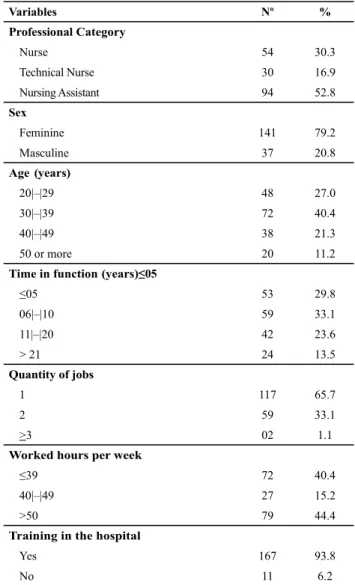
Table 1 shows the professional and demographic data of the 178 professionals surveyed, the majority being female and belonging to the category of nursing assistant.
Table 1 – Professional and demografi c characterization of nur-sing professionals who work in the ICU of a university hospital in São Paulo - Ribeirão Preto, SP, 2010-2011
Variables Nº %
Professional Category
Nurse 54 30.3
Technical Nurse 30 16.9
Nursing Assistant 94 52.8
Sex
Feminine 141 79.2
Masculine 37 20.8
Age (years)
20|–|29 48 27.0
30|–|39 72 40.4
40|–|49 38 21.3
50 or more 20 11.2
Time in function (years)≤05
≤05 53 29.8
06|–|10 59 33.1
11|–|20 42 23.6
> 21 24 13.5
Quantity of jobs
1 117 65.7
2 59 33.1
>3 02 1.1
Worked hours per week
≤39 72 40.4
40|–|49 27 15.2
>50 79 44.4
Training in the hospital
Yes 167 93.8
No 11 6.2
Note: (n=178)
me in the work func on, quan ty of jobs, hours worked per week, and training about the SP. The form and content of this instrument were validated by experts who worked in the area.
Ten Likert-type scales, with a total of 57 items, whose response op ons ranged progressively 1-5, were used for the inves ga on of factors related to adherence. These scales were developed(8-9), translated and validated in our environment(10-11) and grouped into individual dimensions, related to work and organiza ons.
The Individual Factors dimension involved items rela ng to the Formulary of Demographic and Professional Aspects, the Scale of Adherence to SP (13 items), a Knowledge about Occupa onal Transmission of HIV Scale (seven items), the Per-cep on of Risk Scale (three items), the Personality of Risk Scale (four items), and the Effi cacy of Preven on Scale (two items). The Work Factors dimension involved the Obstacles for Following SP Scale (six items) and Workload Scale (three items).
The Organizational Factors dimension included the Safety Climate Scale (12 items), Availability of PPE Scale (two items) and Training in Preven on of Exposure to HIV Scale (four items)
The database was structured in Excel (Windows 2007). Double entry and data valida on were performed to iden fy possible errors.
Sta s cal analysis was performed using the Sta s cal Package for Social Sciences (SPSS), version 15.0, and de-scrip ve sta s cs (frequency, measures of central tendency and dispersion) were used. The correla on of the mean score of the Adherence to SP Scale was performed with other scales, using the Pearson correla on test, considering p 0.05. The Cronbach’s alpha (α) was calculated to evalu-ate the reliability of the scales, with an amplitude ranging from 0 to 1, in which results with values close to 1 indicate higher reliability.
The levels of SP adherence were analyzed by calcula on of simple mean scores of each scale, using the classifi
on(10): high (mean scores greater than or equal to 4.5); intermediate (mean scores with values between from 3.5 to 4.49); and, low (mean scores with values below 3.5).
The item responses of the scales were analyzed ac-cording to the average of the obtained scores. Therefore, all scales achieved a maximum and a minimum score that ranged between 1 to 5. To facilitate the understanding of those values, the items were recoded, so that the higher the value, the greater the perceived intensity.
The project was submi ed to the Commi ee on Ethics and Research and was approved under protocol number 10711/2010. All par cipants had their confi den ality and
anonymity assured, according to Resolu on 196/96 of the
Of the total of the professionals, 141 (79.2%) were fe-male, with ages ranging predominantly from 30 to 39 years (40.4%), and 94 (52.8%) were classifi ed in the category of nursing assistant. Regarding the number of hours worked per week, 79 (44.4%) of the par cipants reported working 50 hours or more. Of the total, 167 (93.8%) reported they had received training in the hospital that occurred within the last 24 months.
The Cronbach’s alpha (α) was calculated for the scales,
Obstacles to Following the SP, (α=0.752); the Effi cacy of Preven on (α=0.387); Percep on of Risk, (α=0.504); Safety Climate (α=0.842); Availability of Personal Protec ve Equip-ment (α=0.710); Workload, (α=0.735) and also the Training in Preven on of Occupa onal Exposure to HIV, (α=0.758) and the Knowledge about Occupa onal Transmission of HIV, (α=0.919).
To facilitate the understanding of the results, the items were described according to the scale to which they belonged, based on the clustering conducted by the previ-ously cited authors(10-11), considering individual, work and organiza onal factors.
Considering the classifi ca on of scores in high ( 4.5), intermediate (3.5 to 4.49) and low (<3.5), there was no high score obtained for any of the individual,
onal or work factors. For the individual factors (N=178),
all scales had intermediate scores: Adherence to SP (4.45), Knowledge about Occupa onal Transmission of HIV (4.44), Percep on of Risk (4.17), the Personality of Risk (4.26), and, Effi cacy of Preven on (4.35).
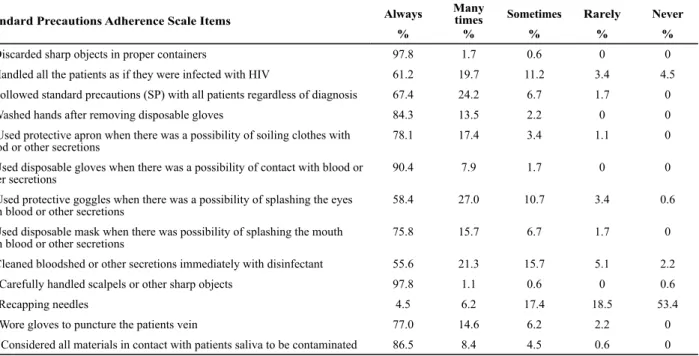
For the Scale of Adherence to SP (Table 2), in the item about the disposal of sharps in appropriate containers, 97.8% of professionals responded that they always per-formed this prac ce, that is, not all of the professionals discard them in the correct way. Regarding hand hygiene a er removing disposable gloves, the alterna ve always corresponded to 84.3% of the responses. Another impor-tant precau on is to use goggles when there is a possibility of splashing in the eyes and mucous membranes; only 58.4% of employees responded that they always used them. For the item, recapping of used needles, the professionals who denied performing this prac ce reached 53.4%.
Table 2 – Distribution of nursing professionals who work in the ICU of a university hospital in São Paulo, according to response to items that compose the Adherence to SP Scale - Ribeirão Preto, SP, 2010-2011
Standard Precautions Adherence Scale Items Always
Many
times Sometimes Rarely Never
% % % % %
1. Discarded sharp objects in proper containers 97.8 1.7 0.6 0 0
2. Handled all the patients as if they were infected with HIV 61.2 19.7 11.2 3.4 4.5
3. Followed standard precautions (SP) with all patients regardless of diagnosis 67.4 24.2 6.7 1.7 0
4. Washed hands after removing disposable gloves 84.3 13.5 2.2 0 0
5. Used protective apron when there was a possibility of soiling clothes with blood or other secretions
78.1 17.4 3.4 1.1 0
6. Used disposable gloves when there was a possibility of contact with blood or other secretions
90.4 7.9 1.7 0 0
7. Used protective goggles when there was a possibility of splashing the eyes with blood or other secretions
58.4 27.0 10.7 3.4 0.6
8. Used disposable mask when there was possibility of splashing the mouth with blood or other secretions
75.8 15.7 6.7 1.7 0
9. Cleaned bloodshed or other secretions immediately with disinfectant 55.6 21.3 15.7 5.1 2.2
10. Carefully handled scalpels or other sharp objects 97.8 1.1 0.6 0 0.6
11. Recapping needles 4.5 6.2 17.4 18.5 53.4
12. Wore gloves to puncture the patients vein 77.0 14.6 6.2 2.2 0
13. Considered all materials in contact with patients saliva to be contaminated 86.5 8.4 4.5 0.6 0
Nota: (n=176)
The Knowledge about Occupa onal Transmission of HIV Scale presents situa ons in which the virus can be transmi ed, and the professionals responded agreeing that transmission could occur in venipuncture without gloves (90.4%), accidents with perfora ng materials from pa ents with HIV (97.2%) and spla er of blood and secre ons (92.1%), among others.
For the Percep on of Risk Scale, composed of ques ons related to the risk of occupa onal exposure, 84.8% reported being exposed to HIV infec on in their work.
With regard to the Personality of Risk Scale, there were
(10.7%), being exposed to hazardous situa ons just for the thrill(3.4%), and preferring unpredictable experiences (7.9%).
The Effi cacy of Preven on Scale approaches items related to the effi ciency in the use of PPE, and 75.5% agreed that the use of disposable gloves provided
on from HIV.
adherence to SP: discomfort using PPE, insuffi cient infor-ma on, lack of me, and general beliefs of diffi cul es for following the SP.
The ques ons about the need for agility and labor demand comprised 87.6% and 91.6% of responses,
vely, for the Workload Scale. The items highlighted such situa ons that are frequently encountered in the execu on of work. Organiza onal factors (N=178) had an intermediate score for Climate of Safety (3.57), Availability of PPE (4.31), and Training for Preven on of HIV exposure (3.82).
The Safety Climate Scale presented an intermediate score close to the low score, according to the classifi ca on. This was related to organiza onal factors that included the management’s commitment to safety of the professional at work as an organiza on value. Thereby, it is clear that this ques on could interfere in the adop on of safety measures for the nursing professional who works in ICU.
In the correla on analysis (N=178), the Personality of Risk Scale (r=-0.169, p=0.024) and Obstacles to Following the SP (r=-0.359, p=0.000) presented a sta s cally signifi
-cant correla on (p<0.05) with the Scale of Adherence to SP.
DISCUSSION
Of the 178 par cipants, there was a predominance of females, corrobora ng results of surveys have shown that women cons tute the largest con ngent of nursing workers(4,11-12).
The professional status of nursing assistant corre-sponded to the majority in this study, represen ng 52.8% of the professionals. Other studies have shown that nurs-ing assistants compose the major part of the staff in these units(13-14). The nursing assistant is allowed to perform simple ac vi es under the supervision of the nurse.
To ensure the quality of intensive care provided to cri cally ill pa ents, possession of technical qualifi ca ons
is required, in a propor on of 52-56% of nurses and nursing technicians(15). The composi on of the nursing technicians comprised 16.9%. While technical educa on is required to work in the unit, the number of nursing assistants was higher.
The minimum age among the professionals was 20 years, with a concentra on noted in the age group between 30 and 39 years. It was a rela vely young popula on, cor-robora ng other studies conducted in ICU(4,12).
Regarding the amount of years worked, 33.1% of the professionals would fall within a range between 6 and 10 years in the func on. In research conducted with ICU nurses, 64% were working less than 5 years in this func on(7).
The working day was shown to be elevated, because most of the par cipants responded that they worked more than 50 hours per week. The overload of the professional is a
facilitat-The majority of the professionals had received training in the hospital through presenta ons. It is noteworthy that the ins tu on provided orienta on about the use of PPE at the me of employee hire, and periodic lectures were conducted as part of the con nuing educa on program. In research con-ducted in a hospital, 81% of nursing professionals reported having received training in the work ins tu on itself (11).
Regarding individual factors, the scale that assessed the Adherence to SP presented intermediate scores, that is, the adop on of protec ve measures had high frequency, indica ng that the professionals did not fully adhere to standard precau ons as recommended. In this scale, some important preventa ve measures did not have proper ad-herence, such as the disposal of sharps, hand hygiene a er removing disposable gloves, and use of protec ve glasses.
The disposal of sharps should occur in appropriate containers with rigid walls, and should be arranged in an appropriate loca on(1-2). Hand hygiene is recommended a er glove removal and should be done by all par cipants; however the results were less than expected. A published survey cited that the hindering factors for hand hygiene reported by nursing professionals of an ICU were forge ul-ness and lack of awareul-ness of its importance(17).
Regarding the use of protec ve goggles, the data were similar to other studies that found a low adherence to this PPE(18-19). Despite all the orienta on and training about the recommenda on not to recap needles, there was s ll a sig-nifi cant part of the sample who performed this procedure.
This fi nding corroborates the results found in the literature, seen in a study with 319 nursing professionals, in which 74% reported recapping needles at least once(20).
The Personality of Risk Scale presented a sta s cally signifi cant correla on (p 0.05) when compared with the
Adherence to SP, revealing that a risk-taking personality could infl uence adherence to SP. Research on adherence to PPE showed that occupa onal exposure may be associated with individual and personal behavior, being strongly infl uenced
by health beliefs(21).
In the Efficacy of Prevention Scale, which includes aspects related to the use of PPE, a mean score of 4.35 (SD=0.65) was obtained, indica ng intermediate percep on in rela on to this equipment, when the expected results would be a high percep on. Professionals s ll considered eff ec veness in adop ng such measures.
The Percep on of Risk Scale had a mean score of 4.17 (SD=0.76). To realize the risk of implemen ng the procedure means adop ng a correct behavior, using the proposed and necessary measures for the occasion. In this study, risk percep on had a posi ve infl uence on adherence to
SP. Workers should recognize the risks they are exposed to; even if they are considered low in some situa ons, the occupa onal risk of HIV infec on may make it high(9).
that correspond to this evalua on are related to HIV trans-mission while performing procedures such as dressings, venipuncture, handling sharps, among others.
For work related factors, Obstacles to Following SP scale showed a mean score of 3.91 (SD=0.76), that is, an intermediate level of infl uence on adherence to SP. The
ques ons in this scale refer to diffi cul es in the use of PPE while performing some tasks. Thereby, one can say that these obstacles can infl uence adherence to SP. When
compared to the Adherence to SP Scale, this scale showed a sta s cally signifi cant correla on (p 0.05), that is, the more obstacles perceived by the professionals, the greater the infl uence on adherence to SP.
In another investigation, the professionals who re-sponded that they perceived few obstacles had an adher-ence of two mes higher to SP than those who reported high levels(9). Other authors have concluded in their studies that professionals with greater adherence to SP had lower perceived obstacles(11).
The Workload Scale presented a mean score of 4.24 (SD=0.60), indica ng that professionals reported an inter-mediate workload. In addi on to addressing issues related to workload, this domain includes the agility and speed with which it should be executed. Considering that it deals with ICU care, other studies have found similar results, since these pa ents require emergency care and high complexity units(7,22).
For the Safety Climate Scale, the mean score was 3.57 (SD =0.65), classifi ed as intermediate, but close to the low score of the classifi ca on. This scale is related to organiza onal
factors, which include the commitment of the management to the professional’s safety at work as a value of the organiza on. It is clear that this issue can interfere in the adop on of safety measures for nursing professional who works in ICU.
A greater percep on of safety is followed by higher adherence to SP(8-9). The organiza onal safety climate is the percep on shared by the professionals of the value a rib-uted to work safety. In addi on, service management should promote dynamic work that permits the maintenance of a labor environment that results in the decrease of barriers encountered in professional prac ce, contribu ng to the adop on of protec ve measures(21).
For the Availability of PPE Scale, the mean score was 4.31 (SD=0.69), in other words, although the responses were posi ve, there was s ll a lack of availability and easy accessibility of PPE in the units.
For the Training for Preven on of Occupa onal Expo-sure to HIV Scale, the mean score was 3.82 (SD=0.80), a value that indicated a defi ciency in respect to the specifi c training about bloodstream infec ons and the use of PPE. The training on SP is a necessity and its u liza on must be monitored by the ins tu on.
Data were collected individually by one of the research-ers with same propor on of me and a en on being given to all par cipants, which contributed to reliability of the instruments. However, the results are limited to a single ins tu on and cannot be generalized.
CONCLUSION
In this study, adherence to SP was infl uenced by
indi-vidual and work-related factors. The level of adherence was intermediate among nurses, technicians and nursing assistants; in other words, it did not occur in its totality.
Several factors that can interfere in this context were iden fi ed in this study. Individual factors such as a risk-taking
personality may be related to poor adherence to precau ons, as well as the percep on of risks, which relates to perceived occupa onal exposure and taking protec ve measures.
Work-related factors, such as perceived obstacles for following SP, can interfere with adherence; the more obstacles no ced by the professional in his work, the greater the infl uence that it will have in the adop on of
the preven ve measures.
Furthermore, the workday referred to by professionals was elevated, and can be characterized by high demands of work and agility in the execu on of procedures in the units inves gated. The work-related factors can compromise the adherence to SP, which increases the risk of professional occupa onal exposure. Therefore, a goal to be achieved is to increase the percep on of risk among the professionals and to reduce obstacles for using the SP, promo ng ongoing training of the nursing staff .
1. Garner JS. Hospital Infection Control Practices Advisory Commi ee. Guideline for isola on precau ons in hospitals. Infect Control Hosp Epidemiol. 1996;17(5):53-80.
2. Siegel JD, Rhinehart E, Jackson M, Chiarello L. Healthcare Infec on Control Prac ces Advisory Commi ee. Guideline for Isolation Precautions: preventing transmission of infectious agents in healthcare settings [Internet]. 2007 [cited 2011 Mar 5]. Available from: h p://www.cdc.gov/
3. Centers for Disease Control and Prevention (CDC). Recommendations for prevention of HIV transmission in health care settings. MMWR [Internet]. 1987 [cited 2011 Mar 5];36(2):3-18. Available from: h p://www. cdc.gov/mmwr/preview/mmwrhtml/00023587.htm
5. Inoue KC, Matsuda LM. Dimensionamento da equipe de enfermagem da UTI - adulto de um hospital ensino. Rev Eletr Enferm [Internet]. 2009 [citado 2011 set. 17];11(1):55-63. Disponível em: http://www.fen.ufg.br/revista/v11/n1/ v11n1a07.hml
6. Nishide VM, Bena MCC, Alexandre NMC. Ocorrência de acidente do trabalho em uma Unidade de Terapia Intensiva. Rev La no Am Enferm. 2004;12(2):204-11.
7. Bonini AM, Zeviani CP, Facchin LT, Gir E, Canini SRMS. Exposição
ocupacional dos profi ssionais de enfermagem de uma Unidade
de Terapia Intensiva a material biológico. Rev Eletr Enferm [Internet]. 2009 [citado 2011 set. 17];11(3):658-64. Disponível em: h p://www.fen.ufg.br/fen_revista/v11/n3/v11n3a25.htm
8. Dejoy DM, Murphy LR, Gershon RRM. The influence of employee, job task, and organiza onal factors on adherence to universal precautions among nurses. Int J Ind Ergon. 1995;(16):43-55.
9. Gershon RRM, Vlahov D, Felknor SA, Vesley D, Johnson PC, Delclos GL, et al. Compliance with universal precau ons among health care workers at three regional hospitals. Am J Infect Control. 1995;23(4):225-36.
10. Brevidelli MM. Modelo explicativo da adesão as precauções-padrão: construção e aplicação [tese doutorado]. São Paulo: Escola de Enfermagem, Universidade de São Paulo; 2003.
11. Brevidelli MM, Cianciarullo TI. Fatores psicossociais e organizacionais na adesão às precauções-padrão. Rev Saúde Pública. 2009;43(6):1-10.
12. Palos MAP, Costa DM, Gir E, Suzuki K, Pimenta FC. Atuação de enfermagem em Unidades de Terapia Intensiva: Implicações para disseminação de micro-organismos mul rresistentes. Rev Panam Infectol. 2010;12(1):37-42.
13. Perroca MG, Jericó MC, Calil ASG. Composição da equipe de enfermagem em Unidades de Terapia Intensiva. Acta Paul Enferm. 2011;24(2):199-205.
14. Zanini J, Nascimento ERP, Barra DCC. Parada e reanimação cardiorrespiratória: conhecimentos da equipe de enfermagem em unidade de terapia intensiva. Rev Bras Ter Intensiva. 2006;(18):143-7.
15. Conselho Federal de Enfermagem. Resolução nº 293/2004. Fixa e Estabelece Parâmetros para o Dimensionamento
do Quadro de Profi ssionais de Enfermagem nas Unidades
Assistenciais das Instituições de Saúde e Assemelhados. Disponível em: www.cofen.gov.br. Acesso em 13 set. 2011.
16. Gallas SR, Fontana RT. Biossegurança e a equipe de enfermagem na unidade de cuidados clínicos: contribuições para a saúde do trabalhador. Rev Bras Enf. 2010;63(5):786-92.
17. Oliveira AC, Cardoso CS, Mascarenhas D. Precauções de contato em Unidade de Terapia Intensiva: fatores facilitadores
e difi cultadores para adesão dos profi ssionais. Rev Esc Enf
USP. 2010;44(1):161-65
18. Lopes ACS, Oliveira AC, Silva JT, Paiva MHRS. Adesão às precauções padrão pela equipe do atendimento pré-hospitalar móvel de Belo Horizonte, Minas Gerais, Brasil. Cad Saúde Pública. 2008;24(6):1387-96.
19. Gershon RRM, Pogorzelska M, Qureshi KA, Sherman M. Home health care, registered nurses and the risk of percutaneous injuries: a pilot study. Am J Infect Control. 2008;36(3):165-72.
20. Brevidelli MM, Cianciarullo TI. Aplicação do modelo de crenças em saúde na prevenção dos acidentes com agulha. Rev Saúde Pública. 2001;35(2):193-101.
21. Neves HCC, Souza ACS, Medeiros M, Munari DB, Ribeiro LCM, Tipple AFV. Segurança dos trabalhadores de enfermagem e fatores determinantes para adesão aos equipamentos de proteção individual. Rev Lat Am Enferm. 2011;19(2):1-8.
22. Leitão IMTA, Fernandes AL, Ramos IC. Saúde ocupacional: analisando os riscos relacionados à equipe De enfermagem numa unidade de terapia intensiva. Ciênc Cuidado Saúde. 2008;7(4):476-84.