O
RIGINAL
A
R
TICLE
RESUMO
Estudo seccional que teve como obje vos avaliar a sobrecarga do cuidado para cuida-dores de indivíduos com Lesão Traumá ca da Medula Espinhal (LTME) e a sua asso-ciação com as variáveis sociodemográfi cas (sexo e idade), estado de saúde (enfer-midades autorrelatadas) e caracterís cas do cuidado (tempo de cuidado em anos e horas diárias de cuidado). Os dados foram coletados por consulta aos prontuários e entrevistas individuais no domicílio uti-lizando o instrumento Caregiver Burden Scale (CBScale). Os resultados apontaram que a maior sobrecarga ocorreu nos domí-nios: ambiente, decepção e tensão geral. Apresentar problema de saúde (para todos os domínios do CBScale) e despender mais horas por dia nos cuidados (no domínio de-cepção) representaram as variáveis associa-das à sobrecarga. Estudos de natureza mais confi rmatória do que exploratória entre as variáveis estudadas poderão u lizar a me-dida de sobrecarga ob da nesta população de cuidadores de indivíduos com LTME.
DESCRITORES Cuidadores
Trauma smos da medula espinal A vidades co dianas
ABSTRACT
A sectional study that had as its objectives to assess caregiver burden of for caregi-vers of individuals with Traumatic Spinal Cord Injury (TSCI) and its association with sociodemographic variables (age and sex), health status (self-reported illnesses) and caregiver characteristics (care time in years and daily hours of care). Data were collected by consultation of patient files and individual interviews at home using the instrument, Caregiver Burden Scale (CBScale). The results showed that most burden occurred in the domains: envi-ronment, disappointment and general strain. Presenting health problem (for all domains of the CBScale) and spending more hours per day in care (in the do-main disappointment) represented the variables associated with burden. Studies of a more confirmatory nature than explo-ratory between the variables studied can be used to measure the burden obtained in this population of caregivers of indivi-duals with TSCI.
DESCRIPTORS Caregivers Spinal cord injuries Ac vi es of daily living
RESUMEN
Estudio transversal que tuvo como obje vo evaluar la carga del cuidado de los cuidado-res de las personas con Lesión Traumá ca de Médula Espinal (LTME) y su asociación con variables sociodemográfi cas (edad y sexo), estado de salud (auto-reporte de en-fermedades) y caracterís cas de la atención ( empo de atención en los úl mos años y las horas de atención). Los datos fueron recogidos por los registros hospitalarios y entrevistas en el hogar u lizando el instru-mento Caregiver Burden Scale (CBScale). Los resultados mostraron que la mayor sobrecarga ocurrido en áreas: ambiente, decepción y tensión general. Problema de salud actual (para todas las áreas de CBSca-le) y pasar más horas por día en la atención (en el campo decepción) representaran las variables asociadas con a sobrecarga. Estudios de una confirmación, más que exploratorio entre variables se pueden u lizar para medir la sobrecarga obtenido en esta población de los cuidadores de los individuos con LTME.
DESCRIPTORES Cuidadores
Trauma smos de la médula espinal Ac vidades co dianas
Caregivers of individuals with spinal cord
injury: caregiver burden
*CUIDADORES DE INDIVÍDUOS COM LESÃO MEDULAR: SOBRECARGA DO CUIDADO
CUIDADORES DE INDIVIDUOS CON LESIÓN MEDULAR: SOBRECARGA DEL CUIDADO
Paula Cristina Nogueira1, Soraia Assad Nasbine Rabeh2,
Maria Helena Larcher Caliri3, Vanderlei José Haas4
INTRODUCTION
Trauma c spinal cord injury (TSCI) does not exclusively compromise the life of the individual a er the incident. Considering the decrease in func onal independence and the social and psychological impact on the individual’s life a er injury(1), his immediate family suff ers consequences that require restructuring to meet the needs arising from the health condi ons.
While the en re family is aff ected by the occurrence, it is one of its members, known as the family caregiver, who assumes responsibility for the care of the individual and his needs. In this way, the caregiver divides her/his me and a en on between the new demands with the family member who suff ered the TSCI and her/his own ac vi es and professional, family, social and marital roles, and may consequently become overwhelmed(2).
The literature provides defi ni ons for the caregiver, dis nguishing the primary or informal caregiver, and the secondary or formal caregiver(2). The primary or infor-mal caregiver is the family member who assumes primary responsibility for care. Generally they have no training in health, learning and performing care and a
on for another person without necessarily coun ng on technical and / or emo onal prepara on(2-3). The secondary or formal caregiver is a person contracted by the family, with prepara on compa ble with the func on, who provides sporadic care(2-3).
Primary caregivers are, for the most part, married women who live with another person and perform other ac vi es in
on to this care. The term family caregiver
is used more than informal caregiver, since the family caregiver is a family member or rela ve who takes care of a family member, with complicity and commitment in this regard(2).
Throughout the process, the impact of the ac vi es exercised by the family caregiver can create problems of a biopsychosocial and spiritual nature that infl uence her life and the quality of care provided(3-4).
A er the TSCI, depending on the neurological level, the individual becomes dependent on the caregiver to perform various ac vi es of daily living (ADL), especially in the fi rst year a er injury. Studies show that, in carrying out their role, family caregivers go through various situa ons that can result in caregiver burden(3-4).
Caregiver burden is defi ned as a percep on that the individual has in rela on to his/her physical health, social life, emo on and status, as a result of caring for a family member, resul ng in the concept of burden as the product of a specifi c, subjec ve and interpre ve process of chronic
disease. It can be seen as a mul dimensional concept that encompasses the biopsychosocial sphere and results in the search for a balance between the variables: me available for care, fi nancial resources, and psychological, physical and social condi ons, responsibili es, and, distribu on of roles(5).
One of the instruments used by researchers in order to measure caregiver burden is the Caregiver Burden Scale (CBScale). This scale was used to assess the burden of care-givers of pa ents with cerebral vascular accident(6). In Brazil, it was validated with caregivers of pa ents with rheumatoid arthri s, showing good levels of reliability and validity(3).
The new caregiver ac vi es demand changes in their lifestyle, which can compromise their health, social linkages and economic status. For the exercise of such ac vi es, the caregiver needs to be prepared from the fi rst hospitaliza on of individuals with TSCI to give con nuity of care in the home and minimize the eff ects of caregiver burden.
The promo on of caregiver well-being and the preven on of burden deserve special a en on by health professionals because individuals with TSCI, who are under their responsibility, depend on them to remain in society. The planning, implementa on and evalua on of educa onal interven ons for home care caregivers regarding appropriate ways to perform care, guidance on caregiver body posture, and adapta ons and accessibil-ity of the environment in which they reside fall under the nurse’s responsibility.
For the prepara on of the home care-giver it also becomes necessary to off er training courses delivered by skilled health personnel with experience to meet the needs of the dyad, through a systema c process of monitoring and evalua on(7).
An online course for training caregivers of people with disabili es, developed by the Faculty of Medicine of the Universidade de São Paulo, with the support of the Secretary of the Rights of Persons with Disabili es, stands out currently in Brazil. It off ers a global and human vision of the aspects that involve the daily life of the individual and his caregiver, whether primary or secondary(8). During the period of conduc ng this study, there were no courses targeted at caregivers, and they reported diffi cul es related to the lack of guidelines for care of individuals with TSCI at home.
Across the country there are also Independent Living Cen-ters, nonprofi t en es formed by teams to provide services and volunteers, with the objec ve of promo ng condi ons for independent, produc ve and quality living, for persons with disabili es, by means of informa on, support and referrals(9).
In order to contribute to be er comprehension and advancement of knowledge about the subject, this study was conducted with the following objec ves: to assess
Caregiver burden
is defi ned as a
perception that the individual has in relation to his/her physical health, social
life, emotion and status, as a result of
caring for a family member, resulting in the concept of burden
as the product of a
specifi c, subjective and
caregiver burden of the caregivers of individuals with TSCI and its associa on with sociodemographic variables (age and sex), health status (self-reported disease) and caregiver characteris cs ( me of care and hours of care daily).
METHOD
A sec onal study conducted with caregivers of individu-als with TSCI. For iden fi ca on of caregivers, pa ents with TSCI were fi rst located, by reviewing the records of health
ins tu ons creden aled by the Unifi ed Health System (SUS) in Ribeirão Preto or within the region (Departamento
Regional de Saúde de Ribeirão Preto – DRS XIII).
The criteria for selec on of poten al par cipants were: suff ered the trauma during the period of December 1998 to December 2008, age of 18 years or older at the me of data collec on; and, treated in health facili es creden aled by the SUS. Of the 70 individuals iden fi ed, 11 reported not having
a caregiver to be contacted by the researcher, resul ng in a
fi nal sample of 59 caregivers. For the selec on of caregivers,
the proposed inclusion criteria were: family member of the pa ent, and indicated by the pa ent as his primary caregiver.
Caregivers were interviewed in their homes. Data were collected about the sociodemographic and clinical characteris cs of the pa ent with TSCI; sociodemographic characteris cs and health status (self-reported diseases) of the caregiver and characteris cs of care provided ( me of performing the caregiver role and number of hours per day spent in the care of the family member with TSCI).
To analyze the perceived caregiver burden, the version of the CBScale instrument(7) adapted for Brazil(3) was used, composed of 22 ques ons divided into fi ve domains:
gen-eral strain, isola on, disappointment, emo onal involve-ment and environinvolve-ment. For each ques on, responses could be a ributed from 1 to 4, with 1 = in no way; 2 = rarely 3 = some mes, and 4 = frequently. The higher the value, the greater the impact/caregiver burden. A global score can be obtained for caregiver burden, or an individual score for each domain. The overall score is obtained by calcula ng the arithme c mean of the 22 items, and the score for each domain is obtained through the arithme c average of the values of each item comprising that domain.
Data analysis was performed by means of exploratory and inferen al sta s cal analysis using the SPSS so ware
(Sta s cal Package for the Social Science), version 15.0.
For caregiver burden, descrip ve measures such as mean, median, standard devia on, minimum and maximum values were used, as well as the Cronbach’s α coeffi cient (internal consistency). In the analysis of caregiver burden according to sex and the presence of self-reported diseases (yes/no) the student t-test was used; or the Mann-Whitney rank test was used when the prerequisites for the t-test were not met (nor-mality for small groups, n<30 subjects). The Pearson correla on or a similar non-parametric test in the bivariate analyses was
employed to analyze the correla ons between measures of burden and the variables, age of caregivers, me providing care, and daily hours spent in care. For the interpreta on of the strengths of correla ons (r-values), we used the classifi
on proposed by Ajzen and Fishbein(10), which considers values up to 0.30 a weak correla on and of li le clinical applicability, even when sta s cally signifi cant; between 0.30 and 0.50, of a moderate magnitude, and values above 0.50 of a strong magnitude. The signifi cance level adopted was 5%.
This study received approval of the Commi ee on Ethics in Research (process nº 3034/2009). Data were collected a er the study was clarifi ed, and consent was obtained
from the par cipants through their signature on the Terms of Free and Informed Consent.
RESULTS
Of the 59 caregivers, 53 (89.8%) were female, with a mean age of 44.8 years (SD=14.7), 44 (74.6%) lived with a partner and 38 (64.4%) had a low level of educa on. Twenty-three (39%) le their labor ac vity to take care of the individual with TSCI at home. Of the self-reported diseases, 18 (30.5%) cases of arterial hypertension and six (10%) cases of depression were noted. Regarding the
onship to the individual with TSCI, 22 (37.3%) caregivers were their spouses, 14 (23.7%) were their mothers, and nine (15.3%) were their sisters.
Of the 59 indivíduals with TSCI, 52 (88.2%) were male, with a mean age of 37 years (SD=10.6). The primary causes of trauma were motor vehicle accidents (22; 37.3%) and injury by fi rearms (17; 22%); 43 (72.8%) were paraplegic
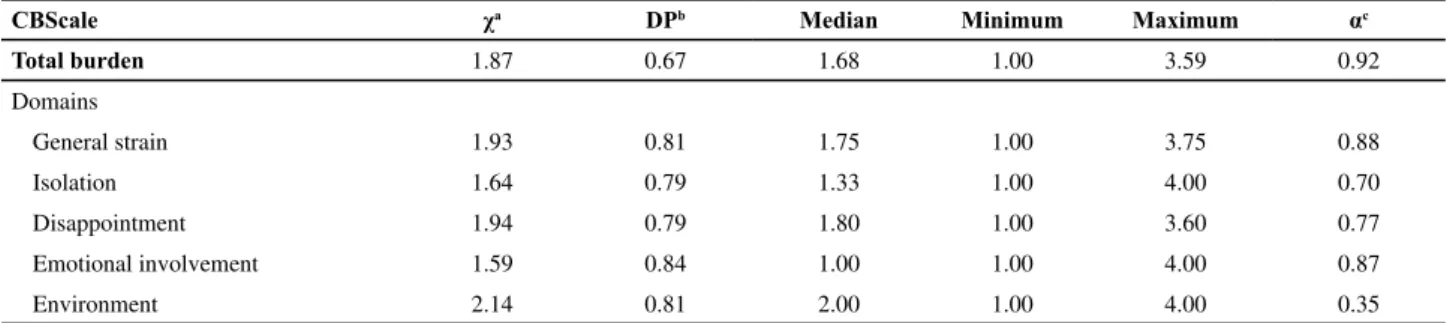
and 16 (27.2%) were quadriplegics. Table 1 presents the descrip ve sta s cs of the scores of the CBScale and the internal consistency (Cronbach’s α coeffi cient).
The highest means of the scale were for the environ-ment, disappointment and general strain domains. The value of the Cronbach’s α coeffi cient was lower for the environment domain and higher for the general strain and emo onal involvement domains.
In Tables 2, 3 and 4, correla ons and comparisons of care-giver burden with some qualita ve and quan ta ve variables of the caregiver of the individual with TSCI are presented.
In rela on to the age of the caregiver, the correla ons were posi ve, that is, the older the caregiver, the greater the caregiver burden; however the correla ons were of weak magnitude, without sta s cal signifi cance. The me spent for care was not sta s cally signifi cant, and correla ons were
weak in all domains. The correla ons were also posi ve in rela on to hours spent per day on care, (the more hours spent on care, the more burden), although weak. There was sta s cal signifi cance in the disappointment domain, but the
Table 1 – Measures of position, variability and internal consistency of the domains of the Caregiver Burden Scale (CBScale) applied with the caregivers of patients with TSCI - Ribeirão Preto, 2010
CBScale χa DPb Median Minimum Maximum αc
Total burden 1.87 0.67 1.68 1.00 3.59 0.92
Domains
General strain 1.93 0.81 1.75 1.00 3.75 0.88
Isolation 1.64 0.79 1.33 1.00 4.00 0.70
Disappointment 1.94 0.79 1.80 1.00 3.60 0.77
Emotional involvement 1.59 0.84 1.00 1.00 4.00 0.87
Environment 2.14 0.81 2.00 1.00 4.00 0.35
a Mean; b Standard deviation; cCronbach’s α coeffi cient
Table 4 – Comparison of the measures of position and variability of caregiver burden, considering the self-reported illnesses of the caregiver - Ribeirão Preto, 2010
CBScale
Self-reported Illnesses
NO (n=30) YES (n=29)
p* p*
χ (DP) Median χ (DP) Median
Total burden 1.57(0.48) 1.52 2.18(0.71) 2.09 <0.001
Domains
General tension 1.66(0.67) 1.56 2.10(0.87) 2.25 0.01
Isolation 1.33(0.40) 1.33 1.96(0.95) 2.00 <0.001
Disappointment 1.56(0.56) 1.60 2.32(0.79) 2.20 <0.001
Emotional involvement 1.34(0.47) 1.16 1.85(1.04) 1.00 0.02
Environment 1.84(0.75) 1.66 2.44(0.75) 2.66 <0.001
*Student t-test.
Table 2 – Correlation between the measures of caregiver burden and the age of the caregiver, time of care, and hours per day spent providing care - Ribeirão Preto, 2010
CBScale Age
How long providing
care
Hours spent per day providing care
r r r
Total Burden 0.16 -0.03 0.20
Domains
General strain 0.14 -0.07 0.20
Isolation 0.13 -0.01 0.18
Disappointment 0.18 0.01 0.26*
Emotional involvement
0.11 0.08 0.06
Environment 0.05 -0.13 0.04
*p≤0,05; r=Pearson Correlation.
Table 3 – Comparison of the measures of position and variability of caregiver burden, considering the sex of the caregiver- Ribeirão Preto, 2010
CBScale
Sex of Caregiver
Female (n=53) Male (n=6)
*p
χ (DP) Median χ (DP) Median
Total burden 1.89(0.69) 1.68 1.69(0.47) 1.75 0.67
Domains
General strain 1.64 (0.48) 1.69 1.96 (0.84) 1.75 0.60
Isolation 1.66(0.82) 1.33 1.44(0.40) 1.50 0.84
Disappointment 1.95(0.79) 1.80 1.80(0.73) 1.80 0.74
Emotional involvement
1.61(0.84) 1.33 1.38(0.80) 1.00 0.42
Environment 2.13(0.82) 2.00 2.16(0.69) 2.16 0.82
*Mann-Whitney test
The medians of the domains of caregiver burden were higher among the male caregivers, except for the domain of emo onal involvement. However, there was no sta s cal signifi cance for any of the domains when using the
Mann-Whitney test.
Caregiver burden was greater when the caregiver re-ported having some health problem. For all domains on
the CBScale and for the total burden score, the diff erence was sta s cally signifi cant (p≤0.05).
DISCUSSION
The predominance of female caregivers refers to gender, because care for the disabled person is usually assigned to women as a result of their tradi onal role as caretakers for the home and family(2,4,11).
With regard to the sociodemographic characteris cs of individuals with TSCI, these were highlighted by other studies repor ng that the popula on most aff ected by TSCI is that of young adults, aged 18 to 35 years, and overwhelm-ingly of the male gender(1,11-13).
In relation to the causes that led to the injury, we observed a higher frequency of motor vehicle accidents, followed by injury with a fi rearm. These results, as well as other studies, confi rm that urban violence, traffi c accidents and work have contributed to the high rate of people with physical disabili es in Brazil, especially in ci es of medium and large size(11-13).
Faced with the new a ribu ons and responsibili es inherent in the care of the individual with TSCI in the home, the caregiver presents demands rela ng to material resources, equipment and an adapted environment that fosters and promotes the care of the health needs for the aff ected family member.
The Na onal Policy for the Integra on of Persons with Disabili es provides principles, direc ves, objec ves and instruments that deal with governmental ac on and the responsibili es of each sector and they determine full ac-cess to the resources for health, educa on, habilita on and voca onal rehabilita on, work, culture, tourism and leisure. Despite the advances in the sphere of the legisla ve force, such ini a ves are not in fact ensuring that individuals with disabili es are protected. Other elements that interfere with the alloca on of public resources for health care, the role of the market economy and the insuffi ciency of the State budget, can interfere and need to be analyzed(14).
In November of 2011, the federal government estab-lished the Na onal Plan on the Rights of Persons with Dis-abili es - Living without Limit, for the purpose of promo ng, through the means of integra on and ar cula on of poli-cies, programs and ac ons, the full and equal enjoyment
of the rights of people with disabili es. Ar cle 3 of the
Direc ves, sec on VI, states: expansion and qualifi ca on of the network of health care for the disabled person, in
par cular the services of habilita on and rehabilita on(15).
In this study, during the interviews, many individuals with TSCI and their caregivers complained about the
dif-fi culty in acquiring necessary resources for assistance in the home, as well as the lack of guidance and referrals to specialized rehabilita on services. It was evident that few municipali es belonging to the region of the DRS-XVIII off ered resources that the individual needed, such as, for example, wheelchairs, uretheral catheter for bladder catheteriza on, dressing materials for pressure ulcers, among others.
Due to the high level of func onal impairment, the care needs of individuals with TSCI are many. Depending on the neurological level of injury, these individuals need assis-tance for the total or par al performance of ADLs, such as dressing, pu ng on shoes, bathing, and ea ng. The higher the neurological level of spinal cord injury, as in the case of quadriplegic pa ents, the greater the me spent in care(1,11,16), because individuals with TSCI, especially quadriplegics, are dependent on long-term care and the lack of, or failure in, the planning of care can lead to caregiver burden.
In this study, family caregivers of quadriplegic or para-plegic individuals with a short period of me since the TSCI reported spending considerable amounts of me on care ac vi es, both throughout the day, for the performance of ADLs, and during the night, with ac vi es such as
oning, intermi ent bladder catheteriza on, among oth-ers. It was also found that the caregivers providing care to pa ents from the ini al moment of TSCI, accompanied them during hospitaliza on and a er discharge care at home. For paraplegic individuals with more me since the injury and greater func onal independence, caregivers reported spending fewer hours of care per day.
In a qualita ve study conducted in the southern and southeastern regions of Brazil, through semi-structured interviews with individuals with spinal cord injury and their parental caregivers, the authors noted that the presence of the family caregiver was essen al for the aid in ADL and in self care of those with high spinal cord injury. The feel-ing of fear of losfeel-ing their parents or caregivers or that they will become sick and would be unable to care for or meet their needs was a concern displayed by all quadriplegic indi-viduals interviewed, who reported having hopes to achieve some func onal gain to acquire more independence and not rely so much on the caregivers to supply their needs(16).
The results concerning caregiver burden were similar to a study conducted in the city of São Paulo with paraplegic pa ents and their caregivers, in which caregiver burden, as-sessed by means of the instrument CBScale, showed higher values in rela on to the domains of environment (x=2.44), disappointment (x=1.74), and general strain (x=1.59)(11).
The ques ons on the CBScale instrument that most contributed to the environment domain obtaining a higher mean were: does the home environment make it diffi cult
for you to care for your rela ve? and is there something in
the neighborhood where your rela ve lives, for example,
dif-fi culty in ge ng transport, diffi cult access to the pharmacy
and/or medical services, problem with the neighbors - which hinders you in caring for him?
factors can act as barriers or facilitators for performing ADLs and the social inclusion of the individuals with TSCI.
The Brazilian Standard for Accessibility NBR9050 ABNT (Brazilian Associa on of Technical Standards), of 2004, provid-ed for the condi ons of accessibility in the urban environment. It established criteria and technical parameters to be observed for construc on, installa on and adapta on of buildings, furniture, urban spaces and equipment to the condi ons of accessibility (inclusion), indica ng specifi ca ons that aimed to
provide the safe use of the environment or equipment for the largest possible quan ty of persons, regardless of age, height or mobility limita on(17). However, in many municipali es there is a lack or insuffi cient numbers of adapted public transport, and lack of adequate sidewalks with ramps for access.
A study conducted in Londrina, PR, evaluated the wheelchair user access to the physical space of movement and sports training at the Center for Physical Educa on and Sport in a state university. The researchers measured 32 points using measuring tape metrics, and recorded digital images. Of the 32 points assessed, 21 (65.6%) were not in accordance with the accessibility standards of NBR9050, and only 11 (34.4%) were adequate(18).
Another study conducted with individuals with spinal cord injury and their families in Maringa, PR, iden fi ed
that one of the diffi cul es encountered by individuals was the lack of physical structure of the city, which included lack of transporta on, employment, physical ac vity and also prejudice. The diffi cul es referred to the inadequate structure of health services, which included everything from transport diffi cul es to defi ciencies in physical
in-frastructure, lack of ramps, wai ng lines and shortages of care by specialized professionals(19).
In a study conducted in Ribeirão Preto, the obstacles faced by individuals with TSCI and their caregivers on re-turning home a er hospital discharge were related to the architectural structure of the residence, mobility diffi
es due to the size of the wheelchair, and also to the fact that the houses were not constructed to harbor a disabled person. Architectural barriers did not allow free access of individuals with TSCI to the rooms of the house, to the en-trance and exit. Many managed to overcome these barriers, while others, due to lack of fi nancial resources, depended
on other family members to overcome the obstacles, such as stairs or even ge ng in and out of the house itself(20).
The disappointment and general strain domains had the second and third highest mean in the CBScale. Caregivers of the individuals with TSCI were mostly women who needed to divide their me among ac vi es required by the care-giver role and those remaining: home, children, professional ac vi es. Ques ons in the disappointment domain that had high scores were, for example: Do you think life has
been unfair to you?, Did you expect that life, at your age,
would be diff erent than it is today?. In the general strain
dimension, the ques ons were: Do you think that you are
assuming too much responsibility for the well-being of your
rela ve? and, Do you some mes feel the urge to fl ee this
whole situa on in which you fi nd yourself?
Studies show that the majority of caregivers of individuals with TSCI are wives or mothers. The results indicate that many have to divide me between care provided and other ac es, leaving li le or no me for leisure ac vi es and rest(2,11).
There are many risk factors considered in the literature for the development of anxiety, depression and other health problems in caregivers. These factors relate not only to the pa ent himself (level of func onal and/or cogni ve dis-ability, behavioral problems, disease dura on) but also to the caregivers themselves (age, sex, degree of rela onship, quality of rela onship with the pa ent, comorbidi es)(2,4).
In a study conducted in the community of Fiji, South Pacifi c, the instrument, the Caregiver Burden Inventory, was
administered to 30 primary caregivers of individuals with spinal cord injury. Among other results, it was observed that the caregivers spent an average of 6.1 hours per day (SD=2.19) in providing care. The burden was signifi cantly
related to the number of hours spent in care (r=0.35, p<0.05) and the age of caregiver, with the oldest presen ng higher caregiver burden (r=0.46, p<0.01). The researcher concluded that being the primary caregiver of an individual with spinal cord injury contributed to caregiver burden and the results indicated that the contribu ons of these people should be recognized and interven ons tailored not only to meet the needs of care recipients, but also of the caregivers(21).
Another study conducted in the Netherlands described the perceived caregiver burden by caregivers of individu-als with spinal cord injury and examined the predictors of burden. The number of hours spent on the performance of ADLs was found to be one of the strongest determinants for caregiver burden (35% of the varia on in perceived caregiver burden). Other signifi cant determinants were the number of psychosocial problems of the individual with the spinal cord injury, the age of the caregiver (older caregivers reported increased burden) and me, that is, the more me in years of care, the lower the burden(22).
The ini al moments a er TSCI are the most diffi cult to tackle, because this is when the pa ent-caregiver dyad is faced with the disabili es resul ng from the injury. It is a phase of adjustment and adapta on to the new condi on. Thus, during hospitaliza on, the care of the pa ent with TSCI should focus on discharge prepara on, by inser ng the family into this process through ac ve par cipa on in care.
In order to give con nuity to pa ent care a er discharge, beyond the family, there must be a suffi cient and complete social support network to address the needs generated by the high complexity care required by a pa ent with TSCI. The ins tu on of measures for ensuring early
The nurse should make home visits, pre- and post-discharge, to perform preven ve interven ons aimed at the quality of long-term care, to guide the adjustments and adapta ons in the environment, in order to promote and facilitate the implementa on of care(23) and to evaluate accessibility issues. The rehabilita on process itself should be ini ated as soon as the individual with TSCI a ains an appropriate clinical condi on and the caregiver should be an ac ve par cipant in the en re process.
The rehabilita on program for individuals with TSCI is understood to be a set of ac vi es performed by specialized professionals, with objec ves established for the treatment of the individual with physical disabili es(1,23).
Nursing is an integral part of the rehabilita on team and its ac ons should be systema zed and interrelated, aiming at comprehensive care for human beings in order to ensure the best quality of care. The role of nursing is not only ap-parent in the process of rehabilita on of the pa ent, but also in the social responsibility of inclusion of the family, as a caregiver, considering the social and environmental context, favoring the dyad, improving their quality of life and reducing caregiver burden(23).
By means of the Nursing Care Systema za on, reha-bilita on nurses can develop and implement a plan of care designed to facilitate the rehabilita on, restore and maintain healthy levels of life and avoid complica ons secondary to the injury.
When there is interac on among health professionals, individuals with TSCI, and their caregivers, there is a greater possibility of ac ve par cipa on in a process which requires that the dyad is informed, mo vated, prepared and has the skills to manage care at home, allowing greater capacity for resolu on of care. However, it is important to integrate health management policies and systems of informa on,
to strengthen partnerships, organize services and prepare the health team.
CONCLUSION
The results of this study demonstrated a predominance of females, mean age of 44.8 years and a low level of edu-ca on, amongst the 59 family edu-caregivers of individuals with TSCI. Caregiver burden was higher for the environment, disappointment, and general strain domains. There were no sta s cally signifi cant associa ons between the caregiver burden and sociodemographic variables (gender and age) of the caregivers, as well as the variable related to the length of me over which they provided the care. Caregivers presented higher burden associated with the fact of spending more hours per day on care (for the disappointment domain) and self-reported disease (for all domains of the CBScale).
The results presented should be analyzed considering the limita ons of the study, which refer to the fact that it was conducted with a small sample, a ended only by public health services, which can bring restric ons to the generaliza on of fi ndings.
The results of this study pointed to the need to design and implement programs for interven ons and support that are eff ec ve for the management of care and
on of burden.
Individuals with TSCI demand care from the simple to the most complex, depending on the neurological level of spinal cord injury. It is necessary and extremely important to conduct further research studies on the theme, which may endorse ini a ves to mi gate and prevent the impact of burden in the life of family caregivers. Ac ons performed with caregivers with the inten on of reducing caregiver burden may become, eff ec vely, a solu on within the task of caring.
1. Rabeh SAN, Caliri MHL. Capacidade funcional em indivíduos com lesão de medula espinal. Acta Paul Enferm. 2010;23(3):321-7.
2. Faro ACM. A vidades realizadas no domicílio pelo cuidador familiar da pessoa com lesão medular. Rev Paul Enferm. 2001;20(2):33-43.
3. Medeiros MMC, Ferraz MB, Quaresma M, Menezes AP. Adaptação ao contexto cultural brasileiro e validação do Caregiver Burden Scale. Rev Bras Reumatol. 1998;38(4):193-99.
4. Robison J, For nsky R, Kleppinger A, Shugrue N, Porter M. A broader view of family caregiving: eff ects of caregiving and caregiver condi ons on depressive symptoms, health, work, an social isola on. J Gerontol B Psychol Sci Soc Sci. 2009;64(6):788-98.
5. Zarit SH, Reever KE, Bach-Peterson J. Rela ves of the impaired elderly: correlates of feelings of burden. Gerontologist. 1980;20(6):649-55.
6. Elmstahl S, Malmberg B, Annerstedt L. Caregiver`s burden of pa ents 3 years a er stroke assessed by a novel caregiver burden scale. Arch Phys Med Rehabil. 1996;77(2):177-82.
7. Machado WCA. Faltam cursos para capacitar quem cuida de pessoas com defi ciência [Internet]. São Paulo: Rede SACI; 2008 [citado 2012 set. 12]. Disponível em: h p://saci.org.br/index. php?modulo=akemi¶metro=21034
8. São Paulo. Secretaria dos Direitos da Pessoa com Defi ciência. Curso de Formação para Cuidadores de Pessoas com Defi ciência [Internet]. São Paulo; 2012 [citado 2012 set. 13]. Disponível em: h p://cuidadores.edm.org.br/aia/
9. CVI - Centro de Vida Independente, o que é isso? [Internet]. Rio de Janeiro; 2007 [citado 2012 set. 13]. Disponível em: http://www.bengalalegal.com/c-v-i
10. Ajzen J, Fishbein M. Understanding attitudes and predicting social behavior. New Jersey: Prentice-Hall; 1998.
11. Blanes L. Short-form-36 e Caregiver Burden Scale em cuidadores primários de paraplégicos [tese doutorado]. São Paulo: Escola Paulista de Medicina, Universidade Federal de São Paulo; 2005.
12. Nogueira PC, Caliri MHL, Haas VJ. Profi le of pa ents with spinal cord injuries and occurrence of pressure ulcer at a university hospital. Rev La no Am Enferm. 2006;14(3):372-77.
13. Araujo Junior FA, Heinrich CB, Cunha MLV, Veríssimo DCA, Rehder R, Pinto CAS et al. Traumatismo raquimedular por ferimento de projétil de arma de fogo: avaliação epidemiológica. Coluna Columna. 2011;10(4):290-2.
14. Bernardes LCG, Maior IMML, Spezia CH, Araujo TCCF. Pessoas com deficiência e políticas de saúde no Brasil: reflexões bioéticas. Ciênc Saúde Coletiva. 2009;14(1):31-8.
15. Brasil. Decreto n. 7.612, de 17 de novembro de 2011. Dispões sobre o Plano Nacional dos Direitos da Pessoa com Deficiência - Plano Viver sem Limite [Internet]. Brasília; 2011 [citado 2012 set. 13]. Disponível em: http://www. planalto.gov.br/ccivil_03/_Ato2011-2014/2011/Decreto/ D7612.htm
16. Machado WCA, Scramin AP. Func onal (in)dependence in the dependent rela onship of quadriplegic men with their (un) replaceable parents/caregivers.Rev Esc Enferm USP [Internet]. 2010 [cited 2012 Sep 13];44(1):53-60. Available from: h p:// www.scielo.br/pdf/reeusp/v44n1/en_a08v44n1.pdf
17. Associação Brasileira de Normas Técnicas (ABNT). NBR 9050: acessibilidade a edifi cações, mobiliário, espaços e equipamentos urbanos. 2ª ed. Rio de Janeiro: ABNT; 2004.
18. Medola FO, Macedo DL, Carreri DS, Marques EFA, Kikuchi LT, Costa NL, et al. Acessibilidade de um Centro de Treinamento Espor vo para usuários de cadeira de rodas. Rev Neurocienc. 2011;19(2):244-9.
19. Venturini DA, Decésaro MN, Marcon SS. Alterações e expecta vas vivenciadas pelos indivíduos com lesão raquimedular e suas famílias. Rev Esc Enferm USP. 2007;41(4):589-96.
20. Sartori NR. Lesão medular traumá ca: tornar-se defi ciente e as difi culdades vivenciadas no retorno ao lar [dissertação]. Ribeirão Preto: Escola de Enfermagem de Ribeirão Preto, Universidade de São Paulo; 2005.
21. Gajraj-Singh P. Psychological impact and the burden of caregiving for persons with spinal cord injury (SCI) living in the community in Fiji. Spinal Cord. 2011;49(8):928-34.
22. Post MW, Bloemen J, Wi e LP. Burden of support for partners of persons with spinal cord injuries. Spinal Cord. 2005;43(5):311-9.