O
RIGINAL
A
R
TICLE
RESUMO
Estudo epidemiológico, longitudinal e analí co, desenvolvido em um hospital de Minas Gerais, com o obje vo de analisar os fatores associados à infecção pelo uso do cateter central de inserção periférica em recém-nascidos internados em unidade de terapia intensiva. A coleta dos dados foi realizada por meio de uma ficha estruturada, preenchida pelos profi ssionais e verifi cada pelos pesquisadores. Foram estudados 291 cateteres inseridos em 233 recém-nascidos. Os fatores associados à re rada por suspeita de infecção foram: prematuridade, peso ao nascer até 1.500 gramas, cateter de poliuretano, localização não centralizada do cateter e tempo de uso superior a 30 dias. Após ajuste mul variado, permaneceram independentemente associados: peso inferior a 2.500 gramas na inserção, reparo e tempo de uso do cateter. Conclui-se que fatores relacionados à prá ca dos profi ssionais contribuíram para a re rada dos cateteres, sinalizando para a necessidade de intervenções que melhorem a segurança e a eficácia em seu uso.
DESCRITORES
Unidades de Terapia Intensiva Neonatal Cateterismo venoso central
Enfermagem neonatal Recém-nascido
Cuidados de enfermagem.
ABSTRACT
This was an epidemiological, longitudinal and analytical study carried out in a hospital in the Brazilian state of Minas Gerais, with the aim of analyzing the factors associated with infec on due to the use of peripherally inserted central catheters in newborn infants hospitalized in the intensive care unit. Data were collected via a structured form, fi lled out by the professionals and checked by the researchers. We studied a total of 291 catheters inserted into 233 neonates. The factors associated with catheter removal due to suspected infection were: prematurity; birthweight ≤1500 g; polyurethane catheter; non-centralized placing of the catheter; and dura on of use >30 days. A er mul variate adjustment, the following factors remained independently associated: weight < 2500 g at the me of inser on, catheter repair, and dura on of catheter use. We concluded that factors related to staff prac ces contributed to removal of the catheters, indica ng a need for interven ons that improve the safety and effi cacy of catheter use.
DESCRIPTORS
Intensive Care Units Neonatal Catheteriza on, central venous Neonatal nursing
Infant, newborn Nursing care
RESUMEN
Estudio epidemiológico, longitudinal, analítico, desarrollado en hospital de Minas Gerais, objetivando analizar factores asociados a infección por uso de catéter central de inserción periférica en recién nacidos internados en unidad de terapia intensiva. Datos recolectados mediante fi cha estructurada, completada por los profesionales y verifi cada por los inves gadores. Se estudiaron 291 catéteres insertados en 233 recién nacidos. Los factores asociados a la quita por sospecha de infección fueron: prematuridad, peso al nacer hasta 1.500 gramos, catéter de poliuretano, localización no centralizada del catéter y tiempo de uso superior a 30 días. Luego de ajuste multivariado, permanecieron independientemente asociados: peso inferior a 2.500 gramos en la inserción, reparación y tiempo de uso del catéter. Se concluye en que factores relativos a la práctica de los profesionales contribuyeron al re ro de los catéteres, determinando la necesidad de intervenciones que mejoren la seguridad y efi cacia de su u lización.
DESCRIPTORES
Unidades de Cuidado Intensivo Neonatal Cateterismo venoso central
Enfermería neonatal Recién nacido
Atención de enfermería
Factors associated with infection from
the use of peripherally inserted central
catheters in a Neonatal Intensive Care unit
FATORES ASSOCIADOS À INFECÇÃO PELO USO DO CATETER CENTRAL DE INSERÇÃO PERIFÉRICA EM UNIDADE DE TERAPIA INTENSIVA NEONATAL FACTORES ASOCIADOS A LA INFECCIÓN POR USO DE CATÉTER CENTRAL DE INSERCIÓN PERIFÉRICA EN UNIDAD DE TERAPIA INTENSIVA NEONATAL
Elysângela Dittz Duarte1, Adriano Marçal Pimenta2, Bárbara Christina Noelly e Silva3, Clarissa Moura de Paula4
1 RN. Ph.D. in Child and Adolescent Health. Adjunct professor in the Department of Maternal Infant and Public Health Nursing of the School of Nursing of Federal
University of Minas Gerais. Belo Horizonte, MG, Brazil. [email protected] 2 RN. Ph.D. in Nursing. Adjunct professor of the Maternal Infant and Public
INTRODUCTION
Peripherally Inserted Central Catheters (PICCs) are am-ply used in neonatal units when children need an venous line for a prolonged amount of me(1). Their use allows
parenteral nutri on, drugs or solu ons in high ons to be off ered, along with irritants and/or vesicants(1),
and further reduces the need for mul ple venous punctures and changes(2).
The fi ne caliber of the catheters and use of an inser on technique into the peripheral veins contribute to make PICCs less invasive, and consequently off er less risk to the pa ents at the me of introduc on, in comparison to de-vices surgically-inserted into large blood vessels(2,3).
However, results from scien fi c studies have shown a set of non-infec ous and infec ous complica ons [from PICCs] in newborns (NBs). The fi rst correspond to obstruc on of the catheter, forma on of thrombi, bleeding, mechanical phlebi s, migra on, fracture of the catheter, draining, car-diac perfora on or perfora on of the vein, among others(4).
Infec ons include infec ous phlebi s, infec on of inser on loca on and blood infec on (sepsis)(2, 5-6).
Among the complica ons related to the use of the central catheter, those that are infec ous stand out as an important cause of morbi-mortality in the neonatal
on(7). Their prevalence, however, varies
from 0 to 40% as a result of the diff erences of concepts and terminologies that are used by authors to characterize them(5).
The risk factors associated with blood infec on caused by central venous catheters may be related to pre-exis ng diseases and
clinical factors, such as admission into Intensive Care Units (ICU), use of mechanical ven la on and invasive hemo-dynamic monitoring. Other risk factors include type and material of the catheter, inser on loca on and following of the recommended technique for inser on and maintenance of the catheter(5). Scien fi c inves ga ons have found that
some factors signifi cantly increase suscep bility to on: use me of the catheter, infusion of parenteral on, blood transfusion(8), absence of subjacent infec on at
me of inser on, more than one indica on for use of the device(2), and place of femoral inser on(9).
Among the repercussions from catheter-related ons, the signifi cant increase of the cost from ons must be considered(9).
Although they can be iden fi ed in the literature, stud-ies carried out on infec ons related to use of PICC have varied delinea ons and popula ons, the majority being descrip ve and referring to pediatric and adult individu-als(2,5-6,10). Addi onally, the PICC is included in the ample
universe of central venous catheters, without considering
the specifi ci es inherent to the device and the technique of inser on and maintenance(5-8).
This theme is highly relevant and of great interest to the nursing professional, because of his/her technical and legal competencies for inser on and maintenance of the PICC(11), the use of which is growing in NB care in ICUs. Thus,
recogni on of the risk factors for infec on related to use of the catheter can contribute to the establishment of proce-dures that qualify nurses’ care, together with his/her team, suppor ng clinical prac ce based on scien fi c evidence.
In this perspec ve, this study had the objec ve to ana-lyze the factors associated with infec on from use of the PICC in NBs hospitalized in the intensive care unit.
METHOD
This paper deals with an epidemiological, longitudinal and analy cal study, developed in a hospital in Belo Hori-zonte, in the Brazilian state of Minas Gerais. The Neonatal Intensive Care Unit of this ins tu on has 40 hospital beds, with an average admission of 73 NBs per month in 2010. The study subjects were all of the NBs that used the PICC at some me during their hos-pitaliza on, with the inser on period being between February and December of 2010. The established exclusion criteria included: unsuccessful inser ons or more than six a empts at installa on of the device, since ins tu onal protocol recommends that this number not be surpassed, based on internal quality indicators of the hospital.
Data collec on was performed through a structured form to record data regarding the process of inser on, maintenance and removal of the PICC, using, as a reference, the exis ng form for the service, adapted from Camargo(12). Following its
re-structuring, this instrument was submi ed to evalua on by two professionals with experience with research and PICC inser on and maintenance. To verify its adequacy, a pilot test was performed for 15 days. A er the fi nal version of the instrument was defi ned, the professionals responsible for inser on and con nuity of care of the device were instructed on how to fi ll out the forms, which were later verifi ed by the research team. When necessary, the pa ent’s hospital record was consulted in order to complete the informa on regarding the child and the device.
In order to characterize the profi le of the children and process of inser on, the form presented variables regard-ing: sex; gesta onal age and birth weight; diagnosis, days of life; gesta onal age and weight at me of inser on of the catheter. In regard to characteris cs of the catheter and its installa on, data regarding type and brand of the device were collected, along with use of methods to control pain, administra on of drugs, number of inser on a empts, and posi oning of the end of the catheter. In
Among the complications related
to the use of the central catheter, those
that are infectious stand out as an important cause of morbi-mortality in the
regard to maintenance and removal, occurrence of repair, a empts at desobstruc on, reposi oning, use me of the catheter (in days) and reason for termina on of the therapy were recorded.
Recommenda on for use of the PICC is determined by the health team which assists the child, and is usually made for administra on of an bio cs, parenteral
on or subs tu on of the umbilical venous catheter. The inser on procedure is performed by trained nurses, under the orienta on of an ins tu onal protocol based on the direc ves of the Brazilian Society of Intravenous Therapy Nurses(13). Defi ni on of the inser on site is performed by
the professional responsible for the procedure, and the fi rst choice is usually through veins of the upper limbs.
Installa on occurs at the side of the bed and seeks the central loca on of the point of the catheter in the supe-rior or infesupe-rior vein cavity. Confi rma on of the loca on of the end is performed by radiography, and reposi oning (trac on) of the catheter occurs in cases of intracardiac posi oning. Maintenance of the catheter includes chang-ing the bandage every seven days when a transparent fi lm is used, or whenever it is dirty, humid, bleeding or
its edges are not a ached properly. In some situa ons, especially cases of clinical instability with impossibility of installa on of a new catheter, repairs are prac ced with the occurrence of the rupture of the external por on of the silicon catheter, which is removed as quickly as pos-sible. In general, however, the PICC is removed only at the end of the therapy or in the presence of side eff ects, in par cular infec on, the outcome variable of this study.
The literature on healthcare-related infec ons(7, 14-15), as
well as the protocol adopted by the ins tu on, signal the need to perform laboratory exams in order to confi rm the diagnosis of infec on related to the central venous catheter. The Center for Disease Control and Preven on (CDC) em-phasizes that for diagnosis of the infec on, the existence of clinical signs should be observed, along with a posi ve blood culture collected from the catheter or neighboring areas
(16). Yet the Brazilian Health Surveillance Agency (ANVISA)
considers the possibility of laboratory or clinical diagnosis from blood infec on. However, in order for it to be associ-ated with the use of the central venous catheter, the device should be present at the me of the diagnosis or up to 48 hours a er its removal, with no minimum period of inser on me(15). Nevertheless, when dealing with infec ous events,
what is observed in prac ce is the removal of the catheter before laboratory proof, due to the presence of clinical signs sugges ve of infec on, such as fever, hypothermal apnea, bradycardia and phlogis c signs at the inser on loca on and/or along the trajectory of the PICC, such as phlebi s, hardening and hyperemia.
Considering the prac ce of the professionals at the study loca on, in this study, removal of the catheter due to infec on refers to suspension of therapy as a result of
The list of poten al risk factors was iden fi ed through a literature review. The following variables were considered for sta s cal analysis: gesta onal age and weight at me of inser on, device material, number of inser on a empts, occurrence of repair, a empts at desobstruc on and repo-si oning, use me of the catheter (in days) and reason for removal of the PICC.
Characterization of the population studied was per-formed through calculation of the absolute and relative frequencies of the interest variables according to reason for removal of the PICC. The statistical differences were evaluated through Pearson’s chi-squared or Fisher’s exact tests.
The modeling process was based on two phases. Ini ally, the variables that showed a < 0.20 p-value in the bivariate analysis were selected. Later, a mul variate analysis was performed which employed Poisson regression with ro-bust variances. The magnitudes of the associa ons were es mated by calcula on of the Rela ve Risk (RR) and its Confi dence Interval of 95% (CI 95%). The variables that showed sta s cal signifi cance levels less than 5% were maintained in the fi nal model, considering the Wald test and The Par al Likelihood Ra o Test.
Evalua on of the quality of the model was performed by calcula ng its coeffi cient of determina on (R2); applica ons of the goodness-of-fi t test, the linktest and by analysis of the remainders, primarily based on the infl uen al points. Collinearity and interac on between the variables that remained in the fi nal model were also tested. The STATA so ware (version 9.0) was used for processing and analysis of the data.
The study was approved by the Research Ethics Commit-tee of the Hospital Sofi a Feldman under opinion 03/2008, a ending to Resolu on 196/96 of the Na onal Health Council on human research. Further, the professionals that par cipated in the study signed the term of free and informed consent and their iden es remained anonymous.
RESULTS
Following applica on of the exclusion criteria, the ons from 291 PICC in 233 children during the period of the study were analyzed. The removal rate of the catheter due to occurrence of infec on was 15.8%, corresponding to 9.7 per 1,000 catheters-day.
7.9% between 31 and 60 days and 7.6% were older than 61 days. The diagnoses observed at the moment of inser on were sepsis (72.5%), prematurity (70.5%), low weight (69.8%) and respiratory discomfort syndrome (16.5%). on for use of the PICC was primarily for an bio c therapy (72.9%), followed by the need to administer parenteral
on (31.3%) and vasoac ve amines (11.0%).
Silicone catheters were used in 57% of the inser ons and polyurethane in 42.6%. The puncture loca ons were upper limbs, lower limbs, and the cervical and cephalic regions, which had the following percentages: 83.1%, 8.6%, 4.1% and 4.1%. Pain management was a strategy used in 74.9% of the inser ons. The number a empts at inser on of the device varied from one to six. The distribu on of the percentages
in this interval was 25.7% for one a empt; 25.7% for two, 21.1% for three; 13.4% for four; 6.3% for fi ve and 7.8% for six a empts. The central loca on of the distal end of the device was observed in 80.1% of inser ons. The use me of the device was up to 7 days in 22.7% of the cases; between 8 and 14 days in 34.4%; between 15 and 21 days in 21.3%; between 22 and 28 days in 7.6%, and greater or equal to 29 days in 14.1%. The maximum use me was 68 days.
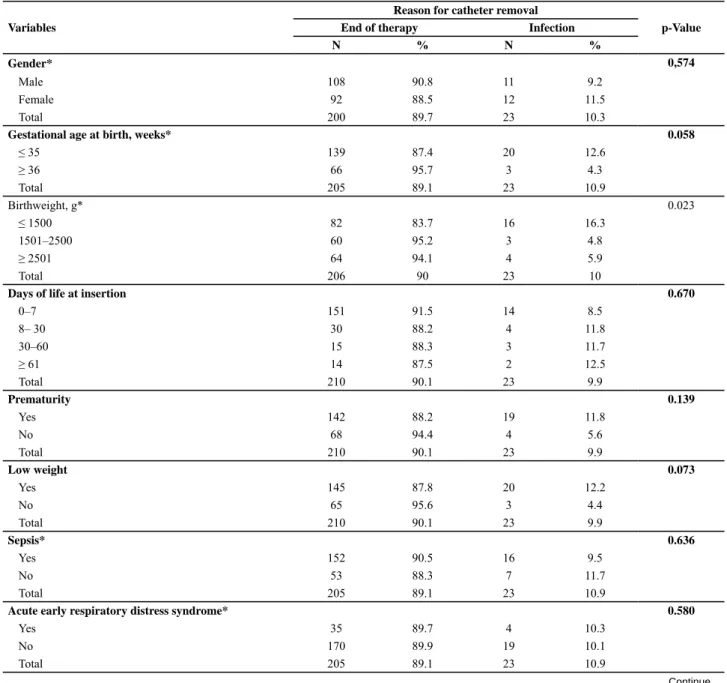
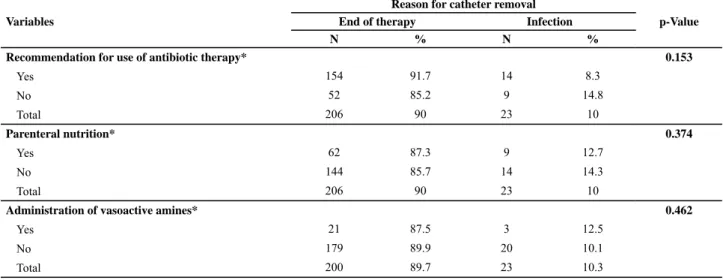
Tables 1 and 2 show the factors associated with the removal of the catheter due to suspected infec on: birth weight 1,500 grams or less (p < 0.023) (Table 1), use of polyurethane catheter (p = 0.002), decentralized loca on of the catheter (p = 0.005) and use me longer than 30 days (p < 0.001) (Table 2).
Table 1 – Characteristics of neonates classifi ed by reason for catheter removal in Belo Horizonte, MG, 2010.
Variables
Reason for catheter removal
p-Value End of therapy Infection
N % N %
Gender* 0,574
Male 108 90.8 11 9.2
Female 92 88.5 12 11.5
Total 200 89.7 23 10.3
Gestational age at birth, weeks* 0.058
≤ 35 139 87.4 20 12.6
≥ 36 66 95.7 3 4.3
Total 205 89.1 23 10.9
Birthweight, g* 0.023
≤ 1500 82 83.7 16 16.3
1501–2500 60 95.2 3 4.8
≥ 2501 64 94.1 4 5.9
Total 206 90 23 10
Days of life at insertion 0.670
0–7 151 91.5 14 8.5
8– 30 30 88.2 4 11.8
30–60 15 88.3 3 11.7
≥ 61 14 87.5 2 12.5
Total 210 90.1 23 9.9
Prematurity 0.139
Yes 142 88.2 19 11.8
No 68 94.4 4 5.6
Total 210 90.1 23 9.9
Low weight 0.073
Yes 145 87.8 20 12.2
No 65 95.6 3 4.4
Total 210 90.1 23 9.9
Sepsis* 0.636
Yes 152 90.5 16 9.5
No 53 88.3 7 11.7
Total 205 89.1 23 10.9
Acute early respiratory distress syndrome* 0.580
Yes 35 89.7 4 10.3
No 170 89.9 19 10.1
Total 205 89.1 23 10.9
Table 2 – Characteristics of the insertion and handling of the catheter by reason for its removal. Belo Horizonte, MG, 2010.
Variáveis
Reason for removal of catheter
p-Value End of therapy Infection
N % N %
Type of catheter* 0.002
Polyurethane 94 76.4 29 23.6
Silicone 149 89.8 17 10.2
Total 243 84.1 46 15.9
Location of puncture* 0.082
Upper limb 207 85.9 34 14.1
Lower limb 17 68 8 32
Cervical 9 75 3 25
Cephalic 11 91.7 1 8.3
Total 244 84.1 46 15.9
Pain control 0.864
No 61 83.6 12 16.4
Yes 184 84.4 34 15.6
Total 245 84.2 46 15.8
Insertion attempts, n* 0.284
1 63 86.3 10 13.7
2 62 84.9 11 15.1
3 48 80 12 20
4 28 73.7 10 26.3
5 17 94.4 1 5.6
6 20 90.9 2 9.1
Total 238 83.8 46 16.2
Location of catheter end* 0.005
Central 194 87.8 27 12.2
Non-central 40 72.7 15 27.3
Total 234 84.8 42 15.2
Use time, days < 0.001
0–7 58 87.9 8 12.1
8–14 96 96 4 4.0
15–21 52 83.9 10 16.1
22–28 17 77.3 5 22.7
>29 22 53.7 19 46.3
Total 245 84.2 46 15.8
...Continuation
Variables
Reason for catheter removal
p-Value End of therapy Infection
N % N %
Recommendation for use of antibiotic therapy* 0.153
Yes 154 91.7 14 8.3
No 52 85.2 9 14.8
Total 206 90 23 10
Parenteral nutrition* 0.374
Yes 62 87.3 9 12.7
No 144 85.7 14 14.3
Total 206 90 23 10
Administration of vasoactive amines* 0.462
Yes 21 87.5 3 12.5
No 179 89.9 20 10.1
Total 200 89.7 23 10.3
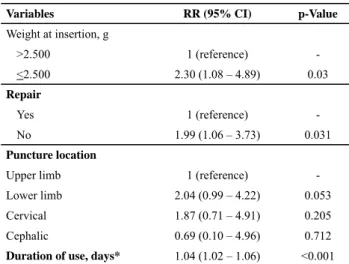
A er multvariate adjustment of the data, the follow-ing factors remained independently associated to re-moval of the catheter due to suspected infec on: weight less than 2,500 grams at me of inser on (RR = 2.30; CI 95% = 1.08 – 4.89; p = 0.030); repair of catheter (RR = 1.99; CI 95% = 1.06 – 3.73; p = 0.031) and use me of the catheter in days (RR = 1.04; CI 95% = 1.02 – 1.06; p<0.000) (Table 3). Removal of the variable puncture
loca-Ɵ on compromises the fi nal adjustment of the model, as observed a er applica on of the sta s cal likelihood ra o test. Thus, it was decided to maintain it in the fi nal model.
DISCUSSION
Analysis of the data shows the infec on rate from use of the PICC was 15.8% (9.7 per 1,000 catheters per day). Addi onally, the variables weight of the NB at Ɵ me of
in-serƟ on, performance of repair and use Ɵ me of the catheter
were independently associated to this outcome. Children with low weight at me of inser on of the PICC showed increased risk (RR = 2.30) of removal of the device due to infec on in comparison to those with weight over 2,500 grams. It was also shown that there is risk of infec on when the catheter is repaired (RR = 1.99). In regard to use me, each day the catheter remained inserted increased the risk of infec on by 4%.
Nevertheless, for analysis of the results, one should consider that the defi ni on of adverse infec ous event related to the PICC primarily showed the occurrence of clinical signs characteris c of infec on as support, a er elimina on of the possibility of other infec ous foci. Thus, to not confi rm the infec on diagnosis as signaled by infec on protocols related to health care represents a limita on of this study.
Table 3 – Variables potentially associated with infection from use
of the catheter, Belo Horizonte, MG, 2010.
Variables RR (95% CI) p-Value
Weight at insertion, g
>2.500 1 (reference)
-<2.500 2.30 (1.08 – 4.89) 0.03
Repair
Yes 1 (reference)
-No 1.99 (1.06 – 3.73) 0.031
Puncture location
Upper limb 1 (reference)
-Lower limb 2.04 (0.99 – 4.22) 0.053
Cervical 1.87 (0.71 – 4.91) 0.205
Cephalic 0.69 (0.10 – 4.96) 0.712
Duration of use, days* 1.04 (1.02 – 1.06) <0.001
*Variable inserted into the model continuously: that is, for every day of use of the PICC, the risk of infection increased by 4%.
Comparison of the infec on rate iden fi ed in this ga on with that of others becomes a delicate task as there is a large varia on of terminologies used to defi ne infec on from the use of the catheter and its removal. For example, one study performed in Taiwan with NBs with very low birth weight considered posi ve blood culture by peripheral vein, clinical signs and absence of another infec on site, iden -fying an incidence rate of 16.3% (8.3 per 1,000 catheters per day(9). Yet in one English NICU, removal of the PICC as
a result of infec on was confi rmed with posi ve culture of blood and/or p of the catheter, which was removed for clinical signs, repor ng an incidence of 21.0% (17 per 1,000 catheters/day)(16). One NICU in Turkey had related
infec on as criteria for removal of the catheter (posi ve culture of blood and p of catheter and clinical signs) and associated infec on (posi ve blood culture, presence of clinical signs and absence of other infec on site), with an incidence of 6.8%(3).
Recent studies on complica ons related to the PICC report prematurity and low weight as condi ons usually existent in infec on cases related to the catheter (8-9, 17-18).
The increased risk of infec on associated with low weight at me of inser on of the PICC shown in our studies is cor-roborated by the fi ndings of other studies performed with at-risk NBs(17-19). This may be explained primarily by the
im-maturity of the immunologic system of these NBs. Extrinsic factors such as me spent in the hospital, performance of mul ple invasive procedures and inadequate hygiene techniques of the professionals also predispose the NBs to nosocomial infec ons(20), with blood infec on associated
with use of the catheter being the most frequent(15).
In selec ng the inser on site of the PICC, it is rec-ommended that the risk and benefi ts of the choice are considered, seeking to reduce infec ous complica ons related to the mechanics(7). It is recommended to avoid
use of the femoral site due to higher risk of thrombus forma on, and higher incidence of blood infec on related to the catheter(9, 18-19). However, few studies consider the
veins of the lower limbs, those being the femoral, great saphenous, small saphenous or the dorsal venous arch of the foot, in comparison to the veins of the upper limbs. Recent studies showed higher rates of infec ous
ons when the inser on site of the catheter was located on the lower limbs. However, there was no sta s cal dif-ference when the rates were compared to those obtained on the upper limbs, which is in consonance with the re-sults of this inves ga on(8,16). On the contrary, authors(17)
concluded that catheters inserted into lower limbs had lower rates of infec on from the PICC, and needed more me to develop complica ons in comparison to catheters inserted into other sites.
infec on does as well(9-22). However, in these studies there
is no clarity to determine the ideal moment of removal of the device in a manner that reduces the risk of infec on.
Performance of repair of the PICC is not recommended by the protocols on infec ons related to health care. How-ever, this prac ce is commonly performed in health ins ons as an alterna ve to make possible the con nuity of the intravenous therapy a er damage to the external por on of the catheter. Considering the increase of handling and exposure of the device at the me of repair, the increased risk of infec on is jus fi ed (RR=3.25) when compared to devices that did not undergo repair.
An evalua on of the na onal literature on factors related to infec on from the PICC in neonates shows that studies are still incipient. Therefore, the results obtained in this study represent a signifi cant
on to understanding ques ons related to the use of the PICC, principally those on adverse events. Added to the strengths of this study are its longitudinal delinea on, which guarantees temporality and rela onship of cause and eff ect between the associa ons.
CONCLUSION
The PICC has been amply used in the neonatal on due to the possibili es that it off ers in the care of at-risk NBs. However, it is verifi ed that it presents adverse events that may be the result of condi ons intrinsic to neonates or their care.
In this study, weight of the NB below 2,500 grams at the me of inser on of the catheter, use me in days and performance of repair of the PICC were shown to be predictors of infec on from the use of the device in NBs hospitalized in an ICU.
Given that infec on is the adverse event that most contributes to removal of the catheter before termina on of the therapy, these fi ndings should be considered in the clinical prac ce of the nurse and other members of the nursing and mul professional teams, especially regarding modifi able factors, such as use me and catheter repair, for greater safety and effi cacy in the use of the PICC in the neonatal popula on, thereby guaranteeing quality care that is free of harm.
1. Infusion Nurses Society. Infusion Nursing Standards of Prac ce. J Infus Nurs. 2006;29(1 Suppl):S1-92.
2. Levy I, Bendet M, Samra Z, Shalit I, Katz J. Infectious complications of peripherally inserted central venous catheters in children. Pediatr Infect Dis J. 2010;29(5):426-9.
3. Bulbul A, Okan F, Nuhoglu A. Percutaneously inserted central catheters in the newborns: a center’s experience in Turkey. J Matern Fetal Neonatal Med. 2010; 23(6):529-35.
4. Baggio MA, Bazzi FCS, Bilibio CA. Peripherally inserted central catheter: descrip on of its use in neonatal and pediatric ICU. Rev Gaúcha Enferm. 2010;31(1):70-6.
5. Polderman KH, Girbes ARJ. Central venous catheter use. Part 2: infectious complications. Intensive Care Med. 2002;28(1):18-28
6. Pe t J. Assessment of infants with peripherally inserted central catheters: Part 2. Detec ng less frequently occurring complica ons. Adv Neonatal Care. 2003;3(1):14-26
7. Center for Disease Control and Preven on. Guidelines for the preven on of intravascular catheter-related infec ons. Clin Infect Dis. 2011;52(9):162-93
8. Wylie MC, Graham DA, Potter-Bynoe G, Kleinman ME, Randolph AG, Costello JM, et al. Risk factors for central line-associated bloodstream infec on in pediatric intensive care
9. Hsu JF, Tsai MH, Huang HR, Lien R, Chu SM, Huang CB. Risk factors of catheter-related bloodstream infec on with percutaneously inserted central venous catheters in very low birth weight infants: a center’s experience in Taiwan. Pediatr Neonatol. 2010; 51(6):336-42.
10. Racadio JM, Doellman DA, Johnson ND, Bean JA, Jacobs BR. Pediatric peripherally inserted central catheters: complica on rates related to catheter p loca on. Pediatrics. 2001;107(2):E28.
11. Conselho Federal de Enfermagem (COFEn). Resoluçã o COFEn 258, de 12 de julho de 2001. Inserção de Cateter Periférico Central pelos Enfermeiros [Internet]. Rio de Janeiro; 2001 [citado 2011 out. 25]. Disponível em: h p://novo.portalcofen. gov.br/resoluo-cofen-2582001_4296.html
12. Camargo PP. Procedimento de inserçã o, manutençã o e remoçã o do cateter central de inserçã o perifé rica em neonatos [dissertaçã o]. Sã o Paulo: Escola de Enfermagem, Universidade de Sã o Paulo; 2007.
13. Sociedade Brasileira de Enfermeiros de Terapia Intensiva. Curso de qualifi caçã o e inserçã o, u lizaçã o e cuidados com cateter venoso central de inserçã o perifé rica – CCIP. Sã o Paulo: SOBETI; 2004.
14. O’Grady NP, Alexander M, Dellinger EP, Gerberding JL, Heard SO, Maki DG, et al.; Center for Disease Control and Preven on. Guidelines for the preven on of intravascular catheter-related
15. Brasil. Ministério da Saúde; Agência Nacional de Vigilância Sanitária, Gerência de Inves gação e Prevenção das Infecções e dos Eventos Adversos. Neonatologia: critérios nacionais de infecção relacionadas à assistência à saúde. Brasília; 2010.
16. Njere I, Islam S, Parish D, Kuna J, Keshtgar AS. Outcome of peripherally inserted central venous catheters in surgical and medical neonates. J Pediatr Surg. 2011;46(5):946-50.
17. Hoang V, Sills J, Chandler M, Busalani E, Cli on-Koeppel R, Modanlou HD. Percutaneously inserted central catheter for total parenteral nutri on in neonates: complica ons rates related to upper versus lower extremity inser on. Pediatrics. 2008;121(5):1152-9.
18. Tsai MH, Chu SM, Lien R, Huang HR, Wang JW, Chiang CC, et al. Complica ons associated with 2 diff erent types of percutaneously inserted central venous catheters in very low birth weight infants. Infect Control Hosp Epidemiol. 2011;32(3):258-66.
19. Bouissou A, Rakza T, Storme L, Lafarghe A, Fily A, Diependaele JF, et al. Umbilical and peripherally inserted venous central catheterization of the newborn. Arch Pediatr. 2008;15(9):1447-53.
20. M u s s i - P i n h a t a M M , R e g o M A . P a r t i c u l a r i d a d e s imunológicas do pré-termo extremo: um desafio para a prevenção da sepse hospitalar. J Pediatr (Rio J). 2005;81(1 Supl):S59-S68.
21. Tsai MH, Lien R, Wang JW, Huang HR, Chiang CC, Chu SM, et al. Complica on rates with central venous catheters inserted at femoral and non-femoral sites in very low birth weight infants. Pediatr Infect Dis J. 2009;28(11):966-70.