INTRODUCTION
Address to: Dr. Lafayette Pereira Candido. Depto Botânica/UFSCAR. Av. Carlos Botelho 3206, 13569-230 São Carlos, SP, Brasil.
Phone: 55 16 8233-4459 e-mail: [email protected] Received 4 June 2013
Accepted 25 July 2013
Bioactivity of plant extracts on the larval and pupal stages
of Aedes aegypti (Diptera, Culicidea)
Lafayette Pereira Candido
[1],[2], Monica Tejo Cavalcanti
[1]and Eduardo Barbosa Beserra
[1][1]. Laboratório de Entomologia, Núcleo de Sistemática e Bioecologia de Insetos, Departamento de Biologia, Universidade Estadual da Paraíba, Campina Grande, PB. [2]. Departamento de Botânica, Laboratório de Ecofi siologia e Germinação de Sementes, Universidade Federal de São Carlos, São Carlos, SP.
ABSTRACT
Introduction: Aedes aegypti is responsible for the transmission of the dengue and yellow fever viruses. This study evaluated the effects of extracts from Cnidosculos phyllacanthus,Ricinus communis, and Coutarea hexandra on the developmental periods of A.aegypti larvae and pupae. Crude extracts of C. phyllacanthus and C. hexandra and oil from R. communis and C. phyllacanthus were used. Methods: Bioassays of the larvicidal and pupicidal effects of these products at different concentrations and times of exposure were evaluated. The lethal and sublethal effects were determined using different concentrations in larvicidal tests. Mortality data were evaluated by Probit analysis to determine the LC50 and LC90 values. Results: The vegetable oils from C. phyllacanthus and R. communis demonstrated greater effi ciency for larval control with an LC50=0.28µl/mL and an LC90=1.48µl/ mL and LC50=0.029µl/mL and a LC90=0.26µl/mL, respectively. In pupal tests toxic effects for all insects were verifi ed after exposure to the products at signifi cant LC50 and LC90 values for 24 and 48h. The effects of sublethal concentrations of C. phyllacanthus (oil) were more effective on the insects. Conclusions: The vegetables oils from C. phyllacanthus and R. communis demonstrated greater potential from the control of different developmental periods in the life cycle of this insect.
Keywords: Larvicidal. Control. Vector.
Aedes aegypti, Diptera, Culicidae (Linnaeus, 1762); can be found in human dwellings where it obtains food, copulates and spawns. As ubiquitous insect, this species exhibits a high ability to adapt to artifi cial habitats allowing for their occupation and expansion and, consequently, emergence of epidemias1. The
highest epidemiologic importance of this study is that mosquitoes play a role as transmitters of yellow fever and dengue virus2.
The control of the dengue vector and important insect species related to public health has been managed in the last decades mainly with synthetic chemical insecticides. The intense use of these synthetic compounds has many exposed mosquito populations to intense selective pressure and hence the prevalence of some populations are resistant to products used to control these vectors. Thus, the use of secondary metabolites of plants that have insecticidal potential is being studied to minimize the impact of synthetic compounds on the environment and human health3.
The close relationship between plants and insects and the possible coevolution of plants led to the development of strategies to attack these invertebrates that, are physical or
chemical in nature4. Thus, Cnidoscolus phyllacanthus, Ricinus communis (Euphorbiaceae) and Coutarea hexandra (Rubiaceae) are chemical compounds whose biological activities have been described5-8.
In view of the operational and economic difficulties generated by increased mosquito resistance to synthetic insecticides, alternative methods have gained increasing attention9. Several plant species have been investigated and
tested with potential larvicides directed against several insect species including Aedes aegypti, Magonia pubescens10, Atlantia monophylla11, Cybistax antisyphilitica12, Anacardium humile13
and Spathelia excelsa14. In this study we report the insecticidal
activity (larval and pupal) of C. phyllacanthus, C. hexandra and R. communis on Aedes aegypti.
METHODS
The population of A. aegypti was collected in the District of Monte Santo, Campina Grande, State of Paraíba, Brazil. The collection and establishment of strains in the laboratory occurred between December 2009 and August 2010. Eggs were collected with 50 ovitraps that were installed inside and outside homes distributed in ten blocks where fi ve traps were installed per block.
Establishment and maintenance of Aedes aegypti in the laboratory
The laboratory bioassays were conducted in a temperature-controlled room (26±2°C and 12h light). Vanes eucatex containing A. aegypti eggs from the fi eld were dried for 48h and then packed in white plastic trays (40x27x7.5cm) with a
RESULTS third of its capacity fi lled with non chlorinated water. After the
outbreak, ornamental fi sh food (Goldfi sh growth) was added (100mg/tray). Adults were maintained in cages with a wooden frame coated with organza (40cm x 40cm x 30cm) containing 200 individuals (100 males and 100 females). Adults were fed with a 20% honey solution and the females were fed blood from the quail Coturnix japonica three times a week for 30min. After meals were introduced inside each cage, a disposable cup containing 200ml of distilled water with a plastic funnel coated with fi lter paper served as a substrate for oviposition.
Collection and preparation of solutions
The ethanolic fraction was obtained from cauline tissue from C. phyllacanthus and C. hexandra, which was placed in an incubator at 40°C for 48h. When dry, the shells were crushed and sieved. The powder was moistened with 90% ethanol and subsequently percolated for cold extraction for 48h. After this period, the ethanolic fractions were collected and concentrated by spin evaporation to yield extracts. Seeds from C. phyllacanthus and R communis were used for the extraction of vegetable oil. These were fi rst crushed and macerated and then subjected to a hydraulic press in the cold. The fi xed oils were stored in glass bottles covered with aluminum foil and kept in the refrigerator.
Larvicidal and pupicidal bioassays
Larvicidal and pupicidal test were performed according to the methodology of the World Health Organization15 with
some adjustments. The biological activity of the extracts of the specimens used in the laboratory was found in late L3 and/ or early L4 larval and pupal stages of populations of A. aegypti to obtain of the lethal concentrations (LC50 and LC90) values. We used 30, 60, 125, 250 and 500mg/mL of ethanolic fractions diluted in 1mL of dimethyl sulfoxide (DMSO). For vegetable oils, a 1:1 ratio with tween 20 was made at the following concentrations: 100, 190, 380, 750 and 1.5µl/mL. DMSO and tween and water were used as controls. For each concentration there were four replicates with 25 individuals per replicate, and mortality assessed was after 24 and 48h of exposure. For pupal tests, the occurrence of adults, if they were dead, was counted as pupae.
Effect of sublethal (lethal concentrations of cumulative effect), plant extracts were established via the LC50 and LC90 values determined with the test larvicide after 48h of exposure to plant products. There were four replicates with each containing 30 third instar A. aegypti larvae. Daily readings were made with verifi cation of the larval stage, behavior changes, the presence of exuvia, adult emergence, possible mortality of the larvae, pupae and adults, and the water temperature. The experiment was conducted until the last pupa or adult died or until the last adult completely emerged.
Mortality data for the larvae and pupae of the studied population were subjected to Probit analysis using the Polo-PC program to determine the lethal concentrations (LC50 and LC90). There was no need to correct the data with the Abbott formula16.
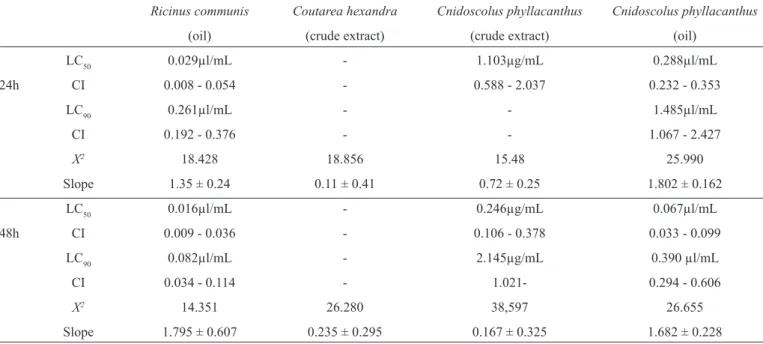
With respective to the larvicidal activity of the plant products analyzed, it was observed that after 24 and 48h of exposure, only vegetable oils demonstrated relevant results against L3 A. aegypti larvae. Tests including vegetable oils from R. communis and C. phyllacanthus on L3 A. aegypti larvae proved to be the most promising for the control of the mosquito larvae, which was confi rmed by the LC50=0.029µl/mL and LC90=0.261µl/mL and LC50=0.288µl/mL and LC90=1.485µl/mL values obtained after 24h of exposure. These tests indicated that lower concentrations are needed for these products to obtain a larval mortality of 50-90% of the population (Table 1). Among the species studied, oil from R. communis was the most effective with regard to lethal concentrations (LC50 and LC90) and had lower values compared to other species studied. The X2 values
indicated the adequacy of the data for the entire experiment using the Probit model (p<0.95).
Seed oil from C. phyllacanthus also showed larvicidal potential after 24h of exposure. However, crude extract made from the bark of this vegetable demonstraded activity after 24 and 48h of exposure with larvae of this vector when the values from the LC50 and LC90 levels were obtained (Table 1).
The results obtained from a crude extract from the stem of C. hexandra allowed us to deduce that these dosages treat yourself a non-toxic plant on L3 stage A. aegypti because they could not be estimated after 24h of exposure lethal concentrations LC50 and LC90(Table 1).
After exposing the larvae to vegetable products for 24 and 48h, it was observed that oil extract from the seeds of R. communis had the lowest lethal dose (LC50=0.016μl/mL and LC90=0.082μl/mL). However, for fractions extracted from the stems of C. phyllacanthus and C. hexandra after 48h of treatment, it was noted that despite a considerable reduction in the LC50 and LC90 values compared with the test performed after 24h, the levels were still considered high for this mosquito larval control (Table 1).
To evaluate potential overlaps in the larvicide behavior induced by the studied extracts was performed principal component analysis (PCA). The analysis demonstrated that in PC1/PC2, there was a split into three groups (C. hexandra with C. phyllacanthus (stem), R. communis and C. phyllacanthus (oil)) which explained 98% of the variance in the data. This result alloweds us to infer that there were differences in the behavior induced by larvicidal oils and extracts from the stem but not from the extracts of C. phyllancanthus (stem) and C. hexandra (stem) which formed a single group (Figure 1).
TABLE 1 - Analysis of larvicidal effect of plant extracts Cnidoscolus phyllacanthus, Ricinus communis and Coutarea hexandra with their
respective lethal concentrations, confi dence intervals (95%), chi-square (χ2) and (Slope) after an exposure of 24 and 48h.
Ricinus communis Coutarea hexandra Cnidoscolus phyllacanthus Cnidoscolus phyllacanthus
(oil) (crude extract) (crude extract) (oil)
LC50 0.029µl/mL - 1.103µg/mL 0.288µl/mL
24h CI 0.008 - 0.054 - 0.588 - 2.037 0.232 - 0.353
LC90 0.261µl/mL - - 1.485µl/mL
CI 0.192 - 0.376 - - 1.067 - 2.427
X2 18.428 18.856 15.48 25.990
Slope 1.35 ± 0.24 0.11 ± 0.41 0.72 ± 0.25 1.802 ± 0.162
LC50 0.016µl/mL - 0.246µg/mL 0.067µl/mL
48h CI 0.009 - 0.036 - 0.106 - 0.378 0.033 - 0.099
LC90 0.082µl/mL - 2.145µg/mL 0.390 µl/mL
CI 0.034 - 0.114 - 1.021- 0.294 - 0.606
X2 14.351 26.280 38,597 26.655
Slope 1.795 ± 0.607 0.235 ± 0.295 0.167 ± 0.325 1.682 ± 0.228
LC50: lethal concentrations; CI: confi dence interval.
12.0
PC2 (5%
)
PC1 (93%)
10.0 8.0 6.0 4.0 2.0 0.0 -2.0 -4.0 -6.0 -8.0
-20.0 -10.0 0.0 10.0 20.0 30.0
Larval:
Cnidoscolus phyllacanthus(stem)
Cnidoscolus phyllacanthus(oil)
Coutera hexandra(stem)
Ricinus communis(oil)
FIGURE 1 - Graph scores for PC1 versus PC2 for the fi ve tested concentrations of plant extracts after 24h of exposure to Aedes aegypti. PC: principal component. When assessing the effect of plant extracts on the pupal
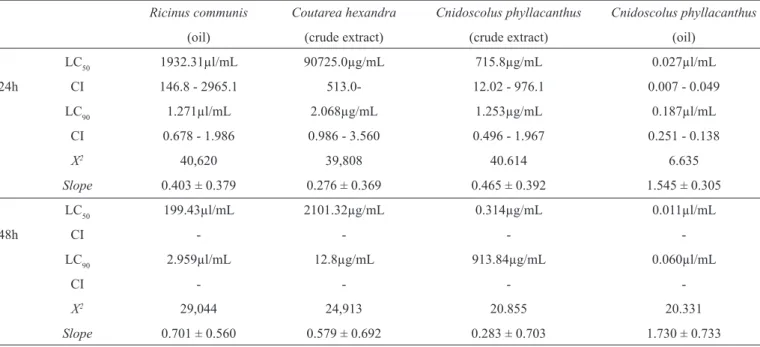
stage of A. aegypti, all results were signifi cant with LC50 and LC90 values thet were more promising than those obtained by the larvicide test. The larvicide test with vegetable oils R. communis and C. phyllacanthus demonstrated greater effi ciency in controlling the pupae of this vector, which was confi rmed by the (LC50 and LC90 values) obtained after 24h
of exposure (Table 2). Oil extracted from the seeds of C. phyllacanthus was among the products evaluated, which demonstrated greater pupicidal activity with lower LC50 and LC90 value after 24 and 48h of exposure.
A greater interaction between the plant products and pupae of A. aegypti was observed when evaluating extracts made after 48h of exposure, which resulted in lower lethal doses capable of killing 50 and 90% of the population. Thus, lethality was enhanced with increasing time of exposure to plant products.
With regard to the species evaluated after 48h of treatment R. communis extract effi ciently killed mosquito pupae, resulting in a mortality rate ranging from 50 to 90% for the lower stage and with small LC50 and LC90 values (Table 2). During this period of exposure (48h), it was found that adults at all concentrations and treatments were susceptible to the extracts tested verifying mortality in all replicates. This newly emerged adult mortality might be related to the action of contact with plant extracts present in solutions for the adult mosquito. Thus, one can conclude that the solutions tested negatively affected adult emergence.
Assessment of the activity pupicidal of plant extracts via analysis of PC1 versus PC2 with 95% of variance shows that there were no differences in the mortality response between treatments after 24h of exposure. In Figure 2, all samples were blended. The toxicity of the products was the same for the pupal
stage of this vector. Therefore, at this stage of the life cycle of A. aegypti, both of the crude vegetable oils demonstrated effi ciency in controlling this vector.
The sublethal effects of C. phyllacanthus (oil) LC50=0.067μl/mL lasted 28 days with a larvicide cumulative mortality of ± 84.1% (Table 3). During the experiment it was observed that the larvae were able to develop and reach the adult stage. In addition, the temperature of the water throughout the experiment was verifi ed to be approximately 22ºC.
TABLE 2 - Analysis of the effect of the plant extracts pupicidal Cnidoscolus phyllacanthus, Ricinus communis and Coutarea hexandra with their
respective lethal concentrations (LC), confi dence intervals (95%), chi-square (χ2) values and slope (Slope) after an exposure of 24 and 48h.
Ricinus communis Coutarea hexandra Cnidoscolus phyllacanthus Cnidoscolus phyllacanthus
(oil) (crude extract) (crude extract) (oil)
LC50 1932.31µl/mL 90725.0µg/mL 715.8µg/mL 0.027µl/mL
24h CI 146.8 - 2965.1 513.0- 12.02 - 976.1 0.007 - 0.049
LC90 1.271µl/mL 2.068µg/mL 1.253µg/mL 0.187µl/mL
CI 0.678 - 1.986 0.986 - 3.560 0.496 - 1.967 0.251 - 0.138
X2 40,620 39,808 40.614 6.635
Slope 0.403 ± 0.379 0.276 ± 0.369 0.465 ± 0.392 1.545 ± 0.305
LC50 199.43µl/mL 2101.32µg/mL 0.314µg/mL 0.011µl/mL
48h CI - - -
LC90 2.959µl/mL 12.8µg/mL 913.84µg/mL 0.060µl/mL
CI - - -
-X2 29,044 24,913 20.855 20.331
Slope 0.701 ± 0.560 0.579 ± 0.692 0.283 ± 0.703 1.730 ± 0.733
LC: lethal concentrations; CI: confi dence interval.
this concentration, there was a mortality rate of ± 88.3%. The effi ciency in reducing adult emergence helped to confi rm that at this dose ± 11.7% of the larvae developed to the pupal stage and only 0.9% became viable adults (Table 3). With regard to a treatment with an LC50 (0.067µl/mL) of C. phyllacanthus, of the larvae that did could develop, 19 turned into pupae, but there was a 5% mortality rate even at this stage, and only ± 10.9% reached adulthood (± 3.1% died in this stage).
The sublethal effects of R. communis at an LC50 of 0.016μl/mL lasted approximately 33 days, and the LC90 concentration lasted 24 days. At the end of the 33 day exposure to 120 larvae, the mortality rate was ± 87.5% LC50R. communis. Between those that managed to develop, 10 became pupae with only one death. The highest number of emerged adults (11.7%) and ± 1.6% mortality was recorded of the (LC50) of the R. communis extract. This was the most effective treatment for the larvae of A. aegypti with a mortality rate of 87.5%. The highest larval
TABLE 3 - Duration of the experiments for sublethal effects of the vegetable oils Cnidoscolus phyllacanthus and Ricinus communis at the lethal LC50 and LC90 concentrations for Aedes aegypti. Total of was 120 L3 larvae of this vector were in each treatment.
Duration Death Death Emergence Death
Plant extracts (days) larvae (%) pupal (%) adults (%) adults (%)
LC50 28 84.1 5.0 10.9 3.1
Cnidoscolus phyllacanthus
LC90 14 88.3 5.8 5.9 5.0
LC50 33 87.5 0.8 11.7 1.6
Ricinus communis
LC90 24 93.3 0.8 5.9 2.3
Control Water 35 4.1 - 95.9
-LC: lethal concentrations.
3.0
PC1 (84%)
PC2 (9%
)
-11.0 -5.0 0.0 5.0 2.0
1.0
0.0
-1.0
-2.0
-3.0
Cnidoscolus phyllacanthus(stem)
Cnidoscolus phyllacanthus(oil)
Coutera hexandra(stem)
Ricinus communis(oil)
mortality observed for the larvicide test was obtained with a LC90 of 0.082μl/mL, where at the end of 24 days, the larval mortality was ± 93.3%. The remaining ± 6.7% developed into pupae, only one death was recorded, and 5.9% emerged into adults and ± 2.3% died at this stage.
The control experiment lasted 35 days with only fi ve larval mortalities (± 4.1%). If the mortality of the control group was between 5 and 20%, it was be adjusted using the Abbott formula or the bioassay would have been repeated according to recommendations of the World Health Organization17,18
(Table 3). Moreover, there was no mortality for pupae and adults, verifying the emergence of 95.9% viable adults.
DISCUSSION
The larvicidal activity of the R. communis oil can be attributed to its chemical components which include the a derivative of ricin ricinoleic acid, a toxic substance that
is present in abundance in the seed oil of this plant7. This
constituent had a negative effect on the larval of this vector. No studies have reported on the effects of R. communis on A. aegypti; however, the insecticidal effect of this vegetable
was evaluated in other species of insects. Hebling19, assessed
the bioactivity of R. communis on ants and demonstrated its
effi cacy in combating Hymenopteran, Burg and Mayer20 tested
the effect of R. communis seed oil on aphids and different species of lice, describing how promising this oil was for the control of these insects. In a study of the effects of aqueous extract from the green fruits of castor on the larvae and pupae of Spodoptera frugiperda, Santiago21 observed a reduction in the lifetime of
these stages, and Rother22 identifi ed toxic effects of leaf extracts
of R. communis on Apis mellifera worker larvae.
The plant extracts studied here showed greater effi ciency
in the control A. aegypti pupae. The promising effects of these products on the pupal stage of A. aegypti are related to the morphological differences between the pupae and larvae of this insect, indicating that the mode of action of these products is by contact or choking and not swallowing, because the pupal stage does not involve ingestion. A curious observation was made
with crude extracts from C. hexandra and C. phyllacanthus
the concentrations studied were nontoxic to the L3 larvae of this vector, but were lethal to the pupae. Furthermore, there was similarity between the pupal mortality of products C. phyllacanthus (stems and seeds) after 24h. According to
Santos23 despite being a source of extracts from different parts
of the plant chemicals biosynthesis is not restricted to one part of the plant; thus, the products are accumulated in the whole plant or different organs because of an intercellular system.
There are several studies of the activity of plant extracts on A. aegypti, mainly examining its larvicidal action. However, there are few studies of the effect of natural products on the pupal stage. Thus, we found no studies in the literature involving these species and their effects on the pupal stage of A. aegypti. However, studies of the pupicidal activity of other plant species
have been reported by Macchioni et al.24 with Condonopsis
javanica on the dipteran Aedes albopictus, demonstrating 75%
mortality of pupae at a concentration of 60.000ppm. Using the extracts of leaves and seeds from Melia azedarach on Anopheles stephensi, Nathan25 found a 92.3 and 90.9% mortality rate,
respectively, at 20,000ppm. Nathan26 also tested Eucalyptus tereticornis on Anophelesstephensi and found a 160ppm 88% mortality for pupae. Although different material was used in this study, the results discussed above only corroborate the need for development studies using plant extracts to evaluate their effects on different stages of A. aegypti.
Regarding the effects of the sublethal plant extracts studied, we observed that although there was a small immediate response for some of the products analyzed, when evaluating larval development, these products interfered with the in timing and number of hatched adult insects. The sublethal effects of chemical compounds on natural specimens of A. aegypti were investigated by Shaalan27 who evaluated the effect of synthetic
insecticides and Callitris glaucophyllam extracts and various chemical insecticides Adanan et al.28 and Kamaraj29 showed that,
while not fatal, these sublethal concentrations lead to a disorder in insect biology, both morphologically and physiologically, interfering with the duration of the larval period and the pupae exposed to these concentrations, refl ected in the emergence of adults.
These results need corroboration further, in addition to the more detailed study on the insecticidal properties with phytochemicals present in R. communis and C. hexandra and C. phyllacanthus. The next challenge consists identify chemical compounds that were responsible for the larval and pupal mortality and control programs in the future serve as a tool to control of the actions to A. aegypti.
ACKNOWLEDGMENTS
We would like to thank the Paraíba State University (UEPB) for the opportunity to develop this research, (Programa de Incentivo à Pós-Graduação e Pesquisa (PROPESQ)/ UEPB).
REFERENCES
The authors declare that there is no confl ict of interest. CONFLICT OF INTEREST
1. Silva HHG, Silva IG, Santos SRMG, Rodrigues FE, Elias CN. Atividade larvicida de taninos isolados de Magoniua pubescens St. Hil. (Sapindaceae) sobre Aedes aegypti (Diptera, Culicidae). Rev Soc Bras Med Trop 2004; 37:396-399.
2. Agrelo RS. Aedes aegypti, Aedes albopictus (Díptera, Culicidae) y su papel como vectores en lãs américas. La situación de Uruguay. 1996. [Cited 2012 November 11]. Available at: http://www.cepes.ops-oms.org/ brsoir/repimdex/repi78/ref.pdf.
3. Barreto CF. Aedes aegypti resistência aos inseticidas químicos e as novas alternativas de controle. Rev Eletr Fac Montes Belos, Goiás 2005; 1:62-73. 4. Freitas AC, Lima MP, Ferreira AG, Tadei WP, Pinto ACS. Constituintes
5. Endo Y, Ohta T, Nozoe S. Favelines novel tricyclic benzocychoheptans with citotoxic activities from the Brazilian plant, Cnidoscolus phyllacanthus. Tetrahedron Lett 1991a; 32:3083-3086.
6. Endo Y, Ohta T, Nozoe S. Favelanone. a novel tetracyclic cyclopropane derivative from de Brazilian plant, Cnidoscolus phyllacanthus. Tetrahedron Lett 1991b; 32:5555-5558.
7. Leite AC, Cabral EC, Santos DAP, Fernandes JB, Vieira PC, Silva MFGF. Isolamento do alcalóide ricinina das folhas de Ricinus communis (Euphorbiaceae) através de cromatografi as contracorrentes. Quim Nova 2005; 28:983-985.
8. Lucena JEX. Efeito antinociceptivo e antiinfl amatório do extrato aquoso da entrecasca de Coutarea hexandra Schum (Rubiaceae). Rev Bras Farmacogn 2006; 16:67-72.
9. World Health Organization (WHO). Dengue hemorrhagic fever: Diagnosis, treatment, prevention and control. Geneva: WHO; 1997. 10. Silva HHG, Silva IG, Santos SRMG, Rodrigues FE, Elias CN.
Atividade larvicida de taninos isolados de Magoniua pubescens St. Hil. (Sapindaceae) sobre Aedes aegypti (Diptera, Culicidae). Rev Soc Bras Med Trop 2004; 37:396-399.
11. Sivagname N, Kalyanasundaram MM. Laboratory avaluation of methanolic extract of Atlantia ophylla (family: Rutaceae) against immature stages of mosquitoes and non-target organisms. Mem Inst Oswaldo Cruz 2004; 99:115-118.
12. Rodrigues MAS, Paula JE, Roblot F, Fournet A, Espindola LS. Larvicida activity of Cybistrax antisyphilitica against Aedes aegypti larvae. Fitoterapia 2005; 76:755-757.
13. Porto KRA, Roel AR, Silva MM, Coelho RM, Scheleder JD, Jeller AH. Atividade Larvicida de óleo de Anacardium humile Saint Hill sobre Aedes aegypti (Linnaeus, 1762) (Diptera, Culicidade). Rev Soc Bras Med Trop 2008: 41:586-589.
14. Freitas AC, Lima MP, Ferreira AG, Tadei WP, Pinto ACS. Constituintes Químicos do caule de Spathelia excelsa (RUTACEAE) e atividade frente a Aedes aegypti. Quim Nova2009; 32:2068-2072.
15. World Heatlth Organization (WHO). Guildelines for laboratory and Field testing of mosquito larvicides. Geneva: WHO; 2005.
16. Abbott WS. A method of computing the effectiveness of an insecticide. J Econ Entomol 1925; 18:265-267.
17. World Health Organization (WHO). Instructions for determining the susceptibility or resistance of mosquito larvae to insecticides. Geneva: WHO; 1981.
18. World Health Organization (WHO). Criteria and meaning of tests for determining the susceptibility or resistance of insects to insecticides. Geneva: WHO; 1981.
19. Hebling MJA. Toxic effect of Ricinus communis (Euphorbeaceae) to laboratory nests of Atta sexdens rubropilosa (Hymenoptera: Formicidae). Bull Entomol Research 1996; 86:253-256.
20. Burg IC, Mayer PH. Alternativas ecológicas para prevenção e controle de pragas e doenças. 7th ed. Francisco Beltrão (PR): Grafi t Gráfi ca e Editora; 1999. 21. Santiago GP. Efeitos de extratos de plantas na biologia de Spodoptera frugiperda (I.E. Smith, 1797), (Lepidoptera: Noctuidae) mantida em dieta artifi cial. Cienc Agrotec 2008; 32:792-796.
22. Rother DC, Souza TF, Malaspina O, Bueno OC, Silva M, Vieira PC, et al. Suscetibilidade de operárias e larvas de abelhas sociais em relação a ricinina. Serie Zoologia 2009; 99:61-65.
23. Santos RI. Metabolismo Básico e origem dos metabólitos secundários In: Simões CMO, Schenkel EP, Gosmann G, Mello JCP, Mentz LA, Petrovick PR. Farmacognosia da planta ao medicamento, 5th ed. Porto Alegre: Universidade Federal do Rio Grande do Sul; 2004. p. 1102. 24. Macchioni F, Carugini S, Cecchi F, Siciliano T, Braca A, Cioni P, et al.
Aqueous extracts of Codonopsis Javanica against larval and pupal stages of Aedes albopictus, Analle della Facolta, 2004. [Cited 2012 September 10]. Available at: http://eprints.adm.unipi.it/50/1/215.pdf/.
25. Nathan SS. Effi cacy of Melia azedarach L. extract on the malarial Vector Anopheles stephensi Liston (Diptera: Culicidae). Bioresour Technol 2006; 97:1316-1323.
26. Nathan SS. The use of Eucalyptus Tereticornis Sm. (Myrtaceae) oil (leof extract) as a natural larvicidal agent against the malaria vector Anopheles stephensi Liston (Diptera: Culicidae). Bioresour Technol 2007; 98: 1856-1860.
27. Shaalan EAS, Canyon D, Younes MWF, Abdel-Wahab HE, Mansour AH. Effects of sub-lethal concentrations of synthetic insecticides and Callitris glaucophylla extracts on the development of Aedes aegypti. J Vector Ecol 2005; 30:295-298.
28. Adanan CR, Zaire J, NG KH. Effi cacy sublethal effects of mosquito mats on Aedes aegypti and Culex quinquefasciatus (Diptera: Culicidae). Proceedings of the fi fth International Conference on Urban Pests. 2005. p. 265-269.