Problem-Solving Skills Appraisal Mediates
Hardiness and Suicidal Ideation among
Malaysian Undergraduate Students
Abbas Abdollahi1*, Mansor Abu Talib1*, Siti Nor Yaacob2, Zanariah Ismail1
1Faculty of Human Ecology, Universiti Putra Malaysia, Serdang, 43400, Selangor, Malaysia,2Family, Adolescent and Child Research Center of Excellent (FACE), Faculty of Human Ecology, Universiti Putra Malaysia, 43400, Selangor, Malaysia
*[email protected](AA);[email protected](MAT)
Abstract
Objectives
Recent evidence suggests that suicidal ideation is increased among university students, it is essential to increase our knowledge concerning the etiology of suicidal ideation among university students. This study was conducted to examine the relationships between prob-lem-solving skills appraisal, hardiness, and suicidal ideation among university students. In addition, this study was conducted to examine problem-solving skills appraisal (including the three components of problem-solving confidence, approach-avoidance style, and per-sonal control of emotion) as a potential mediator between hardiness and suicidal ideation.
Methods
The participants consisted of 500 undergraduate students from Malaysian public universities.
Results
Structural Equation Modelling (SEM) estimated that undergraduate students with lower har-diness, poor problem-solving confidence, external personal control of emotion, and avoid-ing style was associated with higher suicidal ideation. Problem-solvavoid-ing skills appraisal (including the three components of problem-solving confidence, approach-avoidance style, and personal control of emotion) partially mediated the relationship between hardiness and suicidal ideation.
Conclusion
These findings underline the importance of studying mediating processes that explain how hardiness affects suicidal ideation.
OPEN ACCESS
Citation:Abdollahi A, Talib MA, Yaacob SN, Ismail Z
(2015) Problem-Solving Skills Appraisal Mediates Hardiness and Suicidal Ideation among Malaysian Undergraduate Students. PLoS ONE 10(4): e0122222. doi:10.1371/journal.pone.0122222
Academic Editor:Michael A Motes, Center for
BrainHealth, University of Texas at Dallas, UNITED STATES
Received:May 30, 2014
Accepted:February 19, 2015
Published:April 1, 2015
Copyright:© 2015 Abdollahi et al. This is an open
access article distributed under the terms of the
Creative Commons Attribution License, which permits unrestricted use, distribution, and reproduction in any medium, provided the original author and source are credited.
Data Availability Statement:The data are publicly
available at Figshare with thehttp://dx.doi.org/10. 6084/m9.figshare.1158997.
Funding:The authors have no support or funding to
report.
Competing Interests:The authors have declared
Introduction
Suicide is one of the serious and grave public health problems in many countries, and world-wide is the third highest cause of deaths among adolescents between 16 to 24 years old. Similar-ly, suicidal ideation is common during adolescence [1]. According to the World Health Organization, one million people have died from suicide, and one is dying by suicide every 40 seconds. It is also predicted that by 2020, one person will die every 20 seconds if urgent action is not taken [2]. Recent evidence suggests that suicidal ideation and attempts are increased in Asian countries among university students, indicating this group may be an at-risk population [3]. In Taiwan, around 7.5% of university students had ever planned to kill themselves [4], whereas 3.3% Korean university students had attempted suicide [5]. The situation of suicide among university students in Malaysia is no different from many other countries as well [6]. The National Health and Morbidity Survey reported that young Malaysians in the 16–24 year age group had the highest prevalence of acute and chronic suicidal ideation (10.0% and 26.0%, respectively), which may include a significant proportion of the Malaysian undergraduate stu-dents. The prevalence of suicidal ideation was higher in females and Indian race; however, gen-der and race differences in these relationships are unknown among Malaysian ungen-dergraduate students [7]. As university is a period of transition, major shifts may occur in social and psy-chological aspects of the individuals’lives, and they may experience different levels of difficul-ties in academic pressures, occupational choices, and life goal decisions [3]. With regard to the above- mentioned reasons, suicidal ideation is on the increase among university students, mak-ing it important to identify early-warnmak-ing signs to prevent suicide completion [3]. Therefore, this study was conducted to understand suicidal ideation and the variables associated with sui-cidal ideation among Malaysian undergraduate students.
Previous studies revealed that as problem-solving skills appraisal decreased (i.e., weaker be-lief in ability to solve problems, higher tendency to avoid rather than confront problems, and external control of emotion), suicidal ideation and depression considerably increased [8,9]. The term,“problem-solving skills appraisal,”is defined as one’s perception about one’s person-al problem-solving style and the identification of one’s abilities and skills to solve problems [10]. The appraisal of problem-solving skills comprises three styles: problem-solving confi-dence, approach-avoidance style, and personal control of emotion. Problem-solving confidence is defined as having self-assurance in the face a wide range of problems and trusting in one’s own ability to solve the problems. The approach-avoidance style is defined as a tendency to ap-proach or avoid facing problems. Personal control of emotion is defined as one’s ability to con-trol his or her emotions and behavior while facing problems [11]. Several studies have shown that ineffective problem-solving abilities were associated with psychological stress[12,13], and suicidal ideation [14]. Conversely, effective problem-solving abilities were associated with ef-fective emotional awareness [15], mental health, and life satisfaction [16].
committed to activities. Each activity is meaningful and interesting for him/her. Control is de-fined as a person believing that he/she can control or influence their life experiences. Challenge is defined as a person perceiving the world as an opportunity to develop, as well as being a good learner [17]. Research evidence has supported Kobasa's argument that hardiness plays an influencing role against suicidal ideation [20,21]
According to Kobasa’s definition, two mechanisms have been proposed to explain the effect of hardiness: hardy individuals have the motivation to carry on effective problem-solving skills during stressful situations [22], and appraise stressful conditions as being more challenging and controllable and less threatening. Additionally, hardy individuals seek to gain experience from stressful conditions [23]. Garrosa et al. [22] concluded that individuals with high levels of hardiness applied effective managerial strategies to reduce stress and hopelessness. They are more flexible in facing problems [24], and prefer to use rational-oriented coping styles rather than emotional-oriented coping styles in managing stressful conditions [23]. Studies have re-ported that individuals who are high in hardiness are more likely to report happiness, life satis-faction, and mental and physical health [23,25,26], while other studies have reported that individuals who are low in hardiness are more likely to report mental disorders, such as depres-sion, anxiety, and stress [27]. The present study is designed to understand undergraduate stu-dents’hardiness in relation to their suicidal ideation.
There is no academic literature concerning the relationships between problem-solving skills appraisal, hardiness, and suicidal ideation, because, thus far, many of the studies on hardiness have focused on coping with stress [28,29]. This study aims to expand the hardiness theory on suicidal ideation in undergraduate students. Our literature review highlights the lack of re-search about suicidal ideation and hardiness, which is considered to be vital for the improve-ment of public health. There is still a gap in the association between hardiness and suicidal ideation. The reasons why individuals with lower hardiness experience high levels of suicidal ideation is ambiguous, because most of the studies in this area only addressed the association between hardiness and suicidal ideation [30], without considering other variables influencing the association. Therefore, this study can be useful in clarifying the association between hardi-ness and suicidal ideation and the variable influencing the association. Based on the hardihardi-ness theory [31], it is conceivable that poor hardiness prevents individuals from engaging in coping responses to stress and resistance to stressful situations during times of stress [28,29], and may lead to lower levels of problem-solving skills and higher levels of suicidal ideation.
Hypotheses
Methods
Participants
A total of 500 undergraduate students from two Malaysian public universities participated in this study (male = 46%, n = 230, and Female = 54%, n = 270, aged from 18 to 24 years, Mean = 20.28, SD = 2.58). The ethnicity of the participants included Malay 47.8% (n = 223), Chinese 26.8% (n = 134), Indian 22.6% (n = 113), and others 2.8% (n = 14). In terms of marital status, 76.4% (n = 382) of participants were single, 22.6% (n = 113) of participants were mar-ried, and 1% (n = 5) of participants were separated or widowed. Of the 500 participants, 30% (n = 150) were in the freshman year; 23% (n = 115) were in the sophomore year; 25% (n = 125) were in the junior year, and 22% (n = 110) were in the senior year. In terms of religion, 47.2% (n = 224) of the participants were Muslim, 26.2% (n = 131) Hindus, 21.2% (n = 106) Buddhists, 3% (n = 15) Taoists, and 0.8% (n = 4) were of other religious affiliations.
Procedures
The Malaysian Ministry of Science, obtained permission for gathering data from two public universities. The faculty members were categorized into three fields (science, social science, and technical). Then, a faculty was chosen randomly from each field. After that, four classes (first, second, third, and last year undergraduate students) from each faculty were randomly se-lected, and data were collected during one of the regularly scheduled classes. The inclusion cri-teria for the participants were that (a) they should be university students and (b) be between the ages of 16 and 24 years old. The packages of questionnaires were distributed among under-graduate students. Each package contained an introductory letter about the aims of the study and four questionnaires (one of them was a demographic questionnaire). A total of 550 tionnaires were distributed among undergraduate students, of which 500 (90%) usable ques-tionnaires were returned; 6% (33) refused to complete the quesques-tionnaires.
Ethical statement
The ethics committee of Universiti Putra Malaysia (UPM/TNCPI/1.418.1) approved the study. Written informed consent was obtained from the participants in this study for their involve-ment in the research. This included the purpose of the research and the fact that their partici-pation was voluntary. The consent procedure was approved by the ethics committee and Malaysian Ministry of Science.
Measures
Beck scale for suicidal ideation [32]. The Beck Scale for suicidal ideation is a self-report
measure with 21 items that assess suicidal ideation, planning and suicidal intent in the past week. A 3-point Likert scale from 0 to 2 was used for all questions, and the range of scores is from 0 to 38. If a participant had a high score in BSSI it meant that he/she has a higher suicide risk and vice versa, and that he/she has passive or active thoughts about killing himself/herself. Previous studies showed that BSSI had an acceptable internal consistency and convergent va-lidity [33,34]. The current study showed a good convergent validity (AVE: 0.69), and the con-struct reliability (CR: 0.81) for this instrument.
Personal views survey, third edition revised [35]. The revised Personal Views Survey
used for all questions ranging from 0 (not at all true), 1 (somewhat true), 2 (true), and 3 (very true). Studies have shown an acceptable internal consistency (test-retest coefficient, interval be-tween 2 and 4 weeks): for commitment (α: 0.70–0.75); for control of emotion (α:0.61–0.84); for challenge (α:0.60–0.71); and for total hardiness(α:0.80–0.88) [35]. In addition, the construct validity of PVS III-R reportedα: 0.70 to 0.84 [37]. The construct validity of the challenge was (α: 0.62), commitment (α: 0.59), and control was (α: 0.46) [38]. The present study showed a good convergent validity (AVE: 0.60), and the construct reliability (CR: 0.75) for this instrument.
Problem-solving inventory [39]. The problem-solving inventory comprises 32 items that
measure the perceptions of one’s problem solving beliefs and style in facing problems and diffi-culties in one’s daily life [39]. All questions were based on a 6-point Likert scale from 1 (strong-ly agree) to 6 (strong(strong-ly disagree). This questionnaire consists of three factors: (a) Problem-solving confidence (PSC), (b) Approach-Avoidance Style; (c) Personal control of emotion. The problem-solving inventory provides scores on three problem-solving dimensions [39]; there-fore, in this study, three factors were evaluated separately. Based on a wide range of studies, this questionnaire showed good validity [39,40]. The present study showed a good convergent validity for PSC, AAS, and PCS with (AVE: 0.58, 0.53, and 0.51 respectively), and the construct reliability (CR: 0.77, 0.74, and 0.71, respectively).
Demographics. A self- report questionnaire was provided to obtain demographic
infor-mation, such as gender, age, race, educational levels, religious affiliation, and marital status.
Pilot study
A pilot study was conducted on sixty undergraduate students to determine the reliability of the tools. The Cronbach’s Alpha coefficients for the questionnaires in the pilot study were as fol-lows: (1) Beck Suicidal Ideation Scale (α: 0.73); (2) Personal Views Survey, Third Edition Re-vised (α: 0.78); and (3) Problem-Solving Inventory (α: 0.79). In general, the respondents of the pilot study gave positive feedback toward the general structure and presentation of the ques-tionnaire. To improve the face validity of the scales, the survey questionnaire was further re-fined based on some comments collected from the participants. In order to assess the face validity and content validity, and to ensure its adaptability to the local cultural context, the in-strument was reviewed and approved by the Faculty of Human Ecology, Universiti Putra Malaysia.
Analysis
We employed Structural Equation Modelling (SEM) analysis. According to Kline [41], the ad-vantages of employing SEM are that it (a) improves statistical estimation by taking into account the measurement error in the estimation process, (b) enables the testing of multiple relationships simultaneously, (c) tests much more complex models, such as testing mediation, moderation, and provides goodness of fit indices for the model tested, and (d) provides better identification for convergent validity, construct reliability, and discriminant validity for the instruments.
should be bigger than the square of the correlation between the two constructs [42]. The results showed that the constructs had suitable discriminant validity.
Data preparation
The missing range of items and parcels were from 1.81% to 2.81%; therefore, for addressing missing data a multiple imputation method in AMOS 20 software was applied. Outliers of 4% (n = 22) were excluded from the analyses (those scoring three standard deviations from the mean). The data were distributed normally, because the skewness values were from -1.77 to 1.68, and the kurtosis values were from -2.61 to 2.11 for all variables. Byrne [43] stated that if the skewness value is between -2 to +2, and the kurtosis value is between -7 to +7; multivariate normality of the data could be assumed. For model fit, Kline [44] suggested using model fit in-dexes, including the chi square/degree of freedom ratio (CMIN/DF), the comparative-fit index (CFI), the goodness-of-fit index (GFI), and the Tucker-Lewis Index (TLI). A rule of thumb for the fit indices is that values equal or greater than 0.90 indicate acceptable fit [44]. Furthermore, the model may be classified as acceptable if the root mean squared error of approximation (RMSEA) is between 0.03 and 0.08. AMOS 20 software was utilized for analysing the data.
Results
Descriptive statistics
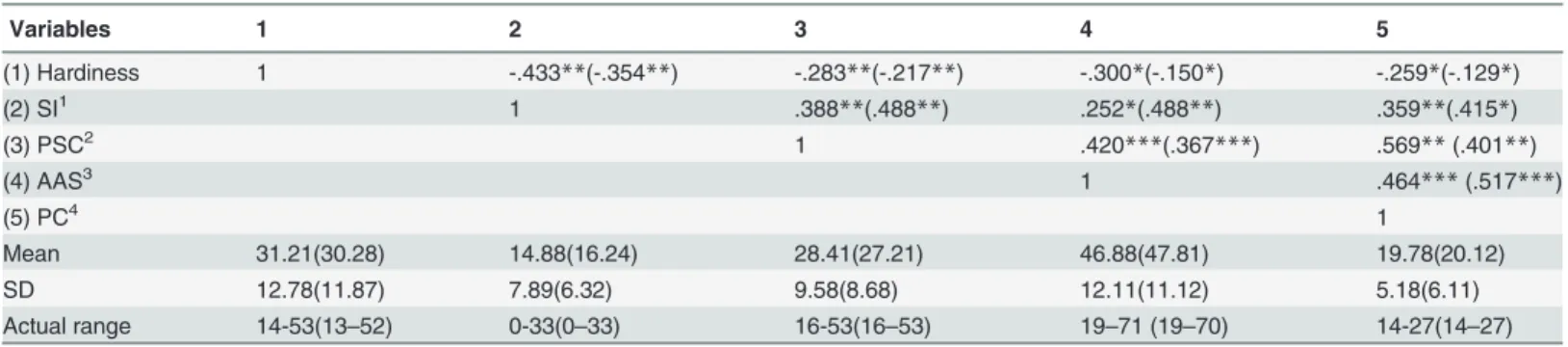
Table 1reports the inter-correlations between hardiness, suicidal ideation, problem-solving confidence, approach-avoidance style, and personal control of emotion for male and female students, as well as the standard deviations, actual range and the means (Table 1).
Measurement model
This model included problem-solving skills appraisal (including the three components of prob-lem-solving confidence, approach-avoidance style, and personal control of emotion), hardi-ness, and suicidal ideation as the latent variables depicted good fit indices: CMIN/DF = 2.95,
Table 1. Correlation between study variables for male and female students, and the mean, SD and actual range.
Variables 1 2 3 4 5
(1) Hardiness 1 -.433**(-.354**) -.283**(-.217**) -.300*(-.150*) -.259*(-.129*)
(2) SI1 1 .388
**(.488**) .252*(.488**) .359**(.415*)
(3) PSC2 1 .420***(.367***) .569**(.401**)
(4) AAS3 1 .464
***(.517***)
(5) PC4 1
Mean 31.21(30.28) 14.88(16.24) 28.41(27.21) 46.88(47.81) 19.78(20.12)
SD 12.78(11.87) 7.89(6.32) 9.58(8.68) 12.11(11.12) 5.18(6.11)
Actual range 14-53(13–52) 0-33(0–33) 16-53(16–53) 19–71 (19–70) 14-27(14–27)
Note: *P<.05
**P<. 01
***P<. 001
1: Suicidal Ideation,
2: Problem-solving Confidence, 3: Approach-Avoidance Style,
4: Personal Control. Results for male are presentedfirst, and results for female are presented in a parenthesis.
p<. 01, CFI = 0.953, GFI = 0.903, TLI = 0.940, RMSEA = 0.063. According to Kline [44], the model provides an acceptable fit for the model.
Structural model
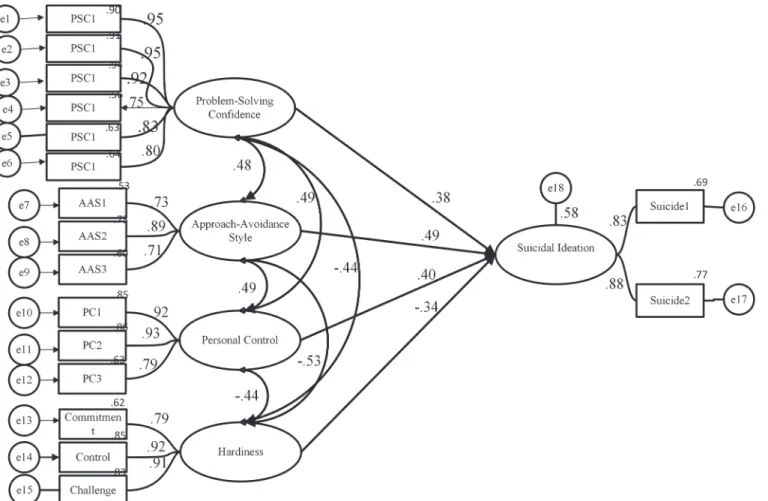
The model included problem-solving skills appraisal (including the three components of prob-lem-solving confidence, approach-avoidance style, and personal control of emotion) and har-diness as exogenous variables; suicidal ideation was an endogenous variable. As it can be seen from theFig 1, problem-solving confidence, approach-avoidance style, personal control of emotion, and hardiness had significant relationships with suicidal ideation. It can be seen from the data inFig 1that ineffective problem-solving confidence, avoiding style and external per-sonal control of emotion were positively associated with suicidal ideation, and a negative asso-ciation existed between hardiness and suicidal ideation in undergraduate students. The findings of this study demonstrated that problem-solving confidence, approach-avoidance style, personal control of emotion, and hardiness are valuable predictors of suicidal ideation. These variables explained 58.0% of the variance in suicidal ideation.
Fig 1. Structural model of suicidal ideation.For all estimatep<0.01. Exogenous Variables including (Problem-solving Confidence, Approach-Avoidance
Style, Personal Control, and Hardiness).
Mediation test of problem-solving skills appraisal
The model included hardiness as an exogenous variable; and problem-solving confidence, ap-proach-avoidance style, personal control of emotion, and suicidal ideation as endogenous vari-ables. Hair, Black, Babin, Anderson, and Tatham [42] indicated that,“a mediation effect is created when a third variable/construct intervenes between two other related constructs” (p. 866). The multi-model analysis was used for testing mediation effects [45]. Hair et al. [42] indicated that: if the relationship between the exogenous variable and the endogenous variable is zero when the mediator is included, full mediation is established. However, if the relationship between the exogenous variable and the endogenous variable is reduced when the mediator is included, partial mediation is established.
In order to establish a mediation effect in the overall model, it must be shown that full medi-ation model is better than an indirect model [45]. The goodness-of-fit indices for full mediation and the indirect model could be compared based on nested model comparisons [44]. The full mediation model showed (Chi-square: 2.362.p>0.01, GFI: 0.901, CFI: 0.901, TLI: 0.899, and RMSEA: 0.052), and the indirect model showed (Chi-square: 2.421,p>0.01, GFI: 0.796, CFI: 0.889, TLI: 0.901, and RMSEA: 0.056). Although both models fit the data according to the nested model comparison, the full mediation model showed a significantly better fit than the indirect model, because the full mediation model showed smaller AIC (Akaike Information Correction: 3987.881), to compare the indirect model (Akaike Information Correction: 4080.969), and the PNFI (Parsimony Normed Fit Index) of the full mediation model was (0.785) bigger than the PNFI of the indirect model (0.781).
According to the above-mentioned condition indicated by Hair et al. [42], problem-solving confidence, approach-avoidance style, and personal control of emotion mediate the relation-ship between hardiness and suicidal ideation. As demonstrated inTable 2, the results show that in the direct model the relationship between hardiness and suicidal ideation was signifi-cant (β= -0.443). In addition, the results based on the mediation model show significant rela-tionships between problem-solving confidence, approach-avoidance style, and personal control of emotion with hardiness (β= -0.504, -0.437, and -0.666 respectively), and hardiness with suicidal ideation (β= -0.261). However, although the size of the standard regression weight for the direct relationship between hardiness and suicidal ideation reduced when prob-lem-solving confidence, approach-avoidance style, and personal control of emotion were
Table 2. Standard Regression Weight in the Full Mediation, direct, and indirect Model.
DV IV Mediation Model Direct Model Indirect Model
PSC1 <
—- Hardiness -.504** -.518***
AAS2 <—- Hardiness -.437** -.455***
PC3 <
—- Hardiness -.666** -.678***
Suicidal Ideation <—- PSC1 .181*** .323**
Suicidal Ideation <—- AAS2 .268*** .347***
Suicidal Ideation <—- PC3 .361*** .564***
Suicidal Ideation <—- Hardiness -.261*** -.443***
Note: **P<. 01
***P<. 001
1: Problem-Solving Confidence, 2: Approach-Avoidance Style, 3: Personal Control.
added as mediating variables in the mediation model, it was still significant. Therefore, the par-tial mediation of problem-solving skills appraisal (problem-solving confidence, approach-avoidance style, and personal control of emotion) on the relationship between hardiness and suicidal ideation was supported.
Moderation test of gender
A comparison between“the variant group model”and“the invariant group model”showed that the variant group model with (CMIN: 918.898, df = 400,p<0.01, RMSEA = 0.052, CFI = 0.929, GFI = 0.891, NFI = 0.901), and the invariant group model with (CMIN: 1276.449, df = 476,p<0.01, RMSEA = 0.058, CFI = 0.913, GFI = 0.823, NFI = 0.818) were significant; however, the variant group model was better than the invariant group model, because the chi-square was smaller [42,46]. According to the invariant group model (CMIN: 1276.449, df = 476, andp<0.01) in“assuming that the unconstrained model is correct," the findings showed that the impact of likely differences across gender was significant.
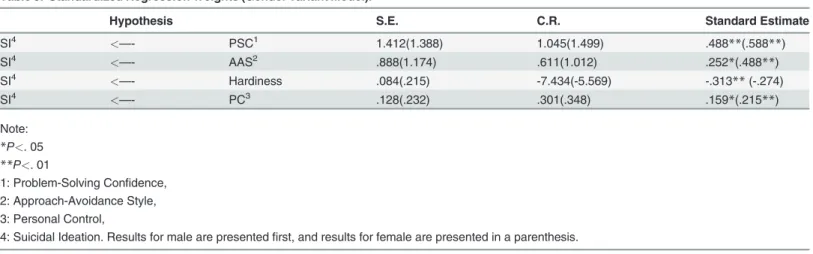
The results indicated that the relationships between problem-solving confidence and ap-proach-avoidance style with suicidal ideation for both male and female students were signifi-cant (SeeTable 3), while there were differences in the value of standard regression weight for male and female students (SeeTable 3). Therefore, the moderating effects of gender on these paths were not supported. In addition, the results revealed that there was no significant rela-tionship between hardiness and suicidal ideation for female students (β= .-0.272), while the path hypothesis for male students was significant (β= -0.313) (Table 3). Therefore, the moder-ating effect of gender on the path relationship between hardiness and suicidal ideation was sup-ported. Our finding supports a previous study representing that male students scored higher on hardiness [47]. Moreover, the results revealed that there was a significant relationship be-tween personal control of emotion and suicidal ideation for both groups (Table 3). Therefore, the moderating effect of gender on the path relationship between personal control of emotion and suicidal ideation was not supported.
Moderation test of race
As depicted inTable 4, the moderating effect of race on the path relationship between prob-lem-solving confidence and suicidal ideation was supported. While there were differences in
Table 3. Standardized Regression Weights (Gender variant Model).
Hypothesis S.E. C.R. Standard Estimate
SI4 <—- PSC1 1.412(1.388) 1.045(1.499) .488**(.588**)
SI4 <
—- AAS2 .888(1.174) .611(1.012) .252
*(.488**)
SI4 <
—- Hardiness .084(.215) -7.434(-5.569) -.313**(-.274)
SI4 <—- PC3 .128(.232) .301(.348) .159*(.215**)
Note: *P<. 05
**P<. 01
1: Problem-Solving Confidence, 2: Approach-Avoidance Style, 3: Personal Control,
4: Suicidal Ideation. Results for male are presentedfirst, and results for female are presented in a parenthesis.
the value of the standard regression weight between hardiness and suicidal ideation, this path was significant for the Malay, Chinese, and Indian groups (SeeTable 4). Therefore, the moder-ating effect of race on this path was not supported. In addition, the results indicated that the re-lationship between approach-avoidance style and personal control of emotion with suicidal ideation for Malay, Chinese, and Indian groups were not significant. Therefore, the moderating effects of race on these paths were not supported.
Discussion
In particular, our findings demonstrated that lower hardiness and poor problem-solving confi-dence, avoiding style, external control of emotion significantly predicted suicidal ideation among undergraduate students.
The empirical findings showed that problem-solving confidence, approach-avoidance style, and personal control of emotion partially mediated the relationship between hardiness and sui-cidal ideation. That is, hardy individuals were less likely to experience suisui-cidal ideation. High-hardy individuals engage in more effective problem-solving skills appraisal and less ineffective problem-solving skills appraisal than do low-hardy individuals. Therefore, if hardiness and problem-solving skills appraisal are increased, suicidal ideation will decrease. Recently, interest into the concepts of resilience in the face of suicidal ideation has increased, but most of the studies only examined resilience factors as linear relationship with suicidal ideation [48], and problem-solving skills appraisal has not been studied as a mediator for these variables. There-fore, hardiness and effective problem-solving skills appraisal need to be understood as influ-encing factors that can decrease the likelihood of suicidal ideation. By finding a relationship between hardiness and problem-solving skills appraisal for the undergraduate students' sample, the present findings confirmed the previous results and improved them in three main ways.
First, the present findings showed that hardiness may constitute a protective factor for un-dergraduate students’sample, especially for individuals with suicidal ideation [24]. The study identified several risk factors for suicidal ideation in individuals, and these factors increased the likelihood of suicidal ideation [8]. Poor problem-solving skill is one of the psychological risk factors for suicidal ideation [49]. Although an understanding of suicidal factors can improve the prediction of suicidality and develop clinical interventions, it is still not comprehensive. The results of this study indicated that hardiness acts as protective factor and that when studied in relationship with risk, it can enhance predictive validity. Furthermore, it can be helpful in Table 4. Standardized Regression Weights (Race Variant Model).
Hypothesis Malay Chinese Indian
SI1 <—- PSC2 .412** .373** .112
SI1 <
—- AAS3 .314 .412 .236
SI1 <
—- Hardiness -.454*** .303*** .294***
SI1 <
—- PC4 .168 .139 .169
Note: **P<. 01
***P<. 001
1: Suicidal Ideation,
2: Problem-solving Confidence, 3: Approach-Avoidance Style, 4: Personal Control.
identifying individuals who are at risk of suicide, so that interventions may be implemented to reduce suicidal thinking and the risk of suicide.
Second, the current study examined the interaction between hardiness and problem-solving styles. Formerly, hardiness was studied in relation to stressful life events [50], but stress may not be an exact predictor of suicidality among individuals with mental disorder [51]. This study focused on one of the risk factors of suicidal ideation, namely, ineffective problem-solv-ing skills. The findproblem-solv-ing that hardiness is a significant factor against ineffective problem-solvproblem-solv-ing skills indicated that the effect of hardiness is not limited to stressful life events and suggests that hardiness may be a significant protective factor for suicidality. Although further investiga-tion is needed, the present study suggests that hardiness plays an important role against suicid-al ideation.
Third, the current study used the hardiness theory, which indicated that a positive appraisal of events may provide a source of resilience. The findings showed that hardiness could be use-ful and protective against ineffective problem-solving styles and suicidal ideation among Ma-laysian undergraduate students. Hardy individuals who tend to believe that the outcomes are promising and positive, [52] may provide a sense of resilience during difficult situations, and are less likely to experience suicidal ideation [30].
Implications for practice
There are two significant implications for clinical treatment in the present study. First, when assessing the risk of suicide in individuals, it is important to account for the presence of hardi-ness in addition to risk factors, such as ineffective problem-solving skills. Previous studies indi-cated hardiness is an ability that prepares an individual to cope with problems [18,53]. Hardy individuals have a more optimistic viewpoint than individuals who are low in hardiness. They are more flexible in facing problems [24], and prefer to use rational-oriented coping styles rath-er than emotional-oriented coping styles in managing stressful conditions [23]. Second, hardi-ness training may help individuals to engage in effective problem-solving skills and decreases the amount of suicidal ideation, and it may be a significant factor to incorporate into suicide treatment programs. Reducing suicidal risk in an individual is a main focus of any clinical intervention.
Strengths and limitations
The primary strength of this study is the role of problem-solving skills appraisal as a mediator between hardiness and suicidal ideation among undergraduate students. The results highlight the role of hardiness in lowering ineffective problem-solving skills and suicidal ideation in un-dergraduate students. One important limitation of this study is its reliance on self-report ques-tionnaires. Although the measures used in the study are psychometrically adequate, a multi-method approach would be superior and lend incremental validity to the current study. Studies have shown that when participants completed questionnaires of mental health and hardiness simultaneously, they may tend to overlap perceptions of mental health with well-being. Conse-quently, it is plausible that clinical interviews would enable us to overcome the aforementioned limitation. In addition, this study employed a cross-sectional design and does not allow for causal interpretation about relationships between variables. Lastly, future studies could investi-gate the role of hardiness in the process of suicidal individuals' treatment.
Author Contributions
Conceived and designed the experiments: AA MAT SNY ZI. Performed the experiments: AA MAT. Analyzed the data: AA ZI. Contributed reagents/materials/analysis tools: AA MAT SNY. Wrote the paper: AA.
References
1. National Center for Injury Prevention and Control (2010) National Center for Injury Prevention and Con-trol. Available:www.cdc.gov/ncipc/wisqars.
2. World Health Organization (2012) Suicide prevention (SUPRE). \Available:http://www.who.int/mental_ health/prevention/suicide/suicideprevent/en/index.html.
3. Garlow SJ, Rosenberg J, Moore JD, Haas AP, Koestner B, Hendin H, et al. (2008) Depression, desper-ation, and suicidal ideation in college students: results from the American Foundation for Suicide Pre-vention College Screening Project at Emory University. Depression and Anxiety 25: 482–488. doi:10. 1002/da.20321PMID:17559087
4. Gau SS-F, Chen Y-Y, Tsai F-J, Lee M-B, Chiu Y-N, Soong Wei-Tsuen, et al. (2008) Risk factors for sui-cide in Taiwanese college students. Journal of American College Health 57: 135–142. doi:10.3200/ JACH.57.2.135-142PMID:18809529
5. Lee H-S, Kim S, Choi I, Lee K-U (2008) Prevalence and risk factors associated with suicide ideation and attempts in korean college students. Psychiatry investigation 5: 86–93. doi:10.4306/pi.2008.5.2. 86PMID:20046350
6. Foo XY, Alwi MNM, Ismail SIF, Ibrahim N, Osman ZJ (2014) Religious commitment, attitudes toward suicide, and suicidal behaviors among college students of different ethnic and religious groups in Ma-laysia. Journal of religion and health 53: 731–746. doi:10.1007/s10943-012-9667-9PMID:23196328
7. Institute for Public Health (IPH) (2008) Institute for Public Health. National Institute of Health, Ministry of Health, Malaysia: Wiley. com.
8. Becker-Weidman EG, Jacobs RH, Reinecke MA, Silva SG, March JS (2010) Social problem-solving among adolescents treated for depression. Behaviour Research and Therapy 48: 11–18. doi:10.1016/ j.brat.2009.08.006PMID:19775677
9. Bell AC, D’Zurilla TJ (2009) Problem-solving therapy for depression: A meta-analysis. Clinical Psychol-ogy Review 29: 348–353. doi:10.1016/j.cpr.2009.02.003PMID:19299058
10. D’Zurilla TJ, Nezu AM (2007) Problem-solving therapy: A positive approach to clinical intervention, ( 3rd ed.). New York: Spring Publishing Company.
11. Heppner MJ, Lee D, Paul Heppner P, McKinnon LC, Multon KD, Gysbers NC, et al. (2004) The role of problem-solving appraisal in the process and outcome of career counseling. Journal of Vocational Be-havior 65: 217–238. Available:http://linkinghub.elsevier.com/retrieve/pii/S0001879103001003. Ac-cessed 15 May 2013.
12. Abdollahi A, Talib MA, Yaacob SN, Ismail Z (2014) Problem-Solving Skills and Hardiness as Protective Factors against Stress in Iranian Nurses. Issues in mental health nursing 35: 100–107. doi:10.3109/ 01612840.2013.843621PMID:24502467
13. Abdollahi A, Talib MA (2014) Hardiness and Problem-Solving Skills as Preventive Factors against Smoking among Adolescents. Asian Social Science 10: p165.
14. Klionsky DJ, Abdalla FC, Abeliovich H, Abraham RT, Acevedo-Arozena A, Adeli K, et al. (2012) Guide-lines for the use and interpretation of assays for monitoring autophagy. Autophagy 8: 445–544. PMID: 22966490
15. Ciarrochi J, Caputi P, Mayer JD (2003) The distinctiveness and utility of a measure of trait emotional awareness. Personality and Individual Differences 34: 1477–1490. Available:http://dx.doi.org/10. 1016/S0191-8869(02)00129-0.
16. Chinaveh M (2010) Training problem-solving to enhance quality of life: implication towards diverse learners. Procedia-Social and Behavioral Sciences 7: 302–310.http://dx.doi.org/10.1016/j.sbspro. 2010.10.042.
17. Kobasa SC, Maddi SR, Kahn S (1982) Hardiness and health: a prospective study. Journal of Personali-ty and Social Psychology 42: 168. doi:10.1037/0022-3514.42.1.168PMID:7057354
18. Kobasa SC (1979) Stressful life events, personality, and health: An inquiry into hardiness. Journal of Personality and Social Psychology 37: 1. doi:10.1037/0022-3514.37.1.1PMID:458548
19. Klag S, Bradley G (2004) The role of hardiness in stress and illness: An exploration of the effect of neg-ative affectivity and gender. British Journal of Health Psychology 9: 137–161. doi:10.1348/
20. Abdollahi a., Abu Talib M, Yaacob SN, Ismail Z (2014) The Role of Hardiness in Decreasing Stress and Suicidal Ideation in a Sample of Undergraduate Students. Journal of Humanistic Psychology. Available: http://jhp.sagepub.com/cgi/doi/10.1177/0022167814543952. Accessed 5 September 2014.
21. Abdollahi A, Talib MA (2015) Hardiness, Spirituality and Suicidal Ideation among Individuals with Sub-stance Abuse: The Moderating Role of Gender and Marital Status. Journal of Dual Diagnosis: Estimat-ed Publication date—05 Jan 2015. doi:10.1080/15504263.2014.988558
22. Garrosa E, Moreno-Jiménez B, Liang Y, González JL (2008) The relationship between socio-demo-graphic variables, job stressors, burnout, and hardy personality in nurses: an exploratory study. Interna-tional Journal of Nursing Studies 45: 418–427. Available:http://www.ncbi.nlm.nih.gov/pubmed/ 17109862. Accessed 13 March 2013. PMID:17109862
23. Delahaij R, Gaillard AWK, van Dam K (2010) Hardiness and the response to stressful situations: Inves-tigating mediating processes. Personality and Individual Differences 49: 386–390.http://dx.doi.org/10. 1016/j.paid.2010.04.002.
24. Erbes CR, Arbisi PA, Kehle SM, Ferrier-Auerbach AG, Barry RA, Polusny Melissa A, et al. (2011) The distinctiveness of hardiness, positive emotionality, and negative emotionality in National Guard sol-diers. Journal of Research in Personality 45: 508–512.http://dx.doi.org/10.1016/j.jrp.2011.07.001.
25. Cunningham CJ, De La Rosa GM (2008) The interactive effects of proactive personality and work-fami-ly interference on well-being. Journal of Occupational Health Psychology 13: 271–282. Available: http://www.ncbi.nlm.nih.gov/pubmed/18572997. doi:10.1037/1076-8998.13.3.271PMID:18572997
26. Schreurs B, van Emmerik H, Notelaers G, De Witte H (2010) Job insecurity and employee health: The buffering potential of job control and job self-efficacy. Work & Stress 24: 56–72. doi:10.1080/ 02678371003718733
27. Eschleman KJ, Bowling NA, Alarcon GM (2010) A meta-analytic examination of hardiness. Internation-al JournInternation-al of Stress Management 17: 277. doi:10.1037/a0020476
28. Vidrine JI, Reitzel LR, Figueroa PY, Velasquez MM, Mazas CA, Cinciripini PM, et al. (2011) Motivation and Problem Solving (MAPS): Motivationally Based Skills Training for Treating Substance Use. Cogni-tive and Behavioral Practice. Available:http://linkinghub.elsevier.com/retrieve/pii/
S1077722911001489. Accessed 26 May 2013.
29. Phillips J (2011) Hardiness as a Defense Against Compassion Fatigue and Burnout. Journal of Emer-gency Nursing 37: 125. doi:10.1016/j.jen.2010.10.012PMID:21397123
30. Bahamin G, Taheri F, Moghaddas A, Sohrabi F, Dortaj F (2012) The Effects of Hardiness Training on Suicide Ideation, Quality of Life and Plasma Levels of Lipoprotein (a) in Patients with Depressive Disor-der. Procedia-Social and Behavioral Sciences 46: 4236–4243.http://dx.doi.org/10.1016/j.sbspro. 2012.06.233.
31. Kobasa SC, Maddi SR, Courington S (1981) Personality and constitution as mediators of the stress-ill-ness relationship. Journal of Health and Social Behavior 22: 368–378. PMID:7320474
32. Beck AT, Steer RA, Ranieri WF (1988) Scale for suicide ideation: Psychometric properties of a self‐ re-port version. Journal of clinical psychology 44: 499–505. doi:10.1002/1097PMID:3170753
33. Bryan CJ, Ray-Sannerud B, Morrow CE, Etienne N (2012) Guilt is more strongly associated with suicid-al ideation among military personnel with direct combat exposure. Journsuicid-al of affective disorders 148: 37–41.http://dx.doi.org/10.1016/j.jad.2012.11.044. doi:10.1016/j.jad.2012.11.044PMID:23232420
34. Polanco-Roman L, Miranda R (2012) Culturally-related stress, hopelessness, and vulnerability to de-pressive symptoms and suicidal ideation in emerging adulthood. Behavior therapy 44: 75–87.http://dx. doi.org/10.1016/j.beth.2012.07.002. doi:10.1016/j.beth.2012.07.002PMID:23312428
35. Maddi SR, Harvey RH, Khoshaba DM, Lu JL, Persico M, Brow M, et al. (2006) The personality construct of hardiness, III: Relationships with repression, innovativeness, authoritarianism, and performance. Journal of Personality 74: 575–598. doi:10.1111/j.1467-6494.2006.00385.xPMID:16529587
36. Maddi SR (2006) Hardiness: The courage to grow from stresses. The Journal of Positive Psychology 1: 160–168.
37. Okun MA, Zautra AJ, Robinson SE (1988) Hardiness and health among women with rheumatoid arthri-tis. Personality and Individual Differences 9: 101–107. http://dx.doi.org/10.1016/0191-8869(88)90035-9.
38. Judkins S, Arris L, Keener E (2005) Program evaluation in graduate nursing education: hardiness as a predictor of success among nursing administration students. Journal of Professional Nursing 21: 314–
321. Available:http://www.ncbi.nlm.nih.gov/pubmed/16179244. Accessed 11 May 2013. PMID: 16179244
40. Heppner PP, Wang Y-W (2003) Problem-solving appraisal. Positive Psychological Assessment: A Handbook of Models and Measures 60: 127–138.
41. Kline RB (2005) Principles and Practice of Structural Equation Modeling ( 3rd edn). Guilford Press. Available:http://books.google.com.my/.
42. Hair JF, Black WC, Babin BJ, Anderson RE, Tatham RL (2006) Multivariate data analysis: A global per-spective (c). Upper Saddle River, NJ: Pearson. Available:http://digitalcommons.kennesaw.edu/.
43. Byrne BM (2010) Structural Equation Modeling With AMOS: Basic Concepts, Applications, and Pro-gramming, Second Edition. ( L. E. A. Publishers, Ed.). Routledge Academic. Available:http://www. amazon.com/dp/0805863737.
44. Kline RB (2010) Principles and practice of structural equation modeling. New York. The Guilford Press. Available:http://books.google.com.my.
45. Baron RM, Kenny DA (1986) The moderator–mediator variable distinction in social psychological re-search: Conceptual, strategic, and statistical considerations. Journal of personality and social psychol-ogy 51: 1173. doi:10.1037/0022-3514.51.6.1173PMID:3806354
46. Davis JW (2008) Handbook of univariate and multivariate data analysis and interpretation with SPSS. The American Statistician 62: 268. doi:10.1198/000313008X332287
47. Nezhad MAS, Besharat MA (2010) Relations of resilience and hardiness with sport achievement and mental health in a sample of athletes. Procedia-Social and Behavioral Sciences 5: 757–763.
48. Rutter PA, Freedenthal S, Osman A (2008) Assessing protection from suicidal risk: Psychometric prop-erties of the suicide resilience inventory. Death Studies 32: 142–153. doi:10.1080/
07481180701801295PMID:18693384
49. Speckens AEM, Hawton K (2005) Social problem solving in adolescents with suicidal behavior: A sys-tematic review. Suicide and Life-Threatening Behavior 35: 365–387. PMID:16178693
50. McVicar A (2003) Workplace stress in nursing: a literature review. Journal of Advanced Nursing 44: 633–642. doi:10.1046/j.0309-2402.2003.02853.xPMID:14651686
51. Bolton C, Gooding P, Kapur N, Barrowclough C, Tarrier N (2007) Developing psychological perspec-tives of suicidal behaviour and risk in people with a diagnosis of schizophrenia: We know they kill them-selves but do we understand why? Clinical Psychology Review 27: 511–536.http://dx.doi.org/10.1016/ j.cpr.2006.12.001. PMID:17229508
52. Maddi SR, Harvey RH, Khoshaba DM, Fazel M, Resurreccion N (2009) Hardiness training facilitates performance in college. The Journal of Positive Psychology 4: 566–577.