Original Article
Utilization of palm oil mill effluent as a novel and promising substrate for
biosurfactant production by
Nevskia ramosa
NA3
Chanika Saenge Chooklin
1, Sirirat Phertmean
2, Benjamas Cheirsilp
3, Suppasil Maneerat
3,
and Atipan Saimmai
2, 4*
1 Faculty of Science and Fisheries Technology,
Rajamangala University of Technology Srivijaya, Trang campus, Sikao, Trang, 92150 Thailand.
2 Faculty of Agricultural Technology, Phuket Rajabhat University, Mueang, Phuket, 83000 Thailand.
3 Department of Industrial Biotechnology, Faculty of Agro-Industry,
Prince of Songkla University, Hat Yai, Songkhla, 90112 Thailand.
4 Institute of Agricultural Technology,
Walailak University, Tha Sala, Nakhon Si Thammarat, 80161 Thailand.
Received 19 November 2012; Accepted 24 January 2013
Abstract
This paper introduces palm oil mill effluent as a promising substrate for biosurfactant production. Potential strains of bacteria were isolated from various hydrocarbon-contaminated soils and screened for biosurfactant production with the help of the drop collapse method and surface tension measurements. Out of 26 isolates of bacteria, the strain NA3 showed the highest bacterial growth with the highest surface tension reduction of 27.2 mN/m. It was then identified as Nevskia ramosa
NA3 by biochemical and 16S rRNA sequence analysis. The Plackett-Burman experimental design was employed to determine the important nutritional requirements for biosurfactant production by N. ramosa NA3 under controlled conditions. Six out of 11 factors of the production medium were found to significantly affect the production of biosurfactant. FeCl2 and NaNO3 had a direct proportional correlation with the biosurfactant production. Commercial sugar, glucose, K2HPO4 and MgCl2 showed inversely proportional relationship with biosurfactant production in the selected experimental range.
Keywords: palm oil mill effluent, biosurfactant, surface tension, medium improvement, Nevskia ramose, Plackett-Burman
1. Introduction
Biosurfactants are a structurally diverse group of surface-active molecules synthesized by microorganisms (Nitschke and Costa, 2007). These amphiphilic compounds contain a hydrophobic and a hydrophilic moiety and have the ability to reduce interfacial tension between different fluid phases. Their uses and potential commercial applications
have been reported in several fields, such as microbial enhanced oil recovery, bioremediation of recalcitrants, com-position for cosmetic industry and food processing (Nitschke and Pastore, 2006). Biosurfactants have gained attention because they exhibit some advantages such as high bio-degradability, low toxicity, being environmental friendly, and can be produced from renewable low-cost materials or waste from agro-industrial processes (Saharan et al., 2011).
However, biosurfactants have not yet been applied widely in industry because of technical and/or economic reasons (Saharan et al., 2011). At present, the potential profit from biosurfactants is not competitive with their chemical
* Corresponding author.
Email address: [email protected]
counterparts, due to high costs and low production yields (Makkar and Cameotra, 2002). In order to alleviate these problems, many studies had been carried out using free-cost or low-cost feed stocks or agricultural by-products and wastes as substrates for biosurfactant production (Nitschke
and Pastore, 2006; Das and Mukherjee, 2007; Joshi et al.,
2008; Sobrinho et al., 2008; Saimmai et al., 2011; 2012a; 2012b; 2012c; 2012d; 2012e; 2012f; 2013). Despite ongoing research using unconventional sources, the selection of appropriate waste substrate is still a challenge (Nawawi et al.,
2010). Researchers are facing the problem of finding a waste with the right balance between carbohydrates and lipids to support the optimal growth of microorganisms and maximum production of biosurfactant (Makkar and Cameotra, 1999).
Palm oil milling is one of the most important agro-industries in the south of Thailand. The management of the ever-increasing organic waste resulting from palm oil mill discharge has been one of the most worrying environmental issues in the area. This requires a practical and economically viable approach to alleviate the problem (Puetpaiboon and Chotwattanasak, 2004). Waste discharged from palm oil extraction process is known as palm oil mill effluent (POME). It is a colloidal suspension comprising 95-96% water, 0.6-0.7% oil and 4-5% total solids including 2-4% suspended solids originating in the mixing of sterilizer condensate, separator sludge and hydrocyclone wastewater (Ma, 2000). It can contain about 4,000-6,000 mg/l of oil and grease, which is present either as oil droplets in a water–oil emulsion or floats on the upper layer of the suspension. In this study, POME was introduced as a novel and promising substrate for biosurfactant production. The uses of waste from agro-industry as a substrate for biotechnological production could not only help reducing the costs of production but also pave the way for an effective waste management.
Biosurfactants are produced by a wide variety of microorganisms, secreted either extracellulary or localized on the cell surface, predominantly during growth on water-immiscible substrates (Desai and Banat, 1997). However, each species corresponds to different types of medium com-ponents. In this study, POME was used as a new substrate for biosurfactant production. Potential microbes were isolated locally and screened in order to find the best strain that could utilize POME for biosurfactant production. The optimal medium components were determined to maximize the bio-surfactant production by the selected strain.
2. Materials and Methods
2.1 Raw material and isolation of microorganisms
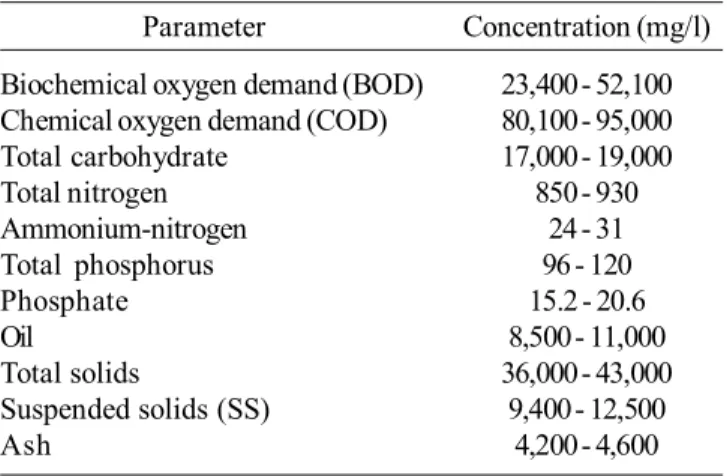
Raw POME was collected from the receiving tank of Asian Palm Oil Co. Ltd. Krabi, Southern Thailand. Raw POME has a brown color, pH of 4.1-4.5 and a water content of 87-92%. The chemical characteristics of the POME are given in Table 1. The POME was kept at -20°C and brought to room temperature before use.
Biosurfactant-producing bacteria were isolated from oils or water contaminated with palm oil from a palm oil refinery factory in southern Thailand. The samples were collected in zipper bags and transported to the laboratory for screening and isolation. The method used for screening was using serial dilutions of the samples and plated on minimal salt medium (MSM). MSM agar using POME (20%, v/v) as the carbon source was used for the isolation of bacteria. Mor-phologically distinct colonies were re-isolated by transfer onto fresh POME-containing agar plates at least three times to obtain pure cultures and subsequently Gram-stained. Pure cultures were stored at -20°C in MSM mixed with sterile glycerol at a final concentration of 30%.
2.2 Preparation of the seed culture
A loop full of isolated bacterial colony, previously maintained on NA plate, was transferred to 50 ml nutrient broth (NB, Difco, MI, U.S.A.). The culture was grown on a rotary incubator shaker for 24 hrs at 30°C and 200 rpm. This primary inoculum was grown until the optical density at 600 nm wavelength (OD600) was reached in the 1.80-1.85
absor-bance unit (AU) and used to inoculate the production media at 5% (v/v).
2.3 Preparation of production media
A minimal salt medium was used as a production medium composed as follow (g/l): K2HPO4, 0.8; KH2PO4, 0.2;
CaCl2, 0.05; MgCl2, 0.5; FeCl2, 0.01; (NH4)2SO4, 1.0; and NaCl,
5.0 (Saimmai et al., 2012b) and supplemented with 20% (v/v) of POME. The medium was sterilized by autoclaving at 121°C for 15 min. Fermentation was carried out in 250 ml Erlenmeyer flasks with a 50 ml working volume. For inocula-tion, the flasks were allowed to cool down to room tempera-ture before transferring 5% (v/v) primary inocula into the production medium. The cultures were incubated in a rotary incubator shaker for 30 hrs at 30°C and 200 rpm. All experi-ments were carried out in triplicate.
Table 1. Chemical characteristics of palm oil mill effluent (POME) used in this study.
Parameter Concentration (mg/l)
Biochemical oxygen demand (BOD) 23,400 - 52,100
Chemical oxygen demand (COD) 80,100 - 95,000
Total carbohydrate 17,000 - 19,000
Total nitrogen 850 - 930
Ammonium-nitrogen 24 - 31
Total phosphorus 96 - 120
Phosphate 15.2 - 20.6
Oil 8,500 - 11,000
Total solids 36,000 - 43,000
Suspended solids (SS) 9,400 - 12,500
2.4 Screening for potential biosurfactant-producing strains
Each isolated strain was subjected to liquid fermenta-tion in the producfermenta-tion medium as described above. The ability of each isolate for biosurfactant production was measured qualitatively using the drop collapse method and quantita-tively using surface tension measurement and emulsification activity. The strain which showed the lowest surface tension value was selected for further study. The ability of a strain to grow in the presence of POME was also one of the criteria used for strain selection.
2.5 Identification of selected strain
The selected strain was identified first by using the biochemical method (Kuda et al., 2011). After observing the cell morphology, Gram staining, catalase testing and the carbohydrate fermentation pattern were examined using the API 50 CHL system and apiweb (bioMerieux, Marcy-l’Etoile, France; http://apiweb.biomerieux. com). In addition, the strain was identified by 16S rRNA gene sequencing and BLAST analysis (DNA Data Bank of Japan (DDBJ), http://www. ncbi.nlm.nih.gov/ BLAST/) were carried out as mentioned in a previous report (Saimmai et al., 2012f). The 16S rRNA gene was amplified with a primer set forward at 27F (AGAGTTTG ATCCTGGCTCAG) and reverse 1492R (GGTTACCTTGTTA CGAC TT).
2.6 Selection of critical medium components: Plackett-Burman design
The selection of the critical medium components was done after the potential biosurfactant producing strain was determined from a previous experiment. The production medium mentioned earlier was a mixture of POME, and in-organic and in-organic salts that supported the growth of the selected bacterial strain. Because nutrient requirements vary among the bacterial strains, not all the salts present in the media were necessary for their survival, growth, and
bio-surfactant production. In order to determine significant media constituents, experiments were designed in which the medium was kept deficient in one or the other components.
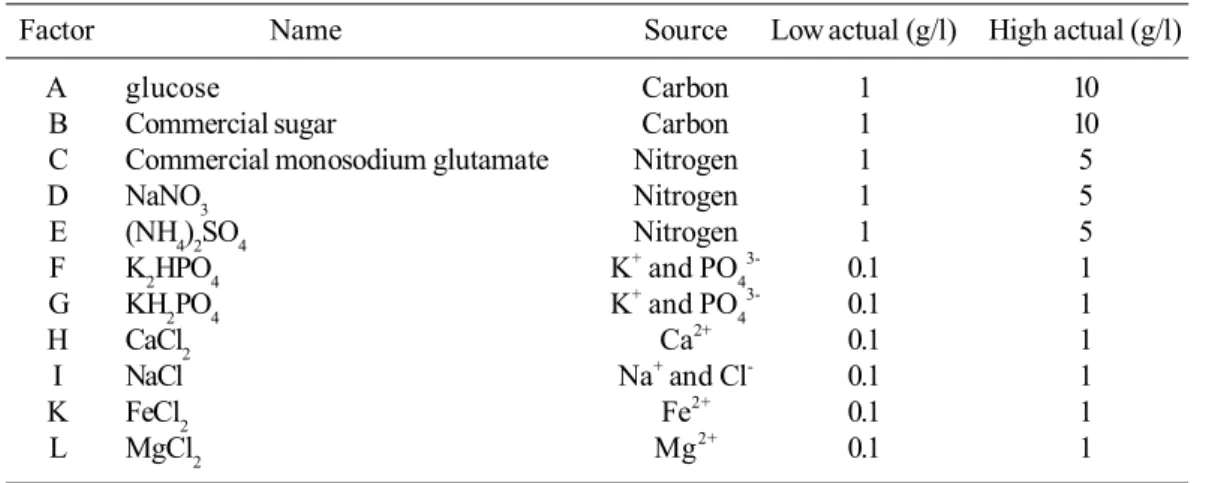
A Plackett-Burman design from the statistical software package Design-Expert version 8.0, Trial Program (Stat-Ease, Minneapolis, USA) was used to design and analyze the experiment. The ranges and levels of variables investigated in this study are shown in Table 2. A new carbon source such as glucose and sucrose (commercial sugar) was also introduced as one of the variables during the screening process, in order to evaluate its contribution as compared to glucose. The selected new substrate, POME, was fixed at a concentration of 20% (v/v). Fermentation was carried out for 30 hrs and the surface tension of the culture supernatant was measured using the Du Nuoy ring method. Emulsification activity of the culture supernatant was also evaluated.
The Plackett-Burman design is suitable for screening the effect of large numbers of parameters in an experiment and can be used to determine the factors that have signifi-cant contributions (Plackett and Burman, 1946). The design assumes that there are no interactions between different media constituents in the range of variables under consider-ation and a linear approach is considered sufficient for screening (Equation 1):
Y = 0+ ixi (i = 1, 2, 3,…, k) (1)
where Y is the response, xi is a variable, and i are the regres-sion coefficients. With this experimental design, N factors can be screened with only N+1 experiments thus saving time. The effect of each variable can be calculated by using the standard equation, Equation 2:
Effect = 2 [R(H) - R(L)] / N (2)
where R(H) denotes all responses when component was at
high levels, R(L) denotes all responses when component was at a low level, and N is the total number of iterations.
Table 2. Low and high levels of each variable in Plackett-Burman design.
Factor Name Source Low actual (g/l) High actual (g/l)
A glucose Carbon 1 10
B Commercial sugar Carbon 1 10
C Commercial monosodium glutamate Nitrogen 1 5
D NaNO3 Nitrogen 1 5
E (NH4)2SO4 Nitrogen 1 5
F K2HPO4 K+ and PO
4
3- 0.1 1
G KH2PO4 K+ and PO
4
3- 0.1 1
H CaCl2 Ca2+ 0.1 1
I NaCl Na+ and Cl- 0.1 1
K FeCl2 Fe2+ 0.1 1
2.7 Analysis of biosurfactant
The analysis was done by first centrifuging the 30 hr– fermentation broth at 9,693 g for 15 min. Residual oil in the culture supernatant was removed by extracting it with an
equal volume of hexane in a separatory funnel (Saimmai et
al., 2012a). The supernatant was then analyzed by using the drop collapse method, surface tension measurement and emulsification activity.
Growth was monitored by measuring the optical den-sity (OD) of the culture broth at 600 nm.
Drop collapse test
The drop collapse test was performed as described by Youssef et al. (2004). Emulsification activity (E24) was measured as described by Plaza et al. (2006). The assessment of surface tension was done as described by Jachimska et al.
(1995). All experiments were carried out in triplicate for the calculation of the mean value. Statistical analysis was performed using Statistical Package for Social Science (SPSS 10.0, for Windows Inc., Chicago, IL).
3. Results and Discussion
3.1 Potential biosurfactant-producing strain
Among 221 bacterial isolates obtained from the samples taken from various palm oil contaminated sources in the south of Thailand, including from Krabi Province (NA1, NA2, NA3, KB4, KB5), Satun Province (ST1, ST2, ST3, ST4), Songkhla Province (SK1, SK2, SK3, SK4, SK5, SK6, SK7, SK8), Surat Thani Province (SR1, SR2, SR3, SR4), and from Trang Province (TR1, TR2, TR3, TR4, TR5), only 26 bacterial isolates showed positive results with the drop collapse method. The microbial growth in a production medium is used as a parameter during the primary screening of bio-surfactant-producing bacteria. After centrifugation of the fermentation broth, only a few strains showed a significant amount of biomass in the form of pellets which indicated their abilities to grow in the production medium. Their growth on water-immiscible substrate has been associated with the production of biosurfactant. It has been reported that bio-surfactant production by growing cells was affected by environmental factors and in most cases the lowest value of surface tension was achieved in the stationary phase (Desai and Banat, 1997; Suwansukho et al., 2008; Priya and Usharani, 2009; Tuleva et al., 2001; Saimmai et al., 2011; 2012b; 2012d; 2012e; 2012f). It was expected that the bio-surfactants produced by these isolates might play an essen-tial role for their survival and growth in situations featuring palm oil contamination including POME by facilitating nutrient transport and also enhancing the accessibility of cell-water immiscible substrate.
Table 3 shows the Gram staining, growth, emulsifica-tion activity and surface activity of selected bacterial isolates. Eighty-five percent of the selected bacterial isolates (22 of 26) were Gram-negative. It has previously been reported that
most bacteria isolated from sites with a history of contamina-tion by hydrocarbon oil or its byproducts and other immis-cible substrate are Gram-negative due to the presence of outer membranes, which act as biosurfactants (Bodour et al.,
2003; Batista et al., 2006; Ruggeri et al., 2009; Saimmai et al.,
2012c; 2012g). In addition, this may be a characteristic that contributes to the survival of these populations in such harsh environments (Bicca et al., 1999). Interestingly, these strains did not give high emulsification activity, but they could produce biosurfactants which exhibited high surface tension reduction. It was found that the strain NA3, isolated from a Krabi Province sample, showed the lowest surface tension, suggesting that this strain has high capability in producing low-molecular-weight biosurfactants (Ron and Rosenberg, 2001) by using POME as a substrate.
Based on previous data from our group, the excreted high-molecular-weight biosurfactant or bioemulsifier from bacterial isolates can be identified by stabilizing by the hydrocarbon-water emulsion. The major difference between bioemulsifier and low-molecular-weight biosurfactant is the ability to reduce surface tension (Saimmai et al., 2012c; 2012g). Although both of them showed emulsifying activi-ties, the bioemulsifier does not necessarily reduce surface tension. As a result, bacterial isolates that exhibited high emulsifying activity are not always good surface tension reducing strains. In the present results, several isolated strains show a high value of xylene-supernatant emulsion; however, not all of them could effectively reduce the surface tension of the culture medium as compared to the NA3 strain. This would be because the other strains produced bioemulsifiers instead of biosurfactants. As shown in Table 3, the NA3 strain reduced the surface tension of the culture supernatant from 67 to 40 mN/m, resulting in a surface tension reduction of 40%. In addition, the NA3 strain also provided a large diameter from the drop collapse method, indicating the high activity of surface tension reduction by the excreted surfactant. Accordingly, the NA3 strain was selected for bio-surfactant production using POME as a substrate in the present study.
3.2 Identification of selected bacterial strain
Isolated NA3 was identified either through cell and colony morphology or biochemical and physiological char-acteristics (data not shown). However, due to the intrinsic limitations, the biochemical and physiological test can only provide a preliminarily identification (Huang et al., 2010). The final identification of the strain was accomplished by com-bining the alignment results of the 16S rRNA sequence analysis with biochemical and physiological characteristics. The result from 16S rRNA analysis was in accord with the colony morphology, cell shape, Gram stain and biochemical tests (data not shown).
using the 16S rRNA gene nucleotide sequences data showed that this strain had the highest homology (over 99.9%) with
Nevskia ramosa MAFF 211643 (AB518684). The phylogene-tic tree based on neighbor joining analysis of the 16S rRNA gene nucleotide sequences is given in Figure 1. Therefore,
the isolate was named as Nevskia ramosa NA3. There have
been many reports on the isolation of biosurfactant-produc-ing bacteria in the last few decades (Batista et al., 2006; Ruggeri et al., 2009; Abdel-Mawgoud et al., 2010; Anandaraj and Thivakaran, 2010; Das et al., 2010; Gudina et al., 2010; Janek et al., 2010; Burgos-Diaz et al., 2011; Van Bogaert et al., 2011; Saimmai et al., 2012c; 2012f). However, reports on biosurfactants produced by palm oil contaminated bacteria have been limited to date (Saimmai et al., 2012b; 2012f). It must also be noted that to the best of our knowledge, this is the first report on the capacity of the genus Nevskia to produce a biosurfactant.
3.3 Critical media components
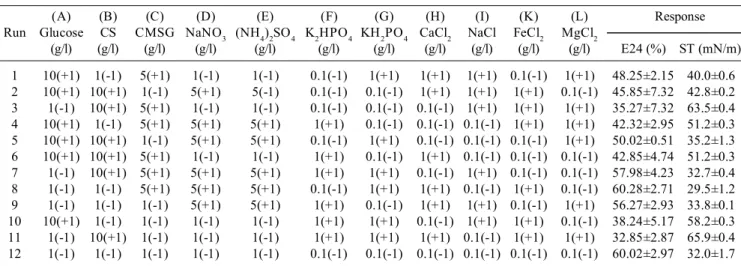
Nevskia ramosa NA3 was cultivated in a production medium which was prepared in accord with various concen-trations of variables for different experiments as suggested by the Plackett-Burman design. The biosurfactant produc-tion by this strain started during the exponential phase and continued up to the stationary phase (Figure 2). The time needed to achieve the maximum concentration of biosurfac-tant is correlated indirectly with the surface tension reduc-tion. Surface tension was used as the main response due to the fact there was a big difference between iterations. The lowering of the surface tension is directly correlated with higher biosurfactant concentration. Table 4 shows the Plackett-Burman experimental design for 12 iterations at two levels of concentration for each variable along with the response in surface tension (ST) and emulsification activity Table 3. Source, Gram’s staining and screening results of isolated strains, DCT: drop collapse test; E24:
emulsification activity; ST: surface tension
Sources Isolate Gram stain OD600 DCT(cm) * E24(%) ST(mN/m) **
Karbi Province NA1 Negative 2.5±1.0** 1.6±0.2*** 31.21±5.20*** 61.2±0.2***
NA2 Negative 2.8±0.5 1.9±0.8 20.50±1.25 70.5±1.1
NA3 Negative 3.7±0.2 4.0±1.0 48.25±2.27 40.0±0.8
KB4 Positive 4.1±0.2 2.0±0.2 51.01±0.25 63.7±2.0
KB5 Negative 2.9±0.8 3.0±2.0 41.26±2.24 62.5±2.4
Satun Province ST1 Negative 3.5±0.7 1.9±0.1 15.22±3.02 67.2±2.5
ST2 Negative 1.9±0.4 2.2±0.0 12.3±1.45 54.7±2.0
ST3 Negative 2.9±0.4 3.0±0.1 8.72±0.54 61.4±1.7
ST4 Negative 2.8±0.2 2.3±0.1 16.78±2.65 65.0±0.1
Songkhla Province SK1 Negative 2.7±0.6 2.0±0.0 26.71±2.56 70.4±2.7
SK2 Negative 3.5±0.2 3.2±0.0 11.98±2.57 63.8±2.1
SK3 Negative 2.8±0.4 3.1±0.0 18.78±1.54 60.5±2.9
SK4 Negative 2.6±0.2 1.5±0.8 24.54±5.65 54.2±3.0
SK5 Positive 1.9±0.5 1.7±0.4 21.51±2.65 62.5±2.0
SK6 Negative 2.9±0.1 2.7±0.4 13.28±2.40 70.7±2.4
SK7 Negative 3.0±0.7 3.2±0.3 24.85±2.89 65.6±2.0
SK8 Negative 2.6±0.2 3.5±0.4 10.22±3.21 66.5±2.8
Surat Thani Province SR1 Negative 2.5±0.4 3.8±0.7 18.91±0.78 68.0±0.7
SR2 Negative 3.0±0.3 3.7±0.9 36.52±2.32 67.1±2.1
SR3 Negative 2.7±0.2 3.2±0.6 28.62±2.85 69.7±2.0
SR4 Negative 2.0±0.25 2.0±0.4 20.25±4.50 65.0±3.8
Trang Province TR1 Positive 2.1±0.9 3.0±0.5 33.85±5.98 65.0±1.4
TR2 Negative 3.6±0.7 3.2±0.1 56.87±3.89 66.3±2.0
TR3 Negative 3.2±0.1 3.0±0.0 58.20±3.85 70.0±2.8
TR4 Negative 3.3±0.8 2.9±0.3 46.81±5.89 68.2±0.1
TR5 Positive 2.8±0.4 2.1±0.2 41.24±2.24 65.9±2.0
* Diameter of negative control for DCT was 1.0 mm;
** Surface tension of MSM supplement with POME was 67.2±0.8 mN/m;
Figure 1. Phylogenetic tree of the strain NA3 and closest NCBI (BLASTn) strains based on the 16S rRNA gene sequences (neighbor join-ing tree method). The scale bar indicates 0.01 nucleotide substitutions per nucleotide position. The numbers at node show the bootstrap values obtained with 1000 resampling analyses. The GenBank accession numbers are reported in parenthesis.
Table 4. Plackett-Burman experimental design in actual and coded values with corresponding responses.
(A) (B) (C) (D) (E) (F) (G) (H) (I) (K) (L) Response Run Glucose CS CMSG NaNO3 (NH4)2SO4 K2HPO4 KH2PO4 CaCl2 NaCl FeCl2 MgCl2
(g/l) (g/l) (g/l) (g/l) (g/l) (g/l) (g/l) (g/l) (g/l) (g/l) (g/l) E24 (%) ST (mN/m) 1 10(+1) 1(-1) 5(+1) 1(-1) 1(-1) 0.1(-1) 1(+1) 1(+1) 1(+1) 0.1(-1) 1(+1) 48.25±2.15 40.0±0.6 2 10(+1) 10(+1) 1(-1) 5(+1) 5(-1) 0.1(-1) 0.1(-1) 1(+1) 1(+1) 1(+1) 0.1(-1) 45.85±7.32 42.8±0.2 3 1(-1) 10(+1) 5(+1) 1(-1) 1(-1) 0.1(-1) 0.1(-1) 0.1(-1) 1(+1) 1(+1) 1(+1) 35.27±7.32 63.5±0.4 4 10(+1) 1(-1) 5(+1) 5(+1) 5(+1) 1(+1) 0.1(-1) 0.1(-1) 0.1(-1) 1(+1) 1(+1) 42.32±2.95 51.2±0.3 5 10(+1) 10(+1) 1(-1) 5(+1) 5(+1) 0.1(-1) 1(+1) 0.1(-1) 0.1(-1) 0.1(-1) 1(+1) 50.02±0.51 35.2±1.3 6 10(+1) 10(+1) 5(+1) 1(-1) 1(-1) 1(+1) 0.1(-1) 1(+1) 0.1(-1) 0.1(-1) 0.1(-1) 42.85±4.74 51.2±0.3 7 1(-1) 10(+1) 5(+1) 5(+1) 5(+1) 1(+1) 1(+1) 0.1(-1) 1(+1) 0.1(-1) 0.1(-1) 57.98±4.23 32.7±0.4 8 1(-1) 1(-1) 5(+1) 5(+1) 5(+1) 0.1(-1) 1(+1) 1(+1) 0.1(-1) 1(+1) 0.1(-1) 60.28±2.71 29.5±1.2 9 1(-1) 1(-1) 1(-1) 5(+1) 5(+1) 1(+1) 0.1(-1) 1(+1) 1(+1) 0.1(-1) 1(+1) 56.27±2.93 33.8±0.1 10 10(+1) 1(-1) 1(-1) 1(-1) 1(-1) 1(+1) 1(+1) 0.1(-1) 1(+1) 1(+1) 0.1(-1) 38.24±5.17 58.2±0.3 11 1(-1) 10(+1) 1(-1) 1(-1) 1(-1) 1(+1) 1(+1) 1(+1) 0.1(-1) 1(+1) 1(+1) 32.85±2.87 65.9±0.4 12 1(-1) 1(-1) 1(-1) 1(-1) 1(-1) 0.1(-1) 0.1(-1) 0.1(-1) 0.1(-1) 0.1(-1) 0.1(-1) 60.02±2.97 32.0±1.7
(E24). The response was analyzed with the help of the statis-tical software package Design Expert version 8.
Table 5 shows the statistical results obtained after the analysis by Design Expert. Analysis of variance (ANOVA) was performed in order to find the effect and contribution of each variable. Both the Fisher variation ratio (F-value) and
p-value from ANOVA were used to confirm the significance
of the variables studied. The greater F-value indicated that the variables explained adequately the variation in the data about its mean and the estimated variable effects were realis-tic. Small p-values were associated with a larger F-value because they imply that the effects were much greater than its standard error. A p<0.05 suggested that the test was statisti-cally significant with a confidence level of above 95%. The contribution percentage is depicted in Figure 3. Six compo-nents, NaNO3, FeCl2,commercial sugar (CS), K2HPO4,MgCl2,
and glucose, were found to be most significant in contribut-ing to biosurfactant production in this study. The main effect of each variable on biosurfactant production was estimated as the difference between the average of the measurements made at high (+1) and low (-1) levels of the factors. Since our optimum result corresponds to lower response of surface tension, the effect of each term in ANOVA was inverted (that is a positive effect became negative and vice versa). Figure 4 shows the main effect of each variable. A positive effect shows that if a higher concentration was used, a better response was achieved. On the other hand, a negative effect means lower concentrations give better results.
3.4 Significant variables
It is clear from Table 5 as well as Figure 3 and 4 that FeCl2 and NaNO3 show the highest level of positive
signifi-cance in contributing to biosurfactant production by N.
Table 5. Statistical analysis (ANOVA) for evaluating the significance of variables.
Source Effect SSa dfb Mean square F-value p-valuec Significance
Model 2004.46 11 200.45 999.51 0.0214 Yes
(A) Glucose -3.17 48.09 1 48.09 213.24 0.0389 Yes
(B) CS -7.89 198.57 1 198.57 987.65 0.0024 Yes
(C) CMSG +0.59 0.91 1 0.91 5.01 0.0985 No
(D) NaNO3 +16.42 751.25 1 751.25 3326.25 0.0118 Yes
(E) (NH4)2SO4 -1.21 4.97 1 4.97 30.85 0.0985 No
(F) K2HPO4 -7.58 187.51 1 187.51 923.85 0.0187 Yes
(G) KH2PO4 +1.69 9.82 1 9.82 48.25 0.0897 No
(H) CaCl2 +1.24 4.25 1 4.25 21.25 0.1564 No
(I) NaCl +0.61 0.79 1 0.79 5.21 0.2841 No
(K) FeCl2 +16.21 608.65 1 608.65 3275.25 0.0121 Yes
(L) MgCl2 -7.58 189.65 1 189.65 851.62 0.0254 Yes
R2 = 0.9982, predicted R2 = 0.9996;
a Sum of squares; b Degree of freedom;
cp<0.05 were considered to be significant.
Figure 3. Percentage of contribution of each nutrient component for biosurfactant production by Nevskia ramosa NA3.
ramosa NA3. The contribution of FeCl2 towards the total
effects was found to be 25.58% (Figure 3). FeCl2 is a critical
component required for the growth and biosurfactant pro-duction by Bacillus subtilis ATCC 21332 (Wei et al., 2007) and Rhodococcus sp. (Yao et al., 2009). In addition, it is a source of Fe2+ ions in the medium. The concentration of metal
ions plays a very important role in the production of some biosurfactants as they form important cofactors of many enzymes (Saharan et al., 2011). NaNO3 as a source of nitrogen
was also found to make a large contribution (25.25%) at a higher concentration. Besides growth, nitrogen plays an important role in structural lipopeptide-biosurfactant as a part of peptide. This justified its significance in the bio-surfactant synthesis, particularly for the lipopeptide type (Nawawi et al., 2010).
Both CS and glucose as carbon sources showed sig-nificant effects in negative terms (Figure 4 and Table 5). Therefore, lower amounts of these carbon sources would lower surface tension and give higher biosurfactant produc-tion. This seems counterintuitive at first as most research studies report that glucose was the main contributor during the bacterial metabolism of biosurfactant production (Abouseoud et al., 2008). However, it must be noted that CS and glucose were used only as co-substrates in this study. These co-substrates were used to feed the bacterium only during the initial phase of growth. After the populations matured, a complex carbon source, POME was used as a main substrate in the production medium. The contribution of both co-substrates (CS and glucose) as a co-carbon source was minimal; moreover they showed negative effects. This suggests for later studies the possibility of using CS alone as a co-carbon source compared to more expensive glucose.
The concentration level of MgCl2 as a source of Mg2+
ions was found to influence biosurfactant production with 11.85% contribution (Figure 3). This salt was found to possess a negative effect that signifies its effectiveness at a lower concentration in experimental design. Similar studies on evaluating the important nutrient requirement for marine bacterium Bacillus sp. (Mukherjee et al., 2008) and palm oil contaminated soil bacteria S02 (Nawawi et al., 2010) also reported that a lower concentration of Mg2+ influenced
bio-surfactant production. K2HPO4 also shows a high level of
significant effect in negative terms with a percentage contri-bution of 11.80. This salt is a source of K+ and PO
43- and can
also act as a buffer in the medium. Although phosphate is essential for bacterial growth, an increase in the concentra-tion of phosphorus in the growth medium was not associated with any remarkable change in growth, emulsifying activity, and surface tension reduction of the culture broth (Pruthi and Cameotra, 2003).
3.5 Non-significant variables
KH2PO4, a source of K+ and PO43- was found to be
statistically insignificant, contributing only 2.63% to the total effect for biosurfactant production by N. ramosa NA3. This
might have been caused by the major involvement of more potassium ions during biosurfactant production. The addi-tion of hydrogen atoms also made the KH2PO4 more acidic
compared to K2HPO4, which in turn affected the total broth
pH during fermentation. NaCl as a source of Na+ and Cl- ions
in the medium showed no significant value (95% confidential level) with only a 0.95% contribution. This was due to the
important role of K+ ions in the medium which masks the
significance of Na+ ions. CaCl
2 as a source of calcium in the
mineral salts medium was also found to be insignificant with only a 1.93% contribution. The insignificant nature of CaCl2
was due to the noninvolvement of Ca2+ in any important
bio-chemical reaction and the presence of a more vital Mg2+ ion in
the production medium. Commercial monosodium glutamate as a complex organic nitrogen source and (NH4)2SO4 as an
inorganic nitrogen source does not show any significant con-tribution in this study (0.92% and 1.89%, respectively). This suggests the tendency of the selected strain for preferring a small nitrogen concentration for biosurfactant production.
4. Conclusions
In this study, POME was introduced as a new substrate for biosurfactant production by using the newly
isolated biosurfactant-producing Nevskia ramosa NA3. CS,
FeCl2, glucose, K2HPO4, MgCl2, and NaNO3 were identified
by the Plackett-Burman design as important parameters for improving biosurfactant production. FeCl2 and NaNO3
showed positive effects, whereas CS, glucose, K2HPO4 and
MgCl2 had mainly a negative effect. This suggests that a
concentration of FeCl2 and NaNO3 higher than 1.0 and 5.0 g/l,
a CS and glucose concentration lower than 1 g/l, K2HPO4 and
MgCl2 concentration lower than 1.0 g/l, should be used for
further improvement of biosurfactant production by N. ramosa NA3.
Acknowledgements
We are grateful to Phuket Rajabhat University for pro-viding a scholarship to Saimmai A. This work was supported by the Higher Education Research Promotion and National Research University Project of Thailand, Office of the Higher Education Commission and International Foundation for Science (Sweden) No. F/5204-1. This work also was supported by Walailak University and Rajamangala University of Tech-nology Srivijaya.
References
Abdel-Mawgoud, A.M., Lepine, F. and Deziel, E. 2010. Rhamnolipids: diversity of structures, microbial origins and roles. Applied Microbiology and Biotechnology. 86, 1323-1336.
Pseudomonas fluorescens. Desalination. 223, 143-151. Anandaraj, B. and Thivakaran, P. 2010. Isolation and produc-tion of biosurfactant producing organism from oil spilled soil. Journal of Bioscience and Bioengineering. 1, 120-126.
Batista, S.B., Mounteer, A.H., Amorim, F.R. and Totola, M.R. 2006. Isolation and characterization of biosurfactant/ bioemulsifierproducing bacteria from petroleum con-taminated sites. Bioresource Technology. 97, 868-875. Bicca, F.C., Fleck, L.C. and Ayub, M.A.Z. 1999. Production of
biosurfactant by hydrocarbon degrading
Rhodococ-cus ruber and Rhodococcus erythropolis. Revista de Microbiologia. 30, 231-236.
Bodour, A.A., Drees, K.P. and Maier, R.M. 2003. Distribution of biosurfactant-producing bacteria in undisturbed and contaminated arid southwestern soils. Applied and Environmental Microbiology. 6, 3280-3287. Burgos-Diaz, C., Pons, R., Espuny, M.J., Aranda, F.J., Teruel,
J.A., Manresa, A., Ortiz, A. and Marques, A.M. 2011. Isolation and partial characterization of a biosurfac-tant mixture produced by Sphingobacterium sp. iso-lated from soil. Journal of Colloid and Interface Science. 361, 195-204.
Das, K. and Mukherjee, A.K. 2007. Comparison of lipopeptide biosurfactants production by Bacillussubtilis strains in submerged and solid state fermentation systems using a cheap carbon source: some industrial applica-tions of biosurfactants. Process Biochemistry. 42, 1191-1199.
Das, P., Mukherjee, S., Sivapathasekaran, S. and Sen, R. 2010. Microbial surfactants of marine origin: potentials and prospects. Advances in Experimental Medicine and Biology. 672, 88-101.
Desai, J.D. and Banat, I.M. 1997. Microbial production of surfactants and their commercial potential. Microbio-logy and Molecular BioMicrobio-logy Reviews. 61, 47-64. Gudina, E.J., Rocha, V., Teixeira, J.A. and Rodrigues, L.R.
2010. Antimicrobial and antiadhesive properties of a biosurfactant isolated from Lactobacillus paracasei
ssp. paracasei A20. Letters in Applied Microbiology. 50, 419-424.
Huang, X.F., Guan, W., Liu, J., Lu, L.J., Xu, J.C. and Zhou, Q. 2010. Characterization and phylogenetic analysis of biodemulsifier-producing bacteria. Bioresource Tech-nology. 101, 317-323.
Jachimska, B., Lunkenheimer, K. and Malysa, K. 1995. Effect of position of the functional group on the equilibrium and surface properties of butyl alcohols. Journal of Colloid and Interface Science. 176, 31-38.
Janek, T., Lukaszewicz, M., Rezanka, T. and Krasowska, A. 2010. Isolation and characterization of two new
lipo-peptide biosurfactants produced by Pseudomonas
fluorescens BD5 isolated from water from the arctic archipelago of Svalbard. Bioresource Technology. 101, 6118-6123.
Joshi, S., Bharucha, C., Jha, S., Yadav, S., Nerurkar, A. and Desai, A.J. 2008. Biosurfactant production using molasses and whey under thermophilic conditions. Bioresource Technology. 99, 195-199.
Kuda, T., Kyoi, D., Takahashi, H., Obama, K. and Kimura, B. 2011. Detection and isolation of p -nitrophenol-lower-ing bacteria from intestine of marine fishes caught in Japanese waters. Marine Pollution Bulletin. 62, 1622-1627.
Ma, A.N. 2000. Environmental management for the palm oil industry. Palm Oil Development. 30, 1-9.
Makkar, R. and Cameotra, S. 2002. An update on the use of unconventional substrates for biosurfactant produc-tion and their new applicaproduc-tions. Applied Microbiology and Biotechnology. 58, 428-434.
Makkar, R.S. and Cameotra, S.S. 1999. Biosurfactant produc-tion by microorganisms on unconvenproduc-tional carbon sources - a review. Journal of Surfactants and Deter-gents. 2, 237-241.
Mukherjee, S., Das, P., Sivapathasekaran, C. and Sen, R. 2008. Enhanced production of biosurfactant by a marinebacterium on statistical screening of nutritional parameters. Biochemical Engineering Journal. 42, 254-260.
Nawawi, W.M.F.W., Jamal, P. and Alam, M.Z. 2010. Utilization of sludge palm oil as a novel substrate for biosurfac-tant production. Bioresource Technology. 101, 9241-9247.
Nitschke, M. and Costa, S.G. 2007. Biosurfactants in food industry. Trends in Food Science and Technology. 18, 252-259.
Nitschke, M. and Pastore, G. 2006. Production and properties of a surfactant obtained from Bacillussubtilis grown on cassava wastewater. Bioresource Technology. 97, 336-341.
Plackett, R.L. and Burman, J.P. 1946. The design of optimum multifactorial experiments. Biometrika. 33, 305-325. Plaza, G.A., Zjawiony, I. and Banat, I.M. 2006. Use of different
methods for detection of thermophilic biosurfactant-producing bacteria from hydrocarbon contaminated and bioremediated soils. Journal of Petroleum Science and Engineering. 50, 71-77.
Priya, T. and Usharani, G. 2009. Comparative study for biosurfactant production by using Bacillus subtilis
and Pseudomonas aeruginosa. Botany Research International. 2, 284-287.
Pruthi, V. and Cameotra, S.S. 2003. Effect of nutrients on opti-mal production of biosurfactants by Pseudomonas putida-a Gujarat oil field isolate. Journal of Surfactants and Detergents. 6, 65-68.
Puetpaiboon, U. and Chotwattanasak, J. 2004. Anaerobic treatment of palm oil mill wastewater under mesophi-lic condition. Proceeding of the 10th World Congress
Ron, E.Z. and Rosenberg, E. 2001. Natural roles of biosurfac-tants. Environmental Microbiology. 3, 229-236. Ruggeri, C., Franzetti, A., Bestetti, G., Caredda, P., La Colla, P.,
Pintus, M., Sergi, S. and Tamburini, E. 2009. Isolation and characterization of surface active compound-producing bacteria from hydrocarbon-contaminated environments. International Biodeterioration and Bio-degradation. 63, 936-942.
Saharan, B.S., Sahu, R.K. and Sharma, D. 2011. A review on biosurfactants: fermentation, current developments and perspectives. Genetic Engineering and Biotech-nology Journal. GEBJ-29.
Saimmai, A., Kaewrueng, J. and Maneerat, S. 2012a. Used lubricating oil degradation and biosurfactant produc-tion by SC-9 consortia obtained from oil contaminated soil. Annals of Microbiology. 62, 1757-1767.
Saimmai, A., Rukadee, O., Onlamool, T., Sobhon, V. and Maneerat, S. 2013. An efficient
biosurfactant-produc-ing bacterium Selenomonas ruminantium CT2,
iso-lated from mangrove sediment in south of Thailand. World Journal of Microbiology and Biotechnology. 29, 87-102.
Saimmai, A., Rukadee, O., Onlamool, T., Sobhon, V. and Maneerat, S. 2012b. Characterization and phylogenetic analysis of microbial surface active compounds-producing bacteria. Applied Biochemistry and Bio-technology. 168, 1003-1018.
Saimmai, A., Rukadee, O., Onlamool, T., Sobhon, V. and Maneerat, S. 2012c. Isolation and functional charac-terization of a biosurfactant produced by a new and
promising strain of Oleomonas sagaranensis AT18.
World Journal of Microbiology and Biotechnology. 28, 2973-2986.
Saimmai, A., Sobhon, V. and Maneerat, S. 2011. Molasses a whole medium for bosurfactants production by
Bacillus strains and their application. Applied Bio-chemistry and Biotechnology. 165, 315-335.
Saimmai, A., Sobhon, V. and Maneerat, S. 2012d. Production of biosurfactant from a new and promising strain of
Leucobacter komagatae 183. Annals of Microbiology. 62, 391-402.
Saimmai, A., Sobhon, V., Rukadee, O. and Maneerat, S. 2012e.
Comparison of biosurfactants produced by Bacillus
subtilis TD4 and Pseudomonas aeruginosa SU7 for microbial surfactant-enhanced oil recovery. Journal of Scientific and Industrial Research. 71, 396-406. Saimmai, A., Tani, A., Sobhon, V. and Maneerat, S. 2012f.
Mangrove sediment, a new source of potential bio-surfactant producing bacteria. Annals of Microbio-logy. 62, 1669-1679.
Sobrinho, H.B.S., Rufino, R.D., Luna, J.M., Salgueiro, A.A., Campos-Takaki, G.M., Leite, L.F.C. and Sarubbo, L.A. 2008. Utilization of two agroindustrial by-products for the production of a surfactant by Candida sphaerica
UCP0995. Process Biochemistry. 43, 912-917.
Suwansukho, P., Rukachisirikul, V., Kawai, F. and Kittikun, A.H. 2008. Production and applications of biosurfac-tant from Bacillus subtilis MUV4. Songklanakarin Journal of Science and Technology. 30, 87-93. Tuleva, B.K., Ivanov, R.G. and Christova, N.E. 2001.
Bio-surfactant production by a new Pseudomonas putida
strain. Zeitschrift für Naturforschung, Section C-A, Journal of Biosciences. 57, 356-360.
Van Bogaert, I.N.A., Zhang, J. and Soetaert, W. 2011. Micro-bial synthesis of sophorolipids. Process Biochemistry. 46, 821-833.
Wei, Y.H., Lai, C.C. and Chang, J.S. 2007. Using Taguchi ex-perimental design methods to optimize trace element composition for enhanced surfactin production by
Bacillus subtilis ATCC 21332. Process Biochemistry. 42, 40-45.
Yao, Y., Lv, Z., Min, H., Lv, Z. and Jiao, H. 2009. Isolation, identification and characterization of a novel Rhodo-coccus sp. strain in biodegradation of tetrahydrofuran and its medium optimization using sequential statis-tics-based experimental designs. Bioresource Techno-logy. 100, 2762-2769.