Pathological Evaluation of Ganglion Cells in Biopsies from Upper
Side of the Dentate Line in Patients with Perianal Problems
Marjan Joudi 1, Alireza Sabzevari 2, Reza Nazarzadeh3 , Reza Sharifi Noghabi4, Leila Ameri5, Mohsen Vaziri6, Amin Dalili4, Azra Izanloo7, *Mehdi Fathi2
1
Assistant Professor of Surgery, Surgical Oncology Research Center, Imam Reza Hospital, Faculty of Medicine, Mashhad University of Medical Sciences, Mashhad, Iran.
2
Assistant Professor of Anesthesiology, Surgical Oncology Research Center, Imam Reza Hospital, Faculty of Medicine, Mashhad University of Medical Sciences, Mashhad, Iran.
3
Resident of Fellowship of Pediatric Surgery, Mashhad University of medical sciences, Mashhad, Iran. 4
Resident of General Surgery, Endoscopic and Minimally Invasive Surgery Research Center, Ghaem Hospital, Faculty of Medicine, Mashhad University of Medical Sciences, Mashhad, Iran.
5
Resident of Radiology, Endoscopic and Minimally Invasive Surgery Research Center, Ghaem Hospital, Faculty of Medicine, Mashhad University of Medical Sciences, Mashhad, Iran .
6
Student of Medicine, Faculty of Medicine, Mashhad University of Medical Sciences, Mashhad, Iran. 7
Msc in Medical Education, Department of Radiology Technology, Faculty of Paramedical Sciences, Mashhad University of Medical Sciences, Mashhad, Iran.
Abstract
Introduction:
Constipation is one of the most common complaints of individuals, which may present with complication like hemorrhoid and fissure. Hirschsprung is a disease presenting with chronic constipation and its diagnosis may be delayed until adulthood. It is diagnosed by biopsies from anorectal transitional zone. This study aimed to evaluate the association between Hirschsprung and anorectal problems.
Materials and Method:
Sixty three patients with anorectal problems who underwent surgery enrolled in this study. Some consecutive biopsies were obtained from anal canal at 2, 4 and 6 cm above the dentate line. Biopsies were assessed for ganglion cells changes. Patients' data and biopsies results were analyzed with SPSS version18.
Results:
Out of 63 patients 29 (46%) patients were female and 34 (54%) were male with the mean of 32.65±13.73 years. Fifty six (73%) patients complained from constipation with the mean time of 57.65±45.21 months. Aganglionic zones were reported in six patients with the mean length of 43.33 mm. There was not any relation between anal ganglion cells pathology and constipation (P=0.363), but there was a significant relation between duration of constipation and pathologic changes (P=0.001). The ratio of constipation duration to age was related to anal ganglion cell pathology (P=0.001). Hemorrhoid degree was also affected anal ganglion cells pathology (P=0.037).
Conclusion:
The relation between Hirschsprung's disease and anorectal problems in adults were significant. The pathologic findings were more presented in younger patients, and those with longer history of constipation and lower degree hemorrhoids.
Key words: Anal ganglion cells, Constipation, Hemorrhoids.
*Corresponding Author:
Mehdi Fathi, MD, Assistant Professor of Anesthesia, Surgical Oncology Research Center, Imam Reza Hospital, Faculty of Medicine, Mashhad University of Medical Sciences, Mashhad, Iran.
Introduction
Constipation is one of the most common complaints of people, and if not treated, it may cause hemorrhoids and fissure (1). For many patients, constipation-associated symptoms are chronic and last for several weeks to several years (2). The exact prevalence of constipation depends on the chosen definition, which ranges from 2% to 28%. Previous studies reported stable or steady prevalence of constipation because of similar rates of the constipation's onset and disappearance; meanwhile they acknowledged the lack of accurate data on its incidence. Almost one third of those individuals with constipation demand for health care, though this is a very high proportion because of investigational and medication costs (3). Although non-steroidal anti-inflammatory drug use and the use of other constipation-inducing medications are important risk factors, there is weak evidence to support casual relationships between life style risk factors and constipation (4).
Hirschsprung's disease is a congenital disease usually diagnosed in childhood as congenital aganglionosis of the distal part of the colon. But its diagnosis sometimes is missed and sometimes is delayed in adulthood which demonstrates chronic constipation (5-7). Biopsies from upper side of anorectal transitional zone may confirm Hirschsprung's diagnosis. In adults with fissure and constipation, evaluation of ganglion cells may show pathological changes and confirm the diagnosis of Hirschsprung's disease (1,7). Therefore in this study we aimed to evaluate anorectal biopsy samples of patients for pathological ganglion cell changes. Patients were also evaluated for the history or length of constipation, and other complications including hemorrhoids and fissure.
Materials and Method
This was a cross sectional study. The research project was approved by the
ethics committee of Mashhad University of Medical Sciences. The study population was patients older than 18 years old with perianal disorders (hemorrhoids and fissure) who underwent surgery during 2011 in Ghaem Hospital, Mashhad-Iran. A non-probability convenience sampling method was used, and the filed data collection was conducted through observation checklists.
Inclusion criteria were presence of hemorrhoids or fissure requiring surgical intervention, and age older than 18 years old. Exclusion criteria were having other colon or rectal diseases such as abscess, fistula, condyloma, bowel inflammatory diseases, angiodysplasia, and neoplasia. Finally, 63 patients were enrolled in the study. An informed consent was obtained from all participants. During surgery some consecutive biopsies were obtained from the anal canal at 2, 4 and 6 cm above the dentate line. Biopsy samples were evaluated regarding ganglion cells condition. Pathologic biopsies were evaluated and compared with normal tissues. Ganglion cells changes were assessed with regard to patients' history of constipation and perianal disorders (hemorrhoids and fissure).
The data was entered into SPSS version18 for analysis. Quantitative data were analyzed by computing indices of central tendency and dispersion as well as frequency distributions. Study goals were evaluated by probability analysis including Chi square test, test for comparing two or more than two independent groups in parametric and non parametric data, statistical tests such as the student's t-test, one way ANOVA, Mann–Whitney test, and Kruskal–Wallis. The quantitative data were tested for normality by Kolmogorov-Smirnov test. The distribution of all the study variables were normal, therefore to analyze the data parametric statistical tests were employed.
Results
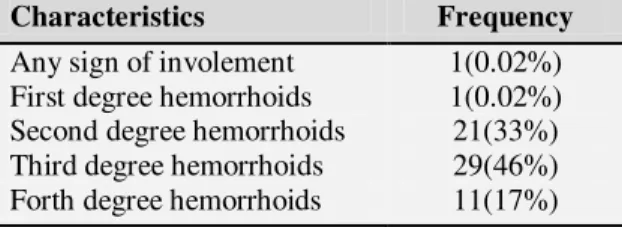
29 were female and 34 were male. Twenty one (34%) patients had low-activity occupations, 31 (49%) patients had medium-activity occupations and 11 (17%) patients had high activity occupations. Seventeen (30%) patients had anal fissure. Only seven (11%) patients did not have any history of constipation, 56 (89%) patients complained from constipation with average length of (57.65±45.21) months. The hemorrhoids involvement of patients are shown in Table1.
Table1: Distribution in patients of hemorrhoid
involvement
Characteristics Frequency
Any sign of involement First degree hemorrhoids Second degree hemorrhoids
1(0.02%) 1(0.02%) 21(33%) Third degree hemorrhoids 29(46%) Forth degree hemorrhoids 11(17%)
Pathologic findings in biopsies (aganglionic zones) were reported in six patients (3 males and 3 females) with average length of 43.33 mm. The other 57 patients (31 males and 26 females) did not show any sign of pathology in their biopsies, so the pathologic changes in ganglion cells of anal area were not related to gender (P= 0.838).
All the patients with anal pathologic findings reported constipation, and in general only seven (11%) patients did not complain from constipation. The mean age of patients with pathologic changes in anal ganglion cells was (18.17±0.41) years; the mean age of other patients was (34.18±13.56) years. The results of this study showed that age was an effective factor in determining pathologic changes in anal ganglion cells (P=0.006). Younger patients had more anal pathological ganglionic findings (P=0.006).
This study demonstrated that patients with average activity had more pathologic changes (P=0.033). Patients with pathologic changes in anal ganglion cells
all had medium-activity occupations , while out of the remaining 57 patients without pathologic findings, 21, 25 and 11 patients had respectively low-, medium-, and high-activity occupations. This suggested that level of activity had significant effect on pathologic changes of anal ganglion cells.
Patients with pathologic findings all had history of constipation, in patients without pathologic changes, 50 (88 %) had history of constipation and the remaining 7 reported no history of constipation. This indicated that constipation was not a significant effective factor for the presence of pathological changes (P=0.363). The mean duration of constipation in patients with pathologic changes was (200. 00± 9.80) months and in other patients it was (28.92±28.87) months. The duration of constipation had significant effect on pathologic changes in anal ganglion cells (P=0.001). The ratio of constipation duration to patient age in the group with pathologic changes was (91.71 ±3.1); this ratio in other patients was (8.00±9.77). It showed that the ratio of constipation duration to patient age was a significant effective factor in determining or detecting pathologic changes in anal ganglion cells (P=0.001) (Fig.1).
Fig 1: The effect of ratio of constipation
duration to age on pathologic changes in ganglion cell
The severity of hemorrhoids was also effective in pathologic changes of anal
Positive
ganglion cells (P= 0.037). Among patients who had pathologic changes (n=6), only one had anal fissure; in other 57 patients 16 (25.3%) had anal fissure. Presence of anal fissure did not show any significant relation with pathologic changes in anal ganglion cells (P=0.20).
Discussion
Vorobyov et al in his study showed that a 60 mm full-thickness strip biopsy is able to confirm aganglionosis in 100 patients (12%). So in adults with constipation symptoms and bowel disorders a biopsy as explained above may confirm aganglio- nosis and Hirschsprung diagnosis. In Kapuller study the length of physiologic hypoganglionic area in people was determined as 7.5 -50 mm (13), for this reason we took our full-thickness biopcies at 2,4, and 6 cm interval from dentate line. The percentage of aganglionosis in our study among adults with constipation was (10.53%). In Koszutski et al (14) study this percentage among children with constipation was (30%), and in Khan et al study was (14%) (15).
In Monajemzadeh study (16) the rate of Hirschsprung among patients with constipation was (75%), and in Ghosh study (17) it was (13%), both of these studies were conducted on children.
Howard (18) in his study on 60 patients with chronic constipation showed that 15 patients had normal biopsy, 7 patients minimal pathologic changes, 15 patients aganglionosis (Hirschsprung), 20 patients hypoganglionosis and 3 patients hyper- ganglionosis. His result indicated that (25%) of patients with chronic constipation had Hirschsprung disease. Regarding colon aganglionosis in patients with anorectal disorders, Jimenez-Urueta PS et al in his 2005 retrospective study in Spain found prevalence of (3.2%) between his study popluation. In our study the prevalence of
agangliosis among pathiemts with hemorrhoid and fissure was (9.52%).
Conclusion
Our results showed that gender, constipation and fissure were not significantly related to pathologic changes in anal ganglion cells. The pathologic changes in anal ganglion cells were more common among younger patients, those with medium level activity, patients with longer history of constipation, and patients who have lower degree of hemorrhoid.
Acknowledgments
The researchers appreciate all staff and patients who, participated in this study. The results described in this paper formed part of a thesis submitted by the forthauthor to Mashhad University of Medical Sciences for a postgraduate degree in general surgery. The project was designed and carried out in Surgical Oncology Research Center and was financially supported by a grant from vice chancellor for research of Mashhad University of Medical Sciences.
References
1.Brunicardi FC, Andersen DK, Billiar TR, Dunn DL, Hunter JG, Matthews JB, et al.
Schwartz’s principles of surgery. 9th ed.
McGraw Hil publishers, New York, 2010. 2. Longstreth GF, Thompson WG, Chey WD, Houghton LA, Mearin F, Spiller RC. Functional bowel disorders. Gastroenterology 2006; 130(5): 1480–91.
3. Pinto Sanchez M.I, Bercik P. Epidemiology and burden of chronic constipation. Can J Gastroenterol 2011 Oct;25 Suppl B:11B-15B. 4.Talley NJ. Definitions, epidemiology, and impact of chronic constipation: Rev Gastroenterol Disord 2004; 4 (l 2):3-10. 5. Medhi B, Rao RS, Prakash A, Prakash O, Kaman L, Pandhi P. Recent advances in the pharmacotherapy of chronic anal fissure: an update .Asian journal of surgery 2008 Jul ; 31(3):154-63.
and manometric study. American journal of surgery 2007 Jul; 194(1):13-6.
7. Boschi L, Lecce F. Two cases of chronic constipation in the adult: Hirschsprung disease and idiopathic megacolon. Minerva chirurgica 1993; 48(12):703-699.
8. Campobasso P, Pesce C, Mercurella A, Fabbro MA. Severe chronic constipation. Limitations of medical therapy and indications for surgical intervention. II. La Pediatria medica e chirurgica. Medical and surgical pediatrics 1996; 18(5):429-31. 9. de Angelis GL, Ghinelli C, Gregori G, Bassani F, Zanacca C, Del Rossi C, et al. Clinical approach to constipation: proposal of a diagnostic and therapeutic protocol. La Pediatria medica e chirurgica. Medical and surgical pediatrics 1983 Sep-Oct; 5(5):381-6. 10. Tobias N, Mason D, Lutkenhoff M, Stoops M, Ferguson D. Management principles of organic causes of childhood constipation .Journal of pediatric health care 2008 Nov-Dec; 22(1):23-12.
11. Vanoorbeek J, Kint M, Yvergneaux JP. Hirschsprung’s disease in adults: the Duhamel procedure. Acta chirurgica Belgica 2004 Jun; 104(3):304-8.
12. Vorobyov GI, Achkasov SI, Biryukov OM. Clinical features’ diagnostics and treatment of Hirschsprung’s disease in adults. Colorectal disease : the official journal of the Association of Coloproctology of Great Britain and Ireland 2010 Dec; 12(12):1242-8.
13. Kapuller LL, Zhuchenko AP, Achkasov SI, Biriukov OM. The extension of a physiologic hypoganglionic area in adults and its significance in the diagnosis of Hirschprung’s disease. Arkhiv patologii 2008 Jan-Feb; 70(1):46-9.
14. Koszutski T, Bohosiewicz J, Kudela G, Owczarek K. Diagnostics and treatment of chronic constipation in children-the experience of the department of paediatric surgery. Wiadomosci lekarskie (Warsaw, Poland: 1960) 2004; 57(3-4):193-6.
15. Khan AR, Vujanic GM, Huddart S. The
constipated child: how likely is Hirschsprung’s
disease? Pediatr Surg Int 2003 Aug ; 19(6):439-42.
16. Monajemzadeh M, Kalantari M, Yaghmai B, Shekarchi R, Mahjoub F, Mehdizadeh M. Hirschsprung’s Disease: a Clinical and Pathologic Study in Iranian Constipated Children. Iranian journal of pediatrics 2011 Sep; 21(3):362-6.
17. Ghosh A, GriYths DM. Rectal biopsy in the investigation of constipation. Arch Dis Child 1998; 79(1):266-8.