J of Evolution of Med and Dent Sci/ eISSN- 2278-4802, pISSN- 2278-4748/ Vol. 3/ Issue 36/Aug 18, 2014 Page 9513
COMPARISON OF STANDARD URINE ANALYSIS WITH URINE DIP STICK TO
DETECT URINARY TRACT INFECTION IN CHILDREN
Suresh P1, Antony Jenifer J2, L. Umadevi3, Rathinasamy M4
HOW TO CITE THIS ARTICLE:
Suresh P, Antony Jenifer J, L. Umadevi, Rathinasamy M. Comparison of Standard Urine Analysis with Urine Dip Stick to Detect Urinary Tract Infection in Children. Journal of Evolution of Medical and Dental Sciences 2014; Vol. 3, Issue 36, August 18; Page: 9513-9517, DOI: 10.14260/jemds/2014/3229
ABSTRACT: AIM: To Provide a prospective comparison of the rapid screening tests abilities
(Standard urinalysis, Urine dipstick test) to detect UTI in children with suspected UTI, admitted to a tertiary care hospital. MATERIALS & METHODS: All children yrs. of age, admitted with
suspected urinary tract infection were included in the study. It is a Prospective, comparative study with a sample size of 500 cases. RESULTS: The epidemiological indices - sensitivity, specificity and
predictive values of the rapid screening tests (The standard urine analysis, enhanced urine analysis, urine dipstick test) were calculated individually for bacteriuria, pyuria, both and compared with a positive urine culture as the validating standard. CONCLUSIONS: All the rapid screening tests had
low sensitivity (<70%) with similar positive predictive values. So no rapid test can screen accurately for UTI in young children. Hence urine culture, the gold standard for diagnosis should be sent if UTI is suspected.
KEYWORDS: UTI, standard urinalysis, urine dipstick.
INTRODUCTION:
AIM: To provide a prospective comparison of the rapid screening tests abilities (Standard urinalysis,
Urine dipstick test) to detect UTI in children with suspected UTI admitted to a tertiary care hospital.
MATERIALS & METHODS: This study was conducted in pediatric OPD, at chettinad hospital and
research institute, Chennai. All children yrs. of age, admitted with suspected urinary tract
infection were included in the study. Children with Extra-renal focus of infection, previous antibiotic exposure, Pre-existing urinary tract anomalies, recurrent urinary tract infection were excluded. A clean–catch midstream urine specimen, from these children was subjected to the standard urine analysis and urine dipstick testing, along with urine culture.
As per routine clinical practice, the urine specimens were sent to the hospital lab in sterile containers. Urine for culture was refrigerated if not plated within 10 minutes of receipt. Technologists in the hematology laboratory performed the dipstick, standard urinalysis, while the microbiology staff performed the urine culture and gram stain.
It is a Prospective, comparative study with a sample size of 500 cases. The epidemiological indices - sensitivity, specificity and predictive values of the rapid screening tests (The standard urine analysis, enhanced urine analysis, urine dipstick test) were calculated individually for bacteriuria, pyuria, both and compared with a positive urine culture as the validating standard.
J of Evolution of Med and Dent Sci/ eISSN- 2278-4802, pISSN- 2278-4748/ Vol. 3/ Issue 36/Aug 18, 2014 Page 9514
RESULTS: A total of 510 children admitted to the hospital with suspected UTI were enrolled in the
study, out of which 287 children were males and 223 were females. Around 60% of the children enrolled were in the <3 year age group, 20% in 3-6 year age group and the remaining in 6 – 12 year age group.
All the rapid screening tests had low sensitivity (<70%) with similar positive predictive values. Standard urine analysis had a higher sensitivity than dipstick. Though dipstick test was less sensitive in detecting bacteriuria / pyuria, it was more specific than standard urine analysis. Urine dipstick had higher predictive values and fewer numbers of false positives / false negatives than standard urine analysis.
NO. INDICES STANDARD URINE ANALYSIS URINE DIPSTICK
BACTERIURIA PYURIA BOTH BACTERIURIA PYURIA BOTH
1 Sensitivity 65.9 64.7 61.3 60.2 64.7 57.9
2 Specificity 81 77.7 88.1 89.8 89.1 92.1
3 Positive Predictive
Value 42 37.7 51.9 55.2 55.3 60.7
4 Negative Predictive
Value 91.9 91.3 91.6 91.5 92.3 91.3
5 Percentage of False
Negatives 34.1 35.2 38.6 39.7 35.2 42
6 Percentage of False
positives 18.1 22.2 11.8 10.1 10.9 7.8
TABLE 1: COMPARISON OF THE SCREENING TESTS USING EPIDEMIOLOGICAL INDICES
THE McNEMAR TEST: Mcnemar’s test, introduced in is another useful statistic tool to
test marginal homogeneity in 2×2 tables. It is applied to 2 × 2 contingency tables with a dichotomous trait with matched pairs of subjects.
The McNemar statistic is calculated as: X2 = (|b - c| - 1)2/ (b + c)
Statistical significance is determined by evaluating the probability of X2 with reference to a table of cumulative probabilities of the chi-squared distribution. The marginal frequencies are not
homogeneous if the χ2 result is significant (p < 0.05). When paired comparison was made between
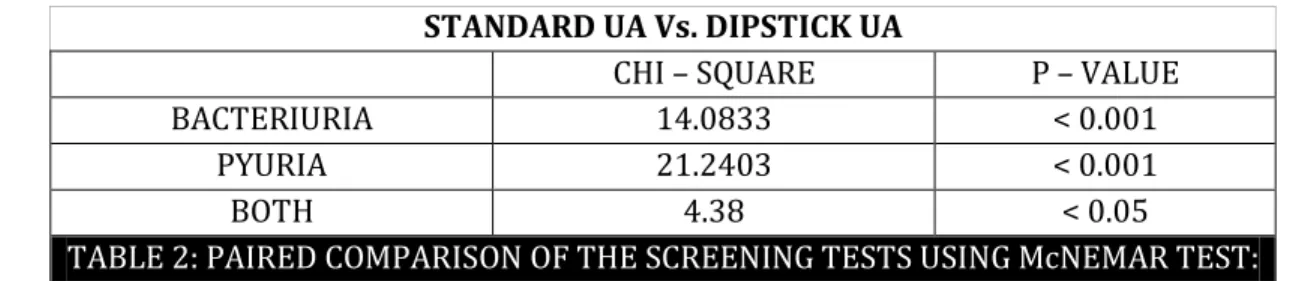
these three tests, significant statistic difference (p-value < 0.05) was noted between the standard UA Vs. urine dipstick groups.
STANDARD UA Vs. DIPSTICK UA
CHI – SQUARE P – VALUE
BACTERIURIA 14.0833 < 0.001
PYURIA 21.2403 < 0.001
BOTH 4.38 < 0.05
J of Evolution of Med and Dent Sci/ eISSN- 2278-4802, pISSN- 2278-4748/ Vol. 3/ Issue 36/Aug 18, 2014 Page 9515
DISCUSSION: Urinary tract infection (UTI) is recognized increasingly as a common cause of fever in
young children.1 Previous studies of the prevalence of UTI among children presenting to an emergency department with fever found rates ranging from 3.5 to 5.5%.2 The overall prevalence of UTI observed in this study 17%, was higher than in previous studies.
The highest prevalence was found in the 0-3 year age group (20.46%). There was a slight male preponderance in the 0-3 year age group (1.13:1) and female preponderance thereafter (2.25:1). This is akin to the observation made by various studies in this regard.3, 4 This distribution is in keeping with the general finding that male infants have a higher incidence of UTI due to incomplete voiding, uncircumcised status.5, 6, 7 With the progress in age, the female children have a higher frequency of infection due to proximity of urethral and anal opening with the introitus serving as reserve camp.
STANDARD URINALYSIS: Despite the knowledge that the results of manual microscopy are highly
variable & are laboratory / technician dependent, it is still widely used as a screening test for UTI. In our study, pyuria was defined as at least 5 WBCs per HPF and bacteriuria as presence of any bacteria per HPF on a centrifuged urine specimen. Bachur et al in his study noted that sensitivity of standard urinalysis is limited to around 80% & does not vary with age in febrile children.8
Lin et al in his study involving 162 febrile children < 8 weeks of age concluded that ESR, CRP, Standard microscopy were all imperfect tools in discriminating UTI.9 Armengol et al, in his study compared the results of standard microscopy with urine dipstick test and observed that standard microscopy has limited usefulness in screening for UTI, owing to its low sensitivity and specificity.10 In our study, standard urinalysis had a low sensitivity (61.3%) with similar specificity (88.1%). It also had a positive predictive value of 51.9%, the lowest among the three screening tests and the highest percentage of false positives.
URINE DIPSTICK TEST: A urinalysis with manual dipstick is commonly ordered on most children
presenting with urinary symptoms. A urine dipstick tests for specific gravity and pH, as well as the presence of urobilinogen, ketones, glucose, hemoglobin, leukocyte esterase and nitrite. In our study using Urinary dipsticks (Multistix 10SG, Bayer Diagnostics), Moderate (2+) or large (3+) leukocyte esterase activity was taken as evidence of pyuria and positive nitrite test was taken as an indicator of
bacteriuria. Kathy et al’s comparative study on screening tests for UTI concluded that the urine
dipstick plus culture tests was the most cost-effective strategy for screening UTI in febrile young children in the emergency setting.11
Zaman et al in his study involving 420 hospital inpatients concluded that urine dipstick test had very low sensitivity as well as high false positivity rates and hence not a suitable screening test for UTI.12 Recently, a Meta-analysis on the diagnostic accuracy of urine dipstick involving 70 publications over 10 years demonstrated that the urine dipstick test alone was useful in all populations to exclude the presence of infection if the results of both nitrites and leukocyte-esterase were negative.13 In our study, urine dipstick test had the lowest sensitivity (57.9%) but specificity (92.1%) and positive predictive value (60.7%) were comparable to standard urine analysis.
COMPARISON OF THE SCREENING TESTS: The most cost effective strategy was to perform cultures
J of Evolution of Med and Dent Sci/ eISSN- 2278-4802, pISSN- 2278-4748/ Vol. 3/ Issue 36/Aug 18, 2014 Page 9516
al’s survey comparing standard urinalysis with urine dipstick test revealed that the sensitivity,
specificity and predictive values of the pyuria, bacteriuria by microscopy and leukocyte esterase by reactive strip were comparable.14 The Meta analytic study concluded that both Gram stain and dipstick analysis for nitrite and Leukocyte Esterase perform similarly in detecting UTI in children and are superior to microscopic analysis for pyuria.15
CONCLUSIONS: Children less than 3 years of age were more susceptible to UTI than older children.
There was a slight male preponderance (1.13:1) in the 0-3 year age group and female preponderance (2.25:1) thereafter. This is because of the fact that male infants have a higher incidence of UTI due to incomplete voiding, uncircumcised status. All the rapid screening tests had low sensitivity (<70%) with similar positive predictive values. So no rapid test can screen accurately for UTI in young children.
Hence urine culture, the gold standard for diagnosis should be sent if UTI is suspected. Standard urine analysis had a higher sensitivity than dipstick. Though dipstick test was less sensitive in detecting bacteriuria / pyuria, it was more specific than standard urine analysis. Urine dipstick had higher predictive values and fewer numbers of false positives / false negatives than standard urine analysis.
BIBLIOGRAPHY:
1. Hoberman A, Han-Pu C, Keller DM, Hickey R, Davis HW, Ellis D. Prevalence of urinary tract infection in febrile infants. J Pediatr. 1993; 123: 17–23.
2. Shaw K N, M Gorelick, K L McGowan, N M Yakscoe, J S Schwartz. Prevalence of urinary tract infection in febrile young childrenin the emergency department. Pediatrics 1998; 102 (2): e16. 3. Joseph J Zorc, Darcie A Kiddoo, Kathy N Shaw. Diagnosis and Management of Pediatric Urinary
Tract Infections. Clinical microbiology reviews 2005; 18: 417–422.
4. Consensus statement on management of urinary tract infections;Indian Pediatric Nephrology Group Indian Academy of Pediatrics. Indian Pediatrics 2001; 38: 1106-1115.
5. Wiswell T E, J D Roscelli. Corroborative evidence for the decreased incidence of urinary tract infections in circumcised male infants. Pediatrics 1986; 78: 96–99.
6. Stephen M Downs. Technical Report: Urinary Tract Infections in Febrile Infants and Young Children.Pediatrics 1999; 103 (4): e54.
7. Joseph J Zorc, Deborah A Levine, Shari L Platt, Peter S Dayan, Charles G Macias, William Krief, et al. Clinical and Demographic Factors Associated With Urinary Tract Infection in Young Febrile Infants. Pediatrics 2005; 116; 644-648.
8. Richard Bachur, Marvin B Harper. Reliability of the Urinalysis for Predicting Urinary Tract Infections in Young Febrile Children. Arch Pediatr Adolesc Med. 2001; 155: 60-65.
9. Dar-Shong Lin, Shing-Huey Huang,, Chun-Chun Lin,, Yi-Chen Tung, Tsu-Tzu Huang, Nan-Chang Chiu et al. Urinary tract infections in febrile infants younger than 8 weeks of age. Pediatrics 2000; 105 (2): e20.
J of Evolution of Med and Dent Sci/ eISSN- 2278-4802, pISSN- 2278-4748/ Vol. 3/ Issue 36/Aug 18, 2014 Page 9517 11.Kathy N Shaw, Karin L McGowan, Marc H Gorelick, J Sanford Schwartz.Screening for Urinary Tract Infection in Infants in the Emergency Department: Which Test Is Best? Pediatrics 1998;101(6):e1
12.Z Zaman, A Borremans, J Verhaegen, L Verbist, N Blanckaert.Disappointing dipstick screening for urinary tract infection in hospital inpatients. J Clin Pathol. 1998; 51; 471-472.
13.Walter LJM Deville, Joris C Yzermans, Nico P van Duijn, P Dick Bezemer, Danielle AWM van der Windt and Lex M Bouter. The urine dipstick test useful to rule out infections. A meta-analysis of the accuracy.BMC Urol. 2004; 4: 4.Published online Jun 2, 2004. doi: 10.1186/1471-2490-4-4 14.Leanos-Miranda A, Contreras-Hernandez I, Camacho R, Villagomez-Salcedo E,
Cervantes-Gorayeb I. Diagnostic yield of various urine tests in urinary tract infections. Rev Invest Clin. 1996;48(2):117-23
15.Marc H. Gorelick, Kathy N. Shaw. Screening Tests for Urinary Tract Infection in Children: A Meta-analysis. Pediatrics 1999; 104 (5): e54.
AUTHORS:
1. Suresh P. 2. Antony Jenifer J. 3. L. Umadevi 4. Rathinasamy M.
PARTICULARS OF CONTRIBUTORS:
1. Associate Professor, Department of
Paediatrics, Chettinad Hospital and Research Institute.
2. Assistant Professor, Department of
Paediatrics, Chettinad Hospital and Research Institute.
3. Professor, Department of Paediatrics, Chettinad Hospital and Research Institute. 4. Professor, Department of Paediatrics,
Chettinad Hospital and Research Institute.
NAME ADDRESS EMAIL ID OF THE
CORRESPONDING AUTHOR:
Dr. P. Suresh,
Old No. 4/ New No. 8/1, Balu Avenue,
Valmiki Street,
Thiruvanmiyur, Chennai-600041. Email: [email protected]