Engineering, Environment
Effect of alkali treatment on the mechanical properties of Poly (lactic acid) /
Guineacorn husk particulate bio-composites
Umar SHEHU1,3*,Umaru Semo ISHIAKU2, Terver AUSE1, Razaina MAT TAIB3 and Ola APONBIEDE1
1 Metallurgical and Materials Engineering Department, Ahmadu Bello University, Zaria, Nigeria 2 Textile Science and Technology Department, Ahmadu Bello University, Zaria, Nigeria
3 School of Materials and Mineral Resources Engineering, Engineering Campuss Universiti Sains Malaysia. 14300 Nibong Tebal, Pulau Pinang, Malaysia
E-mail(s): [email protected]; [email protected]; [email protected]; [email protected]; [email protected].
*
Corresponding author, phone: +2348098359167
Received: July 24, 2016 / Accepted: August 9, 2016 / Published: December 30, 2016
Abstract
The paper focuses on the influence of alkali treatment on the mechanical
properties of biocomposites made from poly(lactic acid) (PLA) and
guineacorn husks particulates (GHP) with respect to that of the untreated
(untrd) biocomposites. The composites were prepared using a single screw
extruder and an injection moulding machine with particulate compositions
varying from 0-40% at 10% interval. It was observed that the tensile
strength of the bio-composites decreased with increase in filler content with
a maximum value of 31.24MPa at 10% filler content. The tensile modulus
recorded an increase with increase in filler content with a maximum value
of 2505MPa at 40% filler content while the maximum hardness stood at
72.9HRR at 30% filler content. The alkali treated bio-composites exhibited
better properties as compared to those of the untreated ones.
17
Keywords
Poly (lactic acid); Guineacorn husks; Tensile strength; Bio-composites;
Pasticizer; Alkali; Filler; Acetic acid
Introduction
Traditional fiber reinforced composites are composed of carbon fibers, glass fibers,
which are incorporated into thermosets or thermoplastic polymers. They have been used for a
variety of applications including those used in consumer products for casing, packaging, etc.
With increasing number of applications due to increasing number of world population,
disposal of composites after their intended life has become a problem as substantial costs are
incurred and recycling most polymer composites is proving difficult [1, 2].
The growing environmental awareness and new rules and regulations are pushing the
industries to develop materials that are more ecologically friendly [3].This has led to the
development of biocomposites which have performance that is comparable with those of the
conventional polymers and can be degraded at the end of their intended use [4].
Biocomposites employ the use of renewable materials such as biopolymers as matrices and
plant lignocellulosic materials as fillers or reinforcements. They can be used in non-durable
applications (a few years), products intended for a short term use (a few times) or for indoor
applications [2, 5].
Poly (lactic acid) (PLA) is a versatile and hydrophobic polymer made from
agricultural-based feed stocks which are fermented to lactic acid and then polymerized. It is
fully biodegradable in the soil, compost or water and the degradation products are reported to
be non-toxic to the environment. However, it is known to be stiff and brittle, and it is
therefore necessary to use plasticizers to improve the elongation and impact properties [2, 3,
5, 6]. A number of plasticizers including glycerol, biomax strong [7], triactine, tributyl citrate
[6], poly (ethylene glycol) (PEG) [8], citrate esters, partial fatty acid ester and ethylene oxide
[9] have been used as impact modifiers for PLA. Essentially, the plasticizers were used to
lower the glass transition temperature, increase ductility and improve the processibility of
PLA [10]. Some typical applications for bio- polymers such as PLA include plastic bags for
cups and plates etc [3]. PLA can be melt-processed with standard processing equipment such
as extrusion and injection moulding at temperatures below those at which natural fibers start
to degrade. These open possibilities of producing bio-composites from lignocellulosic
materials and PLA as the use of renewable and biodegradable fillers is desirable to provide
cost-competitive polymer composites [1, 5]. The motive is that the constituent materials
would reduce volumes of waste deposit while undergoing degradation in a landfill [4].
Lignocellulosic materials have many advantages compared to synthetic fibres, for
example low weight/density, low cost, renewable, they do not cause skin irritations, reduced
wear in processing equipment and they are recyclable and biodegradable. The most important
of these properties is their ecological friendliness as they are produced from renewable
resources [3, 11]. Despite several merits, lignocellulosic materials also possess few drawbacks
such as poor wettability, incompatibility with some polymeric matrices and high moisture
absorption. To tackle the problem of compatibility, specific treatments have been suggested
such as surface modification through alkali treatment and treatment with coupling agents,
which in turn will enhance the overall performance of the composites [12].
Nigeria is a country blessed with a lot of agricultural produce including guineacorn
(Sorghum bicolor). It is one of the most extensively grown cereals in the country especially in
the Northern parts of the country. In Nigeria, guineacorn is the third cereal in terms of volume
of production after maize and millet [13, 14] with more than 4.5 million tonnes harvested in
2010 representing 25% of the total cereal production [15]. Huge amount of wastes are
generated from this crop yearly and only a minute quantity are consumed by animals while
the rest are burnt on the farmlands which constitutes air pollution. The husks are the covering
for the guineacorn seeds and are obtained after the seeds have been removed either through
manual or mechanical means.
In light of the above, wastes from this important crop is investigated in this study as
possible filler in poly (lactic acid) (PLA) to form biocomposites. The PLA in this study was
blended with Biomax strong (PLABM) which serves as an impact modifier.
Material and method
Guineacorn husks particulates (GHP) was obtained from Zaria after the harvest period,
PLA of grade 3051D and Dupont Biomax 100 strong were purchased from Nature works
USA, Sodium Hydroxide (NaOH) pellets and Acetic acid were obtained from The
Netherlands and Sigma-Aldrich respectively.
Particulate filler preparation
The husks were thoroughly washed with detergent to remove all forms dirt including
stones and sand. They were then dried in the sun after which it was oven dried at 105oC for 6hrs. The dried husks were then ground using a laboratory mini-crusher with a sieve of
0.5mm attached to its outlet. The ground husks were then soaked in hot water for 24hrs to
remove any volatile matter and afterwards, they were dried in the open air before alkali
treatment. The dried particulate filler was termed untreated (UNTRD) filler.
For the alkali (ALK) treatment, the particulate filler was soaked in 5% w/w NaOH
concentration for 24hrs at room temperature. The filler was then rinsed repeatedly with
distilled water containing little quantity of acetic acid until no trace of NaOH was confirmed.
The NaOH modified filler was then dried in air for 2days then oven dried at 105oC for 24hrs.
Compounding and Extrusion Process
Compounding was performed using a Brabender single screw extruder with
temperature profile of 160/175/175/165oC from hopper to die and screw speed of 40rpm. The
fillers were varied from 10 to 40% at 10% interval with Pure PLA blended with 5% Biomax
strong as matrix and termed PLABM. The extrudates were passed through a water tank with
continuous flow of water. They were then pelletized using a type 881207 granulator. The
pelletized materials were heated in an oven at 50oC to remove moisture before storing in a desiccator prior to injection moulding.
Injection Moulding
A BOY 22M injection moulding machine was used to produce tensile bars (dumbbell
shapes) according to ASTM D638, flexural bars according to ASTM D790 and impact
samples according to ASTM D256. The temperature profile used was145/180/180/165oC, injection pressure of 50 bars, mould temperature was 30oC and 30 seconds holding time.
All injection moulded specimens were conditioned in a Binder KBF240 humidity
Mechanical Testing
Tensile and flexural tests were conducted according to ASTM D638 and D790
respectively with an Instron 5982 machine. The cross head speed used was 2mm/s for tensile
test and 5mm/s for flexural test. Izod impact test was conducted on unnotched specimens
according to ASTM D256 with a Zwick impact testing machine. A 7.5J hammer was used for
the samples. Five samples were used for the tensile and flexural tests while three samples
were used for the impact test and the average values were recorded. The hardness test was
conducted with a Mitutoyo Universal Hardness testing machine. The surfaces of injection
moulded specimens were smooth enough so there was no surface preparation before carrying
out the test. The test type was Rockwell hardness with R scale (HRR), the indenter used was
¼ inch steel ball with minor and major loads of 10 and 60Kgf respectively. The indentation
was made on five points and the average values were recorded. All the tests were carried out
at room temperature.
Morphological studies using scanning electron microscope (SEM)
Tensile fractured surface was studied with JOEL-JSM 5600 series Scanning Electron
Microscopes (SEM). The specimens were sputter coated with a thin layer of gold to avoid
electrostatic charging during sample examination.
Results
Figure 1 is the results for tensile strength of poly(lactic acid) filled guineacorn husks
particulate biocomposites. Figure 2 shows the results for tensile modulus of PLABM/GHP
biocomposites. The elongation at break of the biocomposite against filler content is presented
in Figure 3. The variation of flexural strength of the biocomposite against filler content is
presented in Figure 4. Figure 5 is the result of flexural modulus against filler content for
PLABM/GHP biocomposite. Figure 6 is the impact strength result of PLABM/GHP
biocomposite. The result for hardness of PLABM/GHP biocomposite is presented in Figure 7.
Morphological observations of tensile fractured surfaces using scanning electron microscope
is presented in Figure 8.
Figure 1. Tensile strength of PLABM/GHP biocomposites against filler content
Figure 2. Tensile modulus of PLABM/GHP biocomposites against filler content 0
500 1000 1500 2000 2500 3000
0 10 20 30 40
Tensile modulus (MPa)
Filler content (wt%)
PLABM
UNTRD ALK 0
5 10 15 20 25 30 35 40 45 50
0 10 20 30 40
Tensile strength (MPa)
Filler content (Wt%)
PLABM UNTRD
Figure 3. Elongation at break for PLABM/GHP biocomposites vs filler content
Figure 4. Flexural strength of PLABM/GHP biocomposites against filler content 0
10 20 30 40 50 60 70
0 10 20 30 40
Flexural strength (MPa)
Filler content (wt%)
PLABM UNTRD ALK 0
0.5 1 1.5 2 2.5 3 3.5 4
0 10 20 30 40
Elongation at break (%)
Filler content (wt%)
PLABM UNTRD ALK
Figure 5. Flexural modulus of PLABM/GHP biocomposites against filler content
Figure 6. Impact strength of PLABM/GHP biocomposites against filler content 0
10 20 30 40 50 60 70 80
0 10 20 30 40
Impact strength (J/m)
Filler content (wt%)
PLABM
UNTRD
ALK 0
500 1000 1500 2000 2500 3000 3500 4000 4500 5000
0 10 20 30 40
Flexural modulus (MPa)
Filler content (wt%)
PLABM
UNTRD
Figure 7. Rockwell hardness of PLABM/GHP composites against filler content
Figure 8. Tensile fractured surfaces for PLABM and PLABM/GHP biocomposites (a) unreinforced matrix (b) 10% untreated GHP content (c) 40%GHP untreated (d) 10%
alkali-treated biocomposite (e) 40% alkali-alkali-treated biocomposite
a b c
d e
0 10 20 30 40 90
0 10 20 30 40
Hardness (HRR)
Filler content (wt%)
PLABM UNTRD ALK
80
70
60
50
Discussion
The tensile strengths results of the produced biocomposites are shown in Figure 1. It
was observed that the unreinforced matrix (PLABM) with a tensile strength of 45MPa had a
higher strength than the reinforced biocomposites whether treated or untreated and a
progressive decrease was exhibited with increase in GHP content. However, the alkali treated
biocomposites possessed higher tensile strength than the untreated ones. Similar observation
was reported by Finkenstadt et al., [2] that noticed a decrease in tensile strength in PLA/Sugar
Beep Pulp (SBP) composite from 69.5MPa for the pure PLA to 29.55MPa for 45% SBP
content. Also, [16], [17] and [18] reported similar findings. Furthermore, [19] reported higher
tensile strengths for acrylic acid treated biocomposites over those of the untreated ones. The
reduction of tensile strength with filler loading could be due to the irregular shape of filler
resulting in poor capability to support stress transmitted from the matrix [20]. Furthermore,
the reduction of tensile strengths at higher filler concentration could be due to increasing
probability of filler agglomeration which could lead to a situation where there is more
to-filler interaction than filler –to-matrix interaction leading to generation of voids at
filler-matrix interface and stress transfer to the filler becomes inefficient leading to low strength
values [21, 22].
From the results in Figure 2, it was observed that the tensile modulus increased with
increase in GHP content and the tensile moduli of the untreated biocomposites were higher
than those of the alkali-treated ones. At 40%GHP content, the tensile moduli were 2505 and
2371MPa for the untreated and alkali-treated biocomposites respectively while for the
unreinforced matrix, the tensile modulus was 1941MPa, a value that was less than those with
reinforced PLA at all the GHP contents. This result is consistent with Shumigin et al., [23]
who observed that the modulus of PLA increased from 1975MPa for neat PLA to 2187MPa
for reinforced PLA.
Increase in tensile modulus as filler content increases could be due to the restriction of the
macromolecules mobility and deformability imposed by the presence of particles and as
modulus is a measure of a material’s stiffness, increase in filler content makes the material
become stiffer [20, 21, 23, 24].
unreinforced matrix exhibited the highest EB with a value of 3.5%. Furthermore, the
untreated biocomposites possessed higher EB than the alkali-treated samples. The decrease in
EB with particle loading could be due to the decrease in the mobility of polymer chain as
more rigid filler is added to a softer matrix [20]. Similarly, Chun et al., [25] reported a
decrease in EB of PLA/Coconut Shell Particulates (CSP) composites with increase in CSP
content due to reduction in PLA chain mobility resulting in a more rigid composite and MA
treated composites had lower values than their untreated composites as well.
Flexural strength results of the biocomposites showed a progressive decrease as GHP
content was increased as seen in Figure 4. The alkali-treated samples exhibited higher flexural
strengths than their untreated counterparts at all contents of the filler. It was observed in the
result that the alkali treated sample at 10%GHP content possessed a flexural strength that is
higher than that of the unreinforced matrix. Huda et al., [26] reported a decrease in the
flexural strength of PLA/kenaf composites with kenaf fibre addition and surface treated fibre
composites had higher flexural strength than the untreated ones. Koutsomitopoulou et al., [27]
also reported a decrease in flexural strength with filler loading. Thamae et al., [28] reported
that probably due to the compressive component of flexural strength which is not interface
dependent, they observed an improvement in flexural strength of their studied composites
with flour loading. However, at higher flour content, there was a decrease probably due to
agglomeration of the particles. Ibrahim et al., [29] who investigated the flexural strength of
Polyester/OPA composites reported a decrease with OPA loading possibly due to poor surface
adhesion between polyester and OPA and also due to limited quantity of the matrix with
increase in filler, polyester resin was not able to completely wet on the surface of filler. This
could also be a probable reason for the behaviour observed in this study.
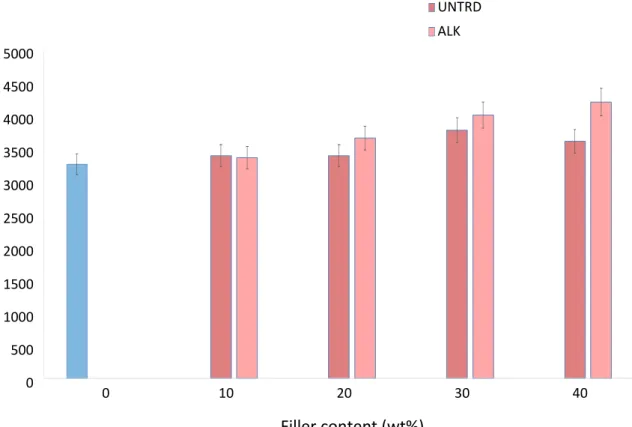
The results for the flexural modulus showed an increase with GHP loading with those
for the alkali-treated samples being higher than those of the untreated as shown in Figure 5.
Flexural modulus has been defined as the ability of a material to maintain its dimensions
before rupture [29]. Increase in modulus relates to the stiffness properties of the composites.
Huda et al., [26] reported an increase in flexural modulus with addition of wood fibres in PLA
matrix. They reported also that PLA and PLA-based composites possessed higher flexural
strengths and moduli than PP and PP-based composites.
The results for the impact strengths for the produced biocomposites are presented in
Figure 6. From the results, it was observed that the unreinforced matrix possessed impact
strength of 71J/m which was higher than those of the reinforced biocomposites. Furthermore,
the impact strength of bio-composites containing treated fillers were higher than those of the
untreated fillers possibly due to better dispersion of the fillers in the matrix as a result of the
chemical treatment. Similar behaviour was reported by Ahmad et al., [30] for Polyester/rice
husk (RH) composites. They noted that impact energy is an indication of tolerance for sudden
force where the composite is subjected to rapid crack propagation through the material. Fillers
disturb matrix continuity and individual filler is a site of stress concentration, which can act as
a micro-crack initiator [31]
Figure 7 indicates that the hardness of the biocomposites increased with increase in
GHP content from 10 to 30% content for both the treated and untreated samples and then
decreased afterwards. However, at 20 and 30% GHP contents, the untreated biocomposites
exhibited higher hardness than the treated ones. Increase in hardness could be as a result of a
more compact structure at the surface of the material which leads to greater resistance to
penetration and consequently resulting in high hardness of the material [32]. Although Saini
et al., [33] reported increase in hardness with filler loading but, treatment with NaOH did not show any improvement at the end of their study.
The SEM of tensile fracture surfaces for PLABM/GHP biocomposites are shown in
Figure 8a-e. The SEM images generally indicated brittle fractures which are more pronounced
in the reinforced specimens (Figure 8b-e) than in the unreinforced specimen (Figure 8a). The
images indicated filler pull out which were more pronounced in the untreated specimens
(Figure 8b and c). The alkali-treated specimens showed cleaner images which indicate better
adhesion between the filler and the matrix than the untreated specimens. This could be a
reason for better tensile strength for the alkali-treated samples over the untreated samples.
Conclusions
From this study, the following conclusions were drawn:
÷ Tensile strength of the biocomposites decreased with increase in the GHP content
÷ The stiffness of the composites increased with increase in filler content as obtained from
the results of tensile modulus.
increased
÷ The hardness of the biocomposites increased with increase in filler content.
÷ The alkali treated biocomposites exhibited better properties as compared to the untreated ones on a general note.
Acknowledgements
Umar Shehu thankfully appreciates the management of Ahmadu Bello University,
Zaria, kaduna State, Nigeria for granting study fellowship and Universiti Sains Malaysia,
Pulau Pinang, Malaysia for providing the opportunity of research attachment. TETFUND is
also appreciated for the sponsorship of the research attachment carried out in Malaysia.
References
1. Mat-Taib R., Ramarad S., Ishak Z. A., Mohd T. M., Water absorption and Tensile
Properties of Kenaf Bast Fiber- Plasticized Poly (Lactic Acid) Biocomposites, Proceedings of the Polymer Processing Society 24th Annual Meeting PPS-24 June
15-19: Salerno (Italy), 2008.
2. Finkenstadt V. L., Liu L., Willett J. L., Evaluation of Poly(lactic acid) and Sugar Beet
Pulp Green Composites, Journal of Polymer and the Environment, 2007a, 15, p. 1–6.
3. Oksman K., Skrifvars M., Selin J. F., Natural fibres as reinforcement in polylactic acid
(PLA) composites, Composites Science and Technology, 2003, 63, p. 1317–1324.
4. Fakhrul T., Islam M. A., Degradation behavior of natural fiber reinforced polymer
matrix composites, Procedia Engineering, 2013, 56, p. 795 – 800.
5. Fang Q., Hanna M. A., Rheological properties of amorphous and semicrystalline
poly(lactic acid) polymers, Industrial Crop and Production, 1999, 10, p. 47-53.
6. Ljungberg N., Andersson T., Wesslén B., Film Extrusion and Film Weldability of
Poly(lactic acid) Plasticized with Triacetine and Tributyl Citrate, Journal of Applied Polymer Science, 2003, 88, p. 3239–3247.
7. Mat-Taib R., Ghaleb Z.A., Mohd-Ishak Z.A., Thermal, Mechanical, and Morphological
Properties of Polylactic Acid Toughened with an Impact Modifier, Journal of Applied Polymer Science, 2012, 123, p. 2715–2725.
8. Pluta M., Paul M.A., Alexandre M., Dubois P., Plasticized Polylactide/Clay
Nanocomposites. II. The Effect of Aging on Structure and Properties in Relation to the Filler Content and the Nature of its Organo-Modification, Journal of Polymer Science: Part B: Polymer Physics, 2006, 44, p. 312–325.
9. Sawalha H., Schroën K., Boom R., Addition of Oils to Polylactide Casting Solutions as
a Tool to Tune Film Morphology and Mechanical Properties, Polymer Engineering and Science, 2010, 50(3), p. 513-519.
10. Rasal R.M., Janorkarc A.V., Hirt D.E., Poly (lactic acid) modifications, Progress in
Polymer Science, 2010, 35, p. 338–356.
11. Kumar R., Anandjiwala R., Flax Fiber Reinforced PLA Composites: Studies on types of
PLA and different methods of fabrication, in 11th International Conference on Frontiers of Polymers and Advanced Materials ICFPAM2010, Pretoria, South Africa.
12. Goud G., Rao R.N., Effect of fibre content and alkali treatment on mechanical
properties of Roystonea regia-reinforced epoxy partially biodegradable composites, Bulletin of Materials Science 2011, 34(7), p. 1575–1581.
13. Maikasuwa, M.A., Ala A.L., Trend Analysis of area and Productivity of Sorghum in
Sokoto State, Nigeria, 1993-2012. European Scientific Journal, 2013, 9(16), p. 69-75.
14. USDA, Foreign Agricultural Service Nigeria Grain and Feed Annual Report, 2014, Global Agricultural Information Network (GAIN).
15. FAO, Monitoring African Food and Agricultural Policies (MAFAP): Analysis of Incentives and Disincentives for Sorghum in Nigeria, July, 2013, p. 6.
16. Clarizio S.C., Tatara R.A., Tensile Strength, Elongation, Hardness, and Tensile and
Flexural Moduli of PLA Filled with Glycerol-Plasticized DDGS, Journal of Polymer and the Environment 2012, 20, p. 638–646.
17. Rosa S. M. L., Santos E. F., Ferreir C. A., Nachtigall S. M. B., Studies on the Properties
12(3), p. 333-338.
18. Finkenstadt V. L., Liu C.K., Evangelista R., Liu L., Cermak S. C., Hojilla-Evangelista,
M., Willett J.L., Poly (lactic acid) green composites using oilseed coproducts as fillers,
Industrial Crops and Products 2007b, 26, p. 36–43.
19. Salmah H., Koay S.C., Hakimah O., Surface modification of coconut shell powder filled
polylactic acid biocomposites, Journal of Thermoplastic Composite Materials, 2012, 26(6), p. 809–819.
20. Viet C. X., Ismail H., Rashid A. A., Takeichi T., Kenaf Powder Filled Recycled High
Density Polyethylene/ Natural Rubber Biocomposites: The Effect of Filler Content, International Journal of Integrated Engineering, 2012, 4(1), p. 22-25.
21. Mohamad-Haafiz M.K., Hassan A., Zakaria Z., Islam M.S., Jawaid M., Inuwa I.M.,
Properties of Polylactic acid composites reinforced with Oil Palm biomass microcrystalline cellulose, Carbohydrate Polymers, 2013,98, p. 139–145.
22. Hardinnawirda K., SitiRabiatull I.A., Effect of rice husks as filler in polymer matrix
composites, Journal of Mechanical Engineering and Sciences (JMES), 2012, 2, p. 181-186.
23. Shumigin D., Tarasova E., Krumme A., Meier P., Rheological and Mechanical
Properties of Poly (lactic) Acid/Cellulose and LDPE/Cellulose Composites, Materials Science (Medžiagotyra), 2011, 17(1), p. 32-37.
24. Eze I.O., Obidiegwu M.U., Eyarefe S.O., Some mechanical and end-use properties of
Bamboo powder filled Low Density Polyethylene composites, Part-I: Natural and Applied Sciences, 2013, 4(2), p. 199-207.
25. Chun K.S., Husseinsyah S., Osman H., Mechanical and thermal properties of coconut
shell powder filled polylactic acid biocomposites: effects of the filler content and silane coupling agent, Journal of Polymer Research, 2012, 19, p. 9859-9866.
26. Huda M. S., Drzal L. T., Misra M., Mohanty A. K., Wood-Fiber-Reinforced Poly (lactic
acid) Composites: Evaluation of the Physicomechanical and Morphological Properties, Journal of Applied Polymer Science, 2006, 102, p. 4856–4869.
27. Koutsomitopoulou A.F., Bénézet J.C., Bergeret A., Papanicolaou G.C., Preparation and
characterization of olive pit powder as a filler to PLA-matrix bio-composites, Powder Technology, 2014, 255, p. 10-16.
28. Thamae T., Vaja S., Shangguan Y., Finoro C., Stefano, N., Baillie C., Mechanical and
moisture absorption of Corn and Wheat flour composites for developing countries, in Green Composites: Properties, Design and Life, F.W.a.P. Moens, Editor. Nova Science Publishers, Inc., 2009, p. 1-16.
29. Ibrahim M.S., Sapuan S.M., Faieza A.A., Mechanical and thermal properties of
composites from unsaturated polyester filled with Oil Palm Ash, Journal of Mechanical Engineering and Sciences, 2012, 2, p. 133-147.
30. Ahmad I., Abu-Bakar D.R., Mokhilas S.N., Raml A., Direct Usage of Products of Poly
(ethylene terephthalate) Glycolysis for Manufacturing of Rice Husk/Unsaturated Polyester Composite, Iranian Polymer Journal, 2007, 16(4), p. 233-239.
31. Khanjanzadeh H., Tabarsa T., Shakeri A., Morphology, dimensional stability and
mechanical properties of polypropylene–wood flour composites with and without nanoclay, Journal of Reinforced Plastics and Composites 2012, 31(5), p. 341–350.
32. Părpărită E., Darie R.N., Popescu C.M., Uddin M. A., Vasile, C.,
Structure-morphology-mechanical properties relationship of some polypropylene / lignocellulosic composites, Materials and Design, 2014, 56, p. 763-772.
33. Saini G., Narula A.K., Choudhary V., Bhardwaj R., Effect of Particle Size and Alkali