Low-energy electron collisions with ethane
M.H.F. Bettega∗
Departamento de F´ısica, Universidade Federal do Paran´a, Caixa Postal 19044, 81531-990, Curitiba, Paran´a, Brazil
R.F. da Costa†
Centro de Ciˆencias Naturais e Humanas, Universidade Federal do ABC, Rua Santa Ad´elia, 166, 09210-170 Santo Andr´e, S˜ao Paulo, Brazil
M.A.P. Lima‡
Centro de Ciˆencia e Tecnologia do Bioetanol CTBE, Caixa Postal 6170, 13083-970, Campinas, S˜ao Paulo, Brazil and Instituto de F´ısica Gleb Wataghin, Universidade Estadual de Campinas, Caixa Postal 6165, 13083-970, Campinas, SP, Brazil
(Received on 20 November, 2008)
We employed the Schwinger multichannel method to compute elastic cross sections for low-energy electron collisions with ethane (C2H6). The calculations were carried out in the static-exchange and static-exchange
plus polarization approximations for energies up to 12 eV. Our integral cross section shows good agreement with experimental data and with theoretical results for energies above 5 eV. There are some differences for energies below 5 eV between our results and the available experimental and theoretical results. Our differential cross sections also agree well with the experiment and with theory for energies above 5 eV; below this energy our results agree in shape, but are smaller than the available experimental and theoretical results. We discuss possible reasons for these discrepancies. We found a broad structure in the integral cross section around 8.5 eV and also a Ramsauer-Townsend minimum around 0.2 eV. These results are in agreement with the experimental observations and theoretical results.
Keywords: Elastic scattering; Polarization effects; Ramsauer-Townsend minimum
1. INTRODUCTION
The recent discovery by Bouda¨ıffa et al. [1] that sec-ondary electrons are responsible for single and double strand breaks in DNA has motivated several studies regarding elec-tron collisions with biological molecules [2]. Most of these studies are concerning with formation of resonances that would be responsible for molecular dissociation. Therefore the correct characterization of a resonance, i.e., its position, symmetry, type (shape, core-excited, Feshbach etc) is an in-formation that helps in the understanding of the dissociation process.
Ethane is a simple hydrocarbon that has been studied by experimental [3–14] and theoretical groups [15–17]. This molecule presents a broad structure around 7 eV and a Ramsauer-Townsend minimum below 1 eV (at ∼ 0.2 eV) [13, 14, 16]. From the theoretical point of view the descrip-tion of these two features needs the inclusion of polarizadescrip-tion effects. These effects arise from the distortion of the molec-ular electronic cloud due to the electric field generated by the incoming electron. In order to obtain good cross sections for electron collisions with biological molecules, one needs to know how to incorporate polarization effects properly. Therefore, studies involving collisions with small molecules can help one to achieve this goal.
In this paper we report cross sections for elastic colli-sions of low-energy electrons with C2H6molecules. We
em-∗Electronic address:[email protected]
†Electronic address:[email protected] ‡Electronic address:[email protected]
ployed the Schwinger multichannel (SMC) method imple-mented with norm-conserving pseudopotentials in the fixed nuclei, static-exchange (SE) and static-exchange plus polar-ization (SEP) approximations. We calculated integral, mo-mentum transfer and differential cross sections for energies up to 12 eV. Our aim is to present results obtained with the inclusion of polarization effects that display the Ramsauer-Townsend minimum at the right location and to describe the correct shape of the differential cross sections. We compared our results with experimental and theoretical results available in the literature. In general our results agree well with the ex-perimental data and theoretical results for energies above 5 eV.
In the next sections we discuss the theoretical procedures used in the current calculations, present our results and dis-cussions and end with a brief summary of our findings.
2. THEORY
The SMC method and its implementation with pseudopo-tentials (SMCPP) were discussed in detail elsewhere [18, 19]. Here we will only discuss the relevant aspects of the present calculation.
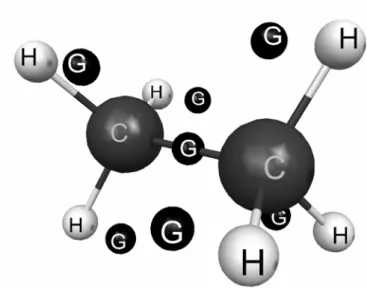
The target was computed in the Hartree-Fock approxi-mation. Bound state and scattering calculations were done within theCs point group at the experimental geometry of equilibrium [20]. The geometrical structure of ethane is shown in Figure 1, generated by McMolPlt [21]. Our calcu-lations employed the norm-conserving pseudopotentials of Bachelet, Hamman and Schl¨uter [22] in order to represent the core electrons, as discussed in Ref. [19].
FIG. 1: Geometrical structure of ethane. The dark centers labeled as Gare extra (chargeless) centers used to locate additional Cartesian Gaussian functions in order to improve the one-particle basis set. See text for discussion.
calculations consists of Cartesian Gaussian functions gener-ated by a variational method [23]. For carbon atoms the ba-sis set conba-sists of 6s5p2d uncontracted Cartesian Gaussian functions with exponents: 12.49408, 2.470291, 0.614027, 0.184029, 0.036799, 0.013682 for the s–type functions; 5.228869, 1.592058, 0.568612, 0.210326, 0.072250, for the p–type functions and 0.603592, 0.156753 for the d–type functions. For the hydrogen atoms we used the 3sbasis set of Dunning [24], augmented by one p–type function with exponent 0.75.
Recent calculations on electron-molecule collisions indi-cate that the most efficient way to take polarization effects into account is through the use of the modified virtual or-bitals (MVOs) [25]. In the present calculations we used the modified virtual orbitals (MVOs) [26] to describe hole, par-ticle and scattering orbitals according to Ref. [25]. We con-sidered single excitations from all valence occupied orbitals to the MVOs with energies less than 15 hartree; the same set of MVOs were then used as scattering orbitals. We consid-ered singlet and triplet coupled excitations which resulted in a total of 19,940 doublet configuration state functions (CSFs) divided per symmetry as follows: 10,460 forA′ and 9,480 for A′ ′. The one particle basis set used in these calcula-tions included 114 primitive Cartesian Gaussian funccalcula-tions contracted to 102 functions. Recent calculations on electron-propane collisions have shown that it is important to include both singlet- and triplet-coupled excitations in order to ob-tain good results for low energies [27].
In order to improve the one-particle basis set, we per-formed another round of calculations including additional Cartesian Gaussian functions on seven extra (chargeless) centers. One center was located in the molecular center of mass, with ones–type function with exponent 0.5 and one p–type function with exponent 0.85, and six remaining ters were placed out of the molecular axis. These six cen-ters were located in the corners of two triangles parallel to
tal of 19,051 CSFs. The one particle basis set used in these calculations included 142 primitive Cartesian Gaussian func-tions contracted to 130 funcfunc-tions.
TABLE I: Cartesian coordinates of the unique atoms used in the present calculations (in units ofa0).
atom x y z
C 0.000000000 0.000000000 1.463563000
H 0.000000000 -1.905867883 2.215033684 G(CM) 0.000000000 0.000000000 0.000000000 G 0.000000000 -1.905867883 0.731781500
The calculations with this larger basis was done in order to help to explain some discrepancies observed between our results and the available theoretical and experimental results, which seems to be due to the coupling of higher angular mo-mentum caused by the use of f-type functions in the calcu-lations of Sunet al. [16]. Since our codes deal only withs-, p-, andd-type functions, we need to include additional func-tions out of the molecular axis in order to obtain this type of coupling.
The computational cost of both calculations was almost the same. The calculations without extra centers used more CSFs than the calculations with extra centers, which means that the matrices to be inverted are bigger, the calculations being more extensive in terms of computational time and computational memory. On the other hand, the calculations with extra centers used more primitive functions and there-fore the number of primitive integrals in these calculations was bigger than in the calculations without extra centers, be-ing more time consumbe-ing.
3. RESULTS AND DISCUSSION
experi-FIG. 2: Cross sections for ethane. Dotted (black) line, our results in the SE approximation; dot-dot-dashed line (blue), results of Ref. [16] in the SE approximation; dot-dashed line (green), our results in the SEP approximation; dashed line (red), results of Ref. [16] in the SEP approximation; stars (magenta), experimental cross section of Ref. [8]; circles (blue), experimental results of Ref. [9]; crosses (orange), results of Ref. [12]; solid (dark green) line, our results in the SEP approximation with the inclusion of extra centers (see text for discussion).
mental data than ours. We believe that the difference seen in the theoretical results occurs because we included onlys–, p– andd–type functions in the one-particle basis set while the complex Kohn results of Ref. [16] were obtained with a much larger basis set which included a substantial number of additionals–,p–,d– and f–type functions on the molecular center of mass.
In order to investigate if the difference between the theo-retical results is due to the one-particle basis, we performed another calculation including additional chargeless centers, as discussed above. This procedure would help in coupling higher angular momenta and therefore change the magnitude of the cross sections below 5 eV. This was done by the com-plex Kohn group by including the additionals–, p–,d– and f–type functions on the molecular center of mass. The re-sults obtained with these calculations are also shown in fig-ure 2. The effect of improving the one-particle basis set in the ICS can be seen in figure 2. At low energy the ICS presents a rise that resembles the behavior of a virtual state. At around 0.2 eV both calculations present a minimum. The mini-mum obtained with the inclusion of extra centers is shifted to higher energy and is larger when compared to the calcula-tion with no extra centers. These two points will be discussed below.
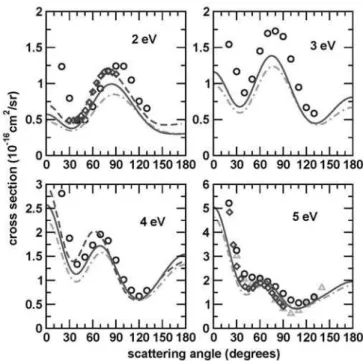
Figures 3 and 4 show our calculated differential cross sec-tions for energies from 2 to 10 eV with and without the extra centers. We also show the results obtained by the complex Kohn group and also experimental results of Curryet al.[7],
FIG. 3: Differential cross sections for ethane at 2, 3, 4 and 5 eV. Dot-dashed line (green), our computed SEP DCSs ; solid line (dark green), our computed SEP DCSs with extra centers; dashed line (red), theoretical results of Ref. [16]; circles (blue), experimental data of Ref. [9]; triangles (cyan), experimental data of Ref. [10] at 4.9 eV; diamonds (violet), results of Ref. [13] at 2 and 5.2 eV
ters seems not to be as important as for lower energies. At 5 eV our results agree well with the experimental data of Merz and Linder for scattering angles above∼30◦.
FIG. 5:s–wave eigenphase for C2H6. Dot-dashed (green) line,
re-sults obtained with no extra centers; solid (dark green) line, rere-sults obtained with extra centers.
Although the calculations including the extra centers have a little less CSFs than the calculations with no extra centers, the results obtained with the extra centers agree better with the experiment. This fact suggests that the small discrepan-cies seen between our results and the complex Kohn results and experimental data has origin in the one-particle basis set, which with the inclusion of extra functions couples higher angular momenta.
As discussed above our calculated integral cross sections show a minimum at around 0.2 eV. We computed the the s−wave eigenphase for both calculations, and the results are shown in figure 5. For the cross section obtained without the extra centers thes−wave eigenphase crosses zero below 0.2 eV while for the cross section obtained with the extra centers thes−wave eigenphase crosses zero above 0.2 eV. These re-sults indicate a presence of a Ramsauer-Towsend minimum in the integral cross section of C2H6. The presence of this minimum has been reported by the complex Kohn calcula-tions and by the experiments. Another point discussed above is that our results obtained with the extra centers show a rise at low energies which suggests a presence of a virtual state.
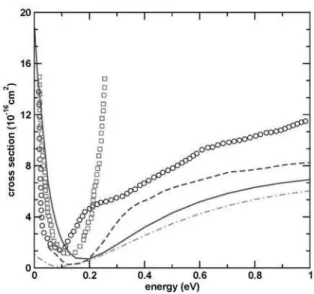
FIG. 6: Momentum transfer cross section for C2H6. As in figure 2,
except circles (blue), results of Ref. [3]; squares (magenta), results of Ref. [5].
However, the behavior of thes–wave eigenphase shows that this rise is not related to a virtual state.
Figure 6 shows our calculated momentum transfer cross section with and without extra centers obtained in the SEP approximation compared to the complex Kohn results also obtained in the SEP approximation and to the experimen-tal data of Duncan and Walker [3] and McCorkleet al. [5]. There is relative good agreement between our results and the other results shown in this figure.
4. SUMMARY
Acknowledgments
M.H.F.B. and M.A.P.L. acknowledge support from Con-selho Nacional de Desenvolvimento Cient´ıfico e Tecnol´ogico (CNPq). R.F. da C. and M.A.P.L. would like to ac-knowledge the financial support from the Brazilian agency Fundac¸˜ao de Amparo `a Pesquisa do Estado de S˜ao Paulo
(FAPESP). M.H.F.B. acknowledges support from the Paran´a State agency Fundac¸˜ao Arauc´aria and from Finep. The au-thors acknowledge computational support from CENAPAD-SP. M.H.F.B. acknowledges computational support from Prof. Carlos de Carvalho at DFis-UFPR. Discussions with Dr. Alexandra P.P. Natalense are greatfully acknowledged.
[1] B. Bouda¨ıffa, P. Cloutier, D. Hunting, M. A. Huels, and L. Sanche, Science287, 1658 (2000)
[2] See, for example, C. Winstead and V. McKoy, J. Chem. Phys. 125, 074302 (2006); D. Bouchiha, J. D. Gorfinkiel, L. G. Caron, and L. Sanche, J. Phys. B: At. Mol. Opt. Phys.39, 975 (2006); T. N. Rescigno, C. S. Trevisan, and A. E. Orel, Phys. Rev. Lett.96, 213201 (2006); M. Allan, J. Phys. B39, 2939 (2006); M. H. F. Bettega and M. A. P. Lima, J. Chem. Phys. 126, 194317 (2007), and references therein.
[3] C. W. Duncan and I. C. Walker, J. Chem. Soc. Faraday II70, 577 (1974).
[4] L. G. Christophorou and D. L. McCorkle, Can. J. Chem.55, 1876 (1977).
[5] D. L. McCorkle, L. G. Christophorou, D. V. Maxey, and J. G. Carter, J. Phys. B11, 3067 (1978).
[6] K. Floeder, D. Fromme, W. Raith, A. Schwab and G. Sinapius, J. Phys. B18, 3347 (1985).
[7] P. J. Curry, W. R. Newell, and A. C. H. Smith, J. Phys. B18, 2303 (1985)
[8] 0. Sueoka and S. Mori, J. Phys. B19, 4035 (1986).
[9] H. Tanaka, L. Boesten, D. Matsunaga, and T. Kudo, J. Phys. B 21, 1255 (1988).
[10] B. Mapstone and W. R. Newell, J. Phys. B25, 491 (1992). [11] H. Nishimura and H. Tawara, J. Phys. B24, L363 (1991). [12] C. Szmytkowski and A. M. Krzysztofowicz, J. Phys. B28,
4291 (1995).
[13] R. Merz and F. Linder, J. Phys. B31, 4663 (1998).
[14] S. L. Lunt, J. Randell, J.-P. Ziesel, G. Mrotzek, and D. Field, J. Phys. B31, 4225 (1998).
[15] C. Winstead, P. G. Hipes, M. A. P. Lima, and V. McCoy, J. Chem. Phys.94, 5455 (1991).
[16] W. Sun, C. W. McCurdy, and B. H. Lengsfield III, J. Chem. Phys.97, 5480 (1992).
[17] M. H. F. Bettega, A. J. S. Oliveira, A. P. P. Natalense, M. A. P. Lima, and L. G. Ferreira, Eur. Phys. J. D1, 291 (1998). [18] K. Takatsuka and V. McKoy, Phys. Rev. A24, 2473 (1981);
Phys. Rev. A30, 1734 (1984).
[19] M. H. F. Bettega, L. G. Ferreira, and M. A. P. Lima, Phys. Rev.
A47, 1111 (1993).
[20] CRC Handbook of Chemistry and Physics, 79th ed., edited by D. R. Lide (CRC, Boca Raton, 1998).
[21] B. M. Bode and M. S. Gordon, J. Mol. Graphics Mod.16, 133 (1998).
[22] G. B. Bachelet, D. R. Hamann, and M. Schl¨uter, Phys. Rev. B 26, 4199 (1982).
[23] M. H. F. Bettega, A. P. P. Natalense, M. A. P. Lima, and L. G. Ferreira, Int. J. Quantum Chem.60, 821 (1996).
[24] T. H. Dunning Jr., J. Chem. Phys.53, 2823 (1970)
[25] C. Winstead and V. McKoy, Phys. Rev. A57, 3589 (1998); C. Winstead, V. McKoy, and M. H. F. Bettega Phys. Rev. A72, 042721 (2005).
[26] C. W. Bauschlicher Jr., J. Chem. Phys.72, 880 (1980). [27] M. H. F. Bettega, R. F. da Costa, and M. A. P. Lima, Phys.
Rev. A77, 052706 (2008).