Brazilian Journal of Physics, vol. 36, no. 4B, December, 2006 1375
Center-of-Mass Correction in a Relativistic Hartree Approximation
P. Alberto, M. Fiolhais, Center for Computational Physics, Physics Department of the University of Coimbra
P-3004-516 Coimbra, Portugal S. S. Avancini, and J. R. Marinelli
Depto de F´ısica, CFM, Universidade Federal de Santa Catarina, Florian´opolis, SC, CP. 476, CEP 88.040 - 900, Brazil
Received on 18 March, 2006
We use the Peierls-Yoccoz projection method to evaluate the center-of-mass correction of a relativistic system of nucleons and sigma and omega mesons, described in a mean-field Hartree approach. This correction for4He, 16O and40Ca is compared with the pure harmonic oscillator center-of-mass energy correction.
Keywords: Peierls-Yoccoz projection method; Center-of-mass correction
It is a well known fact that mean-field approximation to the nuclear many-body problem introduces center-of-mass (CM) spurious components in the solutions. In particular, Hartree-Fock self-consistent mean-fields obtained using real-istic forces in a non-relativreal-istic approach have been consid-ered, and the corresponding CM corrections have been cal-culated for the energy [1, 2] as well as for other observables [3] in a fully microscopic way. For relativistic theories, as the widely used relativistic mean field theory [4] in the Hartree or Hartree-Fock approximations, the correction for the energy is usually estimated using the harmonic oscillator basis [5]. In this case, the treatment for the CM motion becomes triv-ial, though generally not consistent with the nuclear wave-function obtained variationally.
In this paper we also address the problem of the CM energy correction in the framework of a relativistic Hartree approach, including both nucleon and meson degrees of freedom. We considerσandωmesons, without self-interactions, linearly coupled to nucleons. The CM correction is implemented by means of the Peierls-Yoccoz projection, assuming that the nu-cleus as a whole is a nonrelativistic system, though the nucle-ons inside are relativistic particles.
The mesons are explicitly included in the Lagrangian den-sity, and their effect should, in principle, be also considered in the projection procedure. This issue was recently tackled in reference [6] for light nuclei, but a more systematic study is needed. In this paper we only take into account the nu-cleon contributions to the CM corrections. The calculations of the meson contribution are under way and the results will be reported elsewhere. Moreover, in this work we restrict our analysis toN=Z closed-shell nuclei only. The Lagrangian density for a system of nucleons interacting with sigmas and omegas reads (we use the notation and definitions as in refer-ence [7])
L = LfreeN +Lfreeσ +Lωfree+LintNNσ+LintNNω, (1)
where N denotes the nucleon andσ,ωthe mesons. The
La-grangians for the free fields are:
LfreeN = ψ(x)(iγµ∂
µ+M)ψ(x), (2)
Lfreeσ = −1 2
m2σϕ2(x)−∂
µϕ(x)∂µϕ(x)
, (3)
Lfreeω = −1 4Fµν(x)F
µν(x) +1 2m
2
ωων(x)ων(x),
where
Fµν≡∂µων(x)−∂νωµ(x)
andM is the rest mass of the nucleon, and mσ andmω the meson masses. The sigma and omega fields are denoted re-spectively byϕ(x)andων(x), and the nucleon field byψ(x). For the interaction parts of the Lagrangian one has
LintNNσ = gσψ(x)ϕ(x)ψ(x) (4)
LintNNω = −gωψ(x)ων(x)γνψ(x) + fω 4Mψ(x)σ
µνF
µν(x)ψ(x).
(5)
The nucleon field can be expanded as ψ(x) =
∑
α
uα(r)e−iEαtbα+
∑
αvα(r)eiEαtdα† (6) ψ†(x) =
∑
α
u†α(r)eiEαtb†
α+
∑
α
v†α(r)e−iEαtd
α, (7)
whereuα(r)andvα(r)form a complete set of Dirac spinors in the coordinate space, andbα andb†α are the creation and annihilation operators of a nucleon in the stateα. Bydαand
dα† we denote the creation and the annihilation operators for the anti-nucleons in the same stateα. Thus, starting from the above Lagrangian, and disregarding the tensor coupling, one obtains the following Hamiltonian, already restricted to the nucleon subspace [7]:
H =
∑
αα′
fα†′(r)(−iγ0γ.∇+γ0M)fα(r)d3r b†α′bα
+1 2α,α
∑
′,β,β′
fα†′(r1)fβ†′(r2)Vα,α′(|r1−r2|)
1376 P. Alberto et al.
with the potential given by
Vα,α′(|r1−r2|) = Vα,α′(r) =
∑
i=σ,ω
g2i
4πγ0(1)γ0(2)Γi(1,2)
×exp{−r[m
2
i−(Eα−Eα′)2]1/2}
r ,(9)
whereΓσ(1,2) =1 andΓω(1,2) =γµ(1)γµ(2)andEαare the single-particle energies. In the model space, the state vector for a system ofA-nucleons is approximated by
|Ψ>=b†α 1b
†
α2· · ·b †
αA|0> , (10)
whereα1, . . . ,αAare sets of single-particle quantum numbers
and|0>is the bare vacuum. In the Hartree approximation the single-particle energies and wave functions are obtained in the standard fashion by minimizing the ground state energy. We start from [7]
<Ψ|H|Ψ> =
A
∑
α=1
u†α(r)(−iγ0γ.∇+γ0M)u
α(r)d3r
+1 2
A
∑
α,α′=1
u†α(r1)u†α′(r2)Vα,α(r)uα(r1)uα′(r2)d3r1d3r2,
(11)
where the first term corresponds to the kinetic energy and mass, and the second one to the direct potential. The spinors uα(r)are explicitly given by
uα(r) =
gnl j(r)ϕl jm(r)ˆ
i fnl j(r)σ.rˆϕl jm(r)ˆ
ξ1/2,τα, (12)
where
ϕl jm(r) =
∑
ml,µ(lml
1
2µ|jm)Yl,ml(r)ˆχ1/2,µ. (13)
We denote by χ1/2,µ andξ1/2,τα the spin and isospin wave
functions, respectively. For a closed shell nucleus the Hartree equations for the radial functions in both components of the Dirac spinor are given by
dFα(r)
dr = [M−Eα+U (+)
α (r)]Gα(r) +κ
rFα(r) (14) dGα(r)
dr = [M+Eα+U (−)
α (r)]Fα(r)−κ
rGα(r), (15) whereκ=∓(j+1
2)for j=l± 1
2 andα≡(n,l,j). In the previous equation we have introduced new radial functions related to the original ones through
gα=
Gα(r)
r , (16)
fα=
Fα(r)
r . (17)
We have also introduced
Uα(±)(r1) =Wασ(r1)±Wαω(r1) (18) and
Wαk(r1) =±mk
g2k
4π
∑
α2(2jα+1)Ik
α(r1), (19)
wherek=σ,ω. The functionsIαkare given by Iαk(r1) =
∞
0
dr2j0(imkr<)h(+)0 (imkr>)[G2α(r2)∓Fα2(r2)], (20) wheremkare the masses of the corresponding mesons. The±
signs in the above equations are related to theσ(+) andω(−) mesons. In (20) j0andh(+)0 are Bessel and Hankel spherical functions andr<(r>)is the smaller (larger) value betweenr1 andr2. We solve the set of equations (14) to (19) by expand-ing the radial functions f(r)andg(r)in a harmonic oscillator basis, as explained in [5]. A fast convergence is achieved for all nuclei studied in this work.
Next, we want to obtain the center-of-mass correction to the energy using the model just described. It is well known, from the nuclear many-body problem, that the Hartree (or Hartree-Fock) approximation breaks translational invariance (see Ref. [1]) and that the broken symmetry can be recov-ered in the symmetry-breaking state by applying the Peierls-Yoccoz projection operator
P
p=
exp[i(Pˆ−p)·a]d3a, (21) which has the property
P
pP
p′=δ(p−p′)P
p. (22)In (21),Pˆ is the total linear momentum operator andp the corresponding eigenvalue. Our approach consists in assuming that the physical nucleus state is obtained by projecting the product mean-field state into a zero momentum (p=0) state (projection after variation). Because the many-body Hamil-tonian, expressed by (8) and (9), commutes with the projec-tion operator, the total energy can be cast in the form:
Ep=0=<Ψ|H
P
p=0|Ψ> <Ψ|P
p=0|Ψ>. (23)
The denominator,<Ψ|
P
p=0|Ψ>, is a norm overlap matrix element. We start with the calculation of this overlap matrix normalization factor. The easiest way to compute this quan-tity is in momentum space. In configuration space the radial functions are expanded in the oscillator basis asgnl j(r) = N
∑
n=0
CnRnl j(r) (24)
fnl j(r) = N′
∑
n=0 ˜
Brazilian Journal of Physics, vol. 36, no. 4B, December, 2006 1377
whereN′ must be, at least,N+1 [5] andCn,C˜nare expansion
coefficients determined by the variational procedure. Insert-ing these expansions in equation (12) and goInsert-ing to the
mo-mentum space representation, we arrive, after a lengthy but straightforward calculation, to the following overlap kernel:
<Ψ|
P
p=0|Ψ>=
<Ψ|Ψ(a)>d3a=
detB d3a. (26)
The matrix is given by
Bαβ=4π
∑
λ(1+ (−)
λ+lα+lβ
2 )[i
λ+lα−lβ
jλ(pa)g∗αgβp2d p+iλ+
¯
lα−l¯β
jλ(pa)fα∗fβp2d p]Sαβ. (27) where ¯l=l±1 for j=l±1/2 and
Sαβ= (−)mα+mβ+1
2jα+1 2jβ+1
2λ+1
4π (jα−mαλ0|jβ−mβ)(jα1/2λ0|jβ1/2)δτα,τβ (28)
In equation (27) we have explicitly used the fact that we are dealing with closed shell nuclei, so no angular dependence should appear in the overlap matrix. For the Hamiltonian kernel calculation, we have used the following general expressions[8]:
<Ψ|Oˆ|Ψ(a)>=<Ψ|Ψ(a)>
∑
αβ
<α|Oˆ|β(a)>B−βα1 (29) and
<Ψ|Oˆ12|Ψ(a)>= 1
2<Ψ|Ψ(a)>αβγδ
∑
<αβ|Oˆ12|γ(a)δ(a)>B−1
γαB−δβ1, (30)
where ˆOand ˆO12are one and two body operators, respectively and only the direct term of the two-body operator has been kept. Using the same technique applied in the case of the overlap kernel, we find, for the kinetic term, ˆT≡ −γ0γ·P, in the Hamiltonian kernel,
<α|Tˆ|β(a)>=<Ψ|Ψ(a)>
∑
αβ
TαβB−βα1, (31)
with
Tαβ=4π
∑
λ(1+ (−)
λ+lα+lβ
2 )[ −i
λ+1+lα−l¯β j
λ(pa)g∗αgβp3d p+
+iλ+1+l¯α−lβ
jλ(pa)fα∗fβp3d p]Sαβ. (32)
For the mass term one finds
<α|γ0M|β(a)>=<Ψ|Ψ(a)>
∑
αβ
MαβB−βα1, (33)
with
Mαβ=4πM
∑
λ(1+ (−)
λ+lα+lβ
2 )[ i
λ+lα−lβ j
λ(pa)g∗αgβp2d p− −iλ+l¯α−l¯β
jλ(pa)fα∗fβp2d p]Sαβ. (34)
The calculation of the potential term is more involved and it turned out to be easier to perform it in configuration space. Our starting point is to substitute equation (9) with α=α′ in eq.(30), since we are neglecting the Fock correction in the present approach [7]. Again, after a lengthy but straightforward calculation, we arrive at the following potential term:
<ψ|Vk|ψ(a)>=
1 2g
2
kmk<Ψ|Ψ(a)>
∑
L
dr1dr2r12r22jL(imkr<)hL(imkr>)
FL(r1,a)GL(r2,a), (35)
1378 P. Alberto et al.
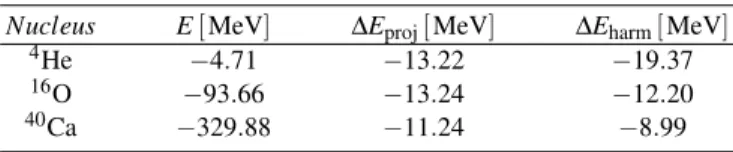
TABLE I: Ground-state energy,E, without the CM correction for the three double-closed shell nuclei considered in this work, the CM correction,∆Eproj, calculated as described in the text, and the CM correction,∆Eharm, calculated in the harmonic oscillator approxima-tion.
Nucleus E[MeV] ∆Eproj[MeV] ∆Eharm[MeV]
4He −4.71 −13.22 −19.37
16O −93.66 −13.24 −12.20
40Ca −329.88 −11.24 −8.99
down the first one:
FL(r,a) =
∑
αβ
d(cosθ)[g∗α(r−)gβ(r+)φαβ(θ,θ−,θ+) + +fα∗(r−)fβ(r+)φ−α−β(θ,θ−,θ+)]B−βα1.(36) We have definedr±=|r±|withr±=r±a2andθ(θ±), which is the azimuthal angle associated with the position vectorr (r±). The function φis proportional to the product of three
spherical harmonics with different (translated) arguments [9].
The minus sign, as in−α, means that the orbital quantum numberlαis changed to ¯lα,i.e.the orbital angular momentum of the lower component.
With the previous expressions we have calculated the CM correction to the ground state energy for4He,16O and 40Ca and the results are shown in table I (to check the accuracy of our calculations we compared our ground state energies – col-umn 1 of table I – with the TIMORA code[10]). For compari-son, we also show the CM correction calculated in the simple harmonic approximation, as described in [5]. Except for the lightest nucleus (4He), the harmonic approximation gives re-alistic values for the CM energy correction, as compared to the Peierls-Yoccoz projection values. However, as discussed in [2, 3], other observables, as the root mean square radius, form factors and spectroscopic factors should be investigated before a firm conclusion might be established. Moreover, as pointed out at the beginning, the meson degrees of freedom should be included in our calculation, and that work is already in progress.
This work was partially supported by CNPq (Brazil) and GRICES (Portugal).
[1] J.M. Eisenberg and W. Greiner, Nuclear Theory Vol. 3, North Holland Publishing Company, 1972.
[2] K.W. Schmid and F. Gr¨umer, Z. Phys. A337, 267 (1990). [3] R.R. Rodr´ıguez-Guzm´an and K.W. Schimid,
arXiv:nucl-th/0503059v1 (2005).
[4] B. Serot and J.D. Wallecka , Advances in Nuclear Physics16, 1 (1986).
[5] Y.K. Gambhir, P. Ring, and A. Thimet, Annals of Physics198, 132 (1990).
[6] P. Alberto, S.S. Avancini, and M. Fiolhais, International Journal of Modern Physics E 14, 1171 (2005).
[7] R. Brockmann, Phys. Rev. C18, 1510 (1978).
[8] J. P. Blaizot and G. Ripka, Quantum Theory of Finite Systems, The MIT Press, Cambridge, Massachusetts, 1986.
[9] D.A. Varshalovich, A.N. Moskalev, and V.K. Khersonskii, Quantum Theory of Angular Momentum, World Scientific, 1988.